FRENCH CUISINE
 Introduced in 20th Century by Georges Auguste Escoffier.
 Cheese, bread, and wine are a major part of the cuisine.
 In the north of France, people often prefer to use butter to
cook.
 In the south, they prefer olive oil and garlic.
 Escoffier created a system of "parties" called the brigade
system, which separated the professional kitchen into
five separate stations.
 Five stations :
the "garde manger" that prepared cold dishes.
the "entremettier" prepared starches and
vegetables.
the "rôtisseur" prepared roasts, grilled and fried
dishes.
the "saucier" prepared sauces and soups.
the "pâtissier" prepared all pastry and desserts
items.
REGIONS
 Paris and Île-de-France
central region.
Over 9,000 restaurants exist in Paris with wide
range of cuisines.
High-quality Michelin Guide rated restaurants
proliferate here.
 Champagne, Lorraine, and Alsace
Champagne : Sparkling Wines
Lorraine : fruit Preserves.
Alsace : Alemannic food culture; as such,
beers
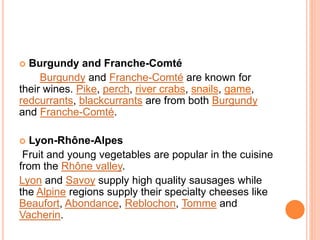
 Burgundy and Franche-Comté
Burgundy and Franche-Comté are known for
their wines. Pike, perch, river crabs, snails, game,
redcurrants, blackcurrants are from both Burgundy
and Franche-Comté.
 Lyon-Rhône-Alpes
Fruit and young vegetables are popular in the cuisine
from the Rhône valley.
Lyon and Savoy supply high quality sausages while
the Alpine regions supply their specialty cheeses like
Beaufort, Abondance, Reblochon, Tomme and
Vacherin.
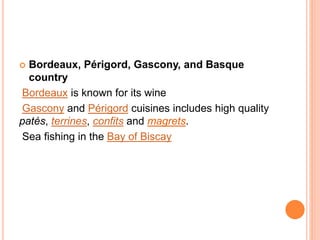
 Bordeaux, Périgord, Gascony, and Basque
country
Bordeaux is known for its wine
Gascony and Périgord cuisines includes high quality
patés, terrines, confits and magrets.
Sea fishing in the Bay of Biscay
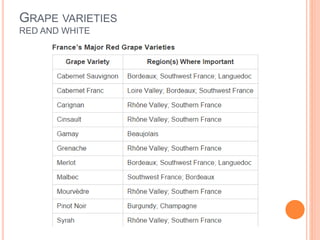
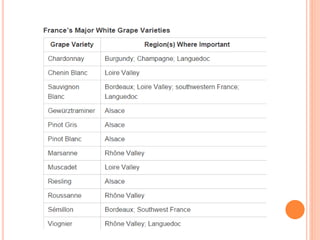
GRAPE VARIETIES
RED AND WHITE
BREAKFAST (LE PETIT DÉJEUNER )
 a quick meal consisting of tartines (slices) of French
bread with jelly or jam, along with coffee or tea.
 Children often drink hot chocolate in bowls or cups
along with their breakfasts.
LUNCH (LE DÉJEUNER )
 Le déjeuner (lunch) is a two-hour mid-day meal.
 A typical French lunch will consist of:
a starter (une entrée), such as a mixed salad,
soup, some terrine or paté.
 A main course, (le plat principal), typically a
choice of meat or fish, with potatoes, rice, pasta
and/or vegetables; a cheese course (often a
selection of local cheeses) and/or a dessert
DINNER (LE DÎNER )
 Le dîner (dinner) often consists of three courses
 hors d'œuvre or entrée (appetizers or introductory
course, sometimes soup),
 plat principal (main course), and a cheese course
or dessert, sometimes with a salad offered before
the cheese or dessert.
 Yogurt may replace the cheese course, while a
simple dessert would be fresh fruit.
 The meal is often accompanied by bread, wine and
mineral water.
 Main meat courses are often served with
vegetables, along with potatoes, rice or pasta.
FRENCH CLASSICAL MENU
 Hors D'oeuvre
 Potage
 Oeufs
 Farineux
 Poisson
 Entrée

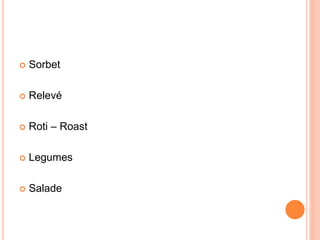
 Sorbet
 Relevé
 Roti – Roast
 Legumes
 Salade
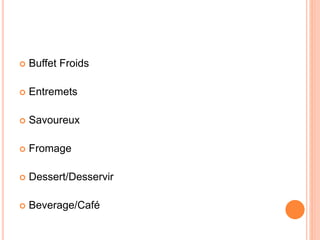
 Buffet Froids
 Entremets
 Savoureux
 Fromage
 Dessert/Desservir
 Beverage/Café

French cuisine

  • 1.
  • 2.
     Introduced in20th Century by Georges Auguste Escoffier.  Cheese, bread, and wine are a major part of the cuisine.  In the north of France, people often prefer to use butter to cook.  In the south, they prefer olive oil and garlic.
  • 3.
     Escoffier createda system of "parties" called the brigade system, which separated the professional kitchen into five separate stations.  Five stations : the "garde manger" that prepared cold dishes. the "entremettier" prepared starches and vegetables. the "rôtisseur" prepared roasts, grilled and fried dishes. the "saucier" prepared sauces and soups. the "pâtissier" prepared all pastry and desserts items.
  • 4.
    REGIONS  Paris andÎle-de-France central region. Over 9,000 restaurants exist in Paris with wide range of cuisines. High-quality Michelin Guide rated restaurants proliferate here.  Champagne, Lorraine, and Alsace Champagne : Sparkling Wines Lorraine : fruit Preserves. Alsace : Alemannic food culture; as such, beers
  • 5.
     Burgundy andFranche-Comté Burgundy and Franche-Comté are known for their wines. Pike, perch, river crabs, snails, game, redcurrants, blackcurrants are from both Burgundy and Franche-Comté.  Lyon-Rhône-Alpes Fruit and young vegetables are popular in the cuisine from the Rhône valley. Lyon and Savoy supply high quality sausages while the Alpine regions supply their specialty cheeses like Beaufort, Abondance, Reblochon, Tomme and Vacherin.
  • 6.
     Bordeaux, Périgord,Gascony, and Basque country Bordeaux is known for its wine Gascony and Périgord cuisines includes high quality patés, terrines, confits and magrets. Sea fishing in the Bay of Biscay
  • 7.
  • 9.
    BREAKFAST (LE PETITDÉJEUNER )  a quick meal consisting of tartines (slices) of French bread with jelly or jam, along with coffee or tea.  Children often drink hot chocolate in bowls or cups along with their breakfasts.
  • 10.
    LUNCH (LE DÉJEUNER)  Le déjeuner (lunch) is a two-hour mid-day meal.  A typical French lunch will consist of: a starter (une entrée), such as a mixed salad, soup, some terrine or paté.  A main course, (le plat principal), typically a choice of meat or fish, with potatoes, rice, pasta and/or vegetables; a cheese course (often a selection of local cheeses) and/or a dessert
  • 11.
    DINNER (LE DÎNER)  Le dîner (dinner) often consists of three courses  hors d'œuvre or entrée (appetizers or introductory course, sometimes soup),  plat principal (main course), and a cheese course or dessert, sometimes with a salad offered before the cheese or dessert.  Yogurt may replace the cheese course, while a simple dessert would be fresh fruit.  The meal is often accompanied by bread, wine and mineral water.  Main meat courses are often served with vegetables, along with potatoes, rice or pasta.
  • 12.
    FRENCH CLASSICAL MENU Hors D'oeuvre  Potage  Oeufs  Farineux  Poisson  Entrée 
  • 13.
     Sorbet  Relevé Roti – Roast  Legumes  Salade
  • 14.
     Buffet Froids Entremets  Savoureux  Fromage  Dessert/Desservir  Beverage/Café