Introduction
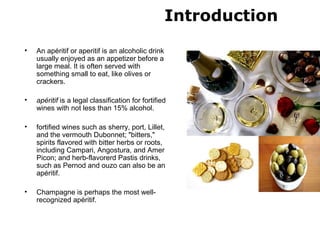
• An apéritif or aperitif is an alcoholic drink
usually enjoyed as an appetizer before a
large meal. It is often served with
something small to eat, like olives or
crackers.
• apéritif is a legal classification for fortified
wines with not less than 15% alcohol.
• fortified wines such as sherry, port, Lillet,
and the vermouth Dubonnet; "bitters,"
spirits flavored with bitter herbs or roots,
including Campari, Angostura, and Amer
Picon; and herb-flavorerd Pastis drinks,
such as Pernod and ouzo can also be an
apéritif.
• Champagne is perhaps the most well-
recognized apéritif.
History
• The word is French and is derived from the Latin verb
"aperire", which means to open
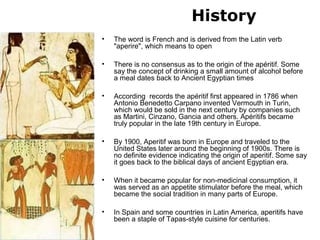
• There is no consensus as to the origin of the apéritif. Some
say the concept of drinking a small amount of alcohol before
a meal dates back to Ancient Egyptian times
• According records the apéritif first appeared in 1786 when
Antonio Benedetto Carpano invented Vermouth in Turin,
which would be sold in the next century by companies such
as Martini, Cinzano, Gancia and others. Apéritifs became
truly popular in the late 19th century in Europe.
• By 1900, Aperitif was born in Europe and traveled to the
United States later around the beginning of 1900s. There is
no definite evidence indicating the origin of aperitif. Some say
it goes back to the biblical days of ancient Egyptian era.
• When it became popular for non-medicinal consumption, it
was served as an appetite stimulator before the meal, which
became the social tradition in many parts of Europe.
• In Spain and some countries in Latin America, aperitifs have
been a staple of Tapas-style cuisine for centuries.
Production
• Pernod – Made with Star Anise
and herbs.
• Suze – Extract of Gentain steeped
in wine.
• Pineau des Charentes – Made by
adding grape brandy to
unfermented grape juice.
• Ouzo – Herbs and plants infused
in purified sprit and essence of
anise added.
Service
• The best aperitifs are between
16% and 24% alcohol (32 to 48
proof). They are often wine
derivatives that producers fortify
and flavor, although some, like
the popular Campari, are more
akin to a spirit than a wine.
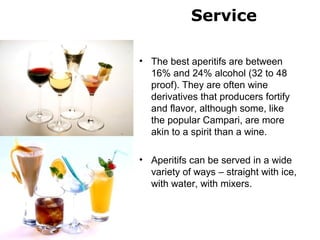
• Aperitifs can be served in a wide
variety of ways – straight with ice,
with water, with mixers.
World Brands
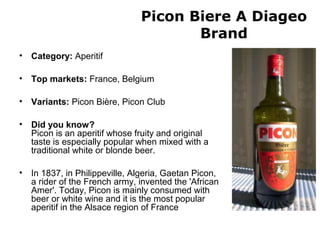
Picon Biere A Diageo
Brand
• Category: Aperitif
• Top markets: France, Belgium
• Variants: Picon Bière, Picon Club
• Did you know?
Picon is an aperitif whose fruity and original
taste is especially popular when mixed with a
traditional white or blonde beer.
• In 1837, in Philippeville, Algeria, Gaetan Picon,
a rider of the French army, invented the 'African
Amer'. Today, Picon is mainly consumed with
beer or white wine and it is the most popular
aperitif in the Alsace region of France
Styles
• Campari
• Absinth
• Dubonnet
• Vermouth
• Pernod
• Ricard
• Pineau des Charentes
• Suze
• Sherry
• Strega
• Gentiane
• Noilly Prat
• Cinzano
• Ouzo
Countries
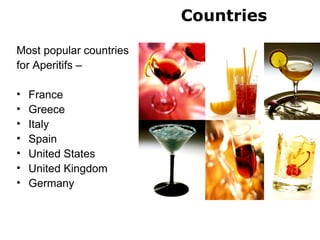
Most popular countries
for Aperitifs –
• France
• Greece
• Italy
• Spain
• United States
• United Kingdom
• Germany
Apperitifs & Bitters
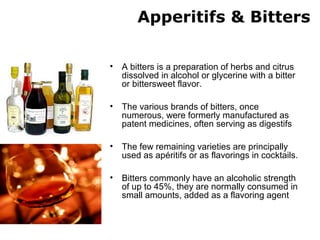
• A bitters is a preparation of herbs and citrus
dissolved in alcohol or glycerine with a bitter
or bittersweet flavor.
• The various brands of bitters, once
numerous, were formerly manufactured as
patent medicines, often serving as digestifs
• The few remaining varieties are principally
used as apéritifs or as flavorings in cocktails.
• Bitters commonly have an alcoholic strength
of up to 45%, they are normally consumed in
small amounts, added as a flavoring agent
• Also popular are "amaros" which are known as
bitter drinks These include Campari, Suze,
Byrrh and Cinzano.
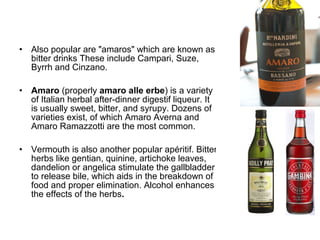
• Amaro (properly amaro alle erbe) is a variety
of Italian herbal after-dinner digestif liqueur. It
is usually sweet, bitter, and syrupy. Dozens of
varieties exist, of which Amaro Averna and
Amaro Ramazzotti are the most common.
• Vermouth is also another popular apéritif. Bitter
herbs like gentian, quinine, artichoke leaves,
dandelion or angelica stimulate the gallbladder
to release bile, which aids in the breakdown of
food and proper elimination. Alcohol enhances
the effects of the herbs.
Most Popular Bitters
• Angostura bitters, often simply referred to as angostura,
is a concentrated bitters for food and beverages made of
herbs and spices.
• Recipe was developed in 1824 by German Dr. Johann
Gottlieb Benjamin Siegert, He was based in Ciuda Bolívar
which was then known as Angostura.
• The exact formula is still top secret, with only five people
knowing the exact recipe.
• Angostura bitters are extremely concentrated, they are not
normally drunk purely, but used to flavour drinks and food;
usually only a few drops or splashes are used.
• Angostura bitters are a key ingredient in many cocktails.
Originally used to mask the flavour of quinine in tonic
water along with gin, the mix stuck in the form of a Pink
Gin, and is also used in many other alcoholic cocktails
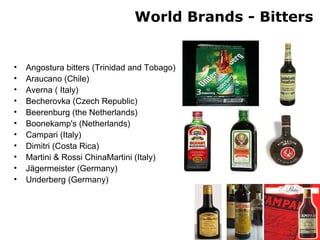
World Brands - Bitters
• Angostura bitters (Trinidad and Tobago)
• Araucano (Chile)
• Averna ( Italy)
• Becherovka (Czech Republic)
• Beerenburg (the Netherlands)
• Boonekamp's (Netherlands)
• Campari (Italy)
• Dimitri (Costa Rica)
• Martini & Rossi ChinaMartini (Italy)
• Jägermeister (Germany)
• Underberg (Germany)
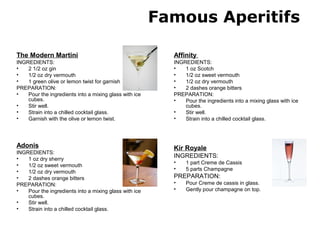
Famous Aperitifs
The Modern Martini
INGREDIENTS:
• 2 1/2 oz gin
• 1/2 oz dry vermouth
• 1 green olive or lemon twist for garnish
PREPARATION:
• Pour the ingredients into a mixing glass with ice
cubes.
• Stir well.
• Strain into a chilled cocktail glass.
• Garnish with the olive or lemon twist.
Adonis
INGREDIENTS:
• 1 oz dry sherry
• 1/2 oz sweet vermouth
• 1/2 oz dry vermouth
• 2 dashes orange bitters
PREPARATION:
• Pour the ingredients into a mixing glass with ice
cubes.
• Stir well.
• Strain into a chilled cocktail glass.
Affinity
INGREDIENTS:
• 1 oz Scotch
• 1/2 oz sweet vermouth
• 1/2 oz dry vermouth
• 2 dashes orange bitters
PREPARATION:
• Pour the ingredients into a mixing glass with ice
cubes.
• Stir well.
• Strain into a chilled cocktail glass.
Kir Royale
INGREDIENTS:
• 1 part Creme de Cassis
• 5 parts Champagne
PREPARATION:
• Pour Creme de cassis in glass.
• Gently pour champagne on top.
Pink gin
INGREDIENTS:
• 1 measure Gin
• 2--3 dashes Angostura bitters
PREPARATION:
• Chill the glass, then coat the inside with the Bitters.
• Add the gin very well chilled.
• Garnish and serve.

Aperitifs

  • 2.
    Introduction • An apéritifor aperitif is an alcoholic drink usually enjoyed as an appetizer before a large meal. It is often served with something small to eat, like olives or crackers. • apéritif is a legal classification for fortified wines with not less than 15% alcohol. • fortified wines such as sherry, port, Lillet, and the vermouth Dubonnet; "bitters," spirits flavored with bitter herbs or roots, including Campari, Angostura, and Amer Picon; and herb-flavorerd Pastis drinks, such as Pernod and ouzo can also be an apéritif. • Champagne is perhaps the most well- recognized apéritif.
  • 3.
    History • The wordis French and is derived from the Latin verb "aperire", which means to open • There is no consensus as to the origin of the apéritif. Some say the concept of drinking a small amount of alcohol before a meal dates back to Ancient Egyptian times • According records the apéritif first appeared in 1786 when Antonio Benedetto Carpano invented Vermouth in Turin, which would be sold in the next century by companies such as Martini, Cinzano, Gancia and others. Apéritifs became truly popular in the late 19th century in Europe. • By 1900, Aperitif was born in Europe and traveled to the United States later around the beginning of 1900s. There is no definite evidence indicating the origin of aperitif. Some say it goes back to the biblical days of ancient Egyptian era. • When it became popular for non-medicinal consumption, it was served as an appetite stimulator before the meal, which became the social tradition in many parts of Europe. • In Spain and some countries in Latin America, aperitifs have been a staple of Tapas-style cuisine for centuries.
  • 4.
    Production • Pernod –Made with Star Anise and herbs. • Suze – Extract of Gentain steeped in wine. • Pineau des Charentes – Made by adding grape brandy to unfermented grape juice. • Ouzo – Herbs and plants infused in purified sprit and essence of anise added.
  • 5.
    Service • The bestaperitifs are between 16% and 24% alcohol (32 to 48 proof). They are often wine derivatives that producers fortify and flavor, although some, like the popular Campari, are more akin to a spirit than a wine. • Aperitifs can be served in a wide variety of ways – straight with ice, with water, with mixers.
  • 6.
  • 7.
    Picon Biere ADiageo Brand • Category: Aperitif • Top markets: France, Belgium • Variants: Picon Bière, Picon Club • Did you know? Picon is an aperitif whose fruity and original taste is especially popular when mixed with a traditional white or blonde beer. • In 1837, in Philippeville, Algeria, Gaetan Picon, a rider of the French army, invented the 'African Amer'. Today, Picon is mainly consumed with beer or white wine and it is the most popular aperitif in the Alsace region of France
  • 8.
    Styles • Campari • Absinth •Dubonnet • Vermouth • Pernod • Ricard • Pineau des Charentes • Suze • Sherry • Strega • Gentiane • Noilly Prat • Cinzano • Ouzo
  • 9.
    Countries Most popular countries forAperitifs – • France • Greece • Italy • Spain • United States • United Kingdom • Germany
  • 10.
    Apperitifs & Bitters •A bitters is a preparation of herbs and citrus dissolved in alcohol or glycerine with a bitter or bittersweet flavor. • The various brands of bitters, once numerous, were formerly manufactured as patent medicines, often serving as digestifs • The few remaining varieties are principally used as apéritifs or as flavorings in cocktails. • Bitters commonly have an alcoholic strength of up to 45%, they are normally consumed in small amounts, added as a flavoring agent
  • 11.
    • Also popularare "amaros" which are known as bitter drinks These include Campari, Suze, Byrrh and Cinzano. • Amaro (properly amaro alle erbe) is a variety of Italian herbal after-dinner digestif liqueur. It is usually sweet, bitter, and syrupy. Dozens of varieties exist, of which Amaro Averna and Amaro Ramazzotti are the most common. • Vermouth is also another popular apéritif. Bitter herbs like gentian, quinine, artichoke leaves, dandelion or angelica stimulate the gallbladder to release bile, which aids in the breakdown of food and proper elimination. Alcohol enhances the effects of the herbs.
  • 12.
    Most Popular Bitters •Angostura bitters, often simply referred to as angostura, is a concentrated bitters for food and beverages made of herbs and spices. • Recipe was developed in 1824 by German Dr. Johann Gottlieb Benjamin Siegert, He was based in Ciuda Bolívar which was then known as Angostura. • The exact formula is still top secret, with only five people knowing the exact recipe. • Angostura bitters are extremely concentrated, they are not normally drunk purely, but used to flavour drinks and food; usually only a few drops or splashes are used. • Angostura bitters are a key ingredient in many cocktails. Originally used to mask the flavour of quinine in tonic water along with gin, the mix stuck in the form of a Pink Gin, and is also used in many other alcoholic cocktails
  • 13.
    World Brands -Bitters • Angostura bitters (Trinidad and Tobago) • Araucano (Chile) • Averna ( Italy) • Becherovka (Czech Republic) • Beerenburg (the Netherlands) • Boonekamp's (Netherlands) • Campari (Italy) • Dimitri (Costa Rica) • Martini & Rossi ChinaMartini (Italy) • Jägermeister (Germany) • Underberg (Germany)
  • 14.
    Famous Aperitifs The ModernMartini INGREDIENTS: • 2 1/2 oz gin • 1/2 oz dry vermouth • 1 green olive or lemon twist for garnish PREPARATION: • Pour the ingredients into a mixing glass with ice cubes. • Stir well. • Strain into a chilled cocktail glass. • Garnish with the olive or lemon twist. Adonis INGREDIENTS: • 1 oz dry sherry • 1/2 oz sweet vermouth • 1/2 oz dry vermouth • 2 dashes orange bitters PREPARATION: • Pour the ingredients into a mixing glass with ice cubes. • Stir well. • Strain into a chilled cocktail glass. Affinity INGREDIENTS: • 1 oz Scotch • 1/2 oz sweet vermouth • 1/2 oz dry vermouth • 2 dashes orange bitters PREPARATION: • Pour the ingredients into a mixing glass with ice cubes. • Stir well. • Strain into a chilled cocktail glass. Kir Royale INGREDIENTS: • 1 part Creme de Cassis • 5 parts Champagne PREPARATION: • Pour Creme de cassis in glass. • Gently pour champagne on top.
  • 15.
    Pink gin INGREDIENTS: • 1measure Gin • 2--3 dashes Angostura bitters PREPARATION: • Chill the glass, then coat the inside with the Bitters. • Add the gin very well chilled. • Garnish and serve.