Verb + verb/that clause patterns
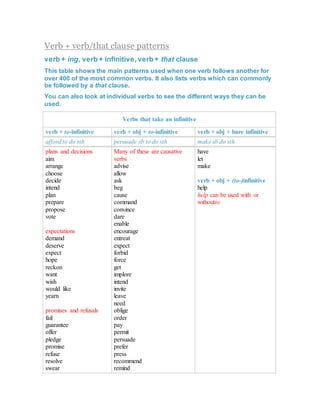
verb + ing, verb + infinitive, verb + that clause
This table shows the main patterns used when one verb follows another for
over 400 of the most common verbs. It also lists verbs which can commonly
be followed by a that clause.
You can also look at individual verbs to see the different ways they can be
used.
Verbs that take an infinitive
verb + to-infinitive verb + obj + to-infinitive verb + obj + bare infinitive
afford to do sth persuade sb to do sth make sb do sth
plans and decisions
aim
arrange
choose
decide
intend
plan
prepare
propose
vote
expectations
demand
deserve
expect
hope
reckon
want
wish
would like
yearn
promises and refusals
fail
guarantee
offer
pledge
promise
refuse
resolve
swear
Many of these are causative
verbs
advise
allow
ask
beg
cause
command
convince
dare
enable
encourage
entreat
expect
forbid
force
get
implore
intend
invite
leave
need
oblige
order
pay
permit
persuade
prefer
press
recommend
remind
have
let
make
verb + obj + (to-)infinitive
help
help can be used with or
withoutto
threaten
undertake
vow
other verbs
afford
agree
allow (passive only)
appear
apply
ask
beg
claim
consent
dare
desire
forget
get
happen
help
learn
know
manage
mean
need
negociate
plead
pretend
seek
seem
tend
train
volunteer
wait
request
require
teach
tell
train
trust
urge
want
warn
would like
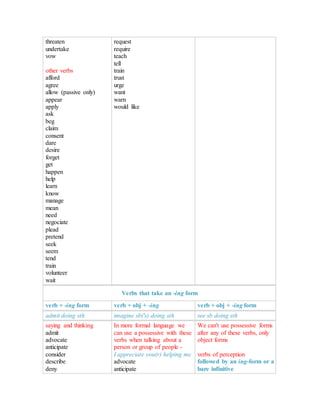
Verbs that take an -ing form
verb + -ing form verb + obj + -ing verb + obj + -ing form
admit doing sth imagine sb('s) doing sth see sb doing sth
saying and thinking
admit
advocate
anticipate
consider
describe
deny
In more formal language we
can use a possessive with these
verbs when talking about a
person or group of people -
I appreciate you(r) helping me
advocate
anticipate
We can't use possessive forms
after any of these verbs, only
object forms
verbs of perception
followed by an ing-form or a
bare infinitive
discuss
envisage
imagine
mention
propose
suggest
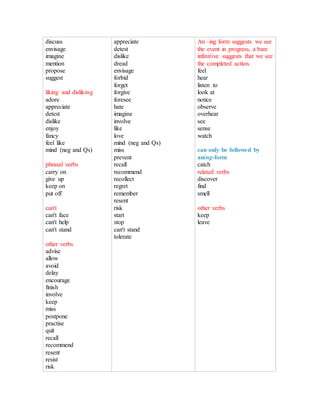
liking and disliking
adore
appreciate
detest
dislike
enjoy
fancy
feel like
mind (neg and Qs)
phrasal verbs
carry on
give up
keep on
put off
can't
can't face
can't help
can't stand
other verbs
advise
allow
avoid
delay
encourage
finish
involve
keep
miss
postpone
practise
quit
recall
recommend
resent
resist
risk
appreciate
detest
dislike
dread
envisage
forbid
forget
forgive
foresee
hate
imagine
involve
like
love
mind (neg and Qs)
miss
prevent
recall
recommend
recollect
regret
remember
resent
risk
start
stop
can't stand
tolerate
An -ing form suggests we see
the event in progress, a bare
infinitive suggests that we see
the completed action.
feel
hear
listen to
look at
notice
observe
overhear
see
sense
watch
can only be followed by
aning-form
catch
related verbs
discover
find
smell
other verbs
keep
leave
spend time
tolerate
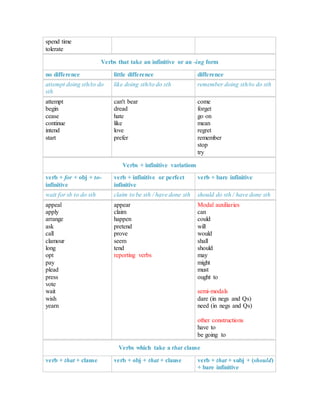
Verbs that take an infinitive or an -ing form
no difference little difference difference
attempt doing sth/to do
sth
like doing sth/to do sth remember doing sth/to do sth
attempt
begin
cease
continue
intend
start
can't bear
dread
hate
like
love
prefer
come
forget
go on
mean
regret
remember
stop
try
Verbs + infinitive variations
verb + for + obj + to-
infinitive
verb + infinitive or perfect
infinitive
verb + bare infinitive
wait for sb to do sth claim to be sth / have done sth should do sth / have done sth
appeal
apply
arrange
ask
call
clamour
long
opt
pay
plead
press
vote
wait
wish
yearn
appear
claim
happen
pretend
prove
seem
tend
reporting verbs
Modal auxiliaries
can
could
will
would
shall
should
may
might
must
ought to
semi-modals
dare (in negs and Qs)
need (in negs and Qs)
other constructions
have to
be going to
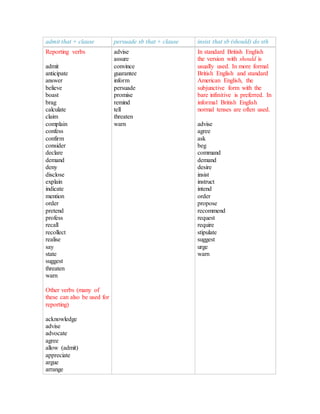
Verbs which take a that clause
verb + that + clause verb + obj + that + clause verb + that + subj + (should)
+ bare infinitive
admit that + clause persuade sb that + clause insist that sb (should) do sth
Reporting verbs
admit
anticipate
answer
believe
boast
brag
calculate
claim
complain
confess
confirm
consider
declare
demand
deny
disclose
explain
indicate
mention
order
pretend
profess
recall
recollect
realise
say
state
suggest
threaten
warn
Other verbs (many of
these can also be used for
reporting)
acknowledge
advise
advocate
agree
allow (admit)
appreciate
argue
arrange
advise
assure
convince
guarantee
inform
persuade
promise
remind
tell
threaten
warn
In standard British English
the version with should is
usually used. In more formal
British English and standard
American English, the
subjunctive form with the
bare infinitive is preferred. In
informal British English
normal tenses are often used.
advise
agree
ask
beg
command
demand
desire
insist
instruct
intend
order
propose
recommend
request
require
stipulate
suggest
urge
warn
assume
check
command
decide
demonstrate
determine
direct
doubt
dream
envisage
estimate
establish
expect
fancy
fear
feel
foresee
forget
guarantee
guess
hear
hold
hope
imagine
instruct
joke
know
learn
maintain
mean
notice
observe
plan
presume
promise
propose
prove
reckon
recognise
regret
remember
reply
report
require
resolve
reveal
see
seem
sense
show
suppose
suspect
swear
think
trust
understand
vow
wish
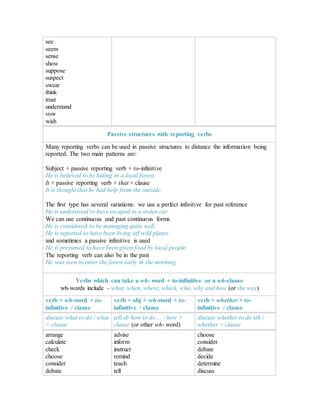
Passive structures with reporting verbs
Many reporting verbs can be used in passive structures to distance the information being
reported. The two main patterns are:
Subject + passive reporting verb + to-infinitive
He is believed to be hiding in a local forest.
It + passive reporting verb + that + clause
It is thought that he had help from the outside.
The first type has several variations: we use a perfect infinitive for past reference
He is understood to have escaped in a stolen car.
We can use continuous and past continuous forms
He is considered to be managing quite well.
He is reported to have been living off wild plants.
and sometimes a passive infinitive is used
He is presumed to have been given food by local people.
The reporting verb can also be in the past
He was seen to enter the forest early in the morning.
Verbs which can take a wh- word + to-infinitive or a wh-clause
wh-words include - what, when, where, which, who, why and how (or the way)
verb + wh-word + to-
infinitive / clause
verb + obj + wh-word + to-
infinitive / clause
verb + whether + to-
infinitive / clause
discuss what to do / what
+ clause
tell sb how to do ... / how +
clause (or other wh- word)
discuss whether to do sth /
whether + clause
arrange
calculate
check
choose
consider
debate
advise
inform
instruct
remind
teach
tell
choose
consider
debate
decide
determine
discuss
decide
describe
demonstrate
determine
discover
discuss
establish
explain
find out
forget
foresee
guess
imagine
know
learn
notice
plan
realise
remember
say
see
talk about
think (about)
understand
wonder
These two verbs can be used
with or without an object - ask
(sb) when to do sth
ask
show
find out
forget
know
remember
wonder
ask can be used with or
without an object - ask (sb)
whether to do sth
ask
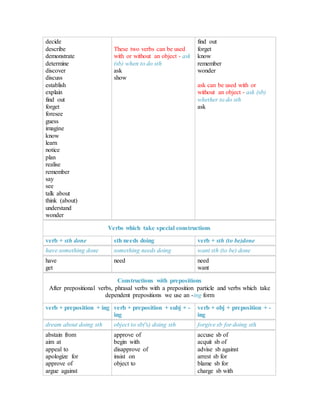
Verbs which take special constructions
verb + sth done sth needs doing verb + sth (to be)done
have something done something needs doing want sth (to be) done
have
get
need need
want
Constructions with prepositions
After prepositional verbs, phrasal verbs with a preposition particle and verbs which take
dependent prepositions we use an -ing form
verb + preposition + ing verb + preposition + subj + -
ing
verb + obj + preposition + -
ing
dream about doing sth object to sb('s) doing sth forgive sb for doing sth
abstain from
aim at
appeal to
apologize for
approve of
argue against
approve of
begin with
disapprove of
insist on
object to
accuse sb of
acquit sb of
advise sb against
arrest sb for
blame sb for
charge sb with
argue for
bargain on
believe in
beware of
boast about
brag about
choose between
complain about
concentrate on
decide on
disapprove of
dream about
escape from
get out of
excel at
hold off
insist on
joke about
look into
object to
participate in
persist in
reckon on
see about
set about
succeed in
take part in
think of / about
win by
compensate sb for
condemn sb for
congratulate sb on
excuse sb for
fine sb for
forbid sb from
forgive sb for
involve sb in
praise sb for
put sb up to
press sb into
prevent sb from
prohibit sb from
punish sb for
stop sb from
suspect sb of
thank sb for
Infinitive of purpose
After many verbs or verb + object we can use an infinitive of purpose
I've come to help you
He's taking her to see the fireworks.
After phrasal verbs with an adverb particle we can also use an infinitive of purpose
She's gone out to buy some vegetables
She went up to greet him
Sources
These lists have been compiled from various sources: from the following books and from the links
below
 Grammar and Vocabulary for Cambridge Advanced and Proficiency Side and Wellman
(Longman)
 Advanced Grammar in Use - Martin Hewings (Cambridge)
 Practical English Usage Michael Swan (Oxford)
 Business Grammar Builder
 Advanced English Practice BD Graver (Oxford)

Verb + verb or that clause patterns

  • 1.
    Verb + verb/thatclause patterns verb + ing, verb + infinitive, verb + that clause This table shows the main patterns used when one verb follows another for over 400 of the most common verbs. It also lists verbs which can commonly be followed by a that clause. You can also look at individual verbs to see the different ways they can be used. Verbs that take an infinitive verb + to-infinitive verb + obj + to-infinitive verb + obj + bare infinitive afford to do sth persuade sb to do sth make sb do sth plans and decisions aim arrange choose decide intend plan prepare propose vote expectations demand deserve expect hope reckon want wish would like yearn promises and refusals fail guarantee offer pledge promise refuse resolve swear Many of these are causative verbs advise allow ask beg cause command convince dare enable encourage entreat expect forbid force get implore intend invite leave need oblige order pay permit persuade prefer press recommend remind have let make verb + obj + (to-)infinitive help help can be used with or withoutto
  • 2.
    threaten undertake vow other verbs afford agree allow (passiveonly) appear apply ask beg claim consent dare desire forget get happen help learn know manage mean need negociate plead pretend seek seem tend train volunteer wait request require teach tell train trust urge want warn would like Verbs that take an -ing form verb + -ing form verb + obj + -ing verb + obj + -ing form admit doing sth imagine sb('s) doing sth see sb doing sth saying and thinking admit advocate anticipate consider describe deny In more formal language we can use a possessive with these verbs when talking about a person or group of people - I appreciate you(r) helping me advocate anticipate We can't use possessive forms after any of these verbs, only object forms verbs of perception followed by an ing-form or a bare infinitive
  • 3.
    discuss envisage imagine mention propose suggest liking and disliking adore appreciate detest dislike enjoy fancy feellike mind (neg and Qs) phrasal verbs carry on give up keep on put off can't can't face can't help can't stand other verbs advise allow avoid delay encourage finish involve keep miss postpone practise quit recall recommend resent resist risk appreciate detest dislike dread envisage forbid forget forgive foresee hate imagine involve like love mind (neg and Qs) miss prevent recall recommend recollect regret remember resent risk start stop can't stand tolerate An -ing form suggests we see the event in progress, a bare infinitive suggests that we see the completed action. feel hear listen to look at notice observe overhear see sense watch can only be followed by aning-form catch related verbs discover find smell other verbs keep leave
  • 4.
    spend time tolerate Verbs thattake an infinitive or an -ing form no difference little difference difference attempt doing sth/to do sth like doing sth/to do sth remember doing sth/to do sth attempt begin cease continue intend start can't bear dread hate like love prefer come forget go on mean regret remember stop try Verbs + infinitive variations verb + for + obj + to- infinitive verb + infinitive or perfect infinitive verb + bare infinitive wait for sb to do sth claim to be sth / have done sth should do sth / have done sth appeal apply arrange ask call clamour long opt pay plead press vote wait wish yearn appear claim happen pretend prove seem tend reporting verbs Modal auxiliaries can could will would shall should may might must ought to semi-modals dare (in negs and Qs) need (in negs and Qs) other constructions have to be going to Verbs which take a that clause verb + that + clause verb + obj + that + clause verb + that + subj + (should) + bare infinitive
  • 5.
    admit that +clause persuade sb that + clause insist that sb (should) do sth Reporting verbs admit anticipate answer believe boast brag calculate claim complain confess confirm consider declare demand deny disclose explain indicate mention order pretend profess recall recollect realise say state suggest threaten warn Other verbs (many of these can also be used for reporting) acknowledge advise advocate agree allow (admit) appreciate argue arrange advise assure convince guarantee inform persuade promise remind tell threaten warn In standard British English the version with should is usually used. In more formal British English and standard American English, the subjunctive form with the bare infinitive is preferred. In informal British English normal tenses are often used. advise agree ask beg command demand desire insist instruct intend order propose recommend request require stipulate suggest urge warn
  • 6.
  • 7.
    see seem sense show suppose suspect swear think trust understand vow wish Passive structures withreporting verbs Many reporting verbs can be used in passive structures to distance the information being reported. The two main patterns are: Subject + passive reporting verb + to-infinitive He is believed to be hiding in a local forest. It + passive reporting verb + that + clause It is thought that he had help from the outside. The first type has several variations: we use a perfect infinitive for past reference He is understood to have escaped in a stolen car. We can use continuous and past continuous forms He is considered to be managing quite well. He is reported to have been living off wild plants. and sometimes a passive infinitive is used He is presumed to have been given food by local people. The reporting verb can also be in the past He was seen to enter the forest early in the morning. Verbs which can take a wh- word + to-infinitive or a wh-clause wh-words include - what, when, where, which, who, why and how (or the way) verb + wh-word + to- infinitive / clause verb + obj + wh-word + to- infinitive / clause verb + whether + to- infinitive / clause discuss what to do / what + clause tell sb how to do ... / how + clause (or other wh- word) discuss whether to do sth / whether + clause arrange calculate check choose consider debate advise inform instruct remind teach tell choose consider debate decide determine discuss
  • 8.
    decide describe demonstrate determine discover discuss establish explain find out forget foresee guess imagine know learn notice plan realise remember say see talk about think(about) understand wonder These two verbs can be used with or without an object - ask (sb) when to do sth ask show find out forget know remember wonder ask can be used with or without an object - ask (sb) whether to do sth ask Verbs which take special constructions verb + sth done sth needs doing verb + sth (to be)done have something done something needs doing want sth (to be) done have get need need want Constructions with prepositions After prepositional verbs, phrasal verbs with a preposition particle and verbs which take dependent prepositions we use an -ing form verb + preposition + ing verb + preposition + subj + - ing verb + obj + preposition + - ing dream about doing sth object to sb('s) doing sth forgive sb for doing sth abstain from aim at appeal to apologize for approve of argue against approve of begin with disapprove of insist on object to accuse sb of acquit sb of advise sb against arrest sb for blame sb for charge sb with
  • 9.
    argue for bargain on believein beware of boast about brag about choose between complain about concentrate on decide on disapprove of dream about escape from get out of excel at hold off insist on joke about look into object to participate in persist in reckon on see about set about succeed in take part in think of / about win by compensate sb for condemn sb for congratulate sb on excuse sb for fine sb for forbid sb from forgive sb for involve sb in praise sb for put sb up to press sb into prevent sb from prohibit sb from punish sb for stop sb from suspect sb of thank sb for Infinitive of purpose After many verbs or verb + object we can use an infinitive of purpose I've come to help you He's taking her to see the fireworks. After phrasal verbs with an adverb particle we can also use an infinitive of purpose She's gone out to buy some vegetables She went up to greet him Sources These lists have been compiled from various sources: from the following books and from the links below  Grammar and Vocabulary for Cambridge Advanced and Proficiency Side and Wellman (Longman)  Advanced Grammar in Use - Martin Hewings (Cambridge)  Practical English Usage Michael Swan (Oxford)
  • 10.
     Business GrammarBuilder  Advanced English Practice BD Graver (Oxford)