
Major verb classes
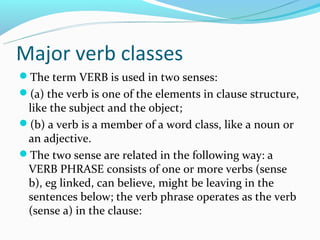
The term VERB is used in two senses:
(a) the verb is one of the elements in clause structure,
 like the subject and the object;
(b) a verb is a member of a word class, like a noun or
 an adjective.
The two sense are related in the following way: a
 VERB PHRASE consists of one or more verbs (sense
 b), eg linked, can believe, might be leaving in the
 sentences below; the verb phrase operates as the verb
 (sense a) in the clause:
Major verb classes
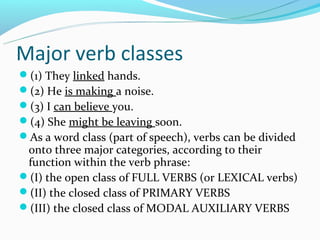
(1) They linked hands.
(2) He is making a noise.
(3) I can believe you.
(4) She might be leaving soon.
As a word class (part of speech), verbs can be divided
 onto three major categories, according to their
 function within the verb phrase:
(I) the open class of FULL VERBS (or LEXICAL verbs)
(II) the closed class of PRIMARY VERBS
(III) the closed class of MODAL AUXILIARY VERBS
Major verb classes
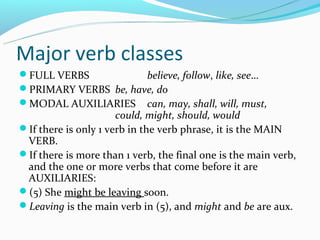
FULL VERBS           believe, follow, like, see…
PRIMARY VERBS be, have, do
MODAL AUXILIARIES can, may, shall, will, must,
                      could, might, should, would
If there is only 1 verb in the verb phrase, it is the MAIN
 VERB.
If there is more than 1 verb, the final one is the main verb,
 and the one or more verbs that come before it are
 AUXILIARIES:
(5) She might be leaving soon.
Leaving is the main verb in (5), and might and be are aux.
Major verb classes
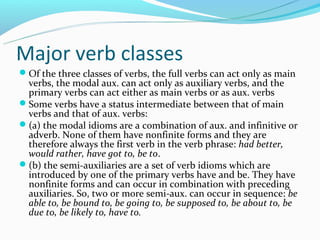
Of the three classes of verbs, the full verbs can act only as main
 verbs, the modal aux. can act only as auxiliary verbs, and the
 primary verbs can act either as main verbs or as aux. verbs
Some verbs have a status intermediate between that of main
 verbs and that of aux. verbs:
(a) the modal idioms are a combination of aux. and infinitive or
 adverb. None of them have nonfinite forms and they are
 therefore always the first verb in the verb phrase: had better,
 would rather, have got to, be to.
(b) the semi-auxiliaries are a set of verb idioms which are
 introduced by one of the primary verbs have and be. They have
 nonfinite forms and can occur in combination with preceding
 auxiliaries. So, two or more semi-aux. can occur in sequence: be
 able to, be bound to, be going to, be supposed to, be about to, be
 due to, be likely to, have to.
Major verb classes
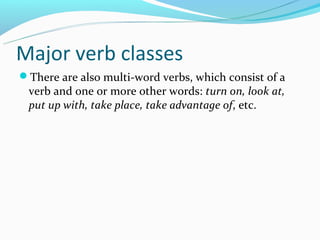
There are also multi-word verbs, which consist of a
 verb and one or more other words: turn on, look at,
 put up with, take place, take advantage of, etc.
Full verbs
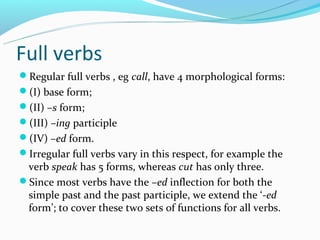
Regular full verbs , eg call, have 4 morphological forms:
(I) base form;
(II) –s form;
(III) –ing participle
(IV) –ed form.
Irregular full verbs vary in this respect, for example the
 verb speak has 5 forms, whereas cut has only three.
Since most verbs have the –ed inflection for both the
 simple past and the past participle, we extend the ‘-ed
 form’; to cover these two sets of functions for all verbs.
Full verbs – the function of verb
forms
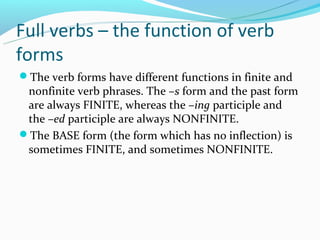
The verb forms have different functions in finite and
 nonfinite verb phrases. The –s form and the past form
 are always FINITE, whereas the –ing participle and
 the –ed participle are always NONFINITE.
The BASE form (the form which has no inflection) is
 sometimes FINITE, and sometimes NONFINITE.
Full verbs – the function of verb
forms
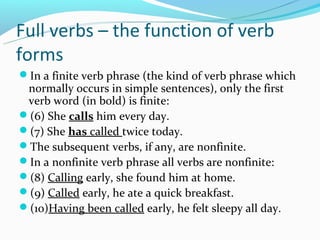
In a finite verb phrase (the kind of verb phrase which
 normally occurs in simple sentences), only the first
 verb word (in bold) is finite:
(6) She calls him every day.
(7) She has called twice today.
The subsequent verbs, if any, are nonfinite.
In a nonfinite verb phrase all verbs are nonfinite:
(8) Calling early, she found him at home.
(9) Called early, he ate a quick breakfast.
(10)Having been called early, he felt sleepy all day.
Full verbs – the function of verb
forms
The verb forms with their syntactic functions:
(I) the base form (call) is a finite verb in:
(a) the present tense in all persons and numbers
 except 3rd person singular: I/you/we/they call regularly.
(b) the imperative: Call at once!
(c) the present subjunctive: They demanded that she
 call and see them.
It is a nonfinite verb in:
(a) the bare infinitive: He may call tonight.
(b) the to-infinitive: We want her to call.
Full verbs – the function of verb
forms
(II) The –s form (calls) is a finite verb in the 3rd person singular
 present tense: She calls him every day.
(III) The –ing participle (calling) is a nonfinite verb in:
(a) the progressive aspect following be: He’s calling her now.
(b) -ing participle clauses: Calling early, I found her at home.
(IV) The past form (called) is a finite verb in the past tense:
 Someone called her yesterday.
(V) the –ed participle (called) is a nonfinite verb in:
(a) the perfect aspect following have: He has called twice today.
(b) the passive voice following be: Her brother is called Jim.
(c) –ed participle clauses: Called early, he ate a quick breakfast.
Primary verbs and modal
auxiliaries – verbs as operators
Aux. have one important syntactic function in
 common: they become the operator when they occur
 as the first verb of a finite VP.
The main verb be and the main verb have are also
 operators when they are the only verb in the verb
 phrase.
On the other hand, only the aux. do is an operator,
 not the main verb do.
Primary verbs and modal
auxiliaries – verbs as operators
Operators share the following main characteristics:
(a) to negate a finite clause, we put not immediately after
 the operator: She may not do it.
(b) to form an interrogative clause, we put the operator in
 front of the subject (subject-operator inversion): Will he
 speak first?
(c) the operator can carry nuclear stress to mark a finite
 clause as positive rather than negative: Won’t you try
 again? –Yes, I WILL try again.
(d) The operator functions in a range of elliptical clauses
 where the rest of the predicate is omitted: Won’t you try
 again? –Yes, I will.
Primary verbs and modal
auxiliaries – verbs as operators
If there is no operator in a corresponding positive
 declarative sentence, the dummy (or ‘empty’)
 operator do is introduced: She did not see the play.
Characteristics of modal aux.
(a) They are followed by the bare infinitive: You will
 ask the question.
(b) They cannot occur in nonfinite functions, i.e. as
 infinitives or participles: may - *to may, *maying,
 *mayed.
(c) They have no –s form for the third person singular
 of the present tense: She must write.
(d) Their past forms are used to refer to present and
 future time: I think we may/might be outside.
Will/Would you phone him tomorrow?
The primary verbs be, have, do
Be:
(a) be is the main verb in: Ann is a happy girl.
Is that building a hotel?
(b) be has two aux. functions: as an aspect aux. for
 the progressive, and as a passive aux.: Ann is learning
 Spanish.
Ann was rewarded a prize.
Be has 8 different forms
The primary verbs be, have, do
Have:
(a) as an aux.: for perfect aspect: I have finished.
(b) as a main verb: I have no money.
Do:
(a) as an aux.: do has no nonfinite forms, but only present and
 past forms
(b) as a main verb, do can function as a pro-predicate or pro-
 predication referring to some unspecified action(s), alone or in
 combination with so, it, this, that, etc.: She didn’t earn as much
 as she might have done.
I’m throwing these books away. – Why are you doing that?
(c) the main verb do has many uses as a general-purpose
 transitive verb: Let’s do the dishes.
Modal aux. and marginal modal
aux.
Marginal modal aux.: used to, ought to, dare, need.
Used to always occurs on the past tense: She used to
 attend regularly.
It is used both as an aux. and as a main verb with do-
 support: He usedn’t (or: used not) to smoke./He didn’t
 use(d) to smoke.
The normal interrogative construction is with do-support:
 Did he use to drink?
Ought to – to optional following ought in ellipsis: You
 oughtn’t to smoke so much.
Ought I to stop smoking? – Yes, I think you ought (to).
Modal aux. and marginal modal
aux.
Dare and need can be used either as modal aux. (with
 bare infinitive and without the inflected forms) or as
 main verbs (with to-infinitive and with inflected –s,
 -ing, and past forms).
The modal construction is reserved to nonassertive
 contexts, i,e, mainly negative and interrogative
 sentences.
The main verb construction can always be used, and
 is in fact more common.

Uvod u morfosintaksu, lecture 04, 12 13

  • 2.
    Major verb classes Theterm VERB is used in two senses: (a) the verb is one of the elements in clause structure, like the subject and the object; (b) a verb is a member of a word class, like a noun or an adjective. The two sense are related in the following way: a VERB PHRASE consists of one or more verbs (sense b), eg linked, can believe, might be leaving in the sentences below; the verb phrase operates as the verb (sense a) in the clause:
  • 3.
    Major verb classes (1)They linked hands. (2) He is making a noise. (3) I can believe you. (4) She might be leaving soon. As a word class (part of speech), verbs can be divided onto three major categories, according to their function within the verb phrase: (I) the open class of FULL VERBS (or LEXICAL verbs) (II) the closed class of PRIMARY VERBS (III) the closed class of MODAL AUXILIARY VERBS
  • 4.
    Major verb classes FULLVERBS believe, follow, like, see… PRIMARY VERBS be, have, do MODAL AUXILIARIES can, may, shall, will, must, could, might, should, would If there is only 1 verb in the verb phrase, it is the MAIN VERB. If there is more than 1 verb, the final one is the main verb, and the one or more verbs that come before it are AUXILIARIES: (5) She might be leaving soon. Leaving is the main verb in (5), and might and be are aux.
  • 5.
    Major verb classes Ofthe three classes of verbs, the full verbs can act only as main verbs, the modal aux. can act only as auxiliary verbs, and the primary verbs can act either as main verbs or as aux. verbs Some verbs have a status intermediate between that of main verbs and that of aux. verbs: (a) the modal idioms are a combination of aux. and infinitive or adverb. None of them have nonfinite forms and they are therefore always the first verb in the verb phrase: had better, would rather, have got to, be to. (b) the semi-auxiliaries are a set of verb idioms which are introduced by one of the primary verbs have and be. They have nonfinite forms and can occur in combination with preceding auxiliaries. So, two or more semi-aux. can occur in sequence: be able to, be bound to, be going to, be supposed to, be about to, be due to, be likely to, have to.
  • 6.
    Major verb classes Thereare also multi-word verbs, which consist of a verb and one or more other words: turn on, look at, put up with, take place, take advantage of, etc.
  • 7.
    Full verbs Regular fullverbs , eg call, have 4 morphological forms: (I) base form; (II) –s form; (III) –ing participle (IV) –ed form. Irregular full verbs vary in this respect, for example the verb speak has 5 forms, whereas cut has only three. Since most verbs have the –ed inflection for both the simple past and the past participle, we extend the ‘-ed form’; to cover these two sets of functions for all verbs.
  • 8.
    Full verbs –the function of verb forms The verb forms have different functions in finite and nonfinite verb phrases. The –s form and the past form are always FINITE, whereas the –ing participle and the –ed participle are always NONFINITE. The BASE form (the form which has no inflection) is sometimes FINITE, and sometimes NONFINITE.
  • 9.
    Full verbs –the function of verb forms In a finite verb phrase (the kind of verb phrase which normally occurs in simple sentences), only the first verb word (in bold) is finite: (6) She calls him every day. (7) She has called twice today. The subsequent verbs, if any, are nonfinite. In a nonfinite verb phrase all verbs are nonfinite: (8) Calling early, she found him at home. (9) Called early, he ate a quick breakfast. (10)Having been called early, he felt sleepy all day.
  • 10.
    Full verbs –the function of verb forms The verb forms with their syntactic functions: (I) the base form (call) is a finite verb in: (a) the present tense in all persons and numbers except 3rd person singular: I/you/we/they call regularly. (b) the imperative: Call at once! (c) the present subjunctive: They demanded that she call and see them. It is a nonfinite verb in: (a) the bare infinitive: He may call tonight. (b) the to-infinitive: We want her to call.
  • 11.
    Full verbs –the function of verb forms (II) The –s form (calls) is a finite verb in the 3rd person singular present tense: She calls him every day. (III) The –ing participle (calling) is a nonfinite verb in: (a) the progressive aspect following be: He’s calling her now. (b) -ing participle clauses: Calling early, I found her at home. (IV) The past form (called) is a finite verb in the past tense: Someone called her yesterday. (V) the –ed participle (called) is a nonfinite verb in: (a) the perfect aspect following have: He has called twice today. (b) the passive voice following be: Her brother is called Jim. (c) –ed participle clauses: Called early, he ate a quick breakfast.
  • 12.
    Primary verbs andmodal auxiliaries – verbs as operators Aux. have one important syntactic function in common: they become the operator when they occur as the first verb of a finite VP. The main verb be and the main verb have are also operators when they are the only verb in the verb phrase. On the other hand, only the aux. do is an operator, not the main verb do.
  • 13.
    Primary verbs andmodal auxiliaries – verbs as operators Operators share the following main characteristics: (a) to negate a finite clause, we put not immediately after the operator: She may not do it. (b) to form an interrogative clause, we put the operator in front of the subject (subject-operator inversion): Will he speak first? (c) the operator can carry nuclear stress to mark a finite clause as positive rather than negative: Won’t you try again? –Yes, I WILL try again. (d) The operator functions in a range of elliptical clauses where the rest of the predicate is omitted: Won’t you try again? –Yes, I will.
  • 14.
    Primary verbs andmodal auxiliaries – verbs as operators If there is no operator in a corresponding positive declarative sentence, the dummy (or ‘empty’) operator do is introduced: She did not see the play.
  • 15.
    Characteristics of modalaux. (a) They are followed by the bare infinitive: You will ask the question. (b) They cannot occur in nonfinite functions, i.e. as infinitives or participles: may - *to may, *maying, *mayed. (c) They have no –s form for the third person singular of the present tense: She must write. (d) Their past forms are used to refer to present and future time: I think we may/might be outside. Will/Would you phone him tomorrow?
  • 16.
    The primary verbsbe, have, do Be: (a) be is the main verb in: Ann is a happy girl. Is that building a hotel? (b) be has two aux. functions: as an aspect aux. for the progressive, and as a passive aux.: Ann is learning Spanish. Ann was rewarded a prize. Be has 8 different forms
  • 17.
    The primary verbsbe, have, do Have: (a) as an aux.: for perfect aspect: I have finished. (b) as a main verb: I have no money. Do: (a) as an aux.: do has no nonfinite forms, but only present and past forms (b) as a main verb, do can function as a pro-predicate or pro- predication referring to some unspecified action(s), alone or in combination with so, it, this, that, etc.: She didn’t earn as much as she might have done. I’m throwing these books away. – Why are you doing that? (c) the main verb do has many uses as a general-purpose transitive verb: Let’s do the dishes.
  • 18.
    Modal aux. andmarginal modal aux. Marginal modal aux.: used to, ought to, dare, need. Used to always occurs on the past tense: She used to attend regularly. It is used both as an aux. and as a main verb with do- support: He usedn’t (or: used not) to smoke./He didn’t use(d) to smoke. The normal interrogative construction is with do-support: Did he use to drink? Ought to – to optional following ought in ellipsis: You oughtn’t to smoke so much. Ought I to stop smoking? – Yes, I think you ought (to).
  • 19.
    Modal aux. andmarginal modal aux. Dare and need can be used either as modal aux. (with bare infinitive and without the inflected forms) or as main verbs (with to-infinitive and with inflected –s, -ing, and past forms). The modal construction is reserved to nonassertive contexts, i,e, mainly negative and interrogative sentences. The main verb construction can always be used, and is in fact more common.