Author
Richard Kibbey
Presented by:
Amna Jalil (04)
CDC 8th National Biosafety Symposium,
Atlanta, Georgia, 2004
Overview of the security concepts and the
systems
 Need of security expert
 One’s own organization
 Full or part-time contractor
Security is the degree of resistance to, or
protection from, harm. It applies to
any vulnerable and valuable asset,
such as a person, community, nation,
or organization (Biosafety labs)
Consist of equipment, policies
and procedures that support
each of the elements of security
Clear Zones
Barriers
Lighting
Shrouds
Locks
Electronic Security Systems
Guard forces
30 feet clear zone --- from the protectable
object or facility
Void of
 Trash receptables
 Ashtrays
 dumpsters
 Restrict, deny or channel pedestrian or
vehicular traffic
 Not necessarily impenetrable – increase the
probability to detect people & vehicles –
trying to get illegal access
Significant deterrent – potential intruders
Enhances visibility for routine patrols &
general staff
Permanent lightening – adequate
illumination to
 Entry points
 Pathways
 Parking lots
Activated by Sensors – activate the lights
when penetrated
Can activated by
 Timers
 Manually
◊ Often neglected component
◊ Support deterrence & delay by providing
concealment from chance and direct
surveillance
◊ Purpose – limit visibility from unauthorized
sources
◊ Simple – darkened windows, curtains
◊ Complex – walls, coverings even shrubbery
Many shapes and forms
Single hasp lock to very complex systems
Include:
 Standard key lock
 Combination lock
 Cipher lock
 Card access control systems including swipe card lock
and biometric
Can be tied in electronic security system
• Come in three flavors
Access Control Systems
Security Surveillance
Intrusion Detection Systems (IDS)
ACCESS CONTROL SYSTEMS
Devices designed to limit access --- site,
building, room or container
Simple – swipe access system
Complex -- biometrics
SECURITY SURVEILLANCE
Most common – CCTV
When choosing CCTV
 Resolution power and image quality
 Color or black & white
 Zoom capability
 Transmission mode
INTRUSION DETECTION SYSTEMS (IDS)
Identify unauthorized entry
Connected to monitoring system – fall into 3
categories
1. Local alarm system – when IDS breached–
sounds an alarm for a local security officer
2. 24-hour central station – usually
commercially operated – when get alarm,
they contact local police
3. Propriety alarm systems – controlled and
monitored within the facility
Response forces
Balance between use of security technology &
properly trained security staff
Elements of security systems are the rings –
around the resource need to be protected
Each ring supported by security equipments
and procedures – deter, detect or support
defeating an adversary by being applied on
one or more rings of security
Rings of
Security
Deter
Detect
Assess
Delay
Respond
Deny
Prevention of action through a fear of
unacceptable consequences
Psychological state
Perception of security system – from outside
look
If PTE feels fear – move to other place
Let’s keep them away from here
o Determination and transmission that an event
has occurred
o Use of technology – increases capability
Analysis of an event by a person directly
onsite or via technology
Now-a-days – CCTV systems
Necessary --- determination of the validation
of alarm & appropriate response
Ability of physical or psychological barriers to
restrict movement
Purpose – allow time for an appropriate
response – make impossible for intruder to
continue
Level of reaction required to counter an
intrusion
Response forces
 Unarmed security guards or staff
 Local police
High level – dedicated armed forces – nuclear
storage areas
Ability to oppose or negate the effects of an
action
Final chance to defeat an adversary
To avoid the Probable threat element (PTE)
Hypothetical Scenario
Four Field members of some terrorist agency
meet in the Baltimore in December 2002
 2 from New york
 2 from Fort Worth
Their Mission: Steal biological material---
used in bioterror attack on US food supply
Hypothetical Scenario
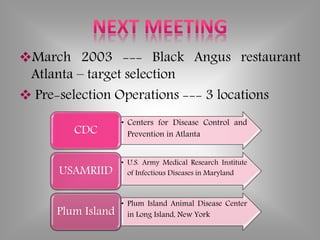
March 2003 --- Black Angus restaurant
Atlanta – target selection
 Pre-selection Operations --- 3 locations
• Centers for Disease Control and
Prevention in AtlantaCDC
• U.S. Army Medical Research Institute
of Infectious Diseases in MarylandUSAMRIID
• Plum Island Animal Disease Center
in Long Island, New YorkPlum Island
 Identification of weaknesses in security – to
exploit
Find a location with
 Poor lighting
 Weak CCTV system
 Inconsistent access control system
Began from April to June 2003
Observations were recorded and discovered
 New alarm systems at CDC
 High-tech TV systems– throughout complex
 Barriers – movement hindrance
Assessment
Security components – hindered proposed
operation
Occurred from July to August 2003
Problems were similar to CDC
 Many lights & security structures
 Barriers
 Access control procedures
Assessment
Location was too difficult
August through September 2003
Many weaknesses were found
 Numerous gaps in security
 Doors left open for ventilation
 Some windows left open overnight
 Alarms and door sensors not operational
 Poor lighting
 Inadequate and broken CCTV
Assessment
Plum Island was selected as target
◊ From September to December 2003
◊ Found a route of entry – A window – left
unlocked most evenings
◊ Daily operations were observer and target
selection was made
Attack was conducted early in January 2004
1 person – at vehicle – half a mile away
3 persons – entered building from window
Gained access – cutting hole in drywall
Took several vials of hoof and mouth virus
and exited
Whole operation took 70 minutes
Understanding Security Basics: A Tutorial on Security Concepts and Technology

Understanding Security Basics: A Tutorial on Security Concepts and Technology

  • 1.
  • 2.
    CDC 8th NationalBiosafety Symposium, Atlanta, Georgia, 2004
  • 4.
    Overview of thesecurity concepts and the systems  Need of security expert  One’s own organization  Full or part-time contractor
  • 5.
    Security is thedegree of resistance to, or protection from, harm. It applies to any vulnerable and valuable asset, such as a person, community, nation, or organization (Biosafety labs)
  • 6.
    Consist of equipment,policies and procedures that support each of the elements of security
  • 7.
  • 8.
    30 feet clearzone --- from the protectable object or facility Void of  Trash receptables  Ashtrays  dumpsters
  • 11.
     Restrict, denyor channel pedestrian or vehicular traffic  Not necessarily impenetrable – increase the probability to detect people & vehicles – trying to get illegal access
  • 13.
    Significant deterrent –potential intruders Enhances visibility for routine patrols & general staff Permanent lightening – adequate illumination to  Entry points  Pathways  Parking lots
  • 14.
    Activated by Sensors– activate the lights when penetrated Can activated by  Timers  Manually
  • 16.
    ◊ Often neglectedcomponent ◊ Support deterrence & delay by providing concealment from chance and direct surveillance ◊ Purpose – limit visibility from unauthorized sources ◊ Simple – darkened windows, curtains ◊ Complex – walls, coverings even shrubbery
  • 18.
    Many shapes andforms Single hasp lock to very complex systems Include:  Standard key lock  Combination lock  Cipher lock  Card access control systems including swipe card lock and biometric Can be tied in electronic security system
  • 21.
    • Come inthree flavors Access Control Systems Security Surveillance Intrusion Detection Systems (IDS)
  • 22.
    ACCESS CONTROL SYSTEMS Devicesdesigned to limit access --- site, building, room or container Simple – swipe access system Complex -- biometrics
  • 24.
    SECURITY SURVEILLANCE Most common– CCTV When choosing CCTV  Resolution power and image quality  Color or black & white  Zoom capability  Transmission mode
  • 27.
    INTRUSION DETECTION SYSTEMS(IDS) Identify unauthorized entry Connected to monitoring system – fall into 3 categories 1. Local alarm system – when IDS breached– sounds an alarm for a local security officer 2. 24-hour central station – usually commercially operated – when get alarm, they contact local police
  • 28.
    3. Propriety alarmsystems – controlled and monitored within the facility
  • 29.
    Response forces Balance betweenuse of security technology & properly trained security staff
  • 32.
    Elements of securitysystems are the rings – around the resource need to be protected Each ring supported by security equipments and procedures – deter, detect or support defeating an adversary by being applied on one or more rings of security
  • 33.
  • 35.
    Prevention of actionthrough a fear of unacceptable consequences Psychological state Perception of security system – from outside look If PTE feels fear – move to other place Let’s keep them away from here
  • 36.
    o Determination andtransmission that an event has occurred o Use of technology – increases capability
  • 37.
    Analysis of anevent by a person directly onsite or via technology Now-a-days – CCTV systems Necessary --- determination of the validation of alarm & appropriate response
  • 38.
    Ability of physicalor psychological barriers to restrict movement Purpose – allow time for an appropriate response – make impossible for intruder to continue
  • 39.
    Level of reactionrequired to counter an intrusion Response forces  Unarmed security guards or staff  Local police High level – dedicated armed forces – nuclear storage areas
  • 40.
    Ability to opposeor negate the effects of an action Final chance to defeat an adversary
  • 41.
    To avoid theProbable threat element (PTE) Hypothetical Scenario Four Field members of some terrorist agency meet in the Baltimore in December 2002  2 from New york  2 from Fort Worth Their Mission: Steal biological material--- used in bioterror attack on US food supply
  • 42.
  • 43.
    March 2003 ---Black Angus restaurant Atlanta – target selection  Pre-selection Operations --- 3 locations • Centers for Disease Control and Prevention in AtlantaCDC • U.S. Army Medical Research Institute of Infectious Diseases in MarylandUSAMRIID • Plum Island Animal Disease Center in Long Island, New YorkPlum Island
  • 44.
     Identification ofweaknesses in security – to exploit Find a location with  Poor lighting  Weak CCTV system  Inconsistent access control system
  • 45.
    Began from Aprilto June 2003 Observations were recorded and discovered  New alarm systems at CDC  High-tech TV systems– throughout complex  Barriers – movement hindrance Assessment Security components – hindered proposed operation
  • 46.
    Occurred from Julyto August 2003 Problems were similar to CDC  Many lights & security structures  Barriers  Access control procedures Assessment Location was too difficult
  • 47.
    August through September2003 Many weaknesses were found  Numerous gaps in security  Doors left open for ventilation  Some windows left open overnight  Alarms and door sensors not operational  Poor lighting  Inadequate and broken CCTV Assessment Plum Island was selected as target
  • 48.
    ◊ From Septemberto December 2003 ◊ Found a route of entry – A window – left unlocked most evenings ◊ Daily operations were observer and target selection was made
  • 49.
    Attack was conductedearly in January 2004 1 person – at vehicle – half a mile away 3 persons – entered building from window Gained access – cutting hole in drywall Took several vials of hoof and mouth virus and exited Whole operation took 70 minutes