VENTURI METER
PREPARED BY: GROUP NO 6
1
Name Reg #
Sajjad Sabir 32
Zeeshan Ahmad 30
Imtiaz Ali 34
Tanzil-ur-Rehman 35
Prepared To:
Dr, M. Mubashir Qurashi
HOD Civil Department
2
DEFINITION & MAIN PARTS
Venturimeter device used for
measuring the rate of flow of a fluid
flowing through a pipe.
It consist of three parts,
•Converging part
•Throat
•Diverging part
3
4
WORKING PRINCIPLE
Venturi meter works under the principle of Bernoulli's
equation and Continuity equation.
5
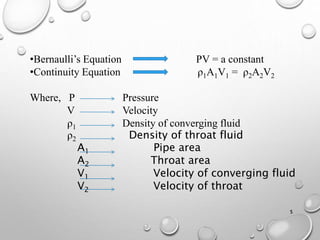
•Bernaulli’s Equation PV = a constant
•Continuity Equation ρ1A1V1 = ρ2A2V2
Where, P Pressure
V Velocity
ρ1 Density of converging fluid
ρ2 Density of throat fluid
A1 Pipe area
A2 Throat area
V1 Velocity of converging fluid
V2 Velocity of throat
6
TYPES OF VENTURIMETER
•Horizontal venturimeter
7
•Inclined venturimeter •Vertical venturimeter
8
SOME ASSUMPTIONS TAKEN
Incompressible fluids
Frictionless inner surfaces
Steady and irrotational flow
9
EXPRESSION FOR RATE OF FLOW
•A(m1,ρ1,p1,v1)
•B(m2,ρ2,p2,v2
)
Z1
Z2
Datum
At pt:-A
P.E = g.z1
V.E = ½ v1
2
Pre.E = P1/ρ
At pt:-B
P.E = g.z2
V.E = ½ v2
2
Pre.E = P2/ρ
10
g(Z1-Z2)+1/2(V12+V22)=(P2-P1)/ρ
Energy equation (horizontal arrangement)
If Z1=Z2
½(v12-v22)= (P2-P1)/ρ ----- (1)
As per law at continuity
A1V1=A2V2 (since density is constant)
V1=(A2/A1)V2 & V2=(A1/A2)V1
Sub V1 value in (1)
½[(A2/A1)*V22-V22]=∆P/ρ
V22=(A1
2/A2
2-A1
2) * 2∆P/ρ
11
Q2=A2.V2= A1.A2 * √2∆P/ρ
(√A22-A12)
Q α √2∆P
Q2=M.√(2∆Pg)/ωTheoretical--
Original-- Q2=CdE M√(2∆P)/ρ
M- velocity approach factor
Q-over all volumetric flow rate
Cd-coefficient of discharge
E- thermal expansion factor
12
Q2=Cd . E . M . A2 √2g{hm[(wm/w )-1]-(Zx-Zy)}
Q2=Cd.E.M.A2√2g {hm(sg-1)-(Zx-Zy)}
Q2 in terms of specific weight
Q2 in terms of specific gravity
13
VENTURI METER V/S FLOW
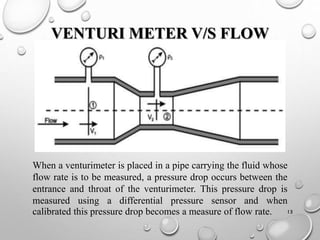
When a venturimeter is placed in a pipe carrying the fluid whose
flow rate is to be measured, a pressure drop occurs between the
entrance and throat of the venturimeter. This pressure drop is
measured using a differential pressure sensor and when
calibrated this pressure drop becomes a measure of flow rate.
14
CONSTRUCTION
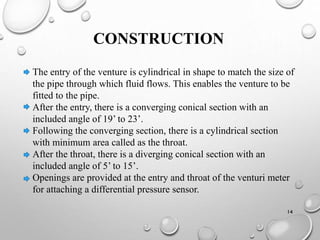
The entry of the venture is cylindrical in shape to match the size of
the pipe through which fluid flows. This enables the venture to be
fitted to the pipe.
After the entry, there is a converging conical section with an
included angle of 19’ to 23’.
Following the converging section, there is a cylindrical section
with minimum area called as the throat.
After the throat, there is a diverging conical section with an
included angle of 5’ to 15’.
Openings are provided at the entry and throat of the venturi meter
for attaching a differential pressure sensor.
15
MANOMETER
The differential pressure sensor used here is
Manometer.
Manometer is a device to measure pressure.
A common simple manometer consists of
a U shaped tube of glass filled with some liquid.
Manometers measure a pressure difference by
balancing the weight of a fluid column between
the two pressures of interest. Large pressure
differences are measured with heavy fluids, such
as mercury (high density).
Small pressure differences, such as those
experienced in experimental wind tunnels
or venturi flowmeters are measured by lighter
fluids such as water .
16
17
OPERATION
The fluid whose flow rate is to be measured enters the entry
section of the venturi meter with a pressure P1.
As the fluid flows into the converging section, its pressure
keeps on reducing and attains a minimum value P2 when it
enters the throat. That is, in the throat, the fluid pressure P2
will be minimum.
18
The Manometer attached between the entry and throat section of
the venturi meter records the pressure difference(P1-P2) which
becomes an indication of the flow rate of the fluid through the
pipe when calibrated.
The diverging section has been provided to enable the fluid to
regain its pressure and hence its kinetic energy. Lesser the angle
of the diverging section, greater is the recovery.
19
•P1
•High
angle
convergin
g
•p2
•P1-p2
throat
• P ses
• Less
angle
divergin
g
20
SAMPLE PROBLEM
A horizontal venture meter with 15 cm inlet . 7.5 cm throat is
used for measurement of flow of water .The differential pressure
between inlet and throat is 17.5 cm, when measured using U-
TUBE manometer. Make the calculations for the water flow rate
where Cd for venturi is 0.97. Specific gravity =13.6.
Q2= Cd . E . M . A2 √2g{ hm [(ρm/ρ )-1]}
M=A1/√A12-A22
A1=π*d2/4=π*152/4=176.71 ,
A2=π*d2/4=π*7.52/4=44.178
M= 1.03
Q2=0.97
* 1
* 1.03
*44.178√2
*9.8
*17.5(13.6-1)
=0.02901 m3/sec
Sol
:
21
PRESSURE IN PIPELINE
22
APPLICATIONS
1
• used where high pressure recovery is
required.
2
• measuring flow rates of water, gases,
suspended solids, slurries and dirty liquids.
3
• measure high flow rates in pipes having
diameters in a few meters.
23
ADVANTAGES
1
• Less chances of getting clogged with
sediments.
2
• Coefficient of discharge is high.
3
• Its behavior can be predicted perfectly.
4
• Can be installed vertically, horizontally or
inclined.
24
DISADVANTAGES
1
•Highly expensive
2
•Occupies considerable space
3
•Cannot be altered for measuring
pressure beyond a maximum velocity
25
THANK YOU

Venturi meter

  • 1.
    VENTURI METER PREPARED BY:GROUP NO 6 1 Name Reg # Sajjad Sabir 32 Zeeshan Ahmad 30 Imtiaz Ali 34 Tanzil-ur-Rehman 35 Prepared To: Dr, M. Mubashir Qurashi HOD Civil Department
  • 2.
    2 DEFINITION & MAINPARTS Venturimeter device used for measuring the rate of flow of a fluid flowing through a pipe. It consist of three parts, •Converging part •Throat •Diverging part
  • 3.
  • 4.
    4 WORKING PRINCIPLE Venturi meterworks under the principle of Bernoulli's equation and Continuity equation.
  • 5.
    5 •Bernaulli’s Equation PV= a constant •Continuity Equation ρ1A1V1 = ρ2A2V2 Where, P Pressure V Velocity ρ1 Density of converging fluid ρ2 Density of throat fluid A1 Pipe area A2 Throat area V1 Velocity of converging fluid V2 Velocity of throat
  • 6.
  • 7.
  • 8.
    8 SOME ASSUMPTIONS TAKEN Incompressiblefluids Frictionless inner surfaces Steady and irrotational flow
  • 9.
    9 EXPRESSION FOR RATEOF FLOW •A(m1,ρ1,p1,v1) •B(m2,ρ2,p2,v2 ) Z1 Z2 Datum At pt:-A P.E = g.z1 V.E = ½ v1 2 Pre.E = P1/ρ At pt:-B P.E = g.z2 V.E = ½ v2 2 Pre.E = P2/ρ
  • 10.
    10 g(Z1-Z2)+1/2(V12+V22)=(P2-P1)/ρ Energy equation (horizontalarrangement) If Z1=Z2 ½(v12-v22)= (P2-P1)/ρ ----- (1) As per law at continuity A1V1=A2V2 (since density is constant) V1=(A2/A1)V2 & V2=(A1/A2)V1 Sub V1 value in (1) ½[(A2/A1)*V22-V22]=∆P/ρ V22=(A1 2/A2 2-A1 2) * 2∆P/ρ
  • 11.
    11 Q2=A2.V2= A1.A2 *√2∆P/ρ (√A22-A12) Q α √2∆P Q2=M.√(2∆Pg)/ωTheoretical-- Original-- Q2=CdE M√(2∆P)/ρ M- velocity approach factor Q-over all volumetric flow rate Cd-coefficient of discharge E- thermal expansion factor
  • 12.
    12 Q2=Cd . E. M . A2 √2g{hm[(wm/w )-1]-(Zx-Zy)} Q2=Cd.E.M.A2√2g {hm(sg-1)-(Zx-Zy)} Q2 in terms of specific weight Q2 in terms of specific gravity
  • 13.
    13 VENTURI METER V/SFLOW When a venturimeter is placed in a pipe carrying the fluid whose flow rate is to be measured, a pressure drop occurs between the entrance and throat of the venturimeter. This pressure drop is measured using a differential pressure sensor and when calibrated this pressure drop becomes a measure of flow rate.
  • 14.
    14 CONSTRUCTION The entry ofthe venture is cylindrical in shape to match the size of the pipe through which fluid flows. This enables the venture to be fitted to the pipe. After the entry, there is a converging conical section with an included angle of 19’ to 23’. Following the converging section, there is a cylindrical section with minimum area called as the throat. After the throat, there is a diverging conical section with an included angle of 5’ to 15’. Openings are provided at the entry and throat of the venturi meter for attaching a differential pressure sensor.
  • 15.
    15 MANOMETER The differential pressuresensor used here is Manometer. Manometer is a device to measure pressure. A common simple manometer consists of a U shaped tube of glass filled with some liquid. Manometers measure a pressure difference by balancing the weight of a fluid column between the two pressures of interest. Large pressure differences are measured with heavy fluids, such as mercury (high density). Small pressure differences, such as those experienced in experimental wind tunnels or venturi flowmeters are measured by lighter fluids such as water .
  • 16.
  • 17.
    17 OPERATION The fluid whoseflow rate is to be measured enters the entry section of the venturi meter with a pressure P1. As the fluid flows into the converging section, its pressure keeps on reducing and attains a minimum value P2 when it enters the throat. That is, in the throat, the fluid pressure P2 will be minimum.
  • 18.
    18 The Manometer attachedbetween the entry and throat section of the venturi meter records the pressure difference(P1-P2) which becomes an indication of the flow rate of the fluid through the pipe when calibrated. The diverging section has been provided to enable the fluid to regain its pressure and hence its kinetic energy. Lesser the angle of the diverging section, greater is the recovery.
  • 19.
  • 20.
    20 SAMPLE PROBLEM A horizontalventure meter with 15 cm inlet . 7.5 cm throat is used for measurement of flow of water .The differential pressure between inlet and throat is 17.5 cm, when measured using U- TUBE manometer. Make the calculations for the water flow rate where Cd for venturi is 0.97. Specific gravity =13.6. Q2= Cd . E . M . A2 √2g{ hm [(ρm/ρ )-1]} M=A1/√A12-A22 A1=π*d2/4=π*152/4=176.71 , A2=π*d2/4=π*7.52/4=44.178 M= 1.03 Q2=0.97 * 1 * 1.03 *44.178√2 *9.8 *17.5(13.6-1) =0.02901 m3/sec Sol :
  • 21.
  • 22.
    22 APPLICATIONS 1 • used wherehigh pressure recovery is required. 2 • measuring flow rates of water, gases, suspended solids, slurries and dirty liquids. 3 • measure high flow rates in pipes having diameters in a few meters.
  • 23.
    23 ADVANTAGES 1 • Less chancesof getting clogged with sediments. 2 • Coefficient of discharge is high. 3 • Its behavior can be predicted perfectly. 4 • Can be installed vertically, horizontally or inclined.
  • 24.
    24 DISADVANTAGES 1 •Highly expensive 2 •Occupies considerablespace 3 •Cannot be altered for measuring pressure beyond a maximum velocity
  • 25.