Concept of vectors for IIT JEE! 
Willard Gibbs was basically a mathematical physicist whose contribution in statistical 
mechanics paved the way for physical 
chemistry as a science. Einstein regarded 
Gibbs as the “greatest mind in American 
history.” Gibbs is also popularly known as the 
father of vector analysis or the proper study 
of vectors in math. The topic of vectors is an 
extremely important topic of IIT JEE 
Mathematics syllabus. The topic is not very 
tough and can be easily mastered with a bit of 
practice. Here, we shall discuss vectors in detail and throw some light on various 
interesting facts including its sub-topics. Besides, we shall also illustrate some 
important tips to master the topic in addition to its practical applications in real life. 
Various sub-topics of vectors include: 
Introduction to vectors 
Basic Vector Operations 
Non-Coplanar Vectors 
Resolution of a Vector 
Dot Product 
Cross Product 
Scalar Triple Product 
Vector Triple Product 
Geometrical Interpretations 
Those willing to study these topics in detail are advised to refer the study material 
section of vectors.
Vectors 
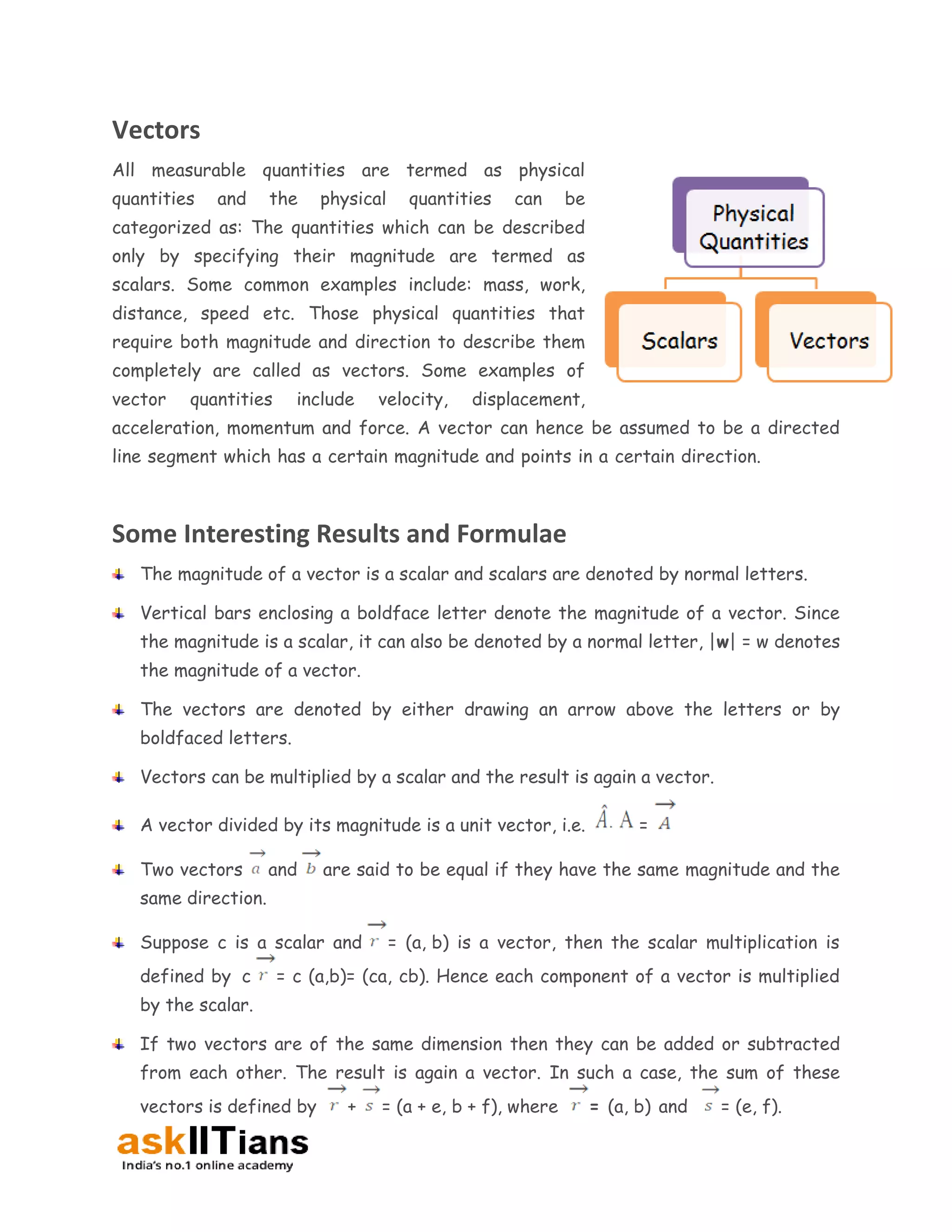
All measurable quantities are termed as physical 
quantities and the physical quantities can be 
categorized as: The quantities which can be described 
only by specifying their magnitude are termed as 
scalars. Some common examples include: mass, work, 
distance, speed etc. Those physical quantities that 
require both magnitude and direction to describe them 
completely are called as vectors. Some examples of 
vector quantities include velocity, displacement, 
acceleration, momentum and force. A vector can hence be assumed to be a directed 
line segment which has a certain magnitude and points in a certain direction. 
Some Interesting Results and Formulae 
The magnitude of a vector is a scalar and scalars are denoted by normal letters. 
Vertical bars enclosing a boldface letter denote the magnitude of a vector. Since 
the magnitude is a scalar, it can also be denoted by a normal letter, |w| = w denotes 
the magnitude of a vector. 
The vectors are denoted by either drawing an arrow above the letters or by 
boldfaced letters. 
Vectors can be multiplied by a scalar and the result is again a vector. 
A vector divided by its magnitude is a unit vector, i.e. = 
Two vectors and are said to be equal if they have the same magnitude and the 
same direction. 
Suppose c is a scalar and = (a, b) is a vector, then the scalar multiplication is 
defined by c = c (a,b)= (ca, cb). Hence each component of a vector is multiplied 
by the scalar. 
If two vectors are of the same dimension then they can be added or subtracted 
from each other. The result is again a vector. In such a case, the sum of these 
vectors is defined by + = (a + e, b + f), where = (a, b) and = (e, f).
We can also subtract two vectors of the same direction. The result is again a 
vector. As in the previous case subtracting vector from yields - = (a - 
e, b – f). The difference of these vectors is actually the vector - = +(-1) 
Dot Product of Two Vectors a and b where a = [a1, a2, ..., an] and b = [b1, b2, ..., bn] is 
given by a1b1 + a2b2 + ..., + anbn . 
Some basic rules 
If , and are three vectors and a, b are scalars then the following results hold 
true: 
Commutative law of addition: + = + 
Existence of additive inverse: +(- ) = 
+ = 
a(b ) = (ab) 
(a+b) = a + b 
a( + ) = a + a 
1. = 
Associative law of addition: +( + ) = ( + )+ 
Triangle Law of Vector Addition: 
Given two vectors and , their sum or resultant written as ( + ) is also a 
vector obtained by first bringing the initial point of b to the terminal point of a and 
then joining the initial point of a to the terminal point of b giving a uniform direction 
by completing the triangle OAB.
Parallelogram Law of Vector Addition 
If two adjacent sides of a parallelogram are represented by two vectors, then the 
diagonal of the parallelogram is represented by the resultant of both the vectors. 
Section Formula 
If there is a line segment AB with coordinates A(x1, y1) and B (x2, y2) and P is a point 
that divides it in the ratio m:n, then by Section Formula we have ((m1x2 + m2x1)/(m1 + 
m2), (m1y2 + m2y1)/(m1 + m2)) 
What is the importance of this topic for an IIT JEE aspirant? 
Vectors occupy an extremely important place in IIT JEE preparation. It accounts for 
5% of the JEE screening. For majority of students, vector is the most interesting
topic encountered by them in JEE Mathematics. The best part is that it also fetches 
good number of questions in JEE. 
What are the Best Books for the Preparation of Vectors? 
Students are advised not to miss the NCERTs as they help in laying good foundation. 
Besides NCERTS, several other books which are considered to be excellent for JEE 
preparations, especially for vectors include: 
Arihant Publication 
R.D.Sharma 
IIT Maths by M.L. Khanna 
These books not only explain the concepts in detail but also contain various solved and 
unsolved examples. Various JEE level questions are also included in them. Arihant 
Calculus is excellent in every respect except that students need to select the 
problems carefully as the ones designed for Olympiads are not very useful for JEE 
aspirants. R.D.Sharma offers plenty of solved examples which help in clearing the 
concepts of students. 
Illustrations 
Illustration 1: 
If =( + + ), . = 1 and x = - , then is (IIT JEE 2003) 
A. - + C. 
B. - D. 2 
Solution: We know that x ( x ) = ( . ) – ( . ) 
Hence, ( + + ) x ( - )= ( + + ) – (√3)2 
This gives, -2 + + = + + – 3 
Hence, 3 = 3 
And this yields =
Illustration 2: 
If the vector = + + , the vector = + + and = + α + β are 
linearly dependent vectors and | | = √3 then, 
A. α = 1, β = -1 B. α = 1, β = ±1 
C. α = -1, β = ±1 D. α = ±1, β = 1 
Solution: Since , and are given to be linearly dependent vectors, so this also 
implies that the vectors are coplanar. 
So, . ( x ) = 0 
Solving this with the help of determinants, and applying the column operation 
C3 – C1, we get,(β-1) (3-4) = 0.This gives β = 1.Also, | | = √3 
√ 1+ α2 + β2 = √3, √ 1+ α2 +1 = √3 
√α2 + 2 = √3, α2 + 2 = 3 so α = ±1. 
Some Interesting Facts 
Vectors which are in the same direction can be added by simply adding their 
magnitudes, while to add two vectors pointing in opposite directions their 
magnitudes are subtracted and not added. 
Column vectors can be added by simply adding the values in each row. 
You can find the magnitude of a vector in three dimensions by using the 
formula a2=b2+c2+d2, where a is the magnitude of the vector, and b, c, and d are the 
components in each direction. 
If l1 + m1 = l2 + m2 then l1 = l2 and m1 = m2 
Cross product of vectors is not commutative. 
Collinear Vectors are also parallel vectors except that they lie on the same line. 
Three vectors are linearly dependent if they are coplanar which implies that any 
one of them can be represented as a linear combination of other two. 
The dot product of two parallel vectors is 1 and their cross product is 0.
Two collinear vectors are always linearly dependent but two non-collinear non-zero 
vectors are always linearly independent. 
Three coplanar vectors are always linearly dependent. 
Three non-coplanar non-zero vectors are always linearly independent. 
More than 3 vectors are always linearly dependent. 
Minimum number of coplanar vectors for zero resultant is 2(for equal magnitude) 
and 3 (for unequal magnitude). 
DCs of a vector are unique and satisfy the relation l2 + m2 + n2 = 1, where l, m and n 
are the three DCs. 
DRs are proportional to DCs and are not unique. 
Tips to Master Vectors for IIT JEE 
Vector is a simple topic but it demands conceptual clarity and 
consistent practice. Due to lack of conceptual clarity, students 
often end up committing silly mistakes which results in loss of 
some easy scores. Listed below are some of the tips which can help you fetch perfect 
scores in this simple topic: 
Consulting too many books can lead to confusion and hence students must refer 
just one or two books after they are done with the NCERTs. 
Vectors are more of a geometrical concept rather than algebraic. Hence, when we 
talk of (say) addition of two vectors, rather than assuming it to be simple addition 
students are advised to visualize the concepts. 
Vectors are free entities and hence one can move around a vector in the plane and 
it will remain the same vector as long as its direction and magnitude are preserved. 
Consistent practice is a must to excel in this topic. 
Various results and formulae should be on fingertips. 
While attempting a question on vectors, students are advised to visualize the 
concept and draw a diagram for the same so that chances of committing mistakes 
are minimized.
The concepts of dot product and cross product including their nature must be very 
clear. 
Suppose we have three non-zero vectors , & , then if their scalar triple 
product is zero, then the three vectors are coplanar. 
Practice sufficient number of previous year papers to get acquainted with the kind 
of questions asked in exam. 
Do not read the questions; try to depict them by figures to reach at the solution 
easily. 
Practical Applications of Vectors for IIT JEE 
Vector is a comparatively new topic in the history of 
mathematics but it has gained immense popularity in this short 
span of time. It has wide range of applications in solving 
geometric problems especially in the area of computer graphics. Some of the practical 
applications include: 
The concepts of vector dot and cross products are used to estimate the capability 
of solar panels to produce the electrical power. 
The concept of unit vectors is used in determining the directions like eats, north 
etc. Whenever and wherever direction is to be determined in real life, unit vectors 
play a vital role. 
Flying planes are based on the concept of vector mathematics. The motion of the 
plane is along the vector sum of wind and propeller velocity. 
Driving and sailing also use the vector principles, although we don’t really realize it. 
If one needs to cross a flowing river, the concept of vectors is used in order to 
determine the point where he will land on the side. 
A bicycler tilts his umbrella forward while riding on a bicycle because the relative 
velocity of the rain is slant and hits his face. The more the speed of the cycle, the 
more he should tilt forward. 
Controlling and tracing the movement of cars, ships and planes moving in space 
involve the use of unit vectors.
Free Coaching Consultation 
For a free demo class or consultation, please 
contact: 
Email: info@askIITians.com 
Call us at: +91 (120) 4616500 (Extn.204) 
Visit: www.askIITians.com

Vectors Preparation Tips for IIT JEE | askIITians

  • 1.
    Concept of vectorsfor IIT JEE! Willard Gibbs was basically a mathematical physicist whose contribution in statistical mechanics paved the way for physical chemistry as a science. Einstein regarded Gibbs as the “greatest mind in American history.” Gibbs is also popularly known as the father of vector analysis or the proper study of vectors in math. The topic of vectors is an extremely important topic of IIT JEE Mathematics syllabus. The topic is not very tough and can be easily mastered with a bit of practice. Here, we shall discuss vectors in detail and throw some light on various interesting facts including its sub-topics. Besides, we shall also illustrate some important tips to master the topic in addition to its practical applications in real life. Various sub-topics of vectors include: Introduction to vectors Basic Vector Operations Non-Coplanar Vectors Resolution of a Vector Dot Product Cross Product Scalar Triple Product Vector Triple Product Geometrical Interpretations Those willing to study these topics in detail are advised to refer the study material section of vectors.
  • 2.
    Vectors All measurablequantities are termed as physical quantities and the physical quantities can be categorized as: The quantities which can be described only by specifying their magnitude are termed as scalars. Some common examples include: mass, work, distance, speed etc. Those physical quantities that require both magnitude and direction to describe them completely are called as vectors. Some examples of vector quantities include velocity, displacement, acceleration, momentum and force. A vector can hence be assumed to be a directed line segment which has a certain magnitude and points in a certain direction. Some Interesting Results and Formulae The magnitude of a vector is a scalar and scalars are denoted by normal letters. Vertical bars enclosing a boldface letter denote the magnitude of a vector. Since the magnitude is a scalar, it can also be denoted by a normal letter, |w| = w denotes the magnitude of a vector. The vectors are denoted by either drawing an arrow above the letters or by boldfaced letters. Vectors can be multiplied by a scalar and the result is again a vector. A vector divided by its magnitude is a unit vector, i.e. = Two vectors and are said to be equal if they have the same magnitude and the same direction. Suppose c is a scalar and = (a, b) is a vector, then the scalar multiplication is defined by c = c (a,b)= (ca, cb). Hence each component of a vector is multiplied by the scalar. If two vectors are of the same dimension then they can be added or subtracted from each other. The result is again a vector. In such a case, the sum of these vectors is defined by + = (a + e, b + f), where = (a, b) and = (e, f).
  • 3.
    We can alsosubtract two vectors of the same direction. The result is again a vector. As in the previous case subtracting vector from yields - = (a - e, b – f). The difference of these vectors is actually the vector - = +(-1) Dot Product of Two Vectors a and b where a = [a1, a2, ..., an] and b = [b1, b2, ..., bn] is given by a1b1 + a2b2 + ..., + anbn . Some basic rules If , and are three vectors and a, b are scalars then the following results hold true: Commutative law of addition: + = + Existence of additive inverse: +(- ) = + = a(b ) = (ab) (a+b) = a + b a( + ) = a + a 1. = Associative law of addition: +( + ) = ( + )+ Triangle Law of Vector Addition: Given two vectors and , their sum or resultant written as ( + ) is also a vector obtained by first bringing the initial point of b to the terminal point of a and then joining the initial point of a to the terminal point of b giving a uniform direction by completing the triangle OAB.
  • 4.
    Parallelogram Law ofVector Addition If two adjacent sides of a parallelogram are represented by two vectors, then the diagonal of the parallelogram is represented by the resultant of both the vectors. Section Formula If there is a line segment AB with coordinates A(x1, y1) and B (x2, y2) and P is a point that divides it in the ratio m:n, then by Section Formula we have ((m1x2 + m2x1)/(m1 + m2), (m1y2 + m2y1)/(m1 + m2)) What is the importance of this topic for an IIT JEE aspirant? Vectors occupy an extremely important place in IIT JEE preparation. It accounts for 5% of the JEE screening. For majority of students, vector is the most interesting
  • 5.
    topic encountered bythem in JEE Mathematics. The best part is that it also fetches good number of questions in JEE. What are the Best Books for the Preparation of Vectors? Students are advised not to miss the NCERTs as they help in laying good foundation. Besides NCERTS, several other books which are considered to be excellent for JEE preparations, especially for vectors include: Arihant Publication R.D.Sharma IIT Maths by M.L. Khanna These books not only explain the concepts in detail but also contain various solved and unsolved examples. Various JEE level questions are also included in them. Arihant Calculus is excellent in every respect except that students need to select the problems carefully as the ones designed for Olympiads are not very useful for JEE aspirants. R.D.Sharma offers plenty of solved examples which help in clearing the concepts of students. Illustrations Illustration 1: If =( + + ), . = 1 and x = - , then is (IIT JEE 2003) A. - + C. B. - D. 2 Solution: We know that x ( x ) = ( . ) – ( . ) Hence, ( + + ) x ( - )= ( + + ) – (√3)2 This gives, -2 + + = + + – 3 Hence, 3 = 3 And this yields =
  • 6.
    Illustration 2: Ifthe vector = + + , the vector = + + and = + α + β are linearly dependent vectors and | | = √3 then, A. α = 1, β = -1 B. α = 1, β = ±1 C. α = -1, β = ±1 D. α = ±1, β = 1 Solution: Since , and are given to be linearly dependent vectors, so this also implies that the vectors are coplanar. So, . ( x ) = 0 Solving this with the help of determinants, and applying the column operation C3 – C1, we get,(β-1) (3-4) = 0.This gives β = 1.Also, | | = √3 √ 1+ α2 + β2 = √3, √ 1+ α2 +1 = √3 √α2 + 2 = √3, α2 + 2 = 3 so α = ±1. Some Interesting Facts Vectors which are in the same direction can be added by simply adding their magnitudes, while to add two vectors pointing in opposite directions their magnitudes are subtracted and not added. Column vectors can be added by simply adding the values in each row. You can find the magnitude of a vector in three dimensions by using the formula a2=b2+c2+d2, where a is the magnitude of the vector, and b, c, and d are the components in each direction. If l1 + m1 = l2 + m2 then l1 = l2 and m1 = m2 Cross product of vectors is not commutative. Collinear Vectors are also parallel vectors except that they lie on the same line. Three vectors are linearly dependent if they are coplanar which implies that any one of them can be represented as a linear combination of other two. The dot product of two parallel vectors is 1 and their cross product is 0.
  • 7.
    Two collinear vectorsare always linearly dependent but two non-collinear non-zero vectors are always linearly independent. Three coplanar vectors are always linearly dependent. Three non-coplanar non-zero vectors are always linearly independent. More than 3 vectors are always linearly dependent. Minimum number of coplanar vectors for zero resultant is 2(for equal magnitude) and 3 (for unequal magnitude). DCs of a vector are unique and satisfy the relation l2 + m2 + n2 = 1, where l, m and n are the three DCs. DRs are proportional to DCs and are not unique. Tips to Master Vectors for IIT JEE Vector is a simple topic but it demands conceptual clarity and consistent practice. Due to lack of conceptual clarity, students often end up committing silly mistakes which results in loss of some easy scores. Listed below are some of the tips which can help you fetch perfect scores in this simple topic: Consulting too many books can lead to confusion and hence students must refer just one or two books after they are done with the NCERTs. Vectors are more of a geometrical concept rather than algebraic. Hence, when we talk of (say) addition of two vectors, rather than assuming it to be simple addition students are advised to visualize the concepts. Vectors are free entities and hence one can move around a vector in the plane and it will remain the same vector as long as its direction and magnitude are preserved. Consistent practice is a must to excel in this topic. Various results and formulae should be on fingertips. While attempting a question on vectors, students are advised to visualize the concept and draw a diagram for the same so that chances of committing mistakes are minimized.
  • 8.
    The concepts ofdot product and cross product including their nature must be very clear. Suppose we have three non-zero vectors , & , then if their scalar triple product is zero, then the three vectors are coplanar. Practice sufficient number of previous year papers to get acquainted with the kind of questions asked in exam. Do not read the questions; try to depict them by figures to reach at the solution easily. Practical Applications of Vectors for IIT JEE Vector is a comparatively new topic in the history of mathematics but it has gained immense popularity in this short span of time. It has wide range of applications in solving geometric problems especially in the area of computer graphics. Some of the practical applications include: The concepts of vector dot and cross products are used to estimate the capability of solar panels to produce the electrical power. The concept of unit vectors is used in determining the directions like eats, north etc. Whenever and wherever direction is to be determined in real life, unit vectors play a vital role. Flying planes are based on the concept of vector mathematics. The motion of the plane is along the vector sum of wind and propeller velocity. Driving and sailing also use the vector principles, although we don’t really realize it. If one needs to cross a flowing river, the concept of vectors is used in order to determine the point where he will land on the side. A bicycler tilts his umbrella forward while riding on a bicycle because the relative velocity of the rain is slant and hits his face. The more the speed of the cycle, the more he should tilt forward. Controlling and tracing the movement of cars, ships and planes moving in space involve the use of unit vectors.
  • 9.
    Free Coaching Consultation For a free demo class or consultation, please contact: Email: info@askIITians.com Call us at: +91 (120) 4616500 (Extn.204) Visit: www.askIITians.com