Diploma in Applied Science
(Forensic Science)


UNIT 7 MATHEMATICAL CALCULATIONS FOR SCIENCE
Diploma in Applied Science (Forensic Science)


Unit 7 Mathematical calculations for science

Aims and purpose

This unit gives learners the skills to use mathematical tools essential for biology, chemistry
and physics. The unit starts with algebraic techniques and moves on to the applications of
trigonometry and calculus.

Unit introduction

This maths unit enables learners to build on
knowledge     gained  from     unit  6:    Using
Mathematical    Tools  for   Science  or   GCSE
mathematics       to    investigate     further
mathematical tools used in all disciplines in
science. It is an essential unit for learners
who wish to pursue science at BTEC Higher
National level, foundation degree or degree
level. The unit is not to make mathematicians
but to use maths for science. Learners will
use maths to solve a number of scientific
problems, including:

   •   how simultaneous equations help solve problems in chemical bonding and in electricity
   •   how trigonometry can be used in forensic science by using the technique of voice
       recognition
   •   how the method of calculus enables scientists to learn about growth studies in
       microbiology.

Learners will develop their knowledge and understanding of algebraic methods, including
indices, logarithmic and simultaneous linear equations and quadratics. These tools will enable
learners to solve many scientific problems, such as sound levels (decibels), light detection
(lux levels), measurement of pH, bacterial growth and electrical power. Then learners will be
introduced to the radian, as another method of angle measurement, and graphical
representation of trigonometric functions. These trigonometric functions allow ample
opportunity for learners to integrate computer simulations and practical activities. Practical
activities could include pendulum motion, mechanics and circular motion, amongst many
others. Finally, a brief introduction to the important tool of calculus. Learners will be exposed
to both simple differentiation and integration and will end with using these concepts to solve
real scientific problems. Problems could include areas such as population growth, radioactive
decay, motion of a particle, energy stored in springs and enzyme activity. On completing this
unit, learners will have been exposed to essential mathematical concepts that will bridge the
gap between Levels 3 and 4.
Learning outcomes

On completion of this unit a learner should:

   1. Be able to use algebraic manipulations to solve scientific problems
   2. Be able to use trigonometric methods to solve scientific problems
   3. Be able to use calculus to solve scientific problems.
Diploma in Applied Science (Forensic Science)

Task 1: Logarithms and algebra

A trainee scientist on a trial period with a multinational company

P1 Carry out calculations involving logarithms and indices
P2 Carry out calculations using algebraic equations
M1 Solve science problems involving indices
M2 Solve science problems using quadratic equations
D1 Solve science problems involving logarithms
D2 Solve science problems using simultaneous equations


You need to complete the following task

For P1, learners need to show that they can
solve   problems   using    all  the   laws  of
logarithms and indices, as indicated in the Unit
content section. For M1, learners need to solve
a chemistry and a physics problem using indices.
For D1, learners need to successfully solve
one problem from biology, one from chemistry
and one from physics using logarithms.

For  P2, learners    need  to   solve  correctly,
factorise,  use   simultaneous     and   quadratic
equations,  as  detailed   in  the  Unit   content
section.   For   M2,   learners     must     solve,
correctly, a scientific problem using quadratic
equations.  To  achieve   D2  learners    need  to
successfully solve a chemistry and physics
problem using simultaneous equations.

Grading tips

Deadline:________________
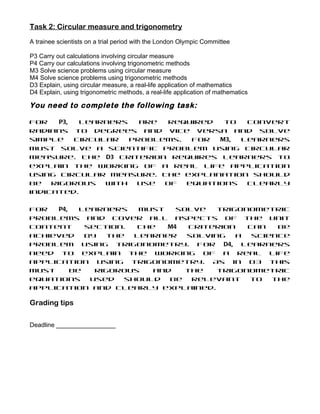
Task 2: Circular measure and trigonometry

A trainee scientists on a trial period with the London Olympic Committee

P3 Carry out calculations involving circular measure
P4 Carry our calculations involving trigonometric methods
M3 Solve science problems using circular measure
M4 Solve science problems using trigonometric methods
D3 Explain, using circular measure, a real-life application of mathematics
D4 Explain, using trigonometric methods, a real-life application of mathematics

You need to complete the following task:

For    P3,  learners    are  required  to  convert
radians to degrees and vice versa and solve
simple     circular   problems.  For  M3, learners
must solve a scientific problem using circular
measure. The D3 criterion requires learners to
explain the working of a real life application
using circular measure. The explanation should
be   rigorous    with  use  of  equations  clearly
indicated.

For  P4,   learners    must   solve   trigonometric
problems and cover all aspects of the Unit
content     section.   The  M4   criterion  can   be
achieved    by   the  learner   solving   a  science
problem using trigonometry. For D4, learners
need to explain the working of a real life
application using trigonometry. As in D3 this
must     be   rigorous    and   the   trigonometric
equations    used   should   be   relevant  to   the
application and clearly explained.

Grading tips

Deadline _________________
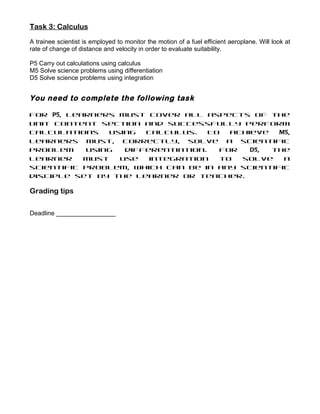
Task 3: Calculus

A trainee scientist is employed to monitor the motion of a fuel efficient aeroplane. Will look at
rate of change of distance and velocity in order to evaluate suitability.

P5 Carry out calculations using calculus
M5 Solve science problems using differentiation
D5 Solve science problems using integration


You need to complete the following task

For P5, learners must cover all aspects of the
Unit content section and successfully perform
calculations    using  calculus.    To  achieve  M5,
learners must, correctly, solve a scientific
problem    using   differentiation.   For   D5, the
learner    must   use   integration   to  solve   a
scientific problem, which can be in any scientific
disciple set by the learner or teacher.

Grading tips

Deadline _________________
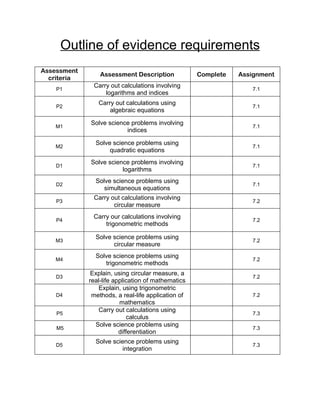
Outline of evidence requirements
Assessment
                 Assessment Description             Complete   Assignment
  criteria
              Carry out calculations involving
    P1                                                            7.1
                  logarithms and indices
                Carry out calculations using
    P2                                                            7.1
                    algebraic equations

             Solve science problems involving
    M1                                                            7.1
                         indices

               Solve science problems using
    M2                                                            7.1
                    quadratic equations
             Solve science problems involving
    D1                                                            7.1
                        logarithms
               Solve science problems using
    D2                                                            7.1
                  simultaneous equations
              Carry out calculations involving
    P3                                                            7.2
                     circular measure
              Carry our calculations involving
    P4                                                            7.2
                  trigonometric methods

               Solve science problems using
    M3                                                            7.2
                     circular measure
               Solve science problems using
    M4                                                            7.2
                  trigonometric methods
              Explain, using circular measure, a
    D3                                                            7.2
             real-life application of mathematics
                Explain, using trigonometric
    D4        methods, a real-life application of                 7.2
                         mathematics
                Carry out calculations using
    P5                                                            7.3
                             calculus
               Solve science problems using
    M5                                                            7.3
                         differentiation
               Solve science problems using
    D5                                                            7.3
                         integration

Unit 7 mathemetical calculations for science

  • 1.
    Diploma in AppliedScience (Forensic Science) UNIT 7 MATHEMATICAL CALCULATIONS FOR SCIENCE
  • 2.
    Diploma in AppliedScience (Forensic Science) Unit 7 Mathematical calculations for science Aims and purpose This unit gives learners the skills to use mathematical tools essential for biology, chemistry and physics. The unit starts with algebraic techniques and moves on to the applications of trigonometry and calculus. Unit introduction This maths unit enables learners to build on knowledge gained from unit 6: Using Mathematical Tools for Science or GCSE mathematics to investigate further mathematical tools used in all disciplines in science. It is an essential unit for learners who wish to pursue science at BTEC Higher National level, foundation degree or degree level. The unit is not to make mathematicians but to use maths for science. Learners will use maths to solve a number of scientific problems, including: • how simultaneous equations help solve problems in chemical bonding and in electricity • how trigonometry can be used in forensic science by using the technique of voice recognition • how the method of calculus enables scientists to learn about growth studies in microbiology. Learners will develop their knowledge and understanding of algebraic methods, including indices, logarithmic and simultaneous linear equations and quadratics. These tools will enable learners to solve many scientific problems, such as sound levels (decibels), light detection (lux levels), measurement of pH, bacterial growth and electrical power. Then learners will be introduced to the radian, as another method of angle measurement, and graphical representation of trigonometric functions. These trigonometric functions allow ample opportunity for learners to integrate computer simulations and practical activities. Practical activities could include pendulum motion, mechanics and circular motion, amongst many others. Finally, a brief introduction to the important tool of calculus. Learners will be exposed to both simple differentiation and integration and will end with using these concepts to solve real scientific problems. Problems could include areas such as population growth, radioactive decay, motion of a particle, energy stored in springs and enzyme activity. On completing this unit, learners will have been exposed to essential mathematical concepts that will bridge the gap between Levels 3 and 4.
  • 3.
    Learning outcomes On completionof this unit a learner should: 1. Be able to use algebraic manipulations to solve scientific problems 2. Be able to use trigonometric methods to solve scientific problems 3. Be able to use calculus to solve scientific problems.
  • 4.
    Diploma in AppliedScience (Forensic Science) Task 1: Logarithms and algebra A trainee scientist on a trial period with a multinational company P1 Carry out calculations involving logarithms and indices P2 Carry out calculations using algebraic equations M1 Solve science problems involving indices M2 Solve science problems using quadratic equations D1 Solve science problems involving logarithms D2 Solve science problems using simultaneous equations You need to complete the following task For P1, learners need to show that they can solve problems using all the laws of logarithms and indices, as indicated in the Unit content section. For M1, learners need to solve a chemistry and a physics problem using indices. For D1, learners need to successfully solve one problem from biology, one from chemistry and one from physics using logarithms. For P2, learners need to solve correctly, factorise, use simultaneous and quadratic equations, as detailed in the Unit content section. For M2, learners must solve, correctly, a scientific problem using quadratic equations. To achieve D2 learners need to successfully solve a chemistry and physics problem using simultaneous equations. Grading tips Deadline:________________
  • 5.
    Task 2: Circularmeasure and trigonometry A trainee scientists on a trial period with the London Olympic Committee P3 Carry out calculations involving circular measure P4 Carry our calculations involving trigonometric methods M3 Solve science problems using circular measure M4 Solve science problems using trigonometric methods D3 Explain, using circular measure, a real-life application of mathematics D4 Explain, using trigonometric methods, a real-life application of mathematics You need to complete the following task: For P3, learners are required to convert radians to degrees and vice versa and solve simple circular problems. For M3, learners must solve a scientific problem using circular measure. The D3 criterion requires learners to explain the working of a real life application using circular measure. The explanation should be rigorous with use of equations clearly indicated. For P4, learners must solve trigonometric problems and cover all aspects of the Unit content section. The M4 criterion can be achieved by the learner solving a science problem using trigonometry. For D4, learners need to explain the working of a real life application using trigonometry. As in D3 this must be rigorous and the trigonometric equations used should be relevant to the application and clearly explained. Grading tips Deadline _________________
  • 7.
    Task 3: Calculus Atrainee scientist is employed to monitor the motion of a fuel efficient aeroplane. Will look at rate of change of distance and velocity in order to evaluate suitability. P5 Carry out calculations using calculus M5 Solve science problems using differentiation D5 Solve science problems using integration You need to complete the following task For P5, learners must cover all aspects of the Unit content section and successfully perform calculations using calculus. To achieve M5, learners must, correctly, solve a scientific problem using differentiation. For D5, the learner must use integration to solve a scientific problem, which can be in any scientific disciple set by the learner or teacher. Grading tips Deadline _________________
  • 8.
    Outline of evidencerequirements Assessment Assessment Description Complete Assignment criteria Carry out calculations involving P1 7.1 logarithms and indices Carry out calculations using P2 7.1 algebraic equations Solve science problems involving M1 7.1 indices Solve science problems using M2 7.1 quadratic equations Solve science problems involving D1 7.1 logarithms Solve science problems using D2 7.1 simultaneous equations Carry out calculations involving P3 7.2 circular measure Carry our calculations involving P4 7.2 trigonometric methods Solve science problems using M3 7.2 circular measure Solve science problems using M4 7.2 trigonometric methods Explain, using circular measure, a D3 7.2 real-life application of mathematics Explain, using trigonometric D4 methods, a real-life application of 7.2 mathematics Carry out calculations using P5 7.3 calculus Solve science problems using M5 7.3 differentiation Solve science problems using D5 7.3 integration