Sangeeta  Jain	
* 
* 
* It is a journey.
* it is an art.
* it is problem solving.
       	
* 
* 
* A  design  brief  is  a  descriptive  
document  that  contains  
information  about  the  client  and  
which  explains  the  client’s  
requirements  for  the  project.  
* 
* Graphic  Design  is  the  art  and  
practice  of  combining  text  and  
graphics  and  communicating  a  
message  effectively  through  any  
type  of  visual  communication.  
* 
* Brief  identifies  the  “what”  of  the  
design  project  and  Design  is  the  
actual  “how”  in  a  project.  
* 
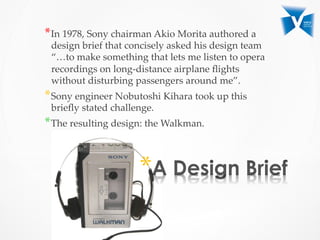
* In  1978,  Sony  chairman  Akio  Morita  authored  a  
design  brief  that  concisely  asked  his  design  team  
“…to  make  something  that  lets  me  listen  to  opera  
recordings  on  long-­‐‑distance  airplane  flights  
without  disturbing  passengers  around  me”.  	
* Sony  engineer  Nobutoshi  Kihara  took  up  this  
briefly  stated  challenge.  	
* The  resulting  design:  the  Walkman.
* From  individual  designers  to  most  advanced  
advertising  agencies  and  design  houses,  
everyone  strives  to  get  a  comprehensively  
wriXen  design  brief.  	
* A  comprehensive,  detailed  brief  eliminates  
ambiguities  in  the  design  process.  It  becomes  
the  guiding  document  in  the  process  and  
detects  exactly  what  the  designer  needs  to  do  
and  the  constraints  within  which  it  has  to  be  
done.	
	
* 
* It  explains  the  client’s  requirements  for  the  project	
* It  is  a  framework/foundation  for  the  designers	
* It  contains  a  well-­‐‑identified  and  articulated  
summary  of  the  key  factors  can  impact  a  project	
* It  focuses  on  the  outcomes  of  the  design  and  the  
business  objectives  of  the  design  project	
* It  serves  as  an  essential  point  of  reference  for  both  
the  client  and  the  designer	
* 
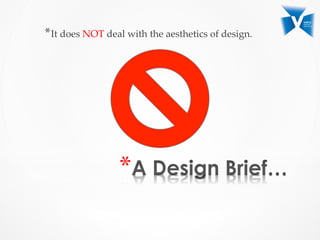
* It  does  NOT  deal  with  the  aesthetics  of  design.	
	
* 
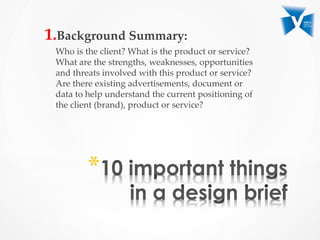
1. Background  Summary:  	
Who  is  the  client?  What  is  the  product  or  service?  
What  are  the  strengths,  weaknesses,  opportunities  
and  threats  involved  with  this  product  or  service?  
Are  there  existing  advertisements,  document  or  
data  to  help  understand  the  current  positioning  of  
the  client  (brand),  product  or  service?	
* 
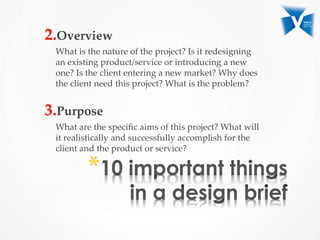
2. Overview	
What  is  the  nature  of  the  project?  Is  it  redesigning  
an  existing  product/service  or  introducing  a  new  
one?  Is  the  client  entering  a  new  market?  Why  does  
the  client  need  this  project?  What  is  the  problem?	
	
3. Purpose	
What  are  the  specific  aims  of  this  project?  What  will  
it  realistically  and  successfully  accomplish  for  the  
client  and  the  product  or  service?  	
* 
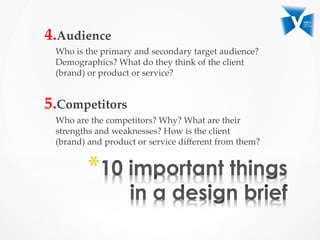
4. Audience	
Who  is  the  primary  and  secondary  target  audience?  
Demographics?  What  do  they  think  of  the  client  
(brand)  or  product  or  service?  	
	
5. Competitors	
Who  are  the  competitors?  Why?  What  are  their  
strengths  and  weaknesses?  How  is  the  client  
(brand)  and  product  or  service  different  from  them?	
* 
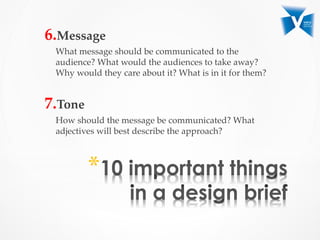
6. Message	
What  message  should  be  communicated  to  the  
audience?  What  would  the  audiences  to  take  away?  
Why  would  they  care  about  it?  What  is  in  it  for  them?	
	
7. Tone	
How  should  the  message  be  communicated?  What  
adjectives  will  best  describe  the  approach?  	
* 
8. Deliverables:  	
Is  the  client  going  to  provide  the  graphics?  If  the  
designer  is  creating  them,  who/what/where?  Why?  
photography  or  illustrating?  What  will  the  client  get  
at  the  end  of  the  project?  Formats?  	
	
9. People:  	
Who  will  the  designer  report  to?  Who  will  approve  
this  work?  By  what  means?	
	
	
 * 
10. Details:  	
Any  mandatory  information  to  be  included?  Any  
disclosers?  Any  confidentiality  agreements  to  be  
completed?  Limitations  and  restrictions?  
Timeline,  schedule,  budget?	
* 
       	
* 
* 
* Reading,  understanding  and  
reconstructing  a  brief.  
* 
* Go  to  
hXp://www.dandad.org/en/new-­‐‑blood-­‐‑
awards/#briefs  	
* Select  a  brief  of  your  choice  and  reconstruct  it.	
* In  order  to  do  this  you  will  need  to  thoroughly  
study,  research,  analyze  the  client  (brand),  the  
product  or  service.	
* Draw  conclusions  based  on  the  information  and  
data  that  you  gather  and  start  to  document  the  
“what” of  the  design  project  carefully.
* 
* State  the  assumptions  and/or  conclusions  
clearly  and  explain  the  rationale  for  all  the  
decisions  made.	
* You  may  also  use  graphics  to  support  the  text.	
* Use  the  template  provided  on  the  class  portal  to  
guide  you  through  this  journey.  Please  make  
sure  that  you  are  not  missing  any  important  
points.  Use  the  template  as  a  guideline  not  a  
rule.  You  may  modify  it  to  suit  your  purpose.
* 
* Submit  the  assessment  task  in  a  PDF  format.	
* Due  Date:  Week  4	
* Weight:  25%	
* In  the  next  lecture  and  assessment  task,  we  will  
closer  at  the  “how” of  the  project.
* 

The Design Brief

  • 1.
  • 2.
  • 3.
    * It is ajourney.
  • 4.
  • 5.
  • 6.
           * 
  • 7.
    *  * A  design  brief is  a  descriptive   document  that  contains   information  about  the  client  and   which  explains  the  client’s   requirements  for  the  project.  
  • 8.
    *  * Graphic  Design  is the  art  and   practice  of  combining  text  and   graphics  and  communicating  a   message  effectively  through  any   type  of  visual  communication.  
  • 9.
    *  * Brief  identifies  the “what”  of  the   design  project  and  Design  is  the   actual  “how”  in  a  project.  
  • 10.
    *  * In  1978,  Sony chairman  Akio  Morita  authored  a   design  brief  that  concisely  asked  his  design  team   “…to  make  something  that  lets  me  listen  to  opera   recordings  on  long-­‐‑distance  airplane  flights   without  disturbing  passengers  around  me”.   * Sony  engineer  Nobutoshi  Kihara  took  up  this   briefly  stated  challenge.   * The  resulting  design:  the  Walkman.
  • 11.
    * From  individual  designers to  most  advanced   advertising  agencies  and  design  houses,   everyone  strives  to  get  a  comprehensively   wriXen  design  brief.   * A  comprehensive,  detailed  brief  eliminates   ambiguities  in  the  design  process.  It  becomes   the  guiding  document  in  the  process  and   detects  exactly  what  the  designer  needs  to  do   and  the  constraints  within  which  it  has  to  be   done. * 
  • 12.
    * It  explains  the client’s  requirements  for  the  project * It  is  a  framework/foundation  for  the  designers * It  contains  a  well-­‐‑identified  and  articulated   summary  of  the  key  factors  can  impact  a  project * It  focuses  on  the  outcomes  of  the  design  and  the   business  objectives  of  the  design  project * It  serves  as  an  essential  point  of  reference  for  both   the  client  and  the  designer * 
  • 13.
    * It  does  NOT deal  with  the  aesthetics  of  design. * 
  • 14.
    1. Background  Summary:   Who is  the  client?  What  is  the  product  or  service?   What  are  the  strengths,  weaknesses,  opportunities   and  threats  involved  with  this  product  or  service?   Are  there  existing  advertisements,  document  or   data  to  help  understand  the  current  positioning  of   the  client  (brand),  product  or  service? * 
  • 15.
    2. Overview What  is  the nature  of  the  project?  Is  it  redesigning   an  existing  product/service  or  introducing  a  new   one?  Is  the  client  entering  a  new  market?  Why  does   the  client  need  this  project?  What  is  the  problem? 3. Purpose What  are  the  specific  aims  of  this  project?  What  will   it  realistically  and  successfully  accomplish  for  the   client  and  the  product  or  service?   * 
  • 16.
    4. Audience Who  is  the primary  and  secondary  target  audience?   Demographics?  What  do  they  think  of  the  client   (brand)  or  product  or  service?   5. Competitors Who  are  the  competitors?  Why?  What  are  their   strengths  and  weaknesses?  How  is  the  client   (brand)  and  product  or  service  different  from  them? * 
  • 17.
    6. Message What  message  should be  communicated  to  the   audience?  What  would  the  audiences  to  take  away?   Why  would  they  care  about  it?  What  is  in  it  for  them? 7. Tone How  should  the  message  be  communicated?  What   adjectives  will  best  describe  the  approach?   * 
  • 18.
    8. Deliverables:   Is  the client  going  to  provide  the  graphics?  If  the   designer  is  creating  them,  who/what/where?  Why?   photography  or  illustrating?  What  will  the  client  get   at  the  end  of  the  project?  Formats?   9. People:   Who  will  the  designer  report  to?  Who  will  approve   this  work?  By  what  means? * 
  • 19.
    10. Details:   Any  mandatory information  to  be  included?  Any   disclosers?  Any  confidentiality  agreements  to  be   completed?  Limitations  and  restrictions?   Timeline,  schedule,  budget? * 
  • 20.
           * 
  • 21.
    *  * Reading,  understanding  and  reconstructing  a  brief.  
  • 22.
    *  * Go  to   hXp://www.dandad.org/en/new-­‐‑blood-­‐‑ awards/#briefs  * Select  a  brief  of  your  choice  and  reconstruct  it. * In  order  to  do  this  you  will  need  to  thoroughly   study,  research,  analyze  the  client  (brand),  the   product  or  service. * Draw  conclusions  based  on  the  information  and   data  that  you  gather  and  start  to  document  the   “what” of  the  design  project  carefully.
  • 23.
    *  * State  the  assumptions and/or  conclusions   clearly  and  explain  the  rationale  for  all  the   decisions  made. * You  may  also  use  graphics  to  support  the  text. * Use  the  template  provided  on  the  class  portal  to   guide  you  through  this  journey.  Please  make   sure  that  you  are  not  missing  any  important   points.  Use  the  template  as  a  guideline  not  a   rule.  You  may  modify  it  to  suit  your  purpose.
  • 24.
    *  * Submit  the  assessment task  in  a  PDF  format. * Due  Date:  Week  4 * Weight:  25% * In  the  next  lecture  and  assessment  task,  we  will   closer  at  the  “how” of  the  project.
  • 25.