Keynotes Diaporamas
Paul Vickers ©
How to create and develop a visual communications project.
Visual Communications Design:
a methodology
Method, process, tools & techniques.
Paul Rand, American designer
“Design is so simple. That’s why it is so complicated.”
Keynotes Diaporamas
Paul Vickers
Ivan Chermayeff, American designer
“Design is directed toward human beings.
To design is to solve problems by identifying them
and executing the best solution.”
Keynotes Diaporamas
Paul Vickers
Antoine de Saint-Exupéry
“A designer knows he has achieved perfection
not when there is nothing left to add,
but when there is nothing left to take away.”
Keynotes Diaporamas
Paul Vickers
Debbie Millman - How to think like a graphic designer
“Design is one of the few disciplines that is a science
as well as an art. Effective, meaningful design requires
intellectual, rational rigour along with the ability to
elicit emotions and beliefs.
Thus, designers must balance both the logic and lyricism
of humanity every time they design something,
a task that requires a singularly mysterious skill..”
Keynotes Diaporamas
Paul Vickers
Leonardo Da Vinci
“Simplicity is the ultimate sophistication.”
Keynotes Diaporamas
Paul Vickers
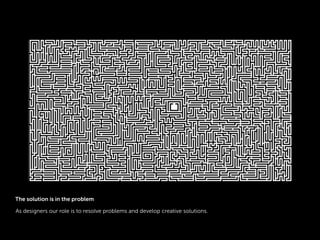
As designers our role is to resolve problems and develop creative solutions.
The solution is in the problem
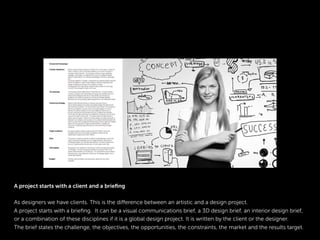
A project starts with a client and a briefing
As designers we have clients. This is the difference between an artistic and a design project.
A project starts with a briefing. It can be a visual communications brief, a 3D design brief, an interior design brief,
or a combination of these disciplines if it is a global design project. It is written by the client or the designer.
The brief states the challenge, the objectives, the opportunities, the constraints, the market and the results target.
The blank sheet of paper syndrome and how to deal with it
The worst scenario is to be confronted by a blank sheet of paper. To find a solution you need stimuli, these come
through research and understanding the problem or challenge. Don't panic in-front of the blank page but
research the subject and start to understand the challenges, the solutions will come from your research.
Designers tools
The fundamental tools for the job include:
• brain, imagination, creativity
• sense of humour
• curiosity
• investment, commitment, hard work and organisation
• keeping your eyes open, keeping your mind open
• sketchbook and drawing tools
• camera
• model making and prototyping tools and materials
• and lastly a computer.
• the computer is just a tool like a pencil, it’s a powerful tool but it’s not a solution.
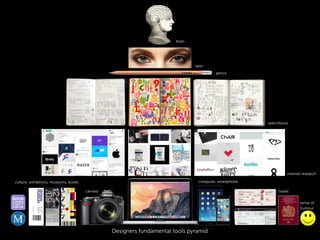
Designers fundamental tools pyramid
brain
eyes
pencil
sketchbook
internet research
computer, smartphone
travel
sense of
humour
culture: exhibitions, museums, books
camera
Research
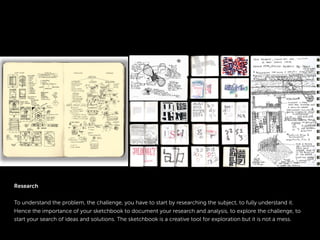
To understand the problem, the challenge, you have to start by researching the subject, to fully understand it.
Hence the importance of your sketchbook to document your research and analysis, to explore the challenge, to
start your search of ideas and solutions. The sketchbook is a creative tool for exploration but it is not a mess.
Market research
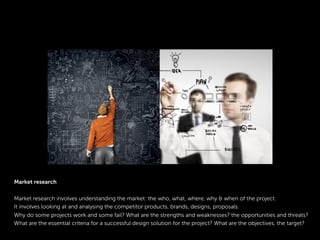
Market research involves understanding the market: the who, what, where, why & when of the project.
It involves looking at and analysing the competitor products, brands, designs, proposals.
Why do some projects work and some fail? What are the strengths and weaknesses? the opportunities and threats?
What are the essential criteria for a successful design solution for the project? What are the objectives, the target?
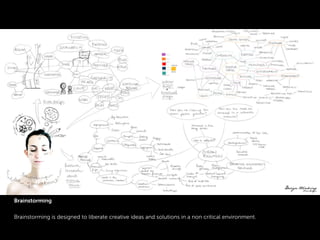
Brainstorming
Brainstorming is designed to liberate creative ideas and solutions in a non critical environment.
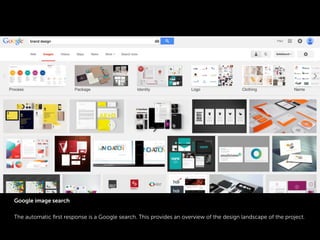
Google image search
The automatic first response is a Google search. This provides an overview of the design landscape of the project.
Titre du slide composé en Museo Sans 700 18pt.
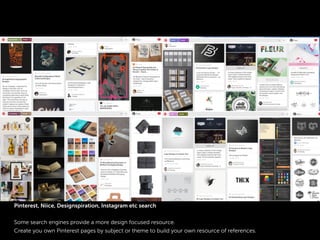
Pinterest, Niice, Designspiration, Instagram etc search
Some search engines provide a more design focused resource.
Create you own Pinterest pages by subject or theme to build your own resource of references.
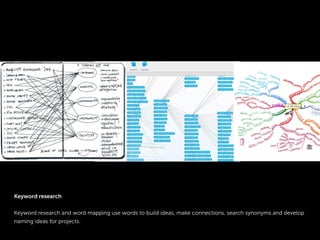
Keyword research
Keyword research and word mapping use words to build ideas, make connections, search synonyms and develop
naming ideas for projects.
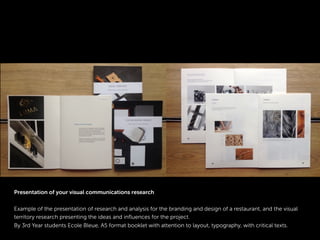
Presentation of your visual communications research
Example of the presentation of research and analysis for the branding and design of a restaurant, and the visual
territory research presenting the ideas and influences for the project.
By 3rd Year students Ecole Bleue, A5 format booklet with attention to layout, typography, with critical texts.
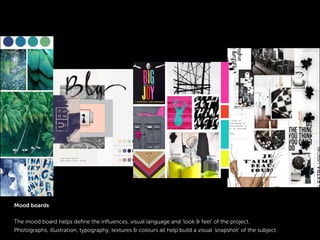
Mood boards
The mood board helps define the influences, visual language and ‘look & feel’ of the project.
Photographs, illustration, typography, textures & colours all help build a visual ‘snapshot’ of the subject.
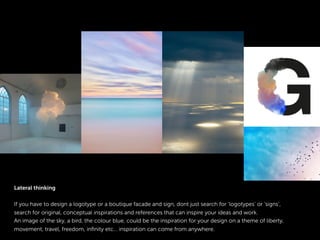
Lateral thinking
If you have to design a logotype or a boutique facade and sign, dont just search for ‘logotypes’ or ‘signs’,
search for original, conceptual inspirations and references that can inspire your ideas and work.
An image of the sky, a bird, the colour blue, could be the inspiration for your design on a theme of liberty,
movement, travel, freedom, infinity etc… inspiration can come from anywhere.
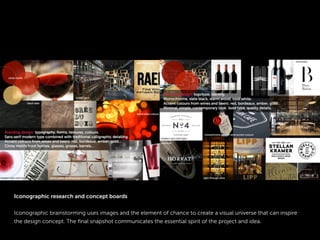
Iconographic research and concept boards
Iconographic brainstorming uses images and the element of chance to create a visual universe that can inspire
the design concept. The final snapshot communicates the essential spirit of the project and idea.
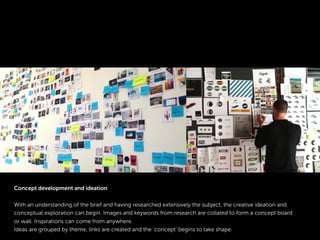
Concept development and ideation
With an understanding of the brief and having researched extensively the subject, the creative ideation and
conceptual exploration can begin. Images and keywords from research are collated to form a concept board
or wall. Inspirations can come from anywhere.
Ideas are grouped by theme, links are created and the ‘concept’ begins to take shape.
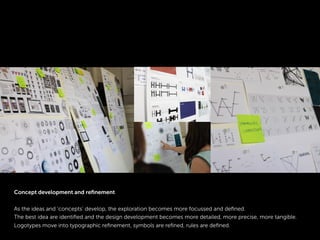
Concept development and refinement
As the ideas and ‘concepts’ develop, the exploration becomes more focussed and defined.
The best idea are identified and the design development becomes more detailed, more precise, more tangible.
Logotypes move into typographic refinement, symbols are refined, rules are defined.
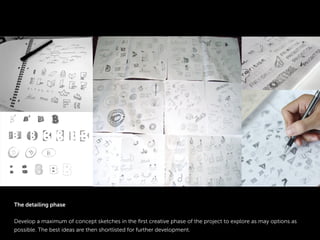
The detailing phase
Develop a maximum of concept sketches in the first creative phase of the project to explore as may options as
possible. The best ideas are then shortlisted for further development.
Titre du Keynote diaporama
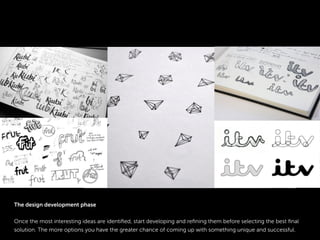
The design development phase
Once the most interesting ideas are identified, start developing and refining them before selecting the best final
solution. The more options you have the greater chance of coming up with something unique and successful.
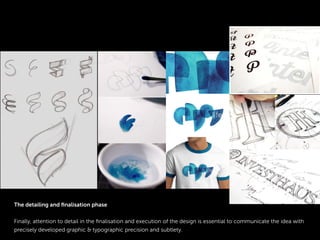
The detailing and finalisation phase
Finally, attention to detail in the finalisation and execution of the design is essential to communicate the idea with
precisely developed graphic & typographic precision and subtlety.
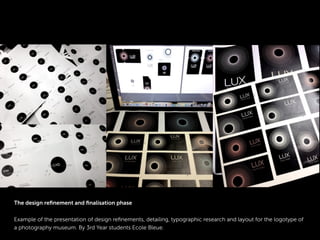
The design refinement and finalisation phase
Example of the presentation of design refinements, detailing, typographic research and layout for the logotype of
a photography museum. By 3rd Year students Ecole Bleue.
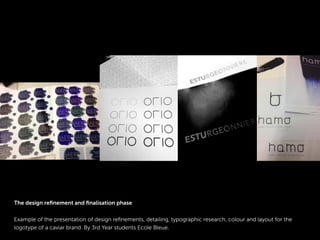
The design refinement and finalisation phase
Example of the presentation of design refinements, detailing, typographic research, colour and layout for the
logotype of a caviar brand. By 3rd Year students Ecole Bleue.
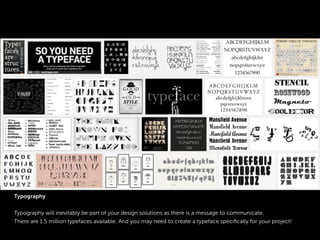
Typography
Typography will inevitably be part of your design solutions as there is a message to communicate.
There are 1.5 million typefaces available. And you may need to create a typeface specifically for your project!
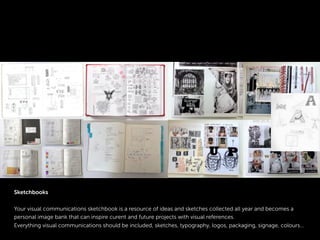
Sketchbooks
Your visual communications sketchbook is a resource of ideas and sketches collected all year and becomes a
personal image bank that can inspire curent and future projects with visual references.
Everything visual communications should be included, sketches, typography, logos, packaging, signage, colours…
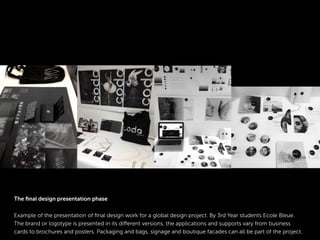
The final design presentation phase
Example of the presentation of final design work for a global design project. By 3rd Year students Ecole Bleue.
The brand or logotype is presented in its different versions, the applications and supports vary from business
cards to brochures and posters. Packaging and bags, signage and boutique facades can all be part of the project.
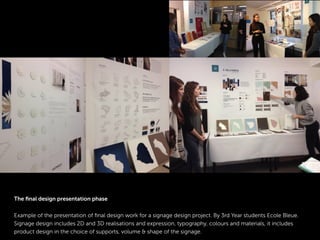
The final design presentation phase
Example of the presentation of final design work for a signage design project. By 3rd Year students Ecole Bleue.
Signage design includes 2D and 3D realisations and expression, typography, colours and materials, it includes
product design in the choice of supports, volume & shape of the signage.
Moving Brands, a UK & USA design agency, illustrate the creative process and their design methodology
well in this video of the development of the CX brand.
Forms of visual communications:
methods, processes, tools & techniques
The fundamental forms of expression in visual communications
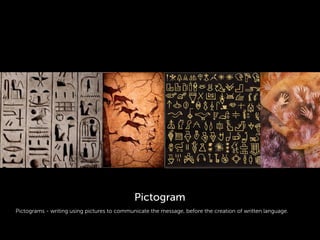
Pictograms - writing using pictures to communicate the message, before the creation of written language.
Pictogram
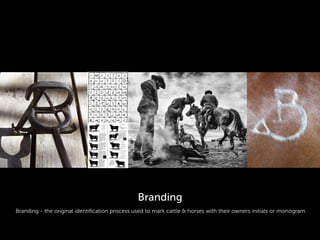
Branding - the original identification process used to mark cattle & horses with their owners initials or monogram.
Branding
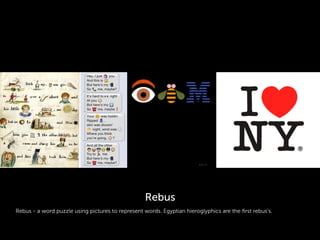
Rebus - a word puzzle using pictures to represent words. Egyptian hieroglyphics are the first rebus’s.
Rebus
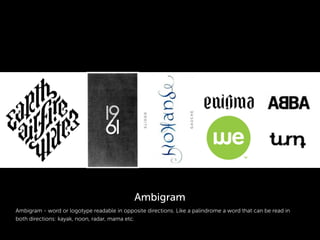
Ambigram - word or logotype readable in opposite directions. Like a palindrome a word that can be read in
both directions: kayak, noon, radar, mama etc.
Ambigram
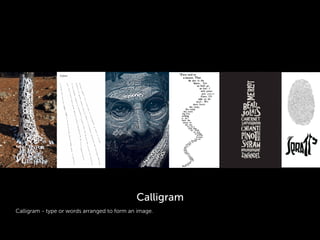
Calligram - type or words arranged to form an image.
Calligram
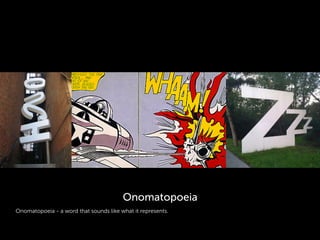
Onomatopoeia - a word that sounds like what it represents.
Onomatopoeia
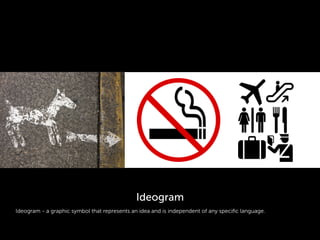
Ideogram - a graphic symbol that represents an idea and is independent of any specific language.
Ideogram
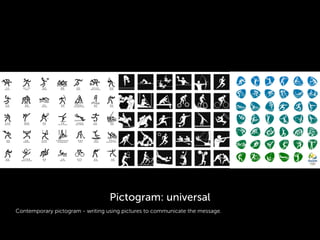
Contemporary pictogram - writing using pictures to communicate the message.
Pictogram: universal
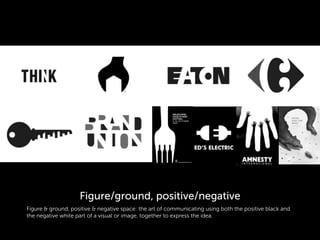
Figure & ground, positive & negative space: the art of communicating using both the positive black and
the negative white part of a visual or image, together to express the idea.
Figure/ground, positive/negative
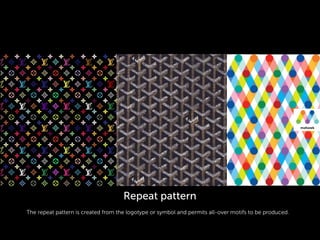
The repeat pattern is created from the logotype or symbol and permits all-over motifs to be produced.
Repeat pattern
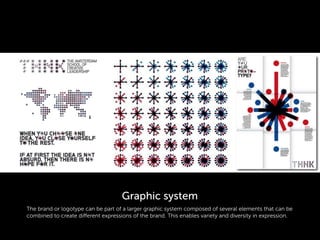
The brand or logotype can be part of a larger graphic system composed of several elements that can be
combined to create different expressions of the brand. This enables variety and diversity in expression.
Graphic system
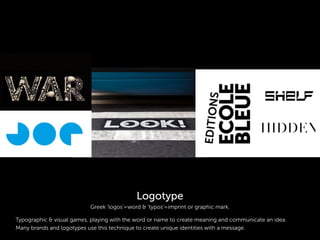
Typographic & visual games, playing with the word or name to create meaning and communicate an idea.
Many brands and logotypes use this technique to create unique identities with a message.
Greek ‘logos’=word & ‘typos’=imprint or graphic mark.
Logotype
Logotype
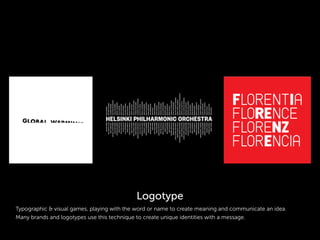
Typographic & visual games, playing with the word or name to create meaning and communicate an idea.
Many brands and logotypes use this technique to create unique identities with a message.
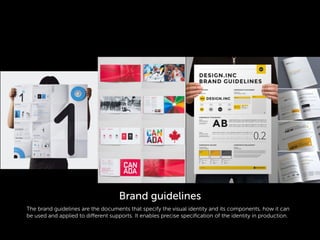
The brand guidelines are the documents that specify the visual identity and its components, how it can
be used and applied to different supports. It enables precise specification of the identity in production.
Brand guidelines
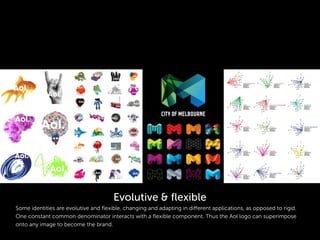
Some identities are evolutive and flexible, changing and adapting in different applications, as opposed to rigid.
One constant common denominator interacts with a flexible component. Thus the Aol logo can superimpose
onto any image to become the brand.
Evolutive & flexible
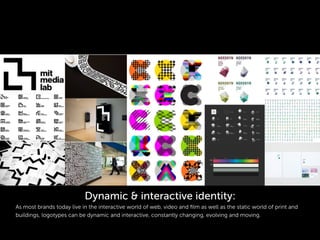
Dynamic & interactive identity:
As most brands today live in the interactive world of web, video and film as well as the static world of print and
buildings, logotypes can be dynamic and interactive, constantly changing, evolving and moving.
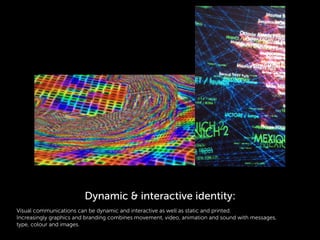
Visual communications can be dynamic and interactive as well as static and printed.
Increasingly graphics and branding combines movement, video, animation and sound with messages,
type, colour and images.
Dynamic & interactive identity:
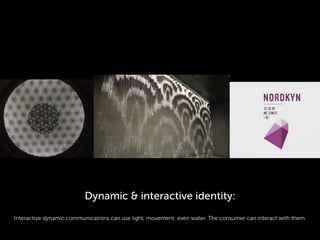
Interactive dynamic communications can use light, movement even water. The consumer can interact with them.
Dynamic & interactive identity:
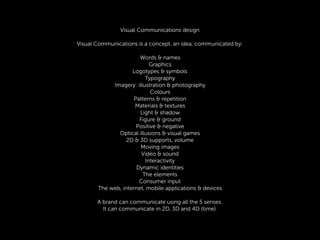
Visual Communications design
Visual Communications is a concept, an idea, communicated by:
Words & names
Graphics
Logotypes & symbols
Typography
Imagery: illustration & photography
Colours
Patterns & repetition
Materials & textures
Light & shadow
Figure & ground
Positive & negative
Optical illusions & visual games
2D & 3D supports, volume
Moving images
Video & sound
Interactivity
Dynamic identities
The elements
Consumer input
The web, internet, mobile applications & devices
A brand can communicate using all the 5 senses.
It can communicate in 2D, 3D and 4D (time).
Keynotes Diaporamas
Paul Vickers
Thank you
Visual Communications Design:
a methodology
Visual Communications Design - a methadology

Visual Communications Design - a methadology

  • 1.
    Keynotes Diaporamas Paul Vickers© How to create and develop a visual communications project. Visual Communications Design: a methodology Method, process, tools & techniques.
  • 2.
    Paul Rand, Americandesigner “Design is so simple. That’s why it is so complicated.” Keynotes Diaporamas Paul Vickers
  • 3.
    Ivan Chermayeff, Americandesigner “Design is directed toward human beings. To design is to solve problems by identifying them and executing the best solution.” Keynotes Diaporamas Paul Vickers
  • 4.
    Antoine de Saint-Exupéry “Adesigner knows he has achieved perfection not when there is nothing left to add, but when there is nothing left to take away.” Keynotes Diaporamas Paul Vickers
  • 5.
    Debbie Millman -How to think like a graphic designer “Design is one of the few disciplines that is a science as well as an art. Effective, meaningful design requires intellectual, rational rigour along with the ability to elicit emotions and beliefs. Thus, designers must balance both the logic and lyricism of humanity every time they design something, a task that requires a singularly mysterious skill..” Keynotes Diaporamas Paul Vickers
  • 6.
    Leonardo Da Vinci “Simplicityis the ultimate sophistication.” Keynotes Diaporamas Paul Vickers
  • 7.
    As designers ourrole is to resolve problems and develop creative solutions. The solution is in the problem
  • 8.
    A project startswith a client and a briefing As designers we have clients. This is the difference between an artistic and a design project. A project starts with a briefing. It can be a visual communications brief, a 3D design brief, an interior design brief, or a combination of these disciplines if it is a global design project. It is written by the client or the designer. The brief states the challenge, the objectives, the opportunities, the constraints, the market and the results target.
  • 9.
    The blank sheetof paper syndrome and how to deal with it The worst scenario is to be confronted by a blank sheet of paper. To find a solution you need stimuli, these come through research and understanding the problem or challenge. Don't panic in-front of the blank page but research the subject and start to understand the challenges, the solutions will come from your research.
  • 10.
    Designers tools The fundamentaltools for the job include: • brain, imagination, creativity • sense of humour • curiosity • investment, commitment, hard work and organisation • keeping your eyes open, keeping your mind open • sketchbook and drawing tools • camera • model making and prototyping tools and materials • and lastly a computer. • the computer is just a tool like a pencil, it’s a powerful tool but it’s not a solution.
  • 11.
    Designers fundamental toolspyramid brain eyes pencil sketchbook internet research computer, smartphone travel sense of humour culture: exhibitions, museums, books camera
  • 12.
    Research To understand theproblem, the challenge, you have to start by researching the subject, to fully understand it. Hence the importance of your sketchbook to document your research and analysis, to explore the challenge, to start your search of ideas and solutions. The sketchbook is a creative tool for exploration but it is not a mess.
  • 13.
    Market research Market researchinvolves understanding the market: the who, what, where, why & when of the project. It involves looking at and analysing the competitor products, brands, designs, proposals. Why do some projects work and some fail? What are the strengths and weaknesses? the opportunities and threats? What are the essential criteria for a successful design solution for the project? What are the objectives, the target?
  • 14.
    Brainstorming Brainstorming is designedto liberate creative ideas and solutions in a non critical environment.
  • 15.
    Google image search Theautomatic first response is a Google search. This provides an overview of the design landscape of the project.
  • 16.
    Titre du slidecomposé en Museo Sans 700 18pt. Pinterest, Niice, Designspiration, Instagram etc search Some search engines provide a more design focused resource. Create you own Pinterest pages by subject or theme to build your own resource of references.
  • 17.
    Keyword research Keyword researchand word mapping use words to build ideas, make connections, search synonyms and develop naming ideas for projects.
  • 18.
    Presentation of yourvisual communications research Example of the presentation of research and analysis for the branding and design of a restaurant, and the visual territory research presenting the ideas and influences for the project. By 3rd Year students Ecole Bleue, A5 format booklet with attention to layout, typography, with critical texts.
  • 19.
    Mood boards The moodboard helps define the influences, visual language and ‘look & feel’ of the project. Photographs, illustration, typography, textures & colours all help build a visual ‘snapshot’ of the subject.
  • 20.
    Lateral thinking If youhave to design a logotype or a boutique facade and sign, dont just search for ‘logotypes’ or ‘signs’, search for original, conceptual inspirations and references that can inspire your ideas and work. An image of the sky, a bird, the colour blue, could be the inspiration for your design on a theme of liberty, movement, travel, freedom, infinity etc… inspiration can come from anywhere.
  • 21.
    Iconographic research andconcept boards Iconographic brainstorming uses images and the element of chance to create a visual universe that can inspire the design concept. The final snapshot communicates the essential spirit of the project and idea.
  • 22.
    Concept development andideation With an understanding of the brief and having researched extensively the subject, the creative ideation and conceptual exploration can begin. Images and keywords from research are collated to form a concept board or wall. Inspirations can come from anywhere. Ideas are grouped by theme, links are created and the ‘concept’ begins to take shape.
  • 23.
    Concept development andrefinement As the ideas and ‘concepts’ develop, the exploration becomes more focussed and defined. The best idea are identified and the design development becomes more detailed, more precise, more tangible. Logotypes move into typographic refinement, symbols are refined, rules are defined.
  • 24.
    The detailing phase Developa maximum of concept sketches in the first creative phase of the project to explore as may options as possible. The best ideas are then shortlisted for further development.
  • 25.
    Titre du Keynotediaporama The design development phase Once the most interesting ideas are identified, start developing and refining them before selecting the best final solution. The more options you have the greater chance of coming up with something unique and successful.
  • 26.
    The detailing andfinalisation phase Finally, attention to detail in the finalisation and execution of the design is essential to communicate the idea with precisely developed graphic & typographic precision and subtlety.
  • 27.
    The design refinementand finalisation phase Example of the presentation of design refinements, detailing, typographic research and layout for the logotype of a photography museum. By 3rd Year students Ecole Bleue.
  • 28.
    The design refinementand finalisation phase Example of the presentation of design refinements, detailing, typographic research, colour and layout for the logotype of a caviar brand. By 3rd Year students Ecole Bleue.
  • 29.
    Typography Typography will inevitablybe part of your design solutions as there is a message to communicate. There are 1.5 million typefaces available. And you may need to create a typeface specifically for your project!
  • 30.
    Sketchbooks Your visual communicationssketchbook is a resource of ideas and sketches collected all year and becomes a personal image bank that can inspire curent and future projects with visual references. Everything visual communications should be included, sketches, typography, logos, packaging, signage, colours…
  • 31.
    The final designpresentation phase Example of the presentation of final design work for a global design project. By 3rd Year students Ecole Bleue. The brand or logotype is presented in its different versions, the applications and supports vary from business cards to brochures and posters. Packaging and bags, signage and boutique facades can all be part of the project.
  • 32.
    The final designpresentation phase Example of the presentation of final design work for a signage design project. By 3rd Year students Ecole Bleue. Signage design includes 2D and 3D realisations and expression, typography, colours and materials, it includes product design in the choice of supports, volume & shape of the signage.
  • 33.
    Moving Brands, aUK & USA design agency, illustrate the creative process and their design methodology well in this video of the development of the CX brand.
  • 34.
    Forms of visualcommunications: methods, processes, tools & techniques The fundamental forms of expression in visual communications
  • 35.
    Pictograms - writingusing pictures to communicate the message, before the creation of written language. Pictogram
  • 36.
    Branding - theoriginal identification process used to mark cattle & horses with their owners initials or monogram. Branding
  • 37.
    Rebus - aword puzzle using pictures to represent words. Egyptian hieroglyphics are the first rebus’s. Rebus
  • 38.
    Ambigram - wordor logotype readable in opposite directions. Like a palindrome a word that can be read in both directions: kayak, noon, radar, mama etc. Ambigram
  • 39.
    Calligram - typeor words arranged to form an image. Calligram
  • 40.
    Onomatopoeia - aword that sounds like what it represents. Onomatopoeia
  • 41.
    Ideogram - agraphic symbol that represents an idea and is independent of any specific language. Ideogram
  • 42.
    Contemporary pictogram -writing using pictures to communicate the message. Pictogram: universal
  • 43.
    Figure & ground,positive & negative space: the art of communicating using both the positive black and the negative white part of a visual or image, together to express the idea. Figure/ground, positive/negative
  • 44.
    The repeat patternis created from the logotype or symbol and permits all-over motifs to be produced. Repeat pattern
  • 45.
    The brand orlogotype can be part of a larger graphic system composed of several elements that can be combined to create different expressions of the brand. This enables variety and diversity in expression. Graphic system
  • 46.
    Typographic & visualgames, playing with the word or name to create meaning and communicate an idea. Many brands and logotypes use this technique to create unique identities with a message. Greek ‘logos’=word & ‘typos’=imprint or graphic mark. Logotype
  • 47.
    Logotype Typographic & visualgames, playing with the word or name to create meaning and communicate an idea. Many brands and logotypes use this technique to create unique identities with a message.
  • 48.
    The brand guidelinesare the documents that specify the visual identity and its components, how it can be used and applied to different supports. It enables precise specification of the identity in production. Brand guidelines
  • 49.
    Some identities areevolutive and flexible, changing and adapting in different applications, as opposed to rigid. One constant common denominator interacts with a flexible component. Thus the Aol logo can superimpose onto any image to become the brand. Evolutive & flexible
  • 50.
    Dynamic & interactiveidentity: As most brands today live in the interactive world of web, video and film as well as the static world of print and buildings, logotypes can be dynamic and interactive, constantly changing, evolving and moving.
  • 51.
    Visual communications canbe dynamic and interactive as well as static and printed. Increasingly graphics and branding combines movement, video, animation and sound with messages, type, colour and images. Dynamic & interactive identity:
  • 52.
    Interactive dynamic communicationscan use light, movement even water. The consumer can interact with them. Dynamic & interactive identity:
  • 53.
    Visual Communications design VisualCommunications is a concept, an idea, communicated by: Words & names Graphics Logotypes & symbols Typography Imagery: illustration & photography Colours Patterns & repetition Materials & textures Light & shadow Figure & ground Positive & negative Optical illusions & visual games 2D & 3D supports, volume Moving images Video & sound Interactivity Dynamic identities The elements Consumer input The web, internet, mobile applications & devices A brand can communicate using all the 5 senses. It can communicate in 2D, 3D and 4D (time).
  • 54.
    Keynotes Diaporamas Paul Vickers Thankyou Visual Communications Design: a methodology