Chapter 11
• Suspension Design
Suspension Design Process
• Selecting appropriate vehicle level targets
• Selecting a systemarchitecture
• Choosing the location of the 'hard points', or theoretical centres of
each ball joint or bushing
• Selecting the rates of the bushings-compliance
• Analysing the loads in the suspension
• Designing the spring rates
• Designing shock absorber characteristics
• Designing the structureof each component so that it is strong, stiff,
light, and cheap
• Analysing the vehicle dynamics of the resulting design
Vehicle Level Targets
• Maximum steady state lateral acceleration (in understeer mode)
• Roll stiffness (degrees per g of lateral acceleration)
• Ride frequencies
• Lateral load transfer percentage distribution front to rear
• Roll moment distribution front to rear
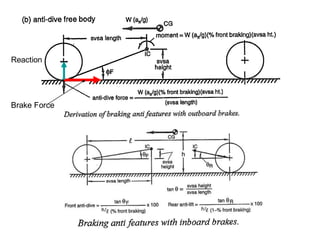
• Ride heights at various states of load
• Understeer gradient
• Turning circle
• Ackermann
• Jounce travel
• Rebound travel
System Architecture
• For the front suspension the following need to be considered
• The type of suspension (Macpherson strut or double wishbone
suspension)
• Type of steering actuator (rack and pinion or recirculatingball)
• Location of the steering actuator in front of, or behind, the wheel
centre
• For the rear suspension there are many more possible suspension
types, in practice.
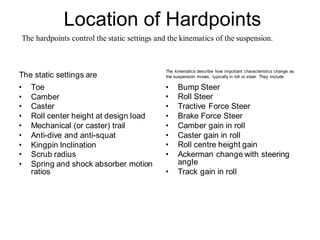
Location of Hardpoints
The hardpoints control the static settings and the kinematics of the suspension.
The static settings are
• Toe
• Camber
• Caster
• Roll center height at design load
• Mechanical (or caster) trail
• Anti-dive and anti-squat
• Kingpin Inclination
• Scrub radius
• Spring and shock absorber motion
ratios
The kinematics describe how important characteristics change as
the suspension moves, typically in roll or steer. They include
• Bump Steer
• Roll Steer
• Tractive Force Steer
• Brake Force Steer
• Camber gain in roll
• Caster gain in roll
• Roll centre height gain
• Ackerman change with steering
angle
• Track gain in roll
Compliance
• The compliance of the bushings, the body, and other parts modify the
behaviour of the suspension.
• In general it is difficult to improve the kinematics of a suspension using the
bushings, but one example where it does work is the toe control bush used
in Twist-beam rear suspensions.
• More generally, modern cars suspensions include an NVH bush. This is
designed as the main path for the vibrations and forces that cause road
noise and impact noise, and is supposed to be tunable without affecting the
kinematics too much;
Loads
• Once the basic geometry is established the loads in each suspension part
can be estimated. This can be as simple as deciding what a likely maximum
load case is at the contact patch, and then drawing a Free body diagram of
each part to work out the forces, or as complex as simulating the behaviour
of the suspension over a rough road, and calculating the loads caused.
Often loads that have been measured on a similar suspension are used
instead - this is the most reliable method.
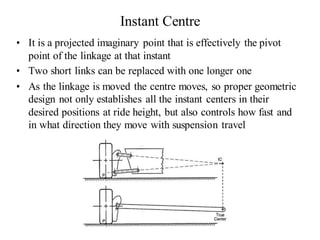
Instant Centre
• It is a projected imaginary point that is effectively the pivot
point of the linkage at that instant
• Two short links can be replaced with one longer one
• As the linkage is moved the centre moves, so proper geometric
design not only establishes all the instant centers in their
desired positions at ride height, but also controls how fast and
in what direction they move with suspension travel
Different Views of Instant Centre
• Instant centre – Front view
– The instant centre defines the camber change rate,
part of the roll centre information, scrub motion,
and data needed to determine the steer
characteristics
• Instant Centre-Side View
– The instant centre define the wheel forth and aft
path, anti-lift and anti dive/squat information, and
caster change rate
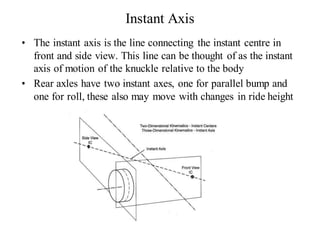
Instant Axis
• The instant axis is the line connecting the instant centre in
front and side view. This line can be thought of as the instant
axis of motion of the knuckle relative to the body
• Rear axles have two instant axes, one for parallel bump and
one for roll, these also may move with changes in ride height
Independent Suspensions
• For all independent suspension there are two instant centres
that establishes the properties of that particular design
• The side view instant centre (bump and droop) controls force
and motion factors predominantly related to fore and aft
accelerations
• The front view instant (or swing) centre controls force and
motion factors due to lateral accelerations
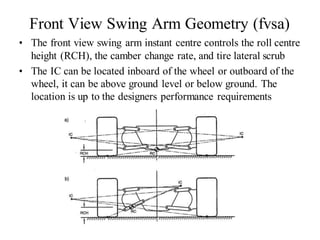
Front View Swing Arm Geometry (fvsa)
• The front view swing arm instant centre controls the roll centre
height (RCH), the camber change rate, and tire lateral scrub
• The IC can be located inboard of the wheel or outboard of the
wheel, it can be above ground level or below ground. The
location is up to the designers performance requirements
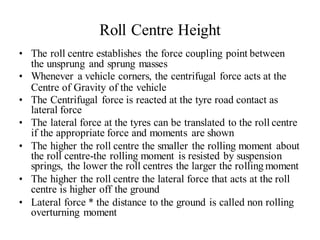
Roll Centre Height
• The roll centre establishes the force coupling point between
the unsprung and sprung masses
• Whenever a vehicle corners, the centrifugal force acts at the
Centre of Gravity of the vehicle
• The Centrifugal force is reacted at the tyre road contact as
lateral force
• The lateral force at the tyres can be translated to the roll centre
if the appropriate force and moments are shown
• The higher the roll centre the smaller the rolling moment about
the roll centre-the rolling moment is resisted by suspension
springs, the lower the roll centres the larger the rolling moment
• The higher the roll centre the lateral force that acts at the roll
centre is higher off the ground
• Lateral force * the distance to the ground is called non rolling
overturning moment
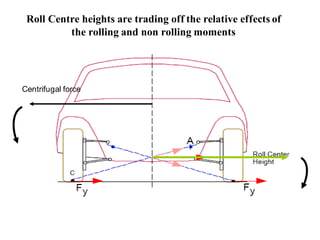
Centrifugal force
Roll Centre heights are trading off the relative effects of
the rolling and non rolling moments
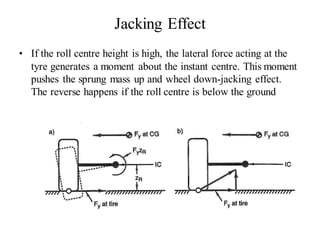
Jacking Effect
• If the roll centre height is high, the lateral force acting at the
tyre generates a moment about the instant centre. This moment
pushes the sprung mass up and wheel down-jacking effect.
The reverse happens if the roll centre is below the ground
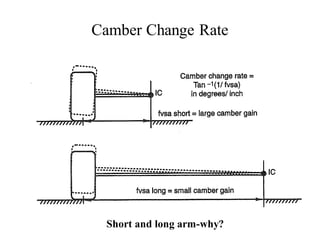
Camber Change Rate
Short and long arm-why?
Scrub
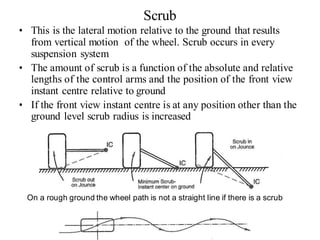
• This is the lateral motion relative to the ground that results
from vertical motion of the wheel. Scrub occurs in every
suspension system
• The amount of scrub is a function of the absolute and relative
lengths of the control arms and the position of the front view
instant centre relative to ground
• If the front view instant centre is at any position other than the
ground level scrub radius is increased
On a rough ground the wheel path is not a straight line if there is a scrub
Side View Swing Arm Geometry (svsa)
• Typically, the instant centre is behind and above the wheel
centre on front suspensions and it is ahead and above on most
rear suspensions
Anti Features
• The Anti effect in suspension is a term that actually describes
the longitudinal to vertical force coupling between the sprung
and un sprung masses. It results purely from the angle or slope
of the side view swing arm
• Suspension “anti’s” do not change the steady state load
transfer at the tire patch
Anti- Dive (Braking)
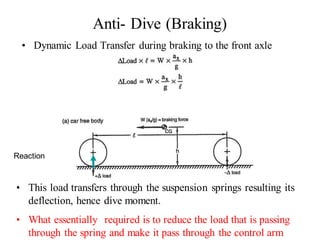
• Dynamic Load Transfer during braking to the front axle
Reaction
• This load transfers through the suspension springs resulting its
deflection, hence dive moment.
• What essentially required is to reduce the load that is passing
through the spring and make it pass through the control arm
Reaction
Brake Force
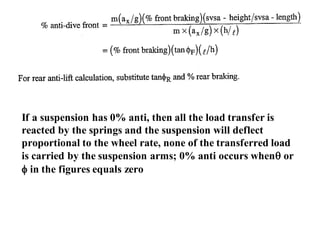
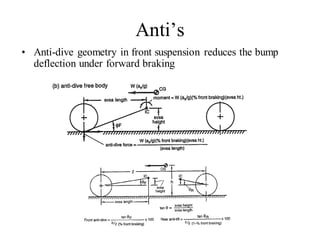
If a suspension has 0% anti, then all the load transfer is
reacted by the springs and the suspension will deflect
proportional to the wheel rate, none of the transferred load
is carried by the suspension arms; 0% anti occurs when or
 in the figures equals zero
Anti Lift
Anti Squat
Anti’s
• Anti-dive geometry in front suspension reduces the bump
deflection under forward braking
Anti’s
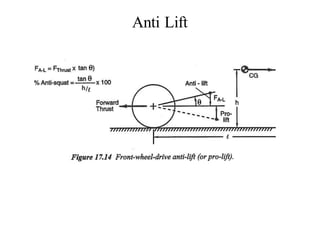
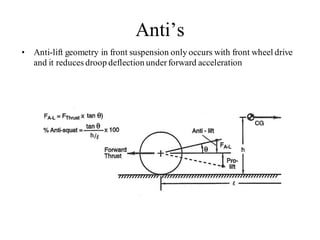
• Anti-lift geometry in front suspension only occurs with front wheel drive
and it reduces droop deflection underforward acceleration
Anti’s
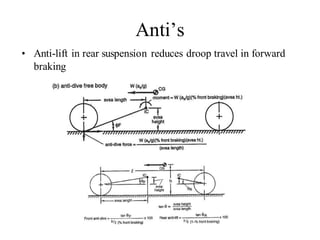
• Anti-lift in rear suspension reduces droop travel in forward
braking
Anti’s
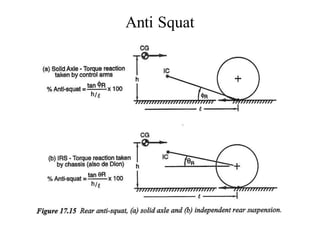
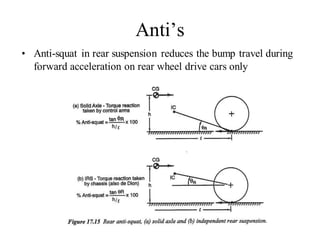
• Anti-squat in rear suspension reduces the bump travel during
forward acceleration on rear wheel drive cars only
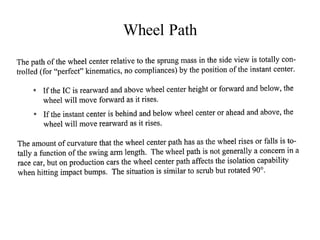
Wheel Path
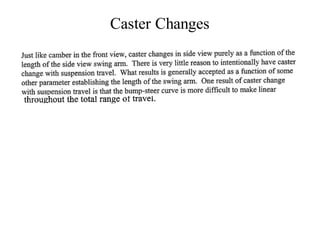
Caster Changes
Suspension Design
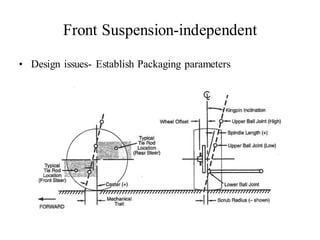
Front Suspension-independent
• Design issues- Establish Packaging parameters
Packaging parameters
• Tire size, rim diameter and width
• Wheel offset
• Brakes, bearings
• Kingpin length, angle, scrub radius, spindle length
• The caster, The camber
• The knuckle design
• Tie rod position
• Rack location
• Trackwidth
• Decide the upper and lower ball joint positions
• Tie rod outer position
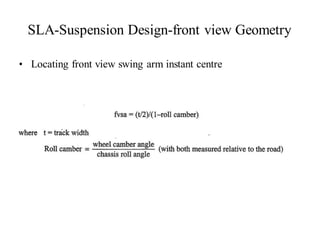
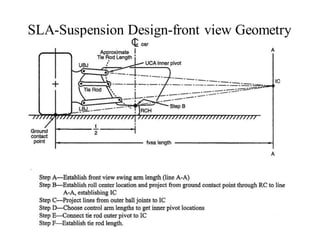
SLA-Suspension Design-front view Geometry
• Locating front view swing arm instant centre
SLA-Suspension Design-front view Geometry
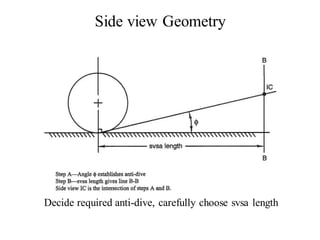
Side view Geometry
Decide required anti-dive, carefully choose svsa length
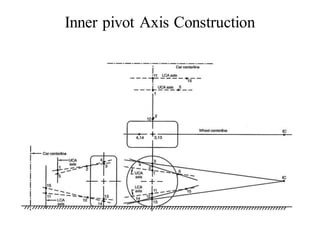
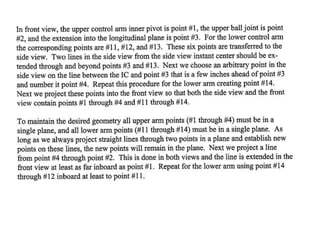
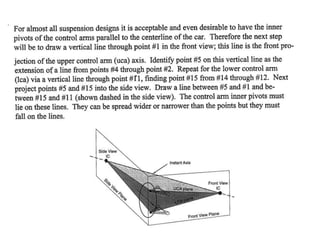
Inner pivot Axis Construction
Design of other Suspension
• Ref. Race Car Vehicle Dynamics _Milliken
Suspension Load Distribution
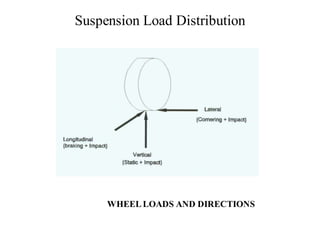
WHEELLOADS AND DIRECTIONS
Suspension Load Distribution
• Front Axle Braking per wheel:
FB =

[static+ dynamic
2
load]
=

[W
2
bcg
l
+ ma
hcg
]
l
=

W[
2
bcg
+
a
l g
hcg
]
l
 = tire-road coefficient of friction W = total vehicle weight
bcg = Cg-to-rear axledistance (LR) l = wheelbase length
a = ave. longitudinal acceleration (deceleration) m = vehicle mass
hcg = Cg height g = acceleration of gravity
Suspension Load Distribution
• VERTICAL: (Total is commonly considered as a 3 g load)
V =
3
[W
2
bcg
l
+ ma
hcg
]
l
=
3
W[
2
bcg g +a
gl
hcg
]
Suspension Load Distribution
• LATERAL: (commonly considered as a 2 g load)
FL =W[
bcg g +a
gl
hcg
]
Suspension Load Distribution
Side view front wheel SLA front suspension
LB is lower ball joint
 M LB =0 Fus h= FB a
a
Fus = FB
h
 Fx =0 FUS - FLS + FB = 0
F LS = FUS + FB FLS = FB [
a
+1]
h
Suspension Load Distribution
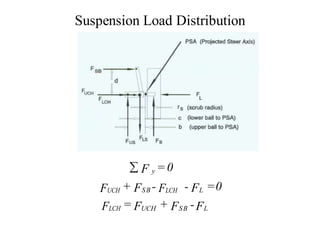
SLA front SUSPENSION TOPVIEW
 M PSA= 0
FSB d + FUS b - FLS c - Fb rs = 0
1 Fb a
FSB =
d
[ FLS c+ Fb rs - FUS b] =
d
[ rs + c - (b -c)]
h
Suspension Load Distribution
 F y =0
FUCH + FSB - FLCH - FL =0
FLCH = FUCH + FSB -FL
Suspension Load Distribution
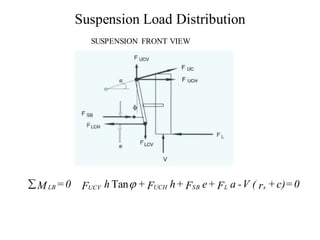
SUSPENSION FRONT VIEW
MLB =0 FUCV h Tan + FUCH h+ FSB e+ FL a -V ( rs +c)=0
Suspension Load Distribution
FUCV = FUC sin  FUCH = FUC sin 
F =
V( rs +c)- FSB e - FL a
UC
sin
= FB
tan +cos h
a
FLCH
d
[( rs +c)-
(b - c)]+ FUC cos
h
- FL
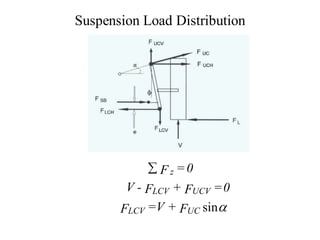
Suspension Load Distribution
 F z =0
V - FLCV + FUCV =0
FLCV =V + FUC sin










Rear Suspension Design
Beam Type Axle suspension (Solid
axle/Dependent)
• The parallel jounce axis and roll axis control the characteristics
of this type of suspension
• Anti-features are similar as explained earlier
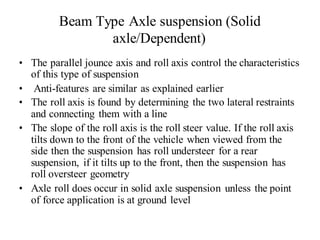
• The roll axis is found by determining the two lateral restraints
and connecting them with a line
• The slope of the roll axis is the roll steer value. If the roll axis
tilts down to the front of the vehicle when viewed from the
side then the suspension has roll understeer for a rear
suspension, if it tilts up to the front, then the suspension has
roll oversteer geometry
• Axle roll does occur in solid axle suspension unless the point
of force application is at ground level
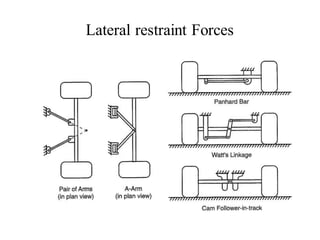
Lateral restraint Forces

VDHS-11-Suspension Design.docx

  • 1.
  • 2.
    Suspension Design Process •Selecting appropriate vehicle level targets • Selecting a systemarchitecture • Choosing the location of the 'hard points', or theoretical centres of each ball joint or bushing • Selecting the rates of the bushings-compliance • Analysing the loads in the suspension • Designing the spring rates • Designing shock absorber characteristics • Designing the structureof each component so that it is strong, stiff, light, and cheap • Analysing the vehicle dynamics of the resulting design
  • 3.
    Vehicle Level Targets •Maximum steady state lateral acceleration (in understeer mode) • Roll stiffness (degrees per g of lateral acceleration) • Ride frequencies • Lateral load transfer percentage distribution front to rear • Roll moment distribution front to rear • Ride heights at various states of load • Understeer gradient • Turning circle • Ackermann • Jounce travel • Rebound travel
  • 4.
    System Architecture • Forthe front suspension the following need to be considered • The type of suspension (Macpherson strut or double wishbone suspension) • Type of steering actuator (rack and pinion or recirculatingball) • Location of the steering actuator in front of, or behind, the wheel centre • For the rear suspension there are many more possible suspension types, in practice.
  • 5.
    Location of Hardpoints Thehardpoints control the static settings and the kinematics of the suspension. The static settings are • Toe • Camber • Caster • Roll center height at design load • Mechanical (or caster) trail • Anti-dive and anti-squat • Kingpin Inclination • Scrub radius • Spring and shock absorber motion ratios The kinematics describe how important characteristics change as the suspension moves, typically in roll or steer. They include • Bump Steer • Roll Steer • Tractive Force Steer • Brake Force Steer • Camber gain in roll • Caster gain in roll • Roll centre height gain • Ackerman change with steering angle • Track gain in roll
  • 6.
    Compliance • The complianceof the bushings, the body, and other parts modify the behaviour of the suspension. • In general it is difficult to improve the kinematics of a suspension using the bushings, but one example where it does work is the toe control bush used in Twist-beam rear suspensions. • More generally, modern cars suspensions include an NVH bush. This is designed as the main path for the vibrations and forces that cause road noise and impact noise, and is supposed to be tunable without affecting the kinematics too much;
  • 7.
    Loads • Once thebasic geometry is established the loads in each suspension part can be estimated. This can be as simple as deciding what a likely maximum load case is at the contact patch, and then drawing a Free body diagram of each part to work out the forces, or as complex as simulating the behaviour of the suspension over a rough road, and calculating the loads caused. Often loads that have been measured on a similar suspension are used instead - this is the most reliable method.
  • 8.
    Instant Centre • Itis a projected imaginary point that is effectively the pivot point of the linkage at that instant • Two short links can be replaced with one longer one • As the linkage is moved the centre moves, so proper geometric design not only establishes all the instant centers in their desired positions at ride height, but also controls how fast and in what direction they move with suspension travel
  • 9.
    Different Views ofInstant Centre • Instant centre – Front view – The instant centre defines the camber change rate, part of the roll centre information, scrub motion, and data needed to determine the steer characteristics • Instant Centre-Side View – The instant centre define the wheel forth and aft path, anti-lift and anti dive/squat information, and caster change rate
  • 10.
    Instant Axis • Theinstant axis is the line connecting the instant centre in front and side view. This line can be thought of as the instant axis of motion of the knuckle relative to the body • Rear axles have two instant axes, one for parallel bump and one for roll, these also may move with changes in ride height
  • 11.
    Independent Suspensions • Forall independent suspension there are two instant centres that establishes the properties of that particular design • The side view instant centre (bump and droop) controls force and motion factors predominantly related to fore and aft accelerations • The front view instant (or swing) centre controls force and motion factors due to lateral accelerations
  • 12.
    Front View SwingArm Geometry (fvsa) • The front view swing arm instant centre controls the roll centre height (RCH), the camber change rate, and tire lateral scrub • The IC can be located inboard of the wheel or outboard of the wheel, it can be above ground level or below ground. The location is up to the designers performance requirements
  • 13.
    Roll Centre Height •The roll centre establishes the force coupling point between the unsprung and sprung masses • Whenever a vehicle corners, the centrifugal force acts at the Centre of Gravity of the vehicle • The Centrifugal force is reacted at the tyre road contact as lateral force • The lateral force at the tyres can be translated to the roll centre if the appropriate force and moments are shown • The higher the roll centre the smaller the rolling moment about the roll centre-the rolling moment is resisted by suspension springs, the lower the roll centres the larger the rolling moment • The higher the roll centre the lateral force that acts at the roll centre is higher off the ground • Lateral force * the distance to the ground is called non rolling overturning moment
  • 14.
    Centrifugal force Roll Centreheights are trading off the relative effects of the rolling and non rolling moments
  • 15.
    Jacking Effect • Ifthe roll centre height is high, the lateral force acting at the tyre generates a moment about the instant centre. This moment pushes the sprung mass up and wheel down-jacking effect. The reverse happens if the roll centre is below the ground
  • 16.
    Camber Change Rate Shortand long arm-why?
  • 17.
    Scrub • This isthe lateral motion relative to the ground that results from vertical motion of the wheel. Scrub occurs in every suspension system • The amount of scrub is a function of the absolute and relative lengths of the control arms and the position of the front view instant centre relative to ground • If the front view instant centre is at any position other than the ground level scrub radius is increased On a rough ground the wheel path is not a straight line if there is a scrub
  • 18.
    Side View SwingArm Geometry (svsa) • Typically, the instant centre is behind and above the wheel centre on front suspensions and it is ahead and above on most rear suspensions
  • 19.
    Anti Features • TheAnti effect in suspension is a term that actually describes the longitudinal to vertical force coupling between the sprung and un sprung masses. It results purely from the angle or slope of the side view swing arm • Suspension “anti’s” do not change the steady state load transfer at the tire patch
  • 20.
    Anti- Dive (Braking) •Dynamic Load Transfer during braking to the front axle Reaction • This load transfers through the suspension springs resulting its deflection, hence dive moment. • What essentially required is to reduce the load that is passing through the spring and make it pass through the control arm
  • 21.
  • 22.
    If a suspensionhas 0% anti, then all the load transfer is reacted by the springs and the suspension will deflect proportional to the wheel rate, none of the transferred load is carried by the suspension arms; 0% anti occurs when or  in the figures equals zero
  • 23.
  • 24.
  • 25.
    Anti’s • Anti-dive geometryin front suspension reduces the bump deflection under forward braking
  • 26.
    Anti’s • Anti-lift geometryin front suspension only occurs with front wheel drive and it reduces droop deflection underforward acceleration
  • 27.
    Anti’s • Anti-lift inrear suspension reduces droop travel in forward braking
  • 28.
    Anti’s • Anti-squat inrear suspension reduces the bump travel during forward acceleration on rear wheel drive cars only
  • 29.
  • 30.
  • 31.
  • 32.
    Front Suspension-independent • Designissues- Establish Packaging parameters
  • 33.
    Packaging parameters • Tiresize, rim diameter and width • Wheel offset • Brakes, bearings • Kingpin length, angle, scrub radius, spindle length • The caster, The camber • The knuckle design • Tie rod position • Rack location • Trackwidth • Decide the upper and lower ball joint positions • Tie rod outer position
  • 34.
    SLA-Suspension Design-front viewGeometry • Locating front view swing arm instant centre
  • 35.
  • 36.
    Side view Geometry Deciderequired anti-dive, carefully choose svsa length
  • 37.
    Inner pivot AxisConstruction
  • 40.
    Design of otherSuspension • Ref. Race Car Vehicle Dynamics _Milliken
  • 41.
  • 42.
    Suspension Load Distribution •Front Axle Braking per wheel: FB =  [static+ dynamic 2 load] =  [W 2 bcg l + ma hcg ] l =  W[ 2 bcg + a l g hcg ] l  = tire-road coefficient of friction W = total vehicle weight bcg = Cg-to-rear axledistance (LR) l = wheelbase length a = ave. longitudinal acceleration (deceleration) m = vehicle mass hcg = Cg height g = acceleration of gravity
  • 43.
    Suspension Load Distribution •VERTICAL: (Total is commonly considered as a 3 g load) V = 3 [W 2 bcg l + ma hcg ] l = 3 W[ 2 bcg g +a gl hcg ]
  • 44.
    Suspension Load Distribution •LATERAL: (commonly considered as a 2 g load) FL =W[ bcg g +a gl hcg ]
  • 45.
    Suspension Load Distribution Sideview front wheel SLA front suspension LB is lower ball joint  M LB =0 Fus h= FB a a Fus = FB h  Fx =0 FUS - FLS + FB = 0 F LS = FUS + FB FLS = FB [ a +1] h
  • 46.
    Suspension Load Distribution SLAfront SUSPENSION TOPVIEW  M PSA= 0 FSB d + FUS b - FLS c - Fb rs = 0 1 Fb a FSB = d [ FLS c+ Fb rs - FUS b] = d [ rs + c - (b -c)] h
  • 47.
    Suspension Load Distribution F y =0 FUCH + FSB - FLCH - FL =0 FLCH = FUCH + FSB -FL
  • 48.
    Suspension Load Distribution SUSPENSIONFRONT VIEW MLB =0 FUCV h Tan + FUCH h+ FSB e+ FL a -V ( rs +c)=0
  • 49.
    Suspension Load Distribution FUCV= FUC sin  FUCH = FUC sin  F = V( rs +c)- FSB e - FL a UC sin = FB tan +cos h a FLCH d [( rs +c)- (b - c)]+ FUC cos h - FL
  • 50.
    Suspension Load Distribution F z =0 V - FLCV + FUCV =0 FLCV =V + FUC sin
  • 51.
  • 52.
    Beam Type Axlesuspension (Solid axle/Dependent) • The parallel jounce axis and roll axis control the characteristics of this type of suspension • Anti-features are similar as explained earlier • The roll axis is found by determining the two lateral restraints and connecting them with a line • The slope of the roll axis is the roll steer value. If the roll axis tilts down to the front of the vehicle when viewed from the side then the suspension has roll understeer for a rear suspension, if it tilts up to the front, then the suspension has roll oversteer geometry • Axle roll does occur in solid axle suspension unless the point of force application is at ground level
  • 53.