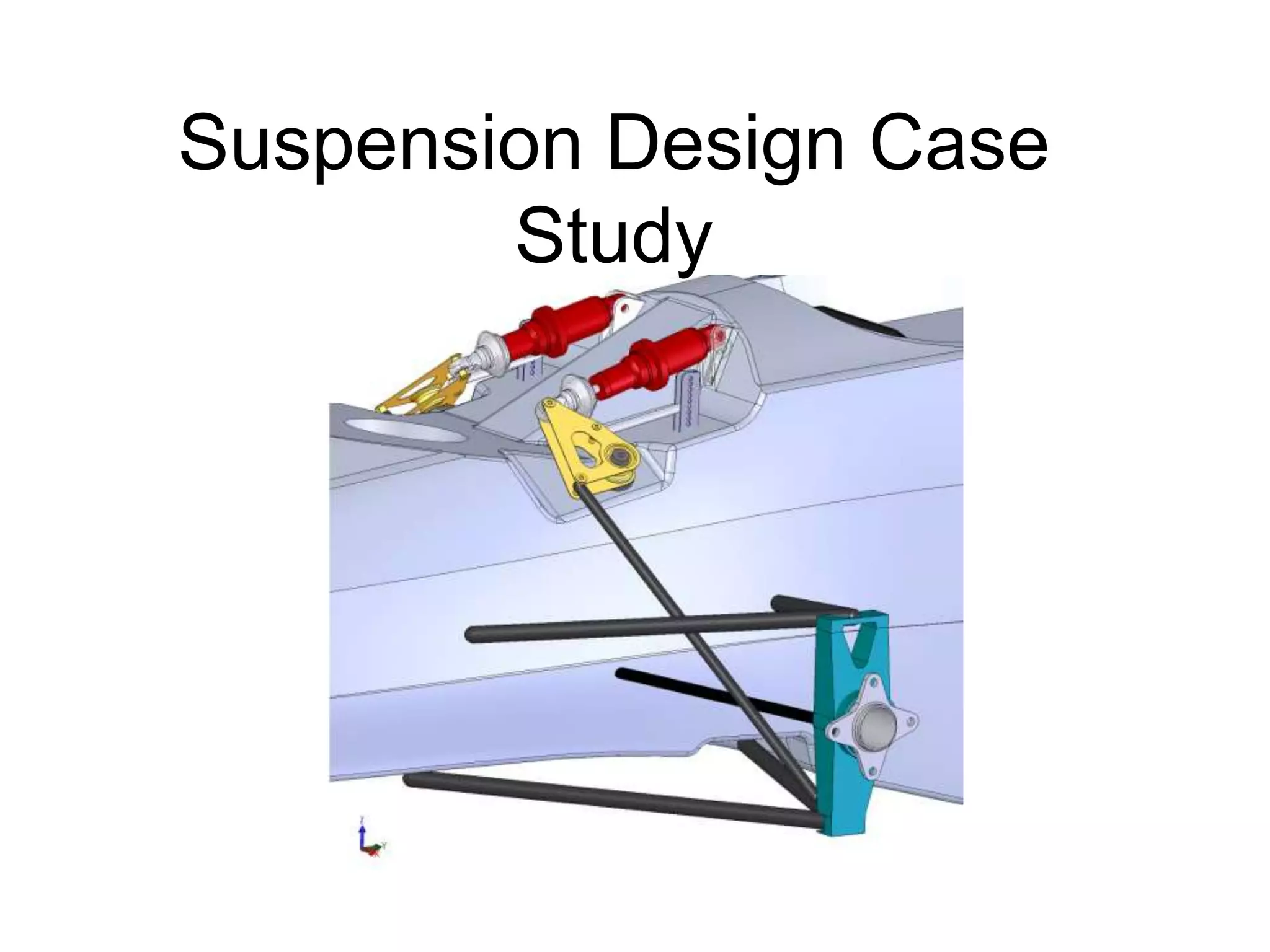
Suspension Design Case
Study
Purpose
• Suspension to be used on a small
(lightweight) formula style racecar.
• Car is intended to navigate tight road
courses
• Surface conditions are expected to be
relatively smooth
Performance Design Parameters
• For this case the main objective is to
optimize mechanical grip from the tire.
• This is achieved by considering as much
tire information as possible while
designing the suspension
• Specific vehicle characteristics will be
considered.
Considerations
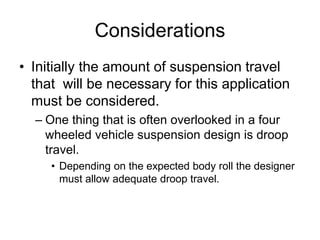
• Initially the amount of suspension travel
that will be necessary for this application
must be considered.
– One thing that is often overlooked in a four
wheeled vehicle suspension design is droop
travel.
• Depending on the expected body roll the designer
must allow adequate droop travel.
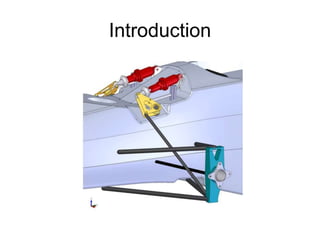
Introduction
Components
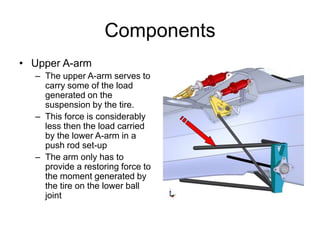
• Upper A-arm
– The upper A-arm serves to
carry some of the load
generated on the
suspension by the tire.
– This force is considerably
less then the load carried
by the lower A-arm in a
push rod set-up
– The arm only has to
provide a restoring force to
the moment generated by
the tire on the lower ball
joint
Components
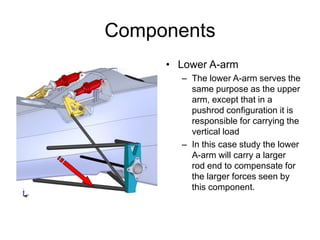
• Lower A-arm
– The lower A-arm serves the
same purpose as the upper
arm, except that in a
pushrod configuration it is
responsible for carrying the
vertical load
– In this case study the lower
A-arm will carry a larger
rod end to compensate for
the larger forces seen by
this component.
Components
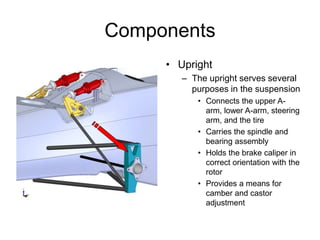
• Upright
– The upright serves several
purposes in the suspension
• Connects the upper A-
arm, lower A-arm, steering
arm, and the tire
• Carries the spindle and
bearing assembly
• Holds the brake caliper in
correct orientation with the
rotor
• Provides a means for
camber and castor
adjustment
Components
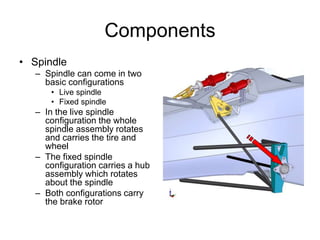
• Spindle
– Spindle can come in two
basic configurations
• Live spindle
• Fixed spindle
– In the live spindle
configuration the whole
spindle assembly rotates
and carries the tire and
wheel
– The fixed spindle
configuration carries a hub
assembly which rotates
about the spindle
– Both configurations carry
the brake rotor
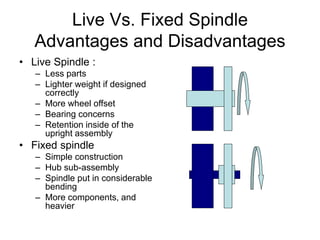
Live Vs. Fixed Spindle
Advantages and Disadvantages
• Live Spindle :
– Less parts
– Lighter weight if designed
correctly
– More wheel offset
– Bearing concerns
– Retention inside of the
upright assembly
• Fixed spindle
– Simple construction
– Hub sub-assembly
– Spindle put in considerable
bending
– More components, and
heavier
Components
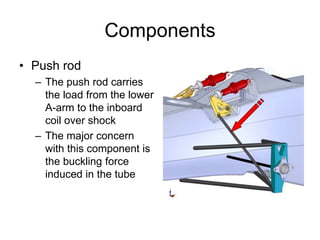
• Push rod
– The push rod carries
the load from the lower
A-arm to the inboard
coil over shock
– The major concern
with this component is
the buckling force
induced in the tube
Components
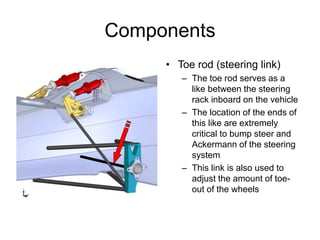
• Toe rod (steering link)
– The toe rod serves as a
like between the steering
rack inboard on the vehicle
– The location of the ends of
this like are extremely
critical to bump steer and
Ackermann of the steering
system
– This link is also used to
adjust the amount of toe-
out of the wheels
Components
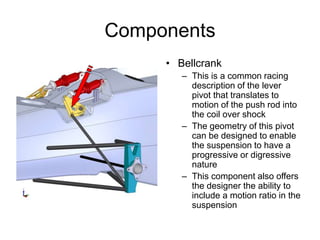
• Bellcrank
– This is a common racing
description of the lever
pivot that translates to
motion of the push rod into
the coil over shock
– The geometry of this pivot
can be designed to enable
the suspension to have a
progressive or digressive
nature
– This component also offers
the designer the ability to
include a motion ratio in the
suspension
Components
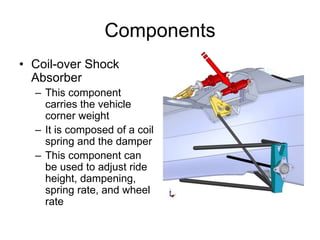
• Coil-over Shock
Absorber
– This component
carries the vehicle
corner weight
– It is composed of a coil
spring and the damper
– This component can
be used to adjust ride
height, dampening,
spring rate, and wheel
rate
Components
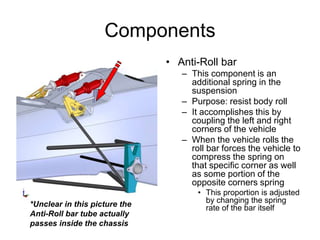
• Anti-Roll bar
– This component is an
additional spring in the
suspension
– Purpose: resist body roll
– It accomplishes this by
coupling the left and right
corners of the vehicle
– When the vehicle rolls the
roll bar forces the vehicle to
compress the spring on
that specific corner as well
as some portion of the
opposite corners spring
• This proportion is adjusted
by changing the spring
rate of the bar itself*Unclear in this picture the
Anti-Roll bar tube actually
passes inside the chassis
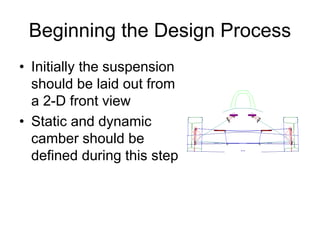
Beginning the Design Process
• Initially the suspension
should be laid out from
a 2-D front view
• Static and dynamic
camber should be
defined during this step
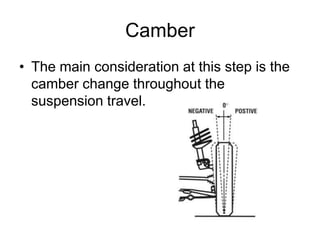
Camber
• The main consideration at this step is the
camber change throughout the
suspension travel.
Camber
• Static Camber
– Describes the camber angle with loaded vehicle not
in motion
• Dynamic Camber
– Describes the camber angle of a corner at any
instant during a maneuver i.e.: cornering,
launching, braking
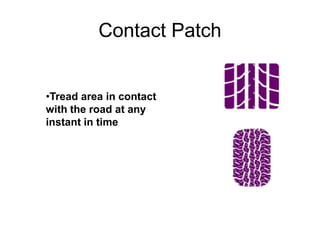
Contact Patch
•Tread area in contact
with the road at any
instant in time
Camber
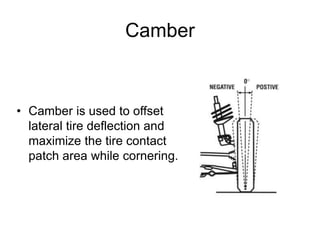
• Camber is used to offset
lateral tire deflection and
maximize the tire contact
patch area while cornering.
Camber
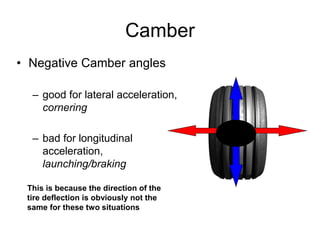
• Negative Camber angles
– good for lateral acceleration,
cornering
– bad for longitudinal
acceleration,
launching/braking
This is because the direction of the
tire deflection is obviously not the
same for these two situations
Camber
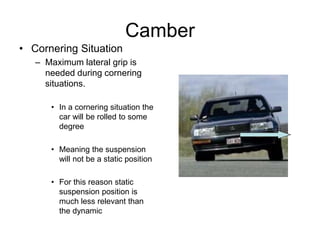
• Cornering Situation
– Maximum lateral grip is
needed during cornering
situations.
• In a cornering situation the
car will be rolled to some
degree
• Meaning the suspension
will not be a static position
• For this reason static
suspension position is
much less relevant than
the dynamic
Camber
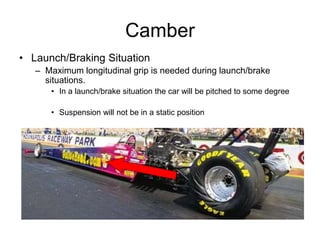
• Launch/Braking Situation
– Maximum longitudinal grip is needed during launch/brake
situations.
• In a launch/brake situation the car will be pitched to some degree
• Suspension will not be in a static position
Compromise
• It is apparent that the suspension is likely to be
at the same position for some cornering
maneuvers as it is during launching/braking
maneuvers
– For this reason we must compromise between too
little and too much negative camber
– This can be approximated with tire data and often
refined during testing
Defining Camber
• Once we set our static camber we must
adjust our dynamic camber curves
– This is done by adjusting the lengths of the
upper and lower A-arms and the position of
the inboard and out board pivots
– These lengths and locations are often driven
by packaging constraints
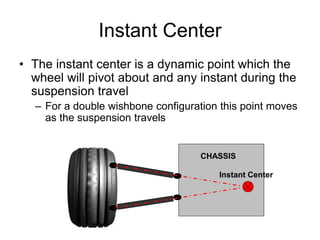
Instant Center
• The instant center is a dynamic point which the
wheel will pivot about and any instant during the
suspension travel
– For a double wishbone configuration this point moves
as the suspension travels
CHASSIS
Instant Center
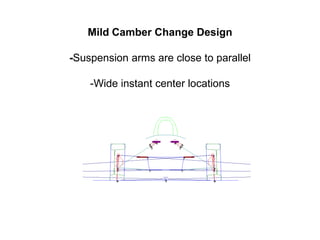
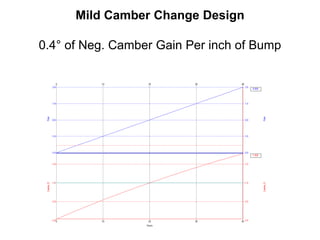
Mild Camber Change Design
-Suspension arms are close to parallel
-Wide instant center locations
Mild Camber Change Design
0.4° of Neg. Camber Gain Per inch of Bump
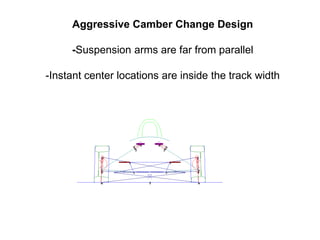
Aggressive Camber Change Design
-Suspension arms are far from parallel
-Instant center locations are inside the track width
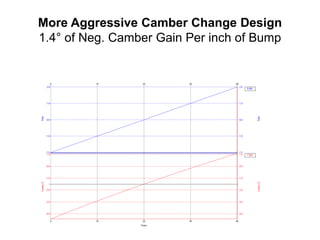
More Aggressive Camber Change Design
1.4° of Neg. Camber Gain Per inch of Bump
Jacking forces
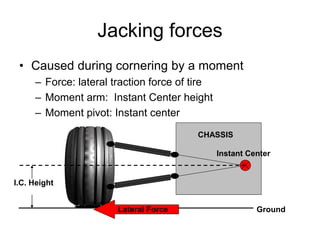
• It is important to consider the Instant
Center Position, because when it moves
vertically off the ground plane Jacking
forces are introduced
Jacking forces
• Caused during cornering by a moment
– Force: lateral traction force of tire
– Moment arm: Instant Center height
– Moment pivot: Instant center
CHASSIS
Instant Center
Lateral Force Ground
I.C. Height
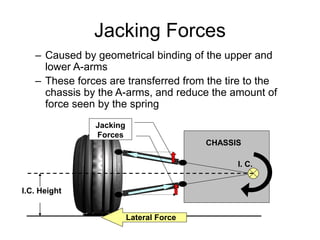
Jacking Forces
CHASSIS
I. C.
Lateral Force
I.C. Height
– Caused by geometrical binding of the upper and
lower A-arms
– These forces are transferred from the tire to the
chassis by the A-arms, and reduce the amount of
force seen by the spring
Jacking
Forces
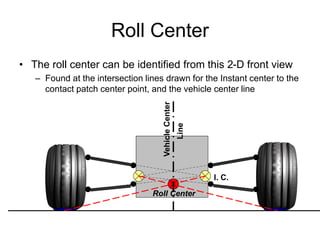
Roll Center
• The roll center can be identified from this 2-D front view
– Found at the intersection lines drawn for the Instant center to the
contact patch center point, and the vehicle center line
I. C.
Roll Center
VehicleCenter
Line
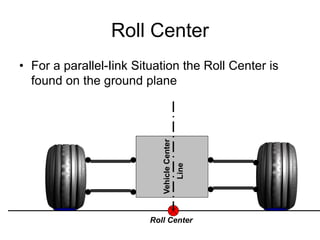
Roll Center
• For a parallel-Iink Situation the Roll Center is
found on the ground plane
Roll Center
VehicleCenter
Line
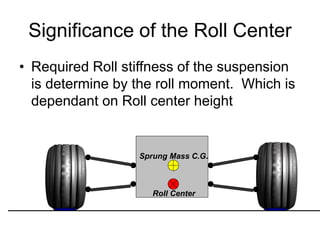
Significance of the Roll Center
• Required Roll stiffness of the suspension
is determine by the roll moment. Which is
dependant on Roll center height
Roll Center
Sprung Mass C.G.
Roll Moment
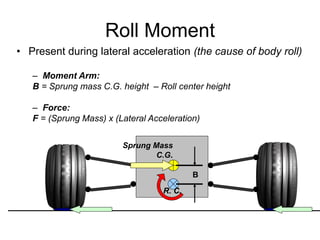
• Present during lateral acceleration (the cause of body roll)
– Moment Arm:
B = Sprung mass C.G. height – Roll center height
– Force:
F = (Sprung Mass) x (Lateral Acceleration)
R. C.
Sprung Mass
C.G.
B
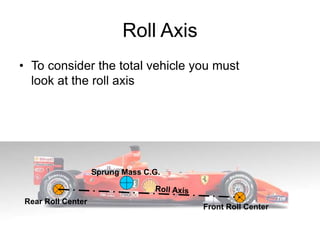
Roll Axis
• To consider the total vehicle you must
look at the roll axis
Rear Roll Center
Front Roll Center
Sprung Mass C.G.
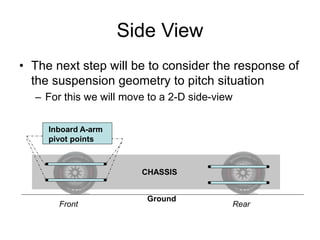
Side View
• The next step will be to consider the response of
the suspension geometry to pitch situation
– For this we will move to a 2-D side-view
Inboard A-arm
pivot points
Ground
Front Rear
CHASSIS
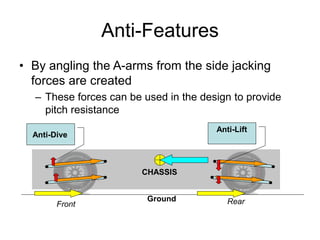
Anti-Features
• By angling the A-arms from the side jacking
forces are created
– These forces can be used in the design to provide
pitch resistance
Ground
Front Rear
CHASSIS
Anti-Dive
Anti-Lift
Anti-Features
• Racecars rely heavily on wings and
aerodynamics for performance.
– Aerodynamically efficient, high-down force
cars are very sensitive to pitch changes.
– A pitch change can drastically affect the
amount of down force being produced.
• Much less important for lower speed cars
Pitch Center
Pitch Center
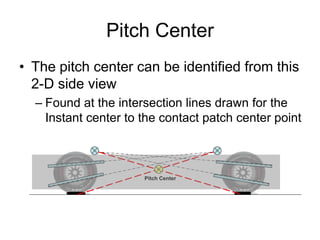
• The pitch center can be identified from this
2-D side view
– Found at the intersection lines drawn for the
Instant center to the contact patch center point
Pitch Center
Pitch Center
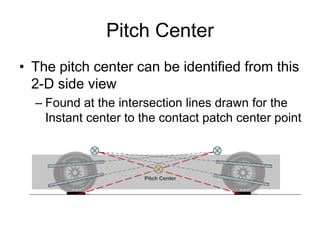
• The pitch center can be identified from this
2-D side view
– Found at the intersection lines drawn for the
Instant center to the contact patch center point
Pitch Moment
Pitch Center
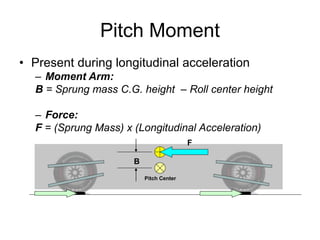
• Present during longitudinal acceleration
– Moment Arm:
B = Sprung mass C.G. height – Roll center height
– Force:
F = (Sprung Mass) x (Longitudinal Acceleration)
B
F

Suspension Design casestudy

  • 1.
  • 2.
    Purpose • Suspension tobe used on a small (lightweight) formula style racecar. • Car is intended to navigate tight road courses • Surface conditions are expected to be relatively smooth
  • 3.
    Performance Design Parameters •For this case the main objective is to optimize mechanical grip from the tire. • This is achieved by considering as much tire information as possible while designing the suspension • Specific vehicle characteristics will be considered.
  • 4.
    Considerations • Initially theamount of suspension travel that will be necessary for this application must be considered. – One thing that is often overlooked in a four wheeled vehicle suspension design is droop travel. • Depending on the expected body roll the designer must allow adequate droop travel.
  • 5.
  • 6.
    Components • Upper A-arm –The upper A-arm serves to carry some of the load generated on the suspension by the tire. – This force is considerably less then the load carried by the lower A-arm in a push rod set-up – The arm only has to provide a restoring force to the moment generated by the tire on the lower ball joint
  • 7.
    Components • Lower A-arm –The lower A-arm serves the same purpose as the upper arm, except that in a pushrod configuration it is responsible for carrying the vertical load – In this case study the lower A-arm will carry a larger rod end to compensate for the larger forces seen by this component.
  • 8.
    Components • Upright – Theupright serves several purposes in the suspension • Connects the upper A- arm, lower A-arm, steering arm, and the tire • Carries the spindle and bearing assembly • Holds the brake caliper in correct orientation with the rotor • Provides a means for camber and castor adjustment
  • 9.
    Components • Spindle – Spindlecan come in two basic configurations • Live spindle • Fixed spindle – In the live spindle configuration the whole spindle assembly rotates and carries the tire and wheel – The fixed spindle configuration carries a hub assembly which rotates about the spindle – Both configurations carry the brake rotor
  • 10.
    Live Vs. FixedSpindle Advantages and Disadvantages • Live Spindle : – Less parts – Lighter weight if designed correctly – More wheel offset – Bearing concerns – Retention inside of the upright assembly • Fixed spindle – Simple construction – Hub sub-assembly – Spindle put in considerable bending – More components, and heavier
  • 11.
    Components • Push rod –The push rod carries the load from the lower A-arm to the inboard coil over shock – The major concern with this component is the buckling force induced in the tube
  • 12.
    Components • Toe rod(steering link) – The toe rod serves as a like between the steering rack inboard on the vehicle – The location of the ends of this like are extremely critical to bump steer and Ackermann of the steering system – This link is also used to adjust the amount of toe- out of the wheels
  • 13.
    Components • Bellcrank – Thisis a common racing description of the lever pivot that translates to motion of the push rod into the coil over shock – The geometry of this pivot can be designed to enable the suspension to have a progressive or digressive nature – This component also offers the designer the ability to include a motion ratio in the suspension
  • 14.
    Components • Coil-over Shock Absorber –This component carries the vehicle corner weight – It is composed of a coil spring and the damper – This component can be used to adjust ride height, dampening, spring rate, and wheel rate
  • 15.
    Components • Anti-Roll bar –This component is an additional spring in the suspension – Purpose: resist body roll – It accomplishes this by coupling the left and right corners of the vehicle – When the vehicle rolls the roll bar forces the vehicle to compress the spring on that specific corner as well as some portion of the opposite corners spring • This proportion is adjusted by changing the spring rate of the bar itself*Unclear in this picture the Anti-Roll bar tube actually passes inside the chassis
  • 16.
    Beginning the DesignProcess • Initially the suspension should be laid out from a 2-D front view • Static and dynamic camber should be defined during this step
  • 17.
    Camber • The mainconsideration at this step is the camber change throughout the suspension travel.
  • 18.
    Camber • Static Camber –Describes the camber angle with loaded vehicle not in motion • Dynamic Camber – Describes the camber angle of a corner at any instant during a maneuver i.e.: cornering, launching, braking
  • 19.
    Contact Patch •Tread areain contact with the road at any instant in time
  • 20.
    Camber • Camber isused to offset lateral tire deflection and maximize the tire contact patch area while cornering.
  • 21.
    Camber • Negative Camberangles – good for lateral acceleration, cornering – bad for longitudinal acceleration, launching/braking This is because the direction of the tire deflection is obviously not the same for these two situations
  • 22.
    Camber • Cornering Situation –Maximum lateral grip is needed during cornering situations. • In a cornering situation the car will be rolled to some degree • Meaning the suspension will not be a static position • For this reason static suspension position is much less relevant than the dynamic
  • 23.
    Camber • Launch/Braking Situation –Maximum longitudinal grip is needed during launch/brake situations. • In a launch/brake situation the car will be pitched to some degree • Suspension will not be in a static position
  • 24.
    Compromise • It isapparent that the suspension is likely to be at the same position for some cornering maneuvers as it is during launching/braking maneuvers – For this reason we must compromise between too little and too much negative camber – This can be approximated with tire data and often refined during testing
  • 25.
    Defining Camber • Oncewe set our static camber we must adjust our dynamic camber curves – This is done by adjusting the lengths of the upper and lower A-arms and the position of the inboard and out board pivots – These lengths and locations are often driven by packaging constraints
  • 26.
    Instant Center • Theinstant center is a dynamic point which the wheel will pivot about and any instant during the suspension travel – For a double wishbone configuration this point moves as the suspension travels CHASSIS Instant Center
  • 27.
    Mild Camber ChangeDesign -Suspension arms are close to parallel -Wide instant center locations
  • 28.
    Mild Camber ChangeDesign 0.4° of Neg. Camber Gain Per inch of Bump
  • 29.
    Aggressive Camber ChangeDesign -Suspension arms are far from parallel -Instant center locations are inside the track width
  • 30.
    More Aggressive CamberChange Design 1.4° of Neg. Camber Gain Per inch of Bump
  • 31.
    Jacking forces • Itis important to consider the Instant Center Position, because when it moves vertically off the ground plane Jacking forces are introduced
  • 32.
    Jacking forces • Causedduring cornering by a moment – Force: lateral traction force of tire – Moment arm: Instant Center height – Moment pivot: Instant center CHASSIS Instant Center Lateral Force Ground I.C. Height
  • 33.
    Jacking Forces CHASSIS I. C. LateralForce I.C. Height – Caused by geometrical binding of the upper and lower A-arms – These forces are transferred from the tire to the chassis by the A-arms, and reduce the amount of force seen by the spring Jacking Forces
  • 34.
    Roll Center • Theroll center can be identified from this 2-D front view – Found at the intersection lines drawn for the Instant center to the contact patch center point, and the vehicle center line I. C. Roll Center VehicleCenter Line
  • 35.
    Roll Center • Fora parallel-Iink Situation the Roll Center is found on the ground plane Roll Center VehicleCenter Line
  • 36.
    Significance of theRoll Center • Required Roll stiffness of the suspension is determine by the roll moment. Which is dependant on Roll center height Roll Center Sprung Mass C.G.
  • 37.
    Roll Moment • Presentduring lateral acceleration (the cause of body roll) – Moment Arm: B = Sprung mass C.G. height – Roll center height – Force: F = (Sprung Mass) x (Lateral Acceleration) R. C. Sprung Mass C.G. B
  • 38.
    Roll Axis • Toconsider the total vehicle you must look at the roll axis Rear Roll Center Front Roll Center Sprung Mass C.G.
  • 39.
    Side View • Thenext step will be to consider the response of the suspension geometry to pitch situation – For this we will move to a 2-D side-view Inboard A-arm pivot points Ground Front Rear CHASSIS
  • 40.
    Anti-Features • By anglingthe A-arms from the side jacking forces are created – These forces can be used in the design to provide pitch resistance Ground Front Rear CHASSIS Anti-Dive Anti-Lift
  • 41.
    Anti-Features • Racecars relyheavily on wings and aerodynamics for performance. – Aerodynamically efficient, high-down force cars are very sensitive to pitch changes. – A pitch change can drastically affect the amount of down force being produced. • Much less important for lower speed cars
  • 42.
    Pitch Center Pitch Center •The pitch center can be identified from this 2-D side view – Found at the intersection lines drawn for the Instant center to the contact patch center point
  • 43.
    Pitch Center Pitch Center •The pitch center can be identified from this 2-D side view – Found at the intersection lines drawn for the Instant center to the contact patch center point
  • 44.
    Pitch Moment Pitch Center •Present during longitudinal acceleration – Moment Arm: B = Sprung mass C.G. height – Roll center height – Force: F = (Sprung Mass) x (Longitudinal Acceleration) B F