MISTAKE-PROOFING
(POKA-YOKE)
Presented To: Prof. Raj Mukundan
Group Number- 12
Poka Yoke
• ‘Poka’ means ‘Mistakes’ & ‘Yoke’ means ‘Avoid’. It’s objective is to achieve
Zero Defects.
• Poka-yoke is a quality assurance technique ,the aim of poka-yoke is to eliminate
defects in a product by preventing or correcting mistakes as early as possible.
• Term adopted by Dr. Shigeo Shingo as part of the Toyota Production System
in 1960.
• It was originally described as “baka-yoke”, but this name mean “Fool-Proofing”
so the name was changed to the Poka-yoke.
DEFECTS AND ITS IMPACT
• Defect free product is a necessity to compete in the market
place.
• Every Customers has a right to demand 100% good product
/service and every provider has an obligation to provide the
same.
• Bad products hurt both reputation and bottom line (Scrap,
rework, warranty….etc.,.)
• Defects have a direct impact on process yield affecting speed
and flow of the product to the customer.
Typical Errors
 Processing errors
 Missing Operation
 Inappropriate procedures
 Missing parts
 Missing information
 Wrong parts
 Damaged materials
 Tools or equipment
improperly prepared or
setup
 Human Errors
HOW TO USE MISTAKE PROOFING?
Identify the process.
Process can fail
Decide right poke yoke approach
Use of checklist
Trail the method
Train the operator
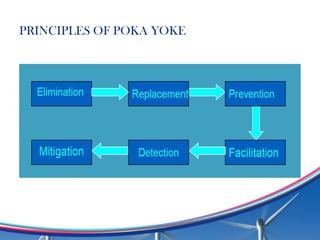
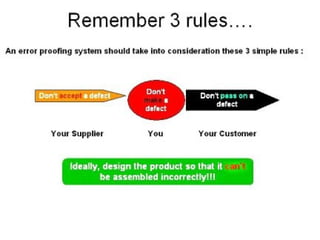
PRINCIPLES OF POKA YOKE
Why is “Zero Defects” an Important
Concept?
Maintain Customer Satisfaction & Loyalty
• Happy Customers mean more sales!
COSTS
There is always a cost
associated with
manufacturing defects!
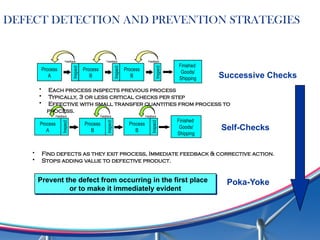
DEFECT DETECTION AND PREVENTION STRATEGIES
Process
B
Process
A
Inspect
Inspect
Process
B
Inspect
Finished
Goods/
Shipping
Feedback
Feedback
Feedback
Self-Checks
Inspect
Inspect
Process
A
Process
B
Process
B
Inspect
Finished
Goods/
Shipping
Feedback Feedback Feedback
Successive Checks
Poka-Yoke
Prevent the defect from occurring in the first place
or to make it immediately evident
• Find defects as they exit process, Immediate feedback & corrective action.
• Stops adding value to defective product.
• Each process inspects previous process
• Typically, 3 or less critical checks per step
• Effective with small transfer quantities from process to
process.
SOME MISTAKE-PROOFING STRATEGIES
 Make it harder to create the error
 Make it possible to reverse the error
 Make it obvious that the error has occurred
 Detect deviations from procedures or fixed values (e.g., Number of parts)
 Design:
 Design process so it tolerates the error and doesn’t result in a defect
 Design process to decrease complexity
APPROACHES TO MISTAKE PROOFING
 Control approach
 Shuts down the process when an error occurs
 High capability of achieving zero defects (ie robust design that can tolerate variation or eliminates
variation or assembly mistakes)
 Warning approach
 Signals the operator to stop the process and correct problem or check for a problem (ie are parts still
ok, is oil level ok)
 Sometimes an automatic shutoff is not an option
 Dials, lights, and sounds to bring attention to the problem
Mistake Proofing Devices
• Types of mistake proofing devices within control or warning approach can be of:
– Contact type:
• The contact type makes contact with every product or has a physical shape that inhibits
mistakes.
– Example: Fixed diameter hole through which all products must fall and an oversize
product does not fall through and a defect is registered.
– Fixed value type:
• The fixed value method is a design that makes it clear when a part is missing or not used.
– Example: “Egg tray” used for supply of parts,
– Motion step type:
• The motion step type automatically ensures that the correct number of steps have been
taken.
– Example: An operator is required to step on a foot pedal every assembly cycle,
Correct sequence for switches that do not work unless the order is correct.
EXAMPLES OF SOME USEFUL MISTAKE-PROOFING DEVICES
• Guide pins, to assure that parts can only be
assembled in the correct way.
• Limit switches, that sense the presence or absence of
a part.
• Mistake-proofing jigs, detect defects immediately
upstream of the process ensuring that only the correct
part reach the process.
• Counters, that verify that the correct number of parts
or steps have been taken.
• Checklist, that reminds operators to do certain
actions.
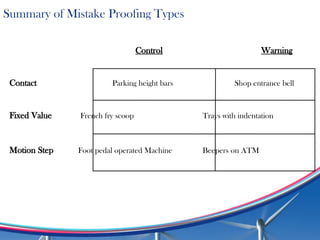
Summary of Mistake Proofing Types
Control Warning
Contact Parking height bars Shop entrance bell
Fixed Value French fry scoop Trays with indentation
Motion Step Foot pedal operated Machine Beepers on ATM
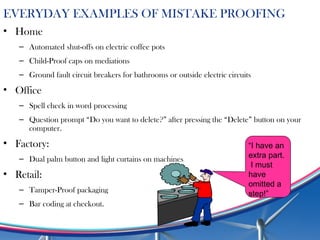
EVERYDAY EXAMPLES OF MISTAKE PROOFING
• Home
– Automated shut-offs on electric coffee pots
– Child-Proof caps on mediations
– Ground fault circuit breakers for bathrooms or outside electric circuits
• Office
– Spell check in word processing
– Question prompt “Do you want to delete?” after pressing the “Delete” button on your
computer.
• Factory:
– Dual palm button and light curtains on machines
• Retail:
– Tamper-Proof packaging
– Bar coding at checkout.
“I have an
extra part.
I must
have
omitted a
step!”
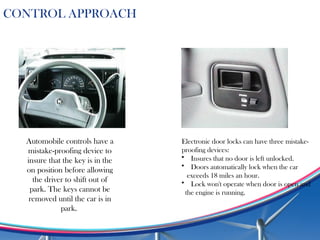
CONTROL APPROACH
Automobile controls have a
mistake-proofing device to
insure that the key is in the
on position before allowing
the driver to shift out of
park. The keys cannot be
removed until the car is in
park.
Electronic door locks can have three mistake-
proofing devices:
• Insures that no door is left unlocked.
• Doors automatically lock when the car
exceeds 18 miles an hour.
• Lock won't operate when door is open and
the engine is running.
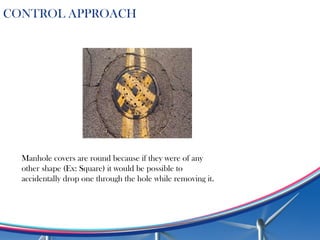
Manhole covers are round because if they were of any
other shape (Ex: Square) it would be possible to
accidentally drop one through the hole while removing it.
CONTROL APPROACH
WARNING APPROACH
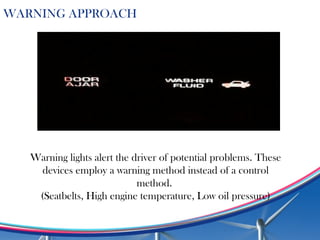
Warning lights alert the driver of potential problems. These
devices employ a warning method instead of a control
method.
(Seatbelts, High engine temperature, Low oil pressure)
TYPES OF SENSING DEVICES
Sensing devices that are traditionally used in poka-yoke systems
can be divided into three categories:
1. Physical contact devices
2. Energy sensing devices
3. Warning Sensors
Each category of sensors includes a
broad range of devices that can be used
depending on the process.
PHYSICAL CONTACT SENSORS
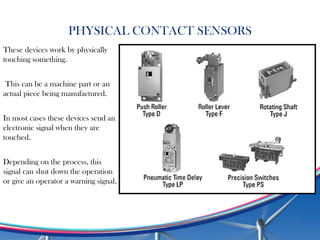
These devices work by physically
touching something.
This can be a machine part or an
actual piece being manufactured.
In most cases these devices send an
electronic signal when they are
touched.
Depending on the process, this
signal can shut down the operation
or give an operator a warning signal.
TOUCH SWITCH
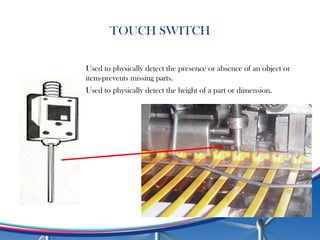
Used to physically detect the presence or absence of an object or
item-prevents missing parts.
Used to physically detect the height of a part or dimension.
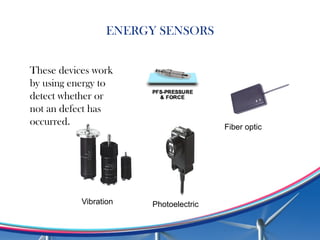
ENERGY SENSORS
These devices work
by using energy to
detect whether or
not an defect has
occurred. Fiber optic
Photoelectric
Vibration
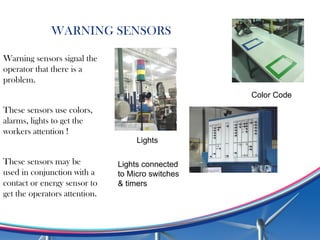
WARNING SENSORS
Warning sensors signal the
operator that there is a
problem.
These sensors use colors,
alarms, lights to get the
workers attention !
These sensors may be
used in conjunction with a
contact or energy sensor to
get the operators attention.
Lights connected
to Micro switches
& timers
Color Code
Lights
The Seven Guidelines to Poka- Yoke Attainment
1.) Quality Processes - Design “Robust” quality processes to achieve zero
defects.
2.) Utilize a Team Environment- leverage the teams knowledge,experience to
enhance the improvement efforts.
3.) Elimination of Errors -Utilize a robust problem solving methodology to
drive defects towards zero.
4.) Eliminate the “Root Cause” of The Errors
5.) Do It Right The First Time- Utilizing resources to perform functions
correctly the “first” time.
6.) Eliminate Non-Value Added Decisions- Don’t make excuses-just do it
7.) Implement an Incremental Continual Improvement Approach-implement
improvement actions immediately and focus on incremental improvements;
efforts do not have to result in a 100% improvement immediately.
SET A STANDARD
• Errors are not acceptable
• Use cross-functional teams to design and maintain processes to be
robust
• Make it right the first time
– Good: Design products and processes so that we make it right the first time
– Best: Design products and processes so we CAN’T make it wrong any time and
get a concurrent productivity improvement
PokaYoke-Final presentation for Beginers

PokaYoke-Final presentation for Beginers

  • 1.
  • 2.
    Poka Yoke • ‘Poka’means ‘Mistakes’ & ‘Yoke’ means ‘Avoid’. It’s objective is to achieve Zero Defects. • Poka-yoke is a quality assurance technique ,the aim of poka-yoke is to eliminate defects in a product by preventing or correcting mistakes as early as possible. • Term adopted by Dr. Shigeo Shingo as part of the Toyota Production System in 1960. • It was originally described as “baka-yoke”, but this name mean “Fool-Proofing” so the name was changed to the Poka-yoke.
  • 3.
    DEFECTS AND ITSIMPACT • Defect free product is a necessity to compete in the market place. • Every Customers has a right to demand 100% good product /service and every provider has an obligation to provide the same. • Bad products hurt both reputation and bottom line (Scrap, rework, warranty….etc.,.) • Defects have a direct impact on process yield affecting speed and flow of the product to the customer.
  • 4.
    Typical Errors  Processingerrors  Missing Operation  Inappropriate procedures  Missing parts  Missing information  Wrong parts  Damaged materials  Tools or equipment improperly prepared or setup  Human Errors
  • 5.
    HOW TO USEMISTAKE PROOFING? Identify the process. Process can fail Decide right poke yoke approach Use of checklist Trail the method Train the operator
  • 6.
  • 7.
    Why is “ZeroDefects” an Important Concept? Maintain Customer Satisfaction & Loyalty • Happy Customers mean more sales! COSTS There is always a cost associated with manufacturing defects!
  • 8.
    DEFECT DETECTION ANDPREVENTION STRATEGIES Process B Process A Inspect Inspect Process B Inspect Finished Goods/ Shipping Feedback Feedback Feedback Self-Checks Inspect Inspect Process A Process B Process B Inspect Finished Goods/ Shipping Feedback Feedback Feedback Successive Checks Poka-Yoke Prevent the defect from occurring in the first place or to make it immediately evident • Find defects as they exit process, Immediate feedback & corrective action. • Stops adding value to defective product. • Each process inspects previous process • Typically, 3 or less critical checks per step • Effective with small transfer quantities from process to process.
  • 9.
    SOME MISTAKE-PROOFING STRATEGIES Make it harder to create the error  Make it possible to reverse the error  Make it obvious that the error has occurred  Detect deviations from procedures or fixed values (e.g., Number of parts)  Design:  Design process so it tolerates the error and doesn’t result in a defect  Design process to decrease complexity
  • 10.
    APPROACHES TO MISTAKEPROOFING  Control approach  Shuts down the process when an error occurs  High capability of achieving zero defects (ie robust design that can tolerate variation or eliminates variation or assembly mistakes)  Warning approach  Signals the operator to stop the process and correct problem or check for a problem (ie are parts still ok, is oil level ok)  Sometimes an automatic shutoff is not an option  Dials, lights, and sounds to bring attention to the problem
  • 11.
    Mistake Proofing Devices •Types of mistake proofing devices within control or warning approach can be of: – Contact type: • The contact type makes contact with every product or has a physical shape that inhibits mistakes. – Example: Fixed diameter hole through which all products must fall and an oversize product does not fall through and a defect is registered. – Fixed value type: • The fixed value method is a design that makes it clear when a part is missing or not used. – Example: “Egg tray” used for supply of parts, – Motion step type: • The motion step type automatically ensures that the correct number of steps have been taken. – Example: An operator is required to step on a foot pedal every assembly cycle, Correct sequence for switches that do not work unless the order is correct.
  • 12.
    EXAMPLES OF SOMEUSEFUL MISTAKE-PROOFING DEVICES • Guide pins, to assure that parts can only be assembled in the correct way. • Limit switches, that sense the presence or absence of a part. • Mistake-proofing jigs, detect defects immediately upstream of the process ensuring that only the correct part reach the process. • Counters, that verify that the correct number of parts or steps have been taken. • Checklist, that reminds operators to do certain actions.
  • 13.
    Summary of MistakeProofing Types Control Warning Contact Parking height bars Shop entrance bell Fixed Value French fry scoop Trays with indentation Motion Step Foot pedal operated Machine Beepers on ATM
  • 14.
    EVERYDAY EXAMPLES OFMISTAKE PROOFING • Home – Automated shut-offs on electric coffee pots – Child-Proof caps on mediations – Ground fault circuit breakers for bathrooms or outside electric circuits • Office – Spell check in word processing – Question prompt “Do you want to delete?” after pressing the “Delete” button on your computer. • Factory: – Dual palm button and light curtains on machines • Retail: – Tamper-Proof packaging – Bar coding at checkout. “I have an extra part. I must have omitted a step!”
  • 15.
    CONTROL APPROACH Automobile controlshave a mistake-proofing device to insure that the key is in the on position before allowing the driver to shift out of park. The keys cannot be removed until the car is in park. Electronic door locks can have three mistake- proofing devices: • Insures that no door is left unlocked. • Doors automatically lock when the car exceeds 18 miles an hour. • Lock won't operate when door is open and the engine is running.
  • 16.
    Manhole covers areround because if they were of any other shape (Ex: Square) it would be possible to accidentally drop one through the hole while removing it. CONTROL APPROACH
  • 17.
    WARNING APPROACH Warning lightsalert the driver of potential problems. These devices employ a warning method instead of a control method. (Seatbelts, High engine temperature, Low oil pressure)
  • 18.
    TYPES OF SENSINGDEVICES Sensing devices that are traditionally used in poka-yoke systems can be divided into three categories: 1. Physical contact devices 2. Energy sensing devices 3. Warning Sensors Each category of sensors includes a broad range of devices that can be used depending on the process.
  • 19.
    PHYSICAL CONTACT SENSORS Thesedevices work by physically touching something. This can be a machine part or an actual piece being manufactured. In most cases these devices send an electronic signal when they are touched. Depending on the process, this signal can shut down the operation or give an operator a warning signal.
  • 20.
    TOUCH SWITCH Used tophysically detect the presence or absence of an object or item-prevents missing parts. Used to physically detect the height of a part or dimension.
  • 21.
    ENERGY SENSORS These deviceswork by using energy to detect whether or not an defect has occurred. Fiber optic Photoelectric Vibration
  • 22.
    WARNING SENSORS Warning sensorssignal the operator that there is a problem. These sensors use colors, alarms, lights to get the workers attention ! These sensors may be used in conjunction with a contact or energy sensor to get the operators attention. Lights connected to Micro switches & timers Color Code Lights
  • 23.
    The Seven Guidelinesto Poka- Yoke Attainment 1.) Quality Processes - Design “Robust” quality processes to achieve zero defects. 2.) Utilize a Team Environment- leverage the teams knowledge,experience to enhance the improvement efforts. 3.) Elimination of Errors -Utilize a robust problem solving methodology to drive defects towards zero. 4.) Eliminate the “Root Cause” of The Errors 5.) Do It Right The First Time- Utilizing resources to perform functions correctly the “first” time. 6.) Eliminate Non-Value Added Decisions- Don’t make excuses-just do it 7.) Implement an Incremental Continual Improvement Approach-implement improvement actions immediately and focus on incremental improvements; efforts do not have to result in a 100% improvement immediately.
  • 24.
    SET A STANDARD •Errors are not acceptable • Use cross-functional teams to design and maintain processes to be robust • Make it right the first time – Good: Design products and processes so that we make it right the first time – Best: Design products and processes so we CAN’T make it wrong any time and get a concurrent productivity improvement

Editor's Notes

  • #18 Sensing devices are the actual mechanism used to make contact, count, or identify the motion sequence of a work piece. They are the third tier of a poka-yoke system ( tires: approaches-methods-sensing devices).
  • #19 Various examples