CLASSIFICATION OF VARIABLES
OBJECTIVES
1. Determine the classifications of variables
2. Differentiate the classifications variables from
one another.
Identify the types of variables used in a
research study.
ACTIVITY:
JEEPNEY RIDE
VARIABLE
 Any property or factor that a researcher measures, controls, and /or
manipulates.
 Any changing quantity or measure of any factor, trait, or condition
that can exist in differing amount or types.
 It is a logical set of characteristics, numbers, or quantities that can be
measured or counted.
 Anything that has quantity or quality that varies.
EXAMPLE:
Age, sex, business income and expenses,
country of birth, capital expenditure, class
grades, eye color and vehicle type.
KINDS OF VARIABLES:
1. Numeric Variable:
- variables with values that normally describe a measurable
numerical quantity.
- values that are considered as quantitative data.
- variables that answer the questions “how many “or “how
much”
a. Continuous variables:
- these are quantitative or numeric variables
- these can be obtained by measuring or
computation
- also called as interval variables
Examples: income, time, age, electric or water bills, height,
weight, length, general average
b. Discrete Variables:
- these are quantitative or numeric variables
- these can be obtained by counting
- these assume any whole value within the limits of given
variables
Examples: number of family members, number of registered cars,
number of votes, number of respondents
2. Categorical Variables:
- these are variables that describe a quality or
characteristic of a data
- variables that answer the questions “ what type,
which category”
a. Ordinal Variables:
- these are values that can be logically arranged or ranked
- these can be expressed through sequential and numerical
order
- these allow comparison of degree
Examples: academic grades such as A, B, C, rank such as first,
second, third, clothing size such as X,L,M,S,
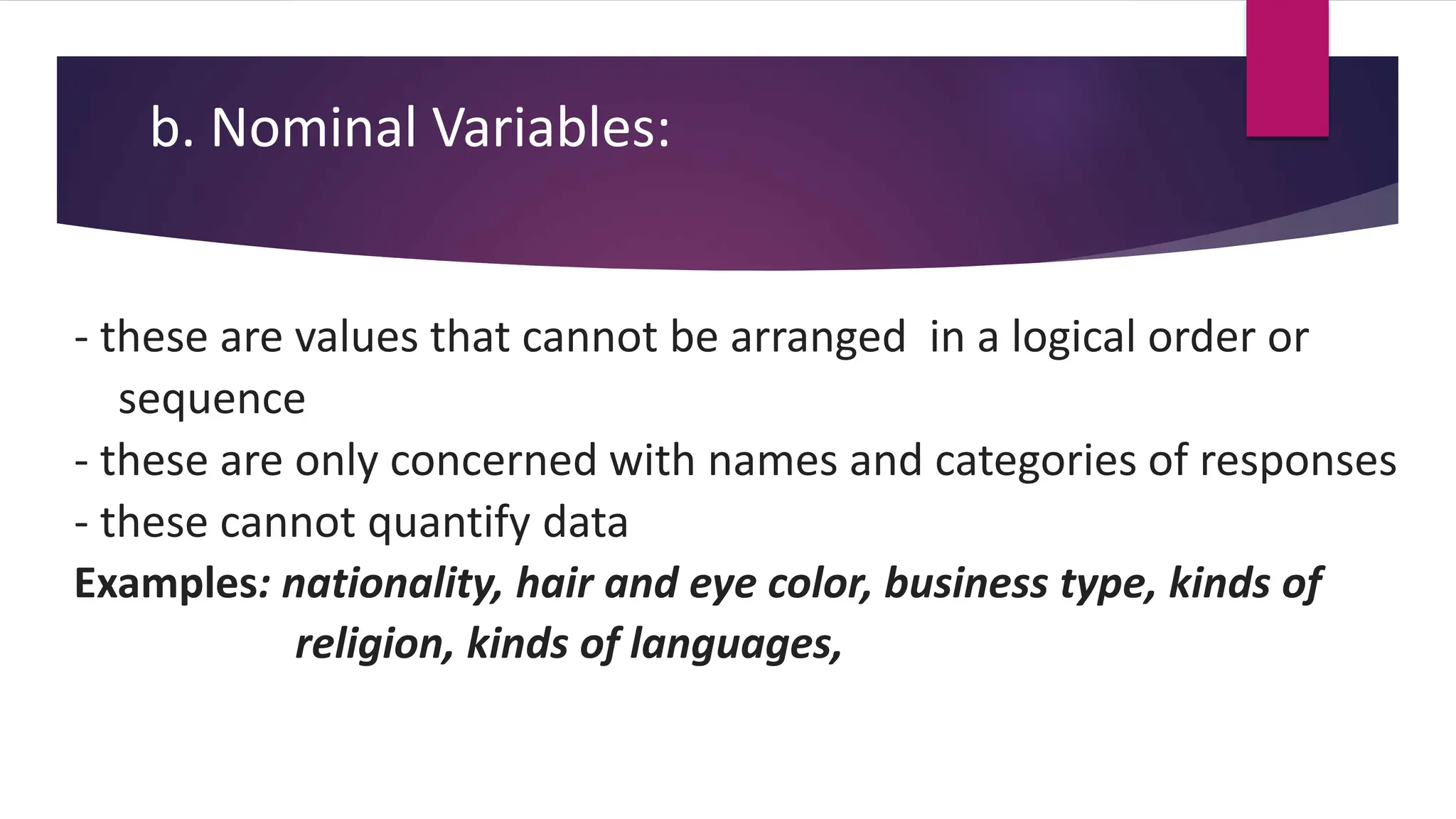
b. Nominal Variables:
- these are values that cannot be arranged in a logical order or
sequence
- these are only concerned with names and categories of responses
- these cannot quantify data
Examples: nationality, hair and eye color, business type, kinds of
religion, kinds of languages,
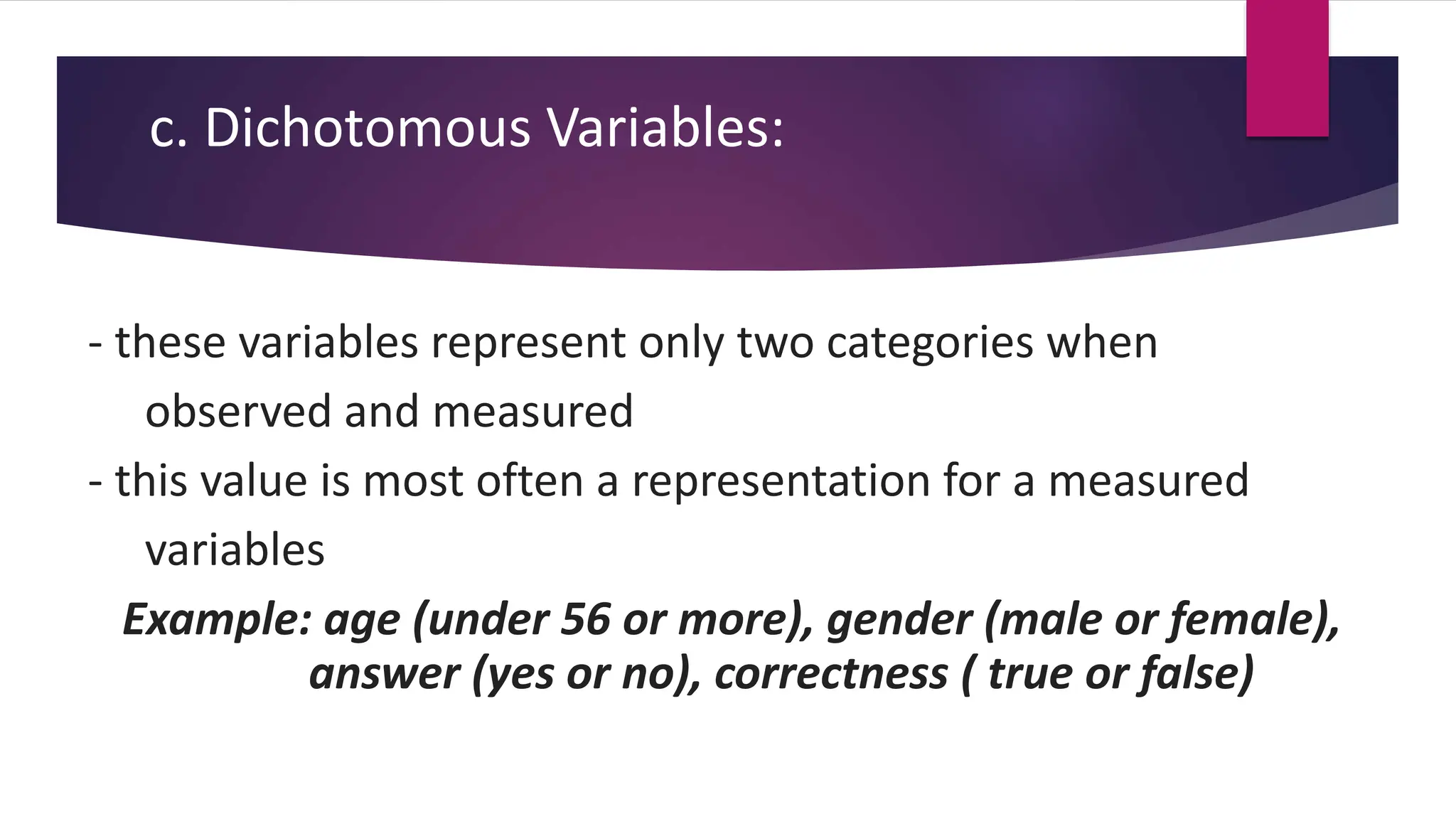
c. Dichotomous Variables:
- these variables represent only two categories when
observed and measured
- this value is most often a representation for a measured
variables
Example: age (under 56 or more), gender (male or female),
answer (yes or no), correctness ( true or false)
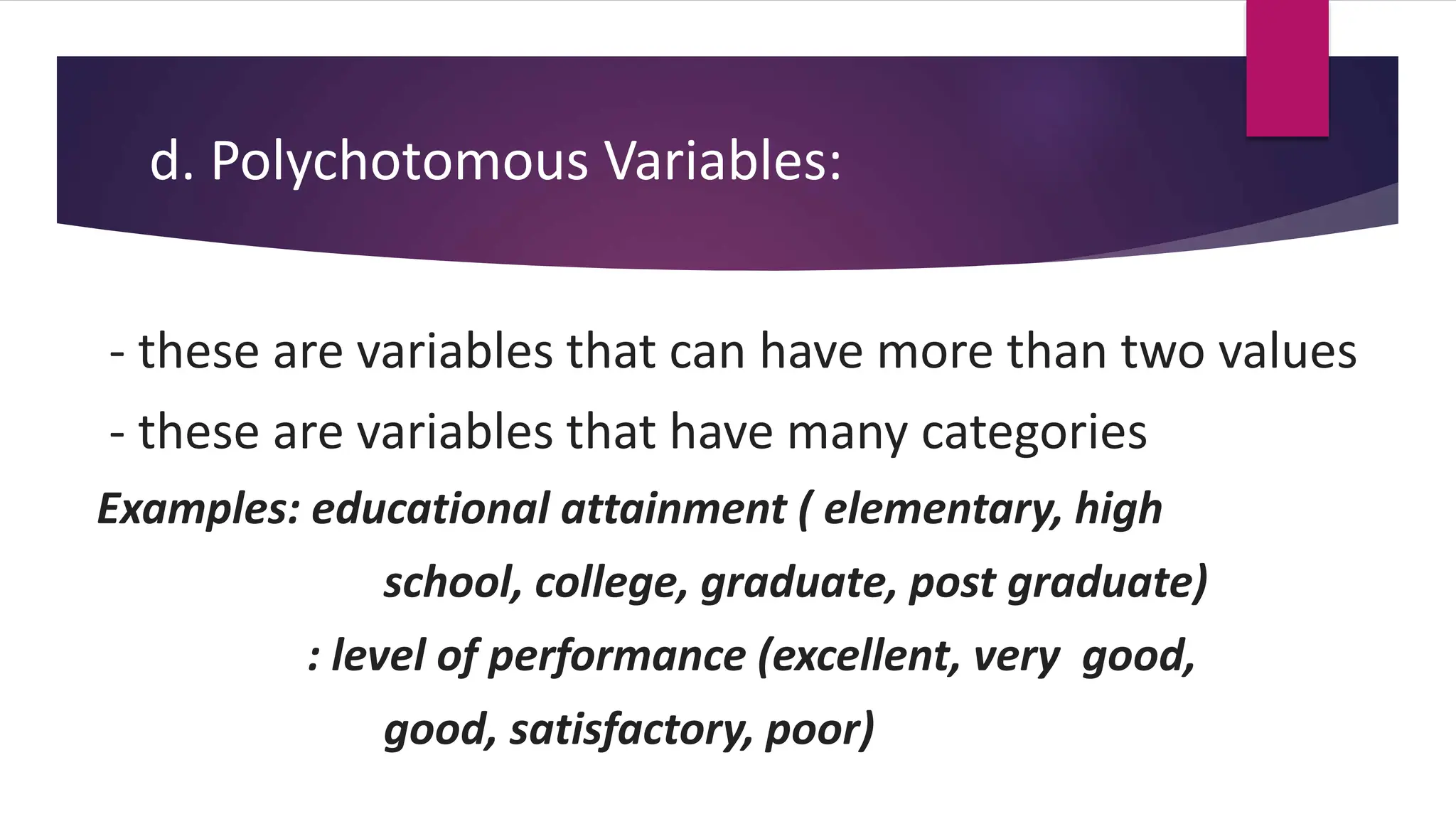
d. Polychotomous Variables:
- these are variables that can have more than two values
- these are variables that have many categories
Examples: educational attainment ( elementary, high
school, college, graduate, post graduate)
: level of performance (excellent, very good,
good, satisfactory, poor)
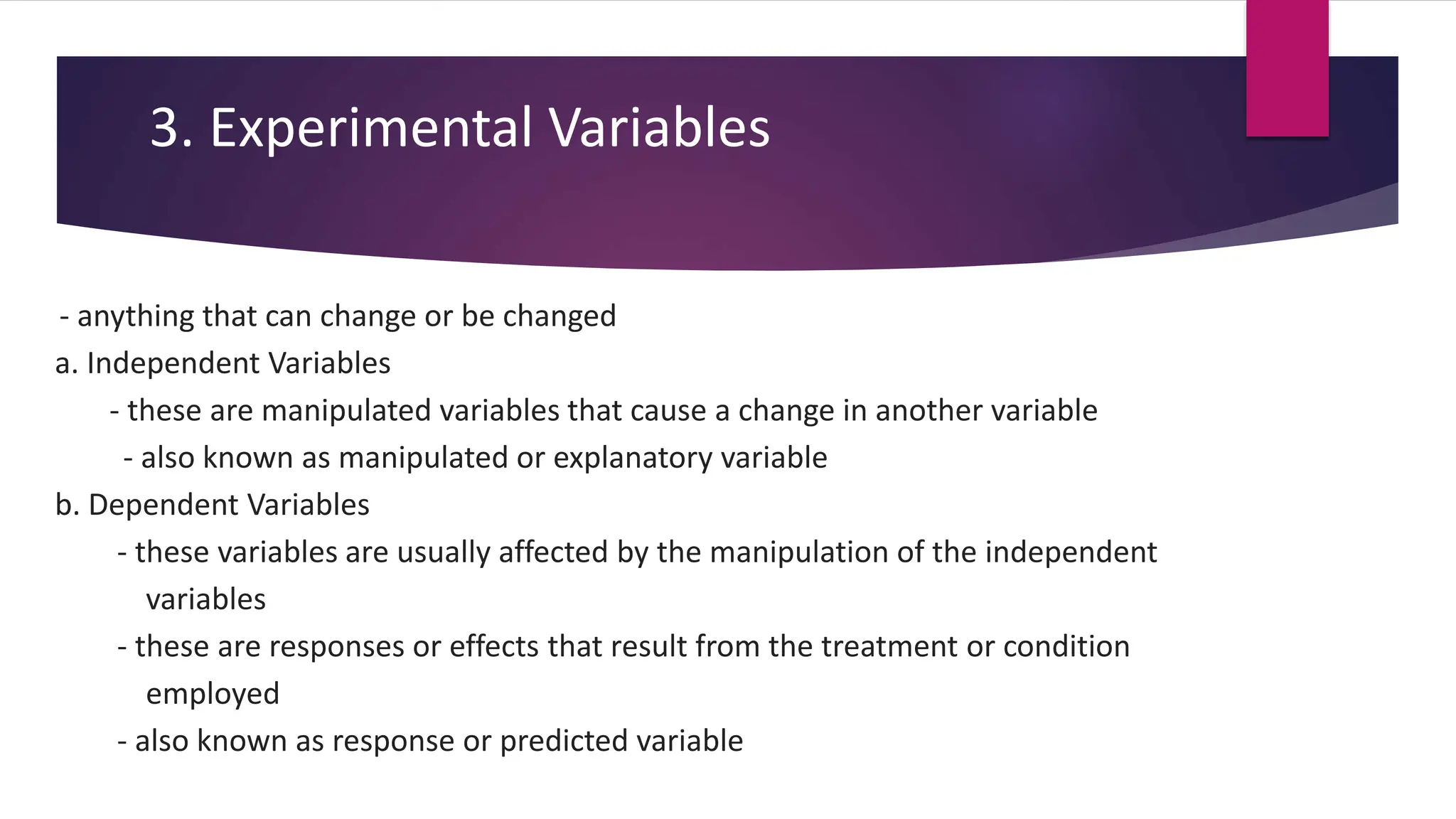
3. Experimental Variables
- anything that can change or be changed
a. Independent Variables
- these are manipulated variables that cause a change in another variable
- also known as manipulated or explanatory variable
b. Dependent Variables
- these variables are usually affected by the manipulation of the independent
variables
- these are responses or effects that result from the treatment or condition
employed
- also known as response or predicted variable
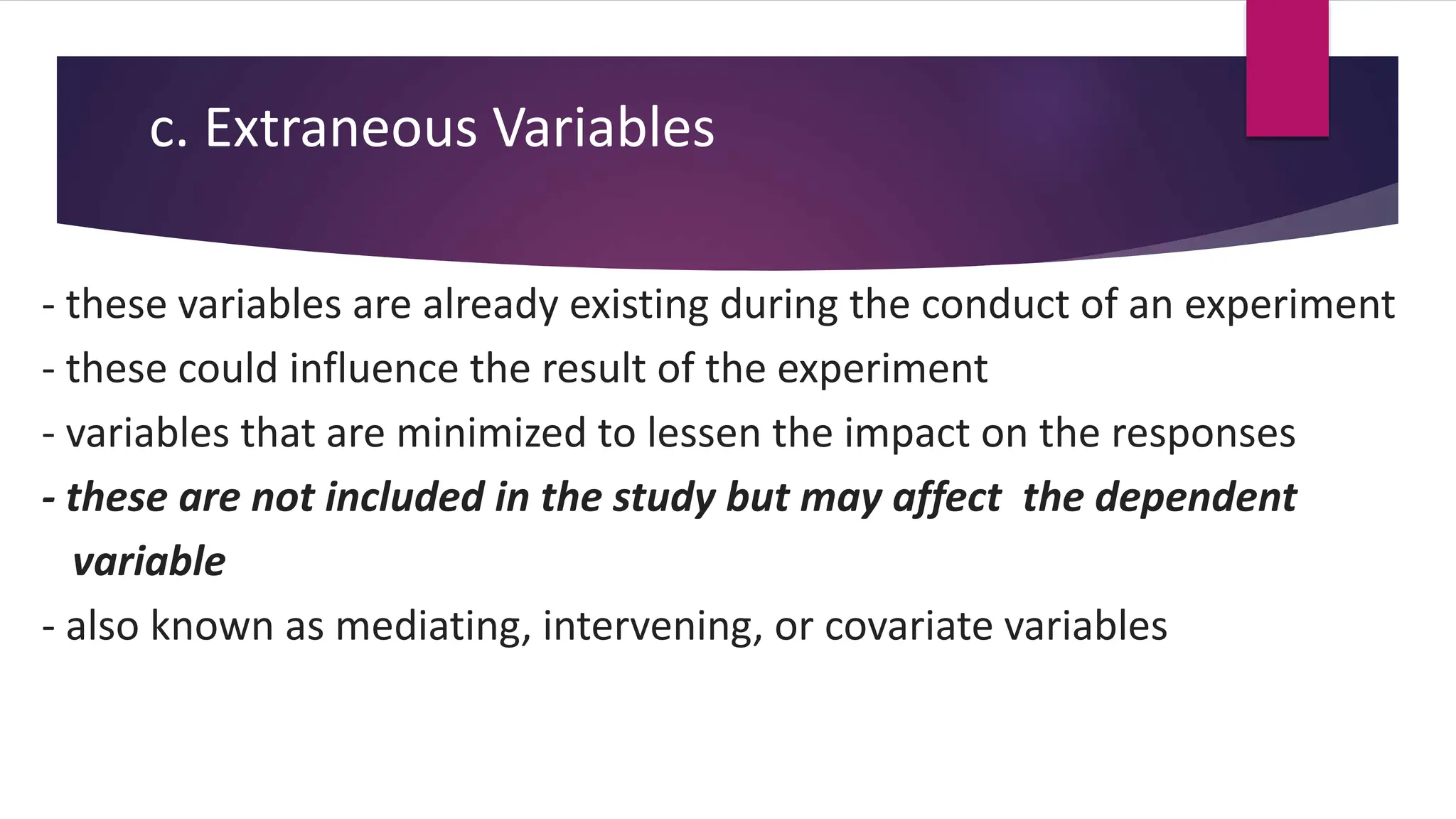
c. Extraneous Variables
- these variables are already existing during the conduct of an experiment
- these could influence the result of the experiment
- variables that are minimized to lessen the impact on the responses
- these are not included in the study but may affect the dependent
variable
- also known as mediating, intervening, or covariate variables
Examples:
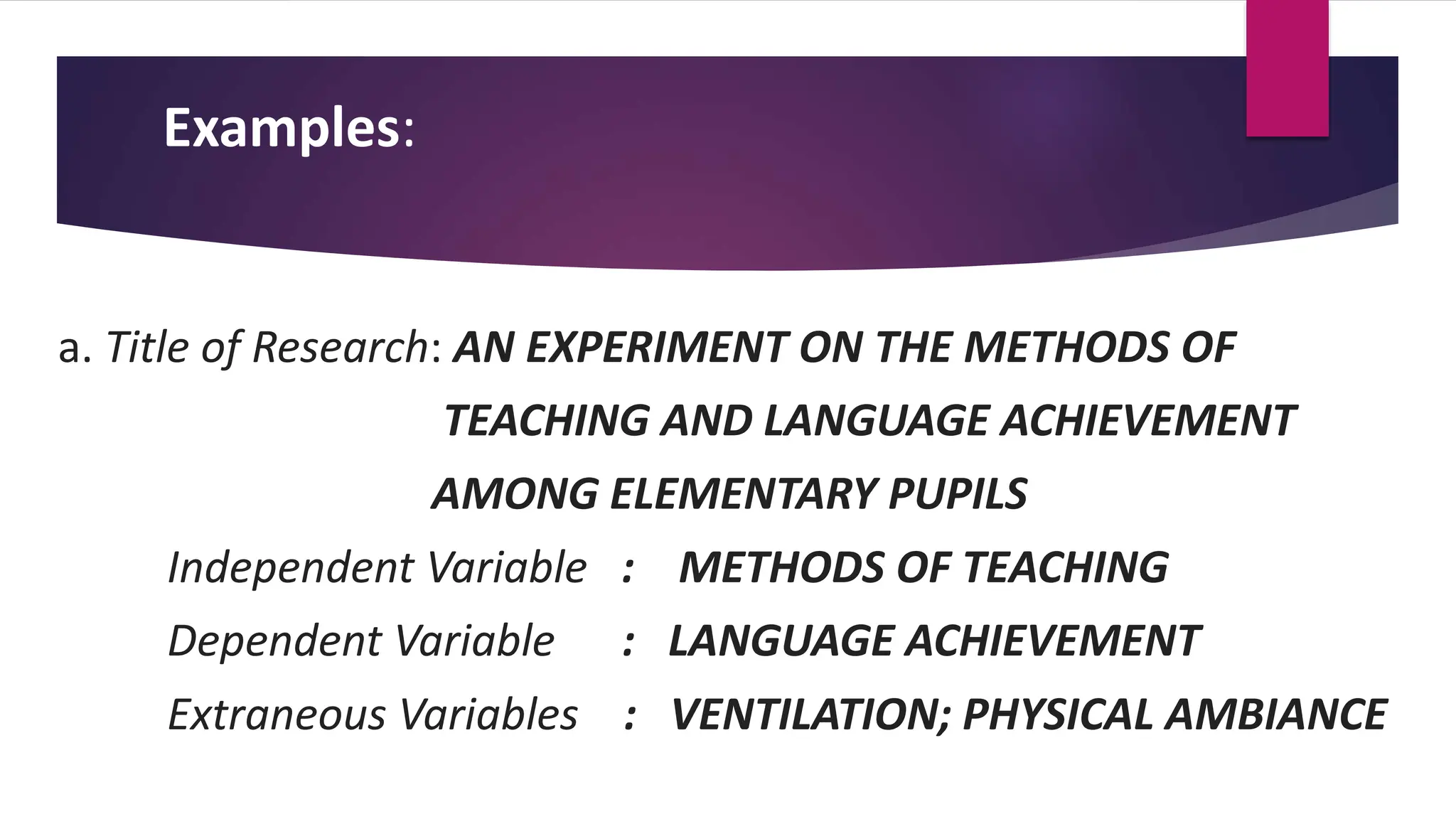
a. Title of Research: AN EXPERIMENT ON THE METHODS OF
TEACHING AND LANGUAGE ACHIEVEMENT
AMONG ELEMENTARY PUPILS
Independent Variable : METHODS OF TEACHING
Dependent Variable : LANGUAGE ACHIEVEMENT
Extraneous Variables : VENTILATION; PHYSICAL AMBIANCE
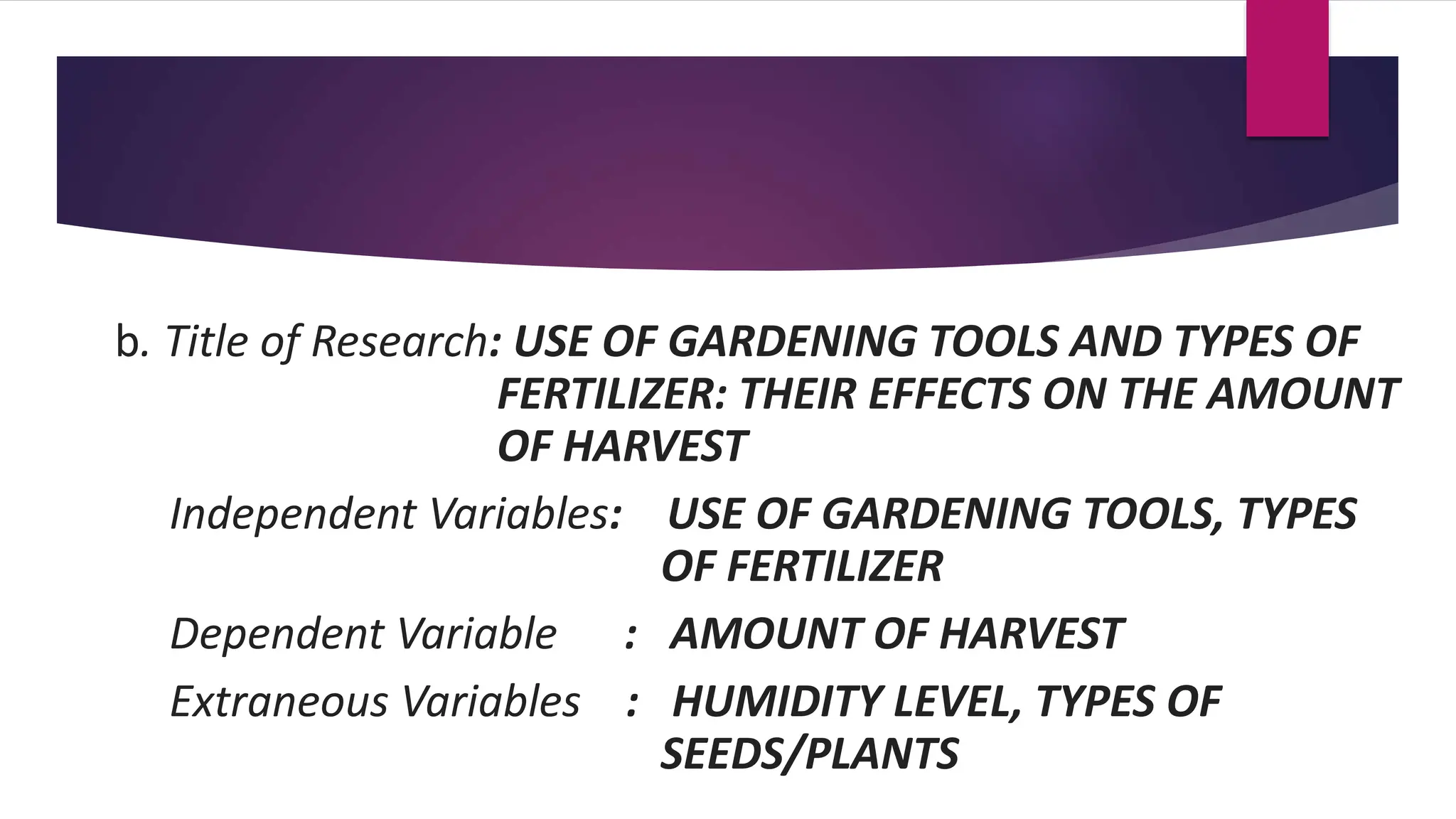
b. Title of Research: USE OF GARDENING TOOLS AND TYPES OF
FERTILIZER: THEIR EFFECTS ON THE AMOUNT
OF HARVEST
Independent Variables: USE OF GARDENING TOOLS, TYPES
OF FERTILIZER
Dependent Variable : AMOUNT OF HARVEST
Extraneous Variables : HUMIDITY LEVEL, TYPES OF
SEEDS/PLANTS
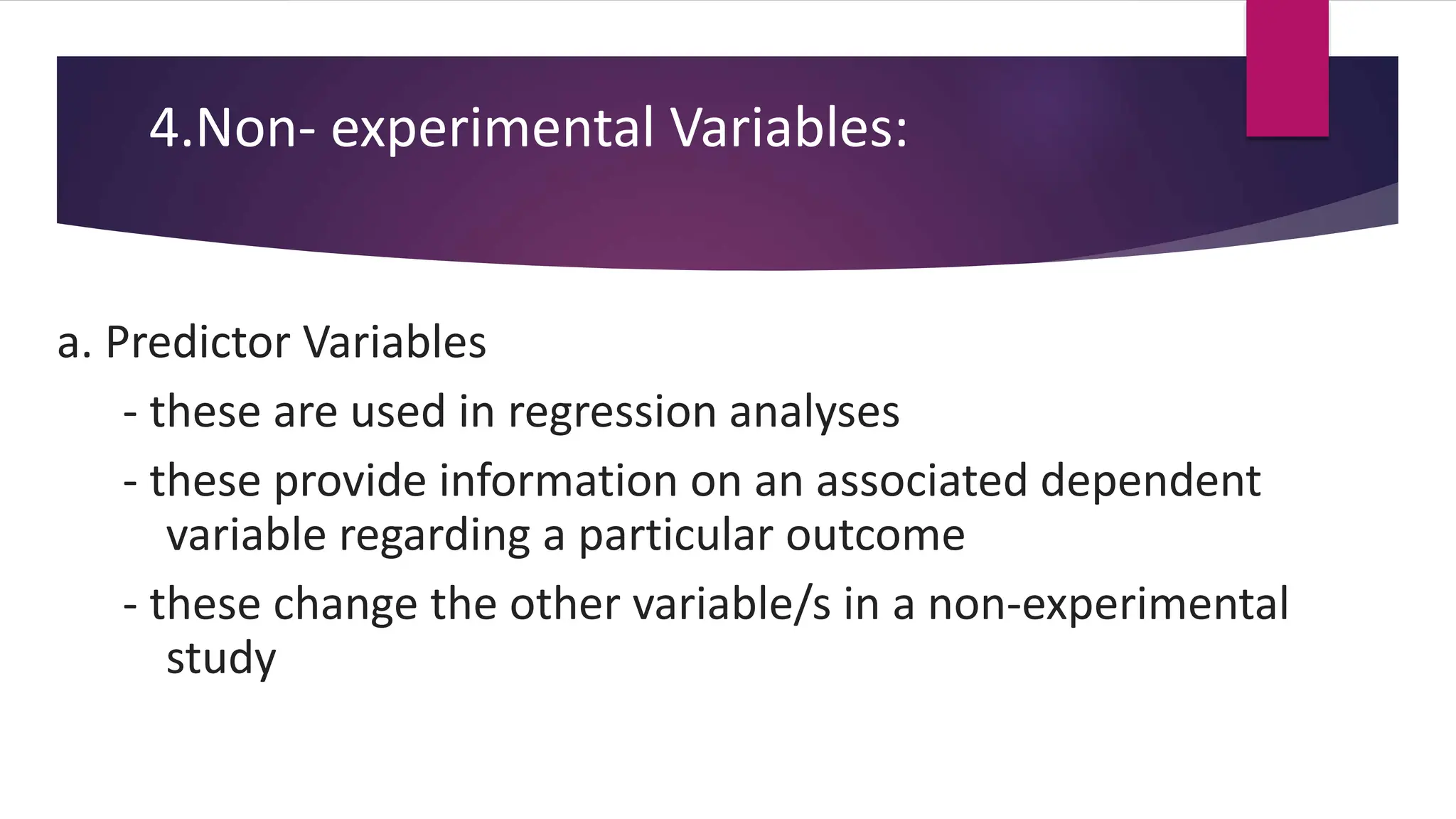
4.Non- experimental Variables:
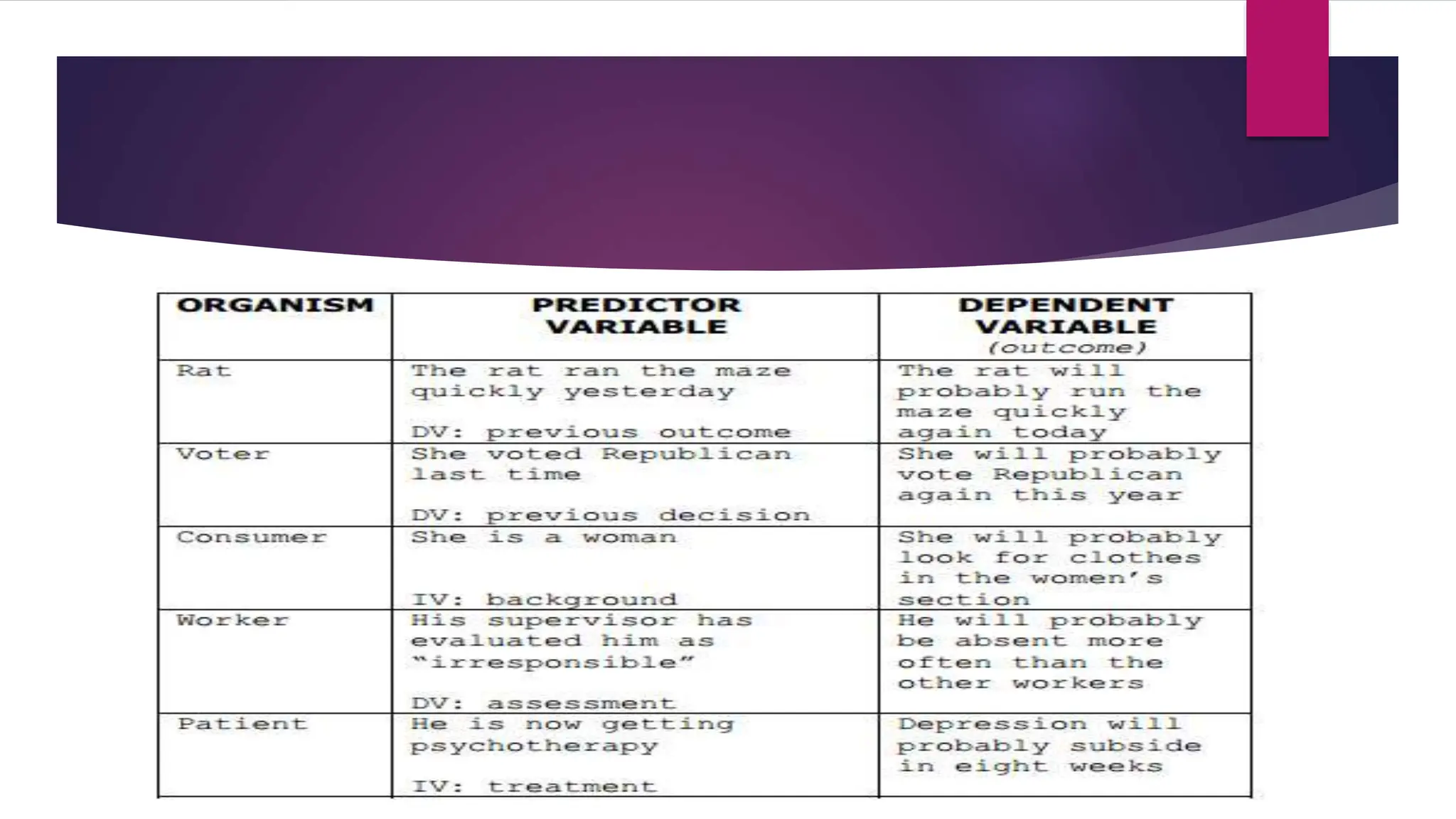
a. Predictor Variables
- these are used in regression analyses
- these provide information on an associated dependent
variable regarding a particular outcome
- these change the other variable/s in a non-experimental
study
b. Criterion Variables
- these are usually affected by predictor variables (outcome)
- these are usually used in making predictions
- also known as the dependent variable but are not exactly
interchangeable
Examples:
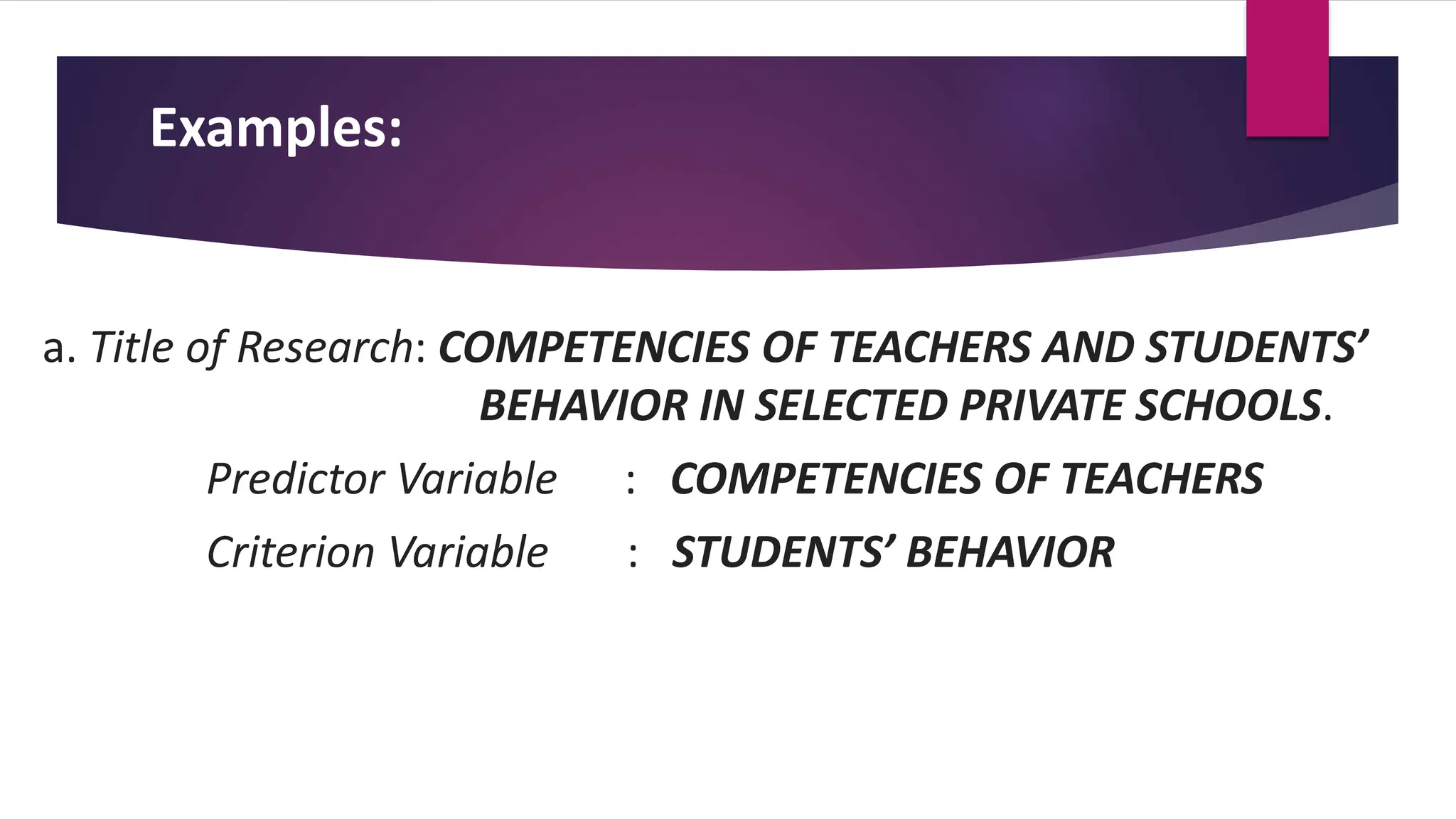
a. Title of Research: COMPETENCIES OF TEACHERS AND STUDENTS’
BEHAVIOR IN SELECTED PRIVATE SCHOOLS.
Predictor Variable : COMPETENCIES OF TEACHERS
Criterion Variable : STUDENTS’ BEHAVIOR
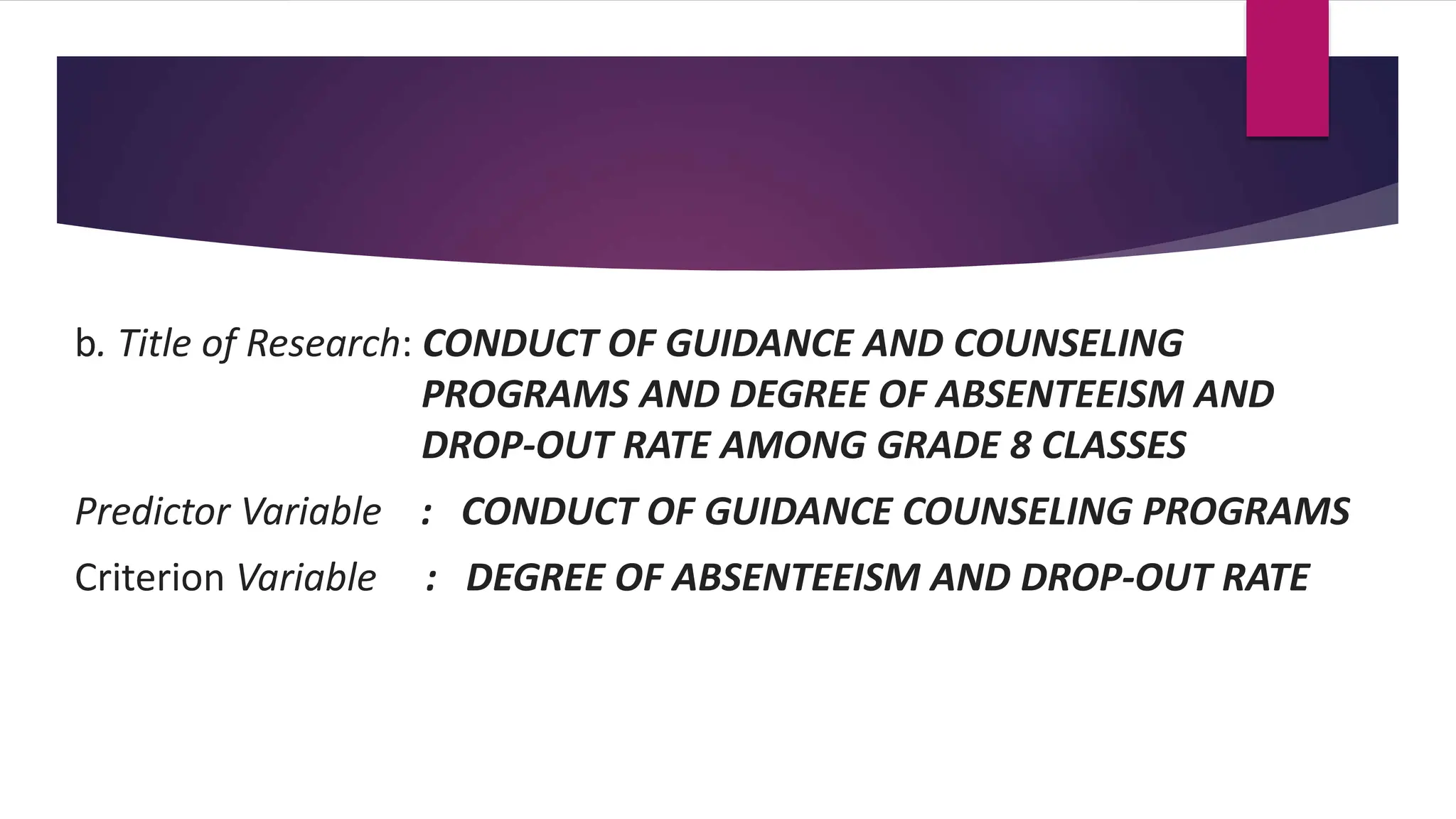
b. Title of Research: CONDUCT OF GUIDANCE AND COUNSELING
PROGRAMS AND DEGREE OF ABSENTEEISM AND
DROP-OUT RATE AMONG GRADE 8 CLASSES
Predictor Variable : CONDUCT OF GUIDANCE COUNSELING PROGRAMS
Criterion Variable : DEGREE OF ABSENTEEISM AND DROP-OUT RATE
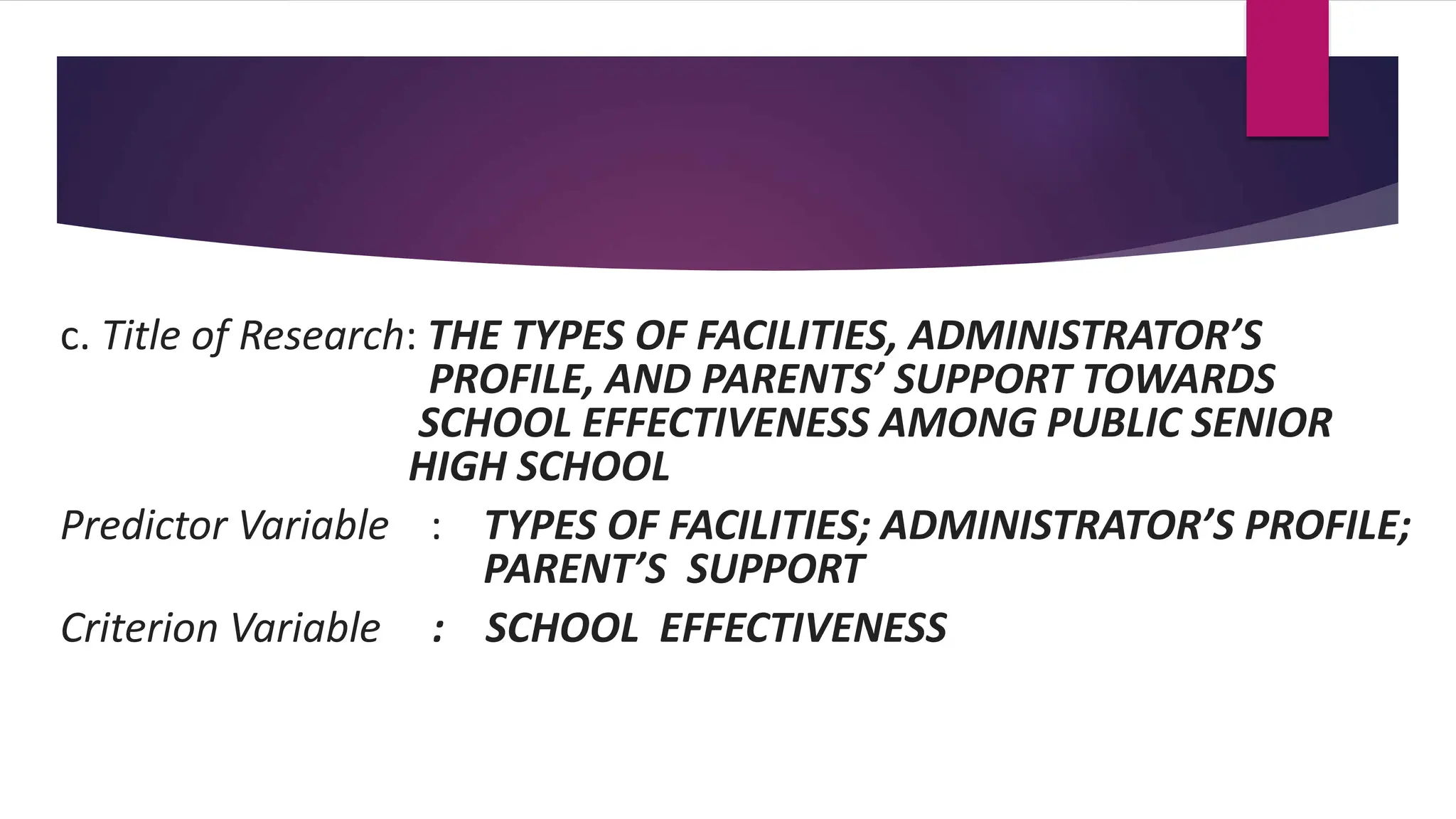
c. Title of Research: THE TYPES OF FACILITIES, ADMINISTRATOR’S
PROFILE, AND PARENTS’ SUPPORT TOWARDS
SCHOOL EFFECTIVENESS AMONG PUBLIC SENIOR
HIGH SCHOOL
Predictor Variable : TYPES OF FACILITIES; ADMINISTRATOR’S PROFILE;
PARENT’S SUPPORT
Criterion Variable : SCHOOL EFFECTIVENESS
THANK YOU
TOPIC EVALUATION
ORDINAL VARIABLE
NOMINAL VARIABLE
DICHOTOMOUS VARIABLE
WHY VARIABLES ARE
IMPORTANT IN
RESEARCH?

CLASSIFICATION-OF-VARIABLES-Research.pptx

  • 1.
  • 2.
    OBJECTIVES 1. Determine theclassifications of variables 2. Differentiate the classifications variables from one another. Identify the types of variables used in a research study.
  • 3.
  • 4.
    VARIABLE  Any propertyor factor that a researcher measures, controls, and /or manipulates.  Any changing quantity or measure of any factor, trait, or condition that can exist in differing amount or types.  It is a logical set of characteristics, numbers, or quantities that can be measured or counted.  Anything that has quantity or quality that varies.
  • 5.
    EXAMPLE: Age, sex, businessincome and expenses, country of birth, capital expenditure, class grades, eye color and vehicle type.
  • 6.
    KINDS OF VARIABLES: 1.Numeric Variable: - variables with values that normally describe a measurable numerical quantity. - values that are considered as quantitative data. - variables that answer the questions “how many “or “how much”
  • 7.
    a. Continuous variables: -these are quantitative or numeric variables - these can be obtained by measuring or computation - also called as interval variables Examples: income, time, age, electric or water bills, height, weight, length, general average
  • 8.
    b. Discrete Variables: -these are quantitative or numeric variables - these can be obtained by counting - these assume any whole value within the limits of given variables Examples: number of family members, number of registered cars, number of votes, number of respondents
  • 9.
    2. Categorical Variables: -these are variables that describe a quality or characteristic of a data - variables that answer the questions “ what type, which category”
  • 10.
    a. Ordinal Variables: -these are values that can be logically arranged or ranked - these can be expressed through sequential and numerical order - these allow comparison of degree Examples: academic grades such as A, B, C, rank such as first, second, third, clothing size such as X,L,M,S,
  • 11.
    b. Nominal Variables: -these are values that cannot be arranged in a logical order or sequence - these are only concerned with names and categories of responses - these cannot quantify data Examples: nationality, hair and eye color, business type, kinds of religion, kinds of languages,
  • 12.
    c. Dichotomous Variables: -these variables represent only two categories when observed and measured - this value is most often a representation for a measured variables Example: age (under 56 or more), gender (male or female), answer (yes or no), correctness ( true or false)
  • 13.
    d. Polychotomous Variables: -these are variables that can have more than two values - these are variables that have many categories Examples: educational attainment ( elementary, high school, college, graduate, post graduate) : level of performance (excellent, very good, good, satisfactory, poor)
  • 14.
    3. Experimental Variables -anything that can change or be changed a. Independent Variables - these are manipulated variables that cause a change in another variable - also known as manipulated or explanatory variable b. Dependent Variables - these variables are usually affected by the manipulation of the independent variables - these are responses or effects that result from the treatment or condition employed - also known as response or predicted variable
  • 15.
    c. Extraneous Variables -these variables are already existing during the conduct of an experiment - these could influence the result of the experiment - variables that are minimized to lessen the impact on the responses - these are not included in the study but may affect the dependent variable - also known as mediating, intervening, or covariate variables
  • 16.
    Examples: a. Title ofResearch: AN EXPERIMENT ON THE METHODS OF TEACHING AND LANGUAGE ACHIEVEMENT AMONG ELEMENTARY PUPILS Independent Variable : METHODS OF TEACHING Dependent Variable : LANGUAGE ACHIEVEMENT Extraneous Variables : VENTILATION; PHYSICAL AMBIANCE
  • 17.
    b. Title ofResearch: USE OF GARDENING TOOLS AND TYPES OF FERTILIZER: THEIR EFFECTS ON THE AMOUNT OF HARVEST Independent Variables: USE OF GARDENING TOOLS, TYPES OF FERTILIZER Dependent Variable : AMOUNT OF HARVEST Extraneous Variables : HUMIDITY LEVEL, TYPES OF SEEDS/PLANTS
  • 18.
    4.Non- experimental Variables: a.Predictor Variables - these are used in regression analyses - these provide information on an associated dependent variable regarding a particular outcome - these change the other variable/s in a non-experimental study
  • 20.
    b. Criterion Variables -these are usually affected by predictor variables (outcome) - these are usually used in making predictions - also known as the dependent variable but are not exactly interchangeable
  • 21.
    Examples: a. Title ofResearch: COMPETENCIES OF TEACHERS AND STUDENTS’ BEHAVIOR IN SELECTED PRIVATE SCHOOLS. Predictor Variable : COMPETENCIES OF TEACHERS Criterion Variable : STUDENTS’ BEHAVIOR
  • 22.
    b. Title ofResearch: CONDUCT OF GUIDANCE AND COUNSELING PROGRAMS AND DEGREE OF ABSENTEEISM AND DROP-OUT RATE AMONG GRADE 8 CLASSES Predictor Variable : CONDUCT OF GUIDANCE COUNSELING PROGRAMS Criterion Variable : DEGREE OF ABSENTEEISM AND DROP-OUT RATE
  • 23.
    c. Title ofResearch: THE TYPES OF FACILITIES, ADMINISTRATOR’S PROFILE, AND PARENTS’ SUPPORT TOWARDS SCHOOL EFFECTIVENESS AMONG PUBLIC SENIOR HIGH SCHOOL Predictor Variable : TYPES OF FACILITIES; ADMINISTRATOR’S PROFILE; PARENT’S SUPPORT Criterion Variable : SCHOOL EFFECTIVENESS
  • 24.
  • 25.
    TOPIC EVALUATION ORDINAL VARIABLE NOMINALVARIABLE DICHOTOMOUS VARIABLE
  • 26.