Variable
BY: DR. VICKY KASUNDRA
(MPT NEURO)
Variable
 A characteristic that varies with an individual or object.
 It can vary from person to person or within one person over time.
 Also known as “attribute or denoted by x”.
 E.g. age, weight, height etc.
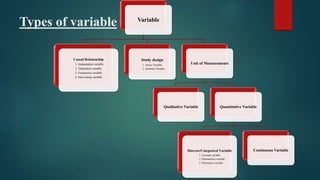
Types of variable Variable
Causal Relationship
1. Independent variable
2. Dependent variable
3. Extraneous variable
4. Intervening variable
Study design
1. Active Variable
2. Attribute Variable
Unit of Measurements
Qualitative Variable Quantitative Variable
Discrete/Categorical Variable
1. Constant variable
2. Dichotomies variable
3. Polytomies variable
Continuous Variable
1. Causal Relationship
I. Independent Variable
 The variables which are manipulated or controlled by researchers k/a
independent variable.
 These variable are manipulated too see effect on dependent variable.
II. Dependent Variable
 A variable that is being tested & measured k/a dependent variable.
 The variable which shows the effect of independent variable k/a
dependent variable.
III. Extraneous Variable
 Undesirable variable that are not related to the purpose of the study, but may
affect the dependent variable k/a extraneous variable.
 It can not be controlled.
IV. Intervening / Moderating / Confounding Variable
 A variable that has a strong contingent effect on the independent & dependent
variable relationship.
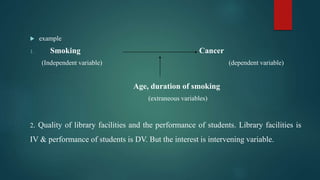
 example
1. Smoking Cancer
(Independent variable) (dependent variable)
Age, duration of smoking
(extraneous variables)
2. Quality of library facilities and the performance of students. Library facilities is
IV & performance of students is DV. But the interest is intervening variable.
2. Study design
I. Active Variable
 The variable that can be manipulated, controlled or changed k/a active variable
 e.g., study intervention (different exercises, teaching method).
 Researcher can manipulate this variable.
II. Attribute Variable
 The variable that can not be manipulated, controlled or changed k/a attribute variable.
 E.g., study population (age, gender, religion) etc.
 Researcher can not manipulate this variable.
3. Unit of measurement
I. Qualitative Variable
 A variable that characteristic can be expressed non-numerically k/a qualitative
variable.
 E.g. eye color, poverty, pain.
 Including the nominal or ordinal scale data.
II. Quantitative variable
 A variable that characteristics can be expressed numerically k/a quantitative
variable.
 E.g.., age, height, weight.
 It can be further classified as continuous or discrete variable.
i. Continuous Variable
 A variable that can take any fraction or integral value as continuous.
 E.g. temperature, height, weight.
ii. Discrete / categorical variable
 A variable that take only discrete set of integers or whole numbers k/ a discrete
variable.
 It can further classified into 3.
 Constant, dichotomus, polytomies.
Discrete
Variable
Constant Variable
•Only one value or category
•e.g. taxi, tree
Dichotomus Variable
Only two value or category
e.g. good/bed, yes/no
Polytomies Variable
More than two values or category
e.g. religion (Hindu/Muslim/Christian
References
 Biostatistics for medical students and research workers by B.K. Mahajan
 Research methodology by Ranjit Kumar
Thank you

variable.pptx

  • 1.
    Variable BY: DR. VICKYKASUNDRA (MPT NEURO)
  • 2.
    Variable  A characteristicthat varies with an individual or object.  It can vary from person to person or within one person over time.  Also known as “attribute or denoted by x”.  E.g. age, weight, height etc.
  • 3.
    Types of variableVariable Causal Relationship 1. Independent variable 2. Dependent variable 3. Extraneous variable 4. Intervening variable Study design 1. Active Variable 2. Attribute Variable Unit of Measurements Qualitative Variable Quantitative Variable Discrete/Categorical Variable 1. Constant variable 2. Dichotomies variable 3. Polytomies variable Continuous Variable
  • 4.
    1. Causal Relationship I.Independent Variable  The variables which are manipulated or controlled by researchers k/a independent variable.  These variable are manipulated too see effect on dependent variable. II. Dependent Variable  A variable that is being tested & measured k/a dependent variable.  The variable which shows the effect of independent variable k/a dependent variable.
  • 5.
    III. Extraneous Variable Undesirable variable that are not related to the purpose of the study, but may affect the dependent variable k/a extraneous variable.  It can not be controlled. IV. Intervening / Moderating / Confounding Variable  A variable that has a strong contingent effect on the independent & dependent variable relationship.
  • 6.
     example 1. SmokingCancer (Independent variable) (dependent variable) Age, duration of smoking (extraneous variables) 2. Quality of library facilities and the performance of students. Library facilities is IV & performance of students is DV. But the interest is intervening variable.
  • 7.
    2. Study design I.Active Variable  The variable that can be manipulated, controlled or changed k/a active variable  e.g., study intervention (different exercises, teaching method).  Researcher can manipulate this variable. II. Attribute Variable  The variable that can not be manipulated, controlled or changed k/a attribute variable.  E.g., study population (age, gender, religion) etc.  Researcher can not manipulate this variable.
  • 8.
    3. Unit ofmeasurement I. Qualitative Variable  A variable that characteristic can be expressed non-numerically k/a qualitative variable.  E.g. eye color, poverty, pain.  Including the nominal or ordinal scale data. II. Quantitative variable  A variable that characteristics can be expressed numerically k/a quantitative variable.  E.g.., age, height, weight.  It can be further classified as continuous or discrete variable.
  • 9.
    i. Continuous Variable A variable that can take any fraction or integral value as continuous.  E.g. temperature, height, weight. ii. Discrete / categorical variable  A variable that take only discrete set of integers or whole numbers k/ a discrete variable.  It can further classified into 3.  Constant, dichotomus, polytomies.
  • 10.
    Discrete Variable Constant Variable •Only onevalue or category •e.g. taxi, tree Dichotomus Variable Only two value or category e.g. good/bed, yes/no Polytomies Variable More than two values or category e.g. religion (Hindu/Muslim/Christian
  • 11.
    References  Biostatistics formedical students and research workers by B.K. Mahajan  Research methodology by Ranjit Kumar
  • 12.