I.F.D.C.	
  LENGUAS	
  VIVAS	
  
TALLER	
  DE	
  PRÁCTICA	
  DOCENTE	


ALUMNO	
  RESIDENTE:	
  CALIZAYA,	
  María	
  Eugenia	


Período	
  de	
  Práctica:	
  Educación	
  Primaria	


Institución	
  Educativa:	
  Escuela	
  Nro.	
  81	


Dirección:	
  Calle	
  118	
  y	
  120	
  B.	
  Industrial	


Sala	
  /	
  Grado	
  /	
  Año	
  -­‐	
  Sección:	
  4to	
  Grado	


Cantidad	
  de	
  alumnos:	
  24	


Nivel	
  lingüístico	
  del	
  curso:	
  Principiantes	


Tipo	
  de	
  Planificación:	
  Clase	


Unidad	
  Temática:	
  Días	
  de	
  la	
  Semana	


Clase	
  Nº:	
  4	


Fecha:	
  12/07/2017	


Hora:	
  13:00hs.	
  –	
  14:20	
  hs.	


Duración	
  de	
  la	
  clase:	
  80	
  minutos	


Fecha	
  de	
  entrega:	
  09/07/2017	


✓ Aims	
  or	
  goals:	
  During	
  this	
  lesson,	
  learners	
  will	
  be	
  able	
  to…	


• Review	
  vocabulary.	
  
• Make	
  predictions	
  about	
  the	
  new	
  topic.	
  	
  
• Introduce	
  new	
  vocabulary	
  related	
  to	
  countable	
  and	
  uncountable	
  nouns.	
  
• Participate	
  actively	
  in	
  the	
  tasks	
  to	
  enhance	
  the	
  development	
  of	
  listening	
  
skills.	


✓ Teaching	
  points:	
  	
  
• Revision	
  of	
  food,	
  numbers	
  and	
  colors.	
  
• Use	
  Present	
  Simple:	
  There	
  is/are.	


✓ 	
  Language	
  focus:	


   Lexis	
   Functions	
  	
   Structures	
   Pronunciation	
  
Revision	
   Hello.	
  
Numbers.	
  
Colours	
  and	
  
Food	
  
Greetings	
  and	
  
Giving	
  
commands.	
  
Identify	
  the	
  
numbers,	
  food	
  
items	
  and	
  
colours.	
  
Present	
  Simple	
  
Hello!	


Fish/ɪ/	
  
New	
   Fruits,	
  
vegetables	
  
and	
  food	
  
items.	
  
Present	
  simple	
  
with	
  There	
  
is/are.	
  
Countable	
  and	
  
uncountable	
  
nouns.	
  
There	
  is/are….in	
  
the	
  fridge	
  
How	
  many	
  eggs	
  
are	
  there?	


There	
  /ð/	


✓ Teaching	
  approach	
  or	
  combination	
  of	
  methods	
  /	
  approaches:	
  The	
  lesson	
  is	
  based	
  
on	
  Communicative	
  Approach	
  and	
  organized	
  through	
  the	
  PPP	
  method.	
  
✓ Integration	
  of	
  skills:	
  The	
  skills	
  the	
  students	
  develop	
  are	
  listening	
  and	
  speaking	
  
skills,	
  through	
  the	
  listening	
  of	
  pronunciation	
  of	
  the	
  objects	
  they	
  can	
  see	
  and	
  
producing	
  their	
  own	
  chunks	
  of	
  vocabulary	
  on	
  their	
  own.	
  Also	
  the	
  students	
  
develop	
  reading	
  and	
  writing	
  skills	
  throughout	
  the	
  activities.	
  
✓ Materials	
  and	
  resources:	
  For	
  this	
  lesson	
  we	
  need	
  a	
  picture	
  of	
  a	
  child,	
  a	
  La	
  
Anónima´s	
  bag,	
  potatoes,	
  eggs,	
  carrots,	
  bananas,	
  apples,	
  spaghetti,	
  sugar,	
  tea,	
  
tomatoes,	
  rice	
  and	
  milk,	
  glue,	
  worksheets,	
  a	
  whiteboard	
  and	
  markers,	
  colours.	
  	
  
✓ Pedagogical	
  use	
  of	
  ICT	
  in	
  class	
  or	
  at	
  home:	
  audiovisual	
  material	
  will	
  be	
  used	
  to	
  
support	
  the	
  exposure	
  of	
  the	
  students	
  to	
  the	
  teaching	
  point.	
  
✓ Seating	
  arrangement:	
  The	
  students	
  will	
  be	
  on	
  their	
  own	
  tables,	
  and	
  later	
  
arranged	
  in	
  groups.	
  Assessment:	
  I’ll	
  check	
  the	
  students’	
  comprehension	
  by	
  
making	
  gestures	
  and	
  miming.	
  Also	
  I’ll	
  check	
  if	
  they	
  understand	
  and	
  identify	
  
names	
  of	
  the	
  objects	
  they	
  see	
  and	
  identify	
  what	
  the	
  activities	
  will	
  be	
  about.	
  I’ll	
  
encourage	
  them	
  to	
  produce	
  chunks	
  of	
  language	
  during	
  the	
  speaking	
  stage.	


➢ Routine:	
  5	
  minutes	
  
Purpose:	
  Start	
  the	
  lesson;	
  get	
  students	
  into	
  the	
  mood	
  for	
  work.	
  
I’ll	
  walk	
  into	
  the	
  classroom	
  and	
  greet	
  students:	
  “Hello!	
  How	
  are	
  you?”	
  EA:	
  Hello!	


Transition:	
  I’ll	
  tell	
  the	
  students	
  I	
  saw	
  Juan	
  this	
  weekend	
  (I	
  stick	
  Juan’s	
  picture	
  on	
  the	
  
board)	
  do	
  you	
  remember	
  Juan?	
  EA:	
  Yes!!	


➢ Warm	
  up:	
  5	
  minutes	
  
Purpose:	
  Introduce	
  the	
  topic	
  and	
  the	
  teaching	
  points.	
  
I	
  say	
  to	
  the	
  students:	
  “Ok,	
  I	
  saw	
  Juan	
  in	
  “La	
  Anónima”	
  with	
  his	
  mother.	
  Juan´s	
  mum	
  was	
  
buying	
  some	
  food	
  there	
  and	
  me	
  too.	
  Do	
  you	
  want	
  to	
  see	
  what´s	
  in	
  my	
  bag??”	
  EA:	
  yes!!	
  	
  
I	
  show	
  them	
  the	
  La	
  Anónima´s	
  bag	
  and	
  open	
  it.	
  I	
  show	
  them	
  what	
  is	
  in	
  my	
  bag.	
  I	
  elicit	
  
the	
  vocabulary	
  as	
  I	
  do	
  that	
  and	
  also	
  it	
  is	
  the	
  opportunity	
  to	
  review	
  colours.	


Transition:	
  I	
  tell	
  my	
  students:	
  “OK!	
  We	
  are	
  talking	
  about	
  how	
  many	
  things	
  are	
  there”.	


➢ Presentation:	
  10	
  minutes	
  
Purpose:	
  To	
  further	
  expose	
  learners	
  to	
  the	
  target	
  language,	
  foster	
  comprehension.	
  
Materials:.	


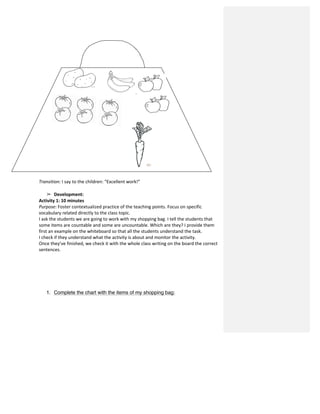
I	
  give	
  my	
  students	
  a	
  worksheet	
  of	
  a	
  similar	
  bag	
  with	
  some	
  food	
  items	
  in	
  it.	
  I	
  tell	
  the	
  
students:	
  “This	
  is	
  Juan´s	
  mum`s	
  shopping	
  bag,	
  let´s	
  see	
  how	
  many	
  things	
  are	
  there.	
  For	
  
example,	
  how	
  many	
  apples	
  are	
  there?	
  I	
  write	
  on	
  the	
  board:	
  There	
  are…	
  EA:	
  There	
  are	
  
four	
  apples.	
  Then	
  I	
  ask:	
  How	
  many	
  carrots	
  are	
  there?	
  I	
  write	
  on	
  the	
  board:	
  There	
  is…	
  EA:	
  
There	
  is	
  one	
  carrot!”	
  I	
  ask	
  them	
  also	
  how	
  many	
  bananas	
  and	
  potatoes	
  are	
  there.	
  	
  
Aurelia 7/10/17 8:48 AM
Deleted: ed


Transition:	
  I	
  say	
  to	
  the	
  children:	
  “Excellent	
  work!”	


➢ Development:	
  	
  
Activity	
  1:	
  10	
  minutes	
  
Purpose:	
  Foster	
  contextualized	
  practice	
  of	
  the	
  teaching	
  points.	
  Focus	
  on	
  specific	
  
vocabulary	
  related	
  directly	
  to	
  the	
  class	
  topic.	
  
I	
  ask	
  the	
  students	
  we	
  are	
  going	
  to	
  work	
  with	
  my	
  shopping	
  bag.	
  I	
  tell	
  the	
  students	
  that	
  
some	
  items	
  are	
  countable	
  and	
  some	
  are	
  uncountable.	
  Which	
  are	
  they?	
  I	
  provide	
  them	
  
first	
  an	
  example	
  on	
  the	
  whiteboard	
  so	
  that	
  all	
  the	
  students	
  understand	
  the	
  task.	
  	
  
I	
  check	
  if	
  they	
  understand	
  what	
  the	
  activity	
  is	
  about	
  and	
  monitor	
  the	
  activity.	
  	
  
Once	
  they’ve	
  finished,	
  we	
  check	
  it	
  with	
  the	
  whole	
  class	
  writing	
  on	
  the	
  board	
  the	
  correct	
  
sentences.	


1. Complete the chart with the items of my shopping bag:
COUNTABLE	
   UNCOUNTABLE	
  
CARROTS	
   MILK	


Transition:	
  After	
  doing	
  this	
  activity,	
  I	
  tell	
  them:	
  “Excellent	
  job!	
  Keep	
  on	
  working	
  with	
  
food	
  items!!!	


Activity	
  2:	
  20	
  minutes	
  
Purpose:	
  review	
  the	
  vocabulary	
  and	
  to	
  further	
  expose	
  to	
  the	
  new	
  vocabulary.	
  
Materials:	
  My	
  shopping	
  bag	
  with	
  the	
  food	
  items,	
  the	
  whiteboard	
  and	
  markers.	
  
I	
  tell	
  the	
  students:	
  “Now,	
  we	
  are	
  asking	
  and	
  answering	
  about	
  what	
  my	
  shopping	
  bag	
  has.	
  
”	
  I	
  write	
  on	
  the	
  board:	
  How	
  many	
  carrots	
  are	
  there?	
  There	
  are	
  two	
  carrots.	
  	
  
How	
  much	
  milk	
  are	
  there?	
  There	
  is	
  some	
  milk.	
  	
  
I	
  explained	
  the	
  difference	
  between	
  them	
  and	
  asked	
  the	
  students	
  to	
  do	
  the	
  same	
  with	
  
the	
  food	
  items	
  listed	
  on	
  the	
  chart.	
  The	
  students	
  will	
  be	
  allowed	
  to	
  sit	
  in	
  small	
  groups	
  to	
  
do	
  the	
  activity.	
  I’ll	
  monitor	
  the	
  activity	
  and	
  provide	
  the	
  vocabulary	
  items	
  as	
  necesasry.	


2. Write the questions and answers:
How	
  many	
  carrots	
  are	
  there?	
  There	
  are	
  two	
  carrots.	
  	
  
How	
  much	
  milk	
  are	
  there?	
  There	
  is	
  a	
  carton	
  of	
  milk
Transition:	
  I	
  say	
  to	
  my	
  students:	
  “Great!!!	
  Now,	
  you	
  can	
  have	
  it	
  in	
  your	
  notebook!!!	


Activity	
  3:	
  25	
  minutes	
  
Purpose:	
  Work	
  collaboratively	
  and	
  review	
  the	
  vocabulary.	
  Further	
  expose	
  the	
  learners	
  
to	
  the	
  new	
  lexical	
  items.	
  	
  
Materials:	
  blackboard	
  and	
  colour	
  pencils	


I’ll	
  ask	
  the	
  students	
  to	
  sit	
  down	
  in	
  groups	
  of	
  four	
  students.	
  I	
  tell	
  them	
  they	
  have	
  to	
  draw	
  
and	
  then	
  explain	
  how	
  they	
  prepare	
  these	
  meals.	
  They	
  have	
  to	
  choose	
  between	
  these	
  
different	
  meals:	
  Pizza,	
  soup,	
  hamburguer	
  and	
  fruit	
  salad.	
  I	
  help	
  them	
  to	
  understand	
  
using	
  some	
  visual	
  aids	
  so	
  that	
  they	
  understand	
  what	
  they	
  have	
  to	
  do.	
  I	
  develop	
  an	
  
example	
  using	
  the	
  recipe	
  of	
  spaghetti:	
  
Aurelia 7/10/17 8:50 AM
Deleted: ed
Aurelia 7/10/17 8:50 AM
Deleted: do	
  
Aurelia 7/10/17 8:51 AM
Comment [1]: As	
  far	
  as	
  I	
  can	
  see,	
  they	
  will	
  
be	
  working	
  on	
  the	
  ingredients,	
  not	
  on	
  the	
  
recipe	
  itself.	
  
Aurelia 7/10/17 8:50 AM
Deleted: usign	
  
3. Draw and complete your recipe:
.	
  Once	
  they’ve	
  finished,	
  I	
  choose	
  two	
  or	
  three	
  menus	
  at	
  random	
  and	
  they	
  share	
  their	
  
work	
  with	
  the	
  rest	
  of	
  the	
  class.	
  I	
  provide	
  assistance	
  if	
  any	
  additional	
  new	
  vocabulary	
  is	
  
needed.	


Closure:	
  	
  10	
  minutes	
  
Recipe:
1. A packet of
spaghetti
2. Three tomatoes
3. Salt
4. Chicken
5. Some cheese
6. Some water
Recipe:
1.
7. 2.
8. 3.
9. 4.
10.5.
11.6.
Aurelia 7/10/17 8:50 AM
Formatted: Indent: Left: 0.25", No bullets
or numbering
Aurelia 7/10/17 8:51 AM
Comment [2]: Lists	
  of	
  ingredients	
  
Purpose:	
  Review	
  the	
  vocabulary	
  and	
  end	
  this	
  lesson.	


At	
  this	
  stage	
  I	
  tell	
  the	
  students:	
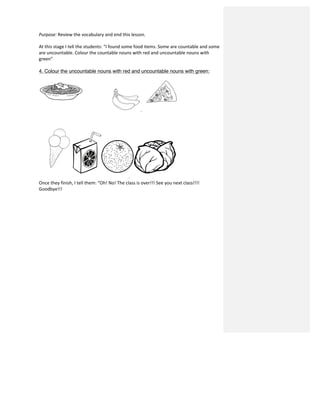
  “I	
  found	
  some	
  food	
  items.	
  Some	
  are	
  countable	
  and	
  some	
  
are	
  uncountable.	
  Colour	
  the	
  countable	
  nouns	
  with	
  red	
  and	
  uncountable	
  nouns	
  with	
  
green”	


4. Colour the uncountable nouns with red and uncountable nouns with green:
.	
  
Once	
  they	
  finish,	
  I	
  tell	
  them:	
  “Oh!	
  No!	
  The	
  class	
  is	
  over!!!	
  See	
  you	
  next	
  class!!!!	
  
Goodbye!!!	


IMPORTANT!	
  	
  
The	
  format	
  in	
  which	
  the	
  stages	
  are	
  presented	
  will	
  vary	
  according	
  to	
  the	
  teaching	
  
approach	
  or	
  combination	
  of	
  approaches	
  you	
  decide	
  to	
  base	
  your	
  lesson	
  plan	
  upon.	


➢ To	
  be	
  completed	
  by	
  your	
  tutors:	


Lesson	
  plan	
  
component	
  
Excellent	
  
5	
  
Very	
  
Good	
  
4	
  
Good	
  
3	
  
Acceptable	
  
2	
  
Below	
  
Standard	
  
1	
  
Visual	
  
organization	
  
x	


Coherence	
  and	
  
sequencing	
  
	
   x	


Variety	
  of	
  
resources	
  –	
  
Learning	
  styles	
  
	
   x	


Stages	
  and	
  
activities	
  
	
   x	


Teaching	
  
strategies	
  
	
   x	


Language	
  
accuracy	
  
	
   x	


Observations	
   Lovely	
  lesson!	
  Work	
  on	
  your	
  teaching	
  strategies,	
  and	
  make	
  sure	
  
you	
  use	
  L2	
  as	
  much	
  as	
  possible.	
  Think	
  of	
  the	
  classroom	
  
arrangement,	
  so	
  that	
  everybody	
  can	
  see	
  and	
  participate	
  actively.	


Do	
  your	
  best!	
  
Aure	


Aurelia 7/10/17 8:52 AM
Comment [3]: Realia	
  	
  

Primary Level - Class Plan 4

  • 1.
          I.F.D.C.  LENGUAS  VIVAS   TALLER  DE  PRÁCTICA  DOCENTE         ALUMNO  RESIDENTE:  CALIZAYA,  María  Eugenia     Período  de  Práctica:  Educación  Primaria     Institución  Educativa:  Escuela  Nro.  81     Dirección:  Calle  118  y  120  B.  Industrial     Sala  /  Grado  /  Año  -­‐  Sección:  4to  Grado     Cantidad  de  alumnos:  24     Nivel  lingüístico  del  curso:  Principiantes     Tipo  de  Planificación:  Clase     Unidad  Temática:  Días  de  la  Semana       Clase  Nº:  4     Fecha:  12/07/2017     Hora:  13:00hs.  –  14:20  hs.     Duración  de  la  clase:  80  minutos     Fecha  de  entrega:  09/07/2017      
  • 2.
    ✓ Aims  or  goals:  During  this  lesson,  learners  will  be  able  to…       • Review  vocabulary.   • Make  predictions  about  the  new  topic.     • Introduce  new  vocabulary  related  to  countable  and  uncountable  nouns.   • Participate  actively  in  the  tasks  to  enhance  the  development  of  listening   skills.     ✓ Teaching  points:     • Revision  of  food,  numbers  and  colors.   • Use  Present  Simple:  There  is/are.     ✓  Language  focus:           Lexis   Functions     Structures   Pronunciation   Revision   Hello.   Numbers.   Colours  and   Food   Greetings  and   Giving   commands.   Identify  the   numbers,  food   items  and   colours.   Present  Simple   Hello!     Fish/ɪ/   New   Fruits,   vegetables   and  food   items.   Present  simple   with  There   is/are.   Countable  and   uncountable   nouns.   There  is/are….in   the  fridge   How  many  eggs   are  there?       There  /ð/              
  • 3.
    ✓ Teaching  approach  or  combination  of  methods  /  approaches:  The  lesson  is  based   on  Communicative  Approach  and  organized  through  the  PPP  method.   ✓ Integration  of  skills:  The  skills  the  students  develop  are  listening  and  speaking   skills,  through  the  listening  of  pronunciation  of  the  objects  they  can  see  and   producing  their  own  chunks  of  vocabulary  on  their  own.  Also  the  students   develop  reading  and  writing  skills  throughout  the  activities.   ✓ Materials  and  resources:  For  this  lesson  we  need  a  picture  of  a  child,  a  La   Anónima´s  bag,  potatoes,  eggs,  carrots,  bananas,  apples,  spaghetti,  sugar,  tea,   tomatoes,  rice  and  milk,  glue,  worksheets,  a  whiteboard  and  markers,  colours.     ✓ Pedagogical  use  of  ICT  in  class  or  at  home:  audiovisual  material  will  be  used  to   support  the  exposure  of  the  students  to  the  teaching  point.   ✓ Seating  arrangement:  The  students  will  be  on  their  own  tables,  and  later   arranged  in  groups.  Assessment:  I’ll  check  the  students’  comprehension  by   making  gestures  and  miming.  Also  I’ll  check  if  they  understand  and  identify   names  of  the  objects  they  see  and  identify  what  the  activities  will  be  about.  I’ll   encourage  them  to  produce  chunks  of  language  during  the  speaking  stage.       ➢ Routine:  5  minutes   Purpose:  Start  the  lesson;  get  students  into  the  mood  for  work.   I’ll  walk  into  the  classroom  and  greet  students:  “Hello!  How  are  you?”  EA:  Hello!       Transition:  I’ll  tell  the  students  I  saw  Juan  this  weekend  (I  stick  Juan’s  picture  on  the   board)  do  you  remember  Juan?  EA:  Yes!!       ➢ Warm  up:  5  minutes   Purpose:  Introduce  the  topic  and  the  teaching  points.   I  say  to  the  students:  “Ok,  I  saw  Juan  in  “La  Anónima”  with  his  mother.  Juan´s  mum  was   buying  some  food  there  and  me  too.  Do  you  want  to  see  what´s  in  my  bag??”  EA:  yes!!     I  show  them  the  La  Anónima´s  bag  and  open  it.  I  show  them  what  is  in  my  bag.  I  elicit   the  vocabulary  as  I  do  that  and  also  it  is  the  opportunity  to  review  colours.       Transition:  I  tell  my  students:  “OK!  We  are  talking  about  how  many  things  are  there”.     ➢ Presentation:  10  minutes   Purpose:  To  further  expose  learners  to  the  target  language,  foster  comprehension.   Materials:.     I  give  my  students  a  worksheet  of  a  similar  bag  with  some  food  items  in  it.  I  tell  the   students:  “This  is  Juan´s  mum`s  shopping  bag,  let´s  see  how  many  things  are  there.  For   example,  how  many  apples  are  there?  I  write  on  the  board:  There  are…  EA:  There  are   four  apples.  Then  I  ask:  How  many  carrots  are  there?  I  write  on  the  board:  There  is…  EA:   There  is  one  carrot!”  I  ask  them  also  how  many  bananas  and  potatoes  are  there.     Aurelia 7/10/17 8:48 AM Deleted: ed
  • 4.
                                                      Transition:  I  say  to  the  children:  “Excellent  work!”     ➢ Development:     Activity  1:  10  minutes   Purpose:  Foster  contextualized  practice  of  the  teaching  points.  Focus  on  specific   vocabulary  related  directly  to  the  class  topic.   I  ask  the  students  we  are  going  to  work  with  my  shopping  bag.  I  tell  the  students  that   some  items  are  countable  and  some  are  uncountable.  Which  are  they?  I  provide  them   first  an  example  on  the  whiteboard  so  that  all  the  students  understand  the  task.     I  check  if  they  understand  what  the  activity  is  about  and  monitor  the  activity.     Once  they’ve  finished,  we  check  it  with  the  whole  class  writing  on  the  board  the  correct   sentences.                 1. Complete the chart with the items of my shopping bag:
  • 5.
    COUNTABLE   UNCOUNTABLE   CARROTS   MILK                 Transition:  After  doing  this  activity,  I  tell  them:  “Excellent  job!  Keep  on  working  with   food  items!!!     Activity  2:  20  minutes   Purpose:  review  the  vocabulary  and  to  further  expose  to  the  new  vocabulary.   Materials:  My  shopping  bag  with  the  food  items,  the  whiteboard  and  markers.   I  tell  the  students:  “Now,  we  are  asking  and  answering  about  what  my  shopping  bag  has.   ”  I  write  on  the  board:  How  many  carrots  are  there?  There  are  two  carrots.     How  much  milk  are  there?  There  is  some  milk.     I  explained  the  difference  between  them  and  asked  the  students  to  do  the  same  with   the  food  items  listed  on  the  chart.  The  students  will  be  allowed  to  sit  in  small  groups  to   do  the  activity.  I’ll  monitor  the  activity  and  provide  the  vocabulary  items  as  necesasry.     2. Write the questions and answers: How  many  carrots  are  there?  There  are  two  carrots.     How  much  milk  are  there?  There  is  a  carton  of  milk Transition:  I  say  to  my  students:  “Great!!!  Now,  you  can  have  it  in  your  notebook!!!     Activity  3:  25  minutes   Purpose:  Work  collaboratively  and  review  the  vocabulary.  Further  expose  the  learners   to  the  new  lexical  items.     Materials:  blackboard  and  colour  pencils     I’ll  ask  the  students  to  sit  down  in  groups  of  four  students.  I  tell  them  they  have  to  draw   and  then  explain  how  they  prepare  these  meals.  They  have  to  choose  between  these   different  meals:  Pizza,  soup,  hamburguer  and  fruit  salad.  I  help  them  to  understand   using  some  visual  aids  so  that  they  understand  what  they  have  to  do.  I  develop  an   example  using  the  recipe  of  spaghetti:   Aurelia 7/10/17 8:50 AM Deleted: ed Aurelia 7/10/17 8:50 AM Deleted: do   Aurelia 7/10/17 8:51 AM Comment [1]: As  far  as  I  can  see,  they  will   be  working  on  the  ingredients,  not  on  the   recipe  itself.   Aurelia 7/10/17 8:50 AM Deleted: usign  
  • 6.
    3. Draw andcomplete your recipe: .  Once  they’ve  finished,  I  choose  two  or  three  menus  at  random  and  they  share  their   work  with  the  rest  of  the  class.  I  provide  assistance  if  any  additional  new  vocabulary  is   needed.         Closure:    10  minutes   Recipe: 1. A packet of spaghetti 2. Three tomatoes 3. Salt 4. Chicken 5. Some cheese 6. Some water Recipe: 1. 7. 2. 8. 3. 9. 4. 10.5. 11.6. Aurelia 7/10/17 8:50 AM Formatted: Indent: Left: 0.25", No bullets or numbering Aurelia 7/10/17 8:51 AM Comment [2]: Lists  of  ingredients  
  • 7.
    Purpose:  Review  the  vocabulary  and  end  this  lesson.     At  this  stage  I  tell  the  students:  “I  found  some  food  items.  Some  are  countable  and  some   are  uncountable.  Colour  the  countable  nouns  with  red  and  uncountable  nouns  with   green”     4. Colour the uncountable nouns with red and uncountable nouns with green: .   Once  they  finish,  I  tell  them:  “Oh!  No!  The  class  is  over!!!  See  you  next  class!!!!   Goodbye!!!                                      
  • 8.
    IMPORTANT!     The  format  in  which  the  stages  are  presented  will  vary  according  to  the  teaching   approach  or  combination  of  approaches  you  decide  to  base  your  lesson  plan  upon.     ➢ To  be  completed  by  your  tutors:     Lesson  plan   component   Excellent   5   Very   Good   4   Good   3   Acceptable   2   Below   Standard   1   Visual   organization   x           Coherence  and   sequencing     x         Variety  of   resources  –   Learning  styles     x         Stages  and   activities     x         Teaching   strategies     x         Language   accuracy     x         Observations   Lovely  lesson!  Work  on  your  teaching  strategies,  and  make  sure   you  use  L2  as  much  as  possible.  Think  of  the  classroom   arrangement,  so  that  everybody  can  see  and  participate  actively.     Do  your  best!   Aure         Aurelia 7/10/17 8:52 AM Comment [3]: Realia  