Taller de Práctica Docente 2015
Tutora: Prof. Cecilia A. Zemborain Co-tutora: Prof. Graciela Inés Manzur
I.F.D.C. LENGUAS VIVAS TALLER DE PRÁCTICA DOCENTE ALUMNO
PRACTICANTE: Estebo, Cynthia
Período de Práctica: Nivel Primario
Institución Educativa: Escuela Primaria “José Manuel Belgrano”
Dirección: Ushuaia 348 – Punta Alta, provincia de Buenos aires
Sala / Grado / Año : 5to “C” – Turno Tarde
Cantidad de alumnos: 22
Nivel lingüístico del curso: Principiantes
Tipo de Planificación: clase
Unidad Temática: “Comidas”
Clase Nº: 3
Fecha: 18/08/2015
Hora: 15-16 hs
Duración de la clase: 60´
• Teaching points: Food
• Aims: During this lesson, learners will be able to…
- Revise, recycle and use food vocabulary in a communicative way
- develop listening skills by listening to narration
- develop speaking skills by talking about healthy food
- develop writing skills by writing a healthy snack poem
• Language focus:
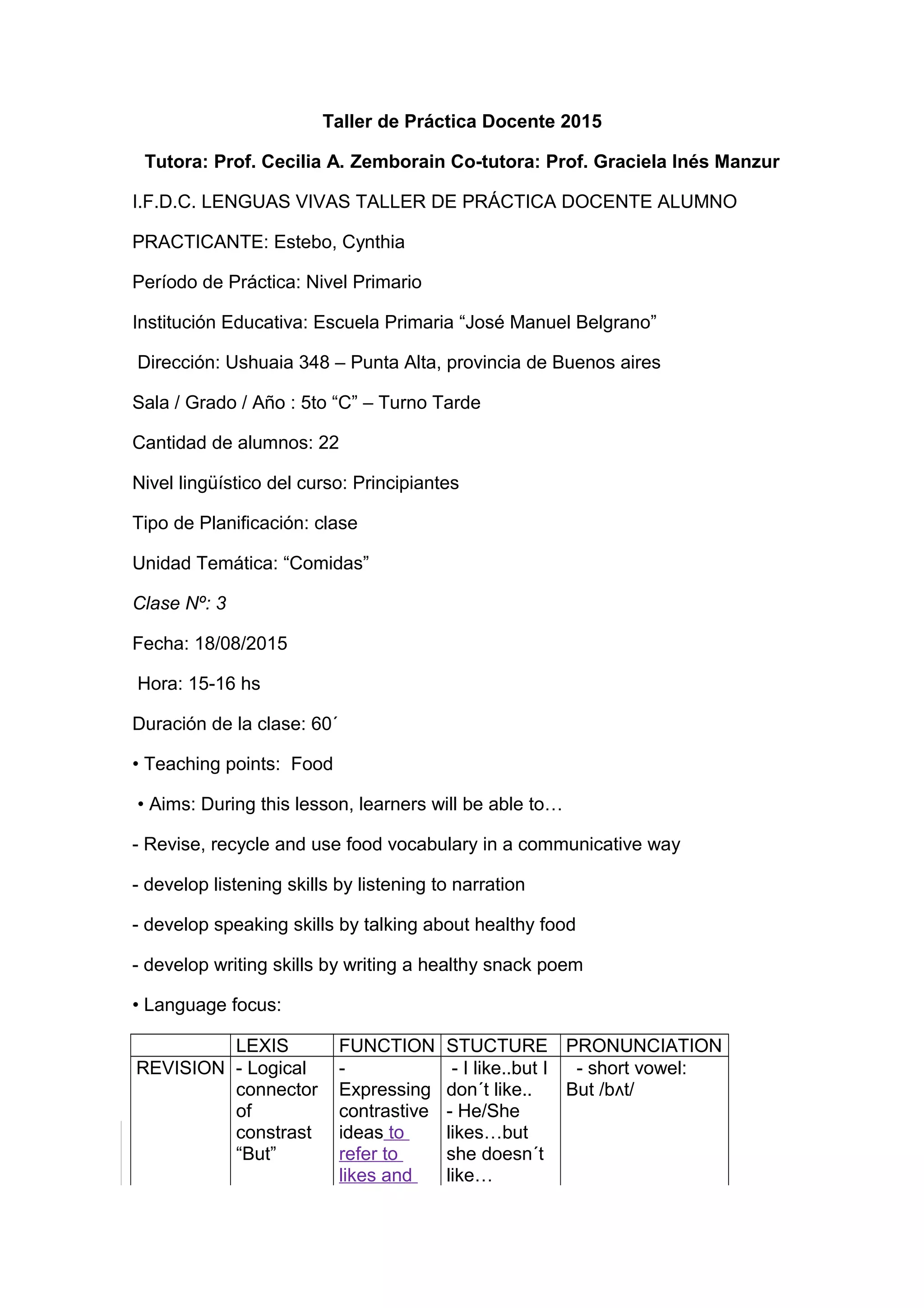
LEXIS FUNCTION STUCTURE PRONUNCIATION
REVISION - Logical
connector
of
constrast
“But”
-
Expressing
contrastive
ideas to
refer to
likes and
- I like..but I
don´t like..
- He/She
likes…but
she doesn´t
like…
- short vowel:
But /b t/ʌ
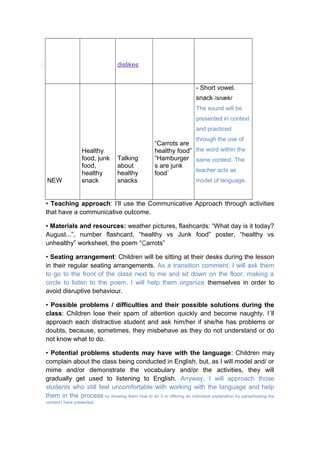
dislikes
NEW
Healthy
food, junk
food,
healthy
snack
Talking
about
healthy
snacks
“Carrots are
healthy food”
“Hamburger
s are junk
food”
- Short vowel.
snack /snæk/
The sound will be
presented in context
and practiced
through the use of
the word within the
same context. The
teacher acts as
model of language.
• Teaching approach: I’ll use the Communicative Approach through activities
that have a communicative outcome.
• Materials and resources: weather pictures, flashcards: “What day is it today?
August...”, number flashcard, “healthy vs Junk food” poster, “healthy vs
unhealthy” worksheet, the poem “Carrots”
• Seating arrangement: Children will be sitting at their desks during the lesson
in their regular seating arrangements. As a transition comment, I will ask them
to go to the front of the class next to me and sit down on the floor, making a
circle to listen to the poem. I will help them organize themselves in order to
avoid disruptive behaviour.
• Possible problems / difficulties and their possible solutions during the
class: Children lose their spam of attention quickly and become naughty. I´ll
approach each distractive student and ask him/her if she/he has problems or
doubts, because, sometimes, they misbehave as they do not understand or do
not know what to do.
• Potential problems students may have with the language: Children may
complain about the class being conducted in English, but, as I will model and/ or
mime and/or demonstrate the vocabulary and/or the activities, they will
gradually get used to listening to English. Anyway, I will approach those
students who still feel uncomfortable with working with the language and help
them in the process by showing them how to do it or offering an individual explanation by paraphrasing the
content I have presented.
• Assessment: I´ll check students’ comprehension through their participation. If
I notice they do not understand, I´ll mime, model the language or ask a partner
or the class to model the activity.
Routine: 10’
I’ll get into the classroom and greet students:
“Hello!, How are you today?”
I will write the following phrase on the board:
What day is it today?
Teacher:“What date is it today?” “Is it August?” and I will show them the word
written on cardboard.
Students: “yes”
I will stick it on the board.
Teacher: “Is it 10th
?” ( and I will show them the number on a small flashcard)
Students: “no”
Teacher: “Is it 18th
?” ( and I will show them the number on a small flashcard)
Students: “YES!”
Teacher: “Great”, “Now, what´s the weather like today?” “Is it cloudy?”(I will
show them the picture)
Students: “no” “It´s sunny”
Teacher: “Very good!”
I will write on the board “It´s sunny today” and I will stick the picture next to the
phrase.
Transition: “Well done!”.
Warm-up 10’:
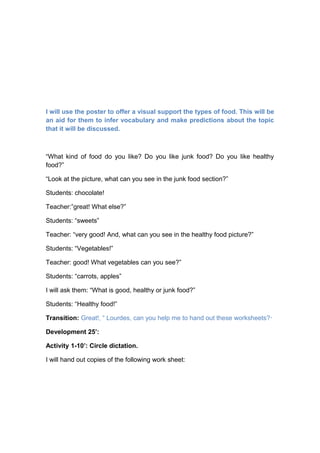
Presentation 5’:
I will tell students “I like healthy food. I eat vegetables and fruits”
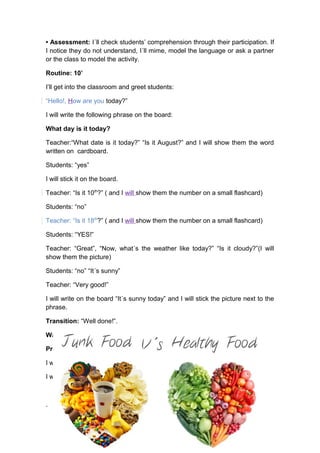
I will stick the following poster on the board.
.
I will use the poster to offer a visual support the types of food. This will be
an aid for them to infer vocabulary and make predictions about the topic
that it will be discussed.
“What kind of food do you like? Do you like junk food? Do you like healthy
food?”
“Look at the picture, what can you see in the junk food section?”
Students: chocolate!
Teacher:”great! What else?”
Students: “sweets”
Teacher: “very good! And, what can you see in the healthy food picture?”
Students: “Vegetables!”
Teacher: good! What vegetables can you see?”
Students: “carrots, apples”
I will ask them: “What is good, healthy or junk food?”
Students: “Healthy food!”
Transition: Great!, “ Lourdes, can you help me to hand out these worksheets?”
Development 25’:
Activity 1-10’: Circle dictation.
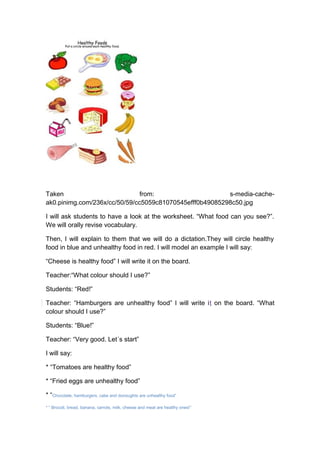
I will hand out copies of the following work sheet:
Taken from: s-media-cache-
ak0.pinimg.com/236x/cc/50/59/cc5059c81070545efff0b49085298c50.jpg
I will ask students to have a look at the worksheet. “What food can you see?”.
We will orally revise vocabulary.
Then, I will explain to them that we will do a dictation.They will circle healthy
food in blue and unhealthy food in red. I will model an example I will say:
“Cheese is healthy food” I will write it on the board.
Teacher:“What colour should I use?”
Students: “Red!”
Teacher: “Hamburgers are unhealthy food” I will write it on the board. “What
colour should I use?”
Students: “Blue!”
Teacher: “Very good. Let´s start”
I will say:
* “Tomatoes are healthy food”
* “Fried eggs are unhealthy food”
* “Chocolate, hamburgers, cake and donoughts are unhealthy food”
* “ Brocoli, bread, banana, carrots, milk, cheese and meat are healthy ones!”
I will name all the food on the worksheet.
When we have finished, we will check it orally. Students will say the correct
answers using the model on the board.
Transition: Great!, “Come with me and sit on the floor.”
Activity 2 -15’: Narrating
I will ask students to look at the poster again. I will point at the carrots and ask:
“What are these? What colour are they?”
Students: “Carrots, they are orange!”
I will ask” what are the benefits of eating carrots?” I will elicit :
• Carrots help us to see better
• Carrots make your teeth stronger
• Carrots makes your hair brighter
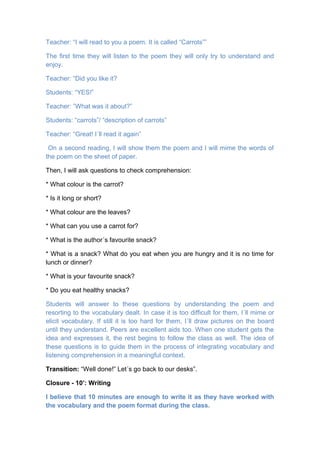
I will ask them to sit on the floor because they will listen to a poem called
“Carrots”
CARROTS
by Judith Natelli McLaughlin
Carrots orange, long and bright
Make my snowman’s nose tonight
Carrots shredded thin and fair
Make lovely, layered orange hair
Carrots crunchy, cold and sweet
Make my favorite snack to eat
Taken from: http://www.superhealthykids.com/poems-on-fruits-and-odes-to-
vegetables/
Teacher: “I will read to you a poem. It is called “Carrots””
The first time they will listen to the poem they will only try to understand and
enjoy.
Teacher: “Did you like it?
Students: “YES!”
Teacher: ”What was it about?”
Students: “carrots”/ “description of carrots”
Teacher: “Great! I´ll read it again”
On a second reading, I will show them the poem and I will mime the words of
the poem on the sheet of paper.
Then, I will ask questions to check comprehension:
* What colour is the carrot?
* Is it long or short?
* What colour are the leaves?
* What can you use a carrot for?
* What is the author´s favourite snack?
* What is a snack? What do you eat when you are hungry and it is no time for
lunch or dinner?
* What is your favourite snack?
* Do you eat healthy snacks?
Students will answer to these questions by understanding the poem and
resorting to the vocabulary dealt. In case it is too difficult for them, I´ll mime or
elicit vocabulary. If still it is too hard for them, I´ll draw pictures on the board
until they understand. Peers are excellent aids too. When one student gets the
idea and expresses it, the rest begins to follow the class as well. The idea of
these questions is to guide them in the process of integrating vocabulary and
listening comprehension in a meaningful context.
Transition: “Well done!” Let´s go back to our desks”.
Closure - 10’: Writing
I believe that 10 minutes are enough to write it as they have worked with
the vocabulary and the poem format during the class.
I will ask students to write a poem about a healthy snack similar to the one they
have heart. I will explain to them that they can write it in the shape of the fruit or
vegetable. I will allot time for them to write and draw. I will stick the poem on the
board for students to have it as a model. I will use it as well for the explanations.
I will brainstorm and create a draft of a poem to exemplify the activity. Once I
have checked they understood, they will begin working on their own
productions.When are ready they will show it to the rest of the class and explain
about it and why they have chosen the food in their assignments.

Estebo tpd-lesson plan nº 3 primary practicum - revised version

  • 1.
    Taller de PrácticaDocente 2015 Tutora: Prof. Cecilia A. Zemborain Co-tutora: Prof. Graciela Inés Manzur I.F.D.C. LENGUAS VIVAS TALLER DE PRÁCTICA DOCENTE ALUMNO PRACTICANTE: Estebo, Cynthia Período de Práctica: Nivel Primario Institución Educativa: Escuela Primaria “José Manuel Belgrano” Dirección: Ushuaia 348 – Punta Alta, provincia de Buenos aires Sala / Grado / Año : 5to “C” – Turno Tarde Cantidad de alumnos: 22 Nivel lingüístico del curso: Principiantes Tipo de Planificación: clase Unidad Temática: “Comidas” Clase Nº: 3 Fecha: 18/08/2015 Hora: 15-16 hs Duración de la clase: 60´ • Teaching points: Food • Aims: During this lesson, learners will be able to… - Revise, recycle and use food vocabulary in a communicative way - develop listening skills by listening to narration - develop speaking skills by talking about healthy food - develop writing skills by writing a healthy snack poem • Language focus: LEXIS FUNCTION STUCTURE PRONUNCIATION REVISION - Logical connector of constrast “But” - Expressing contrastive ideas to refer to likes and - I like..but I don´t like.. - He/She likes…but she doesn´t like… - short vowel: But /b t/ʌ
  • 2.
    dislikes NEW Healthy food, junk food, healthy snack Talking about healthy snacks “Carrots are healthyfood” “Hamburger s are junk food” - Short vowel. snack /snæk/ The sound will be presented in context and practiced through the use of the word within the same context. The teacher acts as model of language. • Teaching approach: I’ll use the Communicative Approach through activities that have a communicative outcome. • Materials and resources: weather pictures, flashcards: “What day is it today? August...”, number flashcard, “healthy vs Junk food” poster, “healthy vs unhealthy” worksheet, the poem “Carrots” • Seating arrangement: Children will be sitting at their desks during the lesson in their regular seating arrangements. As a transition comment, I will ask them to go to the front of the class next to me and sit down on the floor, making a circle to listen to the poem. I will help them organize themselves in order to avoid disruptive behaviour. • Possible problems / difficulties and their possible solutions during the class: Children lose their spam of attention quickly and become naughty. I´ll approach each distractive student and ask him/her if she/he has problems or doubts, because, sometimes, they misbehave as they do not understand or do not know what to do. • Potential problems students may have with the language: Children may complain about the class being conducted in English, but, as I will model and/ or mime and/or demonstrate the vocabulary and/or the activities, they will gradually get used to listening to English. Anyway, I will approach those students who still feel uncomfortable with working with the language and help them in the process by showing them how to do it or offering an individual explanation by paraphrasing the content I have presented.
  • 3.
    • Assessment: I´llcheck students’ comprehension through their participation. If I notice they do not understand, I´ll mime, model the language or ask a partner or the class to model the activity. Routine: 10’ I’ll get into the classroom and greet students: “Hello!, How are you today?” I will write the following phrase on the board: What day is it today? Teacher:“What date is it today?” “Is it August?” and I will show them the word written on cardboard. Students: “yes” I will stick it on the board. Teacher: “Is it 10th ?” ( and I will show them the number on a small flashcard) Students: “no” Teacher: “Is it 18th ?” ( and I will show them the number on a small flashcard) Students: “YES!” Teacher: “Great”, “Now, what´s the weather like today?” “Is it cloudy?”(I will show them the picture) Students: “no” “It´s sunny” Teacher: “Very good!” I will write on the board “It´s sunny today” and I will stick the picture next to the phrase. Transition: “Well done!”. Warm-up 10’: Presentation 5’: I will tell students “I like healthy food. I eat vegetables and fruits” I will stick the following poster on the board. .
  • 4.
    I will usethe poster to offer a visual support the types of food. This will be an aid for them to infer vocabulary and make predictions about the topic that it will be discussed. “What kind of food do you like? Do you like junk food? Do you like healthy food?” “Look at the picture, what can you see in the junk food section?” Students: chocolate! Teacher:”great! What else?” Students: “sweets” Teacher: “very good! And, what can you see in the healthy food picture?” Students: “Vegetables!” Teacher: good! What vegetables can you see?” Students: “carrots, apples” I will ask them: “What is good, healthy or junk food?” Students: “Healthy food!” Transition: Great!, “ Lourdes, can you help me to hand out these worksheets?” Development 25’: Activity 1-10’: Circle dictation. I will hand out copies of the following work sheet:
  • 5.
    Taken from: s-media-cache- ak0.pinimg.com/236x/cc/50/59/cc5059c81070545efff0b49085298c50.jpg Iwill ask students to have a look at the worksheet. “What food can you see?”. We will orally revise vocabulary. Then, I will explain to them that we will do a dictation.They will circle healthy food in blue and unhealthy food in red. I will model an example I will say: “Cheese is healthy food” I will write it on the board. Teacher:“What colour should I use?” Students: “Red!” Teacher: “Hamburgers are unhealthy food” I will write it on the board. “What colour should I use?” Students: “Blue!” Teacher: “Very good. Let´s start” I will say: * “Tomatoes are healthy food” * “Fried eggs are unhealthy food” * “Chocolate, hamburgers, cake and donoughts are unhealthy food” * “ Brocoli, bread, banana, carrots, milk, cheese and meat are healthy ones!”
  • 6.
    I will nameall the food on the worksheet. When we have finished, we will check it orally. Students will say the correct answers using the model on the board. Transition: Great!, “Come with me and sit on the floor.” Activity 2 -15’: Narrating I will ask students to look at the poster again. I will point at the carrots and ask: “What are these? What colour are they?” Students: “Carrots, they are orange!” I will ask” what are the benefits of eating carrots?” I will elicit : • Carrots help us to see better • Carrots make your teeth stronger • Carrots makes your hair brighter I will ask them to sit on the floor because they will listen to a poem called “Carrots” CARROTS by Judith Natelli McLaughlin Carrots orange, long and bright Make my snowman’s nose tonight Carrots shredded thin and fair Make lovely, layered orange hair Carrots crunchy, cold and sweet Make my favorite snack to eat Taken from: http://www.superhealthykids.com/poems-on-fruits-and-odes-to- vegetables/
  • 7.
    Teacher: “I willread to you a poem. It is called “Carrots”” The first time they will listen to the poem they will only try to understand and enjoy. Teacher: “Did you like it? Students: “YES!” Teacher: ”What was it about?” Students: “carrots”/ “description of carrots” Teacher: “Great! I´ll read it again” On a second reading, I will show them the poem and I will mime the words of the poem on the sheet of paper. Then, I will ask questions to check comprehension: * What colour is the carrot? * Is it long or short? * What colour are the leaves? * What can you use a carrot for? * What is the author´s favourite snack? * What is a snack? What do you eat when you are hungry and it is no time for lunch or dinner? * What is your favourite snack? * Do you eat healthy snacks? Students will answer to these questions by understanding the poem and resorting to the vocabulary dealt. In case it is too difficult for them, I´ll mime or elicit vocabulary. If still it is too hard for them, I´ll draw pictures on the board until they understand. Peers are excellent aids too. When one student gets the idea and expresses it, the rest begins to follow the class as well. The idea of these questions is to guide them in the process of integrating vocabulary and listening comprehension in a meaningful context. Transition: “Well done!” Let´s go back to our desks”. Closure - 10’: Writing I believe that 10 minutes are enough to write it as they have worked with the vocabulary and the poem format during the class.
  • 8.
    I will askstudents to write a poem about a healthy snack similar to the one they have heart. I will explain to them that they can write it in the shape of the fruit or vegetable. I will allot time for them to write and draw. I will stick the poem on the board for students to have it as a model. I will use it as well for the explanations. I will brainstorm and create a draft of a poem to exemplify the activity. Once I have checked they understood, they will begin working on their own productions.When are ready they will show it to the rest of the class and explain about it and why they have chosen the food in their assignments.