Selective decontamination of the
            digestive tract:
implications for the critically ill patient


                        Kriton S. Filos, MD
                                 Professor
               Director Department of Anaesthesiology and
                         Intensive Care Medicine
                           University of Patras,
                         26500 Patras - GREECE
The problem:


      Patients in intensive care units (ICUs), represent
       8 to 15% of hospital admissions.
        Richards MJ, et al: Crit Care Med. 1999; 27: 887

      Nosocomial infection rates are 5 to 10 times
       higher in ICUs than on general wards
        Vincent JL et al.: JAMA 1995; 274: 639
Aquired infections in the ICU


      Pneumonia (47%) and
      Lower respiratory tract infections (18%)
      Urinary tract infections (18%) and
      Bloodstream infections (12%)


                            Vincent JL et al.: JAMA 1995; 274: 639
Infections in the ICU

      Community acquired: Already present at
  admission
       Nosocomial: Incubating 48 h after the admission
       to the ICU
      Exogenous infections
             caused by potentially pathogenic micro-
       organisms (PPMs) that have multiplied outside
       the body
            ~ 20% of ICU infections
            The high standards of hygiene are able to
             prevent them
Infections in the ICU (cont.)
       Endogenous infections
             caused by PPMs carried in the throat and
             GI- tract
       Primary endogenous
             caused by PPMs carried in the throat or
             GI-tract on admission to the ICU
             > 50% of all infections occurring in the ICU
       Secondary endogenous
             caused by PPM that have colonized the           throat
              and GI tract during the ICU stay
             ~ 33% of ICU infections
             during hospitalization the initially colonizing
        microorganisms are usually replaced, mainly by Gram-
        negative bacteria.
Ventilator-associated pneumonia (VAP)

      Ventilator-associated pneumonia (VAP) typically

       refers to nosocomial pneumonia developing more

       than 48 hours following endotracheal intubation

       and mechanical ventilation.
      The risk for the emergence of VAP is highest

  within the first week after intubation and has been

  calculated as ~ 3%/day of ICU stay

                             Vincent JL et al.: JAMA 1995; 274: 639
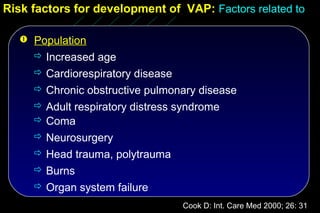
Risk factors for development of VAP: Factors related to

    Population
      Increased age
      Cardiorespiratory disease
      Chronic obstructive pulmonary disease
      Adult respiratory distress syndrome
      Coma
      Neurosurgery
      Head trauma, polytrauma
      Burns
      Organ system failure

                                   Cook D: Int. Care Med 2000; 26: 31
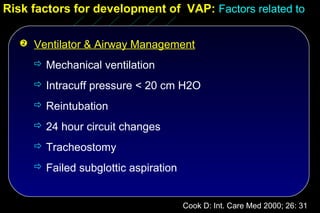
Risk factors for development of VAP: Factors related to

    Ventilator & Airway Management

      Mechanical ventilation

      Intracuff pressure < 20 cm H2O

      Reintubation

      24 hour circuit changes

      Tracheostomy

      Failed subglottic aspiration


                                      Cook D: Int. Care Med 2000; 26: 31
Risk factors for development of VAP: Factors related to

    General ICU Management

      Enteral nutrition

      Supine positioning

      Aspiration

      Histamine-2-receptor antagonists
      Paralytic agents
      Antibiotics
      Transport out of the ICU


                                  Cook D: Int. Care Med 2000; 26: 31
What is SDD ?


      SDD was developed to treat or prevent
  nosocomial infections, especially pneu-                    monias,
  by
               selectively eliminating aerobic Gram-
       negative potentially        pathogenic micro-
       organisms and Candida species
           without disturbing the anaerobic flora


                          Stoutenbeek CP et al: Int. Care Med 1984; 10:185-92
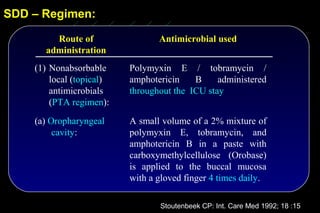
SDD – Regimen:

        Route of                 Antimicrobial used
      administration
    (1) Nonabsorbable     Polymyxin E / tobramycin /
        local (topical)   amphotericin    B     administered
        antimicrobials    throughout the ICU stay
        (PTA regimen):
    (a) Oropharyngeal     A small volume of a 2% mixture of
         cavity:          polymyxin E, tobramycin, and
                          amphotericin B in a paste with
                          carboxymethylcellulose (Orobase)
                          is applied to the buccal mucosa
                          with a gloved finger 4 times daily.

                                 Stoutenbeek CP: Int. Care Med 1992; 18 :15
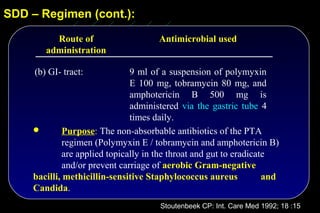
SDD – Regimen (cont.):

          Route of                    Antimicrobial used
        administration

     (b) GI- tract:            9 ml of a suspension of polymyxin
                               E 100 mg, tobramycin 80 mg, and
                               amphotericin B 500 mg is
                               administered via the gastric tube 4
                               times daily.
            Purpose: The non-absorbable antibiotics of the PTA
             regimen (Polymyxin E / tobramycin and amphotericin B)
             are applied topically in the throat and gut to eradicate
             and/or prevent carriage of aerobic Gram-negative
    bacilli, methicillin-sensitive Staphylococcus aureus            and
    Candida.
                                      Stoutenbeek CP: Int. Care Med 1992; 18 :15
SDD – Regimen (cont.):

          Route of                    Antimicrobial used
        administration

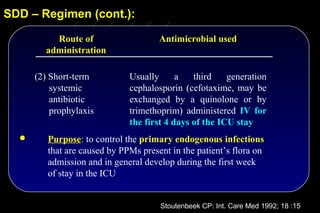
      (2) Short-term          Usually      a   third    generation
          systemic            cephalosporin (cefotaxime, may be
          antibiotic          exchanged by a quinolone or by
          prophylaxis         trimethoprim) administered IV for
                              the first 4 days of the ICU stay
        Purpose: to control the primary endogenous infections
         that are caused by PPMs present in the patient’s flora on
         admission and in general develop during the first week
         of stay in the ICU


                                      Stoutenbeek CP: Int. Care Med 1992; 18 :15
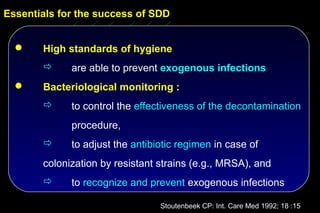
Essentials for the success of SDD


      High standards of hygiene
            are able to prevent exogenous infections
      Bacteriological monitoring :
            to control the effectiveness of the decontamination
             procedure,
            to adjust the antibiotic regimen in case of
       colonization by resistant strains (e.g., MRSA), and
            to recognize and prevent exogenous infections

                                 Stoutenbeek CP: Int. Care Med 1992; 18 :15
SDD – does it work?
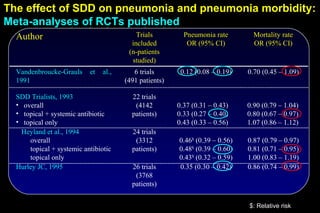
The effect of SDD on pneumonia and pneumonia morbidity:
Meta-analyses of RCTs published
  Author                                   Trials         Pneumonia rate        Mortality rate
                                         included          OR (95% CI)          OR (95% CI)
                                        (n-patients
                                         studied)
  Vandenbroucke-Grauls     et   al.,      6 trials       0.12 (0.08 – 0.19)   0.70 (0.45 – 1.09)
  1991                                 (491 patients)

  SDD Trialists, 1993                    22 trials
  • overall                               (4142         0.37 (0.31 – 0.43)    0.90 (0.79 – 1.04)
  • topical + systemic antibiotic        patients)      0.33 (0.27 – 0.40)    0.80 (0.67 – 0.97)
  • topical only                                        0.43 (0.33 – 0.56)    1.07 (0.86 – 1.12)
    Heyland et al., 1994                 24 trials
      overall                             (3312         0.46$ (0.39 – 0.56)   0.87 (0.79 – 0.97)
      topical + systemic antibiotic      patients)      0.48$ (0.39 – 0.60)   0.81 (0.71 – 0.95)
      topical only                                      0.43$ (0.32 – 0.59)   1.00 (0.83 – 1.19)
  Hurley JC, 1995                        26 trials      0.35 (0.30 – 0.42)    0.86 (0.74 – 0.99)
                                          (3768
                                         patients)


                                                                              $: Relative risk
Caution and criticism


  The members of the 1st European consensus
  conference on SDD:


      “The available information at this time does not
      permit an unequivocal recommendation for the
         use of SDD in any particular population of
                         patients"


                               Loirat P et al: Int Care Med 1992; 18: 182-8
Criticism: 5 underlying principles of antimicrobial resistance
   (1) Given sufficient time and drug use, antibiotic resistance
       will emerge.
   (2) Antibiotic resistance is progressive, evolving from low
       levels through intermediate to high levels.
   (3) Organisms that are resistant to one drug are likely to
       become resistant to other antibiotics.
   (4) Once resistance appears, it is likely to decline slowly, if at
       all.
   (5) The use of antibiotics by any one person affects others in
       the extended and in the immediate environment.
       These principles apply to all antibiotic administration,
       including the use of SDD.
                                        Levy SB: N.Engl.J.Med. 1998; 338: 1376-8
Risks factors leading to the emergence of potentially resistant
pathogens in patients who required mechanical ventilation for >48h

     Trouillet et al. examined 135 consecutive episodes of

       VAP in order to provide a comprehensive description of
       microorganisms responsible for VAP
        77 episodes (57%) were caused by potentially

          antibiotic-resistant bacteria
           MRSA,
           Pseudomonas aeruginosa,
           Acinetobacter baumannii, and
           Stenotrophomonas maltophilia.


                                     Trouillet JL et al: AJRCCM 1998; 157: 531-9
Risks factors leading to the emergence of potentially resistant
pathogens in patients who required mechanical ventilation for >48h

   Logistic regression analysis
      the duration of mechanical ventilation for > 7 days,

        prior antibiotic use,
      prior use of broad-spectrum antibiotics (third-

        generation cephalosporins, fluoroquinolones, and/or
        imipenem)


          were associated with the development of VAP
          due to antibiotic-resistant pathogens
                                   Trouillet JL et al: AJRCCM 1998; 157: 531-9
Influence of SDD on the development of antimicrobial resistance

    New resistance is rarely reported, but
    Severe problems have been encountered in hospitals

      with endemic resistant bacteria, especially with
       MRSA,
       Serratia and
       Acinetobacter
    Emergence of tobramycin resistance was reported

      when the standard SDD protocol (cefotaxime plus topical
      polymyxin E, tobramycin and amphotericin B) was used
            Verwaest C. et al.: Crit Care Med. 1997; 25: 63-71
Influence of SDD on the development of antimicrobial resistance (2)

     However, 17% of the patients studied were already

       colonized on admission by Morganella morganii and
       Serratia;
        the latter is frequently resistant to tobramycin and
        both are usually resistant to polymyxin E.
     Various authors investigators reject the further use of

       SDD, because they have observed increasing rates of
       infections with resistant Gram-positive bacteria
             Kollef MH: Crit Care 2000; 4: 327-32
             Webb CH: J.Hosp.Infect. 2000; 46: 106-9
Other risk factors have also been associated with the emergence
of antibiotic-resistant infections in the ICU
   The need for invasive devices such as
      an endotracheal tube,
      intravascular and
      urinary catheters

        have been shown to predispose to infection with
        antibiotic-resistant and antibiotic-sensitive bacteria.
           Richards MJ et al: Crit Care Med. 1999; 27: 887-92
   Likewise, a prolonged duration of hospital stay

     appears to predispose to infection with antibiotic-resistant
     bacteria
           Trouillet JL et al: AJRCCM 1998; 157: 531-9
So, does SDD work or not ?
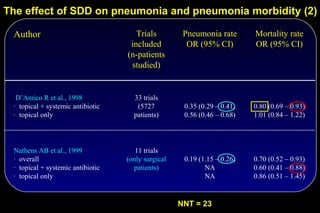
The effect of SDD on pneumonia and pneumonia morbidity (2)

 Author                               Trials         Pneumonia rate       Mortality rate
                                    included          OR (95% CI)         OR (95% CI)
                                   (n-patients
                                    studied)


  D’Amico R et al., 1998             33 trials
 · topical + systemic antibiotic      (5727          0.35 (0.29 – 0.41)   0.80 (0.69 – 0.93)
 · topical only                      patients)       0.56 (0.46 – 0.68)   1.01 (0.84 – 1.22)


 Nathens AB et al., 1999              11 trials
 · overall                         (only surgical    0.19 (1.15 – 0.26)   0.70 (0.52 – 0.93)
 · topical + systemic antibiotic     patients)              NA            0.60 (0.41 – 0.88)
 · topical only                                             NA            0.86 (0.51 – 1.45)


                                                    NNT = 23
Why only meta – analyses ?

Are there no good single RCTs

      supporting SDD ?
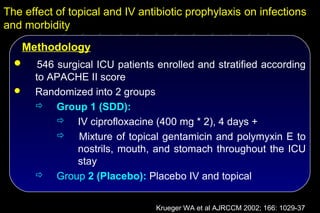
The effect of topical and IV antibiotic prophylaxis on infections
and morbidity
   Methodology
      546 surgical ICU patients enrolled and stratified according
      to APACHE II score
     Randomized into 2 groups
       Group 1 (SDD):
            IV ciprofloxacine (400 mg * 2), 4 days +
               Mixture of topical gentamicin and polymyxin E to
               nostrils, mouth, and stomach throughout the ICU
               stay
       Group 2 (Placebo): Placebo IV and topical


                                Krueger WA et al AJRCCM 2002; 166: 1029-37
The effect of topical and IV antibiotic prophylaxis on infections
and morbidity

     Infections acquired in the ICU                    SDD vs. Control

                                         Pneumonias:
                                                     6 vs. 29 ( P < 0.007)
                                         Other lower resp. tract infections:
                           N=546
                                                     39 vs. 70 ( P < 0.007)
                                         Bloodstream infections:
                                                     14 vs. 36 ( P < 0.007)
                                         Urinary tract infections:
                                                     36 vs. 60 ( P < 0.042)
        P < 0.001, RR 0.477,
        95% CI [0.367 – 0.620]

                                      Krueger WA et al AJRCCM 2002; 166: 1029-37
The effect of topical and IV antibiotic prophylaxis on infections
and morbidity

         Multiorgan failure                            SDD vs. Control

                                        Renal failure:
                                                 17 vs. 38 ( P < 0.018)
                                        ARDS / ALI:
                                                 15 vs. 27 ( NS)
                                        Circulation:
                                                 27 vs. 45 ( NS)
                              N=546
                                        Liver:
                                                 26 vs. 29 ( NS)
                                        Coagulation:
                                                 15 vs. 27 ( NS)
                                        CNS:
     P < 0.0051, RR 0.636,                       3 vs. 5 ( NS)
     95% CI [0.463 – 0.874]

                                      Krueger WA et al AJRCCM 2002; 166: 1029-37
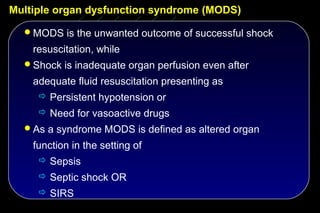
Multiple organ dysfunction syndrome (MODS)

  MODS is the unwanted outcome of successful shock

    resuscitation, while
  Shock is inadequate organ perfusion even after

    adequate fluid resuscitation presenting as
      Persistent hypotension or
      Need for vasoactive drugs
  As a syndrome MODS is defined as altered organ

    function in the setting of
      Sepsis
      Septic shock OR
      SIRS
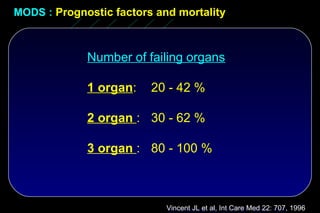
MODS : Prognostic factors and mortality


             Number of failing organs

             1 organ:    20 - 42 %

             2 organ : 30 - 62 %

             3 organ : 80 - 100 %


                            Vincent JL et JE,Int Care Med 22:1996 1996
                            Zimmerman al, CCM 24: 1633, 707,
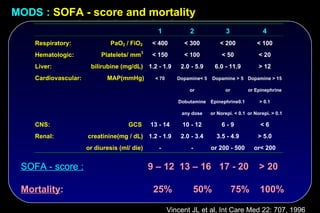
MODS : SOFA - score and mortality
                                                1            2                3                4
    Respiratory:               PaO2 / FiO2    < 400        < 300           < 200            < 100
    Hematologic:           Platelets/ mm3     < 150        < 100            < 50             < 20
    Liver:             bilirubine (mg/dL) 1.2 - 1.9       2.0 - 5.9      6.0 - 11.9          > 12
    Cardiovascular:          MAP(mmHg)         < 70      Dopamine< 5   Dopamine > 5 Dopamine > 15

                                                             or              or         or Epinephrine

                                                         Dobutamine    Epinephrine0.1        > 0.1

                                                          any dose     or Norepi. < 0.1 or Norepi. > 0.1

    CNS:                             GCS      13 - 14      10 - 12          6-9              <6
    Renal:            creatinine(mg / dL) 1.2 - 1.9       2.0 - 3.4      3.5 - 4.9          > 5.0
                      or diuresis (ml/ die)      -            -        or 200 - 500        or< 200


 SOFA - score :                               9 – 12 13 – 16 17 - 20                         > 20

 Mortality:                                    25%            50%                 75%        100%

                                                      Vincent JL et al, Int Care Med 22: 707, 1996
The effect of topical and IV antibiotic prophylaxis on infections
and morbidity
         Multiorgan failure                  SDD vs. Control
                                       Renal failure:
                                                17 vs. 38 ( P < 0.018)
                                       ARDS / ALI:
                                                15 vs. 27 ( NS)
                                       Circulation:
                              N=546             27 vs. 45 ( NS)
                                       Liver:
                                                26 vs. 29 ( NS)
                                       Coagulation:
                                                15 vs. 27 ( NS)
     P < 0.0051, RR 0.636,
     95% CI [0.463 – 0.874]            CNS:
                                                3 vs. 5 ( NS)
                                      Krueger WA et al AJRCCM 2002; 166: 1029-37
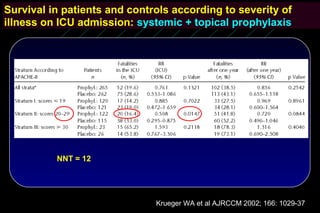
Survival in patients and controls according to severity of
illness on ICU admission: systemic + topical prophylaxis


          NNT = 12


                              Krueger WA et al AJRCCM 2002; 166: 1029-37
The effect of topical and IV antibiotic prophylaxis on infections
and morbidity
   Development of bacterial resistance
     Surveillance cultures from
       tracheobronchial,

       oropharyngeal,

       gastric secretions and

       from rectal swabs

      did not show any evidence for the selection of resistant
      microorganisms in the patients receiving prophylaxis.

                                   Krueger WA et al AJRCCM 2002; 166: 1029-37
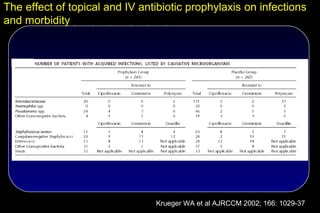
The effect of topical and IV antibiotic prophylaxis on infections
and morbidity


                                Krueger WA et al AJRCCM 2002; 166: 1029-37
Effects of Selective Decontamimation of the

  Digestive Tract on Mortality and Antibiotic

                   Resistance

De Jonghe E., Schultz M.J. Spanjaard L. et al.


                          Int Care Med. 28 (Suppl. 1), S12. 2002.
The effect of topical and IV antibiotic prophylaxis on mortality
and antibiotic resistance
   Methodology

     934 consequtive surgical and medical ICU patients
     Expected duration of MV for > 48 h
     Randomized into 2 groups
       Group 1 (SDD):
           IV cefotaxime, 4 days +
              Mixture of topical tobramycin, polymyxin E and
               amphotericin B to oropharynx and stomach
          throughout the ICU stay
       Group 2 (Placebo): Placebo IV and topical


                      De Jonghe E. et al.: Int Care Med. 28 (Suppl. 1), S12. 2002.
The effect of topical and IV antibiotic prophylaxis on mortality
and antibiotic resistance
   Methodology – cont.
     Weekly cultures from
       rectum
       oropharynx
       axillary and
       wound
      Methicillin resistant S. aureus (MRSA)
   Vancomycin resistant enterococci (VRE)
       Tobramycin, polymyxin, ciprofloxacin and ceftazidime
  resistant P. aeruginosa
   Other Gram – negative bacteria

                       De Jonghe E. et al.: Int Care Med. 28 (Suppl. 1), S12. 2002.
The effect of topical and IV antibiotic prophylaxis on mortality
and antibiotic resistance
                                SDD      Control           Odds-ratio P-
                                (n = 468) (n=466)          [95% C.I.] value
 ICU-mortality (%)              14.8           22.9         0.6 [0.4 – 0.8] 0.002
 Hospital-mortality (%)         24.2           31.2         0.7 [0.5 – 0.9] 0.02
 ICU-LOS (days)                 11.6           13.4                         < 0.001
 Tobramycin/P. aeruginosa 13                    13          1.0 [0.5 – 2.3] NS
 Tobramycin/other Gram neg. 20                  47          0.4 [0.2 – 0.7] 0.001
 Imipenem/ P. aeruginosa   1                    16          0.1 [0.01 – 0.5] < 0.001
 Imipenem/ other Gram neg. 1                    10          0.1 [0.01 – 0.6] 0.01
 Ciproflox./ P. aeruginosa   1                  13          0.1 [0.01 – 0.6] 0.002
 Ciproflox./ other Gram neg. 9                  31          0.3 [0.1 – 0.6] 0.001
 Vancomycin./ enterococcus 4                    5           0.8 [0.2 – 3.1] NS
 Methicillin./ S. aureus   0                    0

                           De Jonghe E. et al.: Int Care Med. 28 (Suppl. 1), S12. 2002.
The effect of topical and IV antibiotic prophylaxis on mortality
and antibiotic resistance

        In the setting with low prevalence of MRSA and VRE,

  SDD significantly decreases ICU – mortality,
        and furthermore, SDD decreases hospital mortality of

  critically ill patients
        Additionally, SDD decreases the LOS in the ICU.
        Finally, SDD decreases colonization with (multi)-resistant

         P. aeruginosa and other Gram- negative bacteria.

                            De Jonghe E. et al.: Int Care Med. 28 (Suppl. 1), S12. 2002.
SDD – does it work? Conclusions
       SDD can cut the rate of VAP by one half on average
       Two meta-analyses calculated a significant survival
  benefit in patients receiving combined topical and
  systemic prophylaxis
       Nevertheless, SDD has not yet gained acceptance as a
  routine treatment concept, mainly because of persisting doubts
  about a true survival benefit as well as major   concerns
  about the risk of increasing resistance
       Now, two recently published RCTs including 1480
  patients could demonstrate lower mortality rates in     patients
  treated with SDD.
             Krueger WA et al AJRCCM 2002; 166: 1029-37
             de Jonge, E. et al Intensive Care Med. 28 (Suppl. 1), S12. 2002.
Conclusions (cont.)

      SDD and resistance
            In the setting with low prevalence of MRSA and
       VRE, SDD significantly decreases ICU – mortality,
            and furthermore, SDD decreases hospital mortality
             of critically ill patients
            Additionally, SDD decreases the LOS in the ICU
            Finally, SDD decreases colonization with (multi)-
       resistant P. aeruginosa and other Gram- negative
       bacteria.
Conclusions (cont.)


      Since equally effective alternative preventive

      measures are not available at this time, SDD

      should be seriously considered as a

 concept, at least in surgical ICU patients, who   are

 mechanically ventilated for more than 48 h
What does the future hold?

      Studies should clarify on three issues:
            whether the intestinal component is necessary,

             what the impact of the long-term use of SDD on

       the overall bacterial ecology is and
            if tailored regimens which cover Gram-positive

       bacteria, might further add any clinical benefit in ICU

       patients.
Thank You

K.S. Filos, MD PhD Selective Gut Decontamination

  • 1.
    Selective decontamination ofthe digestive tract: implications for the critically ill patient Kriton S. Filos, MD Professor Director Department of Anaesthesiology and Intensive Care Medicine University of Patras, 26500 Patras - GREECE
  • 2.
    The problem:  Patients in intensive care units (ICUs), represent 8 to 15% of hospital admissions.  Richards MJ, et al: Crit Care Med. 1999; 27: 887  Nosocomial infection rates are 5 to 10 times higher in ICUs than on general wards  Vincent JL et al.: JAMA 1995; 274: 639
  • 3.
    Aquired infections inthe ICU  Pneumonia (47%) and  Lower respiratory tract infections (18%)  Urinary tract infections (18%) and  Bloodstream infections (12%) Vincent JL et al.: JAMA 1995; 274: 639
  • 4.
    Infections in theICU  Community acquired: Already present at admission  Nosocomial: Incubating 48 h after the admission to the ICU  Exogenous infections  caused by potentially pathogenic micro- organisms (PPMs) that have multiplied outside the body  ~ 20% of ICU infections  The high standards of hygiene are able to prevent them
  • 5.
    Infections in theICU (cont.)  Endogenous infections  caused by PPMs carried in the throat and  GI- tract  Primary endogenous  caused by PPMs carried in the throat or  GI-tract on admission to the ICU  > 50% of all infections occurring in the ICU  Secondary endogenous  caused by PPM that have colonized the throat and GI tract during the ICU stay  ~ 33% of ICU infections  during hospitalization the initially colonizing microorganisms are usually replaced, mainly by Gram- negative bacteria.
  • 6.
    Ventilator-associated pneumonia (VAP)  Ventilator-associated pneumonia (VAP) typically refers to nosocomial pneumonia developing more than 48 hours following endotracheal intubation and mechanical ventilation.  The risk for the emergence of VAP is highest within the first week after intubation and has been calculated as ~ 3%/day of ICU stay Vincent JL et al.: JAMA 1995; 274: 639
  • 8.
    Risk factors fordevelopment of VAP: Factors related to  Population  Increased age  Cardiorespiratory disease  Chronic obstructive pulmonary disease  Adult respiratory distress syndrome  Coma  Neurosurgery  Head trauma, polytrauma  Burns  Organ system failure Cook D: Int. Care Med 2000; 26: 31
  • 9.
    Risk factors fordevelopment of VAP: Factors related to  Ventilator & Airway Management  Mechanical ventilation  Intracuff pressure < 20 cm H2O  Reintubation  24 hour circuit changes  Tracheostomy  Failed subglottic aspiration Cook D: Int. Care Med 2000; 26: 31
  • 10.
    Risk factors fordevelopment of VAP: Factors related to  General ICU Management  Enteral nutrition  Supine positioning  Aspiration  Histamine-2-receptor antagonists  Paralytic agents  Antibiotics  Transport out of the ICU Cook D: Int. Care Med 2000; 26: 31
  • 11.
    What is SDD?  SDD was developed to treat or prevent nosocomial infections, especially pneu- monias, by  selectively eliminating aerobic Gram- negative potentially pathogenic micro- organisms and Candida species  without disturbing the anaerobic flora Stoutenbeek CP et al: Int. Care Med 1984; 10:185-92
  • 12.
    SDD – Regimen: Route of Antimicrobial used administration (1) Nonabsorbable Polymyxin E / tobramycin / local (topical) amphotericin B administered antimicrobials throughout the ICU stay (PTA regimen): (a) Oropharyngeal A small volume of a 2% mixture of cavity: polymyxin E, tobramycin, and amphotericin B in a paste with carboxymethylcellulose (Orobase) is applied to the buccal mucosa with a gloved finger 4 times daily. Stoutenbeek CP: Int. Care Med 1992; 18 :15
  • 13.
    SDD – Regimen(cont.): Route of Antimicrobial used administration (b) GI- tract: 9 ml of a suspension of polymyxin E 100 mg, tobramycin 80 mg, and amphotericin B 500 mg is administered via the gastric tube 4 times daily.  Purpose: The non-absorbable antibiotics of the PTA regimen (Polymyxin E / tobramycin and amphotericin B) are applied topically in the throat and gut to eradicate and/or prevent carriage of aerobic Gram-negative bacilli, methicillin-sensitive Staphylococcus aureus and Candida. Stoutenbeek CP: Int. Care Med 1992; 18 :15
  • 14.
    SDD – Regimen(cont.): Route of Antimicrobial used administration (2) Short-term Usually a third generation systemic cephalosporin (cefotaxime, may be antibiotic exchanged by a quinolone or by prophylaxis trimethoprim) administered IV for the first 4 days of the ICU stay  Purpose: to control the primary endogenous infections that are caused by PPMs present in the patient’s flora on admission and in general develop during the first week of stay in the ICU Stoutenbeek CP: Int. Care Med 1992; 18 :15
  • 15.
    Essentials for thesuccess of SDD  High standards of hygiene  are able to prevent exogenous infections  Bacteriological monitoring :  to control the effectiveness of the decontamination procedure,  to adjust the antibiotic regimen in case of colonization by resistant strains (e.g., MRSA), and  to recognize and prevent exogenous infections Stoutenbeek CP: Int. Care Med 1992; 18 :15
  • 16.
    SDD – doesit work?
  • 17.
    The effect ofSDD on pneumonia and pneumonia morbidity: Meta-analyses of RCTs published Author Trials Pneumonia rate Mortality rate included OR (95% CI) OR (95% CI) (n-patients studied) Vandenbroucke-Grauls et al., 6 trials 0.12 (0.08 – 0.19) 0.70 (0.45 – 1.09) 1991 (491 patients) SDD Trialists, 1993 22 trials • overall (4142 0.37 (0.31 – 0.43) 0.90 (0.79 – 1.04) • topical + systemic antibiotic patients) 0.33 (0.27 – 0.40) 0.80 (0.67 – 0.97) • topical only 0.43 (0.33 – 0.56) 1.07 (0.86 – 1.12) Heyland et al., 1994 24 trials overall (3312 0.46$ (0.39 – 0.56) 0.87 (0.79 – 0.97) topical + systemic antibiotic patients) 0.48$ (0.39 – 0.60) 0.81 (0.71 – 0.95) topical only 0.43$ (0.32 – 0.59) 1.00 (0.83 – 1.19) Hurley JC, 1995 26 trials 0.35 (0.30 – 0.42) 0.86 (0.74 – 0.99) (3768 patients) $: Relative risk
  • 18.
    Caution and criticism The members of the 1st European consensus conference on SDD: “The available information at this time does not permit an unequivocal recommendation for the use of SDD in any particular population of patients" Loirat P et al: Int Care Med 1992; 18: 182-8
  • 19.
    Criticism: 5 underlyingprinciples of antimicrobial resistance (1) Given sufficient time and drug use, antibiotic resistance will emerge. (2) Antibiotic resistance is progressive, evolving from low levels through intermediate to high levels. (3) Organisms that are resistant to one drug are likely to become resistant to other antibiotics. (4) Once resistance appears, it is likely to decline slowly, if at all. (5) The use of antibiotics by any one person affects others in the extended and in the immediate environment. These principles apply to all antibiotic administration, including the use of SDD. Levy SB: N.Engl.J.Med. 1998; 338: 1376-8
  • 20.
    Risks factors leadingto the emergence of potentially resistant pathogens in patients who required mechanical ventilation for >48h  Trouillet et al. examined 135 consecutive episodes of VAP in order to provide a comprehensive description of microorganisms responsible for VAP  77 episodes (57%) were caused by potentially antibiotic-resistant bacteria  MRSA,  Pseudomonas aeruginosa,  Acinetobacter baumannii, and  Stenotrophomonas maltophilia. Trouillet JL et al: AJRCCM 1998; 157: 531-9
  • 21.
    Risks factors leadingto the emergence of potentially resistant pathogens in patients who required mechanical ventilation for >48h  Logistic regression analysis  the duration of mechanical ventilation for > 7 days, prior antibiotic use,  prior use of broad-spectrum antibiotics (third- generation cephalosporins, fluoroquinolones, and/or imipenem) were associated with the development of VAP due to antibiotic-resistant pathogens Trouillet JL et al: AJRCCM 1998; 157: 531-9
  • 22.
    Influence of SDDon the development of antimicrobial resistance  New resistance is rarely reported, but  Severe problems have been encountered in hospitals with endemic resistant bacteria, especially with  MRSA,  Serratia and  Acinetobacter  Emergence of tobramycin resistance was reported when the standard SDD protocol (cefotaxime plus topical polymyxin E, tobramycin and amphotericin B) was used  Verwaest C. et al.: Crit Care Med. 1997; 25: 63-71
  • 23.
    Influence of SDDon the development of antimicrobial resistance (2)  However, 17% of the patients studied were already colonized on admission by Morganella morganii and Serratia;  the latter is frequently resistant to tobramycin and  both are usually resistant to polymyxin E.  Various authors investigators reject the further use of SDD, because they have observed increasing rates of infections with resistant Gram-positive bacteria  Kollef MH: Crit Care 2000; 4: 327-32  Webb CH: J.Hosp.Infect. 2000; 46: 106-9
  • 24.
    Other risk factorshave also been associated with the emergence of antibiotic-resistant infections in the ICU  The need for invasive devices such as  an endotracheal tube,  intravascular and  urinary catheters have been shown to predispose to infection with antibiotic-resistant and antibiotic-sensitive bacteria.  Richards MJ et al: Crit Care Med. 1999; 27: 887-92  Likewise, a prolonged duration of hospital stay appears to predispose to infection with antibiotic-resistant bacteria  Trouillet JL et al: AJRCCM 1998; 157: 531-9
  • 25.
    So, does SDDwork or not ?
  • 26.
    The effect ofSDD on pneumonia and pneumonia morbidity (2) Author Trials Pneumonia rate Mortality rate included OR (95% CI) OR (95% CI) (n-patients studied) D’Amico R et al., 1998 33 trials · topical + systemic antibiotic (5727 0.35 (0.29 – 0.41) 0.80 (0.69 – 0.93) · topical only patients) 0.56 (0.46 – 0.68) 1.01 (0.84 – 1.22) Nathens AB et al., 1999 11 trials · overall (only surgical 0.19 (1.15 – 0.26) 0.70 (0.52 – 0.93) · topical + systemic antibiotic patients) NA 0.60 (0.41 – 0.88) · topical only NA 0.86 (0.51 – 1.45) NNT = 23
  • 27.
    Why only meta– analyses ? Are there no good single RCTs supporting SDD ?
  • 29.
    The effect oftopical and IV antibiotic prophylaxis on infections and morbidity Methodology  546 surgical ICU patients enrolled and stratified according to APACHE II score  Randomized into 2 groups  Group 1 (SDD):  IV ciprofloxacine (400 mg * 2), 4 days +  Mixture of topical gentamicin and polymyxin E to nostrils, mouth, and stomach throughout the ICU stay  Group 2 (Placebo): Placebo IV and topical Krueger WA et al AJRCCM 2002; 166: 1029-37
  • 30.
    The effect oftopical and IV antibiotic prophylaxis on infections and morbidity Infections acquired in the ICU SDD vs. Control  Pneumonias:  6 vs. 29 ( P < 0.007)  Other lower resp. tract infections: N=546  39 vs. 70 ( P < 0.007)  Bloodstream infections:  14 vs. 36 ( P < 0.007)  Urinary tract infections:  36 vs. 60 ( P < 0.042) P < 0.001, RR 0.477, 95% CI [0.367 – 0.620] Krueger WA et al AJRCCM 2002; 166: 1029-37
  • 31.
    The effect oftopical and IV antibiotic prophylaxis on infections and morbidity Multiorgan failure SDD vs. Control  Renal failure:  17 vs. 38 ( P < 0.018)  ARDS / ALI:  15 vs. 27 ( NS)  Circulation:  27 vs. 45 ( NS) N=546  Liver:  26 vs. 29 ( NS)  Coagulation:  15 vs. 27 ( NS)  CNS: P < 0.0051, RR 0.636,  3 vs. 5 ( NS) 95% CI [0.463 – 0.874] Krueger WA et al AJRCCM 2002; 166: 1029-37
  • 32.
    Multiple organ dysfunctionsyndrome (MODS) MODS is the unwanted outcome of successful shock resuscitation, while Shock is inadequate organ perfusion even after adequate fluid resuscitation presenting as  Persistent hypotension or  Need for vasoactive drugs As a syndrome MODS is defined as altered organ function in the setting of  Sepsis  Septic shock OR  SIRS
  • 33.
    MODS : Prognosticfactors and mortality Number of failing organs 1 organ: 20 - 42 % 2 organ : 30 - 62 % 3 organ : 80 - 100 % Vincent JL et JE,Int Care Med 22:1996 1996 Zimmerman al, CCM 24: 1633, 707,
  • 34.
    MODS : SOFA- score and mortality 1 2 3 4 Respiratory: PaO2 / FiO2 < 400 < 300 < 200 < 100 Hematologic: Platelets/ mm3 < 150 < 100 < 50 < 20 Liver: bilirubine (mg/dL) 1.2 - 1.9 2.0 - 5.9 6.0 - 11.9 > 12 Cardiovascular: MAP(mmHg) < 70 Dopamine< 5 Dopamine > 5 Dopamine > 15 or or or Epinephrine Dobutamine Epinephrine0.1 > 0.1 any dose or Norepi. < 0.1 or Norepi. > 0.1 CNS: GCS 13 - 14 10 - 12 6-9 <6 Renal: creatinine(mg / dL) 1.2 - 1.9 2.0 - 3.4 3.5 - 4.9 > 5.0 or diuresis (ml/ die) - - or 200 - 500 or< 200 SOFA - score : 9 – 12 13 – 16 17 - 20 > 20 Mortality: 25% 50% 75% 100% Vincent JL et al, Int Care Med 22: 707, 1996
  • 35.
    The effect oftopical and IV antibiotic prophylaxis on infections and morbidity Multiorgan failure SDD vs. Control  Renal failure:  17 vs. 38 ( P < 0.018)  ARDS / ALI:  15 vs. 27 ( NS)  Circulation: N=546  27 vs. 45 ( NS)  Liver:  26 vs. 29 ( NS)  Coagulation:  15 vs. 27 ( NS) P < 0.0051, RR 0.636, 95% CI [0.463 – 0.874]  CNS:  3 vs. 5 ( NS) Krueger WA et al AJRCCM 2002; 166: 1029-37
  • 36.
    Survival in patientsand controls according to severity of illness on ICU admission: systemic + topical prophylaxis NNT = 12 Krueger WA et al AJRCCM 2002; 166: 1029-37
  • 37.
    The effect oftopical and IV antibiotic prophylaxis on infections and morbidity Development of bacterial resistance  Surveillance cultures from  tracheobronchial,  oropharyngeal,  gastric secretions and  from rectal swabs  did not show any evidence for the selection of resistant microorganisms in the patients receiving prophylaxis. Krueger WA et al AJRCCM 2002; 166: 1029-37
  • 38.
    The effect oftopical and IV antibiotic prophylaxis on infections and morbidity Krueger WA et al AJRCCM 2002; 166: 1029-37
  • 39.
    Effects of SelectiveDecontamimation of the Digestive Tract on Mortality and Antibiotic Resistance De Jonghe E., Schultz M.J. Spanjaard L. et al. Int Care Med. 28 (Suppl. 1), S12. 2002.
  • 40.
    The effect oftopical and IV antibiotic prophylaxis on mortality and antibiotic resistance Methodology  934 consequtive surgical and medical ICU patients  Expected duration of MV for > 48 h  Randomized into 2 groups  Group 1 (SDD):  IV cefotaxime, 4 days +  Mixture of topical tobramycin, polymyxin E and amphotericin B to oropharynx and stomach throughout the ICU stay  Group 2 (Placebo): Placebo IV and topical De Jonghe E. et al.: Int Care Med. 28 (Suppl. 1), S12. 2002.
  • 41.
    The effect oftopical and IV antibiotic prophylaxis on mortality and antibiotic resistance Methodology – cont.  Weekly cultures from  rectum  oropharynx  axillary and  wound  Methicillin resistant S. aureus (MRSA)  Vancomycin resistant enterococci (VRE)  Tobramycin, polymyxin, ciprofloxacin and ceftazidime resistant P. aeruginosa  Other Gram – negative bacteria De Jonghe E. et al.: Int Care Med. 28 (Suppl. 1), S12. 2002.
  • 42.
    The effect oftopical and IV antibiotic prophylaxis on mortality and antibiotic resistance SDD Control Odds-ratio P- (n = 468) (n=466) [95% C.I.] value  ICU-mortality (%) 14.8 22.9 0.6 [0.4 – 0.8] 0.002  Hospital-mortality (%) 24.2 31.2 0.7 [0.5 – 0.9] 0.02  ICU-LOS (days) 11.6 13.4 < 0.001  Tobramycin/P. aeruginosa 13 13 1.0 [0.5 – 2.3] NS  Tobramycin/other Gram neg. 20 47 0.4 [0.2 – 0.7] 0.001  Imipenem/ P. aeruginosa 1 16 0.1 [0.01 – 0.5] < 0.001  Imipenem/ other Gram neg. 1 10 0.1 [0.01 – 0.6] 0.01  Ciproflox./ P. aeruginosa 1 13 0.1 [0.01 – 0.6] 0.002  Ciproflox./ other Gram neg. 9 31 0.3 [0.1 – 0.6] 0.001  Vancomycin./ enterococcus 4 5 0.8 [0.2 – 3.1] NS  Methicillin./ S. aureus 0 0 De Jonghe E. et al.: Int Care Med. 28 (Suppl. 1), S12. 2002.
  • 43.
    The effect oftopical and IV antibiotic prophylaxis on mortality and antibiotic resistance  In the setting with low prevalence of MRSA and VRE, SDD significantly decreases ICU – mortality,  and furthermore, SDD decreases hospital mortality of critically ill patients  Additionally, SDD decreases the LOS in the ICU.  Finally, SDD decreases colonization with (multi)-resistant P. aeruginosa and other Gram- negative bacteria. De Jonghe E. et al.: Int Care Med. 28 (Suppl. 1), S12. 2002.
  • 44.
    SDD – doesit work? Conclusions  SDD can cut the rate of VAP by one half on average  Two meta-analyses calculated a significant survival benefit in patients receiving combined topical and systemic prophylaxis  Nevertheless, SDD has not yet gained acceptance as a routine treatment concept, mainly because of persisting doubts about a true survival benefit as well as major concerns about the risk of increasing resistance  Now, two recently published RCTs including 1480 patients could demonstrate lower mortality rates in patients treated with SDD.  Krueger WA et al AJRCCM 2002; 166: 1029-37  de Jonge, E. et al Intensive Care Med. 28 (Suppl. 1), S12. 2002.
  • 45.
    Conclusions (cont.)  SDD and resistance  In the setting with low prevalence of MRSA and VRE, SDD significantly decreases ICU – mortality,  and furthermore, SDD decreases hospital mortality of critically ill patients  Additionally, SDD decreases the LOS in the ICU  Finally, SDD decreases colonization with (multi)- resistant P. aeruginosa and other Gram- negative bacteria.
  • 46.
    Conclusions (cont.) Since equally effective alternative preventive measures are not available at this time, SDD should be seriously considered as a concept, at least in surgical ICU patients, who are mechanically ventilated for more than 48 h
  • 47.
    What does thefuture hold?  Studies should clarify on three issues:  whether the intestinal component is necessary,  what the impact of the long-term use of SDD on the overall bacterial ecology is and  if tailored regimens which cover Gram-positive bacteria, might further add any clinical benefit in ICU patients.
  • 48.