Nursing management of patients with cardiovascular
disorders
• Prepared By
• Dr. Zuhair Rushdi Mustafa
• Lecturer at University of Duhok/ College of Nursing
VALVULAR DISORDERS
The valves of the heart control the flow of blood through the
heart into the pulmonary artery and aorta by opening and
closing through heart contraction and relaxing through the
cardiac cycle.
The valves of the heart
(aortic , tricuspid, and mitral)
in the closed position.
Tricuspid valve separates the right atrium from the right
ventricle, and the mitral valve separates the left atrium from
the left ventricle.
pulmonic valve
Aortic valve
Disorders of the mitral valve fall into the
following categories:
1. mitral valve prolapse (ie, stretching of the valve
leaflet into the atrium during systole)
2. Mitral stenosis.
3. Mitral regurgitation
These valvular disorders may require surgical repair or
replacement of the valve to correct the problem,
depending on severity of symptoms.
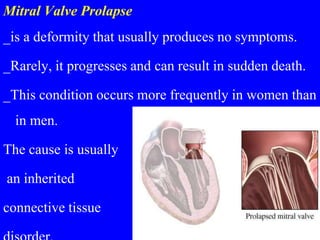
Mitral Valve Prolapse
_is a deformity that usually produces no symptoms.
_Rarely, it progresses and can result in sudden death.
_This condition occurs more frequently in women than
in men.
The cause is usually
an inherited
connective tissue
Pathophysiology
_In mitral valve prolapse, a portion of one or both
mitral valve leaflets balloons back into the atrium
during systole.
_Blood then regurgitates
from the left ventricle back
into the left atrium.
Clinical Manifestations
_Most people never have symptoms.
_A few have symptoms of:
1. Fatigue
2. shortness of breath
3. Dizziness
4. Syncope
5. Palpitations
6. chest pain
7. anxiety.
Assessment and Diagnostic Findings
1. a murmur of mitral regurgitation may be heard.
2. A few patients experience signs and symptoms of
heart failure.
3. Echocardiography may be used to diagnose and
monitor the progression of mitral valve prolapse.
Medical Management
Medical management is directed at controlling symptoms.
1. Most patients do not require any medications.
2. If dysrhythmias occur, the patient is advised to
eliminate caffeine and alcohol from the diet and to
stop smoking.
3. antiarrhythmic medications may be prescribed
(Verapamil, Amiodaron, Adenosine).
4. Chest pain that does not respond to nitrates may
respond to calcium channel blockers (Diltiazem,
amlodepine) or beta-blockers (Propranolol,
Atenolol).
5. In advanced stages of disease, Surgical intervention
consists of mitral valvuloplasty (ie, surgical repair
of the valve) or valve replacement may be
necessary.
valve replacement
Nursing Management
1. The nurse educates the patient about the diagnosis
and the possibility that the condition is hereditary.
Parents and siblings may be advised to have
echocardiograms.
2. Patients may be at risk for infectious endocarditis
The nurse teaches the patient how to minimize this
risk by:
a. practicing good oral hygiene
b. obtaining routine dental care
c. Avoid using toothpicks or other sharp objects in the
oral cavity.
3. To minimize symptoms, the nurse teaches the
patient to avoid caffeine and alcohol.
4. The nurse also give advices regarding diet, activity,
sleep, and other lifestyle factors that may correlate
with symptoms.
Mitral Stenosis
Mitral stenosis is an obstruction of blood flowing from
the left atrium into the left ventricle.
• _It is most often caused by rheumatic endocarditis,
which progressively thickens the mitral valve
leaflets.
• The leaflets often fuse together. Eventually, the
mitral valve orifice narrows and progressively
obstructs blood flow into the ventricle.
Mitral Stenosis: Pathophysiology
Source Undetermined
• Clinical Manifestations
1. Dyspnea on exertion as a result of pulmonary
venous hypertension.
2. fatigue.
3. The enlarged left atrium may create pressure on the
left bronchial tree, resulting in a dry cough or
wheezing.
4. Patients may expectorate blood (ie, hemoptysis) or
experience palpitations, orthopnea, paroxysmal
nocturnal dyspnea (PND), and repeated respiratory
infections.
Assessment and Diagnostic Findings
1. The pulse is weak and often irregular.
2. diastolic murmur is heard at the apex.
3. As a result of the increased blood volume and
pressure, the atrium dilates, hypertrophies, and
becomes electrically unstable, and patients
experience atrial dysrhythmias.
4. Echocardiography is used to diagnose mitral
stenosis.
5. Electrocardiography (ECG) and cardiac
catheterization may be used to help determine the
severity of the mitral stenosis.
Echocardiography: Short Axis
Normal Mitral Stenosis
Source Undetermined Source Undetermined
Medical Management
1. Anticoagulants to decrease the risk for developing
atrial thrombus.
2. Treatment of anemia.
3. Patients are advised to avoid tiring activities and
competitive sports, both of which increase the heart
rate.
4. Surgical intervention consists of:
1. Open surgical commissurotomy to open or rupture the
fused commissures of the mitral valve.
2. Mitral valve replacement may be performed.
3. Balloon mitral commissurotomy
Balloon
Balloon mitral
commissurotomy
Invasive
Valvuloplasty
Mitral Regurgitation
_Mitral regurgitation involves blood flowing back
from the left ventricle into the left atrium during
systole.
The leaflets cannot close completely because the
leaflets have thickened and fibrosed.
Causes of Mitral Regurgitation :
• mitral valve prolapse
• ischemia of the left ventricle
• rheumatic heart disease .
• infective endocarditis,
• annular calcification
• cardiomyopathy
• ischemic heart disease
Clinical Manifestations
Chronic mitral regurgitation is often asymptomatic,
but acute mitral regurgitation (eg, that resulting from
a myocardial infarction) usually manifests as severe
congestive heart failure.
1. Dyspnea
2. Fatigue
3. weakness are the most common symptoms.
4. Palpitations
5. shortness of breath on exertion
6. cough.
Assessment and Diagnostic Findings
1. A systolic murmur is heard.
2. Echocardiography is used to diagnose and monitor the
progression of mitral regurgitation.
4. C-XR: LA and LV enlargement
XR: LA and LV enlargement
Medical Management
1. Management is the same as that for heart failure
2. Reduction (arterial dilation) by treatment with
angiotensin-converting enzyme (ACE) inhibitors
(Vasodilators) , such as captopril (Capoten),
enalapril (Vasotec), lisinopril (Prinivil, Zestril),
ramipril (Altace), or hydralazine (Apresoline).
3. Angiotensin receptor blockers (ARBs), such as
losartan (Cozar) or valsartan (Diovan).
4. beta-blockers, such as carvedilol (Coreg).
5. Digoxin For Arterial Fibrilation
6. Antibiotic Prophylaxis against Infective
7. Once symptoms of heart failure develop, the patient
needs to restrict his or her activity level to
minimize symptoms.
8. Surgical intervention consists of mitral
valvuloplasty (ie, surgical repair of the valve) or
valve replacement.
Prosthetic valve in
place at the
completion of the
procedure
Mechanical Valve
Tissue Valve
Nursing Management: Valvular Heart Disorders
The nurse teaches the patients about:
1. the diagnosis, the progressive nature of valvular
heart disease, and the treatment plan.
2. medication schedule and teaches about the name,
dosage, actions, adverse effects, and any
interactions of the prescribed medications for heart
failure, dysrhythmias, angina pectoris, or other
symptoms.
3. Rest and relaxation.
4. Instruct the patient to check weigh daily and report
gains of 1 kg in 1 day or 2.5 Kg in 1 week to the
health care provider
5. The nurse measures the patient’s vital sings and
compares results with previous data, and notes any
changes.
6. The nurse auscultate heart and lung sounds
and palpate peripheral pulses.
7. The nurse also take care of patients treated with
valvuloplasty or surgical valve replacement.

Valvular disorders

  • 1.
    Nursing management ofpatients with cardiovascular disorders • Prepared By • Dr. Zuhair Rushdi Mustafa • Lecturer at University of Duhok/ College of Nursing
  • 2.
    VALVULAR DISORDERS The valvesof the heart control the flow of blood through the heart into the pulmonary artery and aorta by opening and closing through heart contraction and relaxing through the cardiac cycle. The valves of the heart (aortic , tricuspid, and mitral) in the closed position.
  • 4.
    Tricuspid valve separatesthe right atrium from the right ventricle, and the mitral valve separates the left atrium from the left ventricle. pulmonic valve Aortic valve
  • 5.
    Disorders of themitral valve fall into the following categories: 1. mitral valve prolapse (ie, stretching of the valve leaflet into the atrium during systole) 2. Mitral stenosis. 3. Mitral regurgitation These valvular disorders may require surgical repair or replacement of the valve to correct the problem, depending on severity of symptoms.
  • 6.
    Mitral Valve Prolapse _isa deformity that usually produces no symptoms. _Rarely, it progresses and can result in sudden death. _This condition occurs more frequently in women than in men. The cause is usually an inherited connective tissue
  • 7.
    Pathophysiology _In mitral valveprolapse, a portion of one or both mitral valve leaflets balloons back into the atrium during systole. _Blood then regurgitates from the left ventricle back into the left atrium.
  • 8.
    Clinical Manifestations _Most peoplenever have symptoms. _A few have symptoms of: 1. Fatigue 2. shortness of breath 3. Dizziness 4. Syncope 5. Palpitations 6. chest pain 7. anxiety.
  • 9.
    Assessment and DiagnosticFindings 1. a murmur of mitral regurgitation may be heard. 2. A few patients experience signs and symptoms of heart failure. 3. Echocardiography may be used to diagnose and monitor the progression of mitral valve prolapse.
  • 10.
    Medical Management Medical managementis directed at controlling symptoms. 1. Most patients do not require any medications. 2. If dysrhythmias occur, the patient is advised to eliminate caffeine and alcohol from the diet and to stop smoking. 3. antiarrhythmic medications may be prescribed (Verapamil, Amiodaron, Adenosine).
  • 11.
    4. Chest painthat does not respond to nitrates may respond to calcium channel blockers (Diltiazem, amlodepine) or beta-blockers (Propranolol, Atenolol). 5. In advanced stages of disease, Surgical intervention consists of mitral valvuloplasty (ie, surgical repair of the valve) or valve replacement may be necessary. valve replacement
  • 12.
    Nursing Management 1. Thenurse educates the patient about the diagnosis and the possibility that the condition is hereditary. Parents and siblings may be advised to have echocardiograms. 2. Patients may be at risk for infectious endocarditis The nurse teaches the patient how to minimize this risk by: a. practicing good oral hygiene b. obtaining routine dental care c. Avoid using toothpicks or other sharp objects in the oral cavity.
  • 13.
    3. To minimizesymptoms, the nurse teaches the patient to avoid caffeine and alcohol. 4. The nurse also give advices regarding diet, activity, sleep, and other lifestyle factors that may correlate with symptoms.
  • 14.
    Mitral Stenosis Mitral stenosisis an obstruction of blood flowing from the left atrium into the left ventricle. • _It is most often caused by rheumatic endocarditis, which progressively thickens the mitral valve leaflets. • The leaflets often fuse together. Eventually, the mitral valve orifice narrows and progressively obstructs blood flow into the ventricle.
  • 15.
  • 16.
    • Clinical Manifestations 1.Dyspnea on exertion as a result of pulmonary venous hypertension. 2. fatigue. 3. The enlarged left atrium may create pressure on the left bronchial tree, resulting in a dry cough or wheezing. 4. Patients may expectorate blood (ie, hemoptysis) or experience palpitations, orthopnea, paroxysmal nocturnal dyspnea (PND), and repeated respiratory infections.
  • 17.
    Assessment and DiagnosticFindings 1. The pulse is weak and often irregular. 2. diastolic murmur is heard at the apex. 3. As a result of the increased blood volume and pressure, the atrium dilates, hypertrophies, and becomes electrically unstable, and patients experience atrial dysrhythmias. 4. Echocardiography is used to diagnose mitral stenosis. 5. Electrocardiography (ECG) and cardiac catheterization may be used to help determine the severity of the mitral stenosis.
  • 18.
    Echocardiography: Short Axis NormalMitral Stenosis Source Undetermined Source Undetermined
  • 19.
    Medical Management 1. Anticoagulantsto decrease the risk for developing atrial thrombus. 2. Treatment of anemia. 3. Patients are advised to avoid tiring activities and competitive sports, both of which increase the heart rate. 4. Surgical intervention consists of: 1. Open surgical commissurotomy to open or rupture the fused commissures of the mitral valve. 2. Mitral valve replacement may be performed. 3. Balloon mitral commissurotomy
  • 20.
  • 21.
    Mitral Regurgitation _Mitral regurgitationinvolves blood flowing back from the left ventricle into the left atrium during systole. The leaflets cannot close completely because the leaflets have thickened and fibrosed.
  • 22.
    Causes of MitralRegurgitation : • mitral valve prolapse • ischemia of the left ventricle • rheumatic heart disease . • infective endocarditis, • annular calcification • cardiomyopathy • ischemic heart disease
  • 23.
    Clinical Manifestations Chronic mitralregurgitation is often asymptomatic, but acute mitral regurgitation (eg, that resulting from a myocardial infarction) usually manifests as severe congestive heart failure. 1. Dyspnea 2. Fatigue 3. weakness are the most common symptoms. 4. Palpitations 5. shortness of breath on exertion 6. cough.
  • 24.
    Assessment and DiagnosticFindings 1. A systolic murmur is heard. 2. Echocardiography is used to diagnose and monitor the progression of mitral regurgitation. 4. C-XR: LA and LV enlargement XR: LA and LV enlargement
  • 25.
    Medical Management 1. Managementis the same as that for heart failure 2. Reduction (arterial dilation) by treatment with angiotensin-converting enzyme (ACE) inhibitors (Vasodilators) , such as captopril (Capoten), enalapril (Vasotec), lisinopril (Prinivil, Zestril), ramipril (Altace), or hydralazine (Apresoline). 3. Angiotensin receptor blockers (ARBs), such as losartan (Cozar) or valsartan (Diovan). 4. beta-blockers, such as carvedilol (Coreg). 5. Digoxin For Arterial Fibrilation 6. Antibiotic Prophylaxis against Infective
  • 26.
    7. Once symptomsof heart failure develop, the patient needs to restrict his or her activity level to minimize symptoms. 8. Surgical intervention consists of mitral valvuloplasty (ie, surgical repair of the valve) or valve replacement. Prosthetic valve in place at the completion of the procedure
  • 27.
  • 29.
    Nursing Management: ValvularHeart Disorders The nurse teaches the patients about: 1. the diagnosis, the progressive nature of valvular heart disease, and the treatment plan. 2. medication schedule and teaches about the name, dosage, actions, adverse effects, and any interactions of the prescribed medications for heart failure, dysrhythmias, angina pectoris, or other symptoms. 3. Rest and relaxation.
  • 30.
    4. Instruct thepatient to check weigh daily and report gains of 1 kg in 1 day or 2.5 Kg in 1 week to the health care provider 5. The nurse measures the patient’s vital sings and compares results with previous data, and notes any changes. 6. The nurse auscultate heart and lung sounds and palpate peripheral pulses. 7. The nurse also take care of patients treated with valvuloplasty or surgical valve replacement.