www.valuescentre.com 0www.valuescentre.com
Building a values-driven organisation:
the challenge for leadership
Georgia Parker
Cascade Coaching and Training Ltd
www.cascadecoachingandtraining.co.uk
www.valuescentre.com
1
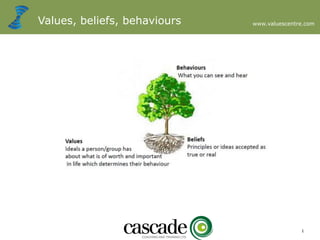
Values, beliefs, behaviours
www.valuescentre.com
2
www.valuescentre.com
3
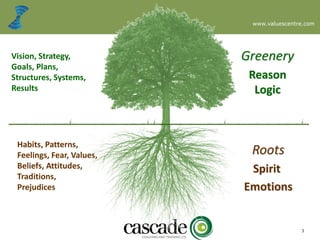
Greenery
Reason
Logic
Roots
Spirit
Emotions
Vision, Strategy,
Goals, Plans,
Structures, Systems,
Results
Habits, Patterns,
Feelings, Fear, Values,
Beliefs, Attitudes,
Traditions,
Prejudices
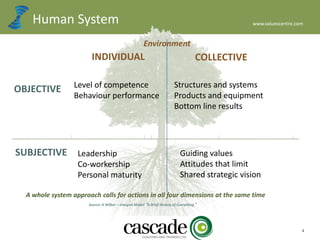
Human System
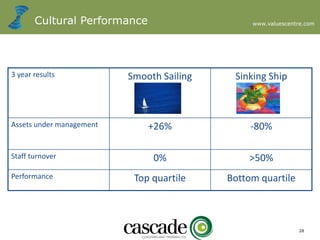
A whole system approach calls for actions in all four dimensions at the same time
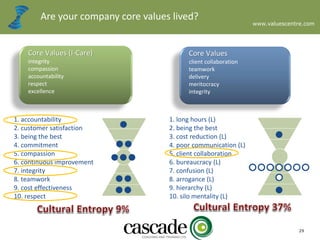
COLLECTIVEINDIVIDUAL
OBJECTIVE
SUBJECTIVE
Level of competence
Behaviour performance
Leadership
Co-workership
Personal maturity
Guiding values
Attitudes that limit
Shared strategic vision
Source: K Wilber – Integral Model “A Brief History of Everything”
Environment
Structures and systems
Products and equipment
Bottom line results
www.valuescentre.com
4
www.valuescentre.com
5
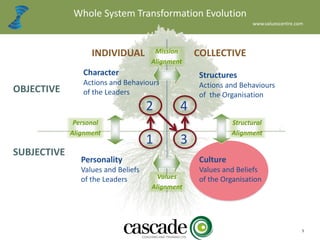
Whole System Transformation Evolution
COLLECTIVEINDIVIDUAL
OBJECTIVE
SUBJECTIVE
2 4
1 3
Mission
Alignment
Structural
Alignment
Values
Alignment
Personal
Alignment
Character
Actions and Behaviours
of the Leaders
Personality
Values and Beliefs
of the Leaders
Culture
Values and Beliefs
of the Organisation
Structures
Actions and Behaviours
of the Organisation
www.valuescentre.com
6
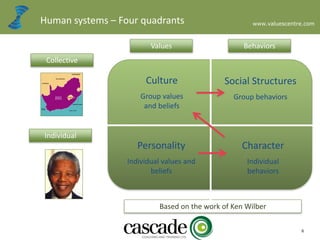
Human systems – Four quadrants
Personality
Individual values and
beliefs
Character
Individual
behaviors
Culture
Group values
and beliefs
Social Structures
Group behaviors
Individual
Collective
Values Behaviors
Based on the work of Ken Wilber
www.valuescentre.com
7
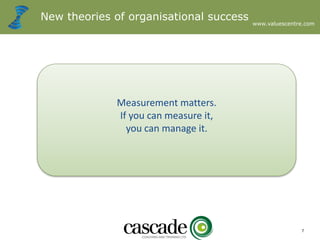
New theories of organisational success
Measurement matters.
If you can measure it,
you can manage it.
www.valuescentre.com
8
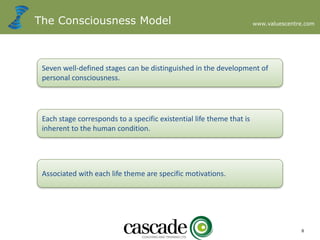
The Consciousness Model
Seven well-defined stages can be distinguished in the development of
personal consciousness.
Each stage corresponds to a specific existential life theme that is
inherent to the human condition.
Associated with each life theme are specific motivations.
www.valuescentre.com
9
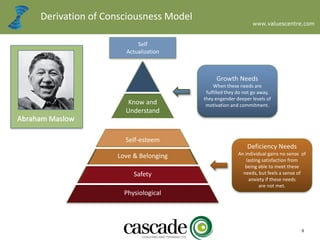
Derivation of Consciousness Model
Growth Needs
When these needs are
fulfilled they do not go away,
they engender deeper levels of
motivation and commitment.
Deficiency Needs
An individual gains no sense of
lasting satisfaction from
being able to meet these
needs, but feels a sense of
anxiety if these needs
are not met.
Physiological
Safety
Love & Belonging
Self-esteem
Know and
Understand
Abraham Maslow
Self
Actualization
www.valuescentre.com
10
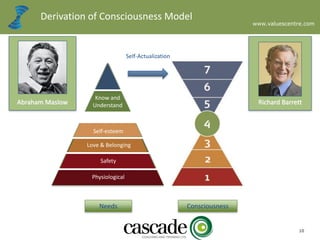
Richard Barrett
Derivation of Consciousness Model
Know and
Understand
Physiological
Safety
Love & Belonging
Self-esteem
Self-Actualization
Abraham Maslow
Know and
Understand
Needs Consciousness
www.valuescentre.com
11
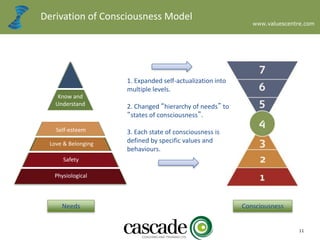
Derivation of Consciousness Model
Know and
Understand
Physiological
Safety
Love & Belonging
Self-esteem
Know and
Understand
Needs Consciousness
1. Expanded self-actualization into
multiple levels.
2. Changed “hierarchy of needs” to
“states of consciousness”.
3. Each state of consciousness is
defined by specific values and
behaviours.
www.valuescentre.com
12
Cultural Transformation Model
Know and
Understand
Physiological
Safety
Love & Belonging
Self-esteem
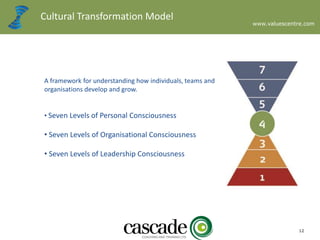
A framework for understanding how individuals, teams and
organisations develop and grow.
• Seven Levels of Personal Consciousness
• Seven Levels of Organisational Consciousness
• Seven Levels of Leadership Consciousness
www.valuescentre.com
13
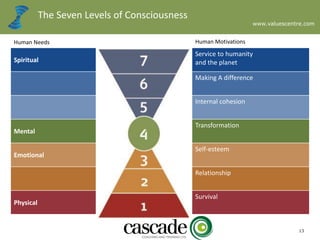
The Seven Levels of Consciousness
Spiritual
Service to humanity
and the planet
Making A difference
Internal cohesion
Mental
Transformation
Emotional
Self-esteem
Relationship
Physical
Survival
Human Needs Human Motivations
www.valuescentre.com
14
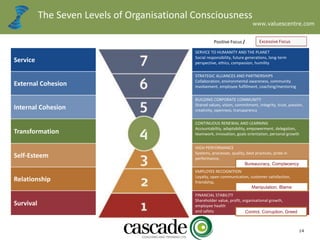
The Seven Levels of Organisational Consciousness
Service
SERVICE TO HUMANITY AND THE PLANET
Social responsibility, future generations, long-term
perspective, ethics, compassion, humility
External Cohesion
STRATEGIC ALLIANCES AND PARTNERSHIPS
Collaboration, environmental awareness, community
involvement, employee fulfillment, coaching/mentoring
Internal Cohesion
BUILDING CORPORATE COMMUNITY
Shared values, vision, commitment, integrity, trust, passion,
creativity, openness, transparency
Transformation
CONTINUOUS RENEWAL AND LEARNING
Accountability, adaptability, empowerment, delegation,
teamwork, innovation, goals orientation, personal growth
Self-Esteem
HIGH PERFORMANCE
Systems, processes, quality, best practices, pride in
performance,
Relationship
EMPLOYEE RECOGNITION
Loyalty, open communication, customer satisfaction,
friendship,
Survival
FINANCIAL STABILITY
Shareholder value, profit, organisational growth,
employee health
and safety
Positive Focus / Excessive Focus
Control, Corruption, Greed
Bureaucracy, Complacency
Manipulation, Blame
www.valuescentre.com
15
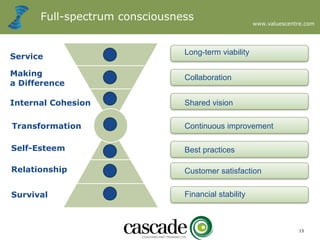
Full-spectrum consciousness
Service
Making
a Difference
Internal Cohesion
Transformation
Self-Esteem
Relationship
Survival
Long-term viability
Collaboration
Shared vision
Continuous improvement
Best practices
Customer satisfaction
Financial stability
www.valuescentre.com
16
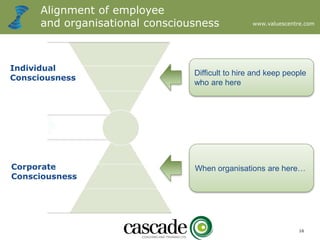
Alignment of employee
and organisational consciousness
Difficult to hire and keep people
who are here
Individual
Consciousness
When organisations are here…Corporate
Consciousness
www.valuescentre.com
17
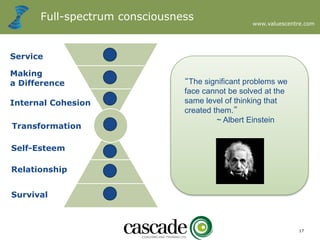
Full-spectrum consciousness
Service
Making
a Difference
Internal Cohesion
Transformation
Self-Esteem
Relationship
Survival
“The significant problems we
face cannot be solved at the
same level of thinking that
created them.”
~ Albert Einstein
www.valuescentre.com
18
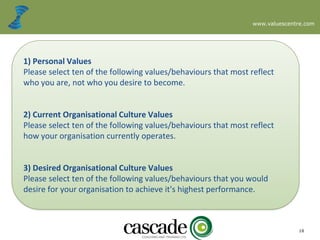
1) Personal Values
Please select ten of the following values/behaviours that most reflect
who you are, not who you desire to become.
2) Current Organisational Culture Values
Please select ten of the following values/behaviours that most reflect
how your organisation currently operates.
3) Desired Organisational Culture Values
Please select ten of the following values/behaviours that you would
desire for your organisation to achieve it's highest performance.
www.valuescentre.com
19
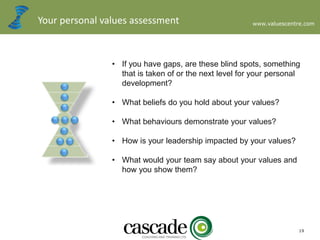
Your personal values assessment
• If you have gaps, are these blind spots, something
that is taken of or the next level for your personal
development?
• What beliefs do you hold about your values?
• What behaviours demonstrate your values?
• How is your leadership impacted by your values?
• What would your team say about your values and
how you show them?
www.valuescentre.com
20
www.valuescentre.com
21
Beliefs Divide
Values Unite
Beliefs Divide
Values Unite
Beliefs divide . . .
Values unite
www.valuescentre.com
22
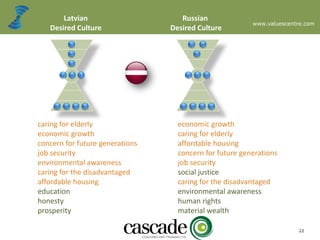
economic growth
caring for elderly
affordable housing
concern for future generations
job security
social justice
caring for the disadvantaged
environmental awareness
human rights
material wealth
caring for elderly
economic growth
concern for future generations
job security
environmental awareness
caring for the disadvantaged
affordable housing
education
honesty
prosperity
Latvian
Desired Culture
Russian
Desired Culture
www.valuescentre.com
23
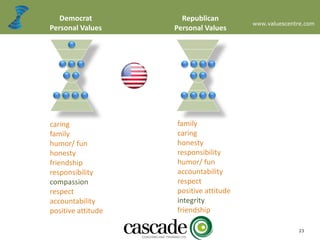
family
caring
honesty
responsibility
humor/ fun
accountability
respect
positive attitude
integrity
friendship
caring
family
humor/ fun
honesty
friendship
responsibility
compassion
respect
accountability
positive attitude
Democrat
Personal Values
Republican
Personal Values
www.valuescentre.com
24
www.valuescentre.com
25
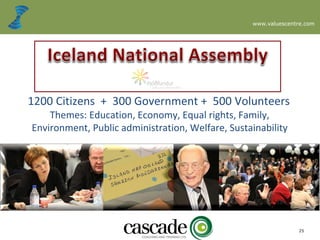
1200 Citizens + 300 Government + 500 Volunteers
Themes: Education, Economy, Equal rights, Family,
Environment, Public administration, Welfare, Sustainability
www.valuescentre.com
26
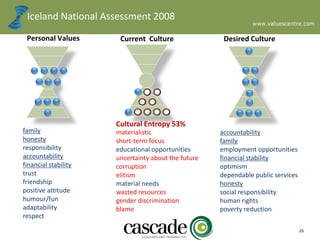
materialistic
short-term focus
educational opportunities
uncertainty about the future
corruption
elitism
material needs
wasted resources
gender discrimination
blame
accountability
family
employment opportunities
financial stability
optimism
dependable public services
honesty
social responsibility
human rights
poverty reduction
Iceland National Assessment 2008
family
honesty
responsibility
accountability
financial stability
trust
friendship
positive attitude
humour/fun
adaptability
respect
Personal Values Desired CultureCurrent Culture
Cultural Entropy 53%
www.valuescentre.com
27
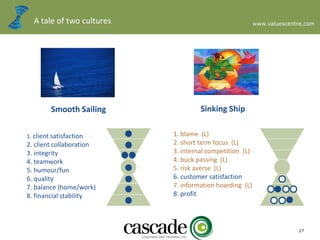
1. client satisfaction
2. client collaboration
3. integrity
4. teamwork
5. humour/fun
6. quality
7. balance (home/work)
8. financial stability
A tale of two cultures
1. blame (L)
2. short term focus (L)
3. internal competition (L)
4. buck passing (L)
5. risk averse (L)
6. customer satisfaction
7. information hoarding (L)
8. profit
Smooth Sailing Sinking Ship
www.valuescentre.com
28
Cultural Performance
3 year results Smooth Sailing Sinking Ship
Assets under management +26% -80%
Staff turnover 0% >50%
Performance Top quartile Bottom quartile
www.valuescentre.com
29
Are your company core values lived?
1. long hours (L)
2. being the best
3. cost reduction (L)
4. poor communication (L)
5. client collaboration
6. bureaucracy (L)
7. confusion (L)
8. arrogance (L)
9. hierarchy (L)
10. silo mentality (L)
1. accountability
2. customer satisfaction
3. being the best
4. commitment
5. compassion
6. continuous improvement
7. integrity
8. teamwork
9. cost effectiveness
10. respect
Core Values
client collaboration
teamwork
delivery
meritocracy
integrity
Core Values (I-Care)
integrity
compassion
accountability
respect
excellence
www.valuescentre.com
30
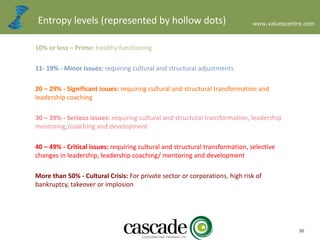
Entropy levels (represented by hollow dots)
10% or less – Prime: healthy functioning
11- 19% - Minor issues: requiring cultural and structural adjustments
20 – 29% - Significant issues: requiring cultural and structural transformation and
leadership coaching
30 – 39% - Serious issues: requiring cultural and structural transformation, leadership
mentoring,/coaching and development
40 – 49% - Critical issues: requiring cultural and structural transformation, selective
changes in leadership, leadership coaching/ mentoring and development
More than 50% - Cultural Crisis: For private sector or corporations, high risk of
bankruptcy, takeover or implosion
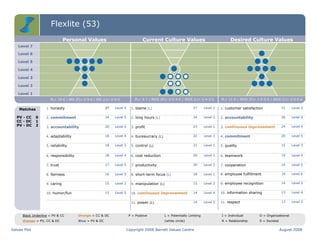
Flexlite (53)
Level 7
Level 6
Level 5
Level 4
Level 3
Level 2
Level 1
Personal Values Current Culture Values Desired Culture Values
PL= 10-0 | IRS (P)= 5-5-0 | IRS (L)= 0-0-0 PL= 4-7 | IROS (P)= 0-0-4-0 | IROS (L)= 0-4-3-0 PL= 11-0 | IROS (P)= 1-5-5-0 | IROS (L)= 0-0-0-0
Matches
PV - CC 0
CC - DC 1
PV - DC 2
1. honesty 27 Level 5
2. commitment 24 Level 5
3. accountability 20 Level 4
4. adaptability 18 Level 4
5. reliability 18 Level 3
6. responsibility 18 Level 4
7. trust 17 Level 5
8. fairness 16 Level 5
9. caring 15 Level 2
10. humor/fun 15 Level 5
Black Underline = PV & CC Orange = CC & DC P = Positive L = Potentially Limiting I = Individual O = Organizational
Orange = PV, CC & DC Blue = PV & DC (white circle) R = Relationship S = Societal
1. blame (L) 27 Level 2
2. long hours (L) 24 Level 3
3. profit 23 Level 1
4. bureaucracy (L) 22 Level 3
5. control (L) 21 Level 1
6. cost reduction 20 Level 1
7. productivity 20 Level 3
8. short-term focus (L) 18 Level 1
9. manipulation (L) 15 Level 2
10. continuous improvement 14 Level 4
11. power (L) 14 Level 3
1. customer satisfaction 31 Level 2
2. accountability 26 Level 4
3. continuous improvement 24 Level 4
4. commitment 20 Level 5
5. quality 15 Level 3
6. teamwork 15 Level 4
7. cooperation 14 Level 5
8. employee fulfillment 14 Level 6
9. employee recognition 14 Level 2
10. information sharing 13 Level 4
11. respect 13 Level 2
Values Plot Copyright 2008 Barrett Values Centre August 2008
www.valuescentre.com
32
www.valuescentre.com
33
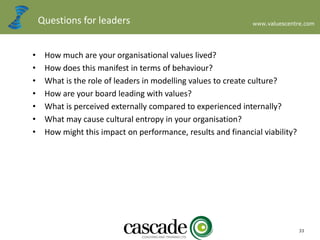
Questions for leaders
• How much are your organisational values lived?
• How does this manifest in terms of behaviour?
• What is the role of leaders in modelling values to create culture?
• How are your board leading with values?
• What is perceived externally compared to experienced internally?
• What may cause cultural entropy in your organisation?
• How might this impact on performance, results and financial viability?
www.valuescentre.com
34

Georgia Park of Cascade Coaching - Building a values-driven organisation: the challenge for leadership

  • 1.
    www.valuescentre.com 0www.valuescentre.com Building avalues-driven organisation: the challenge for leadership Georgia Parker Cascade Coaching and Training Ltd www.cascadecoachingandtraining.co.uk
  • 2.
  • 3.
  • 4.
    www.valuescentre.com 3 Greenery Reason Logic Roots Spirit Emotions Vision, Strategy, Goals, Plans, Structures,Systems, Results Habits, Patterns, Feelings, Fear, Values, Beliefs, Attitudes, Traditions, Prejudices
  • 5.
    Human System A wholesystem approach calls for actions in all four dimensions at the same time COLLECTIVEINDIVIDUAL OBJECTIVE SUBJECTIVE Level of competence Behaviour performance Leadership Co-workership Personal maturity Guiding values Attitudes that limit Shared strategic vision Source: K Wilber – Integral Model “A Brief History of Everything” Environment Structures and systems Products and equipment Bottom line results www.valuescentre.com 4
  • 6.
    www.valuescentre.com 5 Whole System TransformationEvolution COLLECTIVEINDIVIDUAL OBJECTIVE SUBJECTIVE 2 4 1 3 Mission Alignment Structural Alignment Values Alignment Personal Alignment Character Actions and Behaviours of the Leaders Personality Values and Beliefs of the Leaders Culture Values and Beliefs of the Organisation Structures Actions and Behaviours of the Organisation
  • 7.
    www.valuescentre.com 6 Human systems –Four quadrants Personality Individual values and beliefs Character Individual behaviors Culture Group values and beliefs Social Structures Group behaviors Individual Collective Values Behaviors Based on the work of Ken Wilber
  • 8.
    www.valuescentre.com 7 New theories oforganisational success Measurement matters. If you can measure it, you can manage it.
  • 9.
    www.valuescentre.com 8 The Consciousness Model Sevenwell-defined stages can be distinguished in the development of personal consciousness. Each stage corresponds to a specific existential life theme that is inherent to the human condition. Associated with each life theme are specific motivations.
  • 10.
    www.valuescentre.com 9 Derivation of ConsciousnessModel Growth Needs When these needs are fulfilled they do not go away, they engender deeper levels of motivation and commitment. Deficiency Needs An individual gains no sense of lasting satisfaction from being able to meet these needs, but feels a sense of anxiety if these needs are not met. Physiological Safety Love & Belonging Self-esteem Know and Understand Abraham Maslow Self Actualization
  • 11.
    www.valuescentre.com 10 Richard Barrett Derivation ofConsciousness Model Know and Understand Physiological Safety Love & Belonging Self-esteem Self-Actualization Abraham Maslow Know and Understand Needs Consciousness
  • 12.
    www.valuescentre.com 11 Derivation of ConsciousnessModel Know and Understand Physiological Safety Love & Belonging Self-esteem Know and Understand Needs Consciousness 1. Expanded self-actualization into multiple levels. 2. Changed “hierarchy of needs” to “states of consciousness”. 3. Each state of consciousness is defined by specific values and behaviours.
  • 13.
    www.valuescentre.com 12 Cultural Transformation Model Knowand Understand Physiological Safety Love & Belonging Self-esteem A framework for understanding how individuals, teams and organisations develop and grow. • Seven Levels of Personal Consciousness • Seven Levels of Organisational Consciousness • Seven Levels of Leadership Consciousness
  • 14.
    www.valuescentre.com 13 The Seven Levelsof Consciousness Spiritual Service to humanity and the planet Making A difference Internal cohesion Mental Transformation Emotional Self-esteem Relationship Physical Survival Human Needs Human Motivations
  • 15.
    www.valuescentre.com 14 The Seven Levelsof Organisational Consciousness Service SERVICE TO HUMANITY AND THE PLANET Social responsibility, future generations, long-term perspective, ethics, compassion, humility External Cohesion STRATEGIC ALLIANCES AND PARTNERSHIPS Collaboration, environmental awareness, community involvement, employee fulfillment, coaching/mentoring Internal Cohesion BUILDING CORPORATE COMMUNITY Shared values, vision, commitment, integrity, trust, passion, creativity, openness, transparency Transformation CONTINUOUS RENEWAL AND LEARNING Accountability, adaptability, empowerment, delegation, teamwork, innovation, goals orientation, personal growth Self-Esteem HIGH PERFORMANCE Systems, processes, quality, best practices, pride in performance, Relationship EMPLOYEE RECOGNITION Loyalty, open communication, customer satisfaction, friendship, Survival FINANCIAL STABILITY Shareholder value, profit, organisational growth, employee health and safety Positive Focus / Excessive Focus Control, Corruption, Greed Bureaucracy, Complacency Manipulation, Blame
  • 16.
    www.valuescentre.com 15 Full-spectrum consciousness Service Making a Difference InternalCohesion Transformation Self-Esteem Relationship Survival Long-term viability Collaboration Shared vision Continuous improvement Best practices Customer satisfaction Financial stability
  • 17.
    www.valuescentre.com 16 Alignment of employee andorganisational consciousness Difficult to hire and keep people who are here Individual Consciousness When organisations are here…Corporate Consciousness
  • 18.
    www.valuescentre.com 17 Full-spectrum consciousness Service Making a Difference InternalCohesion Transformation Self-Esteem Relationship Survival “The significant problems we face cannot be solved at the same level of thinking that created them.” ~ Albert Einstein
  • 19.
    www.valuescentre.com 18 1) Personal Values Pleaseselect ten of the following values/behaviours that most reflect who you are, not who you desire to become. 2) Current Organisational Culture Values Please select ten of the following values/behaviours that most reflect how your organisation currently operates. 3) Desired Organisational Culture Values Please select ten of the following values/behaviours that you would desire for your organisation to achieve it's highest performance.
  • 20.
    www.valuescentre.com 19 Your personal valuesassessment • If you have gaps, are these blind spots, something that is taken of or the next level for your personal development? • What beliefs do you hold about your values? • What behaviours demonstrate your values? • How is your leadership impacted by your values? • What would your team say about your values and how you show them?
  • 21.
  • 22.
    www.valuescentre.com 21 Beliefs Divide Values Unite BeliefsDivide Values Unite Beliefs divide . . . Values unite
  • 23.
    www.valuescentre.com 22 economic growth caring forelderly affordable housing concern for future generations job security social justice caring for the disadvantaged environmental awareness human rights material wealth caring for elderly economic growth concern for future generations job security environmental awareness caring for the disadvantaged affordable housing education honesty prosperity Latvian Desired Culture Russian Desired Culture
  • 24.
    www.valuescentre.com 23 family caring honesty responsibility humor/ fun accountability respect positive attitude integrity friendship caring family humor/fun honesty friendship responsibility compassion respect accountability positive attitude Democrat Personal Values Republican Personal Values
  • 25.
  • 26.
    www.valuescentre.com 25 1200 Citizens +300 Government + 500 Volunteers Themes: Education, Economy, Equal rights, Family, Environment, Public administration, Welfare, Sustainability
  • 27.
    www.valuescentre.com 26 materialistic short-term focus educational opportunities uncertaintyabout the future corruption elitism material needs wasted resources gender discrimination blame accountability family employment opportunities financial stability optimism dependable public services honesty social responsibility human rights poverty reduction Iceland National Assessment 2008 family honesty responsibility accountability financial stability trust friendship positive attitude humour/fun adaptability respect Personal Values Desired CultureCurrent Culture Cultural Entropy 53%
  • 28.
    www.valuescentre.com 27 1. client satisfaction 2.client collaboration 3. integrity 4. teamwork 5. humour/fun 6. quality 7. balance (home/work) 8. financial stability A tale of two cultures 1. blame (L) 2. short term focus (L) 3. internal competition (L) 4. buck passing (L) 5. risk averse (L) 6. customer satisfaction 7. information hoarding (L) 8. profit Smooth Sailing Sinking Ship
  • 29.
    www.valuescentre.com 28 Cultural Performance 3 yearresults Smooth Sailing Sinking Ship Assets under management +26% -80% Staff turnover 0% >50% Performance Top quartile Bottom quartile
  • 30.
    www.valuescentre.com 29 Are your companycore values lived? 1. long hours (L) 2. being the best 3. cost reduction (L) 4. poor communication (L) 5. client collaboration 6. bureaucracy (L) 7. confusion (L) 8. arrogance (L) 9. hierarchy (L) 10. silo mentality (L) 1. accountability 2. customer satisfaction 3. being the best 4. commitment 5. compassion 6. continuous improvement 7. integrity 8. teamwork 9. cost effectiveness 10. respect Core Values client collaboration teamwork delivery meritocracy integrity Core Values (I-Care) integrity compassion accountability respect excellence
  • 31.
    www.valuescentre.com 30 Entropy levels (representedby hollow dots) 10% or less – Prime: healthy functioning 11- 19% - Minor issues: requiring cultural and structural adjustments 20 – 29% - Significant issues: requiring cultural and structural transformation and leadership coaching 30 – 39% - Serious issues: requiring cultural and structural transformation, leadership mentoring,/coaching and development 40 – 49% - Critical issues: requiring cultural and structural transformation, selective changes in leadership, leadership coaching/ mentoring and development More than 50% - Cultural Crisis: For private sector or corporations, high risk of bankruptcy, takeover or implosion
  • 32.
    Flexlite (53) Level 7 Level6 Level 5 Level 4 Level 3 Level 2 Level 1 Personal Values Current Culture Values Desired Culture Values PL= 10-0 | IRS (P)= 5-5-0 | IRS (L)= 0-0-0 PL= 4-7 | IROS (P)= 0-0-4-0 | IROS (L)= 0-4-3-0 PL= 11-0 | IROS (P)= 1-5-5-0 | IROS (L)= 0-0-0-0 Matches PV - CC 0 CC - DC 1 PV - DC 2 1. honesty 27 Level 5 2. commitment 24 Level 5 3. accountability 20 Level 4 4. adaptability 18 Level 4 5. reliability 18 Level 3 6. responsibility 18 Level 4 7. trust 17 Level 5 8. fairness 16 Level 5 9. caring 15 Level 2 10. humor/fun 15 Level 5 Black Underline = PV & CC Orange = CC & DC P = Positive L = Potentially Limiting I = Individual O = Organizational Orange = PV, CC & DC Blue = PV & DC (white circle) R = Relationship S = Societal 1. blame (L) 27 Level 2 2. long hours (L) 24 Level 3 3. profit 23 Level 1 4. bureaucracy (L) 22 Level 3 5. control (L) 21 Level 1 6. cost reduction 20 Level 1 7. productivity 20 Level 3 8. short-term focus (L) 18 Level 1 9. manipulation (L) 15 Level 2 10. continuous improvement 14 Level 4 11. power (L) 14 Level 3 1. customer satisfaction 31 Level 2 2. accountability 26 Level 4 3. continuous improvement 24 Level 4 4. commitment 20 Level 5 5. quality 15 Level 3 6. teamwork 15 Level 4 7. cooperation 14 Level 5 8. employee fulfillment 14 Level 6 9. employee recognition 14 Level 2 10. information sharing 13 Level 4 11. respect 13 Level 2 Values Plot Copyright 2008 Barrett Values Centre August 2008
  • 33.
  • 34.
    www.valuescentre.com 33 Questions for leaders •How much are your organisational values lived? • How does this manifest in terms of behaviour? • What is the role of leaders in modelling values to create culture? • How are your board leading with values? • What is perceived externally compared to experienced internally? • What may cause cultural entropy in your organisation? • How might this impact on performance, results and financial viability?
  • 35.