Uses of the value chain approach in livestock and beef
Theo Knight-Jones
Animal health challenges to Southern Africa–EU beef export trade
Gaborone, Botswana
8-9 September 2015
Value chain approach
What is it & when is it used?
Different for different people
• Ask an economist
• A veterinary epidemiologist
• Development sociologist
Who has participated in a value chain workshop/analysis?
3
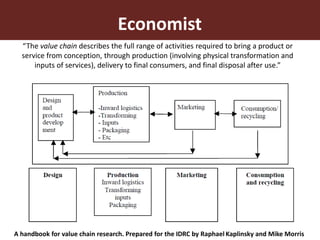
Economist
“The value chain describes the full range of activities required to bring a product or
service from conception, through production (involving physical transformation and
inputs of services), delivery to final consumers, and final disposal after use.”
A handbook for value chain research. Prepared for the IDRC by Raphael Kaplinsky and Mike Morris
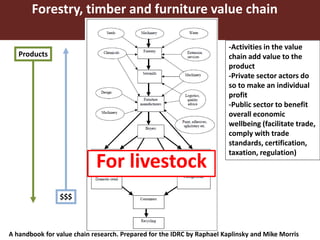
4A handbook for value chain research. Prepared for the IDRC by Raphael Kaplinsky and Mike Morris
Forestry, timber and furniture value chain
For livestock
-Activities in the value
chain add value to the
product
-Private sector actors do
so to make an individual
profit
-Public sector to benefit
overall economic
wellbeing (facilitate trade,
comply with trade
standards, certification,
taxation, regulation)
Products
$$$
Borders
Consumption centre
Production
Cluster
Movement
Corridor
Quarantine
Station
Abattoir
Market
Road
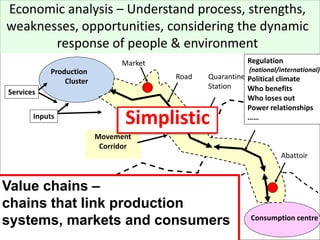
Economic analysis – Understand process, strengths,
weaknesses, opportunities, considering the dynamic
response of people & environment
Value chains –
chains that link production
systems, markets and consumers
SimplisticInputs
Services
Regulation
(national/international)
Political climate
Who benefits
Who loses out
Power relationships
……
6
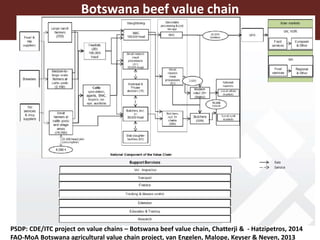
PSDP: CDE/ITC project on value chains – Botswana beef value chain, Chatterji & - Hatzipetros, 2014
FAO-MoA Botswana agricultural value chain project, van Engelen, Malope, Keyser & Neven, 2013
Botswana beef value chain
7
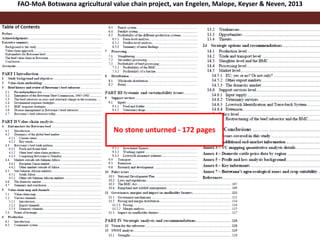
FAO-MoA Botswana agricultural value chain project, van Engelen, Malope, Keyser & Neven, 2013
No stone unturned - 172 pages
8
Identifies & investigates:
- Bottlenecks
- Holistic strategies for upgrading
- Assesses how value in an end market is created by
activities conducted by actors supported by service
providers
- How actors are influenced by the business
environment in which they operate
- Goes beyond linkages between suppliers and buyers
- Dynamic, evolving & reacting
- Focus on key growth and upgrading opportunities
Value chain analysis - purpose
9
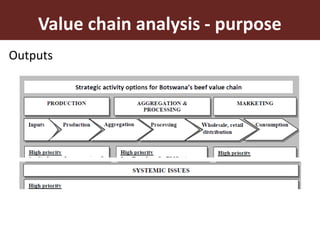
Value chain analysis - purpose
Outputs
10
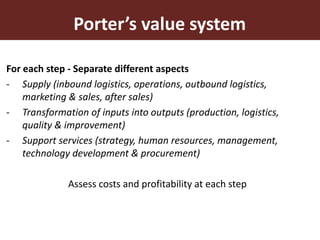
For each step - Separate different aspects
- Supply (inbound logistics, operations, outbound logistics,
marketing & sales, after sales)
- Transformation of inputs into outputs (production, logistics,
quality & improvement)
- Support services (strategy, human resources, management,
technology development & procurement)
Assess costs and profitability at each step
Porter’s value system
11
Porter’s value system
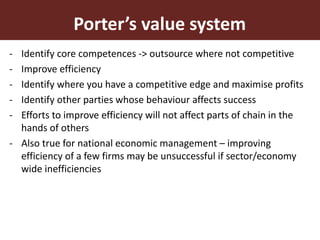
- Identify core competences -> outsource where not competitive
- Improve efficiency
- Identify where you have a competitive edge and maximise profits
- Identify other parties whose behaviour affects success
- Efforts to improve efficiency will not affect parts of chain in the
hands of others
- Also true for national economic management – improving
efficiency of a few firms may be unsuccessful if sector/economy
wide inefficiencies
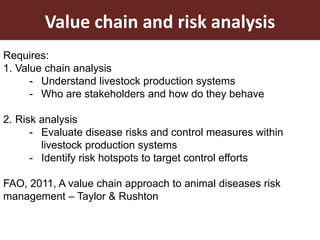
Requires:
1. Value chain analysis
- Understand livestock production systems
- Who are stakeholders and how do they behave
2. Risk analysis
- Evaluate disease risks and control measures within
livestock production systems
- Identify risk hotspots to target control efforts
FAO, 2011, A value chain approach to animal diseases risk
management – Taylor & Rushton
Value chain and risk analysis
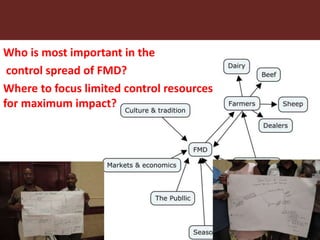
Who is most important in the
control spread of FMD?
Where to focus limited control resources
for maximum impact?
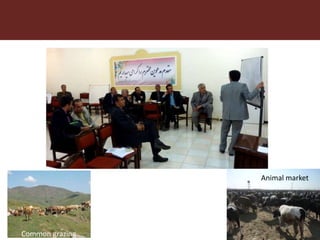
Common grazing
Animal market
Other value chain approaches
- Value chain approaches also used for food safety
assessment
- Chain of actors involved in creation of final product
- All can impact on quality of final product
- Safety/quality related to input costs (margins/profits?)
- Regulation important
- Dynamic
16
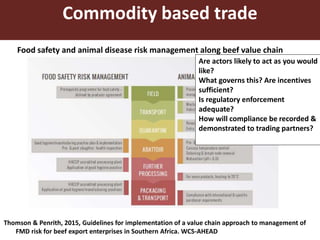
Food safety and animal disease risk management along beef value chain
Commodity based trade
Thomson & Penrith, 2015, Guidelines for implementation of a value chain approach to management of
FMD risk for beef export enterprises in Southern Africa. WCS-AHEAD
Are actors likely to act as you would
like?
What governs this? Are incentives
sufficient?
Is regulatory enforcement
adequate?
How will compliance be recorded &
demonstrated to trading partners?
17
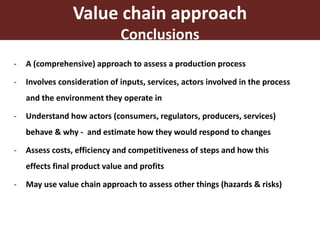
- A (comprehensive) approach to assess a production process
- Involves consideration of inputs, services, actors involved in the process
and the environment they operate in
- Understand how actors (consumers, regulators, producers, services)
behave & why - and estimate how they would respond to changes
- Assess costs, efficiency and competitiveness of steps and how this
effects final product value and profits
- May use value chain approach to assess other things (hazards & risks)
Value chain approach
Conclusions
18
Questions?
19

Uses of the value chain approach in livestock and beef

  • 1.
    Uses of thevalue chain approach in livestock and beef Theo Knight-Jones Animal health challenges to Southern Africa–EU beef export trade Gaborone, Botswana 8-9 September 2015
  • 2.
    Value chain approach Whatis it & when is it used? Different for different people • Ask an economist • A veterinary epidemiologist • Development sociologist Who has participated in a value chain workshop/analysis?
  • 3.
    3 Economist “The value chaindescribes the full range of activities required to bring a product or service from conception, through production (involving physical transformation and inputs of services), delivery to final consumers, and final disposal after use.” A handbook for value chain research. Prepared for the IDRC by Raphael Kaplinsky and Mike Morris
  • 4.
    4A handbook forvalue chain research. Prepared for the IDRC by Raphael Kaplinsky and Mike Morris Forestry, timber and furniture value chain For livestock -Activities in the value chain add value to the product -Private sector actors do so to make an individual profit -Public sector to benefit overall economic wellbeing (facilitate trade, comply with trade standards, certification, taxation, regulation) Products $$$
  • 5.
    Borders Consumption centre Production Cluster Movement Corridor Quarantine Station Abattoir Market Road Economic analysis– Understand process, strengths, weaknesses, opportunities, considering the dynamic response of people & environment Value chains – chains that link production systems, markets and consumers SimplisticInputs Services Regulation (national/international) Political climate Who benefits Who loses out Power relationships ……
  • 6.
    6 PSDP: CDE/ITC projecton value chains – Botswana beef value chain, Chatterji & - Hatzipetros, 2014 FAO-MoA Botswana agricultural value chain project, van Engelen, Malope, Keyser & Neven, 2013 Botswana beef value chain
  • 7.
    7 FAO-MoA Botswana agriculturalvalue chain project, van Engelen, Malope, Keyser & Neven, 2013 No stone unturned - 172 pages
  • 8.
    8 Identifies & investigates: -Bottlenecks - Holistic strategies for upgrading - Assesses how value in an end market is created by activities conducted by actors supported by service providers - How actors are influenced by the business environment in which they operate - Goes beyond linkages between suppliers and buyers - Dynamic, evolving & reacting - Focus on key growth and upgrading opportunities Value chain analysis - purpose
  • 9.
    9 Value chain analysis- purpose Outputs
  • 10.
    10 For each step- Separate different aspects - Supply (inbound logistics, operations, outbound logistics, marketing & sales, after sales) - Transformation of inputs into outputs (production, logistics, quality & improvement) - Support services (strategy, human resources, management, technology development & procurement) Assess costs and profitability at each step Porter’s value system
  • 11.
    11 Porter’s value system -Identify core competences -> outsource where not competitive - Improve efficiency - Identify where you have a competitive edge and maximise profits - Identify other parties whose behaviour affects success - Efforts to improve efficiency will not affect parts of chain in the hands of others - Also true for national economic management – improving efficiency of a few firms may be unsuccessful if sector/economy wide inefficiencies
  • 12.
    Requires: 1. Value chainanalysis - Understand livestock production systems - Who are stakeholders and how do they behave 2. Risk analysis - Evaluate disease risks and control measures within livestock production systems - Identify risk hotspots to target control efforts FAO, 2011, A value chain approach to animal diseases risk management – Taylor & Rushton Value chain and risk analysis
  • 13.
    Who is mostimportant in the control spread of FMD? Where to focus limited control resources for maximum impact?
  • 14.
  • 15.
    Other value chainapproaches - Value chain approaches also used for food safety assessment - Chain of actors involved in creation of final product - All can impact on quality of final product - Safety/quality related to input costs (margins/profits?) - Regulation important - Dynamic
  • 16.
    16 Food safety andanimal disease risk management along beef value chain Commodity based trade Thomson & Penrith, 2015, Guidelines for implementation of a value chain approach to management of FMD risk for beef export enterprises in Southern Africa. WCS-AHEAD Are actors likely to act as you would like? What governs this? Are incentives sufficient? Is regulatory enforcement adequate? How will compliance be recorded & demonstrated to trading partners?
  • 17.
    17 - A (comprehensive)approach to assess a production process - Involves consideration of inputs, services, actors involved in the process and the environment they operate in - Understand how actors (consumers, regulators, producers, services) behave & why - and estimate how they would respond to changes - Assess costs, efficiency and competitiveness of steps and how this effects final product value and profits - May use value chain approach to assess other things (hazards & risks) Value chain approach Conclusions
  • 18.
  • 19.

Editor's Notes

  • #2  To replace a photo above, copy and paste this link in your browser: http://www.flickr.com/photos/ilri/sets/72157632057087650/detail/   Find a photo you like and the right size, copy and paste it in the block above.