Gender mainstreaming
efforts in the Ethiopian
Institute of Agricultural
Research
Rehima Mussema, EIAR

EIAR
Livestock and Fish Gender Working Group
Workshop and Planning Meeting
Addis Ababa, Ethiopia
14-18 October 2013
Outline
•
•
•
•

Overview of Gender Mainstreaming in the NARS
Achievements of GMg strategies in EIAR
Challenges of GMg activities in EIAR
Future plan of GMg in research projects in EIAR
1. Over view of gender mainstreaming in the
NARS
 The Government has given special focus to address gender inequality and
economic empowerment of women

 Agricultural research institutes is therefore expected to contribute to
this initiative by providing guidance, technical advice, and information
through forming strong collaboration with the MoA and other SHs.
 These in return would contribute to achieve sustainable rural
development as well as contributing to poverty reduction initiatives.
 This strategy is thus, prepared to assist agricultural research institutes
to internalize gender aspect into their research and development
activities.
1.1 Gender mainstreaming status
• Gender related activities in NARS were underway since mid-1990s
• EIAR has identified the need for a demand-driven and merit-based
HRD, with particular emphasis on gender
• However, formal GM aspect was commenced during the first
sensitization workshop (Oct. 1999) at the former EARO/ - EIAR.
to commence a firm foundation for the introduction of gender
concerns in to the NARS – to make GSR/GRR

to create gender awareness among researchers and develop a
strategy to integrate gender in agricultural research activities.
GM status…..
• To this effect, a GFU was established under the
REFLD in 2003.
• Gender issue encompasses all aspects of extension
activities
 need assessment,
behavior identification, and

• also REFLD is facilitating participatory and farmers
led research and technology transfer activities.
GM status…..
• to fulfill the institutional and national expectations necessitate
for the unit to stand by its own/independent in October 2006 ,
• obtained additional support and fertile ground for facilitation of
the GM process in the NARS.
• Thus, the unit is given the position of GRCO and officially
mandated to coordinate and facilitate gender related activities
in the research system as of Dec 2009.
2. Accomplished Activities since the
establishment of the GFU
1. Established GM unit at HQ level and GFP at center
and regional level,
2. Organizational assessment carried out (2005),
3. Priority in gender mainstreaming identified,
4. Sex and gender disaggregated information was
produced W/t to resource, decision making,
5. TOR for GU, federal and regional research centers
developed ,
6. Establish national gender mainstreaming network
7. Joint planning workshop was held in Sep. 2009,
Cont…
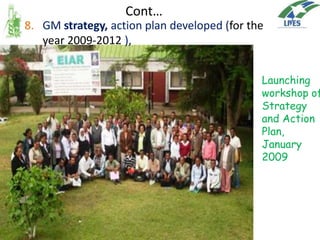
8. GM strategy, action plan developed (for the
year 2009-2012 ),

Launching
workshop of
Strategy
and Action
Plan,
January
2009
Cont…

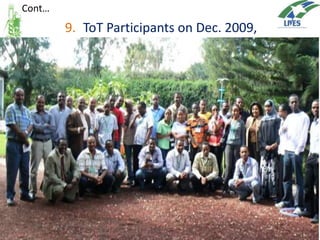
9. ToT Participants on Dec. 2009,
Cont…

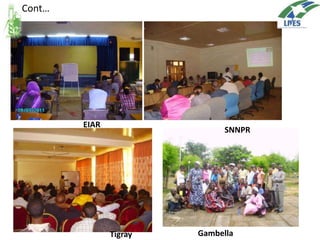
EIAR

SNNPR

Tigray

Gambella
Accomplished Activities…………..
10. Case studies conducted,
11. Development of users guide entitled “Gender analysis tools:
users’ guide in Agricultural Research for development”,
12. Capacity building ,
13. Women specific empowerment activities ,
14. Affirmative actions (employment, training),
15. Women forum established ,
Accomplished Activities…………..
16. Demonstration of newly released technologies,
17. Demonstration and popularization of different soya bean
dishes,
18. Pre scaling up of best technologies,

19. Organizing District level Innovation Platform,
20. Participatory variety selection,

21. gender based pre-scaling up activities,
22. Participatory post harvest handling training, etc.
2.1 Gender mainstreaming strategies and approaches
in EIAR
• Strengthening the political will to achieve gender equality
and equity at all levels;

• Incorporating a gender perspective into the research
planning, implementation, monitoring and evaluation
processes
• Integrating a gender concern into the personnel policies and
management, and legal affairs including the administration
of justice;
• Promote women specific empowerments initiatives through
improved technologies
• Increasing the numbers of women in decision-making
positions;
Cont …

• Promoting the use of sex-disaggregated data in statistical
analysis to reveal how research projects impact differently
on women and men;

• Providing training on gender awareness, gender analysis and
gender planning for: top level decision makers, researchers, TAs and
administrative staff to ensure integration of gender
perspective into their work;

• Creating and strengthening linkages between governments,
the private sector, civil society and other stakeholders to
ensure a co-ordination of efforts and resources; and
• Establishing of M & E, and reporting mechanisms.
GM effort in livestock research
•
•
•
•

Gender specific project -Chicken production
Dairy,
Milk churner
Fish production, feed preparation, processing and
post harvest handling training for women and men
3. GM challenges in Agricultural Research
• Poor participation of women farmers in all project cycle and prescaling up activities (lack of resources, education, skill , knowledge, ..)

• Women farmers lack getting benefits equal to men from the
interventions
• Most of the technologies are not designed in the way to solve
women’s problems in a given area
• Limitation of skill/knowledge/capacity of GM, gender analysis and
using participatory approach
• GFP in center take GM taken as an additional work
• Lack of accountability
• Gender training is not considered as part of other training
4. Future plan of GMg in the research projects
•

Based on the above problem the following plans are designed:
 GFP will strongly participate in all project cycle

 GFD –HRD planned to employ permanent GFP (five centers)
 Giving training/reminding for all (supporting and researchers)
 Participate on research reviews at all level (case team, center,
national)
 Strongly work with PMED
 Gender auditing
All theses planed activities may improve/guide GM activities in
agricultural research
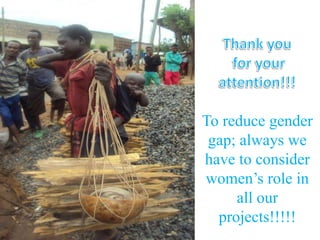
To reduce gender
gap; always we
have to consider
women’s role in
all our
projects!!!!!

Gender mainstreaming efforts in the Ethiopian Institute of Agricultural Research

  • 1.
    Gender mainstreaming efforts inthe Ethiopian Institute of Agricultural Research Rehima Mussema, EIAR EIAR Livestock and Fish Gender Working Group Workshop and Planning Meeting Addis Ababa, Ethiopia 14-18 October 2013
  • 2.
    Outline • • • • Overview of GenderMainstreaming in the NARS Achievements of GMg strategies in EIAR Challenges of GMg activities in EIAR Future plan of GMg in research projects in EIAR
  • 3.
    1. Over viewof gender mainstreaming in the NARS  The Government has given special focus to address gender inequality and economic empowerment of women  Agricultural research institutes is therefore expected to contribute to this initiative by providing guidance, technical advice, and information through forming strong collaboration with the MoA and other SHs.  These in return would contribute to achieve sustainable rural development as well as contributing to poverty reduction initiatives.  This strategy is thus, prepared to assist agricultural research institutes to internalize gender aspect into their research and development activities.
  • 4.
    1.1 Gender mainstreamingstatus • Gender related activities in NARS were underway since mid-1990s • EIAR has identified the need for a demand-driven and merit-based HRD, with particular emphasis on gender • However, formal GM aspect was commenced during the first sensitization workshop (Oct. 1999) at the former EARO/ - EIAR. to commence a firm foundation for the introduction of gender concerns in to the NARS – to make GSR/GRR to create gender awareness among researchers and develop a strategy to integrate gender in agricultural research activities.
  • 5.
    GM status….. • Tothis effect, a GFU was established under the REFLD in 2003. • Gender issue encompasses all aspects of extension activities  need assessment, behavior identification, and • also REFLD is facilitating participatory and farmers led research and technology transfer activities.
  • 6.
    GM status….. • tofulfill the institutional and national expectations necessitate for the unit to stand by its own/independent in October 2006 , • obtained additional support and fertile ground for facilitation of the GM process in the NARS. • Thus, the unit is given the position of GRCO and officially mandated to coordinate and facilitate gender related activities in the research system as of Dec 2009.
  • 7.
    2. Accomplished Activitiessince the establishment of the GFU 1. Established GM unit at HQ level and GFP at center and regional level, 2. Organizational assessment carried out (2005), 3. Priority in gender mainstreaming identified, 4. Sex and gender disaggregated information was produced W/t to resource, decision making, 5. TOR for GU, federal and regional research centers developed , 6. Establish national gender mainstreaming network 7. Joint planning workshop was held in Sep. 2009,
  • 8.
    Cont… 8. GM strategy,action plan developed (for the year 2009-2012 ), Launching workshop of Strategy and Action Plan, January 2009
  • 9.
  • 10.
  • 11.
    Accomplished Activities………….. 10. Casestudies conducted, 11. Development of users guide entitled “Gender analysis tools: users’ guide in Agricultural Research for development”, 12. Capacity building , 13. Women specific empowerment activities , 14. Affirmative actions (employment, training), 15. Women forum established ,
  • 12.
    Accomplished Activities………….. 16. Demonstrationof newly released technologies, 17. Demonstration and popularization of different soya bean dishes, 18. Pre scaling up of best technologies, 19. Organizing District level Innovation Platform, 20. Participatory variety selection, 21. gender based pre-scaling up activities, 22. Participatory post harvest handling training, etc.
  • 13.
    2.1 Gender mainstreamingstrategies and approaches in EIAR • Strengthening the political will to achieve gender equality and equity at all levels; • Incorporating a gender perspective into the research planning, implementation, monitoring and evaluation processes • Integrating a gender concern into the personnel policies and management, and legal affairs including the administration of justice; • Promote women specific empowerments initiatives through improved technologies • Increasing the numbers of women in decision-making positions;
  • 14.
    Cont … • Promotingthe use of sex-disaggregated data in statistical analysis to reveal how research projects impact differently on women and men; • Providing training on gender awareness, gender analysis and gender planning for: top level decision makers, researchers, TAs and administrative staff to ensure integration of gender perspective into their work; • Creating and strengthening linkages between governments, the private sector, civil society and other stakeholders to ensure a co-ordination of efforts and resources; and • Establishing of M & E, and reporting mechanisms.
  • 15.
    GM effort inlivestock research • • • • Gender specific project -Chicken production Dairy, Milk churner Fish production, feed preparation, processing and post harvest handling training for women and men
  • 16.
    3. GM challengesin Agricultural Research • Poor participation of women farmers in all project cycle and prescaling up activities (lack of resources, education, skill , knowledge, ..) • Women farmers lack getting benefits equal to men from the interventions • Most of the technologies are not designed in the way to solve women’s problems in a given area • Limitation of skill/knowledge/capacity of GM, gender analysis and using participatory approach • GFP in center take GM taken as an additional work • Lack of accountability • Gender training is not considered as part of other training
  • 17.
    4. Future planof GMg in the research projects • Based on the above problem the following plans are designed:  GFP will strongly participate in all project cycle  GFD –HRD planned to employ permanent GFP (five centers)  Giving training/reminding for all (supporting and researchers)  Participate on research reviews at all level (case team, center, national)  Strongly work with PMED  Gender auditing All theses planed activities may improve/guide GM activities in agricultural research
  • 18.
    To reduce gender gap;always we have to consider women’s role in all our projects!!!!!