Problems in Credit Risk Management September 16,  2009 By A. V. Vedpuriswar
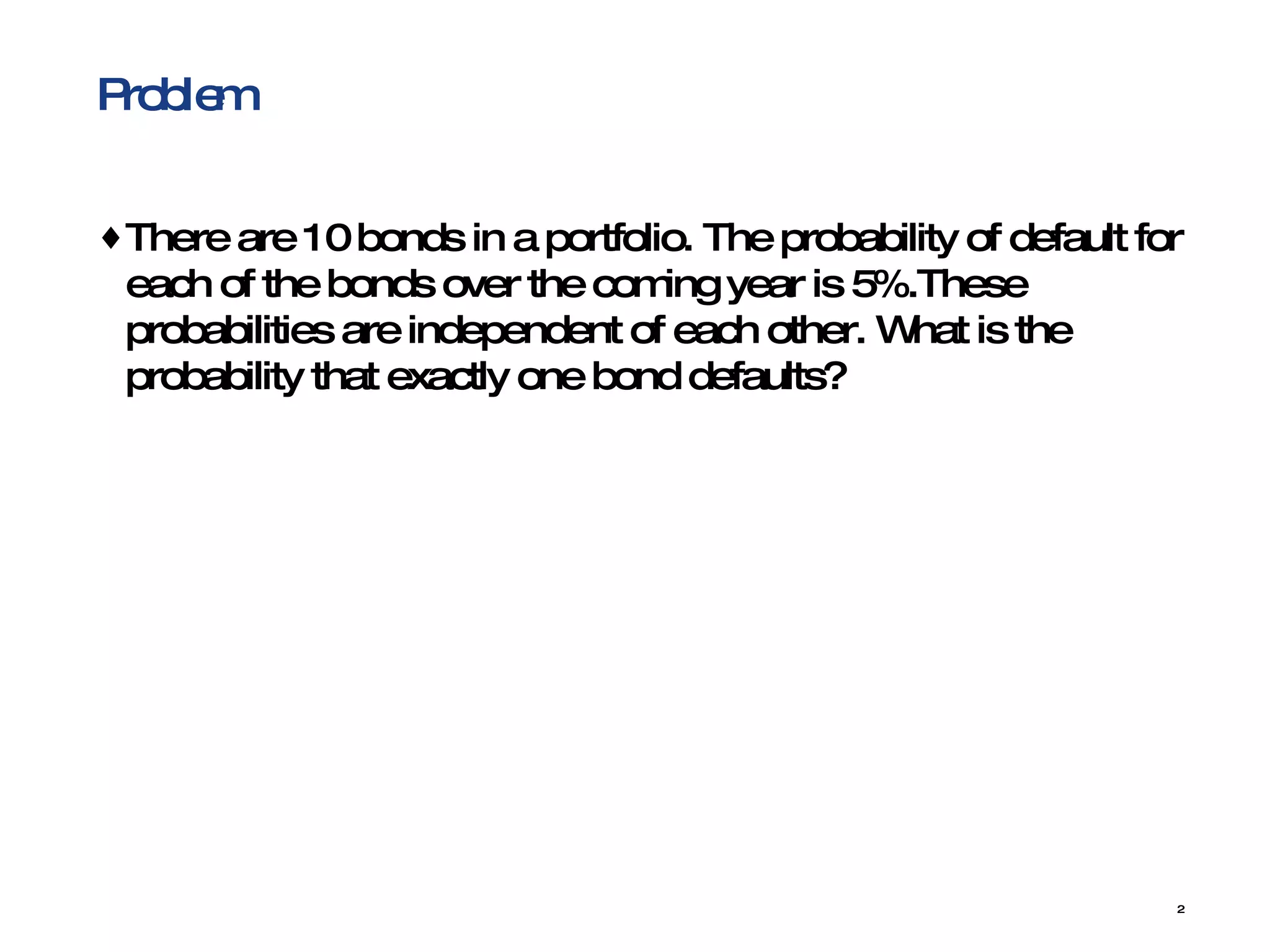
Problem There are 10 bonds in a portfolio. The probability of default for each of the bonds over the coming year is 5%.These probabilities are independent of each other. What is the probability that exactly one bond defaults?
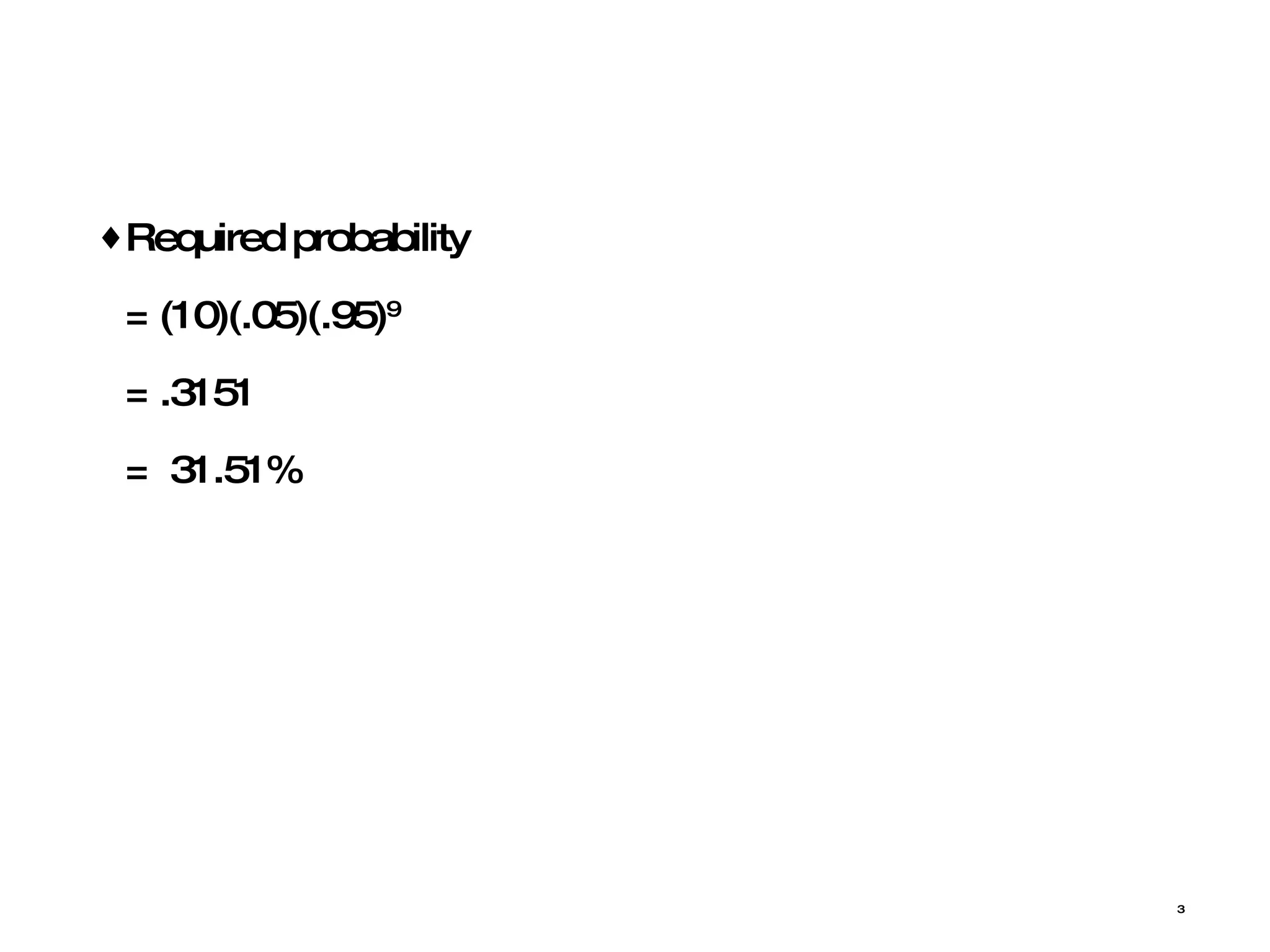
Required probability  = (10)(.05)(.95) 9 = .3151 =  31.51%
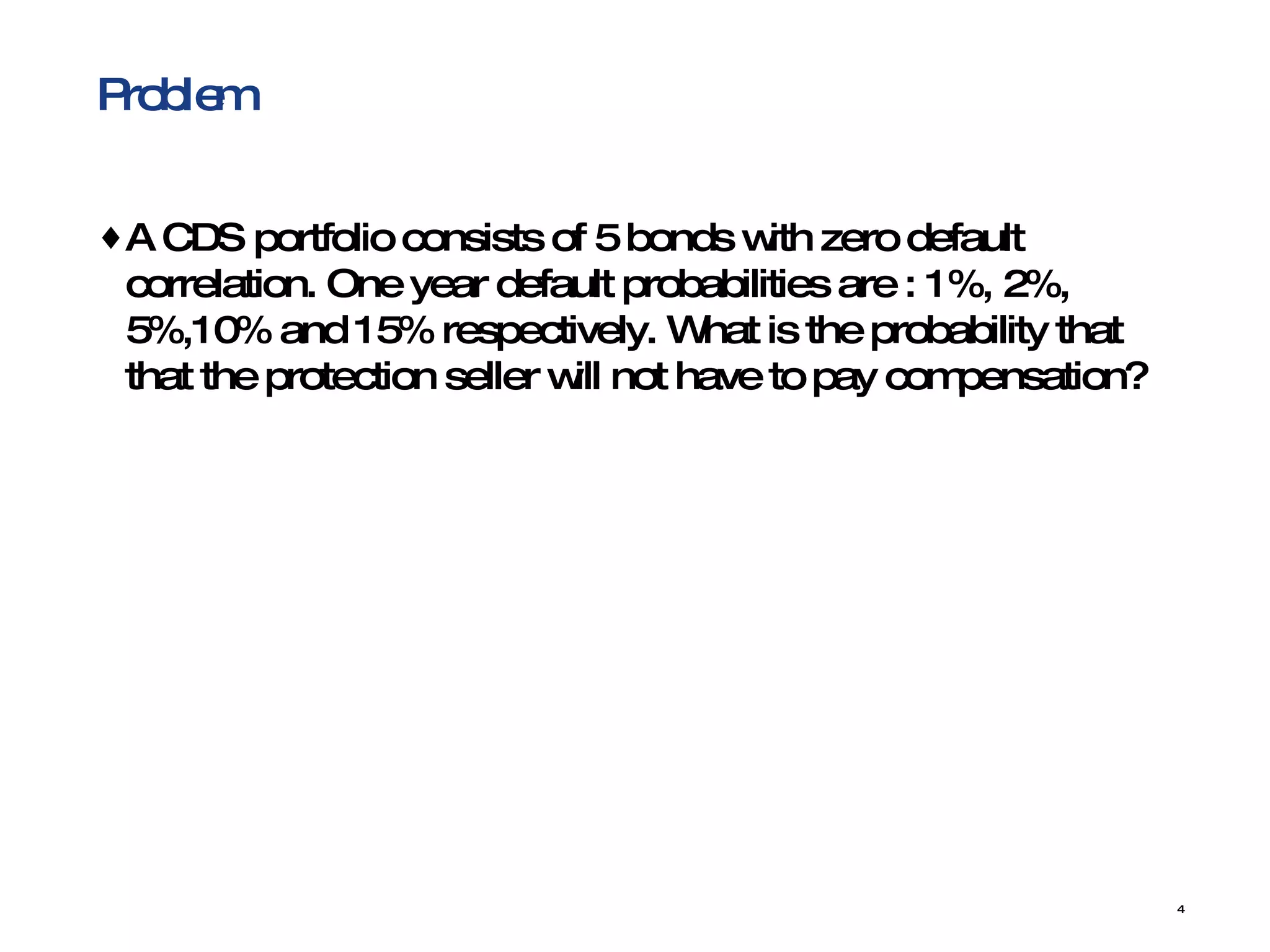
Problem A CDS portfolio consists of 5 bonds with zero default correlation. One year default probabilities are : 1%, 2%, 5%,10% and 15% respectively. What is the probability that that the protection seller will not have to pay compensation?
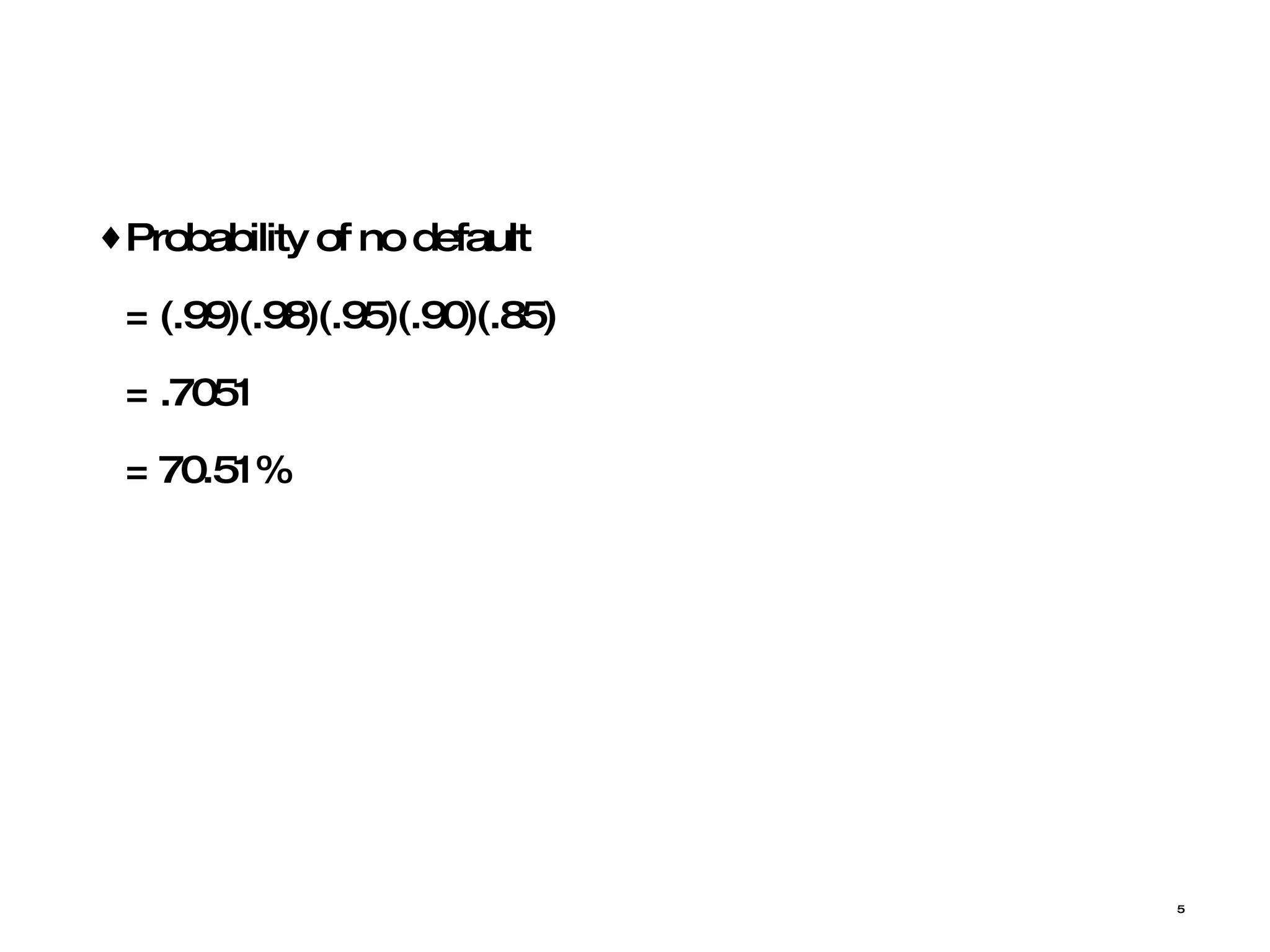
Probability of no default  = (.99)(.98)(.95)(.90)(.85) = .7051 = 70.51%
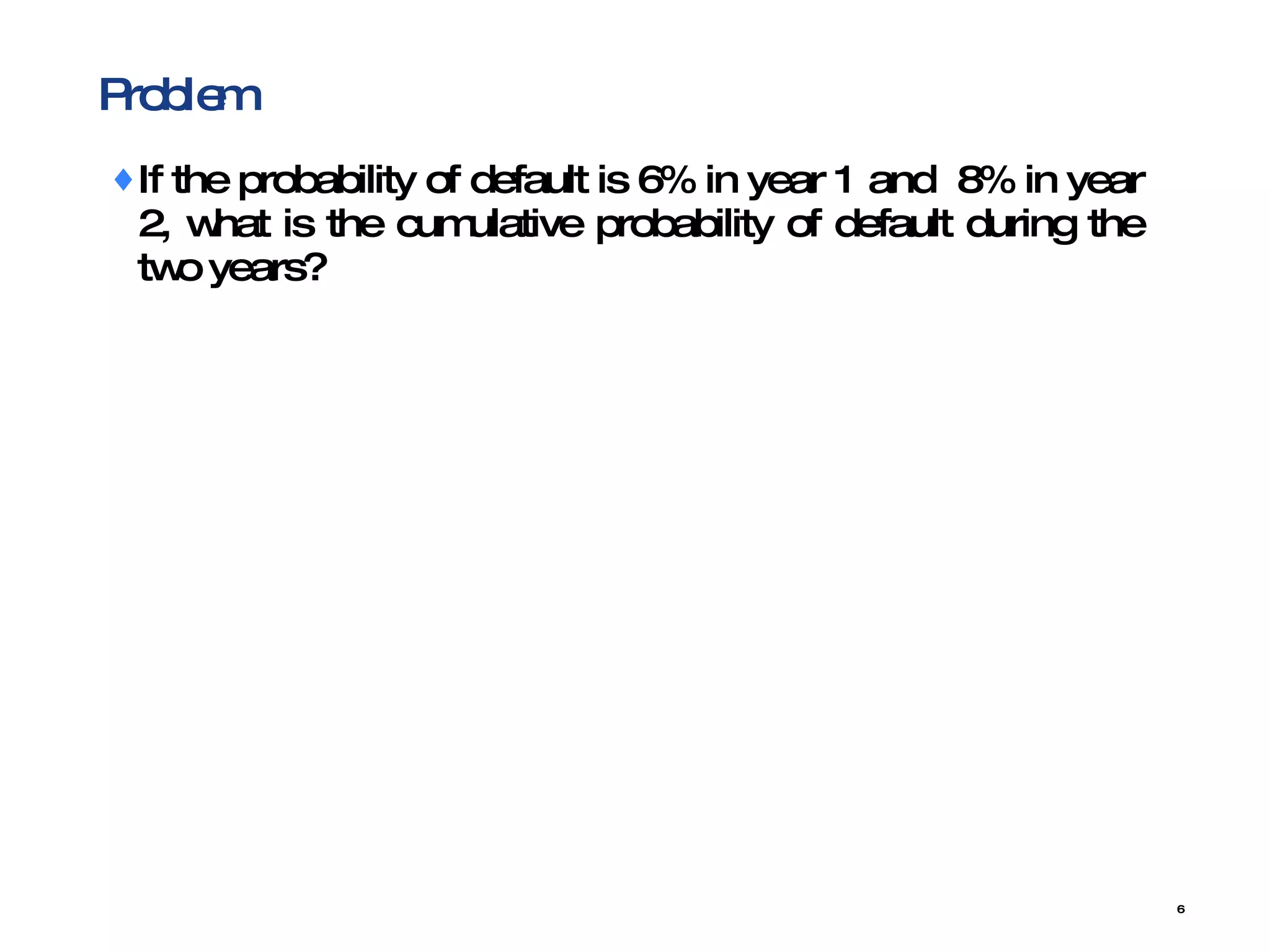
Problem If the probability of default is 6% in year 1 and  8% in year 2, what is the cumulative probability of default during the two years?
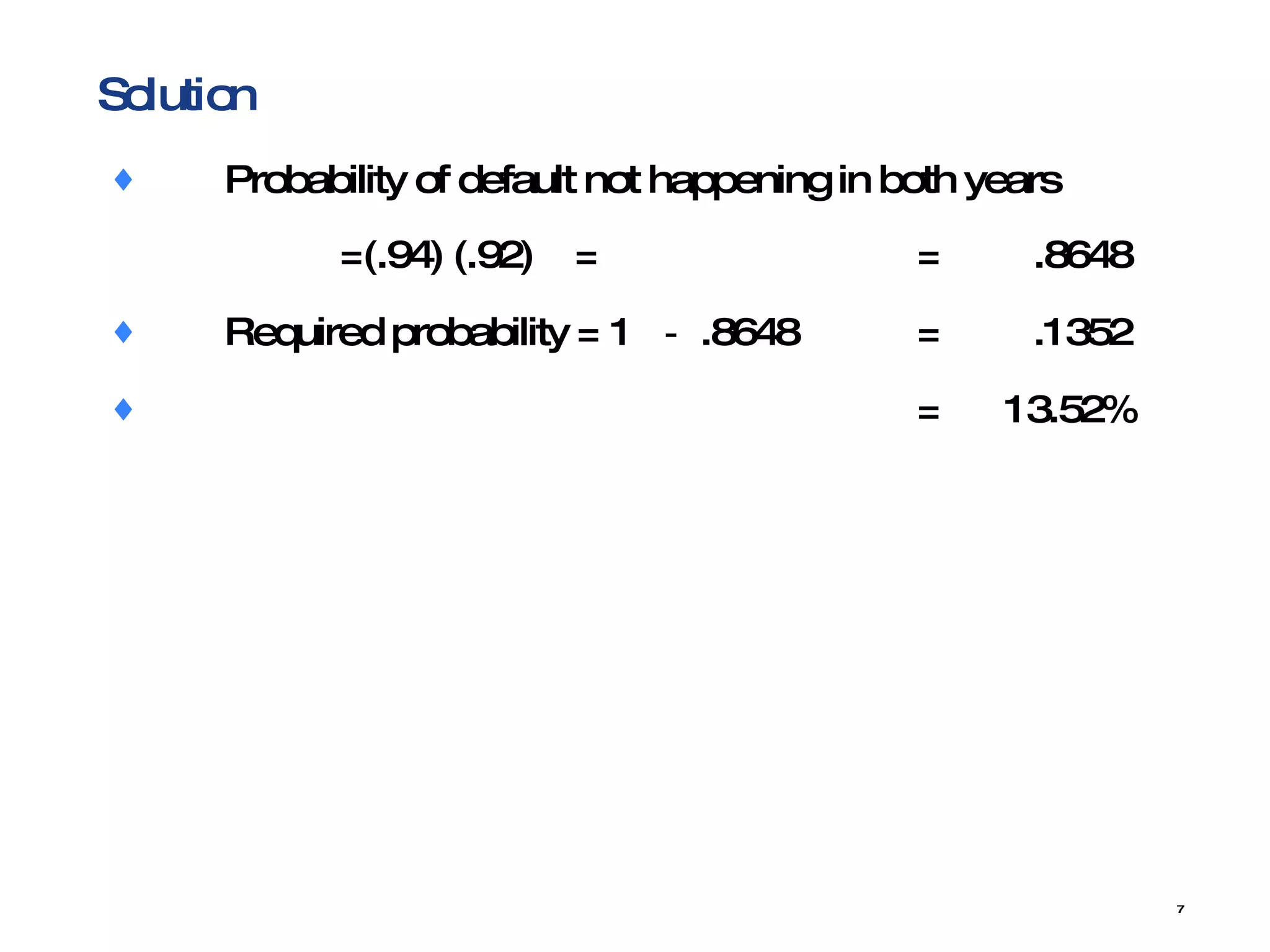
Solution Probability  of default not happening in both years  =(.94) (.92)  = = .8648 Required probability = 1  - .8648 = .1352 =  13.52%
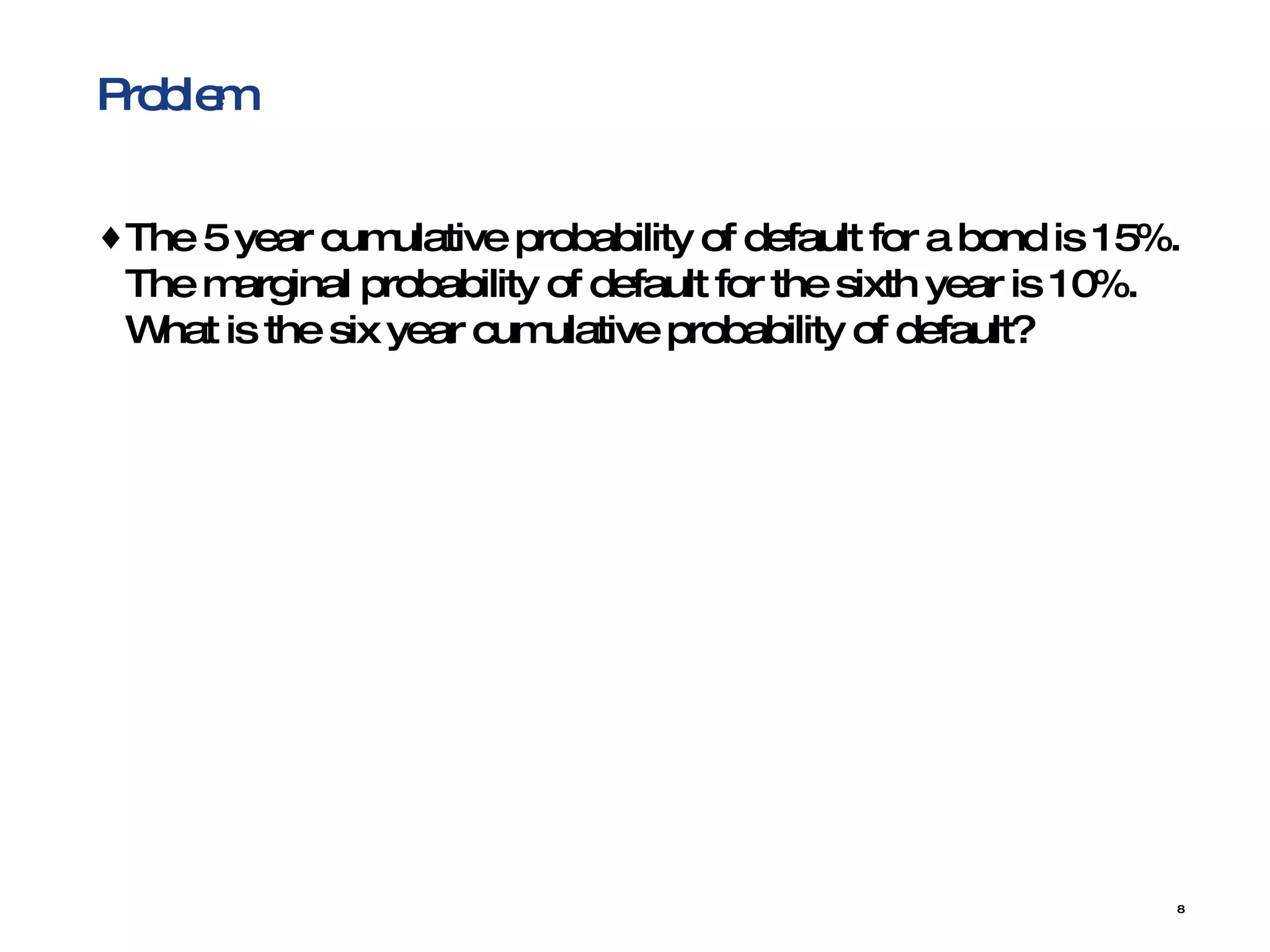
Problem The 5 year cumulative probability of default for a bond is 15%. The marginal probability of default for the sixth year is 10%. What is the six year cumulative probability of default?
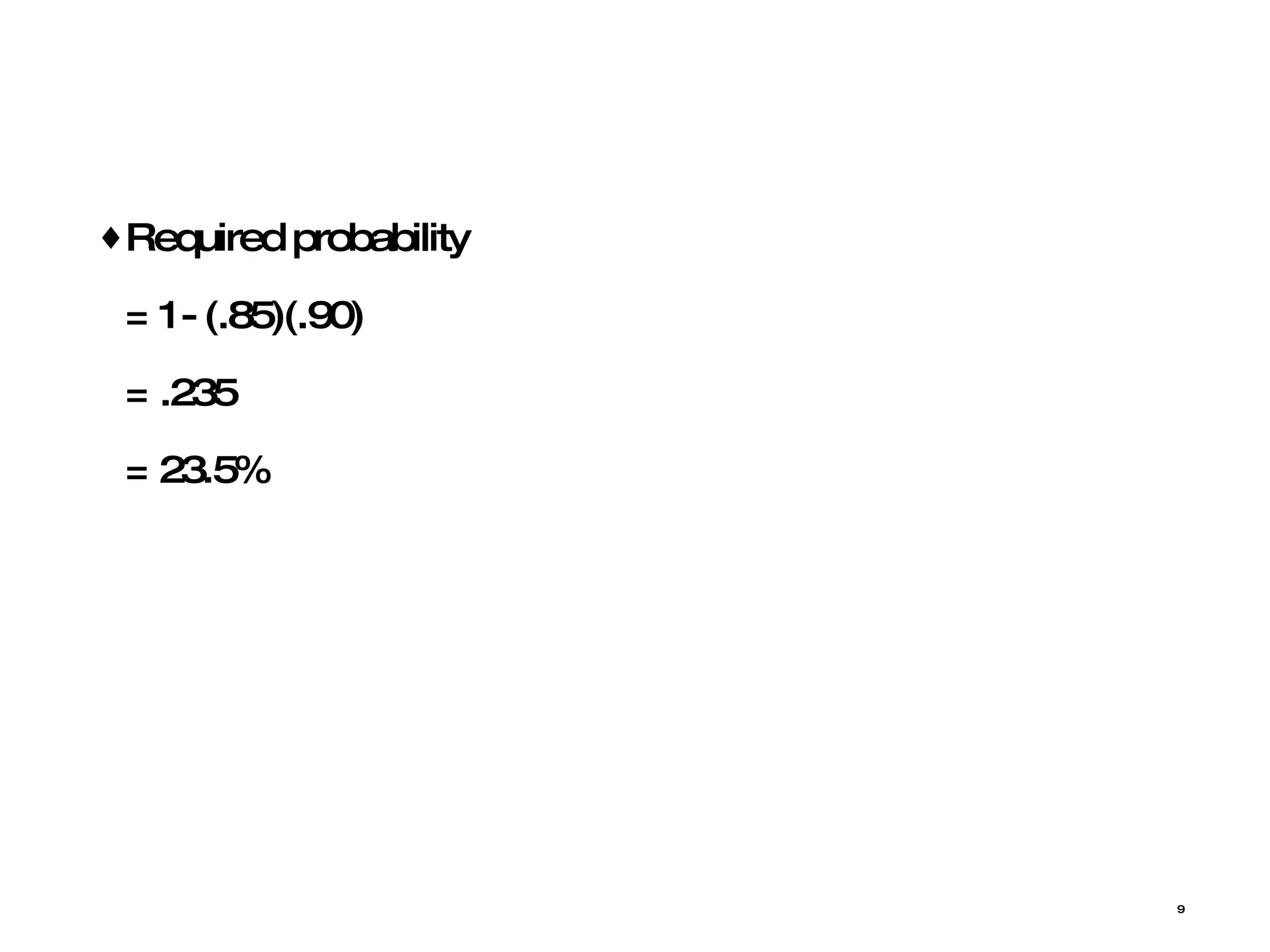
Required probability  = 1- (.85)(.90) = .235 = 23.5%
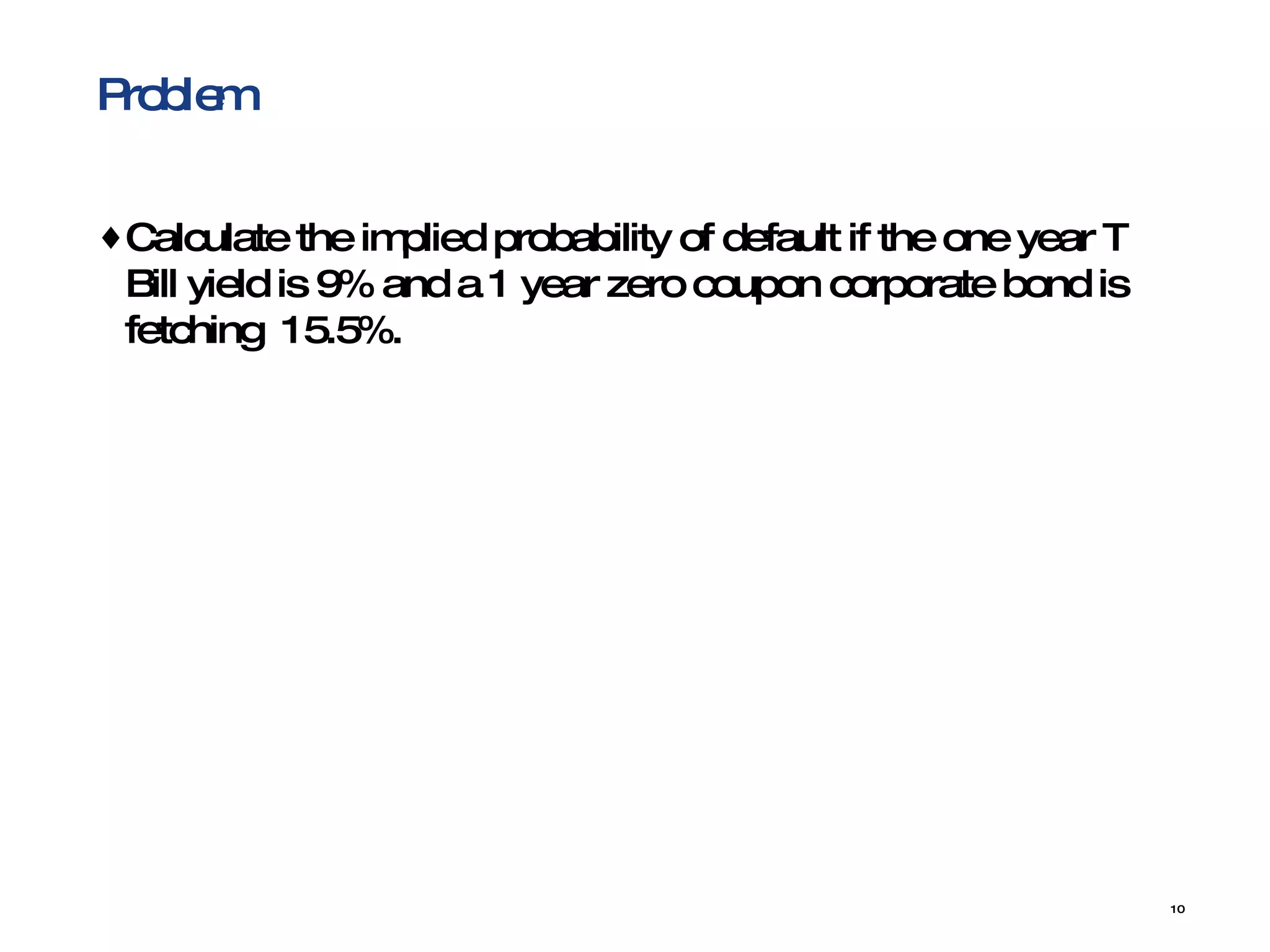
Problem Calculate the implied probability of default if the one year T Bill yield is 9% and a 1 year zero coupon corporate bond is fetching  15.5%.
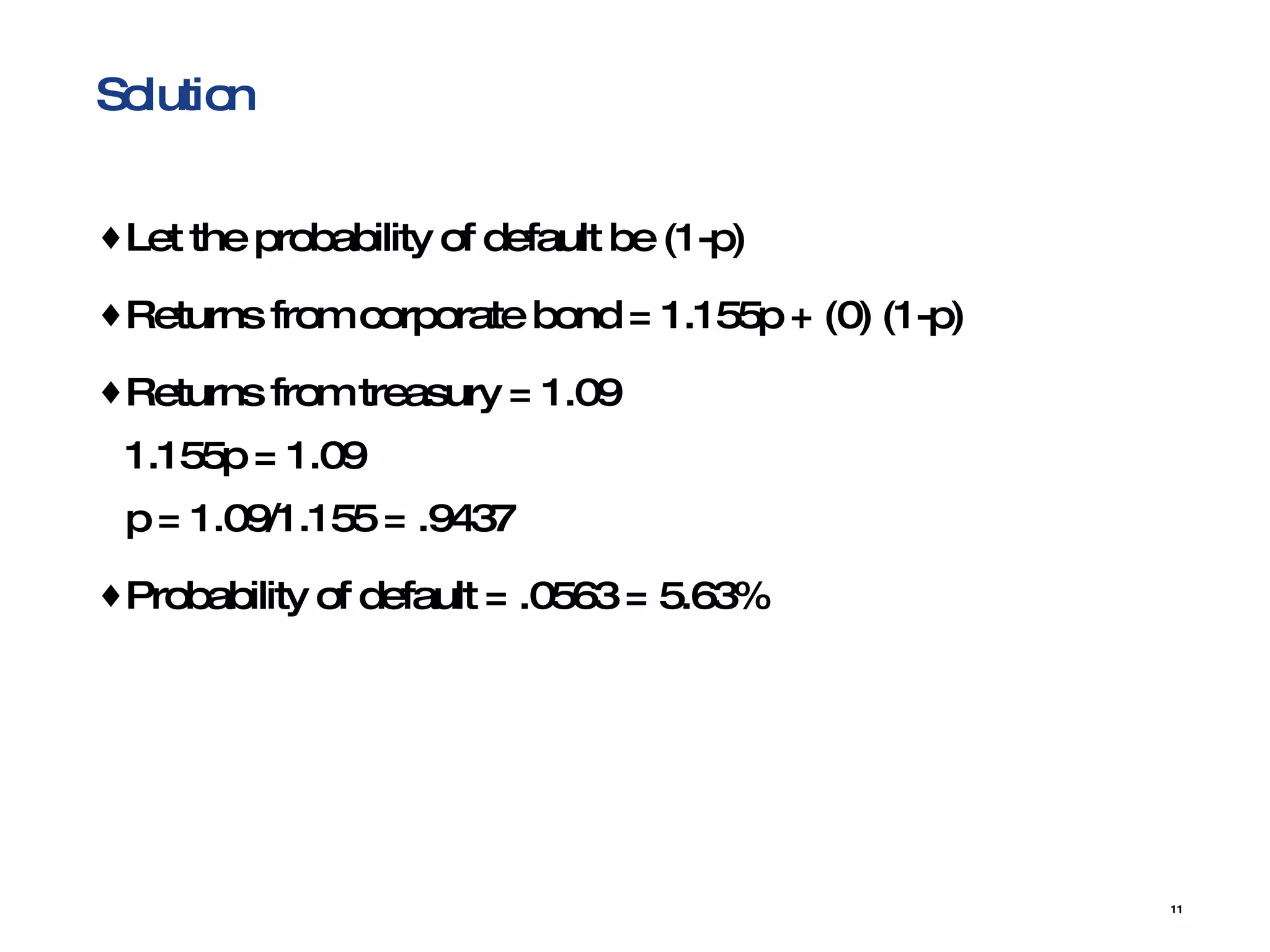
Solution Let the probability of default be (1-p) Returns from corporate bond = 1.155p + (0) (1-p) Returns from treasury = 1.09 1.155p = 1.09 p = 1.09/1.155 = .9437 Probability of default = .0563 = 5.63%
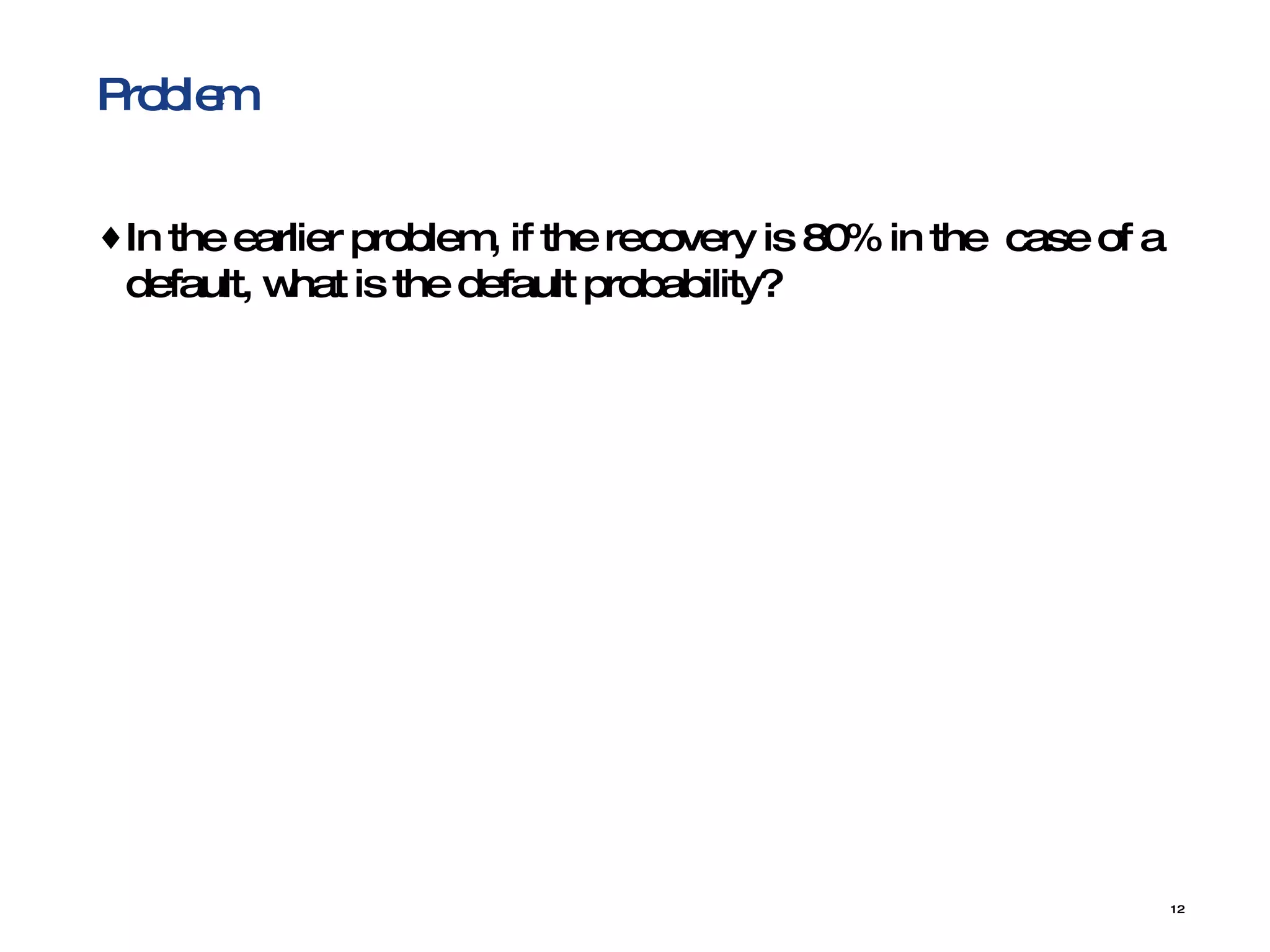
Problem In the earlier problem, if the recovery is 80% in the  case of a default, what is the default probability?
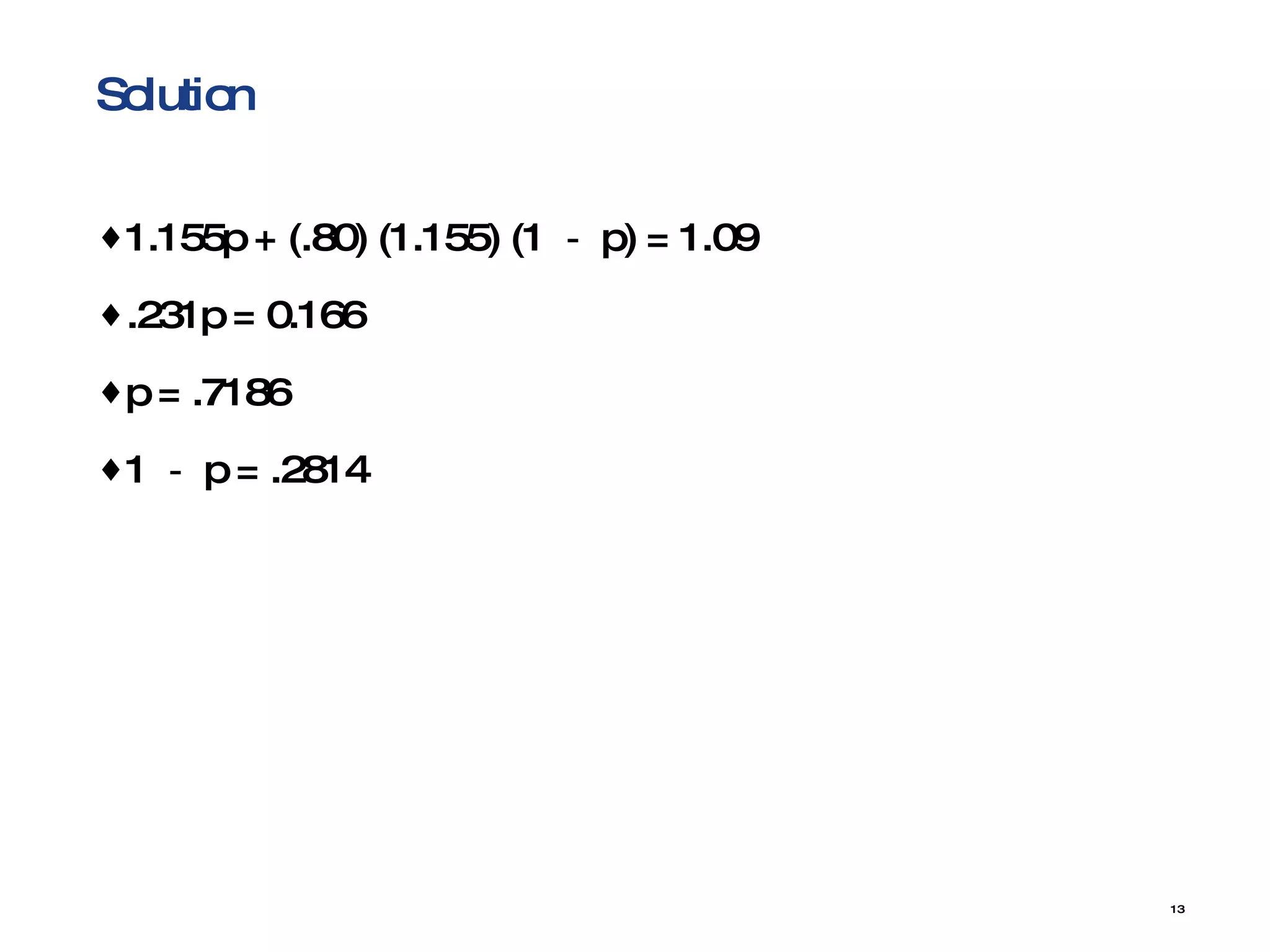
Solution 1.155p + (.80) (1.155) (1 - p) = 1.09 .231p = 0.166 p = .7186 1 - p = .2814
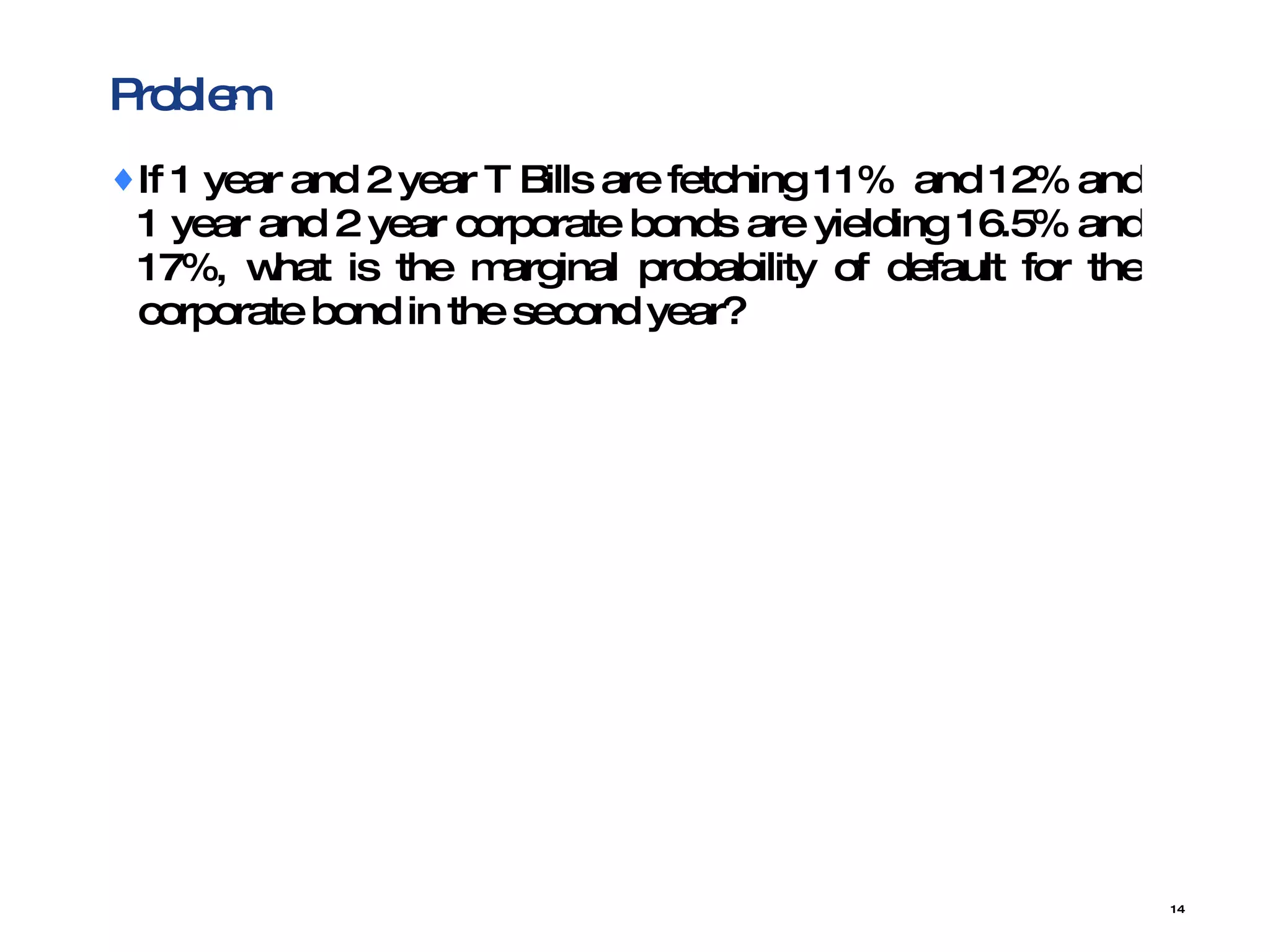
Problem  If 1 year and 2 year T Bills are fetching 11%  and 12% and 1 year and 2 year corporate bonds are yielding 16.5% and 17%, what is the marginal probability of default for the corporate bond in the second year?
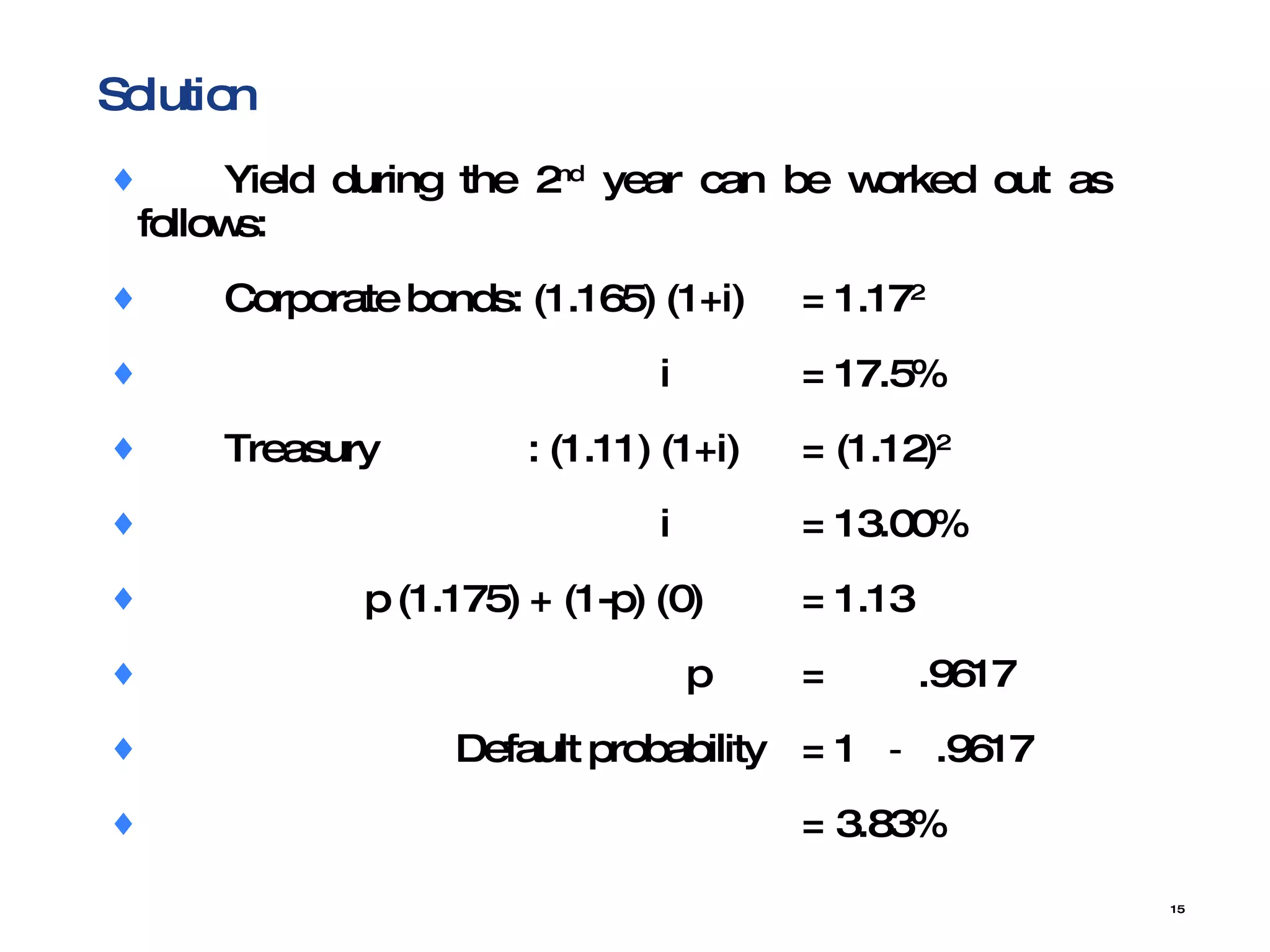
Solution Yield during the 2 nd  year can be worked out as  follows: Corporate bonds: (1.165) (1+i) = 1.17 2   i  = 17.5% Treasury  : (1.11) (1+i) = (1.12) 2   i = 13.00%   p (1.175) + (1-p) (0) = 1.13   p = .9617   Default probability  = 1  -  .9617 = 3.83%
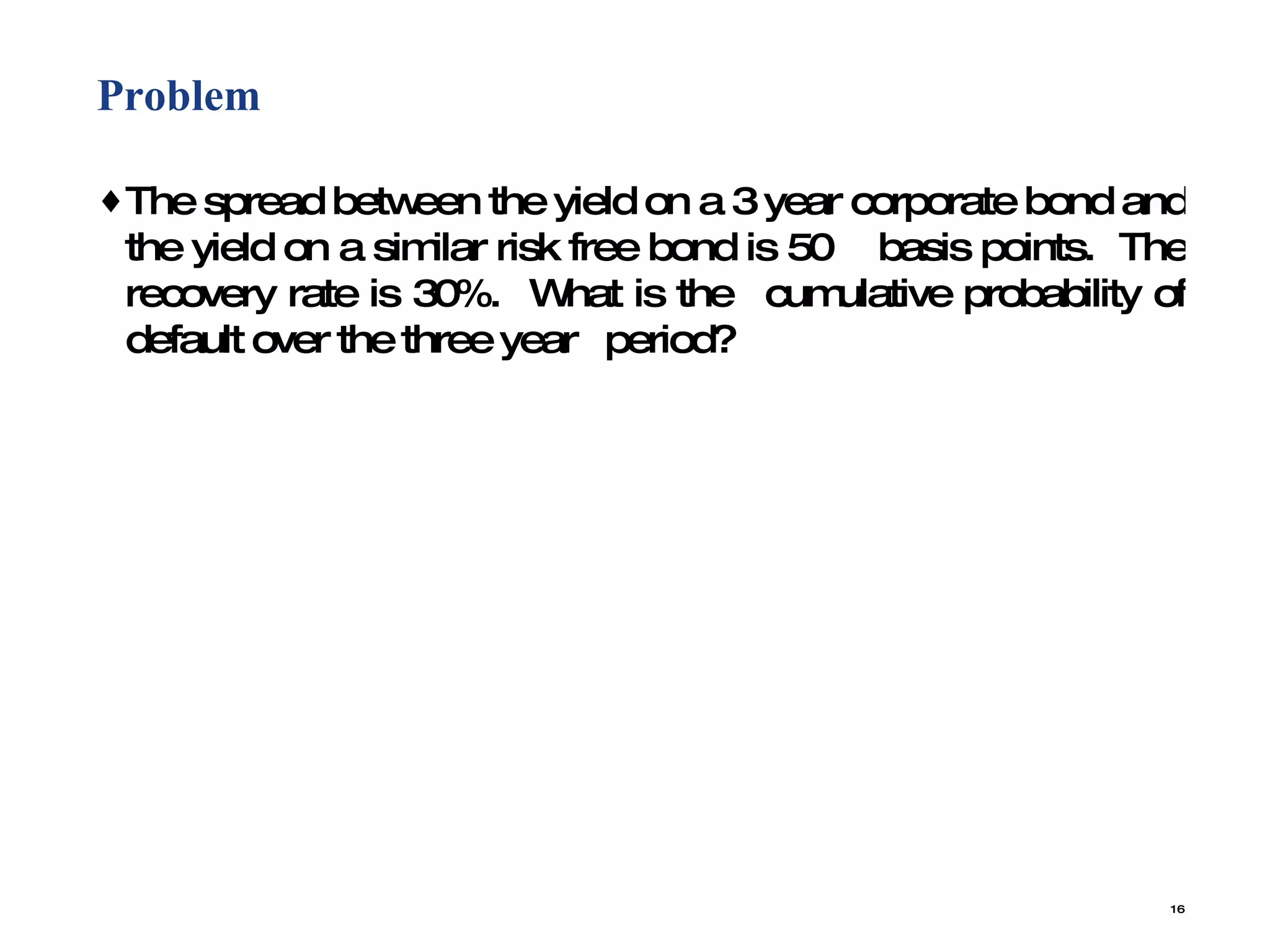
Problem  The spread between the yield on a 3 year corporate bond and the yield on a similar risk free bond is 50  basis points.  The recovery rate is 30%.  What is the  cumulative probability of default over the three year  period?
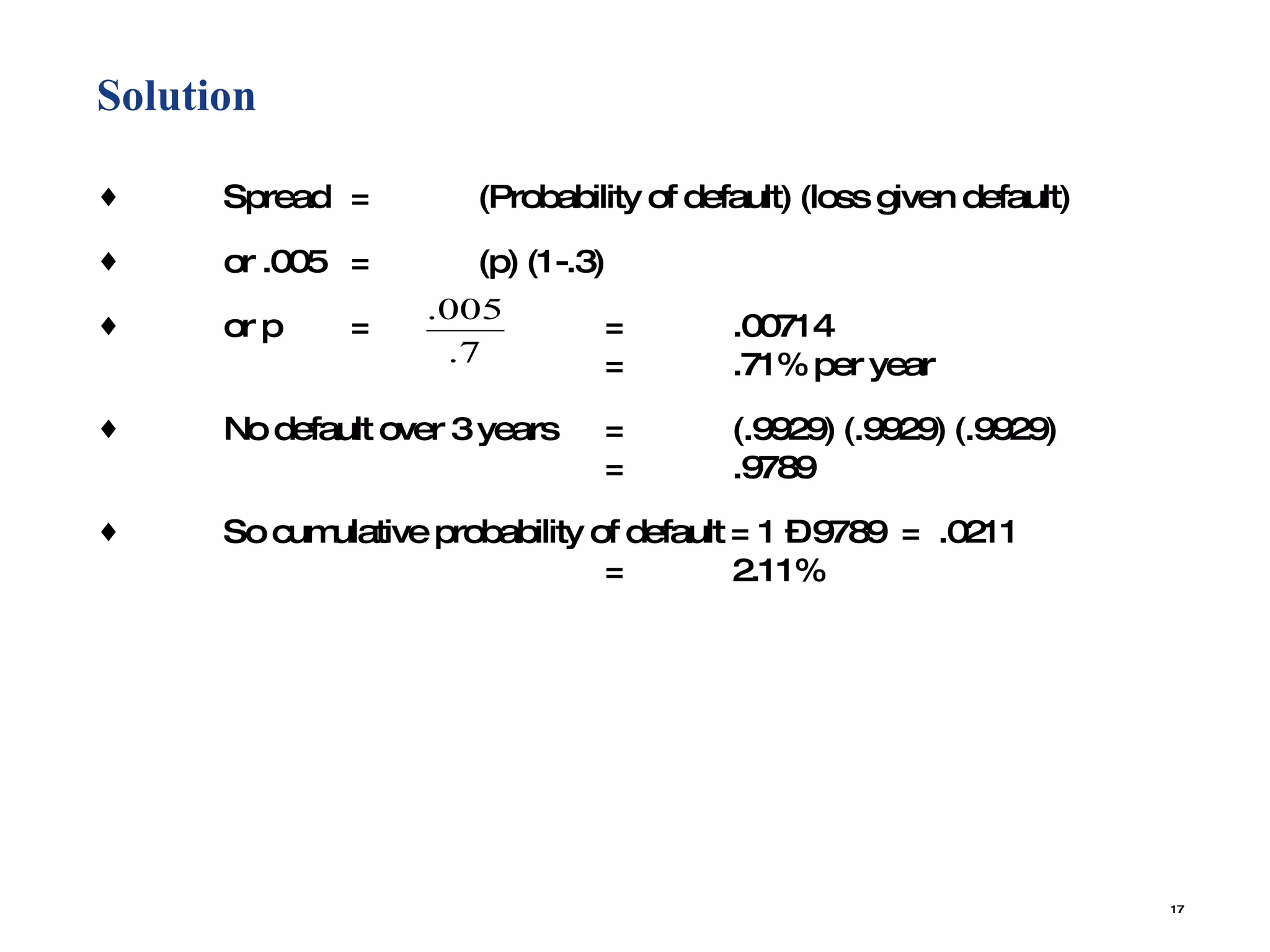
Solution  Spread = (Probability of default) (loss given default) or .005 = (p) (1-.3) or p =   =  .00714   = .71% per year No default over 3 years = (.9929) (.9929) (.9929)  = .9789 So cumulative probability of default = 1 – 9789  =  .0211  = 2.11%
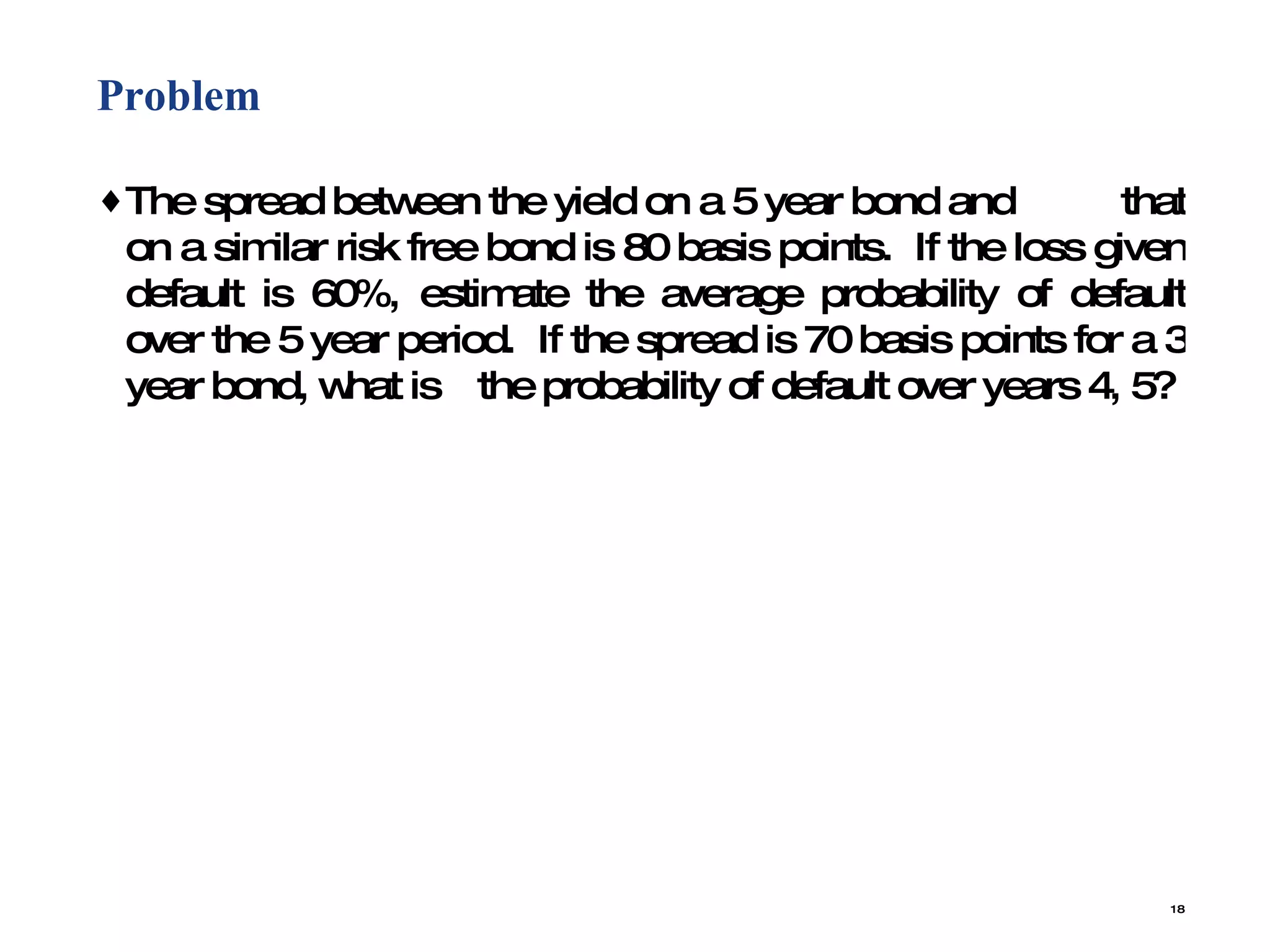
Problem  The spread between the yield on a 5 year bond and  that on a similar risk free bond is 80 basis points.  If the loss given default is 60%, estimate the average probability of default over the 5 year period.  If the spread is 70 basis points for a 3 year bond, what is  the probability of default over years 4, 5?
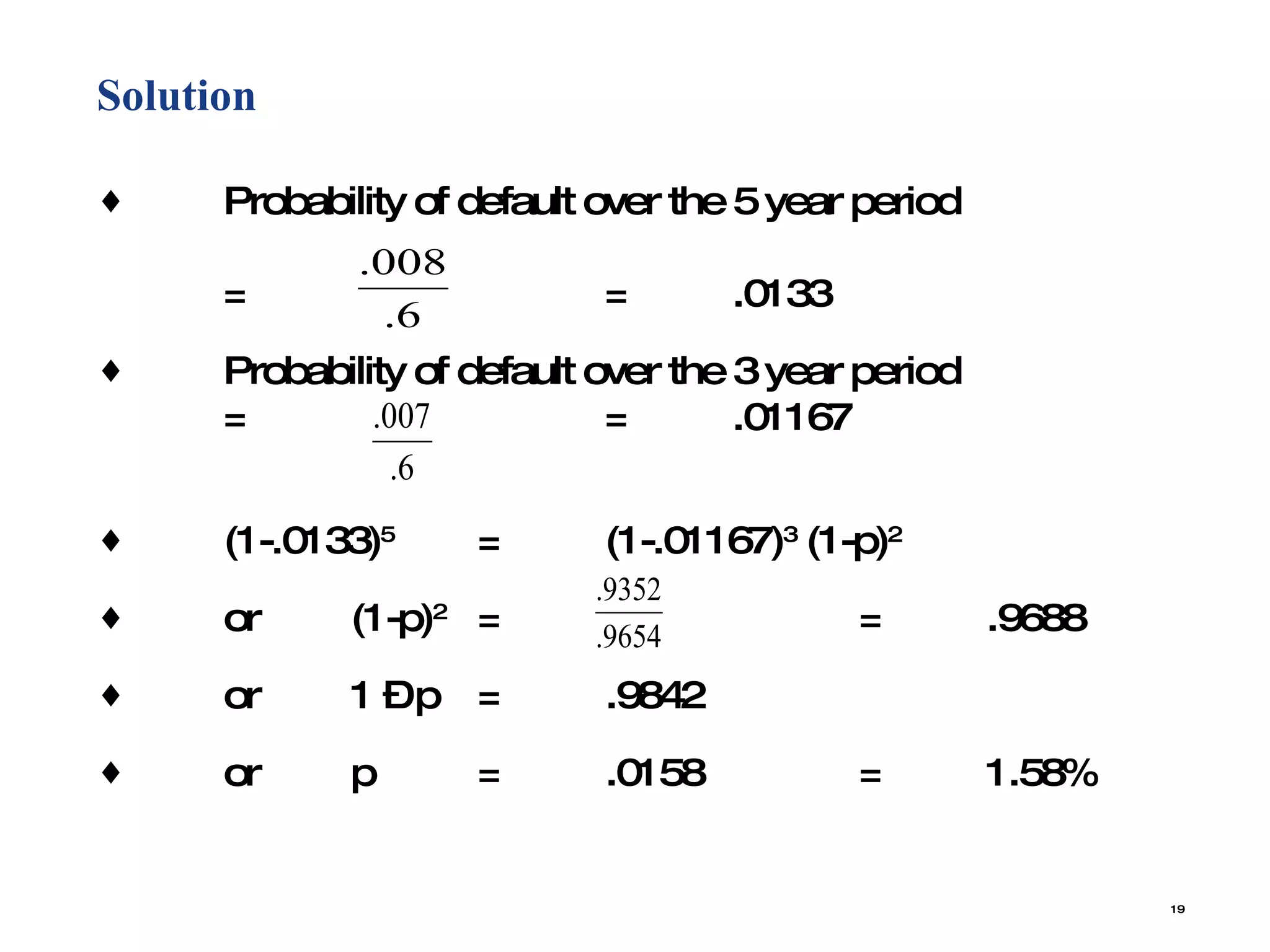
Solution  Probability of default over the 5 year period = = .0133 Probability of default over the 3 year period = = .01167 (1-.0133) 5 = (1-.01167) 3  (1-p) 2 or (1-p) 2 = = .9688 or  1 – p  = .9842 or p = .0158 = 1.58%
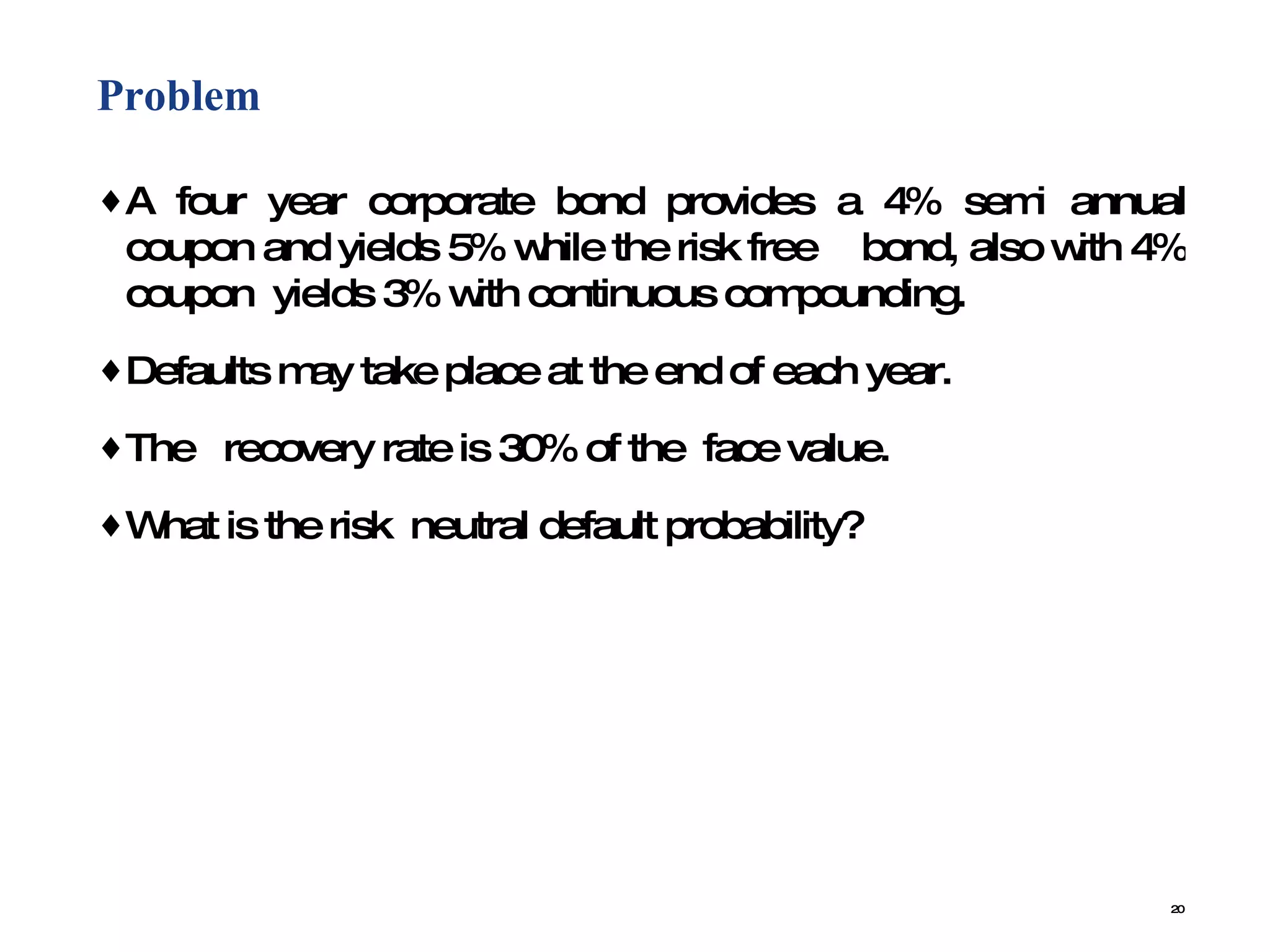
Problem  A four year corporate bond provides a 4% semi annual coupon and yields 5% while the risk free  bond, also with 4% coupon  yields 3% with continuous compounding.  Defaults may take place at the end of each year.  The  recovery rate is 30% of the  face value.  What is the risk  neutral default probability?
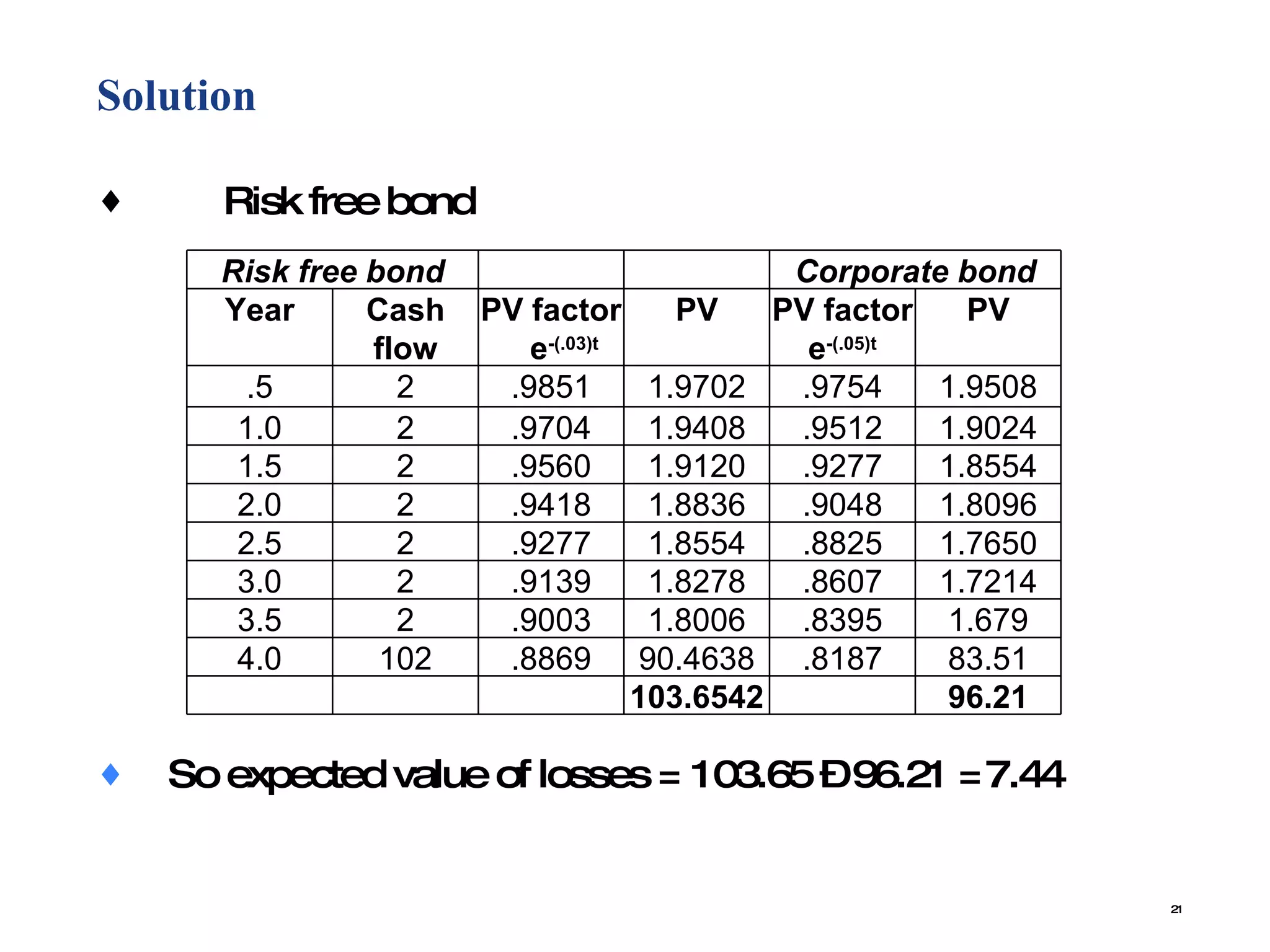
Solution  Risk free bond So expected value of losses = 103.65 – 96.21 = 7.44 Risk free bond Corporate bond Year Cash flow PV factor  e -(.03)t PV PV factor e -(.05)t PV .5 2 .9851 1.9702 .9754 1.9508 1.0 2 .9704 1.9408 .9512 1.9024 1.5 2 .9560 1.9120 .9277 1.8554 2.0 2 .9418 1.8836 .9048 1.8096 2.5 2 .9277 1.8554 .8825 1.7650 3.0 2 .9139 1.8278 .8607 1.7214 3.5 2 .9003 1.8006 .8395 1.679 4.0 102 .8869 90.4638 .8187 83.51 103.6542 96.21
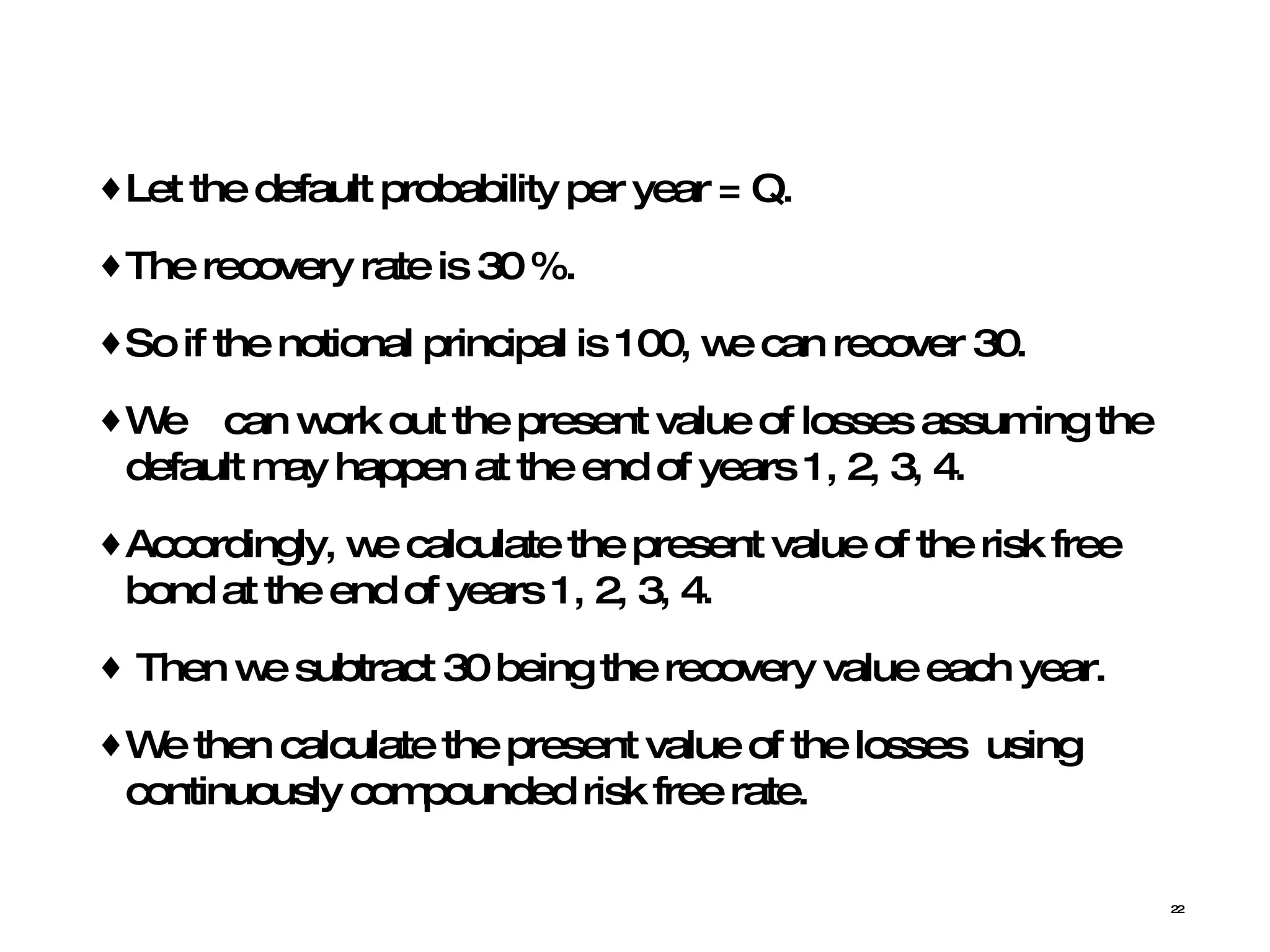
Let the default probability per year = Q.  The recovery rate is 30 %.  So if the notional principal is 100, we can recover 30.  We  can work out the present value of losses assuming the default may happen at the end of years 1, 2, 3, 4.  Accordingly, we calculate the present value of the risk free bond at the end of years 1, 2, 3, 4.  Then we subtract 30 being the recovery value each year.  We then calculate the present value of the losses  using continuously compounded risk free rate.
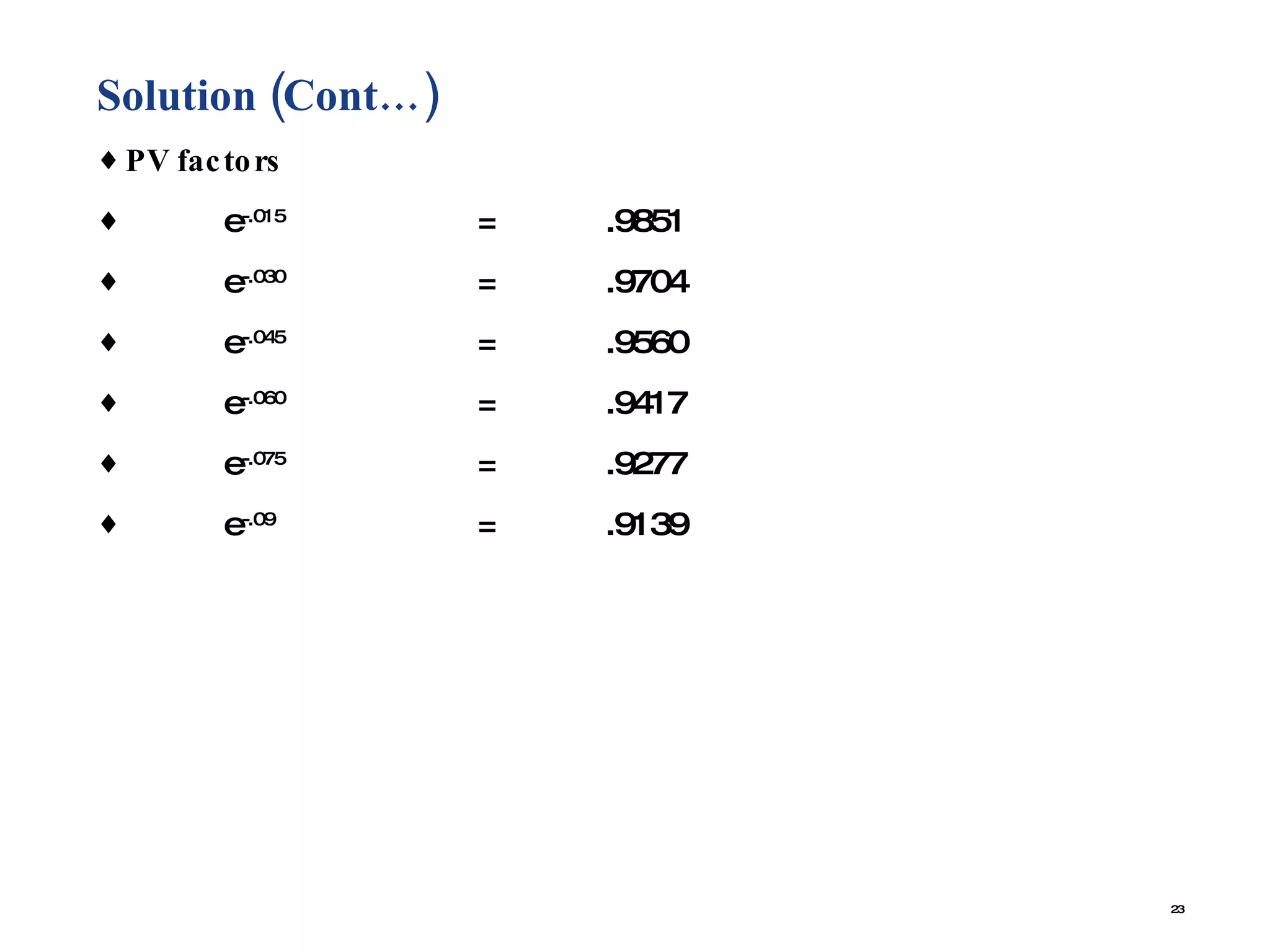
Solution (Cont…)  PV factors e -.015 = .9851 e -.030 = .9704 e -.045 = .9560 e -.060 = .9417 e -.075 = .9277 e -.09 = .9139
Solution (Cont…)  Time of default  = 1 PV of risk free bond = 2+2e -.015 +2e -.030 +2e -.045 + 2e -.060 +2e -075 + (102)e -.090 = 2[1+.9851+.9704+.9560+.9417+.9277]+(102)(.9139) = 11.56 + 93.22  = 104.78 Time of default  = 2 PV of risk free bond = 2[1+.9851+.9704 +.9560]+(102) (.9417) = 7.823 + 96.05 = 103.88
Solution (Cont…)  Time of default  = 3 PV of risk free bond = [1+ .9851] + (102) (.9704) = 3.97 + 98.98 = 102.95 Time of default  = 4 PV of risk free bond = 102
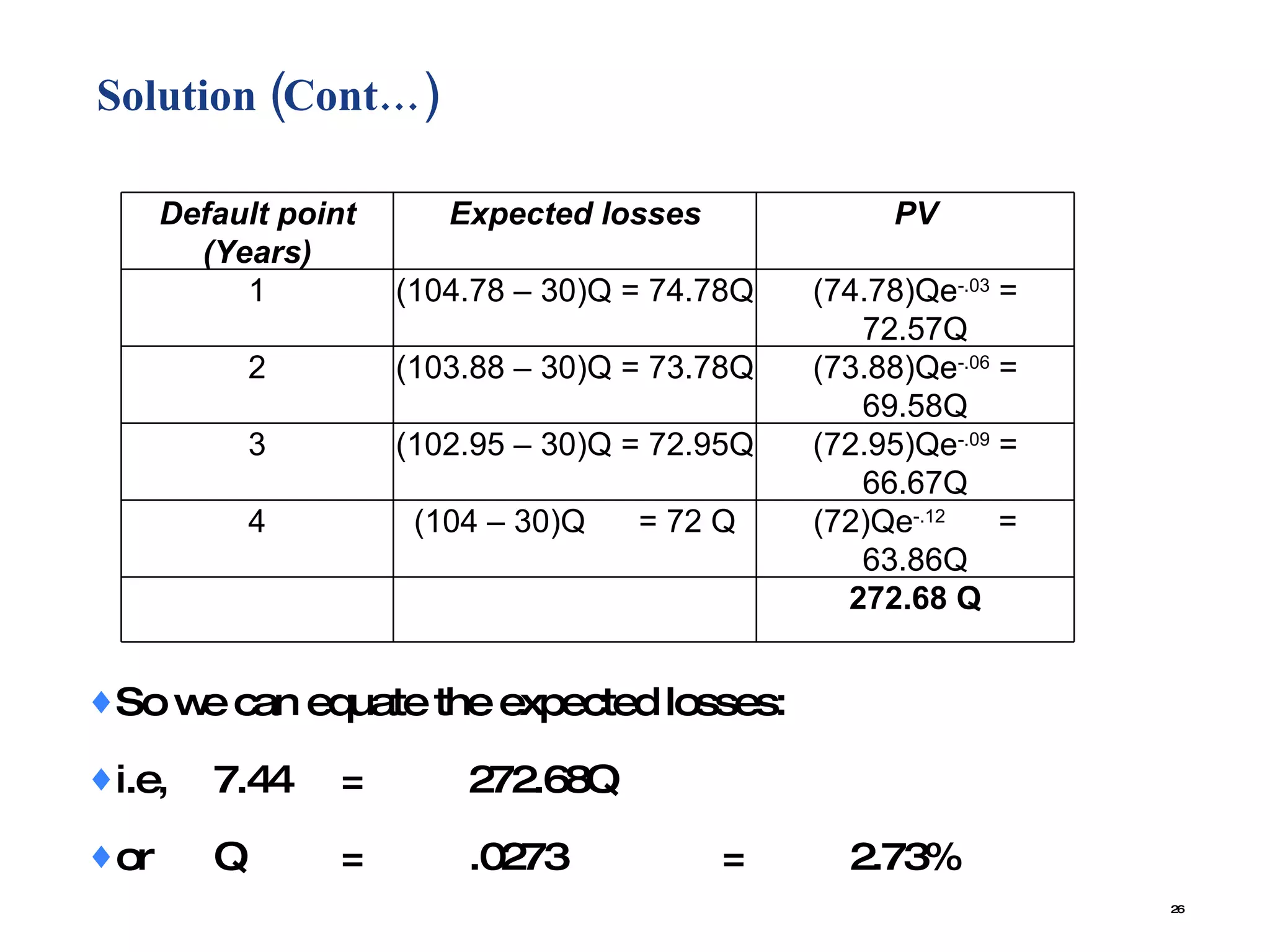
Solution (Cont…)  So we can equate the expected losses: i.e, 7.44  = 272.68Q or Q = .0273 = 2.73% Default point (Years) Expected losses PV 1 (104.78 – 30)Q = 74.78Q (74.78)Qe -.03  = 72.57Q 2 (103.88 – 30)Q = 73.78Q (73.88)Qe -.06  = 69.58Q 3 (102.95 – 30)Q = 72.95Q (72.95)Qe -.09  = 66.67Q 4 (104 – 30)Q  = 72 Q (72)Qe -.12   = 63.86Q 272.68 Q
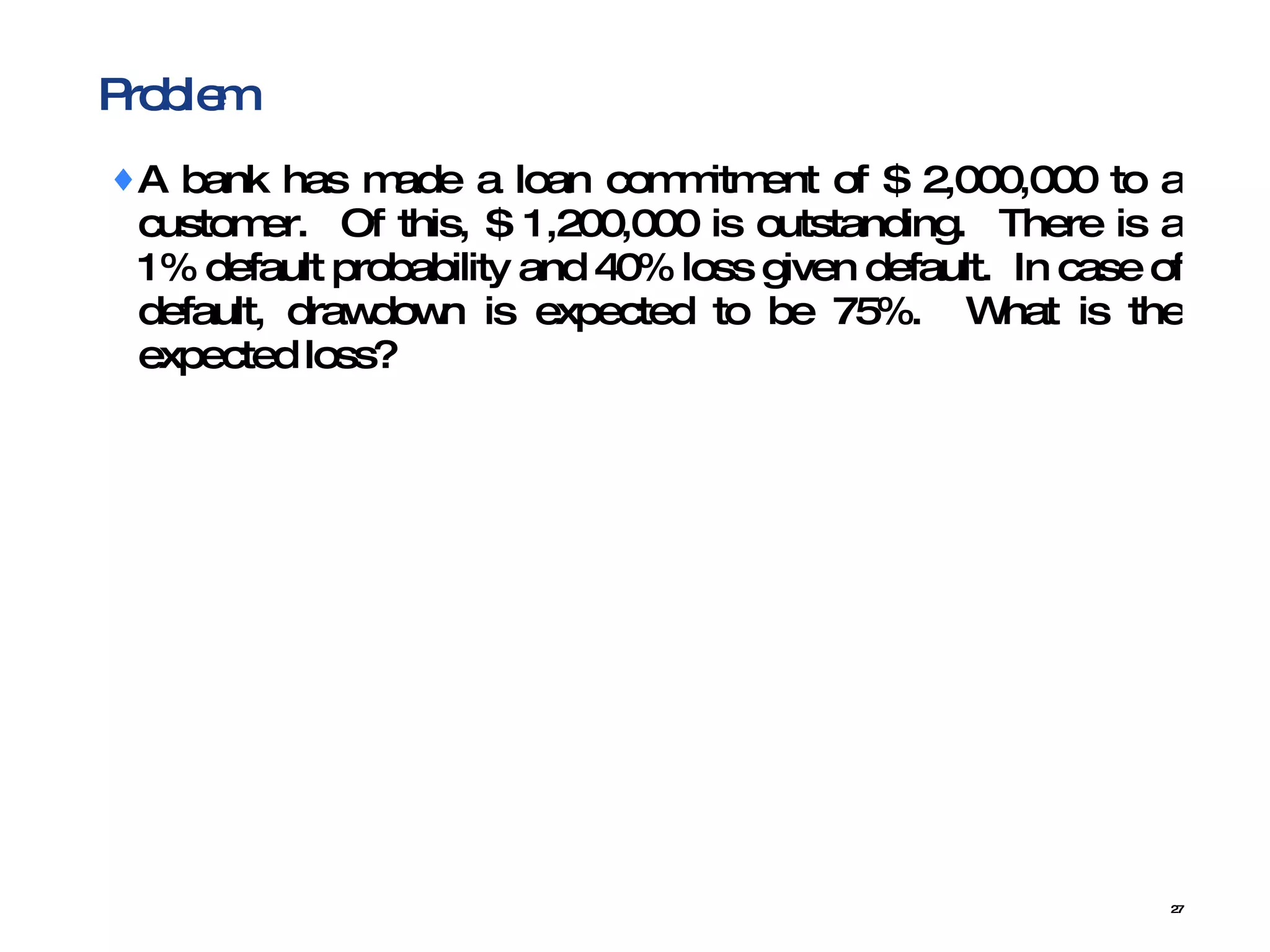
Problem A bank has made a loan commitment of $ 2,000,000 to a customer.  Of this, $ 1,200,000 is outstanding.  There is a 1% default probability and 40% loss given default.  In case of default, drawdown is expected to be 75%.  What is the expected loss?
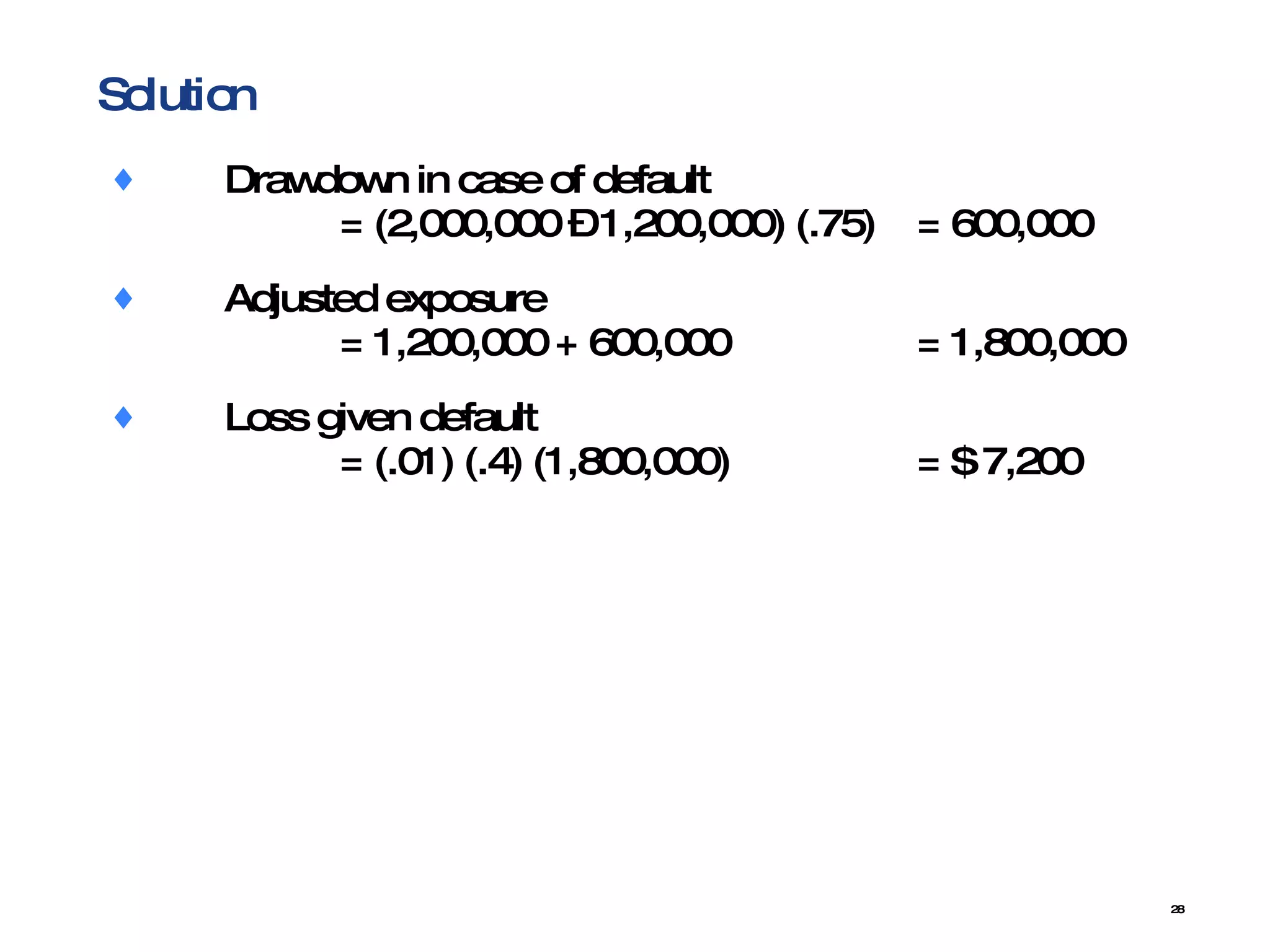
Solution Drawdown in case of default  = (2,000,000 – 1,200,000) (.75) = 600,000 Adjusted exposure  = 1,200,000 + 600,000 = 1,800,000 Loss given default  = (.01) (.4) (1,800,000) = $ 7,200
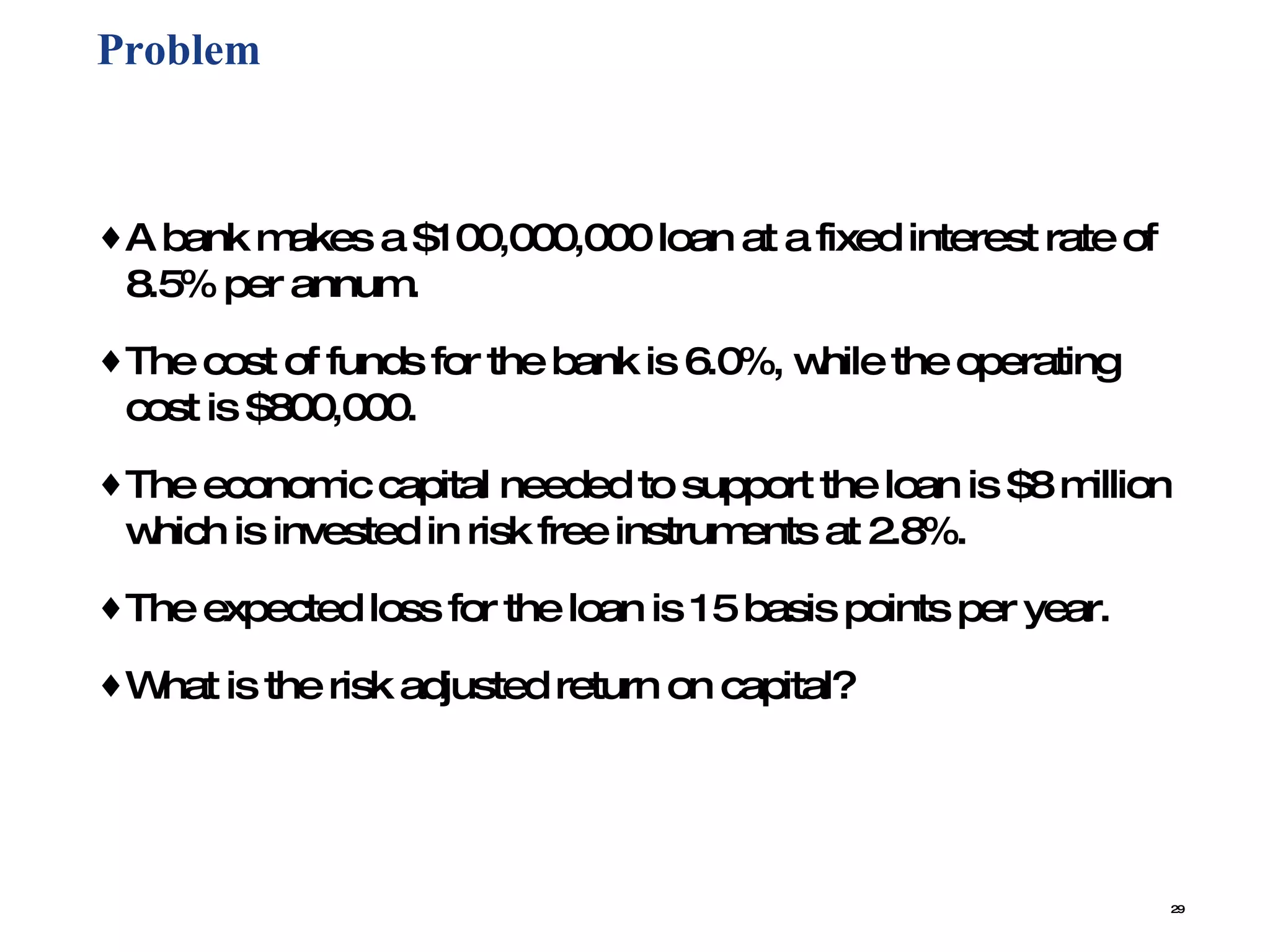
Problem  A bank makes a $100,000,000 loan at a fixed interest rate of 8.5% per annum.  The cost of funds for the bank is 6.0%, while the operating cost is $800,000.  The economic capital needed to support the loan is $8 million which is invested in risk free instruments at 2.8%.  The expected loss for the loan is 15 basis points per year.  What is the risk adjusted return on capital?
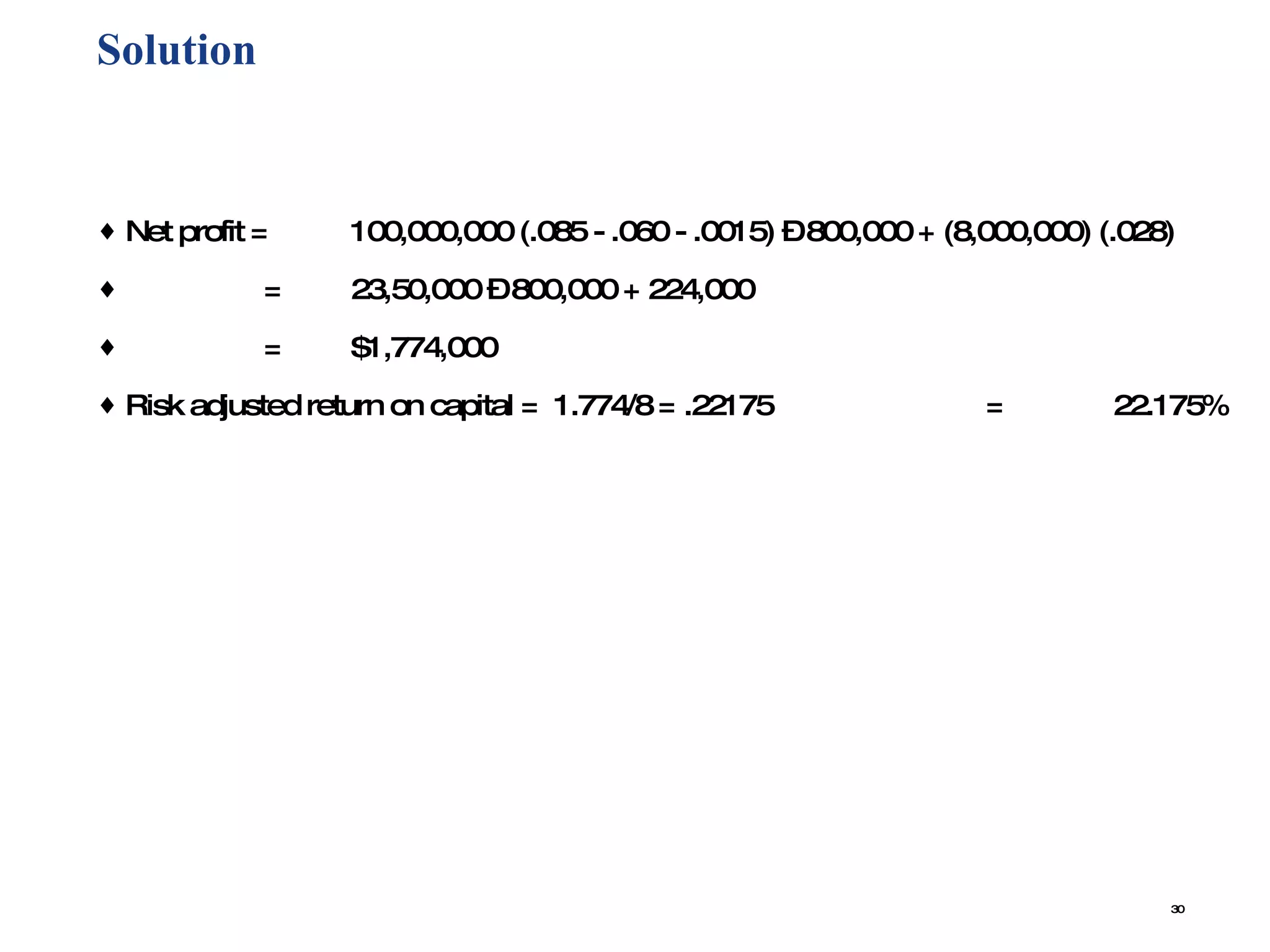
Solution Net profit = 100,000,000 (.085 - .060 - .0015) – 800,000 + (8,000,000) (.028)   = 23,50,000 – 800,000 + 224,000   = $1,774,000 Risk adjusted return on capital =  1.774/8 = .22175 = 22.175%
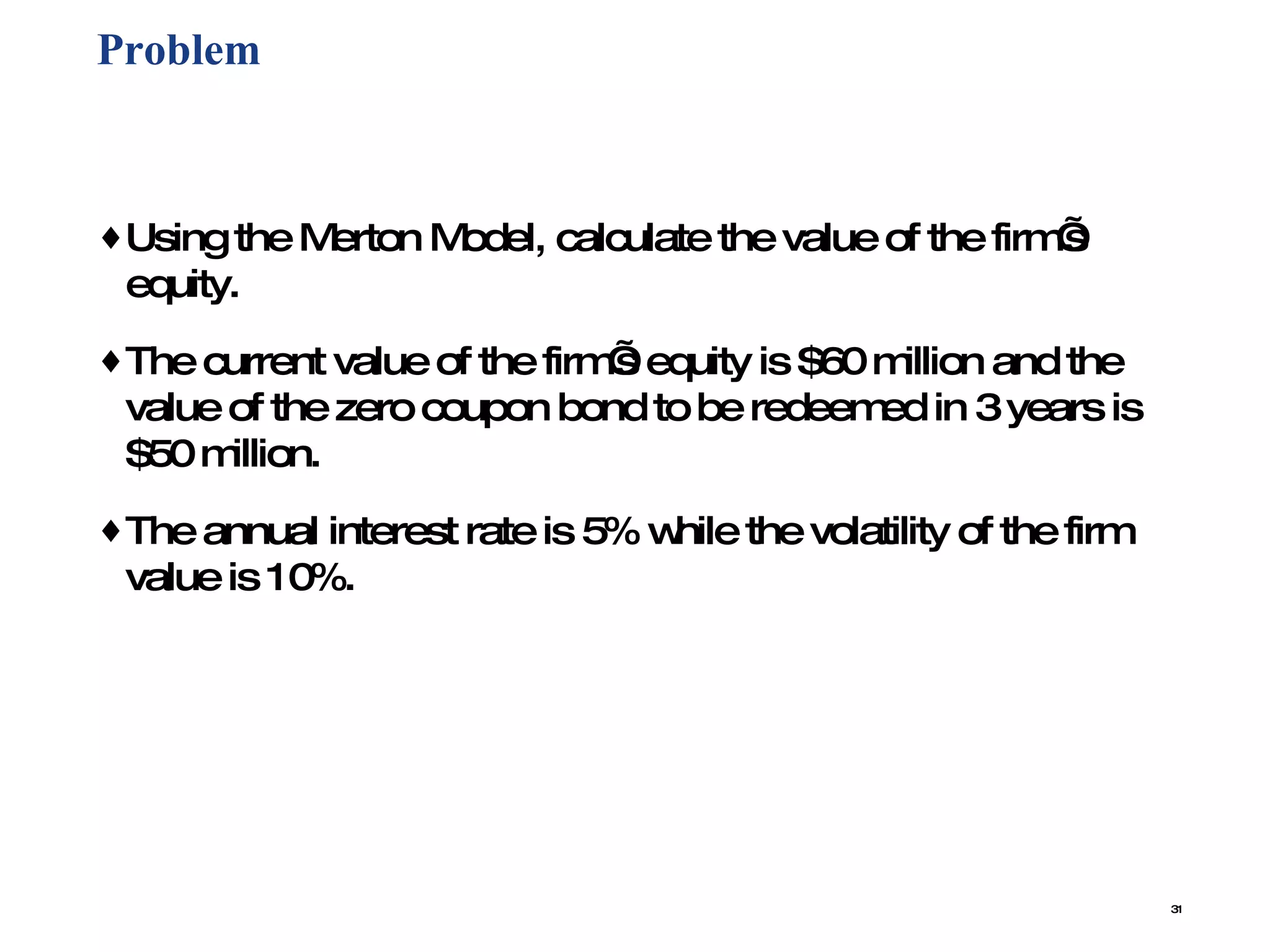
Problem  Using the Merton Model, calculate the value of the firm’s equity.  The current value of the firm’s equity is $60 million and the value of the zero coupon bond to be redeemed in 3 years is $50 million.  The annual interest rate is 5% while the volatility of the firm value is 10%.
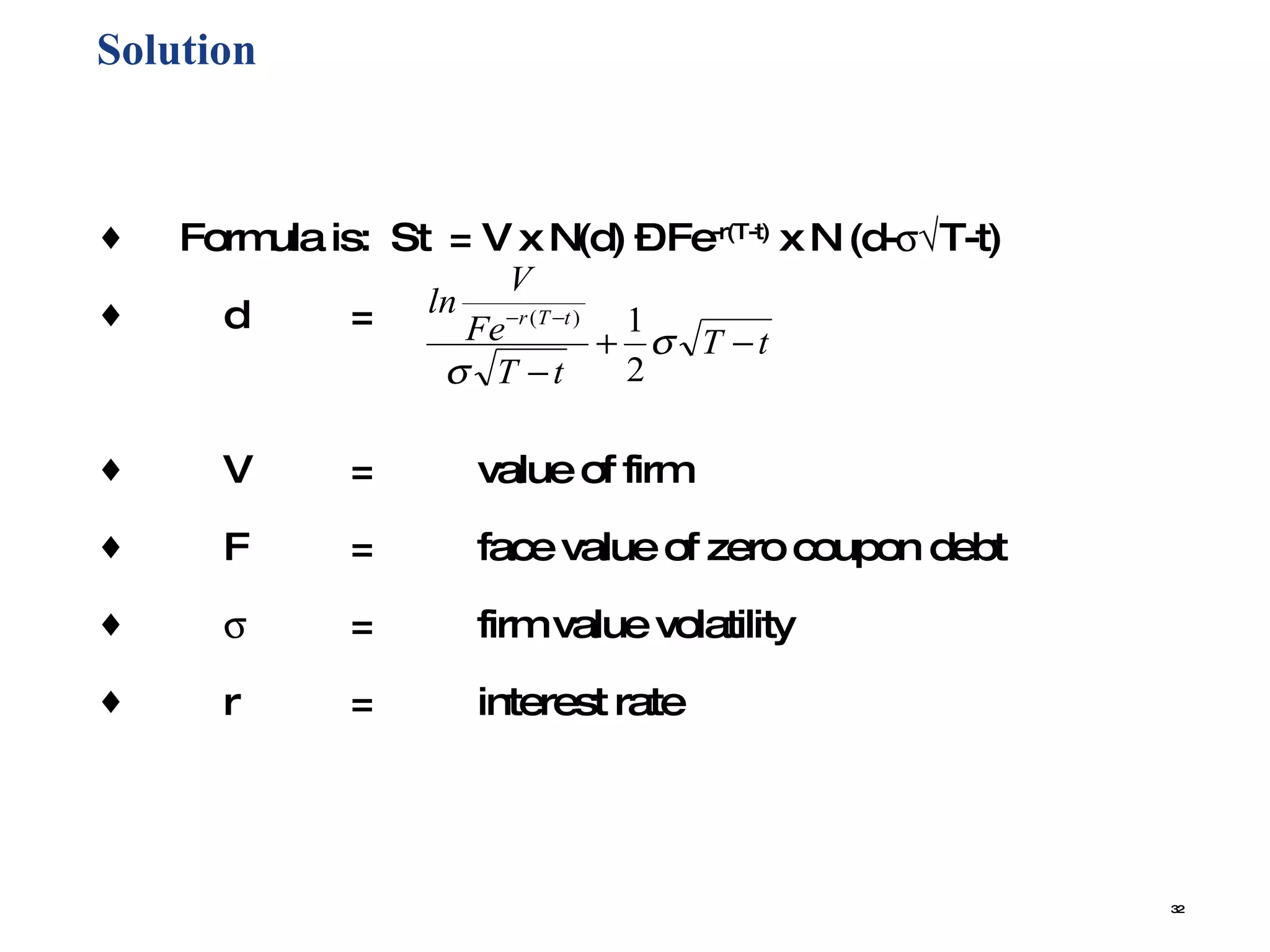
Solution  Formula is:  St  = V x N(d) – Fe -r(T-t)  x N (d-  T-t) d = V = value of firm F = face value of zero coupon debt  = firm value volatility r = interest rate
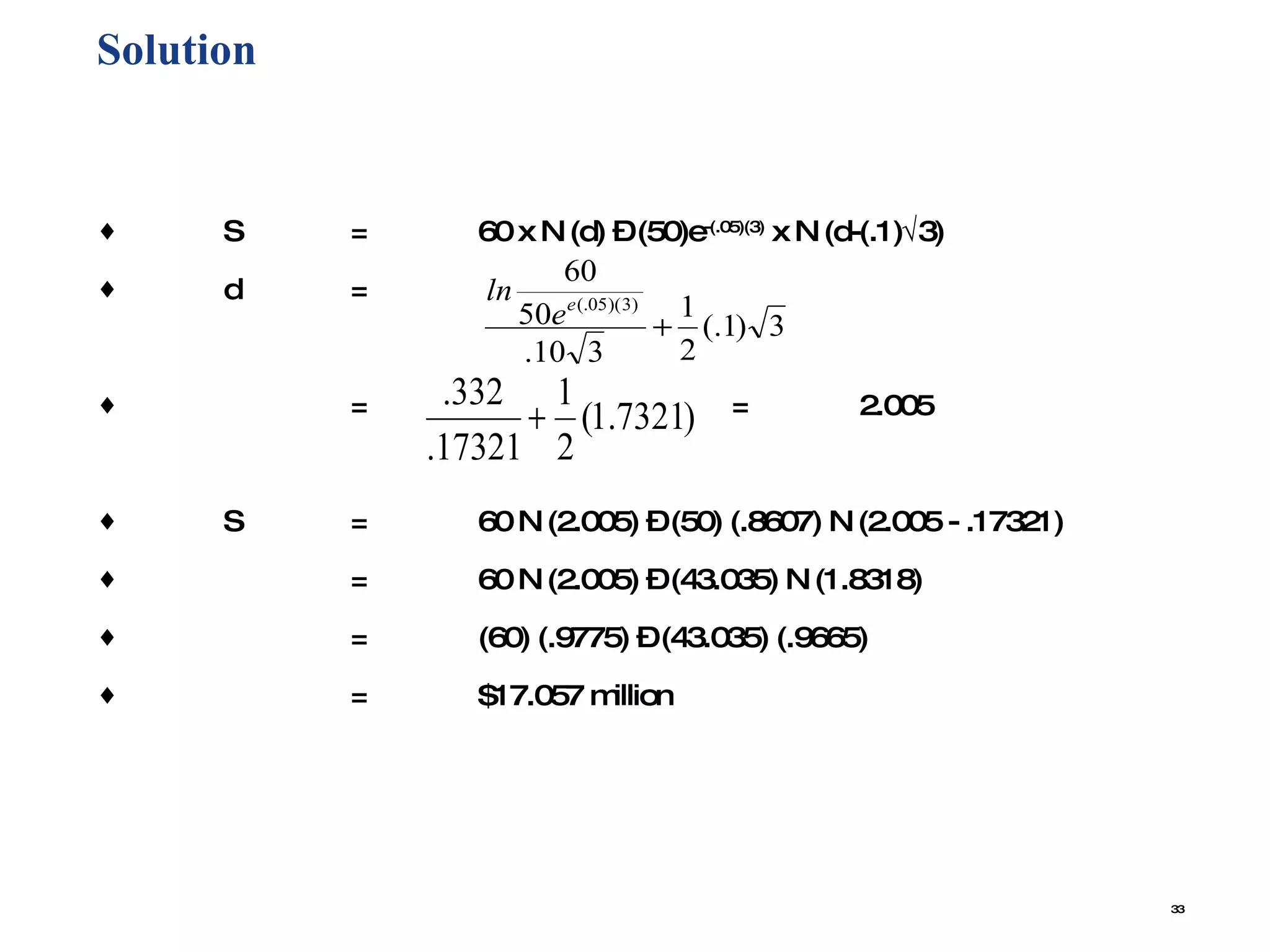
Solution  S = 60 x N (d) – (50)e -(.05)(3)  x N (d-(.1)  3) d = = = 2.005 S = 60 N (2.005) – (50) (.8607) N (2.005 - .17321) = 60 N (2.005) – (43.035) N (1.8318) = (60) (.9775) – (43.035) (.9665) = $17.057 million
Problem In the earlier problem, calculate the value of the firm’s  debt.
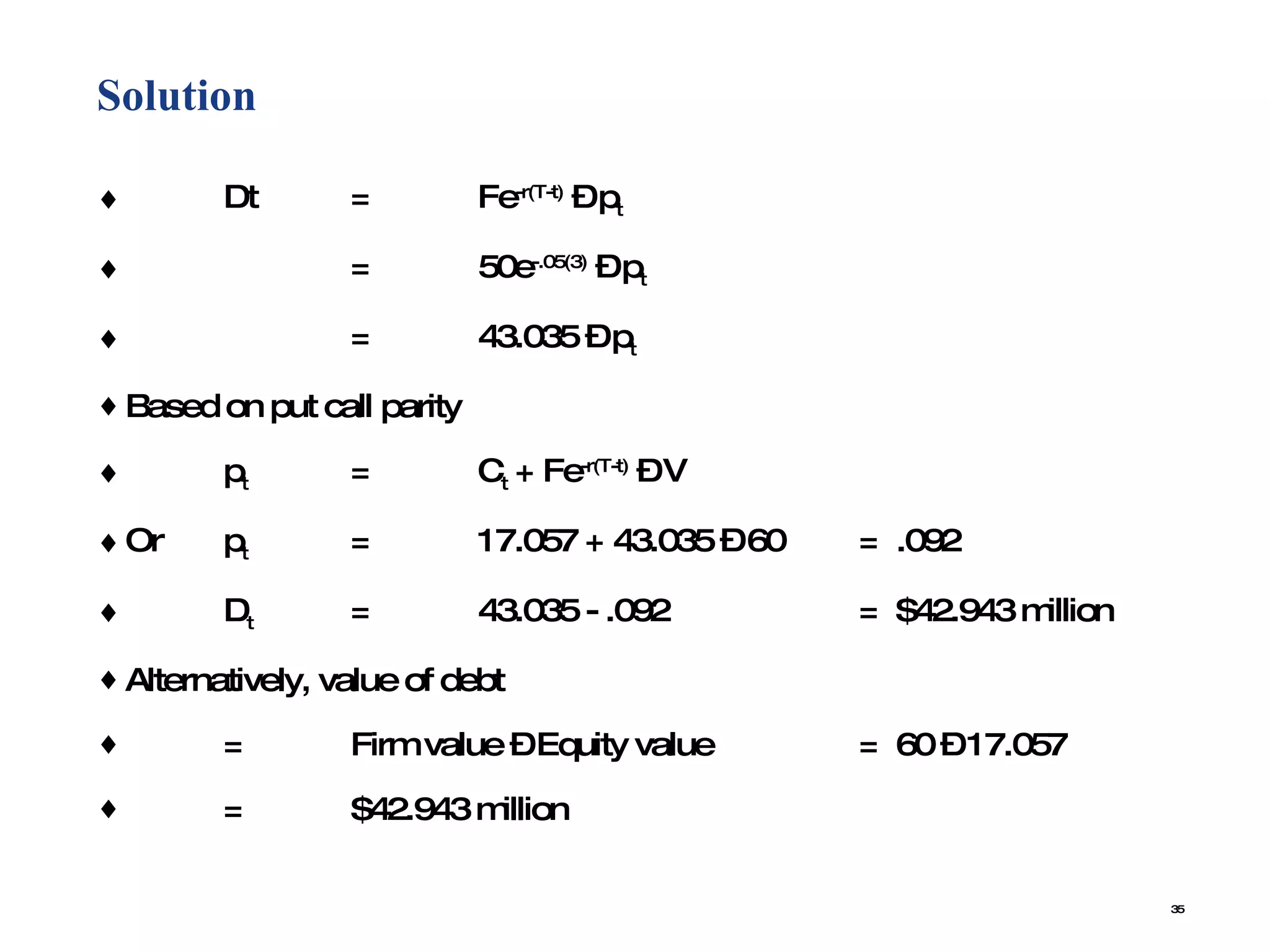
Solution  Dt = Fe -r(T-t)  – p t = 50e -.05(3)  – p t = 43.035 – p t Based on put call parity p t = C t  + Fe -r(T-t)  – V Or p t = 17.057 + 43.035 – 60 =  .092 D t = 43.035 - .092 =  $42.943 million Alternatively, value of debt = Firm value – Equity value  =  60 – 17.057 = $42.943 million
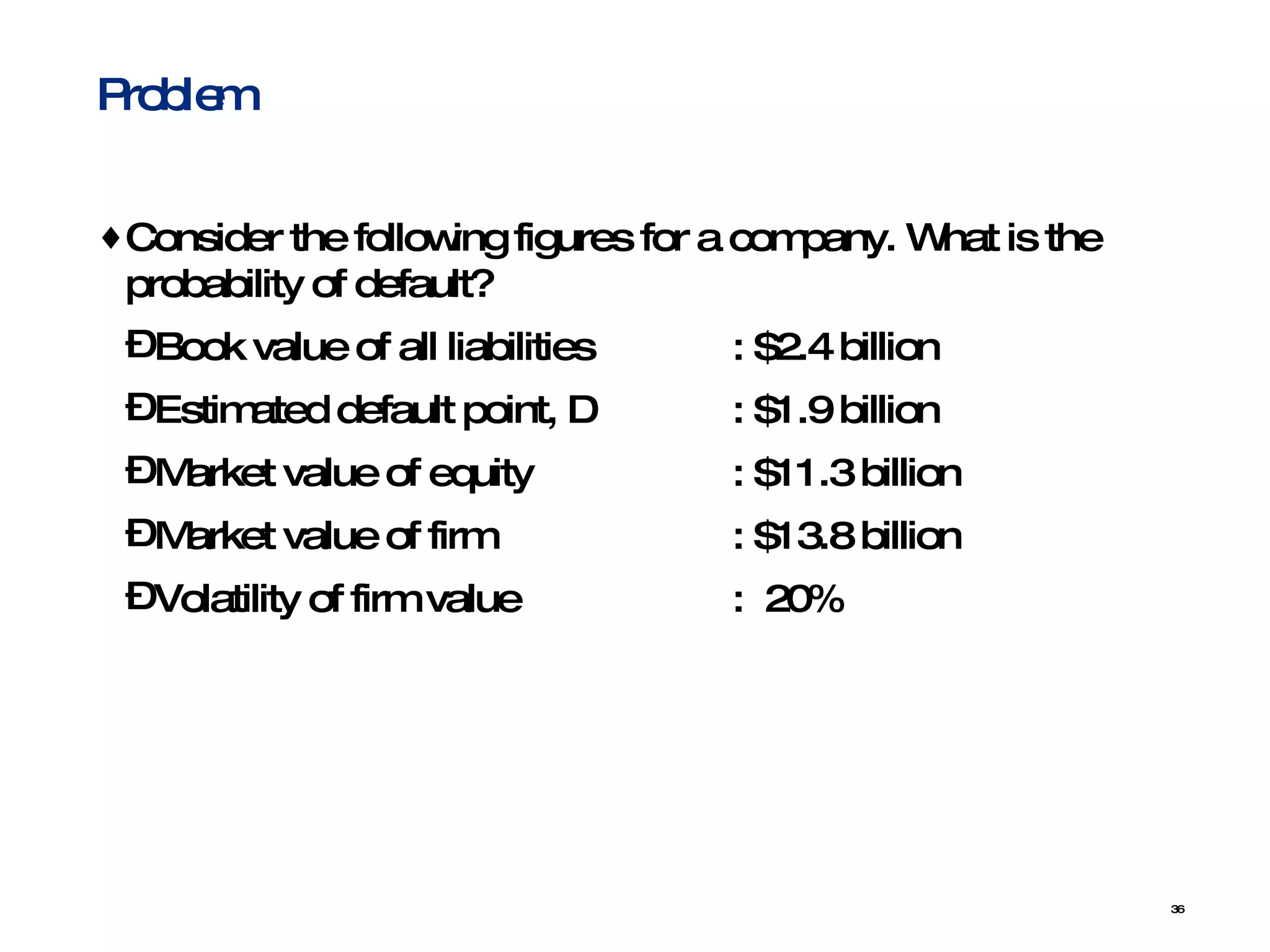
Consider the following figures for a company. What is the probability of default?  Book value of all liabilities  : $2.4 billion Estimated default point, D : $1.9 billion Market value of equity : $11.3 billion Market value of firm : $13.8 billion Volatility of firm value :  20% Problem
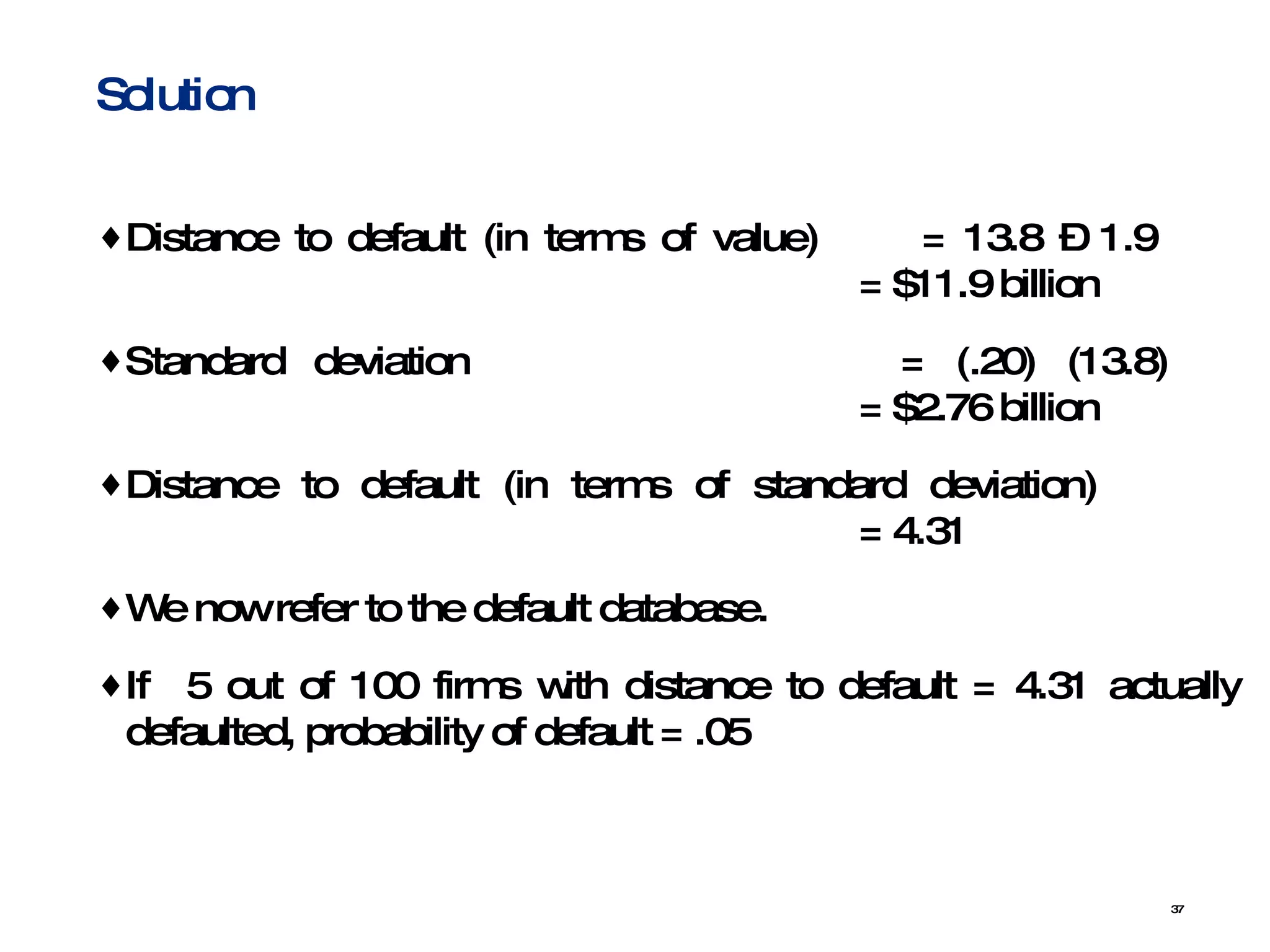
Distance to default (in terms of value)  = 13.8 – 1.9  = $11.9 billion Standard deviation  = (.20) (13.8)  = $2.76 billion Distance to default (in terms of standard deviation)  = 4.31 We now refer to the default database.  If  5 out of 100 firms with distance to default = 4.31 actually defaulted, probability of default = .05 Solution
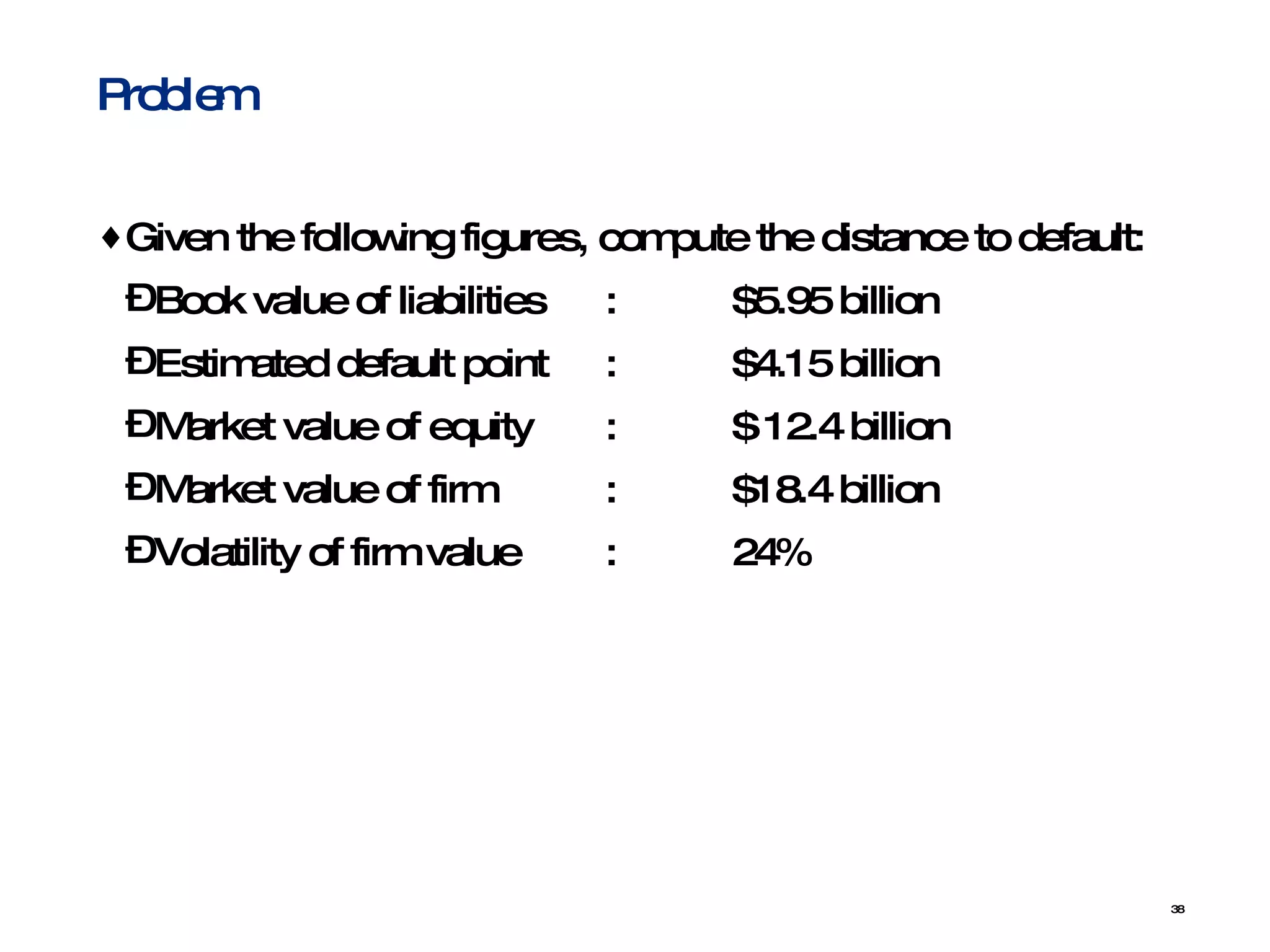
Given the following figures, compute the distance to default: Book value of liabilities  : $5.95 billion Estimated default point : $4.15 billion Market value of equity : $ 12.4 billion Market value of firm : $18.4 billion Volatility of firm value : 24% Problem
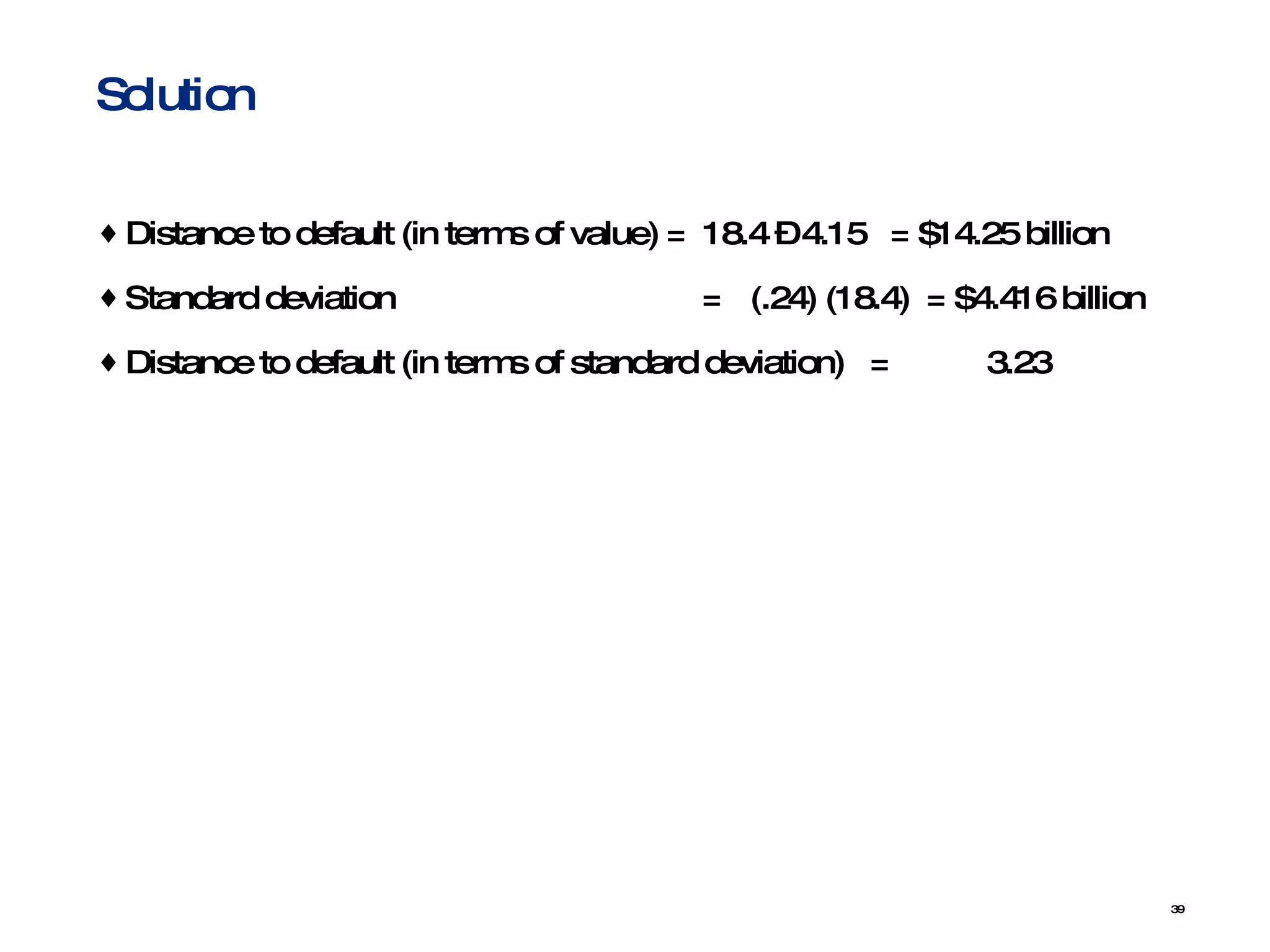
Distance to default (in terms of value) =  18.4 – 4.15  = $14.25 billion Standard deviation    =   (.24) (18.4)  = $4.416 billion Distance to default (in terms of standard deviation)  = 3.23 Solution

Credit Risk Management Problems

  • 1.
    Problems in CreditRisk Management September 16, 2009 By A. V. Vedpuriswar
  • 2.
    Problem There are10 bonds in a portfolio. The probability of default for each of the bonds over the coming year is 5%.These probabilities are independent of each other. What is the probability that exactly one bond defaults?
  • 3.
    Required probability = (10)(.05)(.95) 9 = .3151 = 31.51%
  • 4.
    Problem A CDSportfolio consists of 5 bonds with zero default correlation. One year default probabilities are : 1%, 2%, 5%,10% and 15% respectively. What is the probability that that the protection seller will not have to pay compensation?
  • 5.
    Probability of nodefault = (.99)(.98)(.95)(.90)(.85) = .7051 = 70.51%
  • 6.
    Problem If theprobability of default is 6% in year 1 and 8% in year 2, what is the cumulative probability of default during the two years?
  • 7.
    Solution Probability of default not happening in both years =(.94) (.92) = = .8648 Required probability = 1 - .8648 = .1352 = 13.52%
  • 8.
    Problem The 5year cumulative probability of default for a bond is 15%. The marginal probability of default for the sixth year is 10%. What is the six year cumulative probability of default?
  • 9.
    Required probability = 1- (.85)(.90) = .235 = 23.5%
  • 10.
    Problem Calculate theimplied probability of default if the one year T Bill yield is 9% and a 1 year zero coupon corporate bond is fetching 15.5%.
  • 11.
    Solution Let theprobability of default be (1-p) Returns from corporate bond = 1.155p + (0) (1-p) Returns from treasury = 1.09 1.155p = 1.09 p = 1.09/1.155 = .9437 Probability of default = .0563 = 5.63%
  • 12.
    Problem In theearlier problem, if the recovery is 80% in the case of a default, what is the default probability?
  • 13.
    Solution 1.155p +(.80) (1.155) (1 - p) = 1.09 .231p = 0.166 p = .7186 1 - p = .2814
  • 14.
    Problem If1 year and 2 year T Bills are fetching 11% and 12% and 1 year and 2 year corporate bonds are yielding 16.5% and 17%, what is the marginal probability of default for the corporate bond in the second year?
  • 15.
    Solution Yield duringthe 2 nd year can be worked out as follows: Corporate bonds: (1.165) (1+i) = 1.17 2 i = 17.5% Treasury : (1.11) (1+i) = (1.12) 2 i = 13.00% p (1.175) + (1-p) (0) = 1.13 p = .9617 Default probability = 1 - .9617 = 3.83%
  • 16.
    Problem Thespread between the yield on a 3 year corporate bond and the yield on a similar risk free bond is 50 basis points. The recovery rate is 30%. What is the cumulative probability of default over the three year period?
  • 17.
    Solution Spread= (Probability of default) (loss given default) or .005 = (p) (1-.3) or p = = .00714 = .71% per year No default over 3 years = (.9929) (.9929) (.9929) = .9789 So cumulative probability of default = 1 – 9789 = .0211 = 2.11%
  • 18.
    Problem Thespread between the yield on a 5 year bond and that on a similar risk free bond is 80 basis points. If the loss given default is 60%, estimate the average probability of default over the 5 year period. If the spread is 70 basis points for a 3 year bond, what is the probability of default over years 4, 5?
  • 19.
    Solution Probabilityof default over the 5 year period = = .0133 Probability of default over the 3 year period = = .01167 (1-.0133) 5 = (1-.01167) 3 (1-p) 2 or (1-p) 2 = = .9688 or 1 – p = .9842 or p = .0158 = 1.58%
  • 20.
    Problem Afour year corporate bond provides a 4% semi annual coupon and yields 5% while the risk free bond, also with 4% coupon yields 3% with continuous compounding. Defaults may take place at the end of each year. The recovery rate is 30% of the face value. What is the risk neutral default probability?
  • 21.
    Solution Riskfree bond So expected value of losses = 103.65 – 96.21 = 7.44 Risk free bond Corporate bond Year Cash flow PV factor e -(.03)t PV PV factor e -(.05)t PV .5 2 .9851 1.9702 .9754 1.9508 1.0 2 .9704 1.9408 .9512 1.9024 1.5 2 .9560 1.9120 .9277 1.8554 2.0 2 .9418 1.8836 .9048 1.8096 2.5 2 .9277 1.8554 .8825 1.7650 3.0 2 .9139 1.8278 .8607 1.7214 3.5 2 .9003 1.8006 .8395 1.679 4.0 102 .8869 90.4638 .8187 83.51 103.6542 96.21
  • 22.
    Let the defaultprobability per year = Q. The recovery rate is 30 %. So if the notional principal is 100, we can recover 30. We can work out the present value of losses assuming the default may happen at the end of years 1, 2, 3, 4. Accordingly, we calculate the present value of the risk free bond at the end of years 1, 2, 3, 4. Then we subtract 30 being the recovery value each year. We then calculate the present value of the losses using continuously compounded risk free rate.
  • 23.
    Solution (Cont…) PV factors e -.015 = .9851 e -.030 = .9704 e -.045 = .9560 e -.060 = .9417 e -.075 = .9277 e -.09 = .9139
  • 24.
    Solution (Cont…) Time of default = 1 PV of risk free bond = 2+2e -.015 +2e -.030 +2e -.045 + 2e -.060 +2e -075 + (102)e -.090 = 2[1+.9851+.9704+.9560+.9417+.9277]+(102)(.9139) = 11.56 + 93.22 = 104.78 Time of default = 2 PV of risk free bond = 2[1+.9851+.9704 +.9560]+(102) (.9417) = 7.823 + 96.05 = 103.88
  • 25.
    Solution (Cont…) Time of default = 3 PV of risk free bond = [1+ .9851] + (102) (.9704) = 3.97 + 98.98 = 102.95 Time of default = 4 PV of risk free bond = 102
  • 26.
    Solution (Cont…) So we can equate the expected losses: i.e, 7.44 = 272.68Q or Q = .0273 = 2.73% Default point (Years) Expected losses PV 1 (104.78 – 30)Q = 74.78Q (74.78)Qe -.03 = 72.57Q 2 (103.88 – 30)Q = 73.78Q (73.88)Qe -.06 = 69.58Q 3 (102.95 – 30)Q = 72.95Q (72.95)Qe -.09 = 66.67Q 4 (104 – 30)Q = 72 Q (72)Qe -.12 = 63.86Q 272.68 Q
  • 27.
    Problem A bankhas made a loan commitment of $ 2,000,000 to a customer. Of this, $ 1,200,000 is outstanding. There is a 1% default probability and 40% loss given default. In case of default, drawdown is expected to be 75%. What is the expected loss?
  • 28.
    Solution Drawdown incase of default = (2,000,000 – 1,200,000) (.75) = 600,000 Adjusted exposure = 1,200,000 + 600,000 = 1,800,000 Loss given default = (.01) (.4) (1,800,000) = $ 7,200
  • 29.
    Problem Abank makes a $100,000,000 loan at a fixed interest rate of 8.5% per annum. The cost of funds for the bank is 6.0%, while the operating cost is $800,000. The economic capital needed to support the loan is $8 million which is invested in risk free instruments at 2.8%. The expected loss for the loan is 15 basis points per year. What is the risk adjusted return on capital?
  • 30.
    Solution Net profit= 100,000,000 (.085 - .060 - .0015) – 800,000 + (8,000,000) (.028) = 23,50,000 – 800,000 + 224,000 = $1,774,000 Risk adjusted return on capital = 1.774/8 = .22175 = 22.175%
  • 31.
    Problem Usingthe Merton Model, calculate the value of the firm’s equity. The current value of the firm’s equity is $60 million and the value of the zero coupon bond to be redeemed in 3 years is $50 million. The annual interest rate is 5% while the volatility of the firm value is 10%.
  • 32.
    Solution Formulais: St = V x N(d) – Fe -r(T-t) x N (d-  T-t) d = V = value of firm F = face value of zero coupon debt  = firm value volatility r = interest rate
  • 33.
    Solution S= 60 x N (d) – (50)e -(.05)(3) x N (d-(.1)  3) d = = = 2.005 S = 60 N (2.005) – (50) (.8607) N (2.005 - .17321) = 60 N (2.005) – (43.035) N (1.8318) = (60) (.9775) – (43.035) (.9665) = $17.057 million
  • 34.
    Problem In theearlier problem, calculate the value of the firm’s debt.
  • 35.
    Solution Dt= Fe -r(T-t) – p t = 50e -.05(3) – p t = 43.035 – p t Based on put call parity p t = C t + Fe -r(T-t) – V Or p t = 17.057 + 43.035 – 60 = .092 D t = 43.035 - .092 = $42.943 million Alternatively, value of debt = Firm value – Equity value = 60 – 17.057 = $42.943 million
  • 36.
    Consider the followingfigures for a company. What is the probability of default? Book value of all liabilities : $2.4 billion Estimated default point, D : $1.9 billion Market value of equity : $11.3 billion Market value of firm : $13.8 billion Volatility of firm value : 20% Problem
  • 37.
    Distance to default(in terms of value) = 13.8 – 1.9 = $11.9 billion Standard deviation = (.20) (13.8) = $2.76 billion Distance to default (in terms of standard deviation) = 4.31 We now refer to the default database. If 5 out of 100 firms with distance to default = 4.31 actually defaulted, probability of default = .05 Solution
  • 38.
    Given the followingfigures, compute the distance to default: Book value of liabilities : $5.95 billion Estimated default point : $4.15 billion Market value of equity : $ 12.4 billion Market value of firm : $18.4 billion Volatility of firm value : 24% Problem
  • 39.
    Distance to default(in terms of value) = 18.4 – 4.15 = $14.25 billion Standard deviation = (.24) (18.4) = $4.416 billion Distance to default (in terms of standard deviation) = 3.23 Solution