A QuEST White Paper


                                Quality Engineering & Software Technologies
                                        No. 55, QuEST Towers, Whitefield Main Road,
                                            Mahadevpura, Bangalore, 560 048, INDIA.
                                          Tel: 91 80-4119 0900 Fax: 91 80-4119 0901
                                                              www.quest-global.com


                      Cost Reduction of a product through
                       Value Analysis & Value Engineering


                                                           By Ajitanath Patil.


Date April 28, 2010
1. Introduction:


The current business scenario is very demanding with a continuous demand from the market
forces to reduce the product price. The pricing as demanded by the market, forces the businesses
to reduce product development and manufacturing costs to remain competitive.


Manufacturing costs of a product can be broadly categorized in the following heads:
 • Raw material
 • Labor
 • Process that is technology driven


Product engineers are constantly faced with the following challenges:
 • Reduce production cost
 • Reduce the material cost


Value Analysis & Value Engineering (VAVE) methods are very important and useful in driving
down the product cost which helps companies retain market share and sustain their profitability.


2. What is VAVE ?
Value engineering began at General Electric Co. during World War II. Because of the war, there
were shortages of skilled labor and raw materials. Lawrence Miles and Harry Erlicher at GE
looked for acceptable substitutes for materials. They noticed that these substitutions often
reduced costs, improved the product, and in some cases, both. What started out as an
experiment driven by necessity was turned into a systematic process. They called their technique
“Value Analysis”. As others adopted the technique, the name gradually changed to Value
Engineering.


VAVE is a systematic process used by a multidisciplinary team, directed at analyzing the
functions of a project, product, process, system, design, or service for the purpose of achieving
the essential functions at the lowest life cycle cost consistent with required performance,
reliability, availability, quality and safety.


VAVE is the process of reducing costs in a development project. This process is achieved by
assessing materials, processes and or products and offering alternatives. The outcome should

                                                                                                   2
result in savings to the client / end user without compromising the intent of the design, i.e. by
maintaining or improving performance and quality requirements of the product. The key
metric/factor is to achieve the desired results without compromising on quality and performance of
the product.


Projects that use Value Engineering in the early development or conceptual stages are generally
more successful due to common understanding of the objectives, deliverables, and requirements.
At this point, major design and development resources have not yet been committed and the
manner in which the basic function of the project is to perform has not been established, so
alternative ways may be identified and considered. Applied with flexibility and creativity, Value
Engineering is almost unlimited in its ability to identify areas of potential savings.


An important aspect of Value Engineering lies in its ability to respond with timeliness, flexibility,
and creativity. It can be used for new or existing programs, all phases of a project, and for
organizational processes. Value Engineering can be used to improve quality, achieve lower costs,
assure compliance, improve efficiency, build teamwork and reduce risks.


3. VAVE Approach :


At QuEST, we uncover those projects of our customer which have a good potential to improve
profits. QuEST has a team of engineers who specialize in VAVE to achieve cost reductions of
products.


A typical VAVE exercise could reduce the total cost of a product by 5-40%. The typical elements
of a VAVE exercise are as follows :


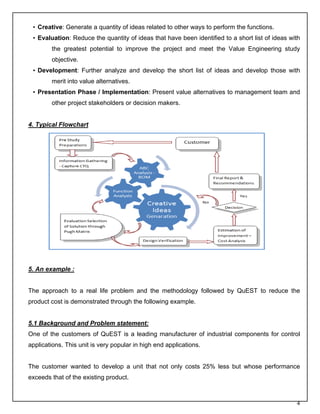
 • Information: Understand the current state of the project and constraints / requirements.
 • Function Analysis: Understand the project from a functional perspective; what must the
         project do, rather than how the project is currently conceived. The function describes
         what something does and function analysis is the process where the team reviews the
         project's functions to determine those that could be improved. Function Analysis can be
         enhanced through the use of a graphical mapping tool known as the Function Analysis
         System Technique (FAST). FAST applies intuitive logic to test functions, create a
         common language for a team, and test the validity of the functions in the project.

                                                                                                   3
• Creative: Generate a quantity of ideas related to other ways to perform the functions.
 • Evaluation: Reduce the quantity of ideas that have been identified to a short list of ideas with
        the greatest potential to improve the project and meet the Value Engineering study
        objective.
 • Development: Further analyze and develop the short list of ideas and develop those with
        merit into value alternatives.
 • Presentation Phase / Implementation: Present value alternatives to management team and
        other project stakeholders or decision makers.


4. Typical Flowchart


5. An example :


The approach to a real life problem and the methodology followed by QuEST to reduce the
product cost is demonstrated through the following example.


5.1 Background and Problem statement:
One of the customers of QuEST is a leading manufacturer of industrial components for control
applications. This unit is very popular in high end applications.


The customer wanted to develop a unit that not only costs 25% less but whose performance
exceeds that of the existing product.


                                                                                                 4
5.2 Challenges:
 • Redesign of parts considering minimum impact on existing tooling
 • Redesigned modules should enable field replacement
 • Logic/Software compatibility with field units
 • Ease of assembly
 • Design must match existing housings and connectors
 • No modification of standardized parts in the product family


5.4 Value Engineering Study :
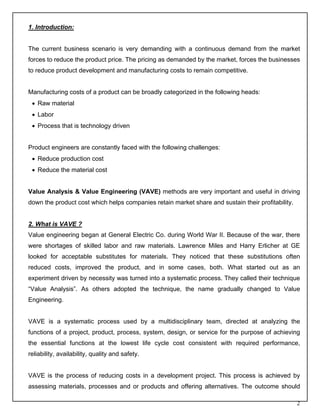
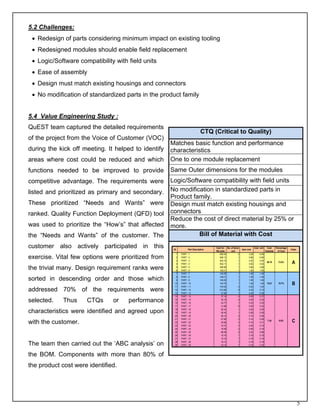
QuEST team captured the detailed requirements
                                                                             CTQ (Critical to Quality)
of the project from the Voice of Customer (VOC)
                                                     Matches basic function and performance
during the kick off meeting. It helped to identify   characteristics
areas where cost could be reduced and which          One to one module replacement
functions needed to be improved to provide           Same Outer dimensions for the modules
competitive advantage. The requirements were         Logic/Software compatibility with field units
listed and prioritized as primary and secondary.     No modification in standardized parts in
                                                     Product family.
These prioritized “Needs and Wants” were             Design must match existing housings and
ranked. Quality Function Deployment (QFD) tool       connectors
                                                     Reduce the cost of direct material by 25% or
was used to prioritize the “How’s” that affected     more.
the “Needs and Wants” of the customer. The                     Bill of Material with Cost
customer also actively participated in this           ID         Part Description
                                                                                    Cost for No. of items
                                                                                                            Item cost
                                                                                                                          Cost unit    Cost    Percentage
                                                                                                                                                            Class
                                                                                    100 units    unit                                 Subtotal   of Cost
                                                       1   PART - 1                     658.50          2          3.29        6.59
exercise. Vital few options were prioritized from      2
                                                       3
                                                           PART - 2
                                                           PART - 3
                                                                                        566.13
                                                                                        422.15
                                                                                                        1
                                                                                                        1
                                                                                                                   5.66
                                                                                                                   4.22
                                                                                                                               5.66
                                                                                                                               4.22
                                                       4   PART - 4                     402.11          1          4.02        4.02
                                                                                                                                       56.78     73.8%       A
the trivial many. Design requirement ranks were        5
                                                       6
                                                           PART - 5
                                                           PART - 6
                                                                                        388.99
                                                                                        150.01
                                                                                                        1
                                                                                                        1
                                                                                                                   3.89
                                                                                                                   1.50
                                                                                                                               3.89
                                                                                                                               1.50
                                                       7   PART - 7                     146.26          1          1.46        1.46
                                                       8   PART - 8                     146.01          1          1.46        1.46
sorted in descending order and those which             9   PART - 9                     146.00          1          1.46        1.46
                                                      10
                                                      11
                                                           PART - 10
                                                           PART - 11
                                                                                        145.75
                                                                                        104.00
                                                                                                        1
                                                                                                        2
                                                                                                                   1.46
                                                                                                                   0.52
                                                                                                                               1.46
                                                                                                                               1.04
                                                                                                                                       12.81     16.7%       B
addressed 70% of the requirements were                12
                                                      13
                                                           PART - 12
                                                           PART - 13
                                                                                        272.96
                                                                                         37.89
                                                                                                        8
                                                                                                        1
                                                                                                                   0.34
                                                                                                                   0.38
                                                                                                                               2.73
                                                                                                                               0.38
                                                      14   PART - 14                     37.16          4          0.09        0.37

selected.    Thus    CTQs      or    performance      15
                                                      16
                                                           PART - 15
                                                           PART - 16
                                                                                         35.19
                                                                                         34.77
                                                                                                        4
                                                                                                        1
                                                                                                                   0.09
                                                                                                                   0.35
                                                                                                                               0.35
                                                                                                                               0.35
                                                      17   PART - 17                     31.86          6          0.05        0.32
                                                      18   PART - 18                     28.34          1          0.28        0.28
characteristics were identified and agreed upon       19   PART - 19                     28.34          1          0.28        0.28
                                                      20   PART - 20                     28.12          2          0.14        0.28
                                                      21   PART - 21                     27.96          2          0.14        0.28
with the customer.                                    22   PART - 22                     20.98          2          0.10        0.21
                                                                                                                                       7.30       9.5%       C
                                                      23   PART - 23                     18.72          4          0.05        0.19
                                                      24   PART - 24                     18.58          2          0.09        0.19
                                                      25   PART - 25                     88.08          4          0.22        0.88
                                                      26   PART - 26                     18.18          1          0.18        0.18
                                                      27   PART - 27                     18.18          1          0.18        0.18
                                                      28   PART - 28                     18.14          1          0.18        0.18
The team then carried out the ‘ABC analysis’ on       29   PART - 29                     18.14          1          0.18        0.18


the BOM. Components with more than 80% of
the product cost were identified.


                                                                                                                                                                    5
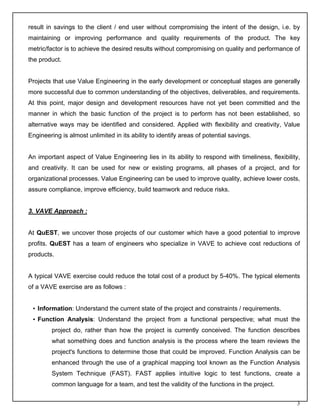
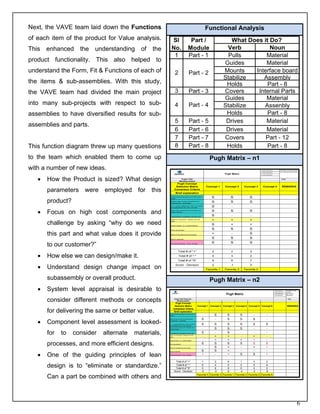
Next, the VAVE team laid down the Functions                                                                   Functional Analysis
of each item of the product for Value analysis.         Sl                              Part /                                  What Does it Do?
This enhanced the understanding of the                  No.                            Module                                 Verb           Noun
                                                         1                             Part - 1                               Pulls        Material
product functionality. This also helped to
                                                                                                                             Guides        Material
understand the Form, Fit & Functions of each of               2                          Part - 2                            Mounts    Interface board
                                                                                                                             Stabilize    Assembly
the items & sub-assemblies. With this study,                                                                                  Holds         Part - 8
the VAVE team had divided the main project                    3                          Part - 3                            Covers     Internal Parts
                                                                                                                             Guides        Material
into many sub-projects with respect to sub-                   4                          Part - 4                            Stabilize    Assenbly
assemblies to have diversified results for sub-                                                                               Holds         Part - 8
                                                              5                          Part - 5                             Drives       Material
assemblies and parts.
                                                              6                          Part - 6                             Drives       Material
                                                              7                          Part - 7                            Covers        Part - 12
This function diagram threw up many questions                 8                          Part - 8                             Holds         Part - 8
to the team which enabled them to come up                                                                        Pugh Matrix – n1
with a number of new ideas.                                                                                                                                  + = Better alternative                 Compare current concept
                                                                                                                                                                                                    with selected alternatives
                                                                                                                                                             - = Worse alternative
                                                                                                                              Pugh Matrix                    s = same alternative


   •   How the Product is sized? What design                             Project Title/
                                                                       Members present
                                                                                                                                                                                                        Date:


                                                               Pugh Concept
                                                              Selection Matrix                                Concept 1        Concept 2        Concept 3        Concept 4                               REMARKS
       parameters were employed for this                     Comarison Criteria
                                                              Brief explanation
                                                       Existing Mounting options as in field units to
                                                       match
                                                                                                                   S                 S              S
       product?                                        Matches basic function and performance
                                                       characteristics - same/better-
                                                                                                                   S                 S              S
                                                       1-2-1 module replacement- either of modules
                                                       are replaceble for the units in the field.
                                                                                                                   S                 -              -

   •   Focus on high cost components and               Same Outer dimensions for the feeder and
                                                       printer modules


                                                       Logic/Software compatibility with field units
                                                                                                                   S
                                                                                                                   S
                                                                                                                                     S
                                                                                                                                     -
                                                                                                                                                    S
                                                                                                                                                    -
                                                       Return on Investment - between 3K to 5K
                                                                                                                   +                 +              +
       challenge by asking “why do we need
                                                       parts


                                                       Less # of parts - w.r.t. present Module
                                                                                                                   S                 +              +
                                                       Parts standardised
                                                                                                                   S                 S              S
       this part and what value does it provide        Ease of manufacturing and sourcing
                                                                                                                   +                 -              S
                                                       Easy to assemble
                                                                                                                   S                 S              S
                                                                                                                   S                 S              S
       to our customer?”                               Environment factors,- Temp, Humidity


                                                                    Total # of "+"                                 2                 2              2

   •   How else we can design/make it.                               Total # of "-"                                0                 3              2
                                                                    Total # of "S"                                 9                 6              7

   •   Understand design change impact on                      Score - Decision                                    2
                                                                                                              Favorite 1
                                                                                                                                     -1
                                                                                                                               Favorite 3
                                                                                                                                                    0
                                                                                                                                                Favorite 2


       subassembly or overall product.                                                                           Pugh Matrix – n2
   •   System level appraisal is desirable to                                                                                                                                         + = Better alternative

                                                                                                                                                                                      - = Worse alternative
                                                                                                                                                                                                                Compare current
                                                                                                                                                                                                                concept
                                                                                                                                Pugh Matrix                                           s = same alternative
                                                                                                                                                                                                                with selected
                                                                                                                                                                                                                alternatives


       consider different methods or concepts                Project Title/ Project No.:
                                                                 Members present
                                                             Pugh Concept
                                                                                                                                                                                                                  Date:


                                                            Selection Matrix                           Concept 1 Concept 2 Concept 3 Concept 4 Concept 5 Concept 6                                              REMARKS
                                                           Comarison Criteria
       for delivering the same or better value.             Brief explanation
                                                      Existing Mounting options as in field units to
                                                      match                                               -            S         S          S           -              -

   •
                                                      Matches basic function and performance              S            -         S          S           S              -
       Component level assessment is looked-          characteristics - same/better-

                                                      1-2-1 module replacement- either of modules
                                                      are replaceble for the units in the field.
                                                                                                          S            S         S          S           S             S
                                                      Same Outer dimensions for the feeder and
                                                      printer modules                                     -            S         S          S           -             -
       for   to   consider   alternate   materials,   Logic/Software compatibility with field units
                                                      Return on Investment - between 3K to 5K
                                                      parts
                                                                                                          S
                                                                                                          -
                                                                                                                       -
                                                                                                                       +
                                                                                                                                 S
                                                                                                                                 +
                                                                                                                                            -
                                                                                                                                            -
                                                                                                                                                        -
                                                                                                                                                        +
                                                                                                                                                                      -
                                                                                                                                                                      -
                                                      Less # of parts - w.r.t. present Module             -            +         +          +           +             -
       processes, and more efficient designs.         Parts standardised

                                                      Ease of manufacturing and sourcing
                                                                                                          S
                                                                                                          -
                                                                                                                       S
                                                                                                                       S
                                                                                                                                 S
                                                                                                                                 +
                                                                                                                                            S
                                                                                                                                            -
                                                                                                                                                        S
                                                                                                                                                        +
                                                                                                                                                                      S
                                                                                                                                                                      +
                                                                                                          S            S         +          -           -             -
   •
                                                      Easy to assemble


       One of the guiding principles of lean          Environment factors,- Temp, Humidity                +            -         +          S           S             +

                                                              Total # of "+"                              1          2          6           1          3          2

       design is to “eliminate or standardize.”                Total # of "-"
                                                              Total # of "S"
                                                                                                          6
                                                                                                          5
                                                                                                                     4
                                                                                                                     6
                                                                                                                                0
                                                                                                                                6
                                                                                                                                            5
                                                                                                                                            6
                                                                                                                                                       5
                                                                                                                                                       4
                                                                                                                                                                  8
                                                                                                                                                                  2
                                                             Score - Decision                             -5         -2         6          -4         -2         -6
                                                                                                       Favorite 5 Favorite 3 Favorite 1 Favorite 4 Favorite 2 Favorite 6
       Can a part be combined with others and


                                                                                                                                                                                                                                  6
thereby be eliminated? If not, can it be made common with other parts in the product,
             without compromising FFF (Form Fit & Function). This typically provides quick savings.
      •      Identify and capture all cost reduction opportunities.


The team applied the concept of Pugh Matrix for system & component level. Rankings were
discussed with team, collated and analyzed for choosing the optimum concepts.


Next, FMEA was conducted on the selected concepts to further fine tune the results. Failure
modes with high Risk Priority Number (RPN) were identified. Failure modes were prioritized and
communicated to the designers to address these risks. Alternate solutions and improvement were
discussed and finalized.


3D solid modeling was done to visualize the product. It also helped to simulate the active and
passive conditions of the product. Components were standardized to reduce the part count.
Simulation and testing against the CTQs helped to optimize the product for performances. Design
calculations were performed to verify the design for gears, springs, snaps in the plastic members,
etc.. Also the DFMA was conducted on various aspects of the design & CTQs.


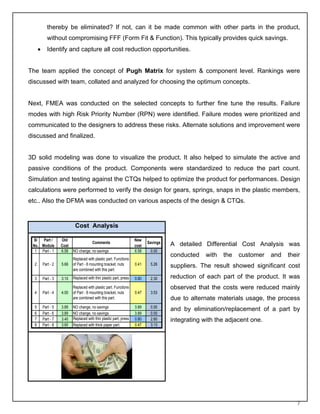
                             Cost Analysis

 Sl   Part /         Old                                             New
                                         Comments                           Savings   A detailed Differential Cost Analysis was
 No. Module          Cost                                            cost
  1 Part - 1         6.58   NO change, no savings                    6.58    0.00
                                                                                      conducted    with   the   customer   and   their
                            Replaced with plastic part. Functions
  2       Part - 2   5.66   of Part - 8 mounting bracket, nuts       0.41    5.26     suppliers. The result showed significant cost
                            are combined with this part.

  3       Part - 3   3.10   Replaced with thin plastic part, press   0.80    2.30     reduction of each part of the product. It was
                            Replaced with plastic part. Functions                     observed that the costs were reduced mainly
  4       Part - 4   4.00   of Part - 8 mounting bracket, nuts       0.47    3.53
                            are combined with this part.                              due to alternate materials usage, the process
  5       Part - 5   3.89   NO change, no savings                    3.89    0.00
                                                                                      and by elimination/replacement of a part by
  6       Part - 6   3.89   NO change, no savings                    3.89    0.00
  7       Part - 7   3.40   Replaced with thin plastic part, press   0.80    2.60     integrating with the adjacent one.
  8       Part - 8   3.60   Replaced with thick paper part.          0.47    3.13


                                                                                                                                    7
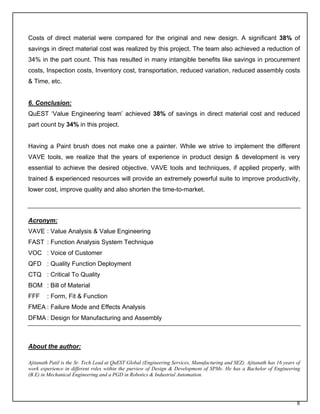
Costs of direct material were compared for the original and new design. A significant 38% of
savings in direct material cost was realized by this project. The team also achieved a reduction of
34% in the part count. This has resulted in many intangible benefits like savings in procurement
costs, Inspection costs, Inventory cost, transportation, reduced variation, reduced assembly costs
& Time, etc.


6. Conclusion:
QuEST ‘Value Engineering team’ achieved 38% of savings in direct material cost and reduced
part count by 34% in this project.


Having a Paint brush does not make one a painter. While we strive to implement the different
VAVE tools, we realize that the years of experience in product design & development is very
essential to achieve the desired objective. VAVE tools and techniques, if applied properly, with
trained & experienced resources will provide an extremely powerful suite to improve productivity,
lower cost, improve quality and also shorten the time-to-market.


Acronym:
VAVE : Value Analysis & Value Engineering
FAST : Function Analysis System Technique
VOC : Voice of Customer
QFD : Quality Function Deployment
CTQ : Critical To Quality
BOM : Bill of Material
FFF     : Form, Fit & Function
FMEA : Failure Mode and Effects Analysis
DFMA : Design for Manufacturing and Assembly


About the author:

Ajitanath Patil is the Sr. Tech Lead at QuEST Global (Engineering Services, Manufacturing and SEZ). Ajitanath has 16 years of
work experience in different roles within the purview of Design & Development of SPMs. He has a Bachelor of Engineering
(B.E) in Mechanical Engineering and a PGD in Robotics & Industrial Automation.


                                                                                                                           8

Cost Reduction of a product through Value Analysis & Value Engineering

  • 1.
    A QuEST WhitePaper Quality Engineering & Software Technologies No. 55, QuEST Towers, Whitefield Main Road, Mahadevpura, Bangalore, 560 048, INDIA. Tel: 91 80-4119 0900 Fax: 91 80-4119 0901 www.quest-global.com Cost Reduction of a product through Value Analysis & Value Engineering By Ajitanath Patil. Date April 28, 2010
  • 2.
    1. Introduction: The currentbusiness scenario is very demanding with a continuous demand from the market forces to reduce the product price. The pricing as demanded by the market, forces the businesses to reduce product development and manufacturing costs to remain competitive. Manufacturing costs of a product can be broadly categorized in the following heads: • Raw material • Labor • Process that is technology driven Product engineers are constantly faced with the following challenges: • Reduce production cost • Reduce the material cost Value Analysis & Value Engineering (VAVE) methods are very important and useful in driving down the product cost which helps companies retain market share and sustain their profitability. 2. What is VAVE ? Value engineering began at General Electric Co. during World War II. Because of the war, there were shortages of skilled labor and raw materials. Lawrence Miles and Harry Erlicher at GE looked for acceptable substitutes for materials. They noticed that these substitutions often reduced costs, improved the product, and in some cases, both. What started out as an experiment driven by necessity was turned into a systematic process. They called their technique “Value Analysis”. As others adopted the technique, the name gradually changed to Value Engineering. VAVE is a systematic process used by a multidisciplinary team, directed at analyzing the functions of a project, product, process, system, design, or service for the purpose of achieving the essential functions at the lowest life cycle cost consistent with required performance, reliability, availability, quality and safety. VAVE is the process of reducing costs in a development project. This process is achieved by assessing materials, processes and or products and offering alternatives. The outcome should 2
  • 3.
    result in savingsto the client / end user without compromising the intent of the design, i.e. by maintaining or improving performance and quality requirements of the product. The key metric/factor is to achieve the desired results without compromising on quality and performance of the product. Projects that use Value Engineering in the early development or conceptual stages are generally more successful due to common understanding of the objectives, deliverables, and requirements. At this point, major design and development resources have not yet been committed and the manner in which the basic function of the project is to perform has not been established, so alternative ways may be identified and considered. Applied with flexibility and creativity, Value Engineering is almost unlimited in its ability to identify areas of potential savings. An important aspect of Value Engineering lies in its ability to respond with timeliness, flexibility, and creativity. It can be used for new or existing programs, all phases of a project, and for organizational processes. Value Engineering can be used to improve quality, achieve lower costs, assure compliance, improve efficiency, build teamwork and reduce risks. 3. VAVE Approach : At QuEST, we uncover those projects of our customer which have a good potential to improve profits. QuEST has a team of engineers who specialize in VAVE to achieve cost reductions of products. A typical VAVE exercise could reduce the total cost of a product by 5-40%. The typical elements of a VAVE exercise are as follows : • Information: Understand the current state of the project and constraints / requirements. • Function Analysis: Understand the project from a functional perspective; what must the project do, rather than how the project is currently conceived. The function describes what something does and function analysis is the process where the team reviews the project's functions to determine those that could be improved. Function Analysis can be enhanced through the use of a graphical mapping tool known as the Function Analysis System Technique (FAST). FAST applies intuitive logic to test functions, create a common language for a team, and test the validity of the functions in the project. 3
  • 4.
    • Creative: Generatea quantity of ideas related to other ways to perform the functions. • Evaluation: Reduce the quantity of ideas that have been identified to a short list of ideas with the greatest potential to improve the project and meet the Value Engineering study objective. • Development: Further analyze and develop the short list of ideas and develop those with merit into value alternatives. • Presentation Phase / Implementation: Present value alternatives to management team and other project stakeholders or decision makers. 4. Typical Flowchart 5. An example : The approach to a real life problem and the methodology followed by QuEST to reduce the product cost is demonstrated through the following example. 5.1 Background and Problem statement: One of the customers of QuEST is a leading manufacturer of industrial components for control applications. This unit is very popular in high end applications. The customer wanted to develop a unit that not only costs 25% less but whose performance exceeds that of the existing product. 4
  • 5.
    5.2 Challenges: •Redesign of parts considering minimum impact on existing tooling • Redesigned modules should enable field replacement • Logic/Software compatibility with field units • Ease of assembly • Design must match existing housings and connectors • No modification of standardized parts in the product family 5.4 Value Engineering Study : QuEST team captured the detailed requirements CTQ (Critical to Quality) of the project from the Voice of Customer (VOC) Matches basic function and performance during the kick off meeting. It helped to identify characteristics areas where cost could be reduced and which One to one module replacement functions needed to be improved to provide Same Outer dimensions for the modules competitive advantage. The requirements were Logic/Software compatibility with field units listed and prioritized as primary and secondary. No modification in standardized parts in Product family. These prioritized “Needs and Wants” were Design must match existing housings and ranked. Quality Function Deployment (QFD) tool connectors Reduce the cost of direct material by 25% or was used to prioritize the “How’s” that affected more. the “Needs and Wants” of the customer. The Bill of Material with Cost customer also actively participated in this ID Part Description Cost for No. of items Item cost Cost unit Cost Percentage Class 100 units unit Subtotal of Cost 1 PART - 1 658.50 2 3.29 6.59 exercise. Vital few options were prioritized from 2 3 PART - 2 PART - 3 566.13 422.15 1 1 5.66 4.22 5.66 4.22 4 PART - 4 402.11 1 4.02 4.02 56.78 73.8% A the trivial many. Design requirement ranks were 5 6 PART - 5 PART - 6 388.99 150.01 1 1 3.89 1.50 3.89 1.50 7 PART - 7 146.26 1 1.46 1.46 8 PART - 8 146.01 1 1.46 1.46 sorted in descending order and those which 9 PART - 9 146.00 1 1.46 1.46 10 11 PART - 10 PART - 11 145.75 104.00 1 2 1.46 0.52 1.46 1.04 12.81 16.7% B addressed 70% of the requirements were 12 13 PART - 12 PART - 13 272.96 37.89 8 1 0.34 0.38 2.73 0.38 14 PART - 14 37.16 4 0.09 0.37 selected. Thus CTQs or performance 15 16 PART - 15 PART - 16 35.19 34.77 4 1 0.09 0.35 0.35 0.35 17 PART - 17 31.86 6 0.05 0.32 18 PART - 18 28.34 1 0.28 0.28 characteristics were identified and agreed upon 19 PART - 19 28.34 1 0.28 0.28 20 PART - 20 28.12 2 0.14 0.28 21 PART - 21 27.96 2 0.14 0.28 with the customer. 22 PART - 22 20.98 2 0.10 0.21 7.30 9.5% C 23 PART - 23 18.72 4 0.05 0.19 24 PART - 24 18.58 2 0.09 0.19 25 PART - 25 88.08 4 0.22 0.88 26 PART - 26 18.18 1 0.18 0.18 27 PART - 27 18.18 1 0.18 0.18 28 PART - 28 18.14 1 0.18 0.18 The team then carried out the ‘ABC analysis’ on 29 PART - 29 18.14 1 0.18 0.18 the BOM. Components with more than 80% of the product cost were identified. 5
  • 6.
    Next, the VAVEteam laid down the Functions Functional Analysis of each item of the product for Value analysis. Sl Part / What Does it Do? This enhanced the understanding of the No. Module Verb Noun 1 Part - 1 Pulls Material product functionality. This also helped to Guides Material understand the Form, Fit & Functions of each of 2 Part - 2 Mounts Interface board Stabilize Assembly the items & sub-assemblies. With this study, Holds Part - 8 the VAVE team had divided the main project 3 Part - 3 Covers Internal Parts Guides Material into many sub-projects with respect to sub- 4 Part - 4 Stabilize Assenbly assemblies to have diversified results for sub- Holds Part - 8 5 Part - 5 Drives Material assemblies and parts. 6 Part - 6 Drives Material 7 Part - 7 Covers Part - 12 This function diagram threw up many questions 8 Part - 8 Holds Part - 8 to the team which enabled them to come up Pugh Matrix – n1 with a number of new ideas. + = Better alternative Compare current concept with selected alternatives - = Worse alternative Pugh Matrix s = same alternative • How the Product is sized? What design Project Title/ Members present Date: Pugh Concept Selection Matrix Concept 1 Concept 2 Concept 3 Concept 4 REMARKS parameters were employed for this Comarison Criteria Brief explanation Existing Mounting options as in field units to match S S S product? Matches basic function and performance characteristics - same/better- S S S 1-2-1 module replacement- either of modules are replaceble for the units in the field. S - - • Focus on high cost components and Same Outer dimensions for the feeder and printer modules Logic/Software compatibility with field units S S S - S - Return on Investment - between 3K to 5K + + + challenge by asking “why do we need parts Less # of parts - w.r.t. present Module S + + Parts standardised S S S this part and what value does it provide Ease of manufacturing and sourcing + - S Easy to assemble S S S S S S to our customer?” Environment factors,- Temp, Humidity Total # of "+" 2 2 2 • How else we can design/make it. Total # of "-" 0 3 2 Total # of "S" 9 6 7 • Understand design change impact on Score - Decision 2 Favorite 1 -1 Favorite 3 0 Favorite 2 subassembly or overall product. Pugh Matrix – n2 • System level appraisal is desirable to + = Better alternative - = Worse alternative Compare current concept Pugh Matrix s = same alternative with selected alternatives consider different methods or concepts Project Title/ Project No.: Members present Pugh Concept Date: Selection Matrix Concept 1 Concept 2 Concept 3 Concept 4 Concept 5 Concept 6 REMARKS Comarison Criteria for delivering the same or better value. Brief explanation Existing Mounting options as in field units to match - S S S - - • Matches basic function and performance S - S S S - Component level assessment is looked- characteristics - same/better- 1-2-1 module replacement- either of modules are replaceble for the units in the field. S S S S S S Same Outer dimensions for the feeder and printer modules - S S S - - for to consider alternate materials, Logic/Software compatibility with field units Return on Investment - between 3K to 5K parts S - - + S + - - - + - - Less # of parts - w.r.t. present Module - + + + + - processes, and more efficient designs. Parts standardised Ease of manufacturing and sourcing S - S S S + S - S + S + S S + - - - • Easy to assemble One of the guiding principles of lean Environment factors,- Temp, Humidity + - + S S + Total # of "+" 1 2 6 1 3 2 design is to “eliminate or standardize.” Total # of "-" Total # of "S" 6 5 4 6 0 6 5 6 5 4 8 2 Score - Decision -5 -2 6 -4 -2 -6 Favorite 5 Favorite 3 Favorite 1 Favorite 4 Favorite 2 Favorite 6 Can a part be combined with others and 6
  • 7.
    thereby be eliminated?If not, can it be made common with other parts in the product, without compromising FFF (Form Fit & Function). This typically provides quick savings. • Identify and capture all cost reduction opportunities. The team applied the concept of Pugh Matrix for system & component level. Rankings were discussed with team, collated and analyzed for choosing the optimum concepts. Next, FMEA was conducted on the selected concepts to further fine tune the results. Failure modes with high Risk Priority Number (RPN) were identified. Failure modes were prioritized and communicated to the designers to address these risks. Alternate solutions and improvement were discussed and finalized. 3D solid modeling was done to visualize the product. It also helped to simulate the active and passive conditions of the product. Components were standardized to reduce the part count. Simulation and testing against the CTQs helped to optimize the product for performances. Design calculations were performed to verify the design for gears, springs, snaps in the plastic members, etc.. Also the DFMA was conducted on various aspects of the design & CTQs. Cost Analysis Sl Part / Old New Comments Savings A detailed Differential Cost Analysis was No. Module Cost cost 1 Part - 1 6.58 NO change, no savings 6.58 0.00 conducted with the customer and their Replaced with plastic part. Functions 2 Part - 2 5.66 of Part - 8 mounting bracket, nuts 0.41 5.26 suppliers. The result showed significant cost are combined with this part. 3 Part - 3 3.10 Replaced with thin plastic part, press 0.80 2.30 reduction of each part of the product. It was Replaced with plastic part. Functions observed that the costs were reduced mainly 4 Part - 4 4.00 of Part - 8 mounting bracket, nuts 0.47 3.53 are combined with this part. due to alternate materials usage, the process 5 Part - 5 3.89 NO change, no savings 3.89 0.00 and by elimination/replacement of a part by 6 Part - 6 3.89 NO change, no savings 3.89 0.00 7 Part - 7 3.40 Replaced with thin plastic part, press 0.80 2.60 integrating with the adjacent one. 8 Part - 8 3.60 Replaced with thick paper part. 0.47 3.13 7
  • 8.
    Costs of directmaterial were compared for the original and new design. A significant 38% of savings in direct material cost was realized by this project. The team also achieved a reduction of 34% in the part count. This has resulted in many intangible benefits like savings in procurement costs, Inspection costs, Inventory cost, transportation, reduced variation, reduced assembly costs & Time, etc. 6. Conclusion: QuEST ‘Value Engineering team’ achieved 38% of savings in direct material cost and reduced part count by 34% in this project. Having a Paint brush does not make one a painter. While we strive to implement the different VAVE tools, we realize that the years of experience in product design & development is very essential to achieve the desired objective. VAVE tools and techniques, if applied properly, with trained & experienced resources will provide an extremely powerful suite to improve productivity, lower cost, improve quality and also shorten the time-to-market. Acronym: VAVE : Value Analysis & Value Engineering FAST : Function Analysis System Technique VOC : Voice of Customer QFD : Quality Function Deployment CTQ : Critical To Quality BOM : Bill of Material FFF : Form, Fit & Function FMEA : Failure Mode and Effects Analysis DFMA : Design for Manufacturing and Assembly About the author: Ajitanath Patil is the Sr. Tech Lead at QuEST Global (Engineering Services, Manufacturing and SEZ). Ajitanath has 16 years of work experience in different roles within the purview of Design & Development of SPMs. He has a Bachelor of Engineering (B.E) in Mechanical Engineering and a PGD in Robotics & Industrial Automation. 8