-ASHWINI CHOPDA
 “Underwriting is an agreement entered into
before the shares are bought by the public
that in the event of the public not taking up
the whole of them the underwriter will take
an allotment of such part of the shares as
the public has not applied for.”
 Syndicate Underwriting is one in which, two or
more agencies or underwriters jointly underwrite an issue of
securities. Such an arrangement is entered into when the total
issue is beyond the resources of one underwriter or when he does
not want to block up large amount of funds in one issue.
 Sub-Underwriting is one in which an underwriter gets
a part of the issue further underwritten by another agency. This is
done to diffuse the risk involved in underwriting.
 Firm Underwriting is one in which the underwriters
apply for a block of securities. Under it, the underwriters agree to
take up and pay for this block of securities as ordinary
subscribers in addition to their commitment as underwriters.
 The primary role of the underwriter is to purchase
securities from the issuer and resell them to
investors.
 Underwriters act as intermediaries between issuers
and investors, providing for an efficient of capital.
 The underwriters take the risk that it will be able to
resell the securities at a profit.
 The underwriter is the organization that is actually
responsible for pricing, selling, and organizing the
issue, and it may or may not provide additional
services.
 Such an activity helps to enhance the goodwill of
the issuing company by purchasing securities
either directly from the company or from the
market, they vouchsafe the financial soundness of
the company.
 By undertaking to take up the whole issue or the
remaining shares not subscribed by the public, it
helps a company to undertake project investments
with the assurance of adequate capital funds.
 Underwriters provide stability to the price of
securities by purchasing and selling various
securities. This ultimately benefits the stock
market.
Eligibility criteria, Procedure for registration and operational
guidelines are covered under SEBI (Underwriters) Rules, 1993
and SEBI (Underwriters) Regulations 1993. The words
"underwriting" and "Underwriter" are defined in the aforesaid
Rules as under:
"underwriting" means an agreement with or without
conditions to subscribe to the securities of a body
corporate when the existing shareholders of such body
corporate or the public do not subscribe to the securities
offered to them.
"underwriter" means a person, who engages in the business
of underwriting of an issue of securities of a body
corporate;
 Rule 3(1) of the aforesaid Rules makes
Registration with the SEBI compulsory.
 To quote the said Rule-
"No person shall act as underwriter unless he
holds a certificate granted by the Board under
the regulations".
The Board may grant or renew a certificate to an underwriter subject to the
following conditions namely;
1) in case of any change in the status and constitution, the underwriter shall
obtain prior permission of the Board to continue to act as underwriter;
2) without prejudice to the obligations under any other, the underwriter shall enter
into a valid agreement with the body corporate on whose behalf he is acting as
underwriter and the said agreement amongst other things may define the
allocation of duties and responsibilities between him and such body corporate
and;
3) he shall pay the amount of fees of registration in the manner provided in the
regulations;
4) he shall abide by the rules and regulations made under the Act in respect of
the activities carried on by him as an underwriter.
 has the necessary infrastructure like adequate office space,
equipments, and manpower to effectively discharge his activities;
 has any past experience in underwriting or has in his
employment minimum two persons who had the experience in
underwriting;
 or any person, directly or indirectly connected with the
applicant has not been granted registration by the Board under
the Act;
 fulfils the capital adequacy requirements specified in
regulation 7 ;
 is a fit and proper person.
 The capital adequacy requirement referred to in sub-
regulation (d) of regulation 6 shall not be less than the
net worth of Rupees Twenty Lakhs
 Every underwriter shall at all times abide by the Code of Conduct as
specified in Schedule III.(Regulation 13)
 Every underwriter shall enter into an agreement referred to in clause
(b) of rule 4 with each body corporate on whose behalf he is acting
as underwriter and the said agreement shall, amongst other things,
provide for the following, namely :- (Regulation 14)
the period for which the agreement shall be in force;
the amount of underwriting obligations;
the period, within which the underwriter has to subscribe to the issue
after being intimated by or on behalf of such body corporate;
the amount of commission or brokerage payable to the underwriter;
details of arrangements, if any, made by the underwriter for
fulfilling the underwriting obligations.
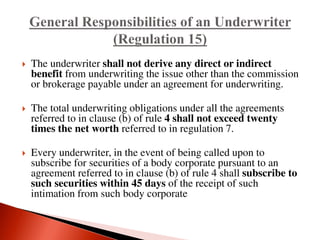
 The underwriter shall not derive any direct or indirect
benefit from underwriting the issue other than the commission
or brokerage payable under an agreement for underwriting.
 The total underwriting obligations under all the agreements
referred to in clause (b) of rule 4 shall not exceed twenty
times the net worth referred to in regulation 7.
 Every underwriter, in the event of being called upon to
subscribe for securities of a body corporate pursuant to an
agreement referred to in clause (b) of rule 4 shall subscribe to
such securities within 45 days of the receipt of such
intimation from such body corporate
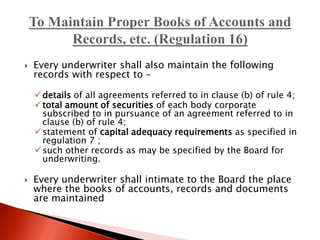
 Every underwriter shall also maintain the following
records with respect to –
details of all agreements referred to in clause (b) of rule 4;
total amount of securities of each body corporate
subscribed to in pursuance of an agreement referred to in
clause (b) of rule 4;
statement of capital adequacy requirements as specified in
regulation 7 ;
such other records as may be specified by the Board for
underwriting.
 Every underwriter shall intimate to the Board the place
where the books of accounts, records and documents
are maintained
 Every underwriter shall preserve the books of
account and other records and documents
mentioned under this chapter for a minimum
period of five years.
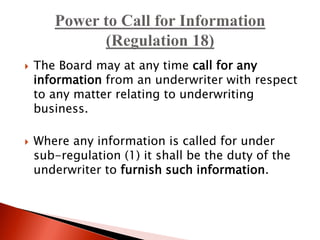
 The Board may at any time call for any
information from an underwriter with respect
to any matter relating to underwriting
business.
 Where any information is called for under
sub-regulation (1) it shall be the duty of the
underwriter to furnish such information.
Alibaba Group Holding Limited is a Chinese e-
commerce company that provides consumer-to-
consumer, business-to-consumer and business-to-
business sales services via web portals.
The company came up with an IPO on 5th
September 2014
The IPO ultimately ended up raising more than
$20 billion.
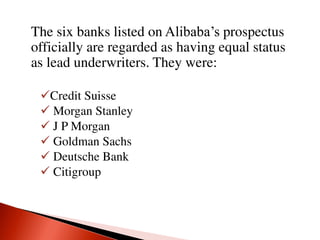
The six banks listed on Alibaba’s prospectus
officially are regarded as having equal status
as lead underwriters. They were:

Credit Suisse
 Morgan Stanley
 J P Morgan
 Goldman Sachs
 Deutsche Bank
 Citigroup
Underwriting

Underwriting

  • 1.
  • 2.
     “Underwriting isan agreement entered into before the shares are bought by the public that in the event of the public not taking up the whole of them the underwriter will take an allotment of such part of the shares as the public has not applied for.”
  • 4.
     Syndicate Underwritingis one in which, two or more agencies or underwriters jointly underwrite an issue of securities. Such an arrangement is entered into when the total issue is beyond the resources of one underwriter or when he does not want to block up large amount of funds in one issue.  Sub-Underwriting is one in which an underwriter gets a part of the issue further underwritten by another agency. This is done to diffuse the risk involved in underwriting.  Firm Underwriting is one in which the underwriters apply for a block of securities. Under it, the underwriters agree to take up and pay for this block of securities as ordinary subscribers in addition to their commitment as underwriters.
  • 6.
     The primaryrole of the underwriter is to purchase securities from the issuer and resell them to investors.  Underwriters act as intermediaries between issuers and investors, providing for an efficient of capital.  The underwriters take the risk that it will be able to resell the securities at a profit.
  • 7.
     The underwriteris the organization that is actually responsible for pricing, selling, and organizing the issue, and it may or may not provide additional services.  Such an activity helps to enhance the goodwill of the issuing company by purchasing securities either directly from the company or from the market, they vouchsafe the financial soundness of the company.
  • 8.
     By undertakingto take up the whole issue or the remaining shares not subscribed by the public, it helps a company to undertake project investments with the assurance of adequate capital funds.  Underwriters provide stability to the price of securities by purchasing and selling various securities. This ultimately benefits the stock market.
  • 10.
    Eligibility criteria, Procedurefor registration and operational guidelines are covered under SEBI (Underwriters) Rules, 1993 and SEBI (Underwriters) Regulations 1993. The words "underwriting" and "Underwriter" are defined in the aforesaid Rules as under: "underwriting" means an agreement with or without conditions to subscribe to the securities of a body corporate when the existing shareholders of such body corporate or the public do not subscribe to the securities offered to them. "underwriter" means a person, who engages in the business of underwriting of an issue of securities of a body corporate;
  • 11.
     Rule 3(1)of the aforesaid Rules makes Registration with the SEBI compulsory.  To quote the said Rule- "No person shall act as underwriter unless he holds a certificate granted by the Board under the regulations".
  • 12.
    The Board maygrant or renew a certificate to an underwriter subject to the following conditions namely; 1) in case of any change in the status and constitution, the underwriter shall obtain prior permission of the Board to continue to act as underwriter; 2) without prejudice to the obligations under any other, the underwriter shall enter into a valid agreement with the body corporate on whose behalf he is acting as underwriter and the said agreement amongst other things may define the allocation of duties and responsibilities between him and such body corporate and; 3) he shall pay the amount of fees of registration in the manner provided in the regulations; 4) he shall abide by the rules and regulations made under the Act in respect of the activities carried on by him as an underwriter.
  • 13.
     has thenecessary infrastructure like adequate office space, equipments, and manpower to effectively discharge his activities;  has any past experience in underwriting or has in his employment minimum two persons who had the experience in underwriting;  or any person, directly or indirectly connected with the applicant has not been granted registration by the Board under the Act;  fulfils the capital adequacy requirements specified in regulation 7 ;  is a fit and proper person.
  • 14.
     The capitaladequacy requirement referred to in sub- regulation (d) of regulation 6 shall not be less than the net worth of Rupees Twenty Lakhs
  • 15.
     Every underwritershall at all times abide by the Code of Conduct as specified in Schedule III.(Regulation 13)  Every underwriter shall enter into an agreement referred to in clause (b) of rule 4 with each body corporate on whose behalf he is acting as underwriter and the said agreement shall, amongst other things, provide for the following, namely :- (Regulation 14) the period for which the agreement shall be in force; the amount of underwriting obligations; the period, within which the underwriter has to subscribe to the issue after being intimated by or on behalf of such body corporate; the amount of commission or brokerage payable to the underwriter; details of arrangements, if any, made by the underwriter for fulfilling the underwriting obligations.
  • 16.
     The underwritershall not derive any direct or indirect benefit from underwriting the issue other than the commission or brokerage payable under an agreement for underwriting.  The total underwriting obligations under all the agreements referred to in clause (b) of rule 4 shall not exceed twenty times the net worth referred to in regulation 7.  Every underwriter, in the event of being called upon to subscribe for securities of a body corporate pursuant to an agreement referred to in clause (b) of rule 4 shall subscribe to such securities within 45 days of the receipt of such intimation from such body corporate
  • 17.
     Every underwritershall also maintain the following records with respect to – details of all agreements referred to in clause (b) of rule 4; total amount of securities of each body corporate subscribed to in pursuance of an agreement referred to in clause (b) of rule 4; statement of capital adequacy requirements as specified in regulation 7 ; such other records as may be specified by the Board for underwriting.  Every underwriter shall intimate to the Board the place where the books of accounts, records and documents are maintained
  • 18.
     Every underwritershall preserve the books of account and other records and documents mentioned under this chapter for a minimum period of five years.
  • 19.
     The Boardmay at any time call for any information from an underwriter with respect to any matter relating to underwriting business.  Where any information is called for under sub-regulation (1) it shall be the duty of the underwriter to furnish such information.
  • 21.
    Alibaba Group HoldingLimited is a Chinese e- commerce company that provides consumer-to- consumer, business-to-consumer and business-to- business sales services via web portals. The company came up with an IPO on 5th September 2014 The IPO ultimately ended up raising more than $20 billion.
  • 22.
    The six bankslisted on Alibaba’s prospectus officially are regarded as having equal status as lead underwriters. They were: Credit Suisse  Morgan Stanley  J P Morgan  Goldman Sachs  Deutsche Bank  Citigroup