MONASH
BUSINESS
SCHOOL
Finances
Fiona McNabb, Industry Fellow, Department of Banking &
Finance
Fiona.mcnabb@monash.edu
MONASH
BUSINESS
SCHOOL
2
Overview
§ Discovering the bottom line
– Costs, pricing and break even
§ Managing Start-up Equity
– Vesting, cliffs, acceleration and valuation
MONASH
BUSINESS
SCHOOL
Overview
MONASH
BUSINESS
SCHOOL
4
Crunching the numbers
§ Prospective investors are mainly interested in the bottom
line
– What profits and cash flows will the business generate?
– What is my required return?
– How much of the business do I need to own?
– What is my exit strategy?
MONASH
BUSINESS
SCHOOL
5
Successful Venture Life Cycle
Stages of a successful venture’s life from development
through various stages of revenue growth
1. Development Stage:
– period involving the progression from an idea to a promising
business opportunity
2. Startup Stage:
– period when the venture is organized, developed, and an initial
revenue model is put in place
MONASH
BUSINESS
SCHOOL
6
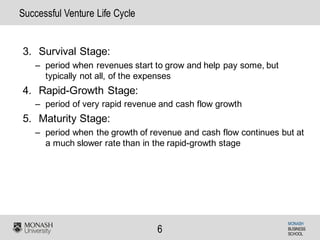
Successful Venture Life Cycle
3. Survival Stage:
– period when revenues start to grow and help pay some, but
typically not all, of the expenses
4. Rapid-Growth Stage:
– period of very rapid revenue and cash flow growth
5. Maturity Stage:
– period when the growth of revenue and cash flow continues but at
a much slower rate than in the rapid-growth stage
MONASH
BUSINESS
SCHOOL
7
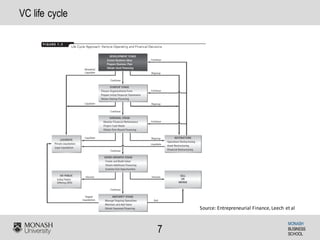
VC life cycle
Source:	Entrepreneurial	Finance,	Leech	et	al
MONASH
BUSINESS
SCHOOL
8
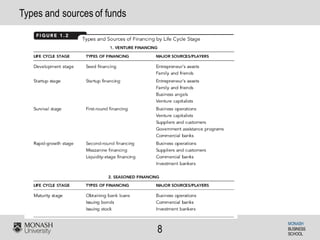
Types and sources of funds
MONASH
BUSINESS
SCHOOL
9
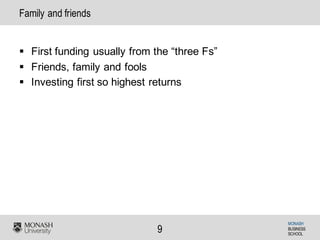
Family and friends
§ First funding usually from the “three Fs”
§ Friends, family and fools
§ Investing first so highest returns
MONASH
BUSINESS
SCHOOL
10
Business Angels
§ Angel investors invest in start-ups. The capital angel
investors provide may be a one-time investment to help
the business propel or an ongoing injection of money to
support and carry the company through its difficult early
stages.
§ Examples:
– http://melbourneangels.net/
– http://scaleinvestors.com.au/
– This program
MONASH
BUSINESS
SCHOOL
11
Venture Capital
§ Venture capital is financing that investors provide to start-
up companies and small businesses that are believed to
have long term growth potential. For startups venture
capital is an essential source of money. Risk is typically
high for investors, and VC investors usually get a say in
company decisions.
§ Typically manage a portfolio of start-up investments
§ Examples:
– http://www.acorncapital.com.au/
– http://www.starfishvc.com/
– http://contango.com.au/
– https://www.trimantium.com/
–
MONASH
BUSINESS
SCHOOL
12
Finance principles for start-ups
1. Real, Human, and Financial Capital Must be Rented
from Owners
2. Risk and Expected Reward Go Hand in Hand
3. While Accounting is the Language of Business, Cash is
the Currency
New Venture Financing Involves Search, Negotiation,
and Privacy
4. A Venture’s Financial Objective is to Increase Value
5. It is Dangerous to Assume that People Act Against Their
Own Self-Interest
6. Venture Character and Reputation Can be Assets or
Liabilities
MONASH
BUSINESS
SCHOOL
The Bottom line
MONASH
BUSINESS
SCHOOL
14
The bottom line
§ Start-ups are usually:
– Burning cash
– Not making profits in the short term
– Takes time to break even
§ Why invest?
– Long term prospects for growth
MONASH
BUSINESS
SCHOOL
15
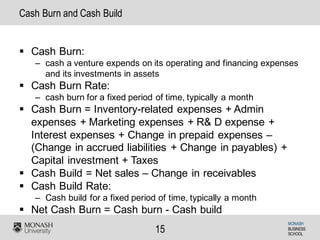
Cash Burn and Cash Build
§ Cash Burn:
– cash a venture expends on its operating and financing expenses
and its investments in assets
§ Cash Burn Rate:
– cash burn for a fixed period of time, typically a month
§ Cash Burn = Inventory-related expenses + Admin
expenses + Marketing expenses + R& D expense +
Interest expenses + Change in prepaid expenses –
(Change in accrued liabilities + Change in payables) +
Capital investment + Taxes
§ Cash Build = Net sales – Change in receivables
§ Cash Build Rate:
– Cash build for a fixed period of time, typically a month
§ Net Cash Burn = Cash burn - Cash build
MONASH
BUSINESS
SCHOOL
16
Forecasting
§ Need to forecast sales, variable costs and fixed costs
over, say, 5 to 7 years, until business is at rapid growth or
(preferably) maturity stage
§ Also include development costs.
§ Expect negative cash flows for the first few years
§ See my Softtec example
MONASH
BUSINESS
SCHOOL
17
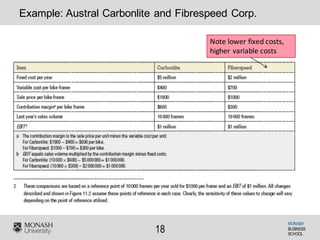
Operating leverage
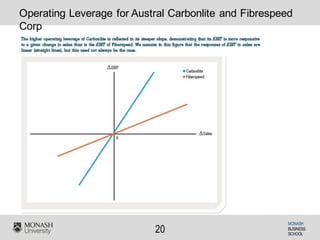
§ Operating leverage is a measure of how revenue growth
translates into growth in operating income
§ It depends on sales and costs
– In particular, fixed versus variable costs
§ If variable costs are low, profit varies more with sales.
MONASH
BUSINESS
SCHOOL
18
Example: Austral Carbonlite and Fibrespeed Corp.
Note	lower	fixed	costs,	
higher	variable	costs
MONASH
BUSINESS
SCHOOL
19
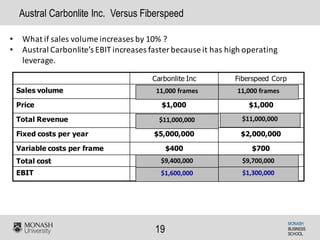
Austral Carbonlite Inc. Versus Fiberspeed
Carbonlite Inc Fiberspeed Corp
Sales volume 10,000 sofas 10,000 sofas
Price $1,000 $1,000
Total Revenue $10,000,000 $10,000,000
Fixed costs per year $5,000,000 $2,000,000
Variable costs per frame $400 $700
Total cost $9,000,000 $9,000,000
EBIT $1,000,000 $1,000,000
11,000	frames11,000	frames
$11,000,000$11,000,000
$9,700,000$9,400,000
$1,300,000$1,600,000
• What	if	sales	volume	increases	by	10%	?
• Austral	Carbonlite’s EBIT	increases	faster	because	it	has	high	operating	
leverage.
MONASH
BUSINESS
SCHOOL
20
Operating Leverage for Austral Carbonlite and Fibrespeed
Corp
MONASH
BUSINESS
SCHOOL
Valuation
MONASH
BUSINESS
SCHOOL
22
Valuing Start-ups
§ Valuation is difficult
– High risk that the venture won’t succeed
– Initial negative cash flows
§ Value of a company
– Present value of all cash flows received
– For an investor, it’s all about $
– Assumptions and forecasting
§ Future cash flows
§ Risk
MONASH
BUSINESS
SCHOOL
23
Venture Capital method
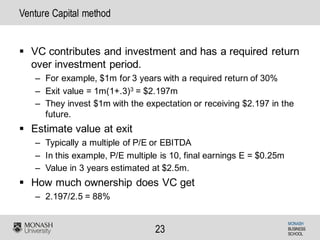
§ VC contributes and investment and has a required return
over investment period.
– For example, $1m for 3 years with a required return of 30%
– Exit value = 1m(1+.3)3 = $2.197m
– They invest $1m with the expectation or receiving $2.197 in the
future.
§ Estimate value at exit
– Typically a multiple of P/E or EBITDA
– In this example, P/E multiple is 10, final earnings E = $0.25m
– Value in 3 years estimated at $2.5m.
§ How much ownership does VC get
– 2.197/2.5 = 88%
MONASH
BUSINESS
SCHOOL
24
Venture Capital method
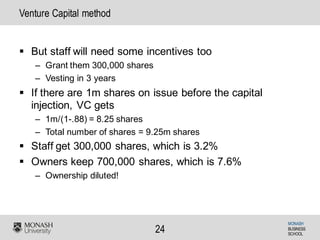
§ But staff will need some incentives too
– Grant them 300,000 shares
– Vesting in 3 years
§ If there are 1m shares on issue before the capital
injection, VC gets
– 1m/(1-.88) = 8.25 shares
– Total number of shares = 9.25m shares
§ Staff get 300,000 shares, which is 3.2%
§ Owners keep 700,000 shares, which is 7.6%
– Ownership diluted!
MONASH
BUSINESS
SCHOOL
25
Example
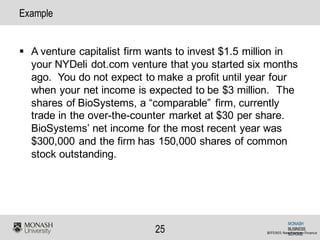
§ A venture capitalist firm wants to invest $1.5 million in
your NYDeli dot.com venture that you started six months
ago. You do not expect to make a profit until year four
when your net income is expected to be $3 million. The
shares of BioSystems, a “comparable” firm, currently
trade in the over-the-counter market at $30 per share.
BioSystems’ net income for the most recent year was
$300,000 and the firm has 150,000 shares of common
stock outstanding.
BFF5905	New	Venture	Finance
MONASH
BUSINESS
SCHOOL
26
Example (2)
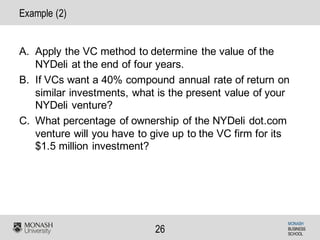
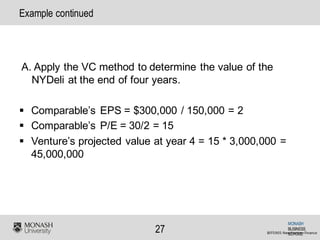
A. Apply the VC method to determine the value of the
NYDeli at the end of four years.
B. If VCs want a 40% compound annual rate of return on
similar investments, what is the present value of your
NYDeli venture?
C. What percentage of ownership of the NYDeli dot.com
venture will you have to give up to the VC firm for its
$1.5 million investment?
MONASH
BUSINESS
SCHOOL
27
Example continued
A. Apply the VC method to determine the value of the
NYDeli at the end of four years.
§ Comparable’s EPS = $300,000 / 150,000 = 2
§ Comparable’s P/E = 30/2 = 15
§ Venture’s projected value at year 4 = 15 * 3,000,000 =
45,000,000
BFF5905	New	Venture	Finance
MONASH
BUSINESS
SCHOOL
28
Example continued
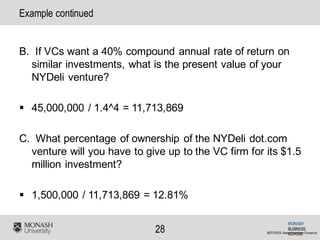
B. If VCs want a 40% compound annual rate of return on
similar investments, what is the present value of your
NYDeli venture?
§ 45,000,000 / 1.4^4 = 11,713,869
C. What percentage of ownership of the NYDeli dot.com
venture will you have to give up to the VC firm for its $1.5
million investment?
§ 1,500,000 / 11,713,869 = 12.81%
BFF5905	New	Venture	Finance
MONASH
BUSINESS
SCHOOL
Summary
MONASH
BUSINESS
SCHOOL
30
Summary
§ This a very brief overview
§ Need a knowledge of accounting practices and finance
§ It’s all about the cash flows
– Forecasting cash flows
– Understanding the risks
– Knowing where to access funds, depending on your lifecycle
stage.
31

Startup Finances

  • 1.
    MONASH BUSINESS SCHOOL Finances Fiona McNabb, IndustryFellow, Department of Banking & Finance Fiona.mcnabb@monash.edu
  • 2.
    MONASH BUSINESS SCHOOL 2 Overview § Discovering thebottom line – Costs, pricing and break even § Managing Start-up Equity – Vesting, cliffs, acceleration and valuation
  • 3.
  • 4.
    MONASH BUSINESS SCHOOL 4 Crunching the numbers §Prospective investors are mainly interested in the bottom line – What profits and cash flows will the business generate? – What is my required return? – How much of the business do I need to own? – What is my exit strategy?
  • 5.
    MONASH BUSINESS SCHOOL 5 Successful Venture LifeCycle Stages of a successful venture’s life from development through various stages of revenue growth 1. Development Stage: – period involving the progression from an idea to a promising business opportunity 2. Startup Stage: – period when the venture is organized, developed, and an initial revenue model is put in place
  • 6.
    MONASH BUSINESS SCHOOL 6 Successful Venture LifeCycle 3. Survival Stage: – period when revenues start to grow and help pay some, but typically not all, of the expenses 4. Rapid-Growth Stage: – period of very rapid revenue and cash flow growth 5. Maturity Stage: – period when the growth of revenue and cash flow continues but at a much slower rate than in the rapid-growth stage
  • 7.
  • 8.
  • 9.
    MONASH BUSINESS SCHOOL 9 Family and friends §First funding usually from the “three Fs” § Friends, family and fools § Investing first so highest returns
  • 10.
    MONASH BUSINESS SCHOOL 10 Business Angels § Angelinvestors invest in start-ups. The capital angel investors provide may be a one-time investment to help the business propel or an ongoing injection of money to support and carry the company through its difficult early stages. § Examples: – http://melbourneangels.net/ – http://scaleinvestors.com.au/ – This program
  • 11.
    MONASH BUSINESS SCHOOL 11 Venture Capital § Venturecapital is financing that investors provide to start- up companies and small businesses that are believed to have long term growth potential. For startups venture capital is an essential source of money. Risk is typically high for investors, and VC investors usually get a say in company decisions. § Typically manage a portfolio of start-up investments § Examples: – http://www.acorncapital.com.au/ – http://www.starfishvc.com/ – http://contango.com.au/ – https://www.trimantium.com/ –
  • 12.
    MONASH BUSINESS SCHOOL 12 Finance principles forstart-ups 1. Real, Human, and Financial Capital Must be Rented from Owners 2. Risk and Expected Reward Go Hand in Hand 3. While Accounting is the Language of Business, Cash is the Currency New Venture Financing Involves Search, Negotiation, and Privacy 4. A Venture’s Financial Objective is to Increase Value 5. It is Dangerous to Assume that People Act Against Their Own Self-Interest 6. Venture Character and Reputation Can be Assets or Liabilities
  • 13.
  • 14.
    MONASH BUSINESS SCHOOL 14 The bottom line §Start-ups are usually: – Burning cash – Not making profits in the short term – Takes time to break even § Why invest? – Long term prospects for growth
  • 15.
    MONASH BUSINESS SCHOOL 15 Cash Burn andCash Build § Cash Burn: – cash a venture expends on its operating and financing expenses and its investments in assets § Cash Burn Rate: – cash burn for a fixed period of time, typically a month § Cash Burn = Inventory-related expenses + Admin expenses + Marketing expenses + R& D expense + Interest expenses + Change in prepaid expenses – (Change in accrued liabilities + Change in payables) + Capital investment + Taxes § Cash Build = Net sales – Change in receivables § Cash Build Rate: – Cash build for a fixed period of time, typically a month § Net Cash Burn = Cash burn - Cash build
  • 16.
    MONASH BUSINESS SCHOOL 16 Forecasting § Need toforecast sales, variable costs and fixed costs over, say, 5 to 7 years, until business is at rapid growth or (preferably) maturity stage § Also include development costs. § Expect negative cash flows for the first few years § See my Softtec example
  • 17.
    MONASH BUSINESS SCHOOL 17 Operating leverage § Operatingleverage is a measure of how revenue growth translates into growth in operating income § It depends on sales and costs – In particular, fixed versus variable costs § If variable costs are low, profit varies more with sales.
  • 18.
    MONASH BUSINESS SCHOOL 18 Example: Austral Carbonliteand Fibrespeed Corp. Note lower fixed costs, higher variable costs
  • 19.
    MONASH BUSINESS SCHOOL 19 Austral Carbonlite Inc.Versus Fiberspeed Carbonlite Inc Fiberspeed Corp Sales volume 10,000 sofas 10,000 sofas Price $1,000 $1,000 Total Revenue $10,000,000 $10,000,000 Fixed costs per year $5,000,000 $2,000,000 Variable costs per frame $400 $700 Total cost $9,000,000 $9,000,000 EBIT $1,000,000 $1,000,000 11,000 frames11,000 frames $11,000,000$11,000,000 $9,700,000$9,400,000 $1,300,000$1,600,000 • What if sales volume increases by 10% ? • Austral Carbonlite’s EBIT increases faster because it has high operating leverage.
  • 20.
    MONASH BUSINESS SCHOOL 20 Operating Leverage forAustral Carbonlite and Fibrespeed Corp
  • 21.
  • 22.
    MONASH BUSINESS SCHOOL 22 Valuing Start-ups § Valuationis difficult – High risk that the venture won’t succeed – Initial negative cash flows § Value of a company – Present value of all cash flows received – For an investor, it’s all about $ – Assumptions and forecasting § Future cash flows § Risk
  • 23.
    MONASH BUSINESS SCHOOL 23 Venture Capital method §VC contributes and investment and has a required return over investment period. – For example, $1m for 3 years with a required return of 30% – Exit value = 1m(1+.3)3 = $2.197m – They invest $1m with the expectation or receiving $2.197 in the future. § Estimate value at exit – Typically a multiple of P/E or EBITDA – In this example, P/E multiple is 10, final earnings E = $0.25m – Value in 3 years estimated at $2.5m. § How much ownership does VC get – 2.197/2.5 = 88%
  • 24.
    MONASH BUSINESS SCHOOL 24 Venture Capital method §But staff will need some incentives too – Grant them 300,000 shares – Vesting in 3 years § If there are 1m shares on issue before the capital injection, VC gets – 1m/(1-.88) = 8.25 shares – Total number of shares = 9.25m shares § Staff get 300,000 shares, which is 3.2% § Owners keep 700,000 shares, which is 7.6% – Ownership diluted!
  • 25.
    MONASH BUSINESS SCHOOL 25 Example § A venturecapitalist firm wants to invest $1.5 million in your NYDeli dot.com venture that you started six months ago. You do not expect to make a profit until year four when your net income is expected to be $3 million. The shares of BioSystems, a “comparable” firm, currently trade in the over-the-counter market at $30 per share. BioSystems’ net income for the most recent year was $300,000 and the firm has 150,000 shares of common stock outstanding. BFF5905 New Venture Finance
  • 26.
    MONASH BUSINESS SCHOOL 26 Example (2) A. Applythe VC method to determine the value of the NYDeli at the end of four years. B. If VCs want a 40% compound annual rate of return on similar investments, what is the present value of your NYDeli venture? C. What percentage of ownership of the NYDeli dot.com venture will you have to give up to the VC firm for its $1.5 million investment?
  • 27.
    MONASH BUSINESS SCHOOL 27 Example continued A. Applythe VC method to determine the value of the NYDeli at the end of four years. § Comparable’s EPS = $300,000 / 150,000 = 2 § Comparable’s P/E = 30/2 = 15 § Venture’s projected value at year 4 = 15 * 3,000,000 = 45,000,000 BFF5905 New Venture Finance
  • 28.
    MONASH BUSINESS SCHOOL 28 Example continued B. IfVCs want a 40% compound annual rate of return on similar investments, what is the present value of your NYDeli venture? § 45,000,000 / 1.4^4 = 11,713,869 C. What percentage of ownership of the NYDeli dot.com venture will you have to give up to the VC firm for its $1.5 million investment? § 1,500,000 / 11,713,869 = 12.81% BFF5905 New Venture Finance
  • 29.
  • 30.
    MONASH BUSINESS SCHOOL 30 Summary § This avery brief overview § Need a knowledge of accounting practices and finance § It’s all about the cash flows – Forecasting cash flows – Understanding the risks – Knowing where to access funds, depending on your lifecycle stage.
  • 31.