WEBSITE: SP3NW.ORG
SOCIALS: @SP3NW
EMAIL: INFO@SP3NW.ORG
WEBSITE: AM-CPAS.COM
EMAIL: SMARTIN@AM-CPAS.COM
Valuing Early-Stage Companies
and Agreements
Your Startup Advisory Board
May 26, 2022
Presented by
Scott H. Martin, CPA/ABV, ASA
Mackenzie Marr, CPA
โˆ— Fair Market Value โ€“ Willing buyer, willing seller, both having
knowledge of all relevant facts and neither being under any
compulsion to buy or sell. Revenue Ruling 59-60.
โˆ— Investment Value โ€“ The value of a business to a particular buyer
based upon a return on investment analysis and the unique
circumstances of the transaction.
โˆ— Fair Value โ€“ The Uniform Business Corporation Act โ€“ โ€œFair
Value,โ€ with respect to a dissenterโ€™s shares, means the value of
the shares immediately before the effectuation of the corporate
action to which the dissenter objects, excluding any appreciation
or depreciation in anticipation of the corporate action unless
exclusion would be inequitable.
Value Definitions
Valuation Approaches
โˆ— A general way of determining a value indication of a
business, business ownership interest, or security
using one or more methods based on the value of the
assets net of liabilities.
Asset Approach
โˆ— A general way of determining a value indication of a
business, business ownership interest, security, or
intangible asset using one or more methods that
convert anticipated economic benefits into a present
single amount.
Income Approach
โˆ— Capitalization of Net Cash Flow Method
โˆ— Capitalization of Earnings Method
โˆ— Discounted Cash Flow Method
โˆ— Capitalization of Excess Earnings Method
Income Approach Methods
โˆ— A general way of determining a value indication of a
business, business ownership interest, security, or
intangible asset using one or more methods that
compare the subject company to similar businesses,
business ownership interest, securities, or intangible
assets that have been sold.
Market Approach
โˆ— Guideline Company Method
โˆ— Merger and Acquisition Method
โˆ— Prior Transactions
โˆ— Rules of Thumb
Market Approach Methods
โˆ— Use more than one approach โ€“ no single method may
be useful every time.
โˆ— No valuation at all โ€“ convertible debt deals.
โˆ— Four approaches:
โˆ— Venture Capital Method
โˆ— Berkus Method
โˆ— Scorecard Valuation Method
โˆ— Risk Factor Summation Method
Early Stage Companies
โˆ— Value is based on expected rates of return at exit.
โˆ— Return on Investment (ROI) = Terminal Value / Post-
Money Valuation
โˆ— Post-Money Valuation = Terminal Value / Anticipated
ROI.
โˆ— Assumes only one round. If multiple rounds, reduce
the pre-money valuation by the estimated level of
dilution from later investors.
Venture Capital Method
โˆ— Attributes a range of dollar values to the progress startup
companies have made towards a commercial market.
โˆ— Each Attribute is worth $500,000 for a Company that has the
potential to reach $20 million in revenue in five years:
โˆ— Sound Idea (basic value, product risk)
โˆ— Prototype (reducing technology risk)
โˆ— Quality Management Team (reducing execution risk)
โˆ— Strategic Relationships (reducing market and competitive risk)
โˆ— Product Rollout or Sales (reducing financial or production risk)
Berkus Method
โˆ— Adjusts the median pre-money valuation for
seed/startup deals in a particular region and in the
business vertical of the target based on seven
characteristics of the company.
Scorecard Valuation Method
โˆ— Compare the target company to similar deals in the regions
considering the following factors:
โˆ— Strength of the Management Team โ€“ 0%- 30%
โˆ— Size of the Opportunity โ€“ 0% - 25%
โˆ— Product/Technology โ€“ 0% - 15%
โˆ— Competitive Environment โ€“ 0% - 10%
โˆ— Marketing/Sales Channels/Partnerships โ€“ 0% - 10%
โˆ— Need for Additional Investment โ€“ 0% - 5%
โˆ— Other โ€“ 0% - 5%
NOTE: Total must equal 100%
Scorecard Valuation Method
โˆ— Compares 12 characteristics of the target company to
what might be expected in a fundable seed/startup
company.
โˆ— Adjusts the average pre-money valuation of pre-
revenue companies in the region.
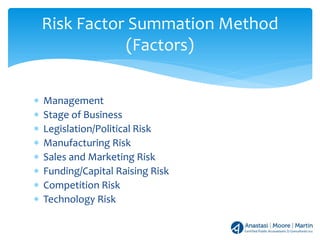
Risk Factor Summation Method
โˆ— Management
โˆ— Stage of Business
โˆ— Legislation/Political Risk
โˆ— Manufacturing Risk
โˆ— Sales and Marketing Risk
โˆ— Funding/Capital Raising Risk
โˆ— Competition Risk
โˆ— Technology Risk
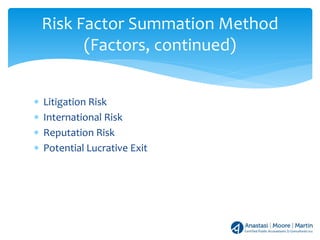
Risk Factor Summation Method
(Factors)
โˆ— Litigation Risk
โˆ— International Risk
โˆ— Reputation Risk
โˆ— Potential Lucrative Exit
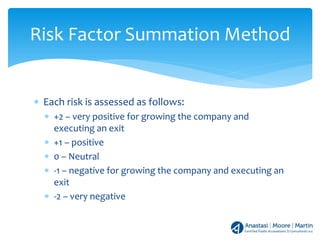
Risk Factor Summation Method
(Factors, continued)
โˆ— Each risk is assessed as follows:
โˆ— +2 โ€“ very positive for growing the company and
executing an exit
โˆ— +1 โ€“ positive
โˆ— 0 โ€“ Neutral
โˆ— -1 โ€“ negative for growing the company and executing an
exit
โˆ— -2 โ€“ very negative
Risk Factor Summation Method
Agreements
โˆ— Buy-Sell Agreements
โˆ— Shareholder Agreements
โˆ— Operating Agreements, Limited Partnership
Agreements, Partnership Agreements
Type of Agreements
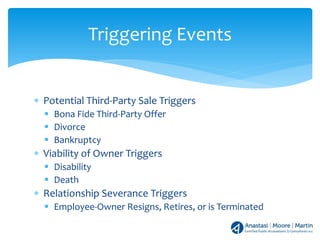
โˆ— Potential Third-Party Sale Triggers
๏‚ง Bona Fide Third-Party Offer
๏‚ง Divorce
๏‚ง Bankruptcy
โˆ— Viability of Owner Triggers
๏‚ง Disability
๏‚ง Death
โˆ— Relationship Severance Triggers
๏‚ง Employee-Owner Resigns, Retires, or is Terminated
Triggering Events
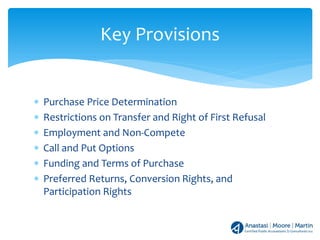
โˆ— Purchase Price Determination
โˆ— Restrictions on Transfer and Right of First Refusal
โˆ— Employment and Non-Compete
โˆ— Call and Put Options
โˆ— Funding and Terms of Purchase
โˆ— Preferred Returns, Conversion Rights, and
Participation Rights
Key Provisions
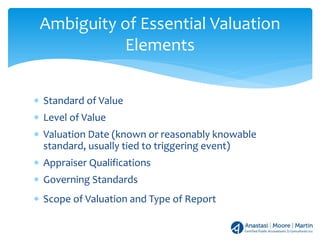
โˆ— Standard of Value
โˆ— Level of Value
โˆ— Valuation Date (known or reasonably knowable
standard, usually tied to triggering event)
โˆ— Appraiser Qualifications
โˆ— Governing Standards
โˆ— Scope of Valuation and Type of Report
Ambiguity of Essential Valuation
Elements
Phone: 509-323-0272
Email:
โˆ— Scott H. Martin - smartin@am-cpas.com
โˆ— Mackenzie Marrโ€“ mmarr@am-cpas.com
Thank you!
Questions?
Scan the code below to attend our
next event!

Startup Advisor Lunch & Learn Slide Deck

  • 1.
    WEBSITE: SP3NW.ORG SOCIALS: @SP3NW EMAIL:INFO@SP3NW.ORG WEBSITE: AM-CPAS.COM EMAIL: SMARTIN@AM-CPAS.COM
  • 2.
    Valuing Early-Stage Companies andAgreements Your Startup Advisory Board May 26, 2022 Presented by Scott H. Martin, CPA/ABV, ASA Mackenzie Marr, CPA
  • 3.
    โˆ— Fair MarketValue โ€“ Willing buyer, willing seller, both having knowledge of all relevant facts and neither being under any compulsion to buy or sell. Revenue Ruling 59-60. โˆ— Investment Value โ€“ The value of a business to a particular buyer based upon a return on investment analysis and the unique circumstances of the transaction. โˆ— Fair Value โ€“ The Uniform Business Corporation Act โ€“ โ€œFair Value,โ€ with respect to a dissenterโ€™s shares, means the value of the shares immediately before the effectuation of the corporate action to which the dissenter objects, excluding any appreciation or depreciation in anticipation of the corporate action unless exclusion would be inequitable. Value Definitions
  • 4.
  • 5.
    โˆ— A generalway of determining a value indication of a business, business ownership interest, or security using one or more methods based on the value of the assets net of liabilities. Asset Approach
  • 6.
    โˆ— A generalway of determining a value indication of a business, business ownership interest, security, or intangible asset using one or more methods that convert anticipated economic benefits into a present single amount. Income Approach
  • 7.
    โˆ— Capitalization ofNet Cash Flow Method โˆ— Capitalization of Earnings Method โˆ— Discounted Cash Flow Method โˆ— Capitalization of Excess Earnings Method Income Approach Methods
  • 8.
    โˆ— A generalway of determining a value indication of a business, business ownership interest, security, or intangible asset using one or more methods that compare the subject company to similar businesses, business ownership interest, securities, or intangible assets that have been sold. Market Approach
  • 9.
    โˆ— Guideline CompanyMethod โˆ— Merger and Acquisition Method โˆ— Prior Transactions โˆ— Rules of Thumb Market Approach Methods
  • 10.
    โˆ— Use morethan one approach โ€“ no single method may be useful every time. โˆ— No valuation at all โ€“ convertible debt deals. โˆ— Four approaches: โˆ— Venture Capital Method โˆ— Berkus Method โˆ— Scorecard Valuation Method โˆ— Risk Factor Summation Method Early Stage Companies
  • 11.
    โˆ— Value isbased on expected rates of return at exit. โˆ— Return on Investment (ROI) = Terminal Value / Post- Money Valuation โˆ— Post-Money Valuation = Terminal Value / Anticipated ROI. โˆ— Assumes only one round. If multiple rounds, reduce the pre-money valuation by the estimated level of dilution from later investors. Venture Capital Method
  • 12.
    โˆ— Attributes arange of dollar values to the progress startup companies have made towards a commercial market. โˆ— Each Attribute is worth $500,000 for a Company that has the potential to reach $20 million in revenue in five years: โˆ— Sound Idea (basic value, product risk) โˆ— Prototype (reducing technology risk) โˆ— Quality Management Team (reducing execution risk) โˆ— Strategic Relationships (reducing market and competitive risk) โˆ— Product Rollout or Sales (reducing financial or production risk) Berkus Method
  • 13.
    โˆ— Adjusts themedian pre-money valuation for seed/startup deals in a particular region and in the business vertical of the target based on seven characteristics of the company. Scorecard Valuation Method
  • 14.
    โˆ— Compare thetarget company to similar deals in the regions considering the following factors: โˆ— Strength of the Management Team โ€“ 0%- 30% โˆ— Size of the Opportunity โ€“ 0% - 25% โˆ— Product/Technology โ€“ 0% - 15% โˆ— Competitive Environment โ€“ 0% - 10% โˆ— Marketing/Sales Channels/Partnerships โ€“ 0% - 10% โˆ— Need for Additional Investment โ€“ 0% - 5% โˆ— Other โ€“ 0% - 5% NOTE: Total must equal 100% Scorecard Valuation Method
  • 15.
    โˆ— Compares 12characteristics of the target company to what might be expected in a fundable seed/startup company. โˆ— Adjusts the average pre-money valuation of pre- revenue companies in the region. Risk Factor Summation Method
  • 16.
    โˆ— Management โˆ— Stageof Business โˆ— Legislation/Political Risk โˆ— Manufacturing Risk โˆ— Sales and Marketing Risk โˆ— Funding/Capital Raising Risk โˆ— Competition Risk โˆ— Technology Risk Risk Factor Summation Method (Factors)
  • 17.
    โˆ— Litigation Risk โˆ—International Risk โˆ— Reputation Risk โˆ— Potential Lucrative Exit Risk Factor Summation Method (Factors, continued)
  • 18.
    โˆ— Each riskis assessed as follows: โˆ— +2 โ€“ very positive for growing the company and executing an exit โˆ— +1 โ€“ positive โˆ— 0 โ€“ Neutral โˆ— -1 โ€“ negative for growing the company and executing an exit โˆ— -2 โ€“ very negative Risk Factor Summation Method
  • 19.
  • 20.
    โˆ— Buy-Sell Agreements โˆ—Shareholder Agreements โˆ— Operating Agreements, Limited Partnership Agreements, Partnership Agreements Type of Agreements
  • 21.
    โˆ— Potential Third-PartySale Triggers ๏‚ง Bona Fide Third-Party Offer ๏‚ง Divorce ๏‚ง Bankruptcy โˆ— Viability of Owner Triggers ๏‚ง Disability ๏‚ง Death โˆ— Relationship Severance Triggers ๏‚ง Employee-Owner Resigns, Retires, or is Terminated Triggering Events
  • 22.
    โˆ— Purchase PriceDetermination โˆ— Restrictions on Transfer and Right of First Refusal โˆ— Employment and Non-Compete โˆ— Call and Put Options โˆ— Funding and Terms of Purchase โˆ— Preferred Returns, Conversion Rights, and Participation Rights Key Provisions
  • 23.
    โˆ— Standard ofValue โˆ— Level of Value โˆ— Valuation Date (known or reasonably knowable standard, usually tied to triggering event) โˆ— Appraiser Qualifications โˆ— Governing Standards โˆ— Scope of Valuation and Type of Report Ambiguity of Essential Valuation Elements
  • 24.
    Phone: 509-323-0272 Email: โˆ— ScottH. Martin - smartin@am-cpas.com โˆ— Mackenzie Marrโ€“ mmarr@am-cpas.com Thank you! Questions?
  • 25.
    Scan the codebelow to attend our next event!