Valuing Early-Stage, Knowledge-based/ 
Tech Companies 
September 18, 2014 
Gregory Phipps – Managing Director, Investment
2 
The Challenge 
• Valuation mix of (black) art & science 
• In start-up/early-stage, valuation exercise more art than science, 
with heavy dose of negotiation thrown in by the investment source 
(VC’s, angels, etc.) 
• Valuation may be used for both negotiated “price” for equity 
investment purposes, Founder/Partner buy-out scenarios (more 
common than you think), marital dissolutions, and third-party 
acquisitions 
• Absence of historic, or (often) accurate means to predict future 
revenues and cash flow, makes it virtually impossible to use 
traditional models like DCF – used frequently by CBV’s 
• How do we do it then?
3 
Alternative Methods 
 Venture Capital Method 
 First Chicago Method 
 Berkus Method 
 Scorecard Method 
 Comparables 
 Negotiation 
 WAG
4 
Venture Capital Method (Bill Sahlman, Harvard) 
 If we know the value of something in the future and we know 
what kind of ROI we need to induce us to make an 
investment, then we figure out its “present value” to us. 
 Present value = valuation 
 Incorporates some elements of DCF insomuch that we apply 
risk premium (expressed as return/discount/hurdle rate), and 
are determining PV, but it is based on future terminal value 
rather than cash flows 
 No time/value of money considered
5 
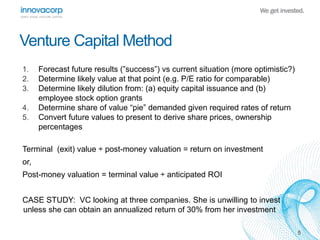
Venture Capital Method 
1. Forecast future results (”success”) vs current situation (more optimistic?) 
2. Determine likely value at that point (e.g. P/E ratio for comparable) 
3. Determine likely dilution from: (a) equity capital issuance and (b) 
employee stock option grants 
4. Determine share of value “pie” demanded given required rates of return 
5. Convert future values to present to derive share prices, ownership 
percentages 
Terminal (exit) value ÷ post-money valuation = return on investment 
or, 
Post-money valuation = terminal value ÷ anticipated ROI 
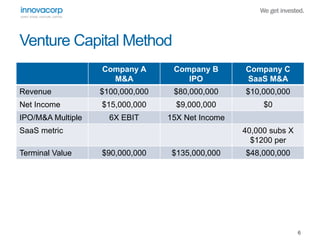
CASE STUDY: VC looking at three companies. She is unwilling to invest 
unless she can obtain an annualized return of 30% from her investment
Company A 
M&A 
Company B 
IPO 
Company C 
SaaS M&A 
Revenue $100,000,000 $80,000,000 $10,000,000 
Net Income $15,000,000 $9,000,000 $0 
IPO/M&A Multiple 6X EBIT 15X Net Income 
SaaS metric 40,000 subs X 
$1200 per 
Terminal Value $90,000,000 $135,000,000 $48,000,000 
6 
Venture Capital Method
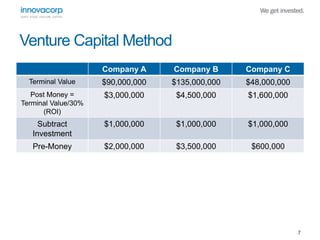
Company A Company B Company C 
Terminal Value $90,000,000 $135,000,000 $48,000,000 
Post Money = 
Terminal Value/30% 
(ROI) 
$3,000,000 $4,500,000 $1,600,000 
Subtract 
Investment 
$1,000,000 $1,000,000 $1,000,000 
Pre-Money $2,000,000 $3,500,000 $600,000 
7 
Venture Capital Method
8 
Venture Capital Method 
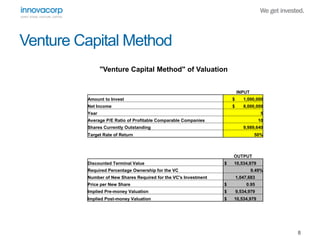
"Venture Capital Method" of Valuation 
INPUT 
Amount to Invest $ 1,000,000 
Net Income $ 8,000,000 
Year 5 
Average P/E Ratio of Profitable Comparable Companies 10 
Shares Currently Outstanding 9,989,640 
Target Rate of Return 50% 
OUTPUT 
Discounted Terminal Value $ 10,534,979 
Required Percentage Ownership for the VC 9.49% 
Number of New Shares Required for the VC's Investment 1,047,683 
Price per New Share $ 0.95 
Implied Pre-money Valuation $ 9,534,979 
Implied Post-money Valuation $ 10,534,979
9 
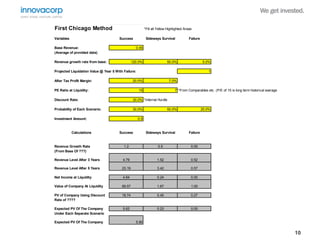
First Chicago Method 
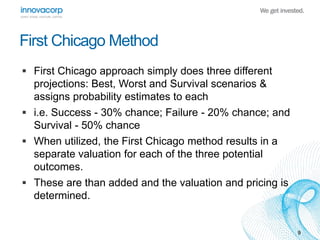
 First Chicago approach simply does three different 
projections: Best, Worst and Survival scenarios & 
assigns probability estimates to each 
 i.e. Success - 30% chance; Failure - 20% chance; and 
Survival - 50% chance 
 When utilized, the First Chicago method results in a 
separate valuation for each of the three potential 
outcomes. 
 These are than added and the valuation and pricing is 
determined.
10 
First Chicago Method *Fill all Yellow Highlighted Areas 
Variables Success Sideways Survival Failure 
Base Revenue: 0.45 
(Average of provided data) 
Revenue growth rate from base: 120.0% 50.0% 5.0% 
Projected Liquidation Value @ Year 5 With Failure: 1 
After Tax Profit Margin: 20.0% 7.0% 
PE Ratio at Liquidity: 15 7 *From Comparables etc. (P/E of 15 is long term historical average) 
Discount Rate: 30.0% *Internal Hurdle 
Probability of Each Scenario: 30.0% 50.0% 20.0% 
Investment Amount: 0.5 
Calculations Success Sideways Survival Failure 
Revenue Growth Rate 1.2 0.5 0.05 
(From Base Of ???) 
Revenue Level After 3 Years 4.79 1.52 0.52 
Revenue Level After 5 Years 23.19 3.42 0.57 
Net Income at Liquidity 4.64 0.24 0.00 
Value of Company At Liquidity 69.57 1.67 1.00 
PV of Company Using Discount 18.74 0.45 0.27 
Rate of ???? 
Expected PV Of The Company 5.62 0.23 0.05 
Under Each Separate Scenario 
Expected PV Of The Company 5.90
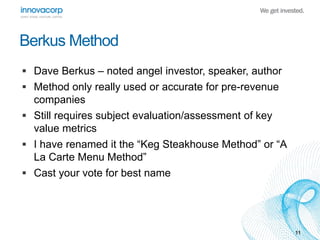
BerkusMethod 
 Dave Berkus – noted angel investor, speaker, author 
 Method only really used or accurate for pre-revenue 
companies 
 Still requires subject evaluation/assessment of key 
value metrics 
 I have renamed it the “Keg Steakhouse Method” or “A 
La Carte Menu Method” 
 Cast your vote for best name 
11
12 
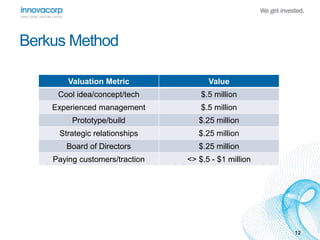
BerkusMethod 
Valuation Metric Value 
Cool idea/concept/tech $.5 million 
Experienced management $.5 million 
Prototype/build $.25 million 
Strategic relationships $.25 million 
Board of Directors $.25 million 
Paying customers/traction <> $.5 - $1 million
13 
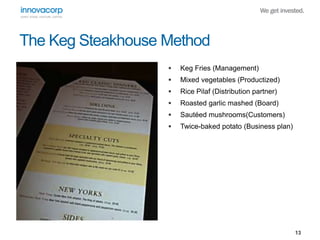
The Keg Steakhouse Method 
 Keg Fries (Management) 
 Mixed vegetables (Productized) 
 Rice Pilaf (Distribution partner) 
 Roasted garlic mashed (Board) 
 Sautéed mushrooms(Customers) 
 Twice-baked potato (Business plan)
 Not really a “valuation method” in itself 
 Ranks various factors consider predictors of entrepreneurial success 
 Somewhat subjective but balanced on the whole 
 Best for comparing a number of companies against each other, by 
type, or by region 
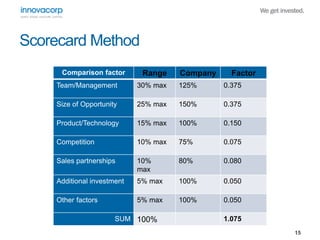
 Company with an avg. product/technology (100% of norm), a strong 
team (125% of norm) and a large market opportunity (150% of norm). 
The company can get to positive cash flow with a single angel round of 
investment (100% of norm). Looking at the strength of the competition 
in the market, the target is weaker (75% of norm) but early customer 
feedback on the product is excellent (Other = 100%). The company 
needs some additional work on building sales channels and 
partnerships (80% of norm). 
 Using this data, we can complete the following calculation: 
14 
Scorecard Method
15 
Scorecard Method 
Comparison factor Range Company Factor 
Team/Management 30% max 125% 0.375 
Size of Opportunity 25% max 150% 0.375 
Product/Technology 15% max 100% 0.150 
Competition 10% max 75% 0.075 
Sales partnerships 10% 
max 
80% 0.080 
Additional investment 5% max 100% 0.050 
Other factors 5% max 100% 0.050 
SUM 100% 1.075
Comparables 
 Accurate, reasonable approach to valuation, in the 
absence of, or willingness, to apply other valuation 
methods 
 Court tested? 
 Simply research valuations, of similar companies who 
have raised equity capital, at same stage, in same 
region 
 Regional “pricing” applies. Valuations in Canada are 
NOT the same as Silicon Valley 
 We use DowJones “VentureSource” and “PitchBook” to 
research comparable valuations as reported in VC deals 
16
17 
Negotiation 
 Used more often than not. 
 Follows traditional, age-old premise of “value”: “what a 
willing seller and a willing buyer agree upon” 
 Can be considered a reasonable foundation value 
(starting point), on which to apply future/next valuation 
exercises 
 Probably hard to argue against, retroactively, in 
legal/court-related testimony of valuation unless one can 
prove duress
18 
Wild Ass Guess
Bonus: Venture Capital Math 
 $1 million at a $3 million pre-money valuation leading to a $4 million post money 
valuation. 
 The math works out that the investor owns 25% of the company post deal ($1 million 
invested / $4 million valuation) and assuming 1 million shares, each share would be 
valued at $3 / share ($3,000,000 pre-money / 1 million shares = $3/share). 
 Investors own 25%, the founders own 75%. 
 But…… ESOP complicates it, and impacts price/share 
 Assuming a 15% option pool post funding then you need a 20% option pool pre 
funding (because the pool gets diluted by 25% also when the VC invests their 
money). So your 100% of the company is down to 80% even before VC funding. 
 The VC’s $1 million still buys them 25% of your company – it’s you who has diluted 
to 60% ownership rather than 75%. 
 The price / share is actually $2.40 (not $3.00), which is $3,000,000 pre-money / 
1,250,000 shares (because you had to create the 250,000 share options). Thus the 
“true” pre-money is only $2.4 million (and not $3 million) because $2.40 per share * 
1 million pre-money outstanding shards = $2.4 million 
19

Valuation models for early-stage knowledge-based/technology companies

  • 1.
    Valuing Early-Stage, Knowledge-based/ Tech Companies September 18, 2014 Gregory Phipps – Managing Director, Investment
  • 2.
    2 The Challenge • Valuation mix of (black) art & science • In start-up/early-stage, valuation exercise more art than science, with heavy dose of negotiation thrown in by the investment source (VC’s, angels, etc.) • Valuation may be used for both negotiated “price” for equity investment purposes, Founder/Partner buy-out scenarios (more common than you think), marital dissolutions, and third-party acquisitions • Absence of historic, or (often) accurate means to predict future revenues and cash flow, makes it virtually impossible to use traditional models like DCF – used frequently by CBV’s • How do we do it then?
  • 3.
    3 Alternative Methods  Venture Capital Method  First Chicago Method  Berkus Method  Scorecard Method  Comparables  Negotiation  WAG
  • 4.
    4 Venture CapitalMethod (Bill Sahlman, Harvard)  If we know the value of something in the future and we know what kind of ROI we need to induce us to make an investment, then we figure out its “present value” to us.  Present value = valuation  Incorporates some elements of DCF insomuch that we apply risk premium (expressed as return/discount/hurdle rate), and are determining PV, but it is based on future terminal value rather than cash flows  No time/value of money considered
  • 5.
    5 Venture CapitalMethod 1. Forecast future results (”success”) vs current situation (more optimistic?) 2. Determine likely value at that point (e.g. P/E ratio for comparable) 3. Determine likely dilution from: (a) equity capital issuance and (b) employee stock option grants 4. Determine share of value “pie” demanded given required rates of return 5. Convert future values to present to derive share prices, ownership percentages Terminal (exit) value ÷ post-money valuation = return on investment or, Post-money valuation = terminal value ÷ anticipated ROI CASE STUDY: VC looking at three companies. She is unwilling to invest unless she can obtain an annualized return of 30% from her investment
  • 6.
    Company A M&A Company B IPO Company C SaaS M&A Revenue $100,000,000 $80,000,000 $10,000,000 Net Income $15,000,000 $9,000,000 $0 IPO/M&A Multiple 6X EBIT 15X Net Income SaaS metric 40,000 subs X $1200 per Terminal Value $90,000,000 $135,000,000 $48,000,000 6 Venture Capital Method
  • 7.
    Company A CompanyB Company C Terminal Value $90,000,000 $135,000,000 $48,000,000 Post Money = Terminal Value/30% (ROI) $3,000,000 $4,500,000 $1,600,000 Subtract Investment $1,000,000 $1,000,000 $1,000,000 Pre-Money $2,000,000 $3,500,000 $600,000 7 Venture Capital Method
  • 8.
    8 Venture CapitalMethod "Venture Capital Method" of Valuation INPUT Amount to Invest $ 1,000,000 Net Income $ 8,000,000 Year 5 Average P/E Ratio of Profitable Comparable Companies 10 Shares Currently Outstanding 9,989,640 Target Rate of Return 50% OUTPUT Discounted Terminal Value $ 10,534,979 Required Percentage Ownership for the VC 9.49% Number of New Shares Required for the VC's Investment 1,047,683 Price per New Share $ 0.95 Implied Pre-money Valuation $ 9,534,979 Implied Post-money Valuation $ 10,534,979
  • 9.
    9 First ChicagoMethod  First Chicago approach simply does three different projections: Best, Worst and Survival scenarios & assigns probability estimates to each  i.e. Success - 30% chance; Failure - 20% chance; and Survival - 50% chance  When utilized, the First Chicago method results in a separate valuation for each of the three potential outcomes.  These are than added and the valuation and pricing is determined.
  • 10.
    10 First ChicagoMethod *Fill all Yellow Highlighted Areas Variables Success Sideways Survival Failure Base Revenue: 0.45 (Average of provided data) Revenue growth rate from base: 120.0% 50.0% 5.0% Projected Liquidation Value @ Year 5 With Failure: 1 After Tax Profit Margin: 20.0% 7.0% PE Ratio at Liquidity: 15 7 *From Comparables etc. (P/E of 15 is long term historical average) Discount Rate: 30.0% *Internal Hurdle Probability of Each Scenario: 30.0% 50.0% 20.0% Investment Amount: 0.5 Calculations Success Sideways Survival Failure Revenue Growth Rate 1.2 0.5 0.05 (From Base Of ???) Revenue Level After 3 Years 4.79 1.52 0.52 Revenue Level After 5 Years 23.19 3.42 0.57 Net Income at Liquidity 4.64 0.24 0.00 Value of Company At Liquidity 69.57 1.67 1.00 PV of Company Using Discount 18.74 0.45 0.27 Rate of ???? Expected PV Of The Company 5.62 0.23 0.05 Under Each Separate Scenario Expected PV Of The Company 5.90
  • 11.
    BerkusMethod  DaveBerkus – noted angel investor, speaker, author  Method only really used or accurate for pre-revenue companies  Still requires subject evaluation/assessment of key value metrics  I have renamed it the “Keg Steakhouse Method” or “A La Carte Menu Method”  Cast your vote for best name 11
  • 12.
    12 BerkusMethod ValuationMetric Value Cool idea/concept/tech $.5 million Experienced management $.5 million Prototype/build $.25 million Strategic relationships $.25 million Board of Directors $.25 million Paying customers/traction <> $.5 - $1 million
  • 13.
    13 The KegSteakhouse Method  Keg Fries (Management)  Mixed vegetables (Productized)  Rice Pilaf (Distribution partner)  Roasted garlic mashed (Board)  Sautéed mushrooms(Customers)  Twice-baked potato (Business plan)
  • 14.
     Not reallya “valuation method” in itself  Ranks various factors consider predictors of entrepreneurial success  Somewhat subjective but balanced on the whole  Best for comparing a number of companies against each other, by type, or by region  Company with an avg. product/technology (100% of norm), a strong team (125% of norm) and a large market opportunity (150% of norm). The company can get to positive cash flow with a single angel round of investment (100% of norm). Looking at the strength of the competition in the market, the target is weaker (75% of norm) but early customer feedback on the product is excellent (Other = 100%). The company needs some additional work on building sales channels and partnerships (80% of norm).  Using this data, we can complete the following calculation: 14 Scorecard Method
  • 15.
    15 Scorecard Method Comparison factor Range Company Factor Team/Management 30% max 125% 0.375 Size of Opportunity 25% max 150% 0.375 Product/Technology 15% max 100% 0.150 Competition 10% max 75% 0.075 Sales partnerships 10% max 80% 0.080 Additional investment 5% max 100% 0.050 Other factors 5% max 100% 0.050 SUM 100% 1.075
  • 16.
    Comparables  Accurate,reasonable approach to valuation, in the absence of, or willingness, to apply other valuation methods  Court tested?  Simply research valuations, of similar companies who have raised equity capital, at same stage, in same region  Regional “pricing” applies. Valuations in Canada are NOT the same as Silicon Valley  We use DowJones “VentureSource” and “PitchBook” to research comparable valuations as reported in VC deals 16
  • 17.
    17 Negotiation Used more often than not.  Follows traditional, age-old premise of “value”: “what a willing seller and a willing buyer agree upon”  Can be considered a reasonable foundation value (starting point), on which to apply future/next valuation exercises  Probably hard to argue against, retroactively, in legal/court-related testimony of valuation unless one can prove duress
  • 18.
  • 19.
    Bonus: Venture CapitalMath  $1 million at a $3 million pre-money valuation leading to a $4 million post money valuation.  The math works out that the investor owns 25% of the company post deal ($1 million invested / $4 million valuation) and assuming 1 million shares, each share would be valued at $3 / share ($3,000,000 pre-money / 1 million shares = $3/share).  Investors own 25%, the founders own 75%.  But…… ESOP complicates it, and impacts price/share  Assuming a 15% option pool post funding then you need a 20% option pool pre funding (because the pool gets diluted by 25% also when the VC invests their money). So your 100% of the company is down to 80% even before VC funding.  The VC’s $1 million still buys them 25% of your company – it’s you who has diluted to 60% ownership rather than 75%.  The price / share is actually $2.40 (not $3.00), which is $3,000,000 pre-money / 1,250,000 shares (because you had to create the 250,000 share options). Thus the “true” pre-money is only $2.4 million (and not $3 million) because $2.40 per share * 1 million pre-money outstanding shards = $2.4 million 19