Start-up ValuationMethods
A compilationof allthearticlesandsourcesI havefoundusefulto value
early stage(including pre-revenue)startups.
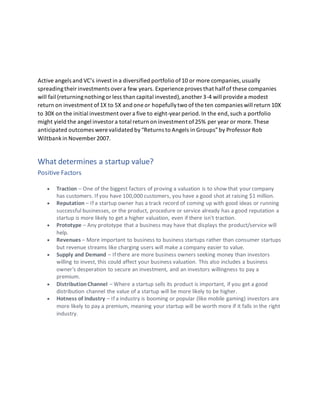
Active angels and VC’s invest in a diversified portfolio of10 or more companies,usually
spreadingtheir investments over a few years. Experience proves that halfof these companies
will fail (returningnothingor less than capital invested),another 3-4 will provide a modest
return on investment of1X to 5X and one or hopefullytwo of the ten companies will return 10X
to 30X on the initial investment over a five to eight-year period.In the end,such a portfolio
might yield the angel investor a total return on investment of25% per year or more. These
anticipated outcomes were validated by“Returns to Angels in Groups”by Professor Rob
Wiltbankin November 2007.
What determines a startup value?
Positive Factors
• Traction – One of the biggest factors of proving a valuation is to show that your company
has customers. If you have 100,000 customers, you have a good shot at raising $1 million.
• Reputation – If a startup owner has a track record of coming up with good ideas or running
successful businesses, or the product, procedure or service already has a good reputation a
startup is more likely to get a higher valuation, even if there isn't traction.
• Prototype – Any prototype that a business may have that displays the product/service will
help.
• Revenues – More important to business to business startups rather than consumer startups
but revenue streams like charging users will make a company easier to value.
• Supply and Demand – If there are more business owners seeking money than investors
willing to invest, this could affect your business valuation. This also includes a business
owner's desperation to secure an investment, and an investors willingness to pay a
premium.
• DistributionChannel – Where a startup sells its product is important, if you get a good
distribution channel the value of a startup will be more likely to be higher.
• Hotness of Industry – If a industry is booming or popular (like mobile gaming) investors are
more likely to pay a premium, meaning your startup will be worth more if it falls in the right
industry.
Negative Factors
• Poor Industry – If a startup is in an industry that has recently shown poor performance or
may be dying off.
• Low Margins – Some startups will be in industries, or sell products that have low-margins,
making an investment less desirable.
• Competition – Some industry sectors have a lot of competition, or other business that have
cornered the market. A startup that might be competing in this situation is likely to put off
investors.
• Management Not Up to Scratch – If the management team of a startup has no track record
or reputation, or key positions are missing.
• Product – If the product doesn't work or has no traction and doesn't seem to be popular or
a good idea.
• Desperation – If the business owner is seeking investment because they are close to
running out of cash.
1) Venture Capital Method
The Venture Capital Method (VC Method) is one of the methods for showing the pre-money
valuation of pre-revenue startups. The concept was first described by Professor Bill Sahlman at
Harvard Business School in 1987.
It uses the following formulas:
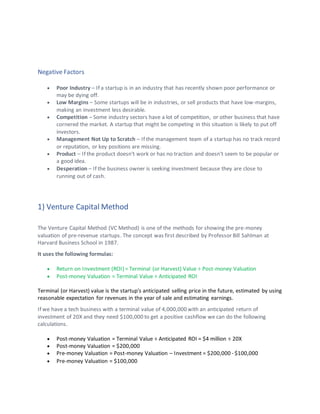
• Return on Investment (ROI) = Terminal (or Harvest) Value ÷ Post-money Valuation
• Post-money Valuation = Terminal Value ÷ Anticipated ROI
Terminal (or Harvest) value is the startup's anticipated selling price in the future, estimated by using
reasonable expectation for revenues in the year of sale and estimating earnings.
If we have a tech business with a terminal value of 4,000,000 with an anticipated return of
investment of 20X and they need $100,000 to get a positive cashflow we can do the following
calculations.
• Post-money Valuation = Terminal Value ÷ Anticipated ROI = $4 million ÷ 20X
• Post-money Valuation = $200,000
• Pre-money Valuation = Post-money Valuation – Investment = $200,000 - $100,000
• Pre-money Valuation = $100,000
2) Berkus Method
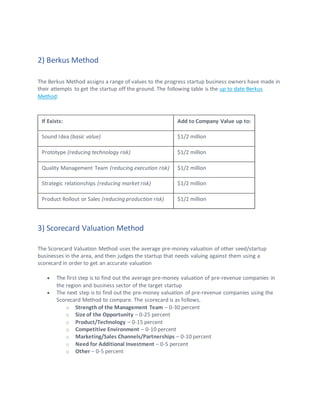
The Berkus Method assigns a range of values to the progress startup business owners have made in
their attempts to get the startup off the ground. The following table is the up to date Berkus
Method:
If Exists: Add to Company Value up to:
Sound Idea (basic value) $1/2 million
Prototype (reducing technology risk) $1/2 million
Quality Management Team (reducing execution risk) $1/2 million
Strategic relationships (reducing market risk) $1/2 million
Product Rollout or Sales (reducing production risk) $1/2 million
3) Scorecard Valuation Method
The Scorecard Valuation Method uses the average pre-money valuation of other seed/startup
businesses in the area, and then judges the startup that needs valuing against them using a
scorecard in order to get an accurate valuation
• The first step is to find out the average pre-money valuation of pre-revenue companies in
the region and business sector of the target startup
• The next step is to find out the pre-money valuation of pre-revenue companies using the
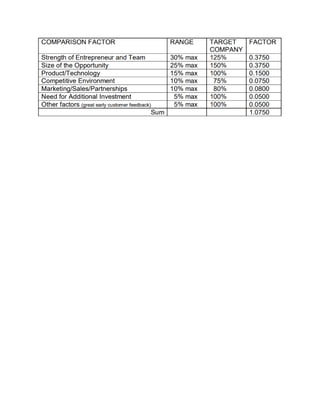
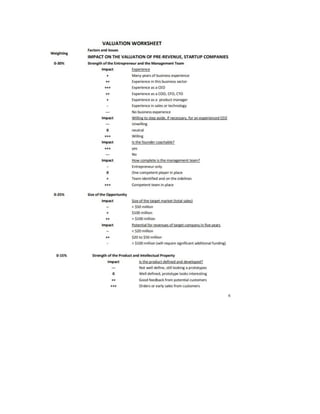
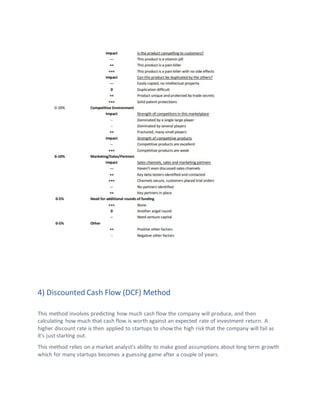
Scorecard Method to compare. The scorecard is as follows,
o Strength of the Management Team – 0-30 percent
o Size of the Opportunity – 0-25 percent
o Product/Technology – 0-15 percent
o Competitive Environment – 0-10 percent
o Marketing/Sales Channels/Partnerships – 0-10 percent
o Need for Additional Investment – 0-5 percent
o Other – 0-5 percent
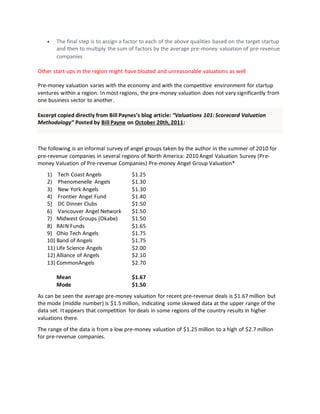
• The final step is to assign a factor to each of the above qualities based on the target startup
and then to multiply the sum of factors by the average pre-money valuation of pre-revenue
companies
Other start-ups in the region might have bloated and unreasonable valuations as well
Pre-money valuation varies with the economy and with the competitive environment for startup
ventures within a region. In most regions, the pre-money valuation does not vary significantly from
one business sector to another.
Excerpt copied directly from Bill Paynes’s blog article: “Valuations 101:Scorecard Valuation
Methodology” Posted by Bill Payne on October 20th, 2011:
The following is an informal survey of angel groups taken by the author in the summer of 2010 for
pre-revenue companies in several regions of North America: 2010 Angel Valuation Survey (Pre-
money Valuation of Pre-revenue Companies) Pre-money Angel Group Valuation*
1) Tech Coast Angels $1.25
2) Phenomenelle Angels $1.30
3) New York Angels $1.30
4) Frontier Angel Fund $1.40
5) DC Dinner Clubs $1.50
6) Vancouver Angel Network $1.50
7) Midwest Groups (Okabe) $1.50
8) RAIN Funds $1.65
9) Ohio Tech Angels $1.75
10) Band of Angels $1.75
11) Life Science Angels $2.00
12) Alliance of Angels $2.10
13) CommonAngels $2.70
Mean $1.67
Mode $1.50
As can be seen the average pre-money valuation for recent pre-revenue deals is $1.67 million but
the mode (middle number) is $1.5 million, indicating some skewed data at the upper range of the
data set. Itappears that competition for deals in some regions of the country results in higher
valuations there.
The range of the data is from a low pre-money valuation of $1.25 million to a high of $2.7 million
for pre-revenue companies.
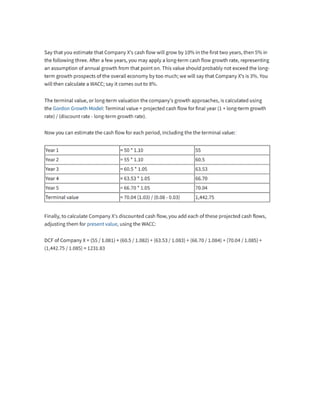
4) Discounted Cash Flow (DCF) Method
This method involves predicting how much cash flow the company will produce, and then
calculating how much that cash flow is worth against an expected rate of investment return. A
higher discount rate is then applied to startups to show the high risk that the company will fail as
it's just starting out.
This method relies on a market analyst's ability to make good assumptions about long term growth
which for many startups becomes a guessing game after a couple of years.
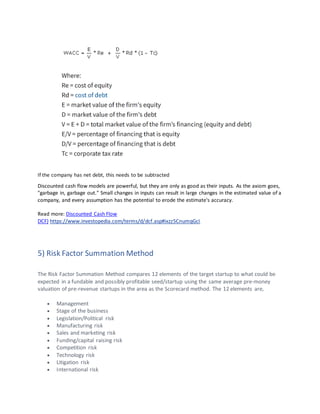
If the company has net debt, this needs to be subtracted
Discounted cash flow models are powerful, but they are only as good as their inputs. As the axiom goes,
"garbage in, garbage out." Small changes in inputs can result in large changes in the estimated value of a
company, and every assumption has the potential to erode the estimate's accuracy.
Read more: Discounted Cash Flow
DCF) https://www.investopedia.com/terms/d/dcf.asp#ixzz5CnumqGcI
5) Risk Factor Summation Method
The Risk Factor Summation Method compares 12 elements of the target startup to what could be
expected in a fundable and possibly profitable seed/startup using the same average pre-money
valuation of pre-revenue startups in the area as the Scorecard method. The 12 elements are,
• Management
• Stage of the business
• Legislation/Political risk
• Manufacturing risk
• Sales and marketing risk
• Funding/capital raising risk
• Competition risk
• Technology risk
• Litigation risk
• International risk
• Reputation risk
• Potential lucrative exit
Each element is assessed as follows:
• +2 - very positive for growing the company and executing a wonderful exit
• +1 - positive
• 0 - neutral
• -1 - negative for growing the company and executing a wonderful exit
• -2 - very negative
The average pre-money valuation of pre-revenue companies in your region is then adjusted
positively by $250,000 for every +1 (+$500K for a +2) and negatively by $250,000 for every -1 (-
$500K for a -2).
6) Cost-to-Duplicate Method
This approach involves looking at the hard assets of a startup and working out how much it would
cost to replicate the same startup business somewhere else. The idea is that an investor wouldn't
invest more than it would cost to duplicate the business.
For example, if you wanted to find the cost-to-duplicate a software business, you would look at the
labor cost for programmers and the amount of programming time that has been used to design the
software.
The big problem with this method is that it doesn't include the future potential of the startup or
intangible assets like brand value, reputation or hotness of the market.
With this is in mind, the cash-to-duplicate method is often used as a 'lowball' estimate of company
value
7) Valuation by Stage
The valuation by stage method is often used by angel investors and venture capital firms to come
up with a quick range of startup valuation.
This method uses the various stages of funding to decide how much risk is still present with
investing in a startup. The further along a business is along the stages of funding the less the
present risk. A valuation-by-stage model might look something like this:
• Estimated Company Value Stage of Development $250,000 - $500,000
• Has an exciting business idea or business plan $500,000 - $1 million
• Has a strong management team in place to execute on the plan $1 million – $2 million
• Has a final product or technology prototype $2 million – $5 million
• Has strategic alliances or partners, or signs of a customer base $5 million and up
Startups with just a business plan will receive a small valuation, but that will increase as they meet
developmental milestones.
8) Comparable Method
This method is to literally look at the implied valuations of other similar startups, factoring in other
ratios and multipliers for things that may not be similar between the two businesses.
For example, if Startup A is acquired for $7,500,000, and its website had 250,000 active users, you
can estimate a valuation between the price of the startup and the number of users, which is
$30/user.
Startup B might have 125,000 users which would then allow it to use the same multiple of $30/user
to reach a valuation of $3,750,000
9) The Book Value Method
This method is based solely on the net worth of the company. i.e. the tangible assets of the
company.
This doesn't take into account any form of growth or revenue and is usually only applied when a
startup is going out of business.
10) First Chicago Method
This method factors in the possibility of a startup really taking off, or really going badly. To do this it
gives business owner three different valuations
• Worst case scenario
• Normal case scenario
• Best case scenario
The First Chicago Method takes account of payouts to the holder of specific investments in a
company through the holding period under various scenarios. Most often this methodology will
involve the construction of:
• An "upside case" or "best-case scenario" (often, the business plan submitted)
• A "base case"
• A "downside" or "worst-casescenario."
Once these have been constructed, the valuation proceeds as follows:
• First, for each of the three cases, a scenario specific, internally consistent forecast of cashflows -
see discussion under Financial modeling - is constructed for the years leading up to the
assumed divestment by the private equity investor.
• Next, a divestment price - i.e. Terminal value - is modelled by assuming an exit
multiple consistent with the scenario in question. (Of course, the divestment may take various
forms - see Investments in private equity under Private equity.)
• The cash flows and exit price are then discounted using the investor’s required return, and the
sum of these is the value of the business under the scenario in question.
• Finally, each of the three scenario-values are multiplied through by a probability corresponding
to each scenario (as estimated by the investor). The value of the investment is then
the probability weighted sum of the three scenarios.
Sources of compiled information:
• UpCounsel https://www.upcounsel.com/startup-valuation-methods
• http://billpayne.com/wp-content/uploads/2011/01/Scorecard-Valuation-Methodology-Jan111.pdf
• https://www.investopedia.com/terms/d/dcf.asp
• https://en.wikipedia.org/wiki/Cost_of_capital
• http://andrewchen.co/how-to-measure-if-users-love-your-product-using-cohorts-and-revisit-rates/
• http://www.perceptualedge.com/articles/guests/intro_to_cycle_plots.pdf

Start up valuation methods

  • 1.
    Start-up ValuationMethods A compilationofallthearticlesandsourcesI havefoundusefulto value early stage(including pre-revenue)startups.
  • 2.
    Active angels andVC’s invest in a diversified portfolio of10 or more companies,usually spreadingtheir investments over a few years. Experience proves that halfof these companies will fail (returningnothingor less than capital invested),another 3-4 will provide a modest return on investment of1X to 5X and one or hopefullytwo of the ten companies will return 10X to 30X on the initial investment over a five to eight-year period.In the end,such a portfolio might yield the angel investor a total return on investment of25% per year or more. These anticipated outcomes were validated by“Returns to Angels in Groups”by Professor Rob Wiltbankin November 2007. What determines a startup value? Positive Factors • Traction – One of the biggest factors of proving a valuation is to show that your company has customers. If you have 100,000 customers, you have a good shot at raising $1 million. • Reputation – If a startup owner has a track record of coming up with good ideas or running successful businesses, or the product, procedure or service already has a good reputation a startup is more likely to get a higher valuation, even if there isn't traction. • Prototype – Any prototype that a business may have that displays the product/service will help. • Revenues – More important to business to business startups rather than consumer startups but revenue streams like charging users will make a company easier to value. • Supply and Demand – If there are more business owners seeking money than investors willing to invest, this could affect your business valuation. This also includes a business owner's desperation to secure an investment, and an investors willingness to pay a premium. • DistributionChannel – Where a startup sells its product is important, if you get a good distribution channel the value of a startup will be more likely to be higher. • Hotness of Industry – If a industry is booming or popular (like mobile gaming) investors are more likely to pay a premium, meaning your startup will be worth more if it falls in the right industry.
  • 3.
    Negative Factors • PoorIndustry – If a startup is in an industry that has recently shown poor performance or may be dying off. • Low Margins – Some startups will be in industries, or sell products that have low-margins, making an investment less desirable. • Competition – Some industry sectors have a lot of competition, or other business that have cornered the market. A startup that might be competing in this situation is likely to put off investors. • Management Not Up to Scratch – If the management team of a startup has no track record or reputation, or key positions are missing. • Product – If the product doesn't work or has no traction and doesn't seem to be popular or a good idea. • Desperation – If the business owner is seeking investment because they are close to running out of cash. 1) Venture Capital Method The Venture Capital Method (VC Method) is one of the methods for showing the pre-money valuation of pre-revenue startups. The concept was first described by Professor Bill Sahlman at Harvard Business School in 1987. It uses the following formulas: • Return on Investment (ROI) = Terminal (or Harvest) Value ÷ Post-money Valuation • Post-money Valuation = Terminal Value ÷ Anticipated ROI Terminal (or Harvest) value is the startup's anticipated selling price in the future, estimated by using reasonable expectation for revenues in the year of sale and estimating earnings. If we have a tech business with a terminal value of 4,000,000 with an anticipated return of investment of 20X and they need $100,000 to get a positive cashflow we can do the following calculations. • Post-money Valuation = Terminal Value ÷ Anticipated ROI = $4 million ÷ 20X • Post-money Valuation = $200,000 • Pre-money Valuation = Post-money Valuation – Investment = $200,000 - $100,000 • Pre-money Valuation = $100,000
  • 4.
    2) Berkus Method TheBerkus Method assigns a range of values to the progress startup business owners have made in their attempts to get the startup off the ground. The following table is the up to date Berkus Method: If Exists: Add to Company Value up to: Sound Idea (basic value) $1/2 million Prototype (reducing technology risk) $1/2 million Quality Management Team (reducing execution risk) $1/2 million Strategic relationships (reducing market risk) $1/2 million Product Rollout or Sales (reducing production risk) $1/2 million 3) Scorecard Valuation Method The Scorecard Valuation Method uses the average pre-money valuation of other seed/startup businesses in the area, and then judges the startup that needs valuing against them using a scorecard in order to get an accurate valuation • The first step is to find out the average pre-money valuation of pre-revenue companies in the region and business sector of the target startup • The next step is to find out the pre-money valuation of pre-revenue companies using the Scorecard Method to compare. The scorecard is as follows, o Strength of the Management Team – 0-30 percent o Size of the Opportunity – 0-25 percent o Product/Technology – 0-15 percent o Competitive Environment – 0-10 percent o Marketing/Sales Channels/Partnerships – 0-10 percent o Need for Additional Investment – 0-5 percent o Other – 0-5 percent
  • 5.
    • The finalstep is to assign a factor to each of the above qualities based on the target startup and then to multiply the sum of factors by the average pre-money valuation of pre-revenue companies Other start-ups in the region might have bloated and unreasonable valuations as well Pre-money valuation varies with the economy and with the competitive environment for startup ventures within a region. In most regions, the pre-money valuation does not vary significantly from one business sector to another. Excerpt copied directly from Bill Paynes’s blog article: “Valuations 101:Scorecard Valuation Methodology” Posted by Bill Payne on October 20th, 2011: The following is an informal survey of angel groups taken by the author in the summer of 2010 for pre-revenue companies in several regions of North America: 2010 Angel Valuation Survey (Pre- money Valuation of Pre-revenue Companies) Pre-money Angel Group Valuation* 1) Tech Coast Angels $1.25 2) Phenomenelle Angels $1.30 3) New York Angels $1.30 4) Frontier Angel Fund $1.40 5) DC Dinner Clubs $1.50 6) Vancouver Angel Network $1.50 7) Midwest Groups (Okabe) $1.50 8) RAIN Funds $1.65 9) Ohio Tech Angels $1.75 10) Band of Angels $1.75 11) Life Science Angels $2.00 12) Alliance of Angels $2.10 13) CommonAngels $2.70 Mean $1.67 Mode $1.50 As can be seen the average pre-money valuation for recent pre-revenue deals is $1.67 million but the mode (middle number) is $1.5 million, indicating some skewed data at the upper range of the data set. Itappears that competition for deals in some regions of the country results in higher valuations there. The range of the data is from a low pre-money valuation of $1.25 million to a high of $2.7 million for pre-revenue companies.
  • 8.
    4) Discounted CashFlow (DCF) Method This method involves predicting how much cash flow the company will produce, and then calculating how much that cash flow is worth against an expected rate of investment return. A higher discount rate is then applied to startups to show the high risk that the company will fail as it's just starting out. This method relies on a market analyst's ability to make good assumptions about long term growth which for many startups becomes a guessing game after a couple of years.
  • 10.
    If the companyhas net debt, this needs to be subtracted Discounted cash flow models are powerful, but they are only as good as their inputs. As the axiom goes, "garbage in, garbage out." Small changes in inputs can result in large changes in the estimated value of a company, and every assumption has the potential to erode the estimate's accuracy. Read more: Discounted Cash Flow DCF) https://www.investopedia.com/terms/d/dcf.asp#ixzz5CnumqGcI 5) Risk Factor Summation Method The Risk Factor Summation Method compares 12 elements of the target startup to what could be expected in a fundable and possibly profitable seed/startup using the same average pre-money valuation of pre-revenue startups in the area as the Scorecard method. The 12 elements are, • Management • Stage of the business • Legislation/Political risk • Manufacturing risk • Sales and marketing risk • Funding/capital raising risk • Competition risk • Technology risk • Litigation risk • International risk
  • 11.
    • Reputation risk •Potential lucrative exit Each element is assessed as follows: • +2 - very positive for growing the company and executing a wonderful exit • +1 - positive • 0 - neutral • -1 - negative for growing the company and executing a wonderful exit • -2 - very negative The average pre-money valuation of pre-revenue companies in your region is then adjusted positively by $250,000 for every +1 (+$500K for a +2) and negatively by $250,000 for every -1 (- $500K for a -2). 6) Cost-to-Duplicate Method This approach involves looking at the hard assets of a startup and working out how much it would cost to replicate the same startup business somewhere else. The idea is that an investor wouldn't invest more than it would cost to duplicate the business. For example, if you wanted to find the cost-to-duplicate a software business, you would look at the labor cost for programmers and the amount of programming time that has been used to design the software. The big problem with this method is that it doesn't include the future potential of the startup or intangible assets like brand value, reputation or hotness of the market. With this is in mind, the cash-to-duplicate method is often used as a 'lowball' estimate of company value 7) Valuation by Stage The valuation by stage method is often used by angel investors and venture capital firms to come up with a quick range of startup valuation. This method uses the various stages of funding to decide how much risk is still present with investing in a startup. The further along a business is along the stages of funding the less the present risk. A valuation-by-stage model might look something like this: • Estimated Company Value Stage of Development $250,000 - $500,000 • Has an exciting business idea or business plan $500,000 - $1 million • Has a strong management team in place to execute on the plan $1 million – $2 million
  • 12.
    • Has afinal product or technology prototype $2 million – $5 million • Has strategic alliances or partners, or signs of a customer base $5 million and up Startups with just a business plan will receive a small valuation, but that will increase as they meet developmental milestones. 8) Comparable Method This method is to literally look at the implied valuations of other similar startups, factoring in other ratios and multipliers for things that may not be similar between the two businesses. For example, if Startup A is acquired for $7,500,000, and its website had 250,000 active users, you can estimate a valuation between the price of the startup and the number of users, which is $30/user. Startup B might have 125,000 users which would then allow it to use the same multiple of $30/user to reach a valuation of $3,750,000 9) The Book Value Method This method is based solely on the net worth of the company. i.e. the tangible assets of the company. This doesn't take into account any form of growth or revenue and is usually only applied when a startup is going out of business. 10) First Chicago Method This method factors in the possibility of a startup really taking off, or really going badly. To do this it gives business owner three different valuations • Worst case scenario • Normal case scenario • Best case scenario The First Chicago Method takes account of payouts to the holder of specific investments in a company through the holding period under various scenarios. Most often this methodology will involve the construction of: • An "upside case" or "best-case scenario" (often, the business plan submitted) • A "base case" • A "downside" or "worst-casescenario." Once these have been constructed, the valuation proceeds as follows:
  • 13.
    • First, foreach of the three cases, a scenario specific, internally consistent forecast of cashflows - see discussion under Financial modeling - is constructed for the years leading up to the assumed divestment by the private equity investor. • Next, a divestment price - i.e. Terminal value - is modelled by assuming an exit multiple consistent with the scenario in question. (Of course, the divestment may take various forms - see Investments in private equity under Private equity.) • The cash flows and exit price are then discounted using the investor’s required return, and the sum of these is the value of the business under the scenario in question. • Finally, each of the three scenario-values are multiplied through by a probability corresponding to each scenario (as estimated by the investor). The value of the investment is then the probability weighted sum of the three scenarios. Sources of compiled information: • UpCounsel https://www.upcounsel.com/startup-valuation-methods • http://billpayne.com/wp-content/uploads/2011/01/Scorecard-Valuation-Methodology-Jan111.pdf • https://www.investopedia.com/terms/d/dcf.asp • https://en.wikipedia.org/wiki/Cost_of_capital • http://andrewchen.co/how-to-measure-if-users-love-your-product-using-cohorts-and-revisit-rates/ • http://www.perceptualedge.com/articles/guests/intro_to_cycle_plots.pdf