Module 1, Part 1: Introduction and The VMP Slide 1 of 22 © WHO – EDM
Validation
Supplementary Training Modules on
Good Manufacturing Practices
Module 1, Part 1: Introduction and The VMP Slide 2 of 22 © WHO – EDM
Part I: Introduction and
The Validation Master Plan (VMP)
Part 2: Cleaning validation
Part 3: Process validation
Part 4: QC-related validation
Part 5: Review and summary
Validation
Module 1, Part 1: Introduction and The VMP Slide 3 of 22 © WHO – EDM
Objectives of Part 1
 To provide an introduction to the subject of
Validation
 To provide information on the Validation
Master Plan
Validation
Module 1, Part 1: Introduction and The VMP Slide 4 of 22 © WHO – EDM
Validation
Introduction
Three basic principles of Quality Assurance:
 Quality, safety, effectiveness
 Cannot inspect quality into a product
 Processes must be under control
Module 1, Part 1: Introduction and The VMP Slide 5 of 22 © WHO – EDM
Validation
WHO validation definition
 The documented act of proving that any
procedure, process, equipment, material,
activity, or system actually leads to the
expected results.
Module 1, Part 1: Introduction and The VMP Slide 6 of 22 © WHO – EDM
Qualification or validation?
 A system must be qualified to operate in a validated
process
 Qualify a system and/or equipment
 Validate a process
 Qualification versus validation, e.g. you
qualify an autoclave, whereas you validate
a sterilization process
Validation
Module 1, Part 1: Introduction and The VMP Slide 7 of 22 © WHO – EDM
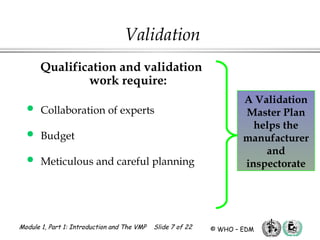
Qualification and validation
work require:
 Collaboration of experts
 Budget
 Meticulous and careful planning
A Validation
Master Plan
helps the
manufacturer
and
inspectorate
Validation
Module 1, Part 1: Introduction and The VMP Slide 8 of 22 © WHO – EDM
Validation
The Validation Master Plan
(VMP)
 Philosophy
 Content
 Strategy
Module 1, Part 1: Introduction and The VMP Slide 9 of 22 © WHO – EDM
Validation
Validation Master Plan
 Recommendation only
 Cover manufacturer’s validation policy and needs
 Provides information on validation organization
 It should describe:
 why?
 what?
 where?
 by whom?
 how?
 when?
Module 1, Part 1: Introduction and The VMP Slide 10 of 22 © WHO – EDM
Validation
Validation Master Plan
 Prospective validation
 Concurrent validation
 Retrospective validation
 Revalidation
 Change control
Module 1, Part 1: Introduction and The VMP Slide 11 of 22 © WHO – EDM
Validation
The VMP helps:
 Management
 Validation team members
 Project leaders
 GMP inspectors
Module 1, Part 1: Introduction and The VMP Slide 12 of 22 © WHO – EDM
Validation
The VMP
 Identifies validation items (products, processes,
systems)
 Defines nature and extent of testing expected
 Outlines test procedures and protocols
 Summary document
 Management agreement
Module 1, Part 1: Introduction and The VMP Slide 13 of 22 © WHO – EDM
Validation Activities in VMP
 Every validation activity included
 Revalidation
 Validation of new process cycles
 Large validation projects have separate VMPs
 Include reasonable unexpected events
Validation
Module 1, Part 1: Introduction and The VMP Slide 14 of 22 © WHO – EDM
Validation
The VMP:
 Enables overview of entire validation project
 Lists items to be validated with the planning
schedule as its heart
 Is like a map
Module 1, Part 1: Introduction and The VMP Slide 15 of 22 © WHO – EDM
Validation
The “Introduction” to the VMP
 Validation policy
 Project scope
 Location and timing (including priorities)
 Validation procedures
 Standards
Module 1, Part 1: Introduction and The VMP Slide 16 of 22 © WHO – EDM
Validation
VMP should state who is responsible for:
 Preparing the VMP
 The protocols and SOPs
 Validation work
 Report and document preparation and control
 Approval/authorisation of validation protocols and
reports in all stages of validation process
 Tracking system
 Training needs in support of validation
Module 1, Part 1: Introduction and The VMP Slide 17 of 22 © WHO – EDM
Validation
VMP should contain:
 Cross references to documents
 Specific process considerations
 Specific characteristics briefly outlined
 Validation list (What to validate)
 premises, systems and equipment
 processes
 products
Module 1, Part 1: Introduction and The VMP Slide 18 of 22 © WHO – EDM
Validation
VMP should contain:
 Descriptions of
 plant (where to validate)
 processes
 products
 Personnel attributes
 expertise and training
 Key acceptance criteria
Module 1, Part 1: Introduction and The VMP Slide 19 of 22 © WHO – EDM
VMP should contain:
 Format for protocols and other documentation
 List of relevant SOPs (How)
 Planning and scheduling (When)
 Location (Where)
 Estimate of staffing requirements (Who)
 A time plan of the project (When)
 Annexes
Validation
Module 1, Part 1: Introduction and The VMP Slide 20 of 22 © WHO – EDM
Validation
VMP should contain change control
 Policy and procedure
 Risk assessment
 Authorization
 Failure to properly document changes to the
system means invalidation of the process
Module 1, Part 1: Introduction and The VMP Slide 21 of 22 © WHO – EDM
Validation
Changes that require revalidation
 Software changes; Controllers
 Site changes; Operational changes
 Change of source of material
 Change in the process
 Significant equipment change
 Production area changes
 Support system changes
Module 1, Part 1: Introduction and The VMP Slide 22 of 22 © WHO – EDM
Validation
In summary, a VMP should contain at
least:
 Validation policy
 Organizational structure
 Summary of facilities, systems, equipment,
processes to be validated
 Documentation format for protocols and reports
 Planning and scheduling
 Change control
 Training requirements

Validation presentation pharmaceutical

  • 1.
    Module 1, Part1: Introduction and The VMP Slide 1 of 22 © WHO – EDM Validation Supplementary Training Modules on Good Manufacturing Practices
  • 2.
    Module 1, Part1: Introduction and The VMP Slide 2 of 22 © WHO – EDM Part I: Introduction and The Validation Master Plan (VMP) Part 2: Cleaning validation Part 3: Process validation Part 4: QC-related validation Part 5: Review and summary Validation
  • 3.
    Module 1, Part1: Introduction and The VMP Slide 3 of 22 © WHO – EDM Objectives of Part 1  To provide an introduction to the subject of Validation  To provide information on the Validation Master Plan Validation
  • 4.
    Module 1, Part1: Introduction and The VMP Slide 4 of 22 © WHO – EDM Validation Introduction Three basic principles of Quality Assurance:  Quality, safety, effectiveness  Cannot inspect quality into a product  Processes must be under control
  • 5.
    Module 1, Part1: Introduction and The VMP Slide 5 of 22 © WHO – EDM Validation WHO validation definition  The documented act of proving that any procedure, process, equipment, material, activity, or system actually leads to the expected results.
  • 6.
    Module 1, Part1: Introduction and The VMP Slide 6 of 22 © WHO – EDM Qualification or validation?  A system must be qualified to operate in a validated process  Qualify a system and/or equipment  Validate a process  Qualification versus validation, e.g. you qualify an autoclave, whereas you validate a sterilization process Validation
  • 7.
    Module 1, Part1: Introduction and The VMP Slide 7 of 22 © WHO – EDM Qualification and validation work require:  Collaboration of experts  Budget  Meticulous and careful planning A Validation Master Plan helps the manufacturer and inspectorate Validation
  • 8.
    Module 1, Part1: Introduction and The VMP Slide 8 of 22 © WHO – EDM Validation The Validation Master Plan (VMP)  Philosophy  Content  Strategy
  • 9.
    Module 1, Part1: Introduction and The VMP Slide 9 of 22 © WHO – EDM Validation Validation Master Plan  Recommendation only  Cover manufacturer’s validation policy and needs  Provides information on validation organization  It should describe:  why?  what?  where?  by whom?  how?  when?
  • 10.
    Module 1, Part1: Introduction and The VMP Slide 10 of 22 © WHO – EDM Validation Validation Master Plan  Prospective validation  Concurrent validation  Retrospective validation  Revalidation  Change control
  • 11.
    Module 1, Part1: Introduction and The VMP Slide 11 of 22 © WHO – EDM Validation The VMP helps:  Management  Validation team members  Project leaders  GMP inspectors
  • 12.
    Module 1, Part1: Introduction and The VMP Slide 12 of 22 © WHO – EDM Validation The VMP  Identifies validation items (products, processes, systems)  Defines nature and extent of testing expected  Outlines test procedures and protocols  Summary document  Management agreement
  • 13.
    Module 1, Part1: Introduction and The VMP Slide 13 of 22 © WHO – EDM Validation Activities in VMP  Every validation activity included  Revalidation  Validation of new process cycles  Large validation projects have separate VMPs  Include reasonable unexpected events Validation
  • 14.
    Module 1, Part1: Introduction and The VMP Slide 14 of 22 © WHO – EDM Validation The VMP:  Enables overview of entire validation project  Lists items to be validated with the planning schedule as its heart  Is like a map
  • 15.
    Module 1, Part1: Introduction and The VMP Slide 15 of 22 © WHO – EDM Validation The “Introduction” to the VMP  Validation policy  Project scope  Location and timing (including priorities)  Validation procedures  Standards
  • 16.
    Module 1, Part1: Introduction and The VMP Slide 16 of 22 © WHO – EDM Validation VMP should state who is responsible for:  Preparing the VMP  The protocols and SOPs  Validation work  Report and document preparation and control  Approval/authorisation of validation protocols and reports in all stages of validation process  Tracking system  Training needs in support of validation
  • 17.
    Module 1, Part1: Introduction and The VMP Slide 17 of 22 © WHO – EDM Validation VMP should contain:  Cross references to documents  Specific process considerations  Specific characteristics briefly outlined  Validation list (What to validate)  premises, systems and equipment  processes  products
  • 18.
    Module 1, Part1: Introduction and The VMP Slide 18 of 22 © WHO – EDM Validation VMP should contain:  Descriptions of  plant (where to validate)  processes  products  Personnel attributes  expertise and training  Key acceptance criteria
  • 19.
    Module 1, Part1: Introduction and The VMP Slide 19 of 22 © WHO – EDM VMP should contain:  Format for protocols and other documentation  List of relevant SOPs (How)  Planning and scheduling (When)  Location (Where)  Estimate of staffing requirements (Who)  A time plan of the project (When)  Annexes Validation
  • 20.
    Module 1, Part1: Introduction and The VMP Slide 20 of 22 © WHO – EDM Validation VMP should contain change control  Policy and procedure  Risk assessment  Authorization  Failure to properly document changes to the system means invalidation of the process
  • 21.
    Module 1, Part1: Introduction and The VMP Slide 21 of 22 © WHO – EDM Validation Changes that require revalidation  Software changes; Controllers  Site changes; Operational changes  Change of source of material  Change in the process  Significant equipment change  Production area changes  Support system changes
  • 22.
    Module 1, Part1: Introduction and The VMP Slide 22 of 22 © WHO – EDM Validation In summary, a VMP should contain at least:  Validation policy  Organizational structure  Summary of facilities, systems, equipment, processes to be validated  Documentation format for protocols and reports  Planning and scheduling  Change control  Training requirements

Editor's Notes

  • #1 Module 1 of the Supplementary Training Modules on GMP expands on the subject of VALIDATION that was introduced to you in WHO Basic Training Module 4. It is, perhaps, one of the least understood aspects of GMP but is fundamental to the production of quality pharmaceuticals.
  • #2 Divided into five parts, this module can be modified to fit a one to one-and- a- half day programme. Part 1 covers an Introduction, after which we will review the Validation Master Plan (VMP). Part 2 focuses on Cleaning validation, and Part 3 on Process validation, which includes aspects of non-sterile liquid and solid dosage forms, sterile manufacturing, and an introduction to steam, and dry heat validation. Part 4 covers QC-related validation including test method validation relating to microbiological, chemical and physical testing validation requirements, followed by Part 5, Review and summary. Suggested times are: Presentation: Part 1 45 –60 minutes Presentation: Part 2 45 –60 minutes Presentation: Part 3 45 –60 minutes Group session 60 minutes (optional) Presentation: Part 4 60 – 90 minutes Presentation: Part 5 30 minutes Test paper 45 minutes (Note for the Trainer: the times noted are very approximate. As part of the preparation phase, the trainer will need to get an understanding of the audience and any special issues involved such as language ability. The times for the different sections may then have to be altered accordingly. Allow for breaks of 20-30 minutes about every one-and-a-half hours.)
  • #3 The objectives of Part 1 are: To provide an introduction to the subject of Validation To provide information on the Validation Master Plan
  • #4 These are the three basic principles of quality assurance: Quality, safety and effectiveness must be designed and built into the product. Quality cannot be inspected or tested into the finished product. Each step of the manufacturing process must be controlled to maximize the probability that the finished product meets all quality and design specifications. Validation of processes and systems is fundamental to achieving these goals.
  • #5 The WHO Validation definition is: “The documented act of proving that any procedure, process, equipment, material, activity, or system actually leads to the expected results.” From: WHO Expert Committee on Specifications for Pharmaceutical Preparations. Thirty-second Report. Geneva, World Health Organization, 1992; 22-52. (WHO Technical Report Series No. 823). Annex 1: Good manufacturing practices for pharmaceutical products.
  • #6 Qualification or validation? The “system” is the complete set of equipment needed to carry out a specific process. A system must be qualified to operate in a validated process. Qualification is part of validation. You qualify a system (systems include autoclave, freeze dryer, cleanroom and water treatment). You validate a process (processes include sterilisation, freeze drying, mixing, cleaning, filling). From: Dr C A Kemper, Kemper-Masterton Inc, PIC Sep 96) Validation or Qualification?
  • #7 Qualification and validation work requires: Collaboration of experts and a multidisciplinary approach: A specific characteristic of validation work is that it requires the collaboration of experts of various disciplines such as pharmacists, technologists, metrologists, chemical analysts, microbiologists, engineers, experts on Q.A. validation etc. The manufacturer may need to engage specialists e.g. for computer software development, check that the manufacturer keeps records of qualifications, experience and training. Budget: the manufacturer must allow enough money, time and human resources to carry out proper validation studies. Costs: Validation studies are costly as they require time of highly specialized personnel and expensive technology. Time constraints: Generally, validation work is subject to rigorous time schedules. These studies are always the last stage prior to taking new processes, and facilities into routine operation. Validation requires a meticulous preparation and careful planning of the various steps in the process. All work should be carried out in a structured way according to documented procedures. The above factors require a well-organized and structured approach that should be adequately described in a Validation Master Plan (VMP), which helps both the manufacture and the inspector understand the company’s strategy and approach to validation.
  • #8 A Validation Master Plan (VMP) is a document that summarizes the manufacturer’s overall philosophy, intentions and approach to be used for establishing performance adequacy. The following slides review the nature and extent of the contents of the VMP and what the manufacturer’s strategy should be. The VMP should present an overview of the entire validation operation, its organizational structure, its content and planning, the core of the VMP being the list/inventory of the items to be validated and the planning schedule. .
  • #9 A Validation Master Plan is a recommendation only, contained within the WHO guidelines, Annex 6. There is no regulatory requirement but the inspector should encourage its development as explained in the following slides The VMP should cover the pharmaceutical manufacturer's validation policy and needs, including qualification and validation, such as: Prospective validation Concurrent validation Retrospective validation Revalidation Change control (See next slide for explanation of these terms.) The VMP provides information on the way a firm organizes validation work It should describe: Why, what where, by whom, how and when?
  • #10 Prospective validation: This is carried out during the development stage. It involves establishing documented evidence that a process, procedure, system, equipment or mechanism used in manufacture does what it purports to do, based on a pre-planned validation protocol. Concurrent validation: This is carried out during normal production of products intended for sale. It requires a full understanding of the process, based on prospective work. It involves very close and intensive monitoring of the steps and critical points in at least the first three production-scale batches. Retrospective validation: This is the analysis of accumulated results from past production to assess the consistency of a process. It includes trend analysis on test results and a close examination of all recorded process deviations. It is important to analyse 10-25 batches manufactured over a period of 12 months, to provide a statistically significant picture. It is not the preferred method of validation and should be used in exceptional cases only. Revalidation: This involves a repeat of the process validation, to provide an assurance that changes in the process/equipment introduced in accordance with change control procedures do not adversely affect process characteristics and product quality. Change control: This is a formal system by which qualified representatives of appropriate disciplines review proposed or actual changes that might affect a validated status. The intent is to determine the need for action that would ensure and document that the system is maintained in a validated state.
  • #11 A VMP helps management: to know what the validation programme involves with respect to time, people and money, and to understand the necessity for the programme. A VMP helps leaders and members of the validation team: to know their tasks and responsibilities. A VMP helps GMP inspectors to understand the manufacturer's approach to validation and how the validation activities are organized and managed.
  • #12 The VMP identifies which items (products, processes, systems) are subject to validation. It defines the nature and extent of the testing expected and it outlines the test procedures and protocols to be followed to accomplish validation. The VMP should be a summary document. It should be brief, concise and clear. It should not repeat information documented elsewhere but refer to existing documents such as policy documents, SOP's and validation protocols/reports. It should include validation of analytical techniques which are to be used in determining the validation status of other processes or systems. All validation activities included in the VMP should be summarized and compiled in a matrix format. Such a matrix should provide an overview and contain all items covered by the VMP that are subject to validation describing the extent of validation required [i.e. IQ, OQ and/or PQ]. The contents of the VMP should be agreed by top management. Management should thus be aware of the nature and extent of the work required and the resources that may be needed.
  • #13 The VMP should include every validation activity, e.g. validation of analytical techniques which are to be used in determining the validation status of other processes or systems. Revalidation provides the evidence that changes in a process and/or the process environment that have been introduced either intentionally or unintentionally, do not adversely affect process characteristics and product quality. There are two basic categories of revalidation : (a) Revalidation in cases of known change (including transfer of processes from one pharmaceutical manufacturer to another or from one site to another), (b) Periodic revalidation carried out at scheduled intervals. The VMP should include the revalidation intervals. The VMP should define how new process cycles will be validated. Large validation projects, such as water systems, HVAC systems, should have separate VMPs. Reasonable unexpected events (worse case) are required to be covered in the VMP e.g: power failure computer crash and recovery filter integrity test failure
  • #14 The VMP should present an overview of the entire validation operation, its organizational structure, its content and planning. The heart of the VMP is the the list or inventory of the items to be validated and the planning schedule. The VMP is like a map – to show you how to get from one place to another.
  • #15 The Introduction should state: validation policy, project scope (general description of the scope of those operations covered by the VMP), location and timing (including priorities), validation procedures, and standards. The individual validation projects should be described with reference to national and international standards as required.
  • #16 The VMP should state the organizational structure and who is responsible for: Preparing the VMP The protocols SOPs (which are the execution of protocols) Report and document preparation, and their control Approval/authorization of validation protocols and reports in all stages of the validation process Tracking changes Training needs in support of validation
  • #17 The VMP should contain: Cross references to other documents, such as standards, SOPs, work instructions, calibration procedures, pharmacopoeias. Specific process considerations; such as dry heat sterilization or gamma-irradiation. Specific characteristics or requirements of the factory or process etc. that may be briefly outlined. Validation list Premises, systems and equipment Processes (for example, aseptic filling) Products
  • #18 The VMP should contain: Descriptions of Plant Processes Products These should be brief. Personnel attributes. This is the requirement for expertize and training of the engineers, pharmacists, chemists, microbiologists who need to undertake and review the validation work. The manufacturer must demonstrate that personnel possess the necessary levels of competency. The signatories of the validation work must have appropriate training, experience, education and qualifications. Microbiologists should sign microbiological work; engineers the engineering, etc. The final report should be co-signed by the person responsible for the project. The training requirements need to be identified for personnel who will maintain or carry out the processes that have been validated. Key acceptance criteria. The acceptance criteria must be set before validation, NOT after the experimental phase of the work has been completed. This is another reason why retrospective validation is not encouraged since the acceptance criteria are set after all the analytical work has already been performed.
  • #19 The VMP should contain: Protocol and documentation format; it is important that there be a systematic approach to the layout and format of the documents. List of relevant SOPs. (How) Planning and scheduling. (When) The location where the validation activity is to be performed. (Where) Estimate of staffing requirements to complete the validation effort described in the plan. (Who) A time plan of the project showing detail planning of sub-projects. (When) Annexes: for training record format, raw data retention, calibration record retention, etc.
  • #20 The manufacturer must have a “change control” procedure. Change control is an important element in any Quality Assurance system. Written procedures should be in place to describe the actions to be taken if a change is proposed to a product component, process equipment, process environment (or site), method of production or testing or any other change that may affect product quality or support system operation. All changes should be formally requested, documented and accepted by representatives of Production, QC/QA, R&D, Engineering and Regulatory Affairs, as appropriate. The likely impact (risk assessment) of the change on the product should be evaluated and the need for, and the extent of revalidation discussed. The change control system should ensure that all notified or requested changes are satisfactorily investigated, documented and authorised. Products made by processes subjected to changes should not be released for sale without full awareness and consideration of the change by responsible staff, including (where appropriate) the Qualified Person. Failure to properly document changes to the system means invalidation.
  • #21 The nature of the changes that require revalidation should be stated in the VMP. If any of the following are changed the process becomes invalid and in some agencies’ view, the process is out of control, even if the finished product meets the marketing authorization specifications for finished products: Software changes, changes in controllers (eg temperature controllers), site changes, operational changes. Changes that are likely to require revalidation are: Changes of starting materials (physical properties such as density, viscosity, particle size distribution may affect the process or product). Transfer of processes to another site. Change of starting material manufacturer. Changes of packaging material (e.g. substituting plastic for glass). Changes in the process (e.g. mixing times, drying temperatures). Changes in the equipment (e.g. addition of automatic detection systems). Changes of equipment which involve the replacement of equipment on a 'like for like' basis would not normally require a revalidation. For example, a new centrifugal pump replacing an older model would not necessarily mean revalidation. Production area and support system changes (e.g. rearrangement of areas, new water treatment method).
  • #22 In summary, a VMP should contain at least: Validation policy Organizational structure of validation and responsibilities Summary of facilities, systems, equipment and processes to be validated Documentation format for protocols and reports Planning and scheduling Change control Training requirements Suggested reading: WHO Expert Committee on Specifications for Pharmaceutical Preparations. Thirty-fourth Report. Geneva, World Health Organization, 1996 (WHO Technical Report Series, No. 863). Annex 6: Good manufacturing practice: Guidelines on the validation of manufacturing processes. Pharmaceutical Inspection Cooperation Scheme (PIC/S). Recommendations on Validation Master Plan, installation and operational qualification, non-sterile process validation, cleaning validation. 3 August 2001. (Refer to www.picscheme.org for copy).