Curriculum Theory
What is a Theory?
The thinking that occurs within a discipline,
or a coherent group of tested general
propositions, commonly regarded as
correct, that can be used as principles of
explanation and prediction for a class of
phenomena: Einstein's theory of relativity.
Synonyms: principle, law, doctrine.
George Beauchamp
Sources of Theories
• Humanities
• Natural Sciences
• Social Sciences
Functions of a Theory
A. Description
• Provides a narrative classification of
knowledge in a particular discipline
• Interprets the complex activities of a
discipline
Functions of a Theory
B. Prediction
can predict the occurrence of as yet
unobserved events on the basis of
explanatory principles imbedded within it
Functions of a Theory
C. Explanation
addresses the “why” question - not only
points out the relationship between
phenomena but suggest the reasons for the
relationships
Functions of a Theory
D. Explanation
serves as a guide - helps researchers
choose data for analysis - theory
generated guides further investigation
Curriculum Theory
Early Theory
Franklin Bobbitt’s The Curriculum (1918)
as the starting point of theorizing in
curriculum
Emphasized “looking for truth in
curriculum”
Early Theory
Harold Rugg
NSSE forums to discuss pertinent ideas of
curriculum design (1926)
NSSE Yearbook (1927) acknowledged
fundamental differences in the curriculum
field & searched for new bases of
professional commonality
Early Theory
John Dewey
tried to show the relationship between schools
and society
linked knowledge in the curriculum to human
experiences
attempted to test curriculum theory in the
schools
Early Theory
Most curricularists who dominated the 20’s
& 30’s were child-centered and were not
interested in formulating theory
Mid-Century (1940-1970)
Mauritz Johnson
presented a model not a theory
distinguished between curriculum plan and
process of plan
discussed differences between curriculum,
instruction & teacher behavior
Mid-Century (1940-1970)
Ralph Tyler (1949)
emphasis on behavioral/learner objectives
sources of curriculum:
learners
subject specialists
contemporary life
psychology
philosophy
Mid-Century (1940-1970)
James B. MacDonald
pointed out major components of schooling:
curriculum, instruction, teaching & learning
and the interactions of these components.
later opposed the behavioristic approach to
curriculum
Current Curriculum Era
Michael Apple, Elliot Eisner, William Pinar
addressing place of schools in our society;
preparing students for an unknown future
relevance of student needs
Theoretical Camps
Traditionalists
more concerned with practical matters than with
theory - interested in curriculum planning &
implementation
tend to be behaviorists
educational practice is science not an art
Theoretical Camps
Conceptual Empiricists
often in social science and view primary mission
as engaging in research that will be theory
producing
question why teachers are teaching what they are
teaching and why they have arranged the content
in the ways they have
Theoretical Camps
Reconstructionists or Reconceptualists
Focus on the individual - who controls the
schools? - what is the purpose of schooling?
How do we liberate schools from the political &
economic establishment?
Aims, Goals & Objectives
Education must be purposeful -
It must have a direction
Most General = Aims
Most Specific = Objectives
Aims, Goals & Objectives
Aims - General Statements that provide
both shape and direction to the more
specific actions of the curriculum
“building worldmindedness”
Aims, Goals & Objectives
Ralph Tyler
1. Developing self-realization
2. Making individuals literate, encouraging
social mobility
3. Providing skills & understanding necessary
for productive employment
4. Furnishing tools requisite for making effective
choices
5. Furnishing tools necessary for continued
learning
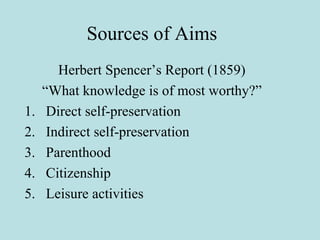
Sources of Aims
Herbert Spencer’s Report (1859)
“What knowledge is of most worthy?”
1. Direct self-preservation
2. Indirect self-preservation
3. Parenthood
4. Citizenship
5. Leisure activities
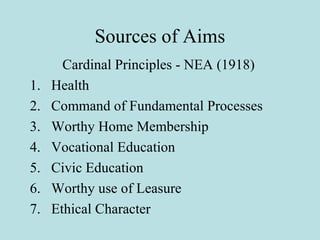
Sources of Aims
Cardinal Principles - NEA (1918)
1. Health
2. Command of Fundamental Processes
3. Worthy Home Membership
4. Vocational Education
5. Civic Education
6. Worthy use of Leasure
7. Ethical Character
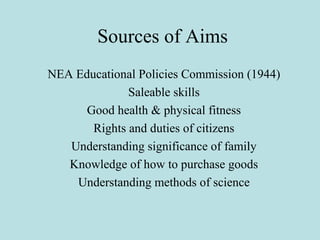
Sources of Aims
NEA Educational Policies Commission (1944)
Saleable skills
Good health & physical fitness
Rights and duties of citizens
Understanding significance of family
Knowledge of how to purchase goods
Understanding methods of science
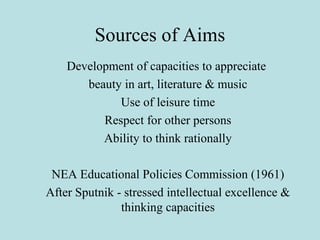
Sources of Aims
Development of capacities to appreciate
beauty in art, literature & music
Use of leisure time
Respect for other persons
Ability to think rationally
NEA Educational Policies Commission (1961)
After Sputnik - stressed intellectual excellence &
thinking capacities
Sources of Aims
Nation at Risk (1983)
Focused on need for higher standards &
expectations by having more rigorous
standards
Concern with excellence reflects changing
“aims” of education
No Child Left Behind (2001)
• High Stakes Testing
• Emphasis on Content
• Closing Achievement Gap
• Annual Yearly Progress
Goals of Education
Goals are statements of purpose
Goals are specific statements designed as guidelines
to achieve particular purpose
“Students will become aware of the various nations
of the world and the roles they play in a world
community.”
Objectives
Objectives indicate in more specific terms the
outcomes of the curriculum
Behavioral Objectives - objectives stated precisely
will improve the quality of teaching and learning
A meaningful objective must be measurable
Objectives
“Students will be able to describe the
countries on the Asian continent and be able
to provide five examples of products these
countries export to the United States.”
Objectives
Robert Mager
Objectives must describe 1) behavior of
learner; 2) conditions; 3) proficiency level
Biggest advantage is the clarity of
communication they foster

Curriculum theory

  • 1.
    Curriculum Theory What isa Theory? The thinking that occurs within a discipline, or a coherent group of tested general propositions, commonly regarded as correct, that can be used as principles of explanation and prediction for a class of phenomena: Einstein's theory of relativity. Synonyms: principle, law, doctrine.
  • 2.
    George Beauchamp Sources ofTheories • Humanities • Natural Sciences • Social Sciences
  • 3.
    Functions of aTheory A. Description • Provides a narrative classification of knowledge in a particular discipline • Interprets the complex activities of a discipline
  • 4.
    Functions of aTheory B. Prediction can predict the occurrence of as yet unobserved events on the basis of explanatory principles imbedded within it
  • 5.
    Functions of aTheory C. Explanation addresses the “why” question - not only points out the relationship between phenomena but suggest the reasons for the relationships
  • 6.
    Functions of aTheory D. Explanation serves as a guide - helps researchers choose data for analysis - theory generated guides further investigation
  • 7.
    Curriculum Theory Early Theory FranklinBobbitt’s The Curriculum (1918) as the starting point of theorizing in curriculum Emphasized “looking for truth in curriculum”
  • 8.
    Early Theory Harold Rugg NSSEforums to discuss pertinent ideas of curriculum design (1926) NSSE Yearbook (1927) acknowledged fundamental differences in the curriculum field & searched for new bases of professional commonality
  • 9.
    Early Theory John Dewey triedto show the relationship between schools and society linked knowledge in the curriculum to human experiences attempted to test curriculum theory in the schools
  • 10.
    Early Theory Most curricularistswho dominated the 20’s & 30’s were child-centered and were not interested in formulating theory
  • 11.
    Mid-Century (1940-1970) Mauritz Johnson presenteda model not a theory distinguished between curriculum plan and process of plan discussed differences between curriculum, instruction & teacher behavior
  • 12.
    Mid-Century (1940-1970) Ralph Tyler(1949) emphasis on behavioral/learner objectives sources of curriculum: learners subject specialists contemporary life psychology philosophy
  • 13.
    Mid-Century (1940-1970) James B.MacDonald pointed out major components of schooling: curriculum, instruction, teaching & learning and the interactions of these components. later opposed the behavioristic approach to curriculum
  • 14.
    Current Curriculum Era MichaelApple, Elliot Eisner, William Pinar addressing place of schools in our society; preparing students for an unknown future relevance of student needs
  • 15.
    Theoretical Camps Traditionalists more concernedwith practical matters than with theory - interested in curriculum planning & implementation tend to be behaviorists educational practice is science not an art
  • 16.
    Theoretical Camps Conceptual Empiricists oftenin social science and view primary mission as engaging in research that will be theory producing question why teachers are teaching what they are teaching and why they have arranged the content in the ways they have
  • 17.
    Theoretical Camps Reconstructionists orReconceptualists Focus on the individual - who controls the schools? - what is the purpose of schooling? How do we liberate schools from the political & economic establishment?
  • 18.
    Aims, Goals &Objectives Education must be purposeful - It must have a direction Most General = Aims Most Specific = Objectives
  • 19.
    Aims, Goals &Objectives Aims - General Statements that provide both shape and direction to the more specific actions of the curriculum “building worldmindedness”
  • 20.
    Aims, Goals &Objectives Ralph Tyler 1. Developing self-realization 2. Making individuals literate, encouraging social mobility 3. Providing skills & understanding necessary for productive employment 4. Furnishing tools requisite for making effective choices 5. Furnishing tools necessary for continued learning
  • 21.
    Sources of Aims HerbertSpencer’s Report (1859) “What knowledge is of most worthy?” 1. Direct self-preservation 2. Indirect self-preservation 3. Parenthood 4. Citizenship 5. Leisure activities
  • 22.
    Sources of Aims CardinalPrinciples - NEA (1918) 1. Health 2. Command of Fundamental Processes 3. Worthy Home Membership 4. Vocational Education 5. Civic Education 6. Worthy use of Leasure 7. Ethical Character
  • 23.
    Sources of Aims NEAEducational Policies Commission (1944) Saleable skills Good health & physical fitness Rights and duties of citizens Understanding significance of family Knowledge of how to purchase goods Understanding methods of science
  • 24.
    Sources of Aims Developmentof capacities to appreciate beauty in art, literature & music Use of leisure time Respect for other persons Ability to think rationally NEA Educational Policies Commission (1961) After Sputnik - stressed intellectual excellence & thinking capacities
  • 25.
    Sources of Aims Nationat Risk (1983) Focused on need for higher standards & expectations by having more rigorous standards Concern with excellence reflects changing “aims” of education
  • 26.
    No Child LeftBehind (2001) • High Stakes Testing • Emphasis on Content • Closing Achievement Gap • Annual Yearly Progress
  • 27.
    Goals of Education Goalsare statements of purpose Goals are specific statements designed as guidelines to achieve particular purpose “Students will become aware of the various nations of the world and the roles they play in a world community.”
  • 28.
    Objectives Objectives indicate inmore specific terms the outcomes of the curriculum Behavioral Objectives - objectives stated precisely will improve the quality of teaching and learning A meaningful objective must be measurable
  • 29.
    Objectives “Students will beable to describe the countries on the Asian continent and be able to provide five examples of products these countries export to the United States.”
  • 30.
    Objectives Robert Mager Objectives mustdescribe 1) behavior of learner; 2) conditions; 3) proficiency level Biggest advantage is the clarity of communication they foster