James Szigeti
Constructivists‟ Contributions
 Jean Piaget: Cognitive Stages, Schema, Assimilation,
  Accommodation
 Jerome Bruner: Cognitive Revolution, The Process of
  Education, Towards a Theory of Instruction, and The
  Culture of Education
 Lev Vygotsky: Social Cognition Theory, Zone of
  Proximal Development, and Collaborative Learning
 John Dewey: Progressive Education and Pragmatism
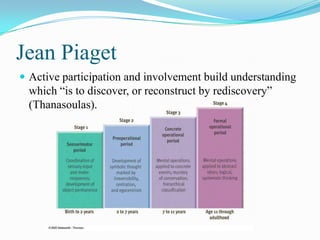
Jean Piaget
 Active participation and involvement build understanding
  which “is to discover, or reconstruct by rediscovery”
  (Thanasoulas).
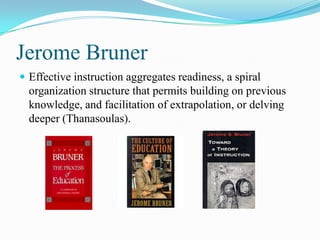
Jerome Bruner
 Effective instruction aggregates readiness, a spiral
  organization structure that permits building on previous
  knowledge, and facilitation of extrapolation, or delving
  deeper (Thanasoulas).
Optimum Learning Process
 Enactive mode: direct manipulation of materials, correct
  method for a specific outcome
 Iconic mode: internal imagery associated with concepts
  that transform perceptions into meaning
 Symbolic mode: based on “abstract, discretionary, and
  flexible thought” (Kristinsdóttir).
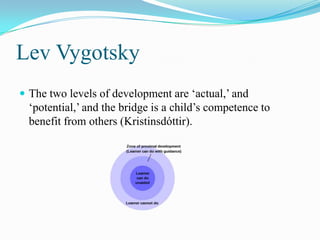
Lev Vygotsky
 The two levels of development are „actual,‟ and
  „potential,‟ and the bridge is a child‟s competence to
  benefit from others (Kristinsdóttir).
John Dewey
 Understanding derives from situations embedded in a
 social context that induces application of concepts through
 meaningful experiences; students can only learn by
 “directed living” (Thanasoulas).
Two Principles of Constructivist View
1. “Knowledge is actively constructed by the learner,
   not passively received from the environment.”
2. “Coming to know is a process of adaptation based on
   and constantly modified by a learner’s experience of
   the world.”

    Acceptance of just the first, or both principles
     separates trivial from radical constructivism.
In the Classroom
 “The constructivist teacher sets up problems and
 monitors student exploration, guides the direction of
 student inquiry and promotes new patterns of
 thinking. Classes can take unexpected turns as
 students are given the autonomy to direct their own
 explorations… Constructivist teachers refer to raw
 data, primary sources, and interactive materials to
 provide experiences for their students rather than
 relying solely on another's set of data.”
Teacher and Student Consequences
 Shifting responsibility to the learner is a tenet of constructivism
  that is reluctantly accepted, or implemented.
 The teacher must accommodate traditional curricula and
  external assessments in their approach. Without technology, a
  teacher may simply listen to students. Technology allows for
  broader access to information for learners that extend beyond
  the text.
 The students have to be willing to learn, and self-disciplined
  enough to be trusted with any level of autonomy.
 Technology opens doors for endless possibilities to reinforce
  their extrapolation, and distract them from their goal.
 Students take initiative and develop individual intellectual
  identities.
(Powell)
Personal Constructivism
 Constructivism is all about empowering students to go
  beyond what is simply necessary, and transcend
  expectations. It seems defies the norms of many
  typical classroom settings, but for those learners with
  the initiative and autonomy to extrapolate and build
  on their knowledge, they will truly go far.
 I will integrate my views of constructivism into my
  curriculum in order to strengthen students abilities to
  improve in the long run.
Works Cited
 Kristinsdóttir, Sólrún B. "J. Bruner." J. Bruner. N.p., 2001. Web. 18
  Nov. 2012.
  <http://mennta.hi.is/starfsfolk/solrunb/jbruner.htm_3.htm>.
 Kristinsdóttir, Sólrún B. "Â LevVygotsky (1896-1934)." Lev
  Vygotsky. N.p., 2001. Web. 18 Nov. 2012.
  <http://mennta.hi.is/starfsfolk/solrunb/vygotsky.htm>.
 Powell, Mary Jo. "Constructing Knowledge in the Classroom."
  SEDL - SCIMAST Classroom Compass. U. S. Department of
  Education, n.d. Web. 18 Nov. 2012.
  <http://www.sedl.org/scimath/compass/v01n03/1.html>.
 Thanasoulas, Dimitrios. "Constructivist Learning."
  Constructivist Learning. N.p., n.d. Web. 18 Nov. 2012.
  <http://www.seasite.niu.edu/Tagalog/Teachers_Page/Language_
  Learning_Articles/constructivist_learning.htm>.

Constructivist theory

  • 1.
  • 2.
    Constructivists‟ Contributions  JeanPiaget: Cognitive Stages, Schema, Assimilation, Accommodation  Jerome Bruner: Cognitive Revolution, The Process of Education, Towards a Theory of Instruction, and The Culture of Education  Lev Vygotsky: Social Cognition Theory, Zone of Proximal Development, and Collaborative Learning  John Dewey: Progressive Education and Pragmatism
  • 3.
    Jean Piaget  Activeparticipation and involvement build understanding which “is to discover, or reconstruct by rediscovery” (Thanasoulas).
  • 4.
    Jerome Bruner  Effectiveinstruction aggregates readiness, a spiral organization structure that permits building on previous knowledge, and facilitation of extrapolation, or delving deeper (Thanasoulas).
  • 5.
    Optimum Learning Process Enactive mode: direct manipulation of materials, correct method for a specific outcome  Iconic mode: internal imagery associated with concepts that transform perceptions into meaning  Symbolic mode: based on “abstract, discretionary, and flexible thought” (Kristinsdóttir).
  • 6.
    Lev Vygotsky  Thetwo levels of development are „actual,‟ and „potential,‟ and the bridge is a child‟s competence to benefit from others (Kristinsdóttir).
  • 7.
    John Dewey  Understandingderives from situations embedded in a social context that induces application of concepts through meaningful experiences; students can only learn by “directed living” (Thanasoulas).
  • 8.
    Two Principles ofConstructivist View 1. “Knowledge is actively constructed by the learner, not passively received from the environment.” 2. “Coming to know is a process of adaptation based on and constantly modified by a learner’s experience of the world.”  Acceptance of just the first, or both principles separates trivial from radical constructivism.
  • 9.
    In the Classroom “The constructivist teacher sets up problems and monitors student exploration, guides the direction of student inquiry and promotes new patterns of thinking. Classes can take unexpected turns as students are given the autonomy to direct their own explorations… Constructivist teachers refer to raw data, primary sources, and interactive materials to provide experiences for their students rather than relying solely on another's set of data.”
  • 10.
    Teacher and StudentConsequences  Shifting responsibility to the learner is a tenet of constructivism that is reluctantly accepted, or implemented.  The teacher must accommodate traditional curricula and external assessments in their approach. Without technology, a teacher may simply listen to students. Technology allows for broader access to information for learners that extend beyond the text.  The students have to be willing to learn, and self-disciplined enough to be trusted with any level of autonomy.  Technology opens doors for endless possibilities to reinforce their extrapolation, and distract them from their goal.  Students take initiative and develop individual intellectual identities. (Powell)
  • 11.
    Personal Constructivism  Constructivismis all about empowering students to go beyond what is simply necessary, and transcend expectations. It seems defies the norms of many typical classroom settings, but for those learners with the initiative and autonomy to extrapolate and build on their knowledge, they will truly go far.  I will integrate my views of constructivism into my curriculum in order to strengthen students abilities to improve in the long run.
  • 12.
    Works Cited  Kristinsdóttir,Sólrún B. "J. Bruner." J. Bruner. N.p., 2001. Web. 18 Nov. 2012. <http://mennta.hi.is/starfsfolk/solrunb/jbruner.htm_3.htm>.  Kristinsdóttir, Sólrún B. "Â LevVygotsky (1896-1934)." Lev Vygotsky. N.p., 2001. Web. 18 Nov. 2012. <http://mennta.hi.is/starfsfolk/solrunb/vygotsky.htm>.  Powell, Mary Jo. "Constructing Knowledge in the Classroom." SEDL - SCIMAST Classroom Compass. U. S. Department of Education, n.d. Web. 18 Nov. 2012. <http://www.sedl.org/scimath/compass/v01n03/1.html>.  Thanasoulas, Dimitrios. "Constructivist Learning." Constructivist Learning. N.p., n.d. Web. 18 Nov. 2012. <http://www.seasite.niu.edu/Tagalog/Teachers_Page/Language_ Learning_Articles/constructivist_learning.htm>.