Acid base
balance
Dr. Indunil Piyadigama
Consultant Obstetrician and Gynaecologist
Director - Base Hospital Kahawatta
• Maintenance of cellular and extracellular pH (hydrogen ion concentration) is
essential to life
• Enzyme function is dependent on pH
• Blood and extracellular fluid pH are tightly regulated by the presence of
buffer systems
• Ultimately acid load must ultimately be eliminated by subsequent excretion
of volatile acids by the lungs and fixed acids by the kidney
pH
pH is the negative logarithm to
the base 10 of the hydrogen
ion concentration
pH= -log [H+]
Normal PH of arterial blood
gas sample= 7.35-7.45
Intracellular pH is more acidic (pH 6.3–7.4) pH of subcellular organelles may be yet more
acidic, reflecting their physiological function
(e.g., lysosomes)
Acids
• Acids - substances that
dissociate to donate H+
pKa
Is the pH at which
50% of the acid is
dissociated
lower the pKa, the
stronger the acid
Alkali
Substance that accepts hydrogen
ions
Milk and milk products
H+
generation
• By metabolic processes
• Lesser extend by diet
• Total of 12–20 moles of CO2 are produced daily
• Other metabolic products include lactic acid, organic acids, and urea
• Metabolism of amino acids
• Absorption of dietary phosphate and faecal loss of bicarbonate represent an
additional acid load
• Total, the net acid load of fixed acid is approximately 1 mmol kg/day
• This may be increased by a high protein intake
• Reduced by a strict vegetarian diet
Food H+
• The major acids contained in food are
• citric acid (in fruit)
• acetic acid (as a preservative, pickles, vinegar)
• lactic acid (yogurt, fermented foods)
• malic acid (fruit)
• oxalic acid (vegetables, that contain smaller amounts of citric and malic acids)
• tartaric acid (wine)
• The largest source of fixed acid comes from the metabolism of amino acids (particularly
those from animal proteins)
• Cysteine or methionine metabolism leads to production of sulfuric and phosphoric acid (H2SO4,
H3PO4)
• Metabolism of other amino acids (lysine, arginine, and histidine) to hydrochloric acid (HCl)
Regulation of
acid
• Buffering within the blood and tissues –
Immediate
• Excretion of volatile acids by lungs – Over
minutes to hours
• Excretion of fixed acids by the kidneys – Hours to
days
Three levels
Buffer systems
• Buffering is the ability of weak acids, present in excess, to accept H+ donated from strong acids,
thus limiting changes in free H+ concentrations and pH changes
• Buffering systems
• 60–70% of the buffering capacity of blood is accounted for by the bicarbonate buffer system
• 20–30% is dependent on direct binding to haemoglobin and to other proteins
• In bones Calcium phosphite
• H+ ions move across cell membranes
• Depending on concentration and charge
• H+ ions may move into cells in exchange for K+
• To a lesser extent Na+ ions)
Lungs
• Excrete volatile acid (CO2) by changes in the
rate and volume of respiration
• This is regulated by
• Respiratory centres in the brainstem, that
respond to changes in the pH of cerebrospinal
fluid
• Signals from chemoreceptors in the carotid and
aortic bodies that are responsive to changes in
pH and PCO2 of arterial blood
• Acidosis increases the ventilatory volume.
The pattern in severe acidosis being
described as Kussmaul breathing
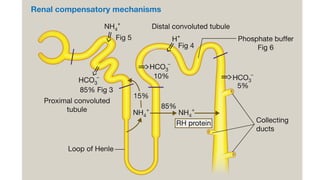
Kidneys
• Mainly 2 mechanisms
• recovery of filtered bicarbonate and generation of new bicarbonate
• excretion of fixed acid
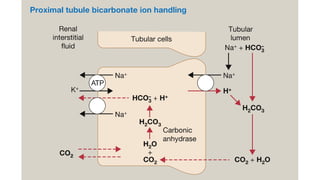
• Bicarbonate reabsorption mainly occurs in the proximal convoluted
tubule (PCT) – 85%
• Thick ascending limb of the Loop of Henle accounts for 10%
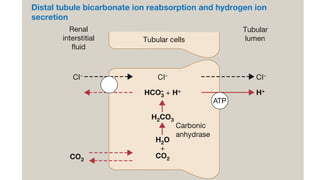
• Remainder being titrated to regulate total acid excretion, in the
collecting duct
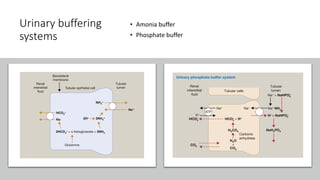
Urinary buffering
systems
• Amonia buffer
• Phosphate buffer
Liver and bone
• Liver metabolizes lactate and ketoacids; the rate of metabolism is
dependent on pH
• The synthesis of urea from ammonium and carbon dioxide results in
genesis of two protons
• Buffering occurs in bone due to slow exchange of bone calcium
carbonate for extracellular phosphate.
Effects of acidaemia
• Metabolism of carbohydrate is altered; both glycolysis and gluconeogenesis are
inhibited in the liver
• Delivery of oxygen to the tissues is increased by the reduced ability of
haemoglobin to retain oxygen in an acid environment (the Bohr effect)
• Consciousness is impaired, leading to coma in severe cases
• vasodilatation occurs in peripheral tissues, cardiac contractility is impaired
resulting in reduced blood pressure and, when severe, in reduced tissue
perfusion
Abnormal
acid base
balance
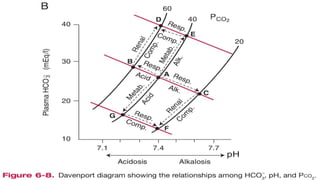
• Disturbances in acid–base balance are usually labelled
according to their origin
• Respiratory acidosis reflects a primary problem in gas
exchange with impaired excretion of CO2
• Metabolic acidosis reflects over production of fixed acid or
loss of bicarbonate
• Additionally in some circumstances, a mixed respiratory
and metabolic acidosis may be present
• Compensation refers to the body’s ability to offset the primary
problem
• response to a primary metabolic acidosis is to increase
excretion of CO2
• In a primary respiratory acidosis, increased+ is secreted by
the kidney with increased bicarbonate generation
• If the pH returns to normal the problem is said to be ‘fully
compensated’ whereas most disturbances tend to only be
partially compensated
Normal ranges
Clinical
scenarios
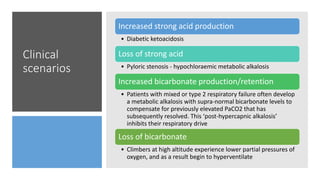
Increased strong acid production
• Diabetic ketoacidosis
Loss of strong acid
• Pyloric stenosis - hypochloraemic metabolic alkalosis
Increased bicarbonate production/retention
• Patients with mixed or type 2 respiratory failure often develop
a metabolic alkalosis with supra-normal bicarbonate levels to
compensate for previously elevated PaCO2 that has
subsequently resolved. This ‘post-hypercapnic alkalosis’
inhibits their respiratory drive
Loss of bicarbonate
• Climbers at high altitude experience lower partial pressures of
oxygen, and as a result begin to hyperventilate
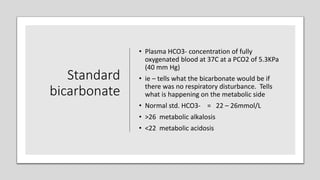
Standard
bicarbonate
• Plasma HCO3- concentration of fully
oxygenated blood at 37C at a PCO2 of 5.3KPa
(40 mm Hg)
• ie – tells what the bicarbonate would be if
there was no respiratory disturbance. Tells
what is happening on the metabolic side
• Normal std. HCO3- = 22 – 26mmol/L
• >26 metabolic alkalosis
• <22 metabolic acidosis
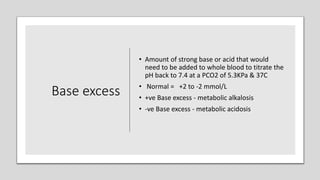
Base excess
• Amount of strong base or acid that would
need to be added to whole blood to titrate the
pH back to 7.4 at a PCO2 of 5.3KPa & 37C
• Normal = +2 to -2 mmol/L
• +ve Base excess - metabolic alkalosis
• -ve Base excess - metabolic acidosis
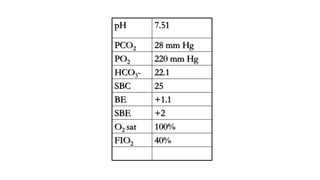
pH 7.51
PCO2 28 mm Hg
PO2 220 mm Hg
HCO3- 22.1
SBC 25
BE +1.1
SBE +2
O2 sat 100%
FIO2 40%
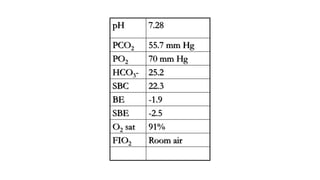
pH 7.28
PCO2 55.7 mm Hg
PO2 70 mm Hg
HCO3- 25.2
SBC 22.3
BE -1.9
SBE -2.5
O2 sat 91%
FIO2 Room air
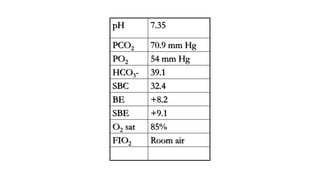
pH 7.35
PCO2 70.9 mm Hg
PO2 54 mm Hg
HCO3- 39.1
SBC 32.4
BE +8.2
SBE +9.1
O2 sat 85%
FIO2 Room air
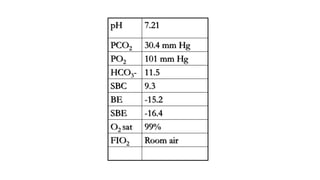
pH 7.21
PCO2 30.4 mm Hg
PO2 101 mm Hg
HCO3- 11.5
SBC 9.3
BE -15.2
SBE -16.4
O2 sat 99%
FIO2 Room air
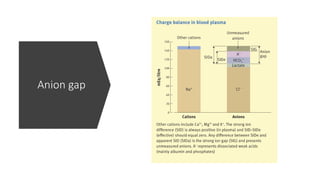
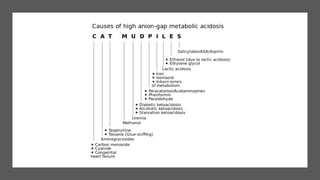
Anion gap
Thank you

Acid base balance.pptx

  • 1.
    Acid base balance Dr. IndunilPiyadigama Consultant Obstetrician and Gynaecologist Director - Base Hospital Kahawatta
  • 2.
    • Maintenance ofcellular and extracellular pH (hydrogen ion concentration) is essential to life • Enzyme function is dependent on pH • Blood and extracellular fluid pH are tightly regulated by the presence of buffer systems • Ultimately acid load must ultimately be eliminated by subsequent excretion of volatile acids by the lungs and fixed acids by the kidney
  • 3.
    pH pH is thenegative logarithm to the base 10 of the hydrogen ion concentration pH= -log [H+] Normal PH of arterial blood gas sample= 7.35-7.45
  • 4.
    Intracellular pH ismore acidic (pH 6.3–7.4) pH of subcellular organelles may be yet more acidic, reflecting their physiological function (e.g., lysosomes)
  • 5.
    Acids • Acids -substances that dissociate to donate H+
  • 6.
    pKa Is the pHat which 50% of the acid is dissociated lower the pKa, the stronger the acid
  • 7.
    Alkali Substance that acceptshydrogen ions Milk and milk products
  • 8.
    H+ generation • By metabolicprocesses • Lesser extend by diet • Total of 12–20 moles of CO2 are produced daily • Other metabolic products include lactic acid, organic acids, and urea • Metabolism of amino acids • Absorption of dietary phosphate and faecal loss of bicarbonate represent an additional acid load • Total, the net acid load of fixed acid is approximately 1 mmol kg/day • This may be increased by a high protein intake • Reduced by a strict vegetarian diet
  • 9.
    Food H+ • Themajor acids contained in food are • citric acid (in fruit) • acetic acid (as a preservative, pickles, vinegar) • lactic acid (yogurt, fermented foods) • malic acid (fruit) • oxalic acid (vegetables, that contain smaller amounts of citric and malic acids) • tartaric acid (wine) • The largest source of fixed acid comes from the metabolism of amino acids (particularly those from animal proteins) • Cysteine or methionine metabolism leads to production of sulfuric and phosphoric acid (H2SO4, H3PO4) • Metabolism of other amino acids (lysine, arginine, and histidine) to hydrochloric acid (HCl)
  • 10.
    Regulation of acid • Bufferingwithin the blood and tissues – Immediate • Excretion of volatile acids by lungs – Over minutes to hours • Excretion of fixed acids by the kidneys – Hours to days Three levels
  • 11.
    Buffer systems • Bufferingis the ability of weak acids, present in excess, to accept H+ donated from strong acids, thus limiting changes in free H+ concentrations and pH changes • Buffering systems • 60–70% of the buffering capacity of blood is accounted for by the bicarbonate buffer system • 20–30% is dependent on direct binding to haemoglobin and to other proteins • In bones Calcium phosphite • H+ ions move across cell membranes • Depending on concentration and charge • H+ ions may move into cells in exchange for K+ • To a lesser extent Na+ ions)
  • 12.
    Lungs • Excrete volatileacid (CO2) by changes in the rate and volume of respiration • This is regulated by • Respiratory centres in the brainstem, that respond to changes in the pH of cerebrospinal fluid • Signals from chemoreceptors in the carotid and aortic bodies that are responsive to changes in pH and PCO2 of arterial blood • Acidosis increases the ventilatory volume. The pattern in severe acidosis being described as Kussmaul breathing
  • 13.
    Kidneys • Mainly 2mechanisms • recovery of filtered bicarbonate and generation of new bicarbonate • excretion of fixed acid • Bicarbonate reabsorption mainly occurs in the proximal convoluted tubule (PCT) – 85% • Thick ascending limb of the Loop of Henle accounts for 10% • Remainder being titrated to regulate total acid excretion, in the collecting duct
  • 17.
    Urinary buffering systems • Amoniabuffer • Phosphate buffer
  • 18.
    Liver and bone •Liver metabolizes lactate and ketoacids; the rate of metabolism is dependent on pH • The synthesis of urea from ammonium and carbon dioxide results in genesis of two protons • Buffering occurs in bone due to slow exchange of bone calcium carbonate for extracellular phosphate.
  • 19.
    Effects of acidaemia •Metabolism of carbohydrate is altered; both glycolysis and gluconeogenesis are inhibited in the liver • Delivery of oxygen to the tissues is increased by the reduced ability of haemoglobin to retain oxygen in an acid environment (the Bohr effect) • Consciousness is impaired, leading to coma in severe cases • vasodilatation occurs in peripheral tissues, cardiac contractility is impaired resulting in reduced blood pressure and, when severe, in reduced tissue perfusion
  • 20.
    Abnormal acid base balance • Disturbancesin acid–base balance are usually labelled according to their origin • Respiratory acidosis reflects a primary problem in gas exchange with impaired excretion of CO2 • Metabolic acidosis reflects over production of fixed acid or loss of bicarbonate • Additionally in some circumstances, a mixed respiratory and metabolic acidosis may be present • Compensation refers to the body’s ability to offset the primary problem • response to a primary metabolic acidosis is to increase excretion of CO2 • In a primary respiratory acidosis, increased+ is secreted by the kidney with increased bicarbonate generation • If the pH returns to normal the problem is said to be ‘fully compensated’ whereas most disturbances tend to only be partially compensated
  • 21.
  • 22.
    Clinical scenarios Increased strong acidproduction • Diabetic ketoacidosis Loss of strong acid • Pyloric stenosis - hypochloraemic metabolic alkalosis Increased bicarbonate production/retention • Patients with mixed or type 2 respiratory failure often develop a metabolic alkalosis with supra-normal bicarbonate levels to compensate for previously elevated PaCO2 that has subsequently resolved. This ‘post-hypercapnic alkalosis’ inhibits their respiratory drive Loss of bicarbonate • Climbers at high altitude experience lower partial pressures of oxygen, and as a result begin to hyperventilate
  • 23.
    Standard bicarbonate • Plasma HCO3-concentration of fully oxygenated blood at 37C at a PCO2 of 5.3KPa (40 mm Hg) • ie – tells what the bicarbonate would be if there was no respiratory disturbance. Tells what is happening on the metabolic side • Normal std. HCO3- = 22 – 26mmol/L • >26 metabolic alkalosis • <22 metabolic acidosis
  • 24.
    Base excess • Amountof strong base or acid that would need to be added to whole blood to titrate the pH back to 7.4 at a PCO2 of 5.3KPa & 37C • Normal = +2 to -2 mmol/L • +ve Base excess - metabolic alkalosis • -ve Base excess - metabolic acidosis
  • 25.
    pH 7.51 PCO2 28mm Hg PO2 220 mm Hg HCO3- 22.1 SBC 25 BE +1.1 SBE +2 O2 sat 100% FIO2 40%
  • 26.
    pH 7.28 PCO2 55.7mm Hg PO2 70 mm Hg HCO3- 25.2 SBC 22.3 BE -1.9 SBE -2.5 O2 sat 91% FIO2 Room air
  • 27.
    pH 7.35 PCO2 70.9mm Hg PO2 54 mm Hg HCO3- 39.1 SBC 32.4 BE +8.2 SBE +9.1 O2 sat 85% FIO2 Room air
  • 28.
    pH 7.21 PCO2 30.4mm Hg PO2 101 mm Hg HCO3- 11.5 SBC 9.3 BE -15.2 SBE -16.4 O2 sat 99% FIO2 Room air
  • 29.
  • 31.