Post Partum Haemorrage
Management of tears
Dr. Indunil Piyadigama
Consultant Obstetrician and Gynaecologist
London Trainees Teaching
14th October 2021
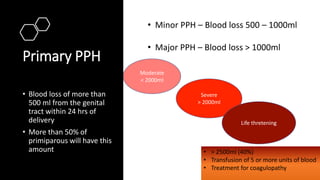
Primary PPH
• Blood loss of more than
500 ml from the genital
tract within 24 hrs of
delivery
• More than 50% of
primiparous will have this
amount
• Minor PPH – Blood loss 500 – 1000ml
• Major PPH – Blood loss > 1000ml
Moderate
< 2000ml
Severe
> 2000ml
Life thretening
• > 2500ml (40%)
• Transfusion of 5 or more units of blood
• Treatment for coagulopathy
PPH
• Major killer in both developed and developing
countries
• More than half of the deaths due to PPH would
have been prevented even in UK
Causes for PPH
90% - uterine atony
Trauma
Uterine inversion
Retained placental tissue
Acquired coagulopathy
Mostly the emphasis is on
the management of uterine
atony
Management of bleeding
due tears is a neglected area
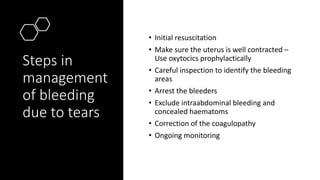
Steps in
management
of bleeding
due to tears
• Initial resuscitation
• Make sure the uterus is well contracted –
Use oxytocics prophylactically
• Careful inspection to identify the bleeding
areas
• Arrest the bleeders
• Exclude intraabdominal bleeding and
concealed haematoms
• Correction of the coagulopathy
• Ongoing monitoring
Principles in
arresting
bleeding due
to tears
Good light, preferrably theatre
Exposure
Lithotomy position
Simms speculums
Experienced assistant
Examine from top to bottom
Arrest bleeding
Experience surgeon
Long handled instruments
Atraumatic handling
Use of bsorbable sutures
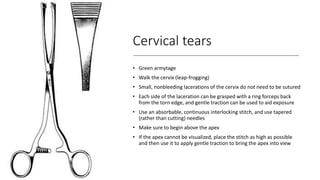
Cervical tears
• Green armytage
• Walk the cervix (leap-frogging)
• Small, nonbleeding lacerations of the cervix do not need to be sutured
• Each side of the laceration can be grasped with a ring forceps back
from the torn edge, and gentle traction can be used to aid exposure
• Use an absorbable, continuous interlocking stitch, and use tapered
(rather than cutting) needles
• Make sure to begin above the apex
• If the apex cannot be visualized, place the stitch as high as possible
and then use it to apply gentle traction to bring the apex into view
Vaginal
lacerations
• Technical difficulties to suture
• Specially when its deep in the fornices
• Vaginal tissues are very friable following a
vaginal delivery
• Handling can result in degloving injuries to
the vaginal mucosa leading to further
bleeding
• Generally there is coagulopathy - more prick
points at suturing can add to more bleeding
Our
experience
Even at the most experienced hands
it is difficult to suture deep tears
Specially if not attended immediately
or successful in the first attempt
Maternal deaths have occurred
A life saving alternative is using
tamponade
An ideal tamponade system
Should be able to achieve high intravaginal pressure
Pressure can be distributed equally over the vaginal wall
Water-tight system so concealed bleeding is less
Less traumatic avoiding further injuries. Specially the degloving injury
Freely available
Can be performed even by an inexperienced person
Can be retained in situ untill the bleeding is settled
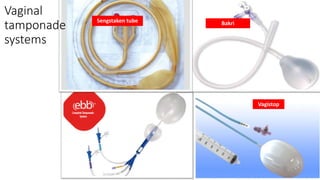
Different vaginal tamponade systems
Guaze packs
Blood pressure
cuff
Sengesteken
tube
Bakri balloon
with gauze
packs
Vaginal balloons
– Vagistop, Ebbs,
Zhukovsky
Gauze packs
Traumatic and degloving injuries can
occur
Concealed haemorrhage
High pressures cannot be achieved
Vagistop
Bakri
Sengstaken tube
Vaginal
tamponade
systems
Case study
• A 33-year-old woman
• Previous LSCS - fetal distress at 5 cm, 2 years and 3 months prior to the index pregnancy
• Uncomplicated pregnancy
• BMI 29 kg/m2
• Spontaneous labour at 39 weeks+4days of gestation
• Satisfactory progression in labour
• Forceps delivery due to delay in second stage giving birth to a 3.7 kg baby
• Active management of the third stage was carried out and placenta delivered with
controlled code traction
• She developed profuse vaginal bleeding
• Examination revealed a contracted uterus and no bleeding was observed through the
cervical os.
• Blood was pooling in the vagina due to multiple vaginal lacerations extending to both
fornices.
• Initial resuscitation was carried out promptly.
• Attempts of suturing the lacerations failed and exact bleeding points could not be
visualised.
• Vaginal tamponade was done with vaginal gauze packs.
• Within 15min of tamponade, packs were completely soaked and the patient was in grade
3 haemorrhagic shock.
• Rotational thromboelastometry (ROTEM) results showed severe coagulopathy
• Blood products were started
• Second inspection and attempts to suture the bleeding sites in the theatre under general
anaesthesia by the most senior obstetrician also failed
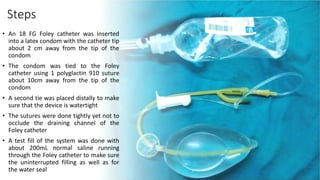
• As the last resort, condom catheter inflation inside the vagina was carried out
Vaginal condom catheter - material
• 18 FG Foley catheter
• Latex condom
• 0.9% saline
• saline giving set
• 1 polyglactin
Steps
• An 18 FG Foley catheter was inserted
into a latex condom with the catheter tip
about 2 cm away from the tip of the
condom
• The condom was tied to the Foley
catheter using 1 polyglactin 910 suture
about 10cm away from the tip of the
condom
• A second tie was placed distally to make
sure that the device is watertight
• The sutures were done tightly yet not to
occlude the draining channel of the
Foley catheter
• A test fill of the system was done with
about 200mL normal saline running
through the Foley catheter to make sure
the uninterrupted filling as well as for
the water seal
• Normal saline was drained out back through the Foley catheter
• The system was introduced into the vagina using a sponge forceps
• The tip of the condom was placed at the posterior fornix
• The end of the Foley catheter was connected to a saline giving set with a normal saline
bottle hanging at about 1 m above the operating table
• While the condom was being distended, the vaginal introitus was sealed with four
interrupted horizontal mattress nylon stitches running between the labia minora
• Condom catheter was distended with 700mL of normal saline under gravitational force
The bleeding through the vaginal introitus
settled completely with the vaginal
tamponade
With the guidance of ROTEM, she had 4
units of fresh frozen plasma and 2 pools of
cryoprecipitate by the end of the procedure
Thank you
SAMUDRA BOOK PUBLICATIONS
AUTHOR
Dr. Indunil Piyadigama
CONTRIBUTORS
Dr. Madura Jayawardena
Dr. Chandana Jayasundara
EDITED BY
Mr. Tony Hollingworth
Prof. Athula Kaluarachchi
Gynaecology
GUIDE FOR
MD & MRCOG in

Vaginal tamponade

  • 1.
    Post Partum Haemorrage Managementof tears Dr. Indunil Piyadigama Consultant Obstetrician and Gynaecologist London Trainees Teaching 14th October 2021
  • 2.
    Primary PPH • Bloodloss of more than 500 ml from the genital tract within 24 hrs of delivery • More than 50% of primiparous will have this amount • Minor PPH – Blood loss 500 – 1000ml • Major PPH – Blood loss > 1000ml Moderate < 2000ml Severe > 2000ml Life thretening • > 2500ml (40%) • Transfusion of 5 or more units of blood • Treatment for coagulopathy
  • 3.
    PPH • Major killerin both developed and developing countries • More than half of the deaths due to PPH would have been prevented even in UK
  • 4.
    Causes for PPH 90%- uterine atony Trauma Uterine inversion Retained placental tissue Acquired coagulopathy
  • 5.
    Mostly the emphasisis on the management of uterine atony Management of bleeding due tears is a neglected area
  • 6.
    Steps in management of bleeding dueto tears • Initial resuscitation • Make sure the uterus is well contracted – Use oxytocics prophylactically • Careful inspection to identify the bleeding areas • Arrest the bleeders • Exclude intraabdominal bleeding and concealed haematoms • Correction of the coagulopathy • Ongoing monitoring
  • 7.
    Principles in arresting bleeding due totears Good light, preferrably theatre Exposure Lithotomy position Simms speculums Experienced assistant Examine from top to bottom Arrest bleeding Experience surgeon Long handled instruments Atraumatic handling Use of bsorbable sutures
  • 8.
    Cervical tears • Greenarmytage • Walk the cervix (leap-frogging) • Small, nonbleeding lacerations of the cervix do not need to be sutured • Each side of the laceration can be grasped with a ring forceps back from the torn edge, and gentle traction can be used to aid exposure • Use an absorbable, continuous interlocking stitch, and use tapered (rather than cutting) needles • Make sure to begin above the apex • If the apex cannot be visualized, place the stitch as high as possible and then use it to apply gentle traction to bring the apex into view
  • 9.
    Vaginal lacerations • Technical difficultiesto suture • Specially when its deep in the fornices • Vaginal tissues are very friable following a vaginal delivery • Handling can result in degloving injuries to the vaginal mucosa leading to further bleeding • Generally there is coagulopathy - more prick points at suturing can add to more bleeding
  • 10.
    Our experience Even at themost experienced hands it is difficult to suture deep tears Specially if not attended immediately or successful in the first attempt Maternal deaths have occurred A life saving alternative is using tamponade
  • 11.
    An ideal tamponadesystem Should be able to achieve high intravaginal pressure Pressure can be distributed equally over the vaginal wall Water-tight system so concealed bleeding is less Less traumatic avoiding further injuries. Specially the degloving injury Freely available Can be performed even by an inexperienced person Can be retained in situ untill the bleeding is settled
  • 12.
    Different vaginal tamponadesystems Guaze packs Blood pressure cuff Sengesteken tube Bakri balloon with gauze packs Vaginal balloons – Vagistop, Ebbs, Zhukovsky
  • 13.
    Gauze packs Traumatic anddegloving injuries can occur Concealed haemorrhage High pressures cannot be achieved
  • 14.
  • 15.
    Case study • A33-year-old woman • Previous LSCS - fetal distress at 5 cm, 2 years and 3 months prior to the index pregnancy • Uncomplicated pregnancy • BMI 29 kg/m2 • Spontaneous labour at 39 weeks+4days of gestation • Satisfactory progression in labour • Forceps delivery due to delay in second stage giving birth to a 3.7 kg baby • Active management of the third stage was carried out and placenta delivered with controlled code traction
  • 16.
    • She developedprofuse vaginal bleeding • Examination revealed a contracted uterus and no bleeding was observed through the cervical os. • Blood was pooling in the vagina due to multiple vaginal lacerations extending to both fornices. • Initial resuscitation was carried out promptly. • Attempts of suturing the lacerations failed and exact bleeding points could not be visualised. • Vaginal tamponade was done with vaginal gauze packs.
  • 17.
    • Within 15minof tamponade, packs were completely soaked and the patient was in grade 3 haemorrhagic shock. • Rotational thromboelastometry (ROTEM) results showed severe coagulopathy • Blood products were started • Second inspection and attempts to suture the bleeding sites in the theatre under general anaesthesia by the most senior obstetrician also failed • As the last resort, condom catheter inflation inside the vagina was carried out
  • 18.
    Vaginal condom catheter- material • 18 FG Foley catheter • Latex condom • 0.9% saline • saline giving set • 1 polyglactin
  • 19.
    Steps • An 18FG Foley catheter was inserted into a latex condom with the catheter tip about 2 cm away from the tip of the condom • The condom was tied to the Foley catheter using 1 polyglactin 910 suture about 10cm away from the tip of the condom • A second tie was placed distally to make sure that the device is watertight • The sutures were done tightly yet not to occlude the draining channel of the Foley catheter • A test fill of the system was done with about 200mL normal saline running through the Foley catheter to make sure the uninterrupted filling as well as for the water seal
  • 20.
    • Normal salinewas drained out back through the Foley catheter • The system was introduced into the vagina using a sponge forceps • The tip of the condom was placed at the posterior fornix • The end of the Foley catheter was connected to a saline giving set with a normal saline bottle hanging at about 1 m above the operating table • While the condom was being distended, the vaginal introitus was sealed with four interrupted horizontal mattress nylon stitches running between the labia minora • Condom catheter was distended with 700mL of normal saline under gravitational force
  • 22.
    The bleeding throughthe vaginal introitus settled completely with the vaginal tamponade With the guidance of ROTEM, she had 4 units of fresh frozen plasma and 2 pools of cryoprecipitate by the end of the procedure
  • 24.
    Thank you SAMUDRA BOOKPUBLICATIONS AUTHOR Dr. Indunil Piyadigama CONTRIBUTORS Dr. Madura Jayawardena Dr. Chandana Jayasundara EDITED BY Mr. Tony Hollingworth Prof. Athula Kaluarachchi Gynaecology GUIDE FOR MD & MRCOG in