UXToolkit
Phase One: Discovery
UXToolkit
discovery
PHASE 1
structure
PHASE 2
skeleton
PHASE 3
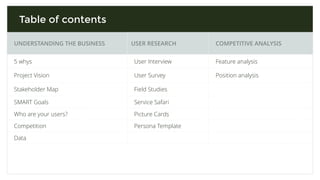
Table of contents
UNDERSTANDING THE BUSINESS USER RESEARCH COMPETITIVE ANALYSIS
5 whys User Interview Feature analysis
Project Vision User Survey Position analysis
Stakeholder Map Field Studies
SMART Goals Service Safari
Who are your users? Picture Cards
Competition Persona Template
Data
UNDERSTANDING
the business
Find the need. Then design the solution.
In that order.
“
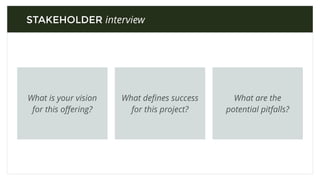
STAKEHOLDER interview
What is your vision
for this offering?
What defines success
for this project?
What are the
potential pitfalls?
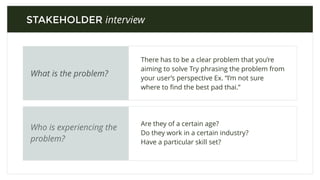
STAKEHOLDER interview
What is the problem?
Who is experiencing the
problem?
There has to be a clear problem that you’re
aiming to solve Try phrasing the problem from
your user’s perspective Ex. “I’m not sure
where to find the best pad thai.”
Are they of a certain age?
Do they work in a certain industry?
Have a particular skill set?
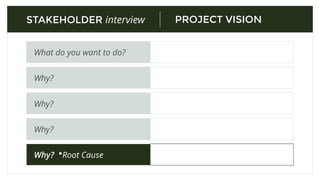
What do you want to do?
Why?
Why?
Why? *Root Cause
Why?
PROJECT VISIONSTAKEHOLDER interview
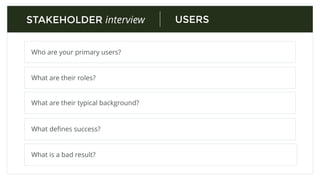
USERSSTAKEHOLDER interview
Who are your primary users?
What are their roles?
What are their typical background?
What defines success?
What is a bad result?
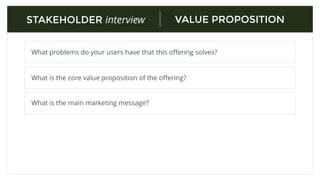
VALUE PROPOSITIONSTAKEHOLDER interview
What problems do your users have that this offering solves?
What is the core value proposition of the offering?
What is the main marketing message?
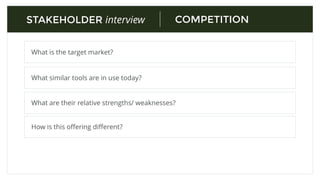
COMPETITIONSTAKEHOLDER interview
What is the target market?
What similar tools are in use today?
What are their relative strengths/ weaknesses?
How is this offering different?
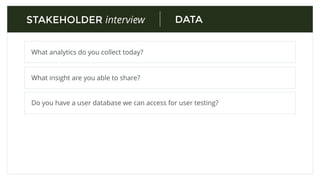
DATASTAKEHOLDER interview
What analytics do you collect today?
What insight are you able to share?
Do you have a user database we can access for user testing?
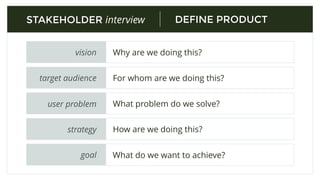
vision
target audience
strategy
user problem
DEFINE PRODUCTSTAKEHOLDER interview
goal
Why are we doing this?
For whom are we doing this?
What problem do we solve?
How are we doing this?
What do we want to achieve?
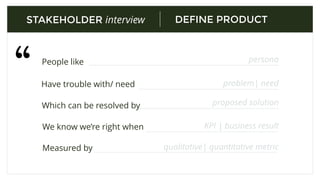
DEFINE PRODUCTSTAKEHOLDER interview
People like
Have trouble with/ need
Which can be resolved by
We know we’re right when
Measured by
persona
problem| need
proposed solution
KPI | business result
qualitative| quantitative metric
“
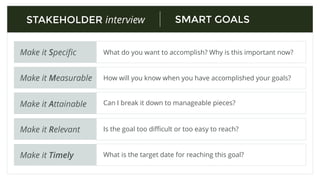
Make it Specific
Make it Measurable
Make it Relevant
Make it Attainable
SMART GOALSSTAKEHOLDER interview
Make it Timely
What do you want to accomplish? Why is this important now?
How will you know when you have accomplished your goals?
Can I break it down to manageable pieces?
Is the goal too difficult or too easy to reach?
What is the target date for reaching this goal?
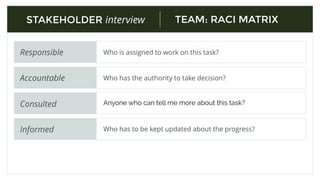
Responsible
Accountable
Informed
Consulted
TEAM: RACI MATRIXSTAKEHOLDER interview
Who is assigned to work on this task?
Who has the authority to take decision?
Anyone who can tell me more about this task?
Who has to be kept updated about the progress?
UNDERSTANDING
the user
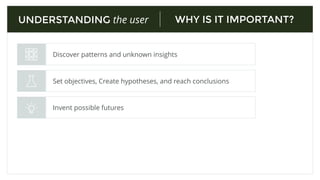
WHY IS IT IMPORTANT?UNDERSTANDING the user
Discover patterns and unknown insights
Set objectives, Create hypotheses, and reach conclusions
Invent possible futures
INTERVIWING
users
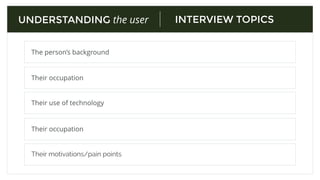
INTERVIEW TOPICS
The person’s background
Their occupation
Their use of technology
Their occupation
UNDERSTANDING the user
Their motivations/pain points
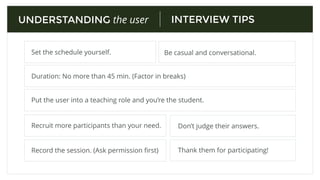
INTERVIEW TIPS
Set the schedule yourself.
Recruit more participants than your need.
UNDERSTANDING the user
Duration: No more than 45 min. (Factor in breaks)
Record the session. (Ask permission first)
Put the user into a teaching role and you’re the student.
Be casual and conversational.
Don’t judge their answers.
Thank them for participating!
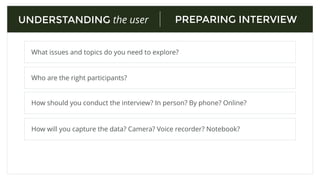
PREPARING INTERVIEW
What issues and topics do you need to explore?
Who are the right participants?
How should you conduct the interview? In person? By phone? Online?
How will you capture the data? Camera? Voice recorder? Notebook?
UNDERSTANDING the user
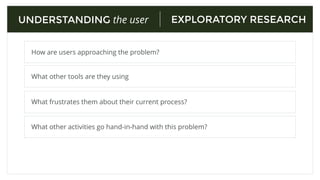
EXPLORATORY RESEARCH
How are users approaching the problem?
What frustrates them about their current process?
What other activities go hand-in-hand with this problem?
UNDERSTANDING the user
What other tools are they using
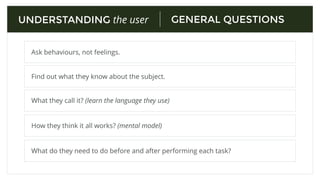
GENERAL QUESTIONS
Ask behaviours, not feelings.
What they call it? (learn the language they use)
UNDERSTANDING the user
Find out what they know about the subject.
How they think it all works? (mental model)
What do they need to do before and after performing each task?
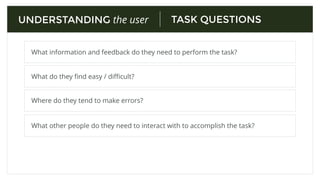
TASK QUESTIONS
What information and feedback do they need to perform the task?
Where do they tend to make errors?
UNDERSTANDING the user
What do they find easy / difficult?
What other people do they need to interact with to accomplish the task?
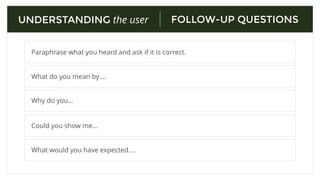
FOLLOW-UP QUESTIONS
Paraphrase what you heard and ask if it is correct.
Why do you…
UNDERSTANDING the user
What do you mean by….
Could you show me…
What would you have expected….
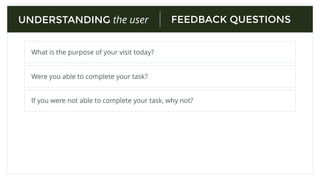
FEEDBACK QUESTIONS
What is the purpose of your visit today?
If you were not able to complete your task, why not?
UNDERSTANDING the user
Were you able to complete your task?
RESEARCH
methods
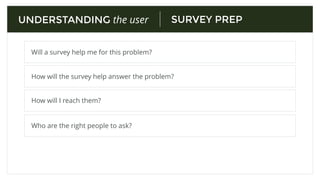
SURVEY PREP
Will a survey help me for this problem?
How will I reach them?
UNDERSTANDING the user
How will the survey help answer the problem?
Who are the right people to ask?
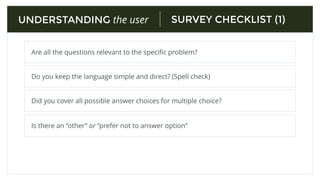
SURVEY CHECKLIST (1)
Are all the questions relevant to the specific problem?
UNDERSTANDING the user
Do you keep the language simple and direct? (Spell check)
Is there an “other” or “prefer not to answer option”
Did you cover all possible answer choices for multiple choice?
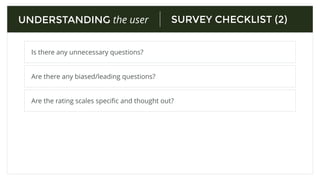
SURVEY CHECKLIST (2)
Is there any unnecessary questions?
UNDERSTANDING the user
Are there any biased/leading questions?
Are the rating scales specific and thought out?
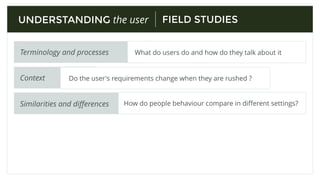
FIELD STUDIESUNDERSTANDING the user
Terminology and processes
Context
Similarities and differences
What do users do and how do they talk about it
Do the user's requirements change when they are rushed ?
How do people behaviour compare in different settings?
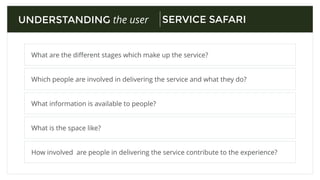
What are the different stages which make up the service?
UNDERSTANDING the user
Which people are involved in delivering the service and what they do?
What information is available to people?
SERVICE SAFARI
What is the space like?
How involved are people in delivering the service contribute to the experience?
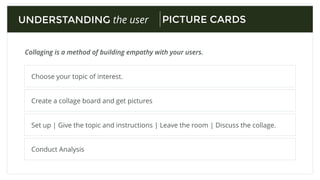
Collaging is a method of building empathy with your users.
UNDERSTANDING the user
Choose your topic of interest.
Create a collage board and get pictures
PICTURE CARDS
Set up | Give the topic and instructions | Leave the room | Discuss the collage.
Conduct Analysis
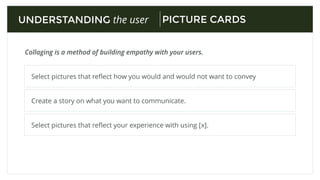
Collaging is a method of building empathy with your users.
UNDERSTANDING the user
Select pictures that reflect how you would and would not want to convey
Create a story on what you want to communicate.
PICTURE CARDS
Select pictures that reflect your experience with using [x].
STEPS
UNDERSTANDING the user
Choose your topic of interest.
Create a collage board and get pictures
PICTURE CARDS
Set up | Give the topic and instructions | Leave the room | Discuss the collage.
Conduct Analysis
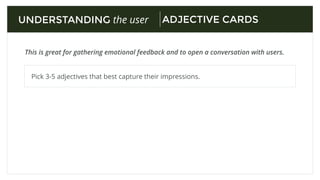
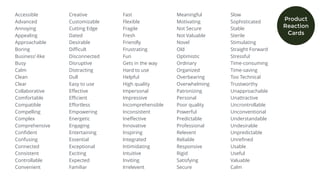
This is great for gathering emotional feedback and to open a conversation with users.
UNDERSTANDING the user
Pick 3-5 adjectives that best capture their impressions.
ADJECTIVE CARDS
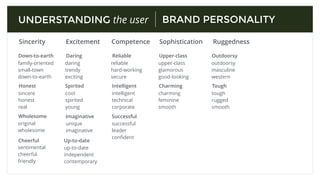
BRAND PERSONALITYUNDERSTANDING the user
Sincerity Excitement Competence Sophistication Ruggedness
Down-to-earth Daring Reliable Upper-class Outdoorsy
family-oriented
small-town
down-to-earth
daring
trendy
exciting
reliable
hard-working
secure
upper-class
glamorous
good-looking
outdoorsy
masculine
western
Honest
sincere
honest
real
Wholesome
original
wholesome
Cheerful
sentimental
cheerful
friendly
Intelligent
intelligent
technical
corporate
Successful
successful
leader
confident
Spirited
cool
spirited
young
Imaginative
unique
imaginative
Up-to-date
up-to-date
independent
contemporary
Charming
charming
feminine
smooth
Tough
tough
rugged
smooth
adjective Cards
Accessible Creative Fast Meaningful Slow
Advanced Customizable Flexible Motivating Sophisticated
Annoying Cutting Edge Fragile Not Secure Stable
Appealing Dated Fresh Not Valuable Sterile
Approachable Desirable Friendly Novel Stimulating
Boring Difficult Frustrating Old Straight Forward
Business’-like Disconnected Fun Optimistic Stressful
Busy Disruptive Gets in the way Ordinary Time-consuming
Calm Distracting Hard to use Organized Time-saving
Clean Dull Helpful Overbearing Too Technical
Clear Easy to use High quality Overwhelming Trustworthy
Collaborative Effective Impersonal Patronizing Unapproachable
Comfortable Efficient Impressive Personal Unattractive
Compatible Effortless Incomprehensible Poor quality Uncrontrollable
Compelling Empowering Inconsistent Powerful Unconventional
Complex Energetic Ineffective Predictable Understandable
Comprehensive Engaging Innovative Professional Undesirable
Confident Entertaining Inspiring Relevent Unpredictable
Confusing Essential Integrated Reliable Unrefined
Connected Exceptional Intimidating Responsive Usable
Consistent Exciting Intuitive Rigid Useful
Controllable Expected Inviting Satisfying Valuable
Convenient Familiar Irrelevent Secure Calm
Product
Reaction
Cards
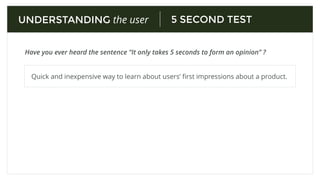
Have you ever heard the sentence “It only takes 5 seconds to form an opinion” ?
UNDERSTANDING the user
Quick and inexpensive way to learn about users’ first impressions about a product.
5 SECOND TEST
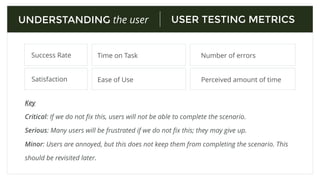
UNDERSTANDING the user USER TESTING METRICS
Success Rate Time on Task Number of errors
Satisfaction Ease of Use Perceived amount of time
Key
Critical: If we do not fix this, users will not be able to complete the scenario.
Serious: Many users will be frustrated if we do not fix this; they may give up.
Minor: Users are annoyed, but this does not keep them from completing the scenario. This
should be revisited later.
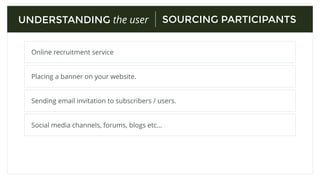
SOURCING PARTICIPANTS
Online recruitment service
UNDERSTANDING the user
Placing a banner on your website.
Sending email invitation to subscribers / users.
Social media channels, forums, blogs etc…
USER
persona
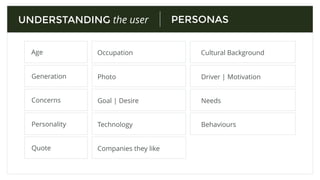
PERSONAS
Age
UNDERSTANDING the user
Occupation Cultural Background
Generation Photo Driver | Motivation
Concerns Goal | Desire Needs
Personality Technology Behaviours
Quote Companies they like
PERSONAS
Age
UNDERSTANDING the user
Occupation Cultural Background
Generation Photo Driver | Motivation
Concerns Goal | Desire Needs
Personality Technology Behaviours
Quote Companies they like
UNDERSTANDING
the market
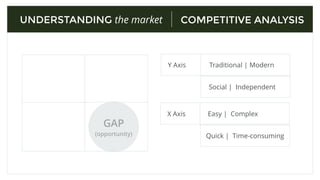
COMPETITIVE ANALYSISUNDERSTANDING the market
GAP
(opportunity)
Y Axis AgeTraditional | Modern
AgeSocial | Independent
X Axis AgeEasy | Complex
AgeQuick | Time-consuming
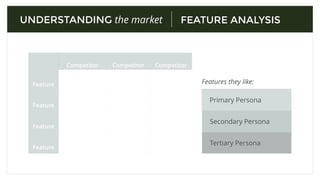
FEATURE ANALYSISUNDERSTANDING the market
Features they like:
Primary Persona
Competitor Competitor Competitor
Feature
Feature
Feature
Feature
Secondary Persona
Tertiary Persona
UXToolkit
discovery
PHASE 1
structure
PHASE 2
skeleton
PHASE 3
NEXT UP
UXDesigner
@maitedalila

UX Toolkit - Phase One

  • 1.
  • 2.
  • 3.
    Table of contents UNDERSTANDINGTHE BUSINESS USER RESEARCH COMPETITIVE ANALYSIS 5 whys User Interview Feature analysis Project Vision User Survey Position analysis Stakeholder Map Field Studies SMART Goals Service Safari Who are your users? Picture Cards Competition Persona Template Data
  • 4.
  • 5.
    Find the need.Then design the solution. In that order. “
  • 6.
    STAKEHOLDER interview What isyour vision for this offering? What defines success for this project? What are the potential pitfalls?
  • 7.
    STAKEHOLDER interview What isthe problem? Who is experiencing the problem? There has to be a clear problem that you’re aiming to solve Try phrasing the problem from your user’s perspective Ex. “I’m not sure where to find the best pad thai.” Are they of a certain age? Do they work in a certain industry? Have a particular skill set?
  • 8.
    What do youwant to do? Why? Why? Why? *Root Cause Why? PROJECT VISIONSTAKEHOLDER interview
  • 9.
    USERSSTAKEHOLDER interview Who areyour primary users? What are their roles? What are their typical background? What defines success? What is a bad result?
  • 10.
    VALUE PROPOSITIONSTAKEHOLDER interview Whatproblems do your users have that this offering solves? What is the core value proposition of the offering? What is the main marketing message?
  • 11.
    COMPETITIONSTAKEHOLDER interview What isthe target market? What similar tools are in use today? What are their relative strengths/ weaknesses? How is this offering different?
  • 12.
    DATASTAKEHOLDER interview What analyticsdo you collect today? What insight are you able to share? Do you have a user database we can access for user testing?
  • 13.
    vision target audience strategy user problem DEFINEPRODUCTSTAKEHOLDER interview goal Why are we doing this? For whom are we doing this? What problem do we solve? How are we doing this? What do we want to achieve?
  • 14.
    DEFINE PRODUCTSTAKEHOLDER interview Peoplelike Have trouble with/ need Which can be resolved by We know we’re right when Measured by persona problem| need proposed solution KPI | business result qualitative| quantitative metric “
  • 15.
    Make it Specific Makeit Measurable Make it Relevant Make it Attainable SMART GOALSSTAKEHOLDER interview Make it Timely What do you want to accomplish? Why is this important now? How will you know when you have accomplished your goals? Can I break it down to manageable pieces? Is the goal too difficult or too easy to reach? What is the target date for reaching this goal?
  • 16.
    Responsible Accountable Informed Consulted TEAM: RACI MATRIXSTAKEHOLDERinterview Who is assigned to work on this task? Who has the authority to take decision? Anyone who can tell me more about this task? Who has to be kept updated about the progress?
  • 17.
  • 18.
    WHY IS ITIMPORTANT?UNDERSTANDING the user Discover patterns and unknown insights Set objectives, Create hypotheses, and reach conclusions Invent possible futures
  • 19.
  • 20.
    INTERVIEW TOPICS The person’sbackground Their occupation Their use of technology Their occupation UNDERSTANDING the user Their motivations/pain points
  • 21.
    INTERVIEW TIPS Set theschedule yourself. Recruit more participants than your need. UNDERSTANDING the user Duration: No more than 45 min. (Factor in breaks) Record the session. (Ask permission first) Put the user into a teaching role and you’re the student. Be casual and conversational. Don’t judge their answers. Thank them for participating!
  • 22.
    PREPARING INTERVIEW What issuesand topics do you need to explore? Who are the right participants? How should you conduct the interview? In person? By phone? Online? How will you capture the data? Camera? Voice recorder? Notebook? UNDERSTANDING the user
  • 23.
    EXPLORATORY RESEARCH How areusers approaching the problem? What frustrates them about their current process? What other activities go hand-in-hand with this problem? UNDERSTANDING the user What other tools are they using
  • 24.
    GENERAL QUESTIONS Ask behaviours,not feelings. What they call it? (learn the language they use) UNDERSTANDING the user Find out what they know about the subject. How they think it all works? (mental model) What do they need to do before and after performing each task?
  • 25.
    TASK QUESTIONS What informationand feedback do they need to perform the task? Where do they tend to make errors? UNDERSTANDING the user What do they find easy / difficult? What other people do they need to interact with to accomplish the task?
  • 26.
    FOLLOW-UP QUESTIONS Paraphrase whatyou heard and ask if it is correct. Why do you… UNDERSTANDING the user What do you mean by…. Could you show me… What would you have expected….
  • 27.
    FEEDBACK QUESTIONS What isthe purpose of your visit today? If you were not able to complete your task, why not? UNDERSTANDING the user Were you able to complete your task?
  • 28.
  • 29.
    SURVEY PREP Will asurvey help me for this problem? How will I reach them? UNDERSTANDING the user How will the survey help answer the problem? Who are the right people to ask?
  • 30.
    SURVEY CHECKLIST (1) Areall the questions relevant to the specific problem? UNDERSTANDING the user Do you keep the language simple and direct? (Spell check) Is there an “other” or “prefer not to answer option” Did you cover all possible answer choices for multiple choice?
  • 31.
    SURVEY CHECKLIST (2) Isthere any unnecessary questions? UNDERSTANDING the user Are there any biased/leading questions? Are the rating scales specific and thought out?
  • 32.
    FIELD STUDIESUNDERSTANDING theuser Terminology and processes Context Similarities and differences What do users do and how do they talk about it Do the user's requirements change when they are rushed ? How do people behaviour compare in different settings?
  • 33.
    What are thedifferent stages which make up the service? UNDERSTANDING the user Which people are involved in delivering the service and what they do? What information is available to people? SERVICE SAFARI What is the space like? How involved are people in delivering the service contribute to the experience?
  • 34.
    Collaging is amethod of building empathy with your users. UNDERSTANDING the user Choose your topic of interest. Create a collage board and get pictures PICTURE CARDS Set up | Give the topic and instructions | Leave the room | Discuss the collage. Conduct Analysis
  • 35.
    Collaging is amethod of building empathy with your users. UNDERSTANDING the user Select pictures that reflect how you would and would not want to convey Create a story on what you want to communicate. PICTURE CARDS Select pictures that reflect your experience with using [x].
  • 36.
    STEPS UNDERSTANDING the user Chooseyour topic of interest. Create a collage board and get pictures PICTURE CARDS Set up | Give the topic and instructions | Leave the room | Discuss the collage. Conduct Analysis
  • 37.
    This is greatfor gathering emotional feedback and to open a conversation with users. UNDERSTANDING the user Pick 3-5 adjectives that best capture their impressions. ADJECTIVE CARDS
  • 38.
    BRAND PERSONALITYUNDERSTANDING theuser Sincerity Excitement Competence Sophistication Ruggedness Down-to-earth Daring Reliable Upper-class Outdoorsy family-oriented small-town down-to-earth daring trendy exciting reliable hard-working secure upper-class glamorous good-looking outdoorsy masculine western Honest sincere honest real Wholesome original wholesome Cheerful sentimental cheerful friendly Intelligent intelligent technical corporate Successful successful leader confident Spirited cool spirited young Imaginative unique imaginative Up-to-date up-to-date independent contemporary Charming charming feminine smooth Tough tough rugged smooth
  • 39.
    adjective Cards Accessible CreativeFast Meaningful Slow Advanced Customizable Flexible Motivating Sophisticated Annoying Cutting Edge Fragile Not Secure Stable Appealing Dated Fresh Not Valuable Sterile Approachable Desirable Friendly Novel Stimulating Boring Difficult Frustrating Old Straight Forward Business’-like Disconnected Fun Optimistic Stressful Busy Disruptive Gets in the way Ordinary Time-consuming Calm Distracting Hard to use Organized Time-saving Clean Dull Helpful Overbearing Too Technical Clear Easy to use High quality Overwhelming Trustworthy Collaborative Effective Impersonal Patronizing Unapproachable Comfortable Efficient Impressive Personal Unattractive Compatible Effortless Incomprehensible Poor quality Uncrontrollable Compelling Empowering Inconsistent Powerful Unconventional Complex Energetic Ineffective Predictable Understandable Comprehensive Engaging Innovative Professional Undesirable Confident Entertaining Inspiring Relevent Unpredictable Confusing Essential Integrated Reliable Unrefined Connected Exceptional Intimidating Responsive Usable Consistent Exciting Intuitive Rigid Useful Controllable Expected Inviting Satisfying Valuable Convenient Familiar Irrelevent Secure Calm Product Reaction Cards
  • 40.
    Have you everheard the sentence “It only takes 5 seconds to form an opinion” ? UNDERSTANDING the user Quick and inexpensive way to learn about users’ first impressions about a product. 5 SECOND TEST
  • 41.
    UNDERSTANDING the userUSER TESTING METRICS Success Rate Time on Task Number of errors Satisfaction Ease of Use Perceived amount of time Key Critical: If we do not fix this, users will not be able to complete the scenario. Serious: Many users will be frustrated if we do not fix this; they may give up. Minor: Users are annoyed, but this does not keep them from completing the scenario. This should be revisited later.
  • 42.
    SOURCING PARTICIPANTS Online recruitmentservice UNDERSTANDING the user Placing a banner on your website. Sending email invitation to subscribers / users. Social media channels, forums, blogs etc…
  • 43.
  • 44.
    PERSONAS Age UNDERSTANDING the user OccupationCultural Background Generation Photo Driver | Motivation Concerns Goal | Desire Needs Personality Technology Behaviours Quote Companies they like
  • 45.
    PERSONAS Age UNDERSTANDING the user OccupationCultural Background Generation Photo Driver | Motivation Concerns Goal | Desire Needs Personality Technology Behaviours Quote Companies they like
  • 46.
  • 47.
    COMPETITIVE ANALYSISUNDERSTANDING themarket GAP (opportunity) Y Axis AgeTraditional | Modern AgeSocial | Independent X Axis AgeEasy | Complex AgeQuick | Time-consuming
  • 48.
    FEATURE ANALYSISUNDERSTANDING themarket Features they like: Primary Persona Competitor Competitor Competitor Feature Feature Feature Feature Secondary Persona Tertiary Persona
  • 49.
  • 50.