Lecture 3: Hypertext

     Prof. Alvarado
   MDST 3703/7703
   4 September 2012
Business
• The weekly blogging cycle
  – READ, COMMENT, DISCUSS, POST, REPEAT
  – Comment by Monday at 5
  – Post after class on Thursday (by Friday at 5)
• Grace period this week …
Review
• Digital representation
  – Anything can be represented by numbers
  – Numbers are just characters that can be
    manipulated (sorted, counted, repeated, etc.)
  – Information is just a series of characters
• Can we/you come up with a system to
  represent taste?
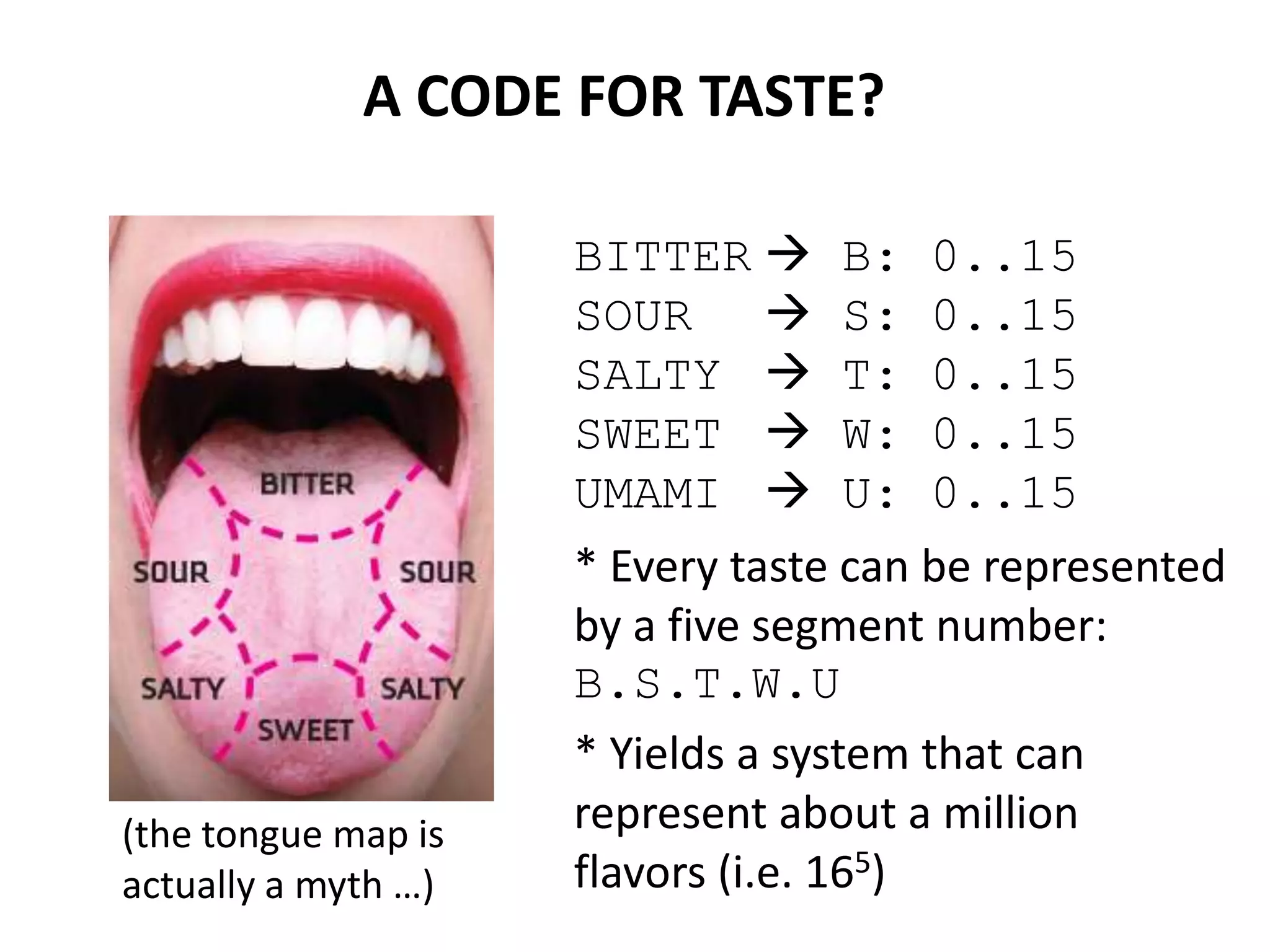
A CODE FOR TASTE?

                     BITTER  B:       0..15
                     SOUR  S:         0..15
                     SALTY  T:        0..15
              A   Code for Taste
                     SWEET  W:        0..15
                     UMAMI  U:        0..15
                      * Every taste can be represented
                      by a five segment number:
                      B.S.T.W.U
                      * Yields a system that can
(the tongue map is    represent about a million
actually a myth …)    flavors (i.e. 165)
Taste “files”
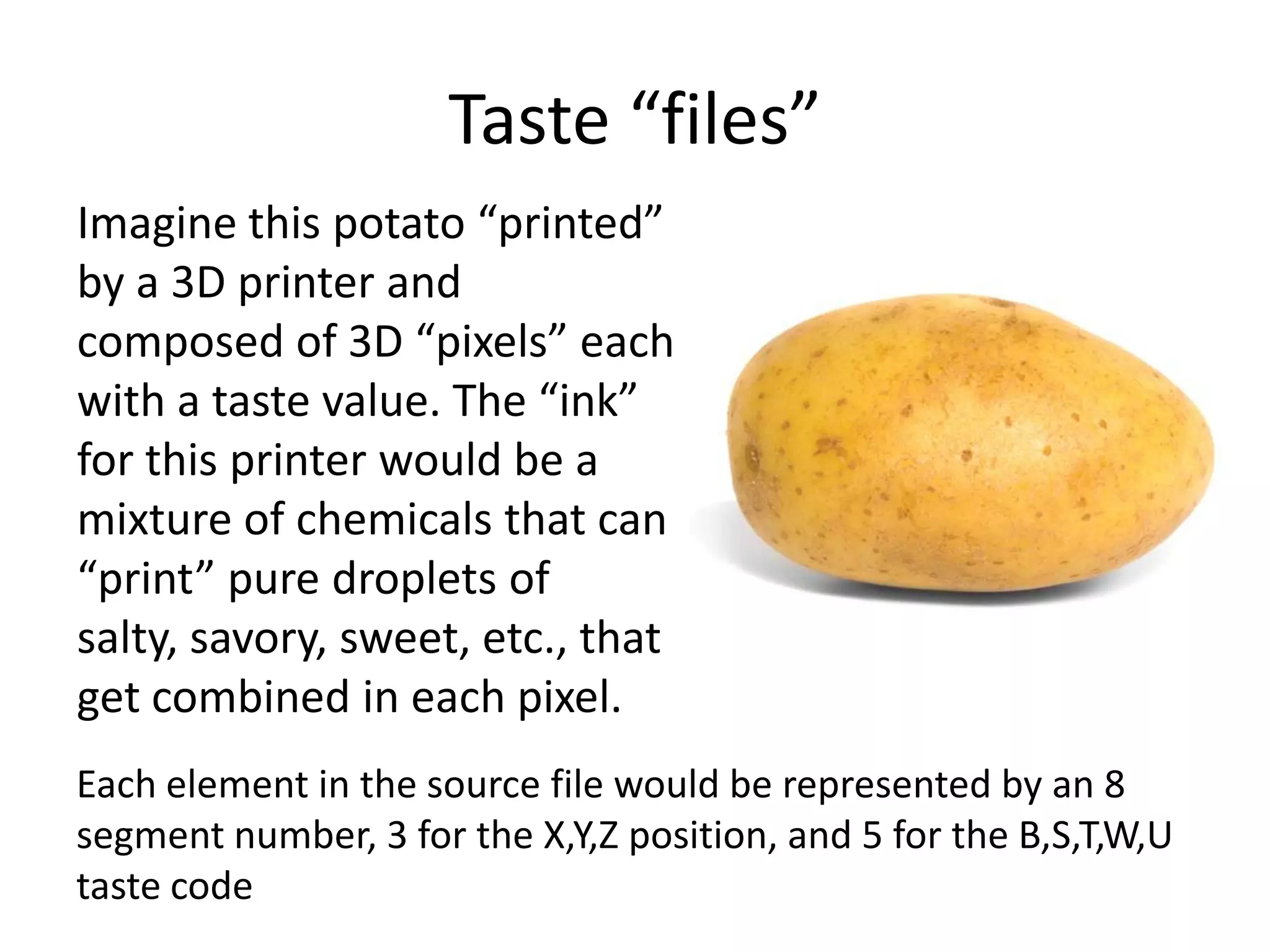
Imagine this potato “printed”
by a 3D printer and
composed of 3D “pixels” each
with a taste value. The “ink”
for this printer would be a
mixture of chemicals that can
“print” pure droplets of
salty, savory, sweet, etc., that
get combined in each pixel.
Each element in the source file would be represented by an 8
segment number, 3 for the X,Y,Z position, and 5 for the B,S,T,W,U
taste code
Hypertext
Liberation

What does hypertext liberate us
        from? How?
“When reading these articles and
watching the video, it immediately
made think of Quentin Tarantino
movies, The Six Degrees of Kevin
Bacon, and the Choose Your Own
Adventure books I checked out it bulk
as a kid – all have this out-of-order
connectedness, similar to how
hypertext functions, that create a
very satisfying (user) experience.
People don’t naturally seem to think
sequentially – it almost seems like
more of an effort.”
“All of these authors see
hypertext as a way to escape the
many limitations of the
analog, terrestrial world by
making text multidimensional and
placing it in a networked
informational system, which
breaks down the barriers of a
linear world.”
Liberation from …
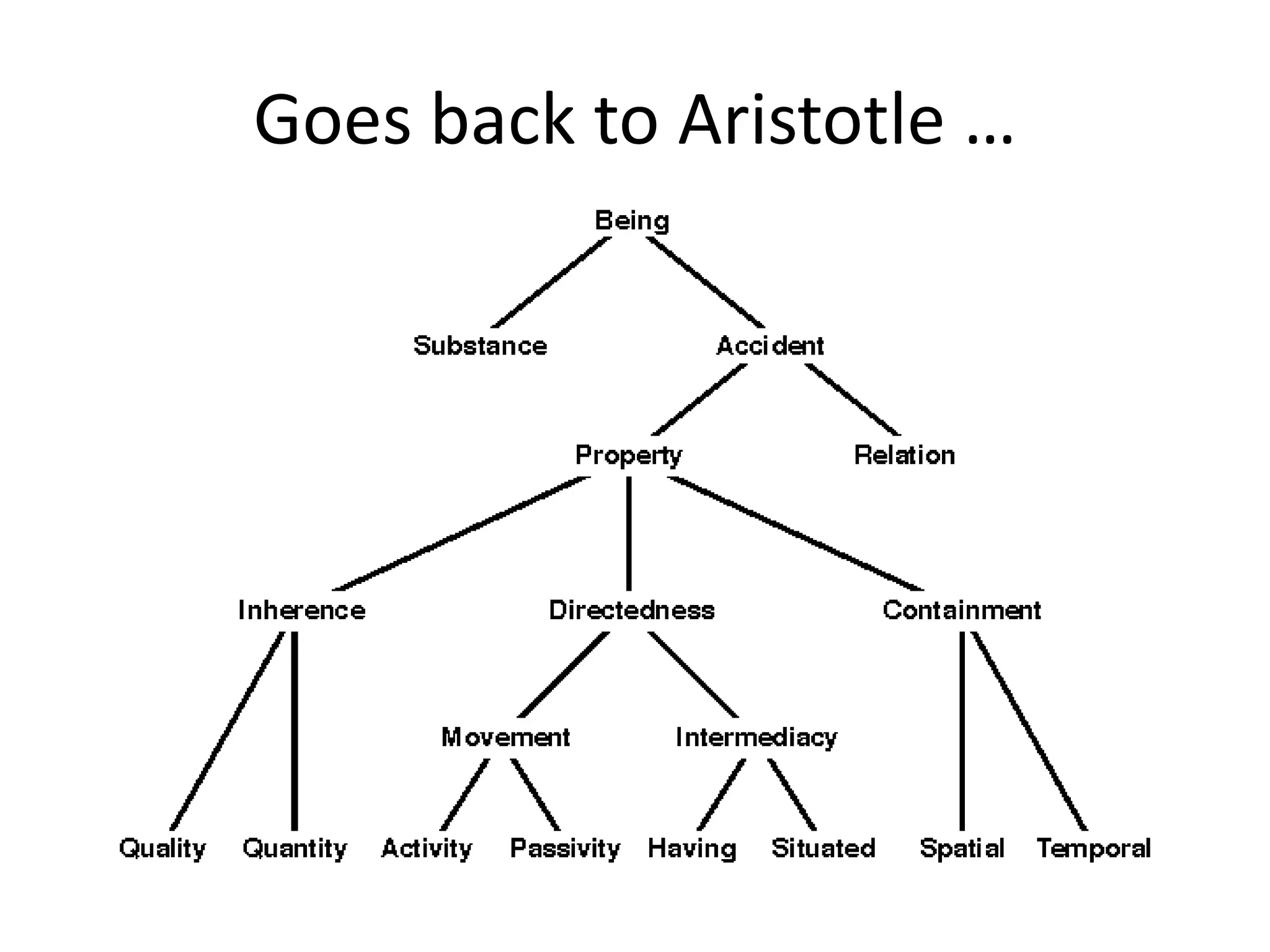
• Hierarchy and linear thinking implied by how
  books and libraries are organized
• Limits imposed by the material form of texts
  that prevent minds from making natural
  connections
Where does hierarchy come in?

       Where do you find it?
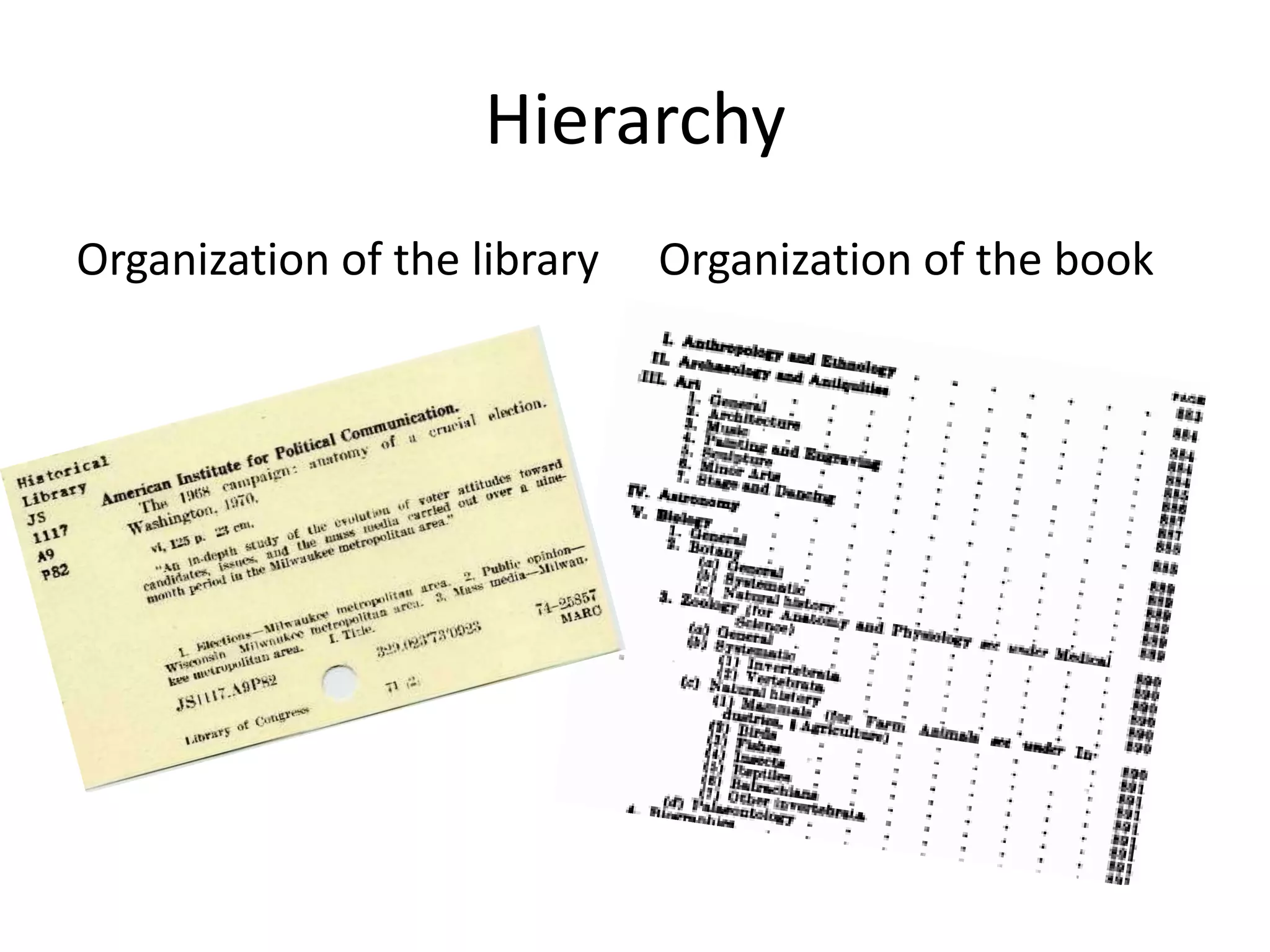
Hierarchy
Organization of the library   Organization of the book
Goes back to Aristotle …
So, what’s wrong with hierarchy?
Hierarchies fail because things
belong in more than one place
[Tomato]
How does digital text overcome
      these problems?
      Let’s look at the history …
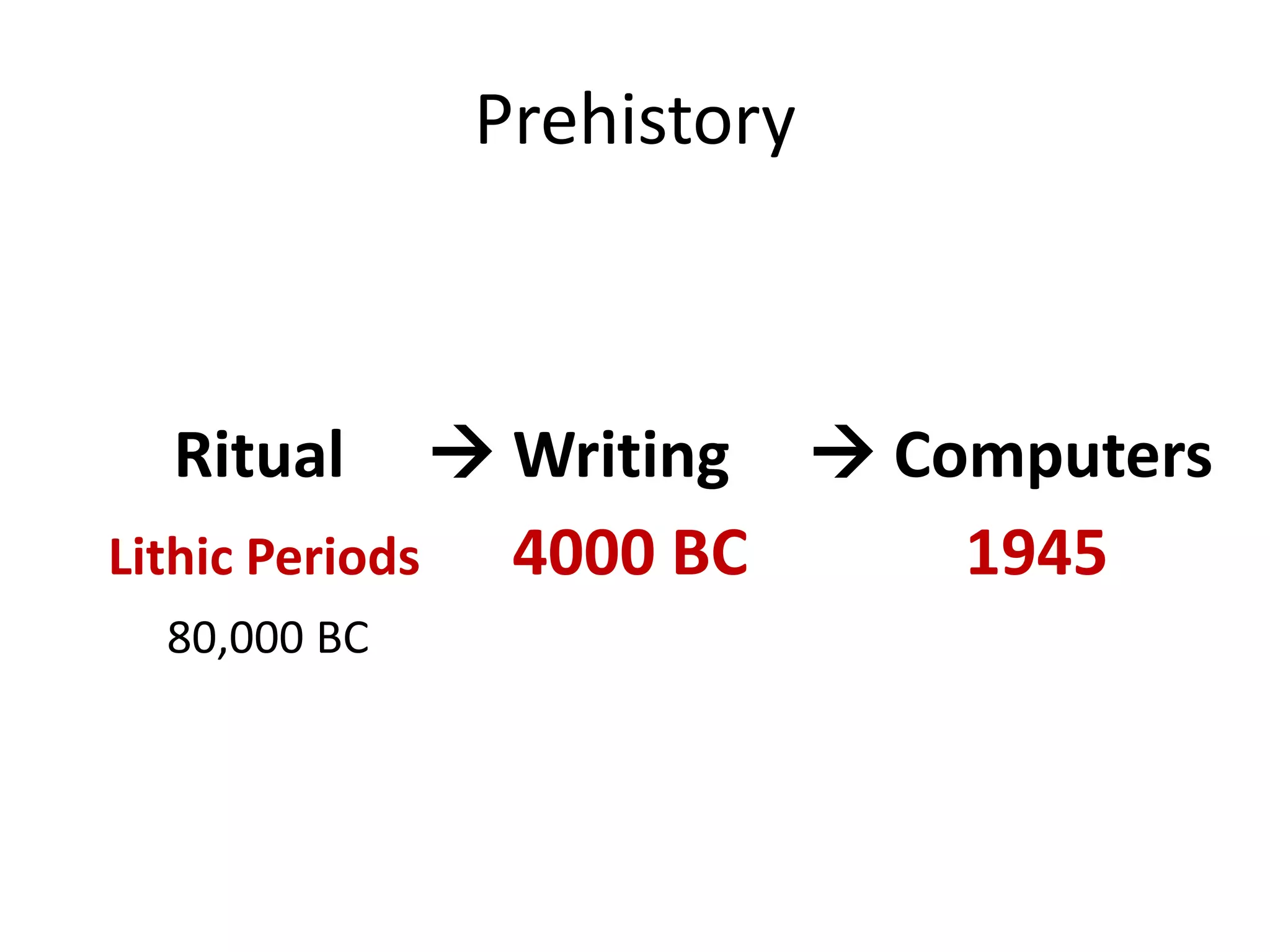
Prehistory


  Ritual        Writing  Computers
Lithic Periods   4000 BC     1945
 80,000 BC
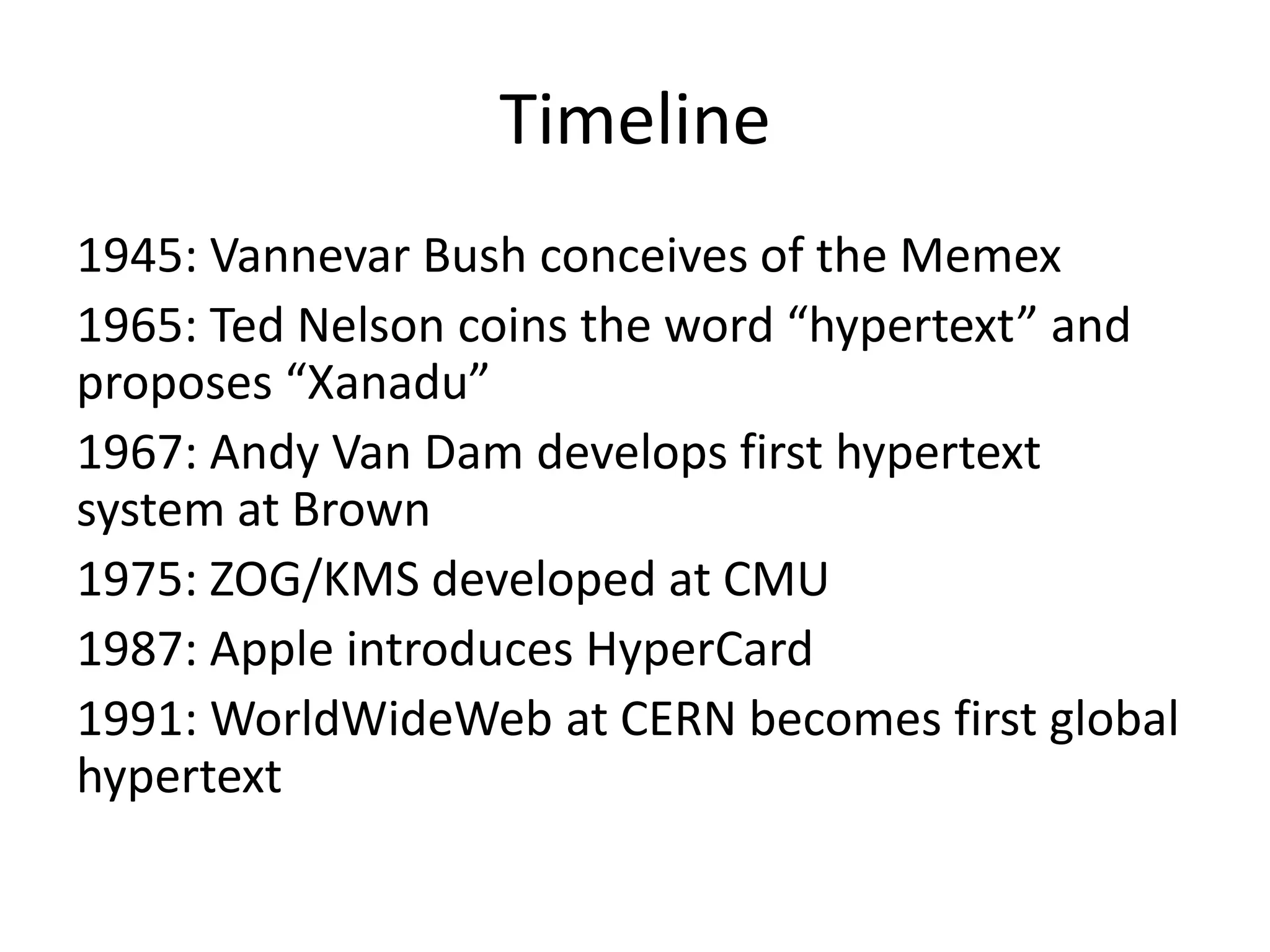
Timeline
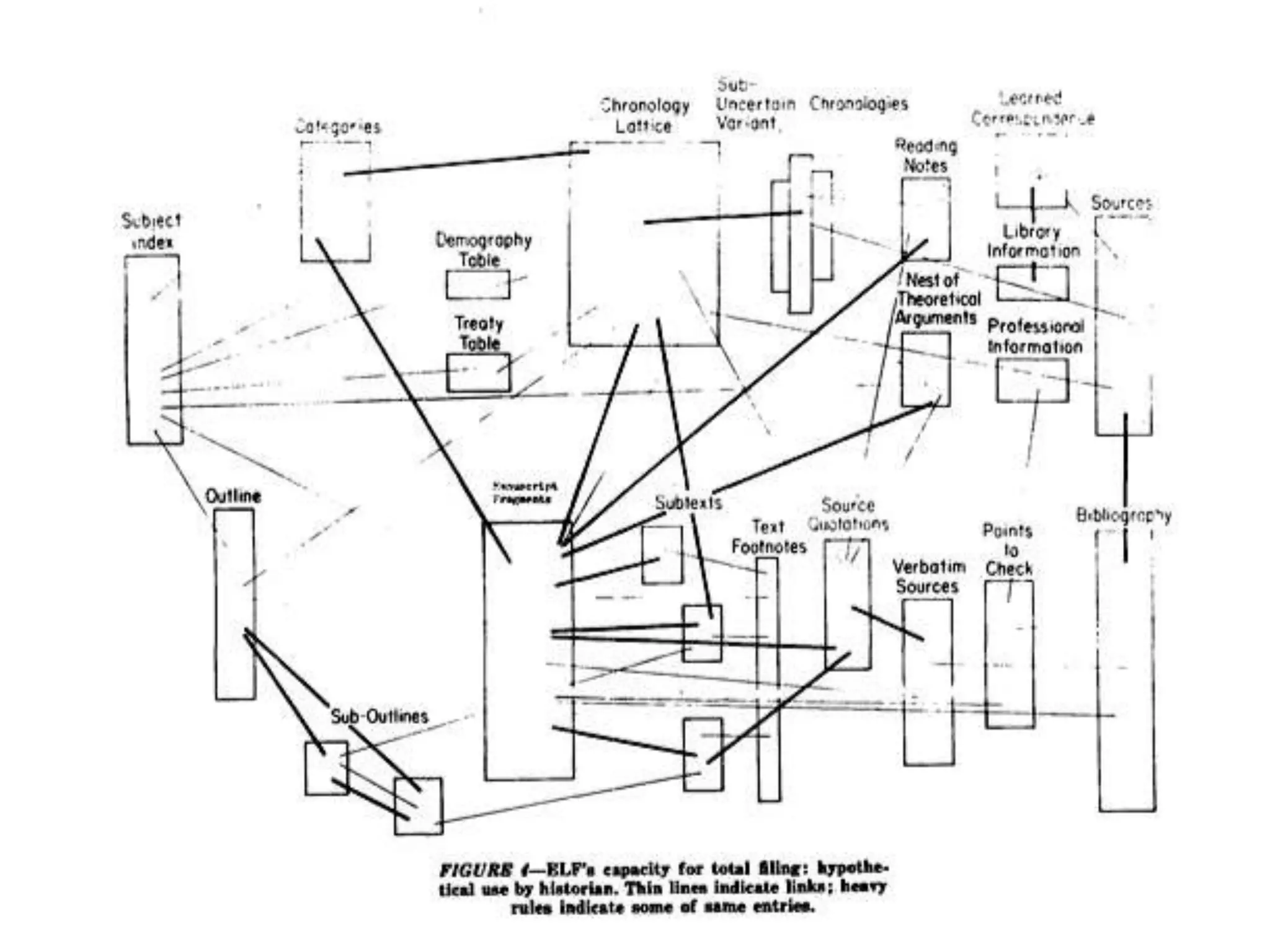
1945: Vannevar Bush conceives of the Memex
1965: Ted Nelson coins the word “hypertext” and
proposes “Xanadu”
1967: Andy Van Dam develops first hypertext
system at Brown
1975: ZOG/KMS developed at CMU
1987: Apple introduces HyperCard
1991: WorldWideWeb at CERN becomes first global
hypertext
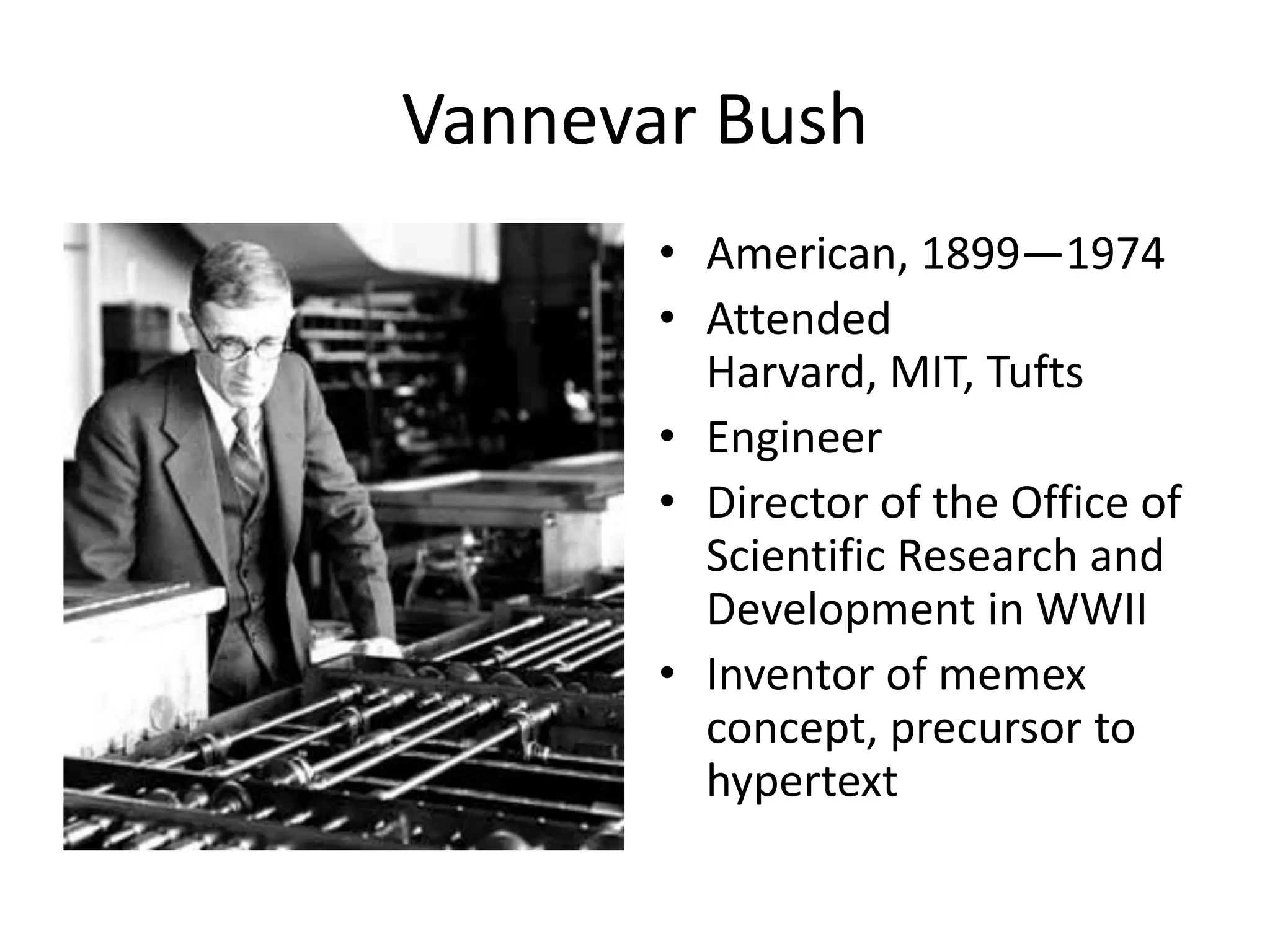
Vannevar Bush
       • American, 1899—1974
       • Attended
         Harvard, MIT, Tufts
       • Engineer
       • Director of the Office of
         Scientific Research and
         Development in WWII
       • Inventor of memex
         concept, precursor to
         hypertext
What is the problem Bush
addresses in As We May Think?
There is a growing mountain of research.

                          AND
      A record if it is to be useful to
      science, must be continuously
      extended, it must be stored, and above
      all it must be consulted.
               BUT
Publication has been extended far
beyond our present ability to make real
use of the record.
What makes it hard to find
        things?
    The problem of selection
When data are placed in storage, they are
filed alphabetically or numerically, and
information is found (when it is) by tracing it
down from subclass to subclass. It can be in
only one place, unless duplicates are used;
one has to have rules as to which path will
locate it, and the rules are cumbersome.
Having found one item, moreover, one has
to emerge from the system and re-enter on
a new path. . . . The hman mind does not
work that way. It operates by association.
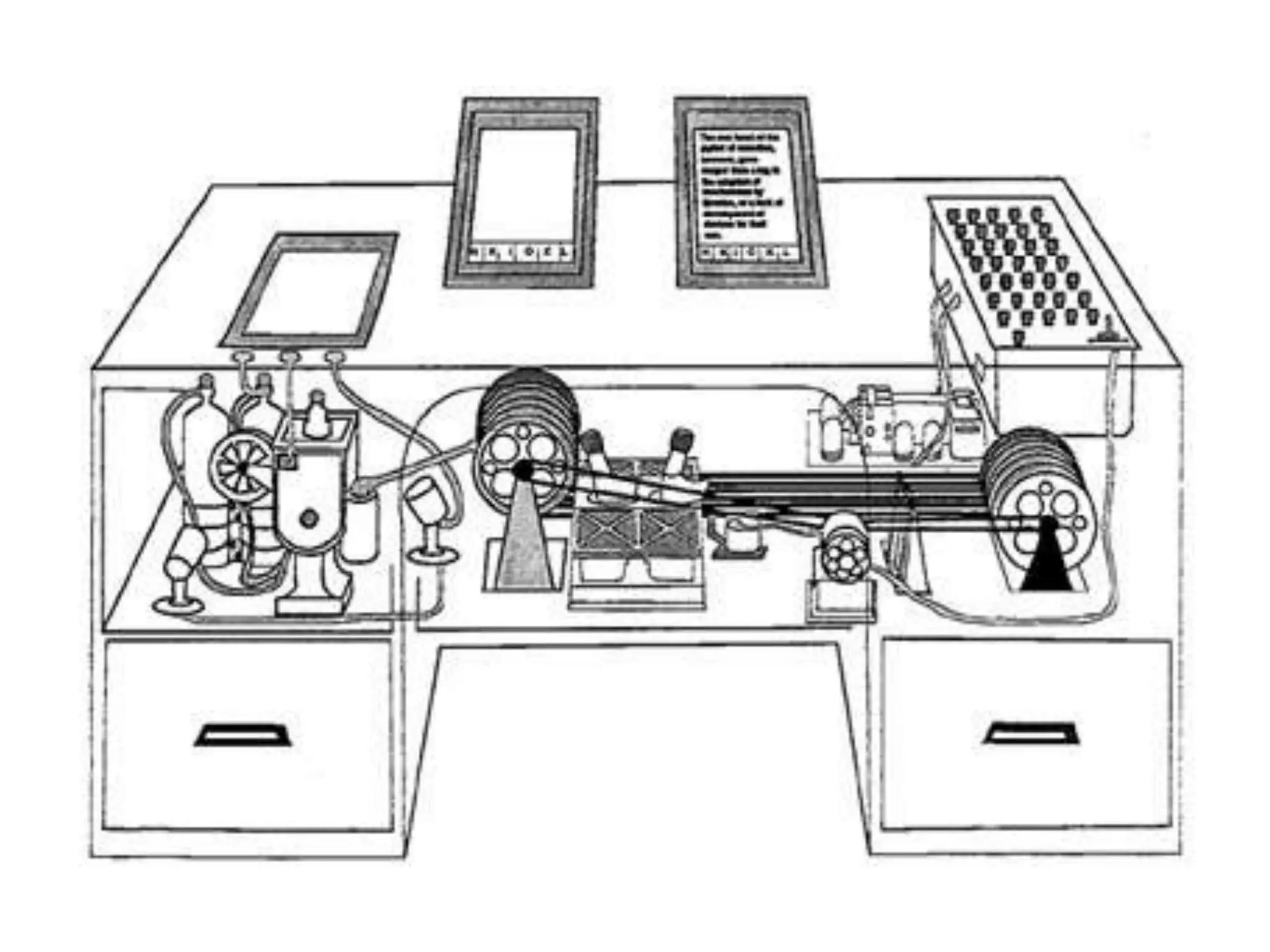
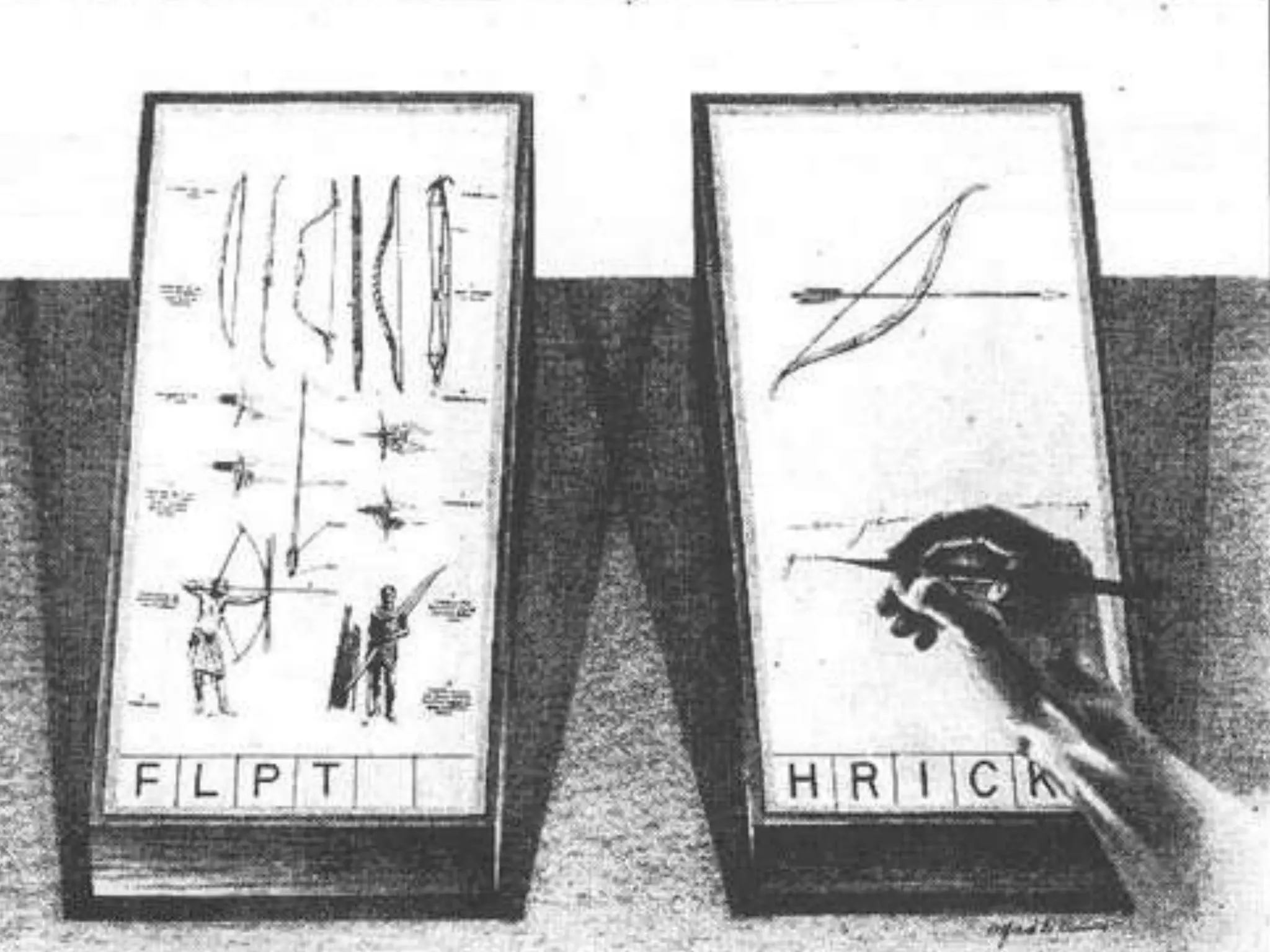
How does the
Memex solve the
  problem of
  selection?
It is exactly as though the physical
items had been gathered together
from widely separated sources and
bound together to form a new book. It
is more than this, for any item can be
joined into numerous trails.


                READING AS WRITING
Key ideas
• Associative indexing
  – “Any item may be caused at will to select
    immediately and automatically another”
  – “This is the essential feature of the memex”
• Trails and Codes
• The idea is to have media model how the
  mind (supposedly) works
• Any analogs in contemporary technology?
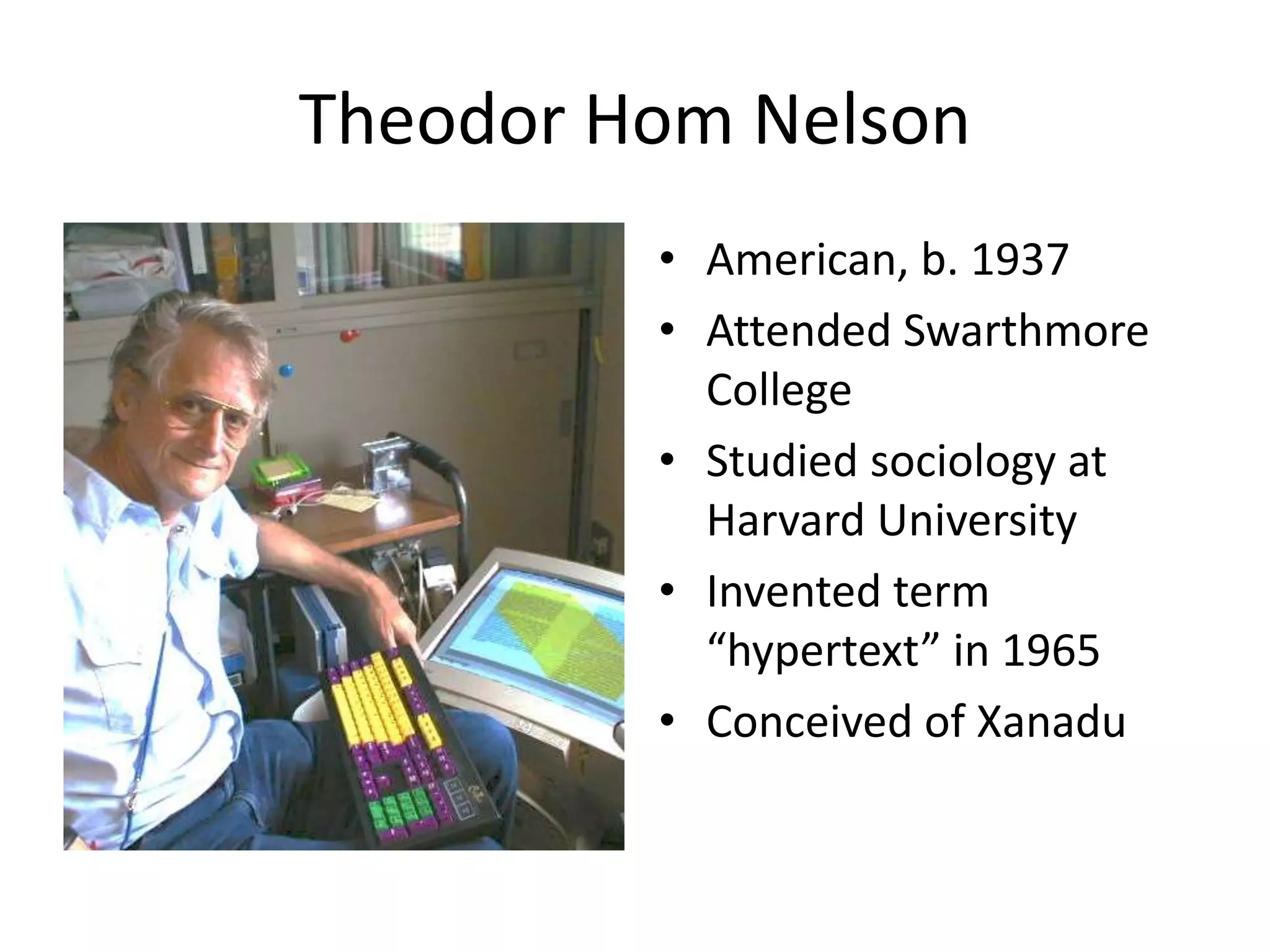
Theodor Hom Nelson
         • American, b. 1937
         • Attended Swarthmore
           College
         • Studied sociology at
           Harvard University
         • Invented term
           “hypertext” in 1965
         • Conceived of Xanadu
“Hypertext is non-sequential
        writinng”
             From Literary Machines
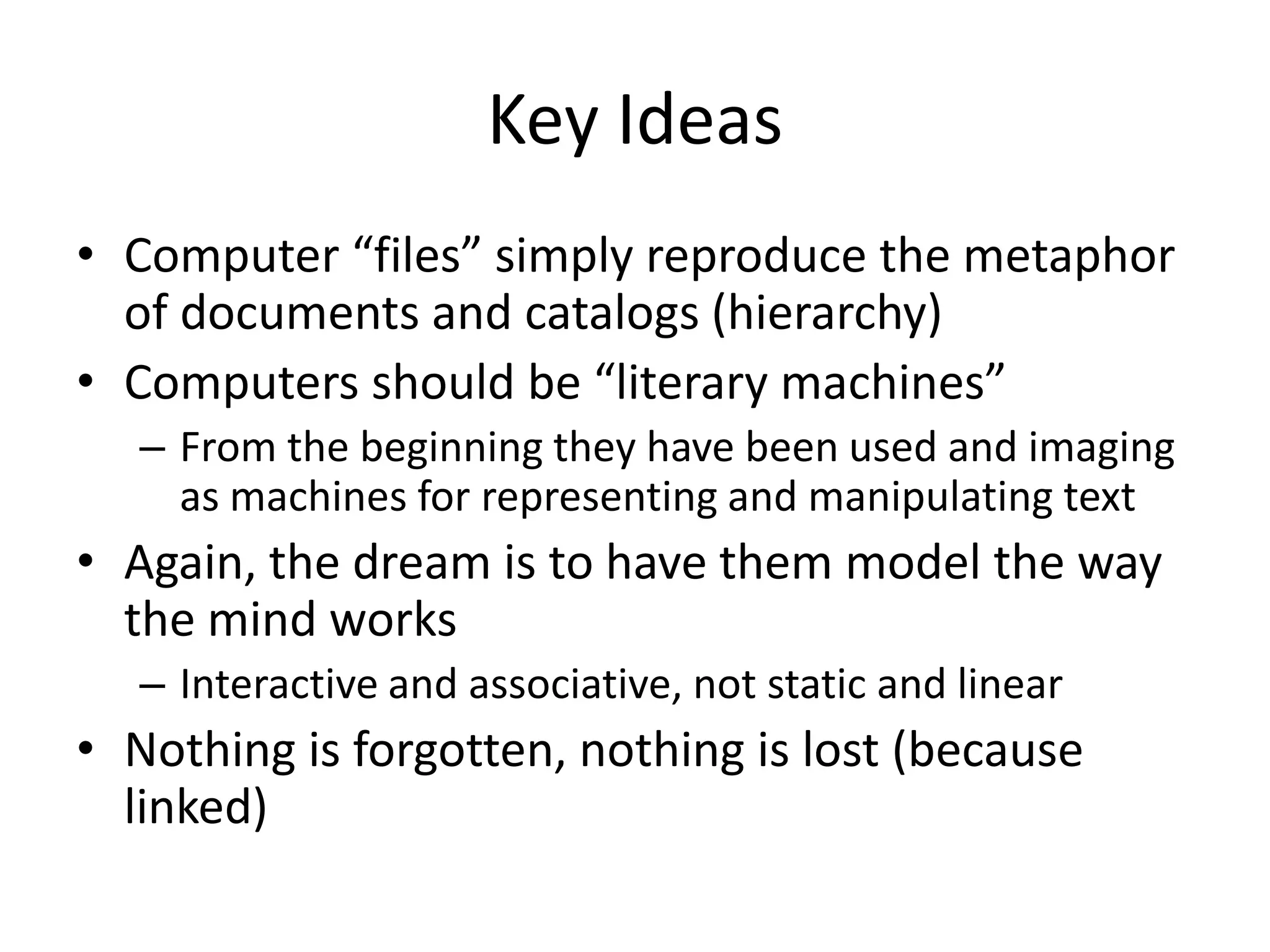
Key Ideas
• Computer “files” simply reproduce the metaphor
  of documents and catalogs (hierarchy)
• Computers should be “literary machines”
   – From the beginning they have been used and imaging
     as machines for representing and manipulating text
• Again, the dream is to have them model the way
  the mind works
   – Interactive and associative, not static and linear
• Nothing is forgotten, nothing is lost (because
  linked)
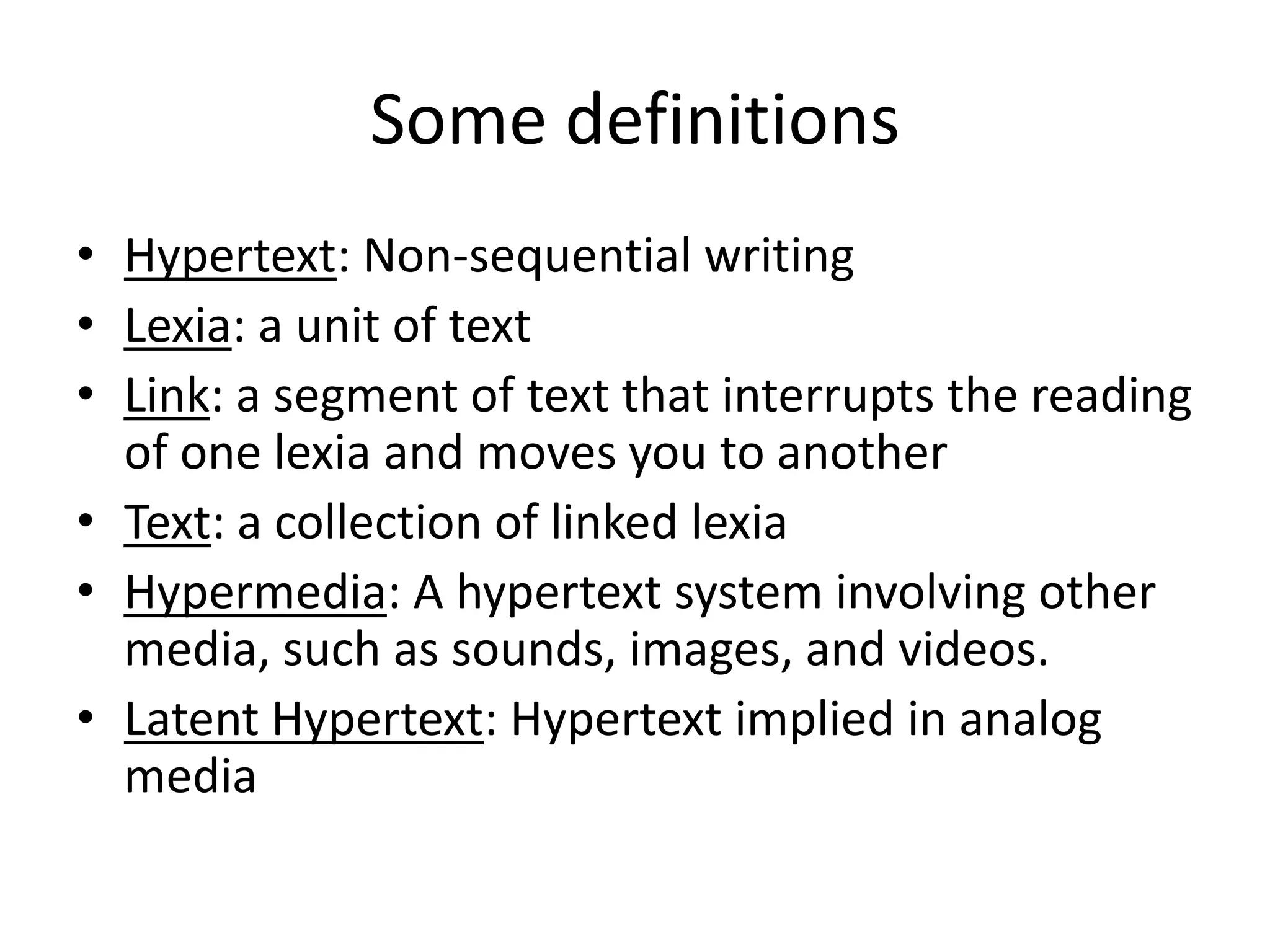
Some definitions
• Hypertext: Non-sequential writing
• Lexia: a unit of text
• Link: a segment of text that interrupts the reading
  of one lexia and moves you to another
• Text: a collection of linked lexia
• Hypermedia: A hypertext system involving other
  media, such as sounds, images, and videos.
• Latent Hypertext: Hypertext implied in analog
  media
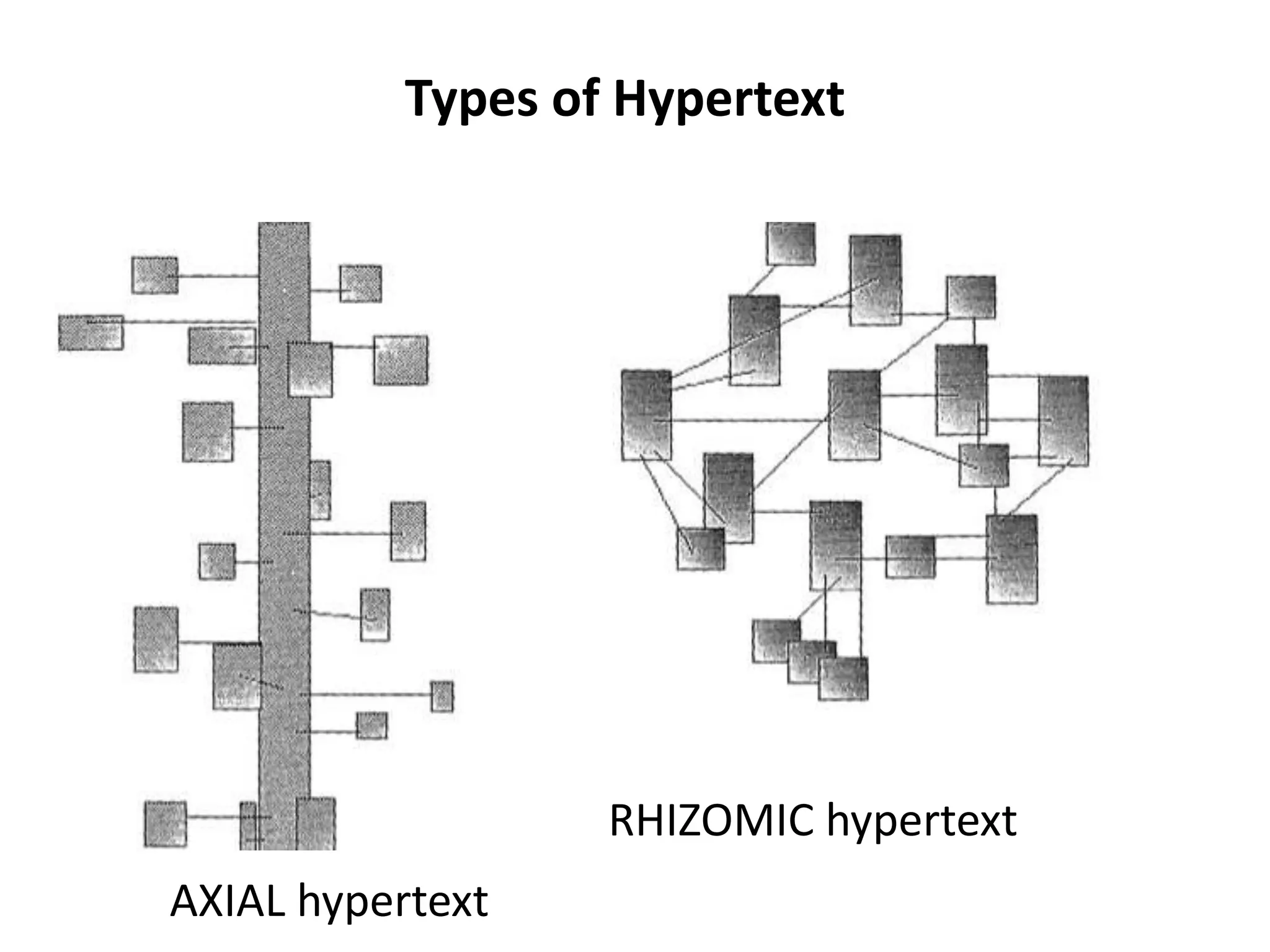
Types of Hypertext


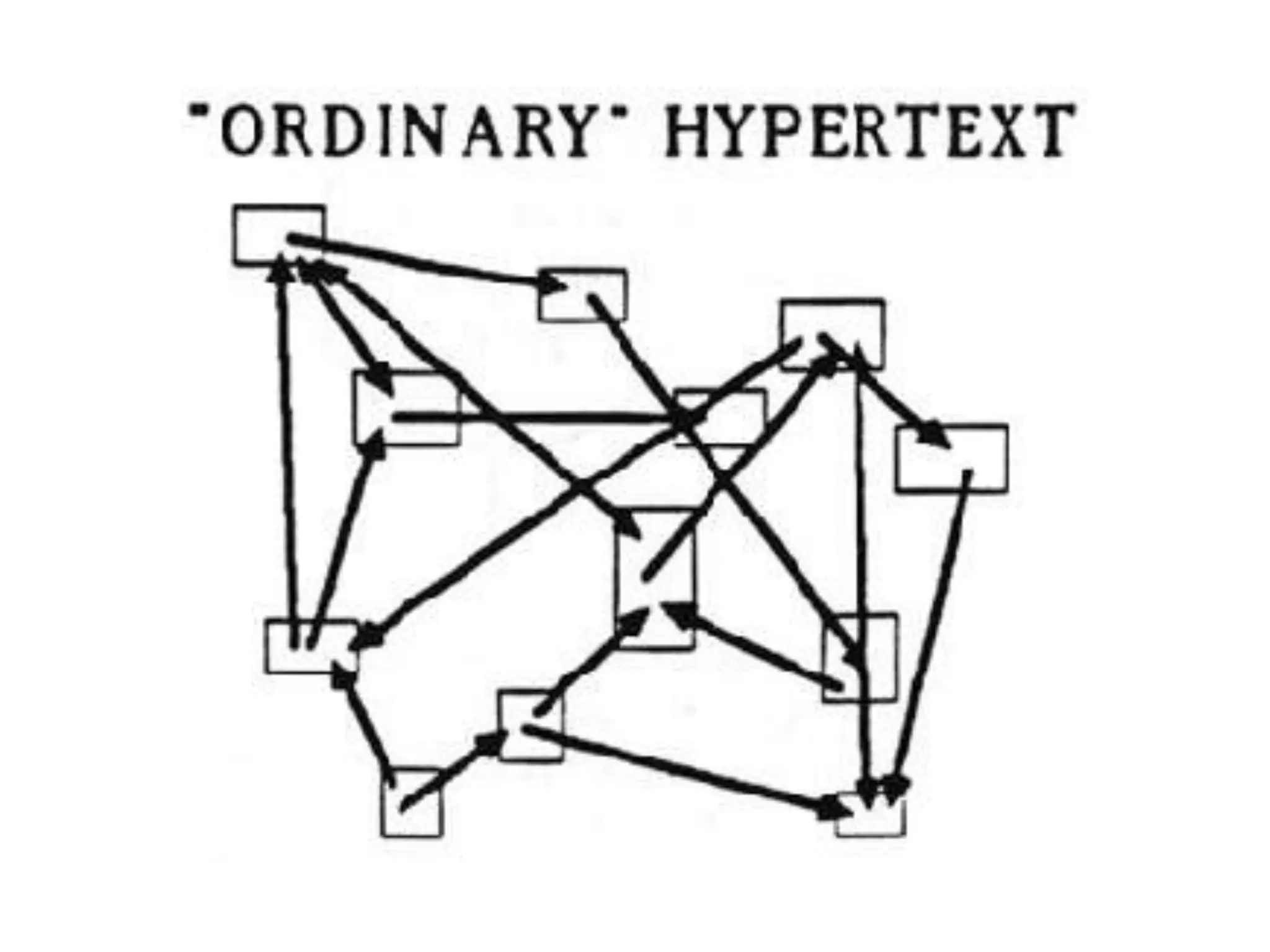
          Axial Hypertext


                   RHIZOMIC hypertext
AXIAL hypertext
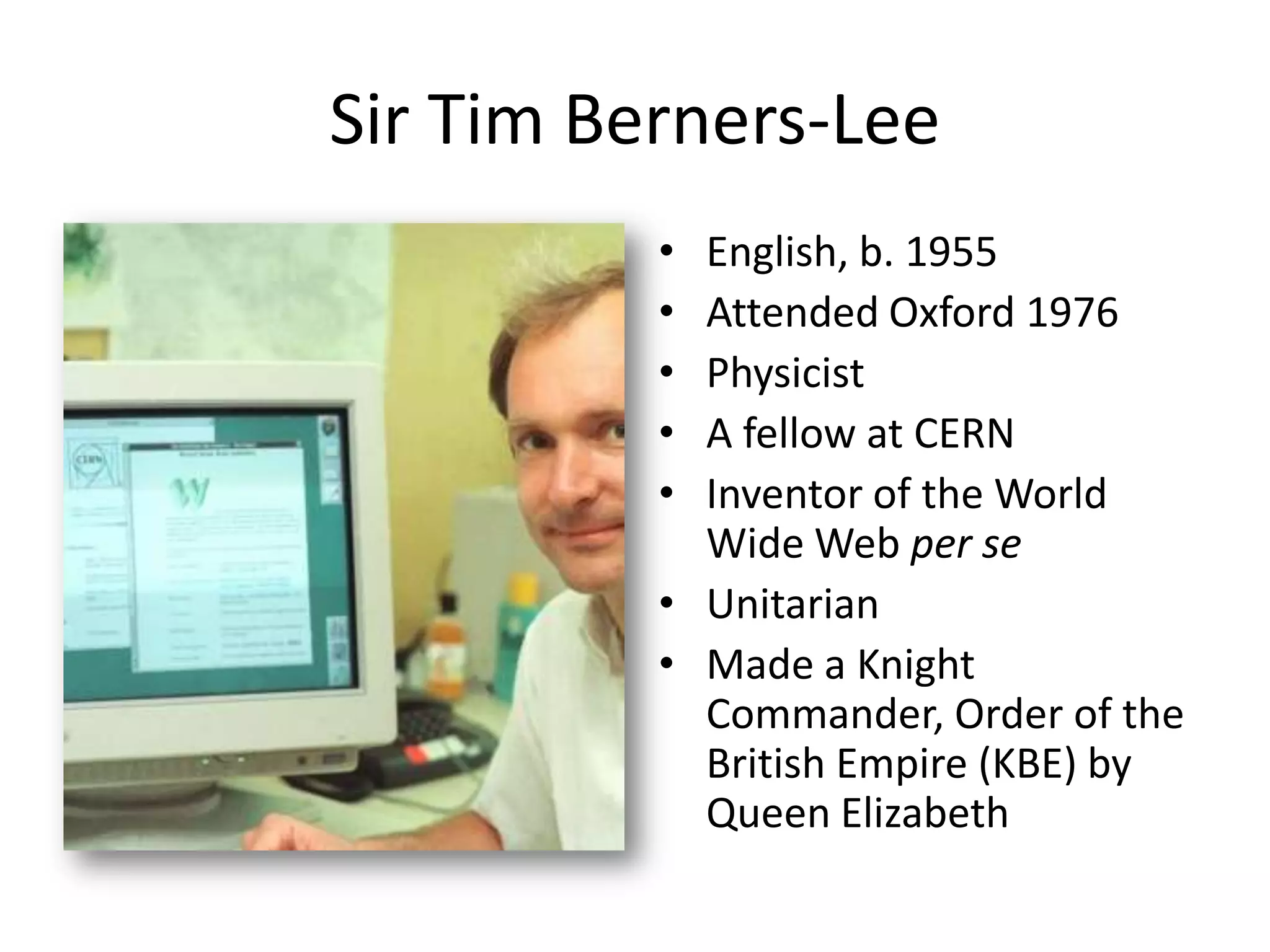
Sir Tim Berners-Lee
          • English, b. 1955
          • Attended Oxford 1976
          • Physicist
          • A fellow at CERN
          • Inventor of the World
            Wide Web per se
          • Unitarian
          • Made a Knight
            Commander, Order of the
            British Empire (KBE) by
            Queen Elizabeth
[Angels and Demons]

Dan Brown, Angels & Demons, p. 19
“In March 1989, Tim Berners-Lee submitted a proposal for an information
management system to his boss, Mike Sendall. ‘Vague, but exciting’, were the
words that Sendall wrote on the proposal, allowing Berners-Lee to continue.”
                                      (http://info.cern.ch/Proposal.html)


                          [CERN doc]
“CERN is a wonderful organisation. It involves
several thousand people …. Although they are
nominally organised into a hierarchical
management structure, this does not
constrain the way peoplesocial org]
      [BL quote are will
communicate, and share
information, equipment and software across
groups. … The actual observed working
structure of the organisation is a multiply
connected "web" whose interconnections
evolve with time.”
[Berners-Lee’s diagram]
Berners-Lee’s was the first system to
   link lexia across the network
    Hypertext not only linked lexia, but
       people – across the planet
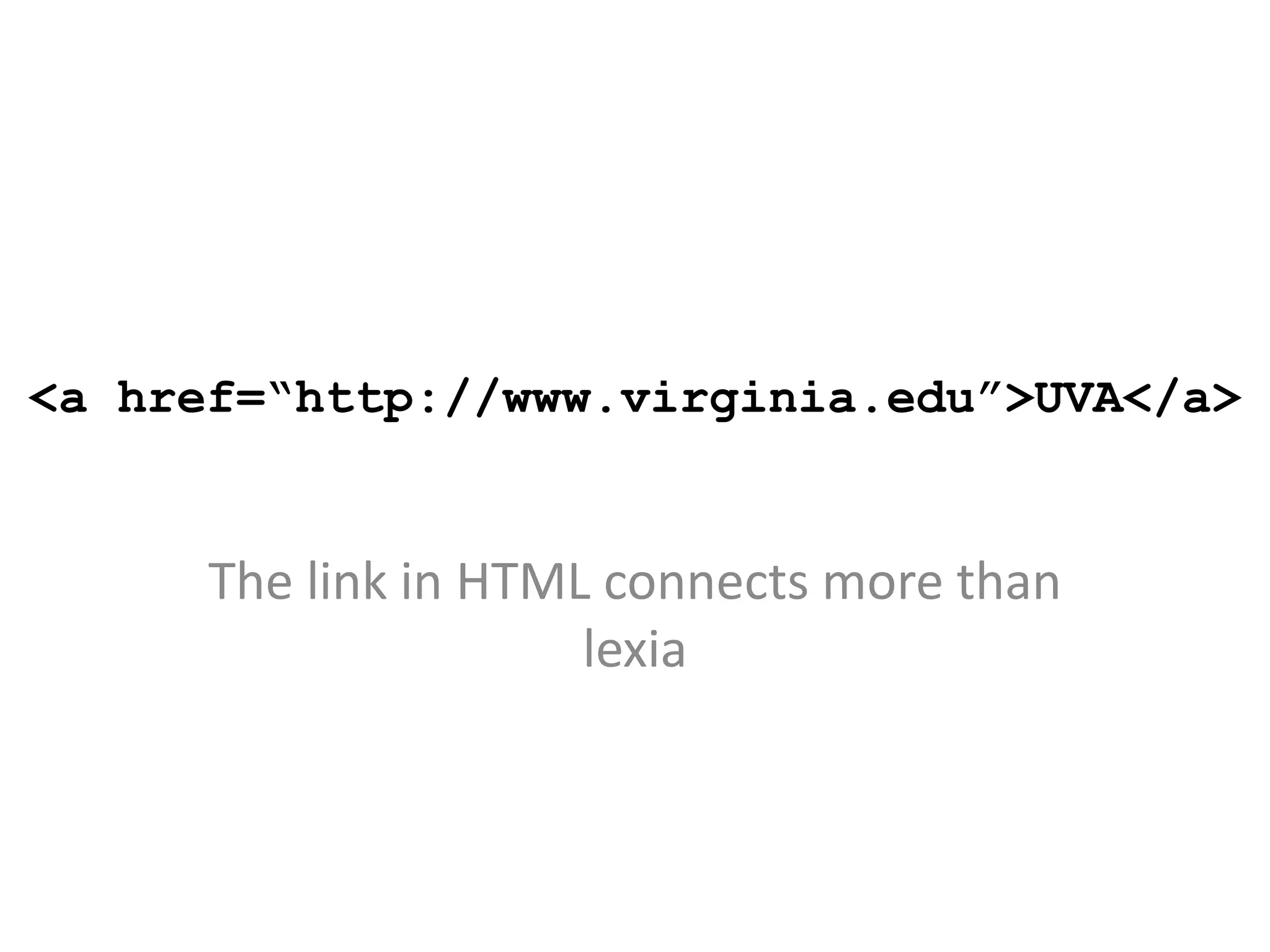
<a href=“http://www.virginia.edu”>UVA</a>


      The link in HTML connects more than
                      lexia
Nelson never liked the Web
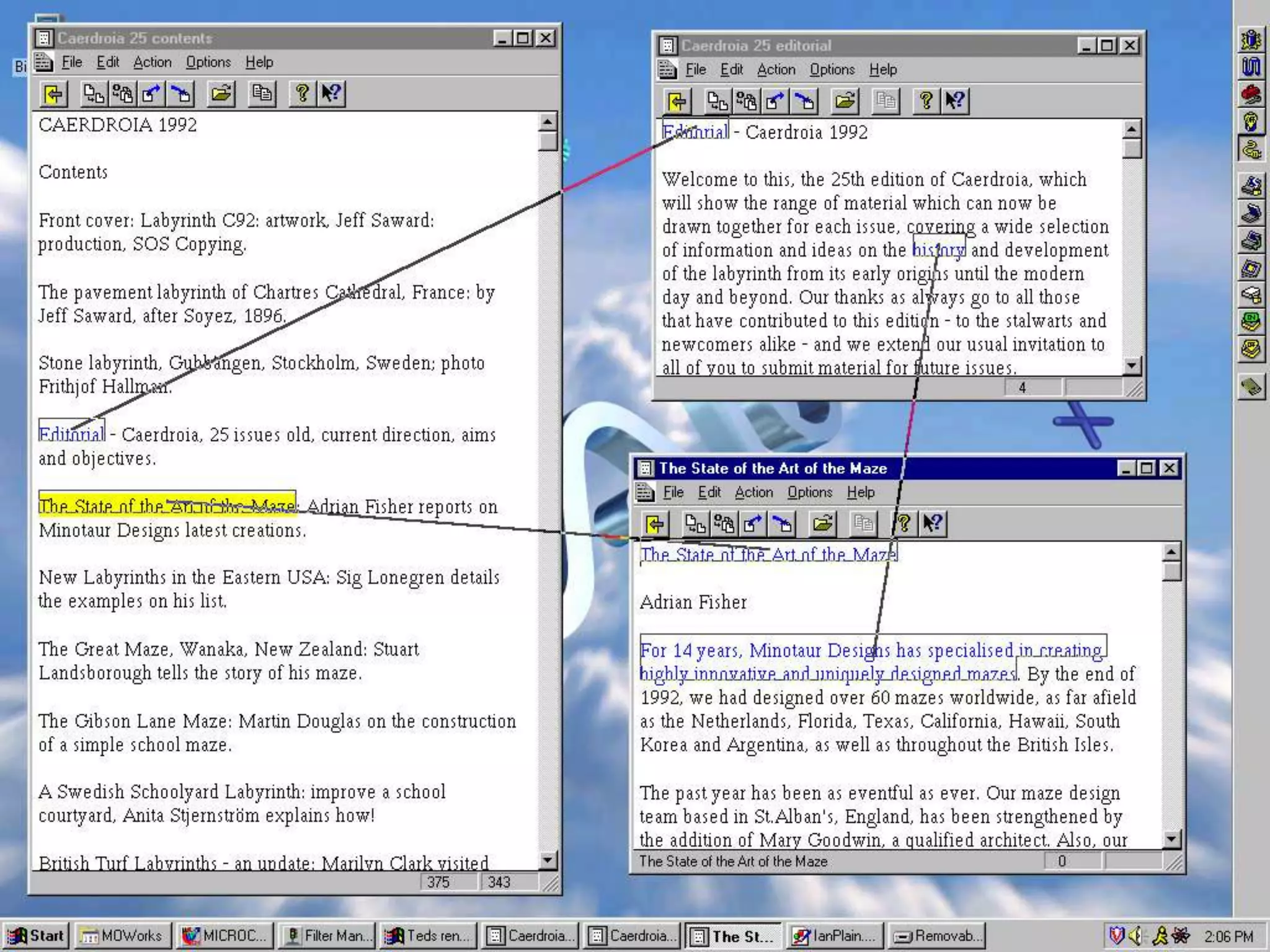
• The web remains bound to the metaphor of
  the file
• Links point to files (for the most part), not to
  true lexia
• Links are also “dumb” – they don’t go in both
  directions, and they are not named (as Bush
  would have wanted)
• Google has changed this some …
UVA MDST 3703 Hypertext 2012-09-04

UVA MDST 3703 Hypertext 2012-09-04

  • 1.
    Lecture 3: Hypertext Prof. Alvarado MDST 3703/7703 4 September 2012
  • 2.
    Business • The weeklyblogging cycle – READ, COMMENT, DISCUSS, POST, REPEAT – Comment by Monday at 5 – Post after class on Thursday (by Friday at 5) • Grace period this week …
  • 3.
    Review • Digital representation – Anything can be represented by numbers – Numbers are just characters that can be manipulated (sorted, counted, repeated, etc.) – Information is just a series of characters • Can we/you come up with a system to represent taste?
  • 4.
    A CODE FORTASTE? BITTER  B: 0..15 SOUR  S: 0..15 SALTY  T: 0..15 A Code for Taste SWEET  W: 0..15 UMAMI  U: 0..15 * Every taste can be represented by a five segment number: B.S.T.W.U * Yields a system that can (the tongue map is represent about a million actually a myth …) flavors (i.e. 165)
  • 5.
    Taste “files” Imagine thispotato “printed” by a 3D printer and composed of 3D “pixels” each with a taste value. The “ink” for this printer would be a mixture of chemicals that can “print” pure droplets of salty, savory, sweet, etc., that get combined in each pixel. Each element in the source file would be represented by an 8 segment number, 3 for the X,Y,Z position, and 5 for the B,S,T,W,U taste code
  • 6.
  • 7.
    Liberation What does hypertextliberate us from? How?
  • 8.
    “When reading thesearticles and watching the video, it immediately made think of Quentin Tarantino movies, The Six Degrees of Kevin Bacon, and the Choose Your Own Adventure books I checked out it bulk as a kid – all have this out-of-order connectedness, similar to how hypertext functions, that create a very satisfying (user) experience. People don’t naturally seem to think sequentially – it almost seems like more of an effort.”
  • 9.
    “All of theseauthors see hypertext as a way to escape the many limitations of the analog, terrestrial world by making text multidimensional and placing it in a networked informational system, which breaks down the barriers of a linear world.”
  • 10.
    Liberation from … •Hierarchy and linear thinking implied by how books and libraries are organized • Limits imposed by the material form of texts that prevent minds from making natural connections
  • 11.
    Where does hierarchycome in? Where do you find it?
  • 12.
    Hierarchy Organization of thelibrary Organization of the book
  • 13.
    Goes back toAristotle …
  • 14.
    So, what’s wrongwith hierarchy?
  • 15.
    Hierarchies fail becausethings belong in more than one place
  • 16.
  • 17.
    How does digitaltext overcome these problems? Let’s look at the history …
  • 18.
    Prehistory Ritual  Writing  Computers Lithic Periods 4000 BC 1945 80,000 BC
  • 19.
    Timeline 1945: Vannevar Bushconceives of the Memex 1965: Ted Nelson coins the word “hypertext” and proposes “Xanadu” 1967: Andy Van Dam develops first hypertext system at Brown 1975: ZOG/KMS developed at CMU 1987: Apple introduces HyperCard 1991: WorldWideWeb at CERN becomes first global hypertext
  • 20.
    Vannevar Bush • American, 1899—1974 • Attended Harvard, MIT, Tufts • Engineer • Director of the Office of Scientific Research and Development in WWII • Inventor of memex concept, precursor to hypertext
  • 21.
    What is theproblem Bush addresses in As We May Think?
  • 22.
    There is agrowing mountain of research. AND A record if it is to be useful to science, must be continuously extended, it must be stored, and above all it must be consulted. BUT Publication has been extended far beyond our present ability to make real use of the record.
  • 23.
    What makes ithard to find things? The problem of selection
  • 24.
    When data areplaced in storage, they are filed alphabetically or numerically, and information is found (when it is) by tracing it down from subclass to subclass. It can be in only one place, unless duplicates are used; one has to have rules as to which path will locate it, and the rules are cumbersome. Having found one item, moreover, one has to emerge from the system and re-enter on a new path. . . . The hman mind does not work that way. It operates by association.
  • 26.
    How does the Memexsolve the problem of selection?
  • 28.
    It is exactlyas though the physical items had been gathered together from widely separated sources and bound together to form a new book. It is more than this, for any item can be joined into numerous trails. READING AS WRITING
  • 29.
    Key ideas • Associativeindexing – “Any item may be caused at will to select immediately and automatically another” – “This is the essential feature of the memex” • Trails and Codes • The idea is to have media model how the mind (supposedly) works • Any analogs in contemporary technology?
  • 30.
    Theodor Hom Nelson • American, b. 1937 • Attended Swarthmore College • Studied sociology at Harvard University • Invented term “hypertext” in 1965 • Conceived of Xanadu
  • 31.
    “Hypertext is non-sequential writinng” From Literary Machines
  • 36.
    Key Ideas • Computer“files” simply reproduce the metaphor of documents and catalogs (hierarchy) • Computers should be “literary machines” – From the beginning they have been used and imaging as machines for representing and manipulating text • Again, the dream is to have them model the way the mind works – Interactive and associative, not static and linear • Nothing is forgotten, nothing is lost (because linked)
  • 37.
    Some definitions • Hypertext:Non-sequential writing • Lexia: a unit of text • Link: a segment of text that interrupts the reading of one lexia and moves you to another • Text: a collection of linked lexia • Hypermedia: A hypertext system involving other media, such as sounds, images, and videos. • Latent Hypertext: Hypertext implied in analog media
  • 38.
    Types of Hypertext Axial Hypertext RHIZOMIC hypertext AXIAL hypertext
  • 39.
    Sir Tim Berners-Lee • English, b. 1955 • Attended Oxford 1976 • Physicist • A fellow at CERN • Inventor of the World Wide Web per se • Unitarian • Made a Knight Commander, Order of the British Empire (KBE) by Queen Elizabeth
  • 40.
    [Angels and Demons] DanBrown, Angels & Demons, p. 19
  • 41.
    “In March 1989,Tim Berners-Lee submitted a proposal for an information management system to his boss, Mike Sendall. ‘Vague, but exciting’, were the words that Sendall wrote on the proposal, allowing Berners-Lee to continue.” (http://info.cern.ch/Proposal.html) [CERN doc]
  • 42.
    “CERN is awonderful organisation. It involves several thousand people …. Although they are nominally organised into a hierarchical management structure, this does not constrain the way peoplesocial org] [BL quote are will communicate, and share information, equipment and software across groups. … The actual observed working structure of the organisation is a multiply connected "web" whose interconnections evolve with time.”
  • 43.
  • 44.
    Berners-Lee’s was thefirst system to link lexia across the network Hypertext not only linked lexia, but people – across the planet
  • 45.
    <a href=“http://www.virginia.edu”>UVA</a> The link in HTML connects more than lexia
  • 46.
    Nelson never likedthe Web • The web remains bound to the metaphor of the file • Links point to files (for the most part), not to true lexia • Links are also “dumb” – they don’t go in both directions, and they are not named (as Bush would have wanted) • Google has changed this some …

Editor's Notes