Connections that work 
Linked Open Data demystified 
Jakob Voß 
October 22th, 2014 (#kivepa2014)
connections
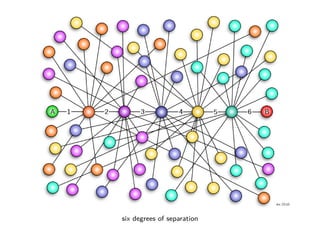
everything is connected
everything is connected 
with everything
six degrees of separation
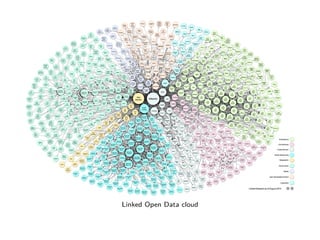
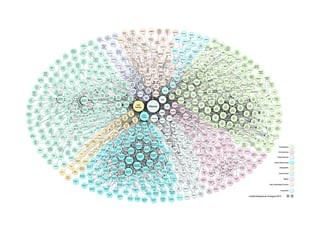
Linked Open Data cloud
What is a useful connection?
connections that work
connection that can be processed
connection that can be processed 
automatically
connection expressed as 
Linked Open Data
Overview 
1. History 
2. Present 
3. Future
History
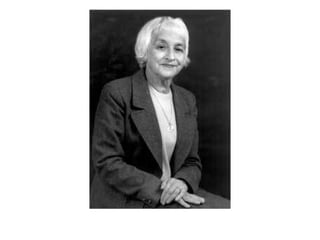
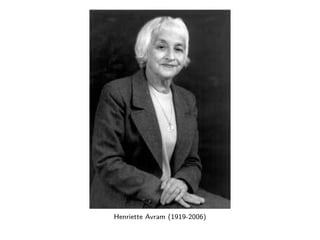
Henriette Avram (1919-2006)
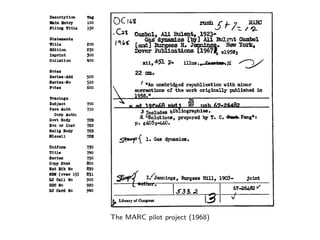
The MARC pilot project (1968)
Machine Readable Cataloging (MARC) 
good… 
▶ encoding of bibliographic information as data 
▶ controlled collaboration
Machine Readable Cataloging (MARC) 
good… 
▶ encoding of bibliographic information as data 
▶ controlled collaboration 
…but… 
▶ primary use case: printed cards
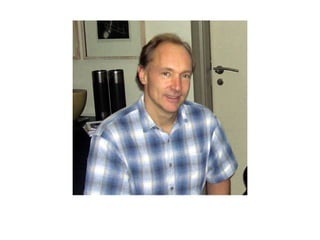
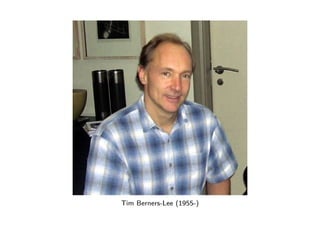
Tim Berners-Lee (1955-)
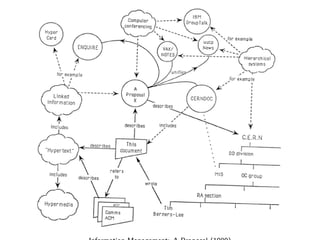
Information Management: A Proposal (1989)
World Wide Web (WWW) 
good… 
▶ worldwide connections 
▶ uncontrolled collaboration
World Wide Web (WWW) 
good… 
▶ worldwide connections 
▶ uncontrolled collaboration 
…but… 
▶ only for browsing interfaces
Present
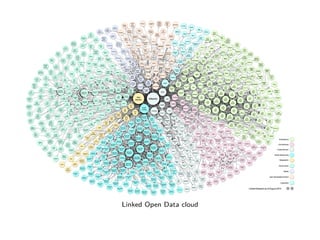
Linked Open Data cloud
Semantic Web 
good… 
▶ data integration and analysis 
▶ semi-controlled collaboration
Semantic Web 
good… 
▶ data integration and analysis 
▶ semi-controlled collaboration 
…but… 
▶ promises of artificial intelligence
Linked Open Data (LOD) 
good… 
▶ data integration and analysis 
▶ semi-controlled collaboration 
…but… 
▶ promises of artificial intelligence
Linked Open Data (LOD) 
sounds nice… 
▶ encoding of information as data 
▶ worldwide connections 
▶ data integration and analysis
Linked Open Data (LOD) 
sounds nice… 
▶ encoding of information as data 
▶ worldwide connections 
▶ data integration and analysis 
…but… 
▶ how does it actually work?!
a little theory of data
Data 
▶ all data refers to something
Data 
▶ all data refers to something 
▶ some data refer to the “same” thing
Data 
▶ all data refers to something 
▶ some data refer to the “same” thing 
▶ for instance the same person 
▶ as author in a library catalog 
▶ in a university research management system 
▶ Wikipedia article about the person 
▶ …
Data 
▶ all data refers to something 
▶ some data refer to the “same” thing 
▶ Linked Data makes true sense only with data 
from multiple sources about the same thing
“Old School” Library Linked Data 
authority files registry, classification, thesaurus… 
controlled vocabularies no homonyms/synonyms 
identifier notations, codes, numbers…
“Old School” Library Linked Data 
authority files registry, classification, thesaurus… 
controlled vocabularies no homonyms/synonyms 
identifier notations, codes, numbers… 
same identifier ) data refers to the same thing
unique identification
unique identification 
with URIs
an example
Karl Marx
Karl Marx (German artist, 1929-2008)
unique identification of things 
▶ “author:” 
http://d-nb.info/gnd/118578545
unique identification of things 
▶ object: 
http://d-nb.info/gnd/118578545 
(“Karl Marx, the artists”)
unique identification of things and connections 
▶ object: 
http://d-nb.info/gnd/118578545 
(“Karl Marx, the artists”) 
▶ property: 
http://purl.org/dc/terms/creator 
(“authorship, as defined by Dublin Core”)
Ei kaksi kolmannetta
Ei kaksi kolmannetta 
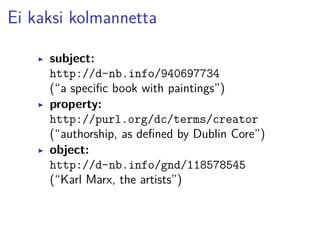
▶ subject: 
http://d-nb.info/940697734 
(“a specific book with paintings”) 
▶ property: 
http://purl.org/dc/terms/creator 
(“authorship, as defined by Dublin Core”) 
▶ object: 
http://d-nb.info/gnd/118578545 
(“Karl Marx, the artists”)
Ei kaksi kolmannetta 
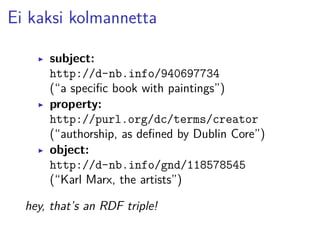
▶ subject: 
http://d-nb.info/940697734 
(“a specific book with paintings”) 
▶ property: 
http://purl.org/dc/terms/creator 
(“authorship, as defined by Dublin Core”) 
▶ object: 
http://d-nb.info/gnd/118578545 
(“Karl Marx, the artists”) 
hey, that’s an RDF triple!
technical break
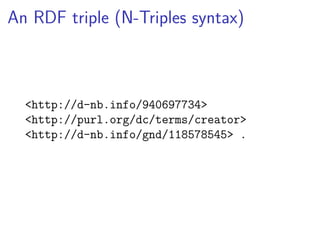
An RDF triple (N-Triples syntax) 
<http://d-nb.info/940697734> 
<http://purl.org/dc/terms/creator> 
<http://d-nb.info/gnd/118578545> .
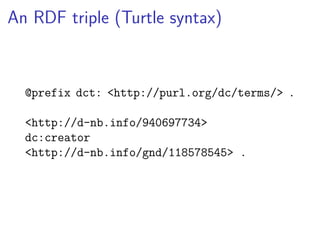
An RDF triple (Turtle syntax) 
@prefix dct: <http://purl.org/dc/terms/> . 
<http://d-nb.info/940697734> 
dc:creator 
<http://d-nb.info/gnd/118578545> .
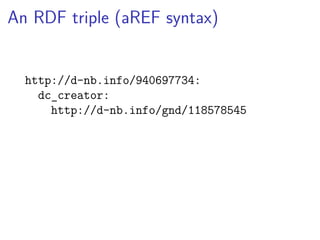
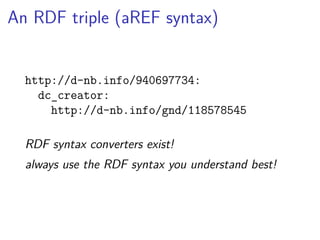
An RDF triple (aREF syntax) 
http://d-nb.info/940697734: 
dc_creator: 
http://d-nb.info/gnd/118578545
An RDF triple (aREF syntax) 
http://d-nb.info/940697734: 
dc_creator: 
http://d-nb.info/gnd/118578545 
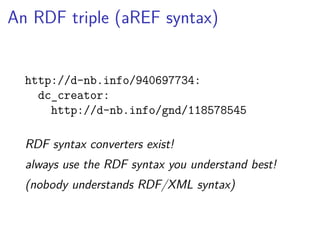
RDF syntax converters exist!
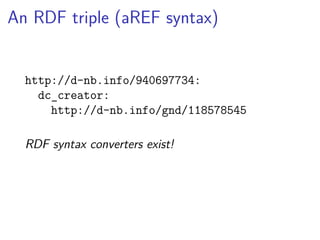
An RDF triple (aREF syntax) 
http://d-nb.info/940697734: 
dc_creator: 
http://d-nb.info/gnd/118578545 
RDF syntax converters exist! 
always use the RDF syntax you understand best!
An RDF triple (aREF syntax) 
http://d-nb.info/940697734: 
dc_creator: 
http://d-nb.info/gnd/118578545 
RDF syntax converters exist! 
always use the RDF syntax you understand best! 
(nobody understands RDF/XML syntax)
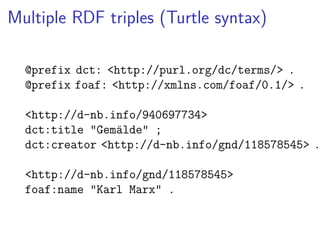
Multiple RDF triples (Turtle syntax) 
@prefix dct: <http://purl.org/dc/terms/> . 
@prefix foaf: <http://xmlns.com/foaf/0.1/> . 
<http://d-nb.info/940697734> 
dct:title "Gemälde" ; 
dct:creator <http://d-nb.info/gnd/118578545> . 
<http://d-nb.info/gnd/118578545> 
foaf:name "Karl Marx" .
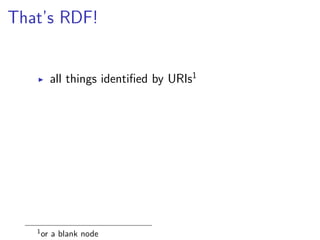
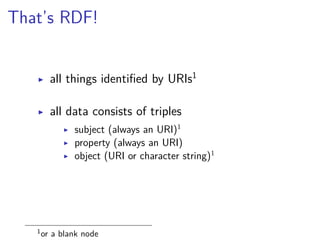
That’s RDF! 
▶ all things identified by URIs1 
1or a blank node
That’s RDF! 
▶ all things identified by URIs1 
▶ all data consists of triples 
▶ subject (always an URI)1 
▶ property (always an URI) 
▶ object (URI or character string)1 
1or a blank node
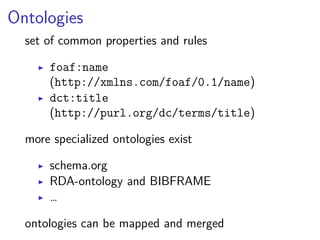
Ontologies
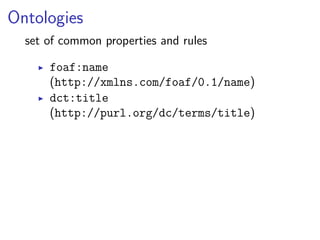
Ontologies 
set of common properties and rules 
▶ foaf:name 
(http://xmlns.com/foaf/0.1/name) 
▶ dct:title 
(http://purl.org/dc/terms/title)
Ontologies 
set of common properties and rules 
▶ foaf:name 
(http://xmlns.com/foaf/0.1/name) 
▶ dct:title 
(http://purl.org/dc/terms/title) 
more specialized ontologies exist 
▶ schema.org 
▶ RDA-ontology and BIBFRAME 
▶ …
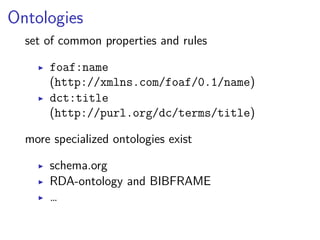
Ontologies 
set of common properties and rules 
▶ foaf:name 
(http://xmlns.com/foaf/0.1/name) 
▶ dct:title 
(http://purl.org/dc/terms/title) 
more specialized ontologies exist 
▶ schema.org 
▶ RDA-ontology and BIBFRAME 
▶ … 
ontologies can be mapped and merged
end of technical break. 
wake up!
Lesson learned 
▶ RDF data consists of triples
Lesson learned 
▶ RDF data consists of triples 
▶ subjects, properties, and most objects 
identified by URIs
Lesson learned 
▶ RDF data consists of triples 
▶ subjects, properties, and most objects 
identified by URIs 
▶ common properties from ontologies
Lesson learned 
▶ RDF data consists of triples 
▶ subjects, properties, and most objects 
identified by URIs 
▶ common properties from ontologies 
=) easy to mix and merge!
summary of the present 
linked open data
Linked Open Data 
1. Data 
with URIs, in RDF
Linked Open Data 
1. Data 
with URIs, in RDF 
2. Open 
accesible via HTTP-URIs
Linked Open Data 
1. Data 
with URIs, in RDF 
2. Open 
accesible via HTTP-URIs 
3. Linked 
contains other HTTP-URIs
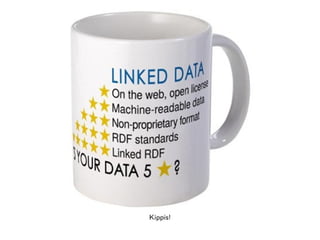
Kippis!
Linked RDF
Linked RDF 
contains other HTTP-URIs
Future
Future of cataloging
cataloging?
intellectual creation of data
intellectual creation of data 
about existing works
Creation of data about existing works 
1. digitization
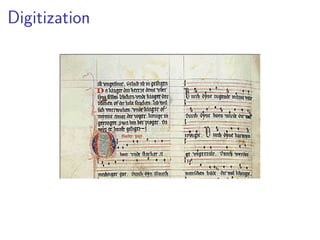
Digitization
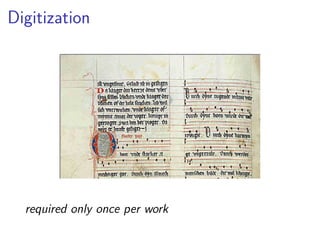
Digitization 
required only once per work
creation of data about existing works 
1. digitization
creation of data about existing works 
1. digitization 
2. connections
creation of data about existing works 
1. digitization 
2. connections 
infinite combination of connections
Connections that work 
▶ selection from already existing URIs
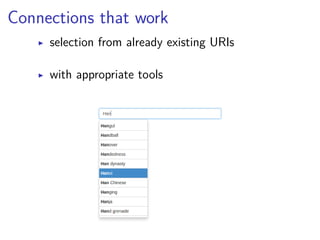
Connections that work 
▶ selection from already existing URIs 
▶ with appropriate tools
why Linked Open Data?
Benefits 
▶ common data format 
▶ accessibility of data 
▶ flexible aggregation and subsets 
▶ collaborative creation
Disadvantages 
▶ some data is more difficult to express in RDF 
(e.g. hierarchies and order)
Disadvantages 
▶ some data is more difficult to express in RDF 
(e.g. hierarchies and order) 
▶ data modeling is complicated
Disadvantages 
▶ some data is more difficult to express in RDF 
(e.g. hierarchies and order) 
▶ data modeling is complicated 
▶ reality is complicated
Disadvantages 
▶ some data is more difficult to express in RDF 
(e.g. hierarchies and order) 
▶ data modeling is complicated 
▶ reality is complicated 
▶ collaboration can be complicated
where to start?
Linked Data Finland 
http://www.ldf.fi/ 
please contact to share your datasets!
summary
everything can be connected
everything can be connected with URIs
everything can be connected 
as soon as you connect it!
Conferences 
SWIB Semantic Web in Libraries (since 2009) 
http://swib.org/ 
LODLAM Linked Open Data in Libraries, Archives, 
and Museums (since 2011) 
http://lodlam.net 
SEMANTiCS http://www.semantics.cc
Image sources 
▶ Six degrees of separation by Daniel Walker (User:Dannie-walker) 
▶ Linking Open Data cloud diagram (2014) by Max Schmachtenberg, 
Christian Bizer, Anja Jentzsch and Richard Cyganiak 
http://lod-cloud.net/ 
▶ Henriette Avram from 
http://www.loc.gov/loc/lcib/0605/avram.html 
▶ Information Management: A Proposal (1989) by Tim-Berners-Lee. 
http://www.w3.org/History/1989/proposal.html 
▶ Tim Berners-Lee (2005) by Uldis Bojārs from Flickr
thanks!
questions!

Connections that work: Linked Open Data demystified

  • 1.
    Connections that work Linked Open Data demystified Jakob Voß October 22th, 2014 (#kivepa2014)
  • 2.
  • 3.
  • 4.
    everything is connected with everything
  • 5.
    six degrees ofseparation
  • 6.
  • 7.
    What is auseful connection?
  • 8.
    What is auseful connection?
  • 9.
  • 10.
    connection that canbe processed
  • 11.
    connection that canbe processed automatically
  • 12.
    connection expressed as Linked Open Data
  • 13.
    Overview 1. History 2. Present 3. Future
  • 14.
  • 16.
  • 17.
    The MARC pilotproject (1968)
  • 18.
    Machine Readable Cataloging(MARC) good… ▶ encoding of bibliographic information as data ▶ controlled collaboration
  • 19.
    Machine Readable Cataloging(MARC) good… ▶ encoding of bibliographic information as data ▶ controlled collaboration …but… ▶ primary use case: printed cards
  • 21.
  • 22.
  • 23.
    World Wide Web(WWW) good… ▶ worldwide connections ▶ uncontrolled collaboration
  • 24.
    World Wide Web(WWW) good… ▶ worldwide connections ▶ uncontrolled collaboration …but… ▶ only for browsing interfaces
  • 25.
  • 26.
  • 27.
    Semantic Web good… ▶ data integration and analysis ▶ semi-controlled collaboration
  • 28.
    Semantic Web good… ▶ data integration and analysis ▶ semi-controlled collaboration …but… ▶ promises of artificial intelligence
  • 29.
    Linked Open Data(LOD) good… ▶ data integration and analysis ▶ semi-controlled collaboration …but… ▶ promises of artificial intelligence
  • 30.
    Linked Open Data(LOD) sounds nice… ▶ encoding of information as data ▶ worldwide connections ▶ data integration and analysis
  • 31.
    Linked Open Data(LOD) sounds nice… ▶ encoding of information as data ▶ worldwide connections ▶ data integration and analysis …but… ▶ how does it actually work?!
  • 32.
  • 33.
    Data ▶ alldata refers to something
  • 34.
    Data ▶ alldata refers to something ▶ some data refer to the “same” thing
  • 35.
    Data ▶ alldata refers to something ▶ some data refer to the “same” thing ▶ for instance the same person ▶ as author in a library catalog ▶ in a university research management system ▶ Wikipedia article about the person ▶ …
  • 36.
    Data ▶ alldata refers to something ▶ some data refer to the “same” thing ▶ Linked Data makes true sense only with data from multiple sources about the same thing
  • 37.
    “Old School” LibraryLinked Data authority files registry, classification, thesaurus… controlled vocabularies no homonyms/synonyms identifier notations, codes, numbers…
  • 38.
    “Old School” LibraryLinked Data authority files registry, classification, thesaurus… controlled vocabularies no homonyms/synonyms identifier notations, codes, numbers… same identifier ) data refers to the same thing
  • 39.
  • 40.
  • 41.
  • 43.
  • 44.
    Karl Marx (Germanartist, 1929-2008)
  • 45.
    unique identification ofthings ▶ “author:” http://d-nb.info/gnd/118578545
  • 46.
    unique identification ofthings ▶ object: http://d-nb.info/gnd/118578545 (“Karl Marx, the artists”)
  • 47.
    unique identification ofthings and connections ▶ object: http://d-nb.info/gnd/118578545 (“Karl Marx, the artists”) ▶ property: http://purl.org/dc/terms/creator (“authorship, as defined by Dublin Core”)
  • 48.
  • 49.
    Ei kaksi kolmannetta ▶ subject: http://d-nb.info/940697734 (“a specific book with paintings”) ▶ property: http://purl.org/dc/terms/creator (“authorship, as defined by Dublin Core”) ▶ object: http://d-nb.info/gnd/118578545 (“Karl Marx, the artists”)
  • 50.
    Ei kaksi kolmannetta ▶ subject: http://d-nb.info/940697734 (“a specific book with paintings”) ▶ property: http://purl.org/dc/terms/creator (“authorship, as defined by Dublin Core”) ▶ object: http://d-nb.info/gnd/118578545 (“Karl Marx, the artists”) hey, that’s an RDF triple!
  • 51.
  • 52.
    An RDF triple(N-Triples syntax) <http://d-nb.info/940697734> <http://purl.org/dc/terms/creator> <http://d-nb.info/gnd/118578545> .
  • 53.
    An RDF triple(Turtle syntax) @prefix dct: <http://purl.org/dc/terms/> . <http://d-nb.info/940697734> dc:creator <http://d-nb.info/gnd/118578545> .
  • 54.
    An RDF triple(aREF syntax) http://d-nb.info/940697734: dc_creator: http://d-nb.info/gnd/118578545
  • 55.
    An RDF triple(aREF syntax) http://d-nb.info/940697734: dc_creator: http://d-nb.info/gnd/118578545 RDF syntax converters exist!
  • 56.
    An RDF triple(aREF syntax) http://d-nb.info/940697734: dc_creator: http://d-nb.info/gnd/118578545 RDF syntax converters exist! always use the RDF syntax you understand best!
  • 57.
    An RDF triple(aREF syntax) http://d-nb.info/940697734: dc_creator: http://d-nb.info/gnd/118578545 RDF syntax converters exist! always use the RDF syntax you understand best! (nobody understands RDF/XML syntax)
  • 58.
    Multiple RDF triples(Turtle syntax) @prefix dct: <http://purl.org/dc/terms/> . @prefix foaf: <http://xmlns.com/foaf/0.1/> . <http://d-nb.info/940697734> dct:title "Gemälde" ; dct:creator <http://d-nb.info/gnd/118578545> . <http://d-nb.info/gnd/118578545> foaf:name "Karl Marx" .
  • 59.
    That’s RDF! ▶all things identified by URIs1 1or a blank node
  • 60.
    That’s RDF! ▶all things identified by URIs1 ▶ all data consists of triples ▶ subject (always an URI)1 ▶ property (always an URI) ▶ object (URI or character string)1 1or a blank node
  • 61.
  • 62.
    Ontologies set ofcommon properties and rules ▶ foaf:name (http://xmlns.com/foaf/0.1/name) ▶ dct:title (http://purl.org/dc/terms/title)
  • 63.
    Ontologies set ofcommon properties and rules ▶ foaf:name (http://xmlns.com/foaf/0.1/name) ▶ dct:title (http://purl.org/dc/terms/title) more specialized ontologies exist ▶ schema.org ▶ RDA-ontology and BIBFRAME ▶ …
  • 64.
    Ontologies set ofcommon properties and rules ▶ foaf:name (http://xmlns.com/foaf/0.1/name) ▶ dct:title (http://purl.org/dc/terms/title) more specialized ontologies exist ▶ schema.org ▶ RDA-ontology and BIBFRAME ▶ … ontologies can be mapped and merged
  • 65.
    end of technicalbreak. wake up!
  • 66.
    Lesson learned ▶RDF data consists of triples
  • 67.
    Lesson learned ▶RDF data consists of triples ▶ subjects, properties, and most objects identified by URIs
  • 68.
    Lesson learned ▶RDF data consists of triples ▶ subjects, properties, and most objects identified by URIs ▶ common properties from ontologies
  • 69.
    Lesson learned ▶RDF data consists of triples ▶ subjects, properties, and most objects identified by URIs ▶ common properties from ontologies =) easy to mix and merge!
  • 70.
    summary of thepresent linked open data
  • 71.
    Linked Open Data 1. Data with URIs, in RDF
  • 72.
    Linked Open Data 1. Data with URIs, in RDF 2. Open accesible via HTTP-URIs
  • 73.
    Linked Open Data 1. Data with URIs, in RDF 2. Open accesible via HTTP-URIs 3. Linked contains other HTTP-URIs
  • 74.
  • 75.
  • 76.
    Linked RDF containsother HTTP-URIs
  • 78.
  • 79.
  • 80.
  • 81.
  • 82.
    intellectual creation ofdata about existing works
  • 83.
    Creation of dataabout existing works 1. digitization
  • 84.
  • 85.
  • 86.
    creation of dataabout existing works 1. digitization
  • 87.
    creation of dataabout existing works 1. digitization 2. connections
  • 88.
    creation of dataabout existing works 1. digitization 2. connections infinite combination of connections
  • 89.
    Connections that work ▶ selection from already existing URIs
  • 90.
    Connections that work ▶ selection from already existing URIs ▶ with appropriate tools
  • 91.
  • 92.
    Benefits ▶ commondata format ▶ accessibility of data ▶ flexible aggregation and subsets ▶ collaborative creation
  • 93.
    Disadvantages ▶ somedata is more difficult to express in RDF (e.g. hierarchies and order)
  • 94.
    Disadvantages ▶ somedata is more difficult to express in RDF (e.g. hierarchies and order) ▶ data modeling is complicated
  • 95.
    Disadvantages ▶ somedata is more difficult to express in RDF (e.g. hierarchies and order) ▶ data modeling is complicated ▶ reality is complicated
  • 96.
    Disadvantages ▶ somedata is more difficult to express in RDF (e.g. hierarchies and order) ▶ data modeling is complicated ▶ reality is complicated ▶ collaboration can be complicated
  • 97.
  • 98.
    Linked Data Finland http://www.ldf.fi/ please contact to share your datasets!
  • 99.
  • 100.
  • 101.
    everything can beconnected with URIs
  • 102.
    everything can beconnected as soon as you connect it!
  • 103.
    Conferences SWIB SemanticWeb in Libraries (since 2009) http://swib.org/ LODLAM Linked Open Data in Libraries, Archives, and Museums (since 2011) http://lodlam.net SEMANTiCS http://www.semantics.cc
  • 104.
    Image sources ▶Six degrees of separation by Daniel Walker (User:Dannie-walker) ▶ Linking Open Data cloud diagram (2014) by Max Schmachtenberg, Christian Bizer, Anja Jentzsch and Richard Cyganiak http://lod-cloud.net/ ▶ Henriette Avram from http://www.loc.gov/loc/lcib/0605/avram.html ▶ Information Management: A Proposal (1989) by Tim-Berners-Lee. http://www.w3.org/History/1989/proposal.html ▶ Tim Berners-Lee (2005) by Uldis Bojārs from Flickr
  • 105.
  • 106.