CHAPTER 2


 CHARTING A COMPANY’S DIRECTION:
  VISION AND MISSION, OBJECTIVES,
           AND STRATEGY


        Crafting and Executing
               STRATEGY
       The Quest for Competitive Advantage

                                             2–1
WHAT DOES THE STRATEGY-MAKING,
   STRATEGY-EXECUTING PROCESS ENTAIL?


1. Developing a strategic vision, a mission, and a set
   of values.
2. Setting objectives for measuring performance and
   progress.
3. Crafting a strategy to achieve those objectives.
4. Executing the chosen strategy efficiently and
   effectively.
5. Monitoring strategic developments, evaluating
   execution, and making adjustments in the vision
   and mission, objectives, strategy, or execution as
   necessary.
                                                         2–2
2.1   The Strategy-Making, Strategy-Executing Process


                                                        2–3
STAGE 1: DEVELOPING A STRATEGIC
  VISION, A MISSION, AND A SET OF
  CORE VALUES

♦ Developing a Strategic Vision:
  ●   Delineates management’s future aspirations
      for the business to its stakeholders.
  ●   Provides direction—“where we are going.”
  ●   Sets out the compelling rationale (strategic
      soundness) for the firm’s direction.
  ●   Uses distinctive and specific language to set
      the firm apart from its rivals.

                                                      2–4
Communicating the Strategic Vision

♦ Why Communicate the Vision:
  ●   Fosters employee commitment to the firm’s
      chosen strategic direction.
  ●   Ensures understanding of its importance.
  ●   Motivates, informs, and inspires internal and
      external stakeholders.
  ●   Demonstrates top management support for
      the firm’s future strategic direction and
      competitive efforts.

                                                      2–5
Crafting a Mission Statement

♦ The Mission Statement:
  ●   Uses specific language to give the firm its
      own unique identity.
  ●   Describes the firm’s current business and
      purpose—“who we are, what we do, and
      why we are here.”
  ●   Should focus on describing the company’s
      business, not on “making a profit”—earning
      a profit is an objective not a mission.

                                                    2–6
The Ideal Mission Statement

♦ Identifies the firm’s product or services.
♦ Specifies the buyer needs it seeks to satisfy.
♦ Identifies the customer groups or markets it is
  endeavoring to serve.
♦ Specifies its approach to pleasing customers.
♦ Sets the firm apart from its rivals.
♦ Clarifies the firm’s business to stakeholders.


                                                    2–7
Vision vs. Mission

                                        VISION
                               ♦ Future-oriented
                                  ♦ Inspirational


MISSION
♦ Present-oriented
♦ Informational

                                                    2–8
Linking Vision and Mission with Core Values

♦ Core Values
  ●   Are the beliefs, traits, and behavioral norms
      that employees are expected to display in
      conducting the firm’s business and in pursuing its
      strategic vision and mission.
  ●   Become an integral part of the firm’s culture
      and what makes it tick when strongly espoused
      and supported by top management.
  ●   Matched with the firm’s vision, mission, and
      strategy contribute to the firm’s business success.


                                                            2–9
EXAMPLES – vision:

♦ FedEx
   Satisfying worldwide demand for fast, time-
    definite, reliable distribution
♦ The Home Depot
   Helping people improve the places where they
    live and work
♦ Charles Schwab
   To provide customers with the most useful and
    ethical financial services in the world

                                                  2–10
EXAMPLES - mission:

♦ Yahoo
   To be the most essential global Internet service
    for consumers and businesses.
♦ Google
   To organize the world’s information and make it
    universally accessible and useful


                                                   2–11
EXAMPLES – core values:

♦ American Express
   Customer commitment, quality, integrity,
    teamwork and respect for people.
♦ Abbott Laboratories
   Pioneering, achieving, caring and enduring.
♦ DuPont
   Safety,ethics, respect for people, and
    environmental stewardship.


                                                  2–12
STAGE 2: SETTING OBJECTIVES


♦ The Purposes of Setting Objectives:
  ●   To convert the vision and mission into specific,
      measurable, timely performance targets.
  ●   To focus efforts and align actions throughout
      the organization.
  ●   To serve as yardsticks for tracking a firm’s
      performance and progress.
  ●   To provide motivation and inspire employees
      to greater levels of effort.
                                                      2–13
THE TWO ESSENTIAL KINDS OF
      OBJECTIVES TO SET

♦ Financial Objectives            ♦ Strategic Objectives
  ●   Communicate top               ●   Are related to a firm’s
      management’s targets for          marketing standing and
      financial performance.            competitive vitality.
  ●   Are focused internally on     ●   Are focused externally
      the firm’s operations and         on competition vis-à-
      activities.                       vis the firm’s rivals.


                                                                 2–14
SETTING FINANCIAL OBJECTIVES

                Examples of Financial Objectives
♦ An x percent increase in annual revenues
♦ Annual increases in after-tax profits of x percent
♦ Annual increases in earnings per share of x percent
♦ Annual dividend increases of x percent
♦ Profit margins of x percent
♦ An x percent return on capital employed (ROCE) or return on
  shareholders’ equity investment (ROE)
♦ Increased shareholder value—in the form of an upward-trending stock
  price
♦ Bond and credit ratings of x
♦ Internal cash flows of x dollars to fund new capital investment


                                                                        2–15
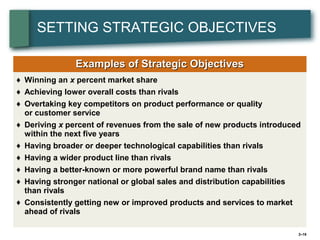
SETTING STRATEGIC OBJECTIVES

               Examples of Strategic Objectives
♦ Winning an x percent market share
♦ Achieving lower overall costs than rivals
♦ Overtaking key competitors on product performance or quality
  or customer service
♦ Deriving x percent of revenues from the sale of new products introduced
  within the next five years
♦ Having broader or deeper technological capabilities than rivals
♦ Having a wider product line than rivals
♦ Having a better-known or more powerful brand name than rivals
♦ Having stronger national or global sales and distribution capabilities
  than rivals
♦ Consistently getting new or improved products and services to market
  ahead of rivals

                                                                        2–16
EMPLOYING A BALANCED SCORECARD

♦ A balanced scorecard measures a firm’s
  optimal performance by:
         Placing a balanced emphasis on achieving
          both financial and strategic objectives.
         Avoiding tracking only financial performance and
          overlooking the importance of measuring whether
          a firm is strengthening its competitiveness and
          market position.

The surest path to sustained future profitability year after year is to relentlessly
pursue strategic outcomes that strengthen a firm’s business position and give
it a growing competitive advantage over rivals!


                                                                                       2–17
THE NEED FOR SHORT-TERM AND
  LONG-TERM OBJECTIVES

♦ Short-Term Objectives:
  ●   Focus attention on quarterly and annual
      performance improvements to satisfy near-
      term shareholder expectations.
♦ Long-Term Objectives:
  ●   Force consideration of what to do now to
      achieve optimal long-term performance.
  ●   Stand as a barrier to an undue focus on
      short-term results.

                                                  2–18
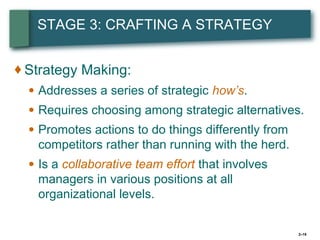
STAGE 3: CRAFTING A STRATEGY


♦ Strategy Making:
  ●   Addresses a series of strategic how’s.
  ●   Requires choosing among strategic alternatives.
  ●   Promotes actions to do things differently from
      competitors rather than running with the herd.
  ●   Is a collaborative team effort that involves
      managers in various positions at all
      organizational levels.


                                                       2–19
Who Is Involved in Strategy Making?

  ♦ Chief Executive Officer (CEO)
          ●     Has ultimate responsibility for leading the strategy-making
                process as strategic visionary and as chief architect of
                strategy.
  ♦ Senior Executives
          ●     Fashion the major strategy components involving their areas
                of responsibility.
  ♦ Managers of subsidiaries, divisions, geographic
    regions, plants, and other operating units (and key
    employees with specialized expertise)
          ●     Utilize on-the-scene familiarity with their business units to
                orchestrate their specific pieces of the strategy.


Copyright © 2011 by The McGraw-Hill Companies, Inc. All rights reserved.        2–20
2.2
A Company’s Strategy-
Making Hierarchy


                        2–21
What Is a Strategic Plan?


                                        Elements of a Firm’s
                                           Strategic Plan


                                                            Its strategic vision, business
                                                               mission, and core values


                                                                Its strategic and financial
                                                                         objectives


                                                                      Its chosen strategy


Copyright © 2011 by The McGraw-Hill Companies, Inc. All rights reserved.                      2–22
STAGE 4: EXECUTING THE STRATEGY

♦ Converting strategic plans into actions
  requires:
  ●   Directing organizational action.
  ●   Motivating people.
  ●   Building and strengthening the firm’s
      competencies and competitive capabilities.
  ●   Creating and nurturing a strategy-supportive
      work climate.
  ●   Meeting or beating performance targets.
                                                     2–23
Managing the Strategy Execution Process

♦ Staffing the firm with the needed skills and expertise.
♦ Building and strengthening strategy-supporting
  resources and competitive capabilities.
♦ Organizing work effort along the lines of best practice.
♦ Allocating ample resources to the activities critical to
  strategic success.
♦ Ensuring that policies and procedures facilitate rather
  than impede effective strategy execution.


                                                             2–24
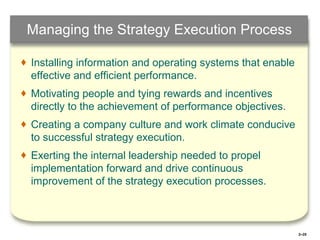
Managing the Strategy Execution Process

♦ Installing information and operating systems that enable
  effective and efficient performance.
♦ Motivating people and tying rewards and incentives
  directly to the achievement of performance objectives.
♦ Creating a company culture and work climate conducive
  to successful strategy execution.
♦ Exerting the internal leadership needed to propel
  implementation forward and drive continuous
  improvement of the strategy execution processes.


                                                             2–25
STAGE 5: EVALUATING PERFORMANCE
      AND INITIATING CORRECTIVE
      ADJUSTMENTS

♦ Evaluating Performance:
  ●   Deciding whether the enterprise is passing the
      three tests of a winning strategy—good fit,
      competitive advantage, strong performance.
♦ Initiating Corrective Adjustments:
  ●   Deciding whether to continue or change the
      firm’s vision and mission, objectives, strategy,
      and/or strategy execution methods.
  ●   Based on organizational learning.
                                                         2–26
THE ROLE OF THE BOARD OF DIRECTORS
  IN CORPORATE GOVERNANCE


♦ Obligations of the Board of Directors:
  ●   Critically appraise the firm’s direction, strategy, and
      business approaches.
  ●   Evaluate the caliber of senior executives’ strategic
      leadership skills.
  ●   Institute a compensation plan that rewards top
      executives for actions and results that serve
      stakeholder interests—especially shareholders.
  ●   Oversee the firm’s financial accounting and reporting
      practices compliance with the Sarbanes-Oxley Act.

                                                                2–27

Ch 2

  • 1.
    CHAPTER 2 CHARTINGA COMPANY’S DIRECTION: VISION AND MISSION, OBJECTIVES, AND STRATEGY Crafting and Executing STRATEGY The Quest for Competitive Advantage 2–1
  • 2.
    WHAT DOES THESTRATEGY-MAKING, STRATEGY-EXECUTING PROCESS ENTAIL? 1. Developing a strategic vision, a mission, and a set of values. 2. Setting objectives for measuring performance and progress. 3. Crafting a strategy to achieve those objectives. 4. Executing the chosen strategy efficiently and effectively. 5. Monitoring strategic developments, evaluating execution, and making adjustments in the vision and mission, objectives, strategy, or execution as necessary. 2–2
  • 3.
    2.1 The Strategy-Making, Strategy-Executing Process 2–3
  • 4.
    STAGE 1: DEVELOPINGA STRATEGIC VISION, A MISSION, AND A SET OF CORE VALUES ♦ Developing a Strategic Vision: ● Delineates management’s future aspirations for the business to its stakeholders. ● Provides direction—“where we are going.” ● Sets out the compelling rationale (strategic soundness) for the firm’s direction. ● Uses distinctive and specific language to set the firm apart from its rivals. 2–4
  • 5.
    Communicating the StrategicVision ♦ Why Communicate the Vision: ● Fosters employee commitment to the firm’s chosen strategic direction. ● Ensures understanding of its importance. ● Motivates, informs, and inspires internal and external stakeholders. ● Demonstrates top management support for the firm’s future strategic direction and competitive efforts. 2–5
  • 6.
    Crafting a MissionStatement ♦ The Mission Statement: ● Uses specific language to give the firm its own unique identity. ● Describes the firm’s current business and purpose—“who we are, what we do, and why we are here.” ● Should focus on describing the company’s business, not on “making a profit”—earning a profit is an objective not a mission. 2–6
  • 7.
    The Ideal MissionStatement ♦ Identifies the firm’s product or services. ♦ Specifies the buyer needs it seeks to satisfy. ♦ Identifies the customer groups or markets it is endeavoring to serve. ♦ Specifies its approach to pleasing customers. ♦ Sets the firm apart from its rivals. ♦ Clarifies the firm’s business to stakeholders. 2–7
  • 8.
    Vision vs. Mission VISION ♦ Future-oriented ♦ Inspirational MISSION ♦ Present-oriented ♦ Informational 2–8
  • 9.
    Linking Vision andMission with Core Values ♦ Core Values ● Are the beliefs, traits, and behavioral norms that employees are expected to display in conducting the firm’s business and in pursuing its strategic vision and mission. ● Become an integral part of the firm’s culture and what makes it tick when strongly espoused and supported by top management. ● Matched with the firm’s vision, mission, and strategy contribute to the firm’s business success. 2–9
  • 10.
    EXAMPLES – vision: ♦FedEx  Satisfying worldwide demand for fast, time- definite, reliable distribution ♦ The Home Depot  Helping people improve the places where they live and work ♦ Charles Schwab  To provide customers with the most useful and ethical financial services in the world 2–10
  • 11.
    EXAMPLES - mission: ♦Yahoo  To be the most essential global Internet service for consumers and businesses. ♦ Google  To organize the world’s information and make it universally accessible and useful 2–11
  • 12.
    EXAMPLES – corevalues: ♦ American Express  Customer commitment, quality, integrity, teamwork and respect for people. ♦ Abbott Laboratories  Pioneering, achieving, caring and enduring. ♦ DuPont  Safety,ethics, respect for people, and environmental stewardship. 2–12
  • 13.
    STAGE 2: SETTINGOBJECTIVES ♦ The Purposes of Setting Objectives: ● To convert the vision and mission into specific, measurable, timely performance targets. ● To focus efforts and align actions throughout the organization. ● To serve as yardsticks for tracking a firm’s performance and progress. ● To provide motivation and inspire employees to greater levels of effort. 2–13
  • 14.
    THE TWO ESSENTIALKINDS OF OBJECTIVES TO SET ♦ Financial Objectives ♦ Strategic Objectives ● Communicate top ● Are related to a firm’s management’s targets for marketing standing and financial performance. competitive vitality. ● Are focused internally on ● Are focused externally the firm’s operations and on competition vis-à- activities. vis the firm’s rivals. 2–14
  • 15.
    SETTING FINANCIAL OBJECTIVES Examples of Financial Objectives ♦ An x percent increase in annual revenues ♦ Annual increases in after-tax profits of x percent ♦ Annual increases in earnings per share of x percent ♦ Annual dividend increases of x percent ♦ Profit margins of x percent ♦ An x percent return on capital employed (ROCE) or return on shareholders’ equity investment (ROE) ♦ Increased shareholder value—in the form of an upward-trending stock price ♦ Bond and credit ratings of x ♦ Internal cash flows of x dollars to fund new capital investment 2–15
  • 16.
    SETTING STRATEGIC OBJECTIVES Examples of Strategic Objectives ♦ Winning an x percent market share ♦ Achieving lower overall costs than rivals ♦ Overtaking key competitors on product performance or quality or customer service ♦ Deriving x percent of revenues from the sale of new products introduced within the next five years ♦ Having broader or deeper technological capabilities than rivals ♦ Having a wider product line than rivals ♦ Having a better-known or more powerful brand name than rivals ♦ Having stronger national or global sales and distribution capabilities than rivals ♦ Consistently getting new or improved products and services to market ahead of rivals 2–16
  • 17.
    EMPLOYING A BALANCEDSCORECARD ♦ A balanced scorecard measures a firm’s optimal performance by:  Placing a balanced emphasis on achieving both financial and strategic objectives.  Avoiding tracking only financial performance and overlooking the importance of measuring whether a firm is strengthening its competitiveness and market position. The surest path to sustained future profitability year after year is to relentlessly pursue strategic outcomes that strengthen a firm’s business position and give it a growing competitive advantage over rivals! 2–17
  • 18.
    THE NEED FORSHORT-TERM AND LONG-TERM OBJECTIVES ♦ Short-Term Objectives: ● Focus attention on quarterly and annual performance improvements to satisfy near- term shareholder expectations. ♦ Long-Term Objectives: ● Force consideration of what to do now to achieve optimal long-term performance. ● Stand as a barrier to an undue focus on short-term results. 2–18
  • 19.
    STAGE 3: CRAFTINGA STRATEGY ♦ Strategy Making: ● Addresses a series of strategic how’s. ● Requires choosing among strategic alternatives. ● Promotes actions to do things differently from competitors rather than running with the herd. ● Is a collaborative team effort that involves managers in various positions at all organizational levels. 2–19
  • 20.
    Who Is Involvedin Strategy Making? ♦ Chief Executive Officer (CEO) ● Has ultimate responsibility for leading the strategy-making process as strategic visionary and as chief architect of strategy. ♦ Senior Executives ● Fashion the major strategy components involving their areas of responsibility. ♦ Managers of subsidiaries, divisions, geographic regions, plants, and other operating units (and key employees with specialized expertise) ● Utilize on-the-scene familiarity with their business units to orchestrate their specific pieces of the strategy. Copyright © 2011 by The McGraw-Hill Companies, Inc. All rights reserved. 2–20
  • 21.
  • 22.
    What Is aStrategic Plan? Elements of a Firm’s Strategic Plan Its strategic vision, business mission, and core values Its strategic and financial objectives Its chosen strategy Copyright © 2011 by The McGraw-Hill Companies, Inc. All rights reserved. 2–22
  • 23.
    STAGE 4: EXECUTINGTHE STRATEGY ♦ Converting strategic plans into actions requires: ● Directing organizational action. ● Motivating people. ● Building and strengthening the firm’s competencies and competitive capabilities. ● Creating and nurturing a strategy-supportive work climate. ● Meeting or beating performance targets. 2–23
  • 24.
    Managing the StrategyExecution Process ♦ Staffing the firm with the needed skills and expertise. ♦ Building and strengthening strategy-supporting resources and competitive capabilities. ♦ Organizing work effort along the lines of best practice. ♦ Allocating ample resources to the activities critical to strategic success. ♦ Ensuring that policies and procedures facilitate rather than impede effective strategy execution. 2–24
  • 25.
    Managing the StrategyExecution Process ♦ Installing information and operating systems that enable effective and efficient performance. ♦ Motivating people and tying rewards and incentives directly to the achievement of performance objectives. ♦ Creating a company culture and work climate conducive to successful strategy execution. ♦ Exerting the internal leadership needed to propel implementation forward and drive continuous improvement of the strategy execution processes. 2–25
  • 26.
    STAGE 5: EVALUATINGPERFORMANCE AND INITIATING CORRECTIVE ADJUSTMENTS ♦ Evaluating Performance: ● Deciding whether the enterprise is passing the three tests of a winning strategy—good fit, competitive advantage, strong performance. ♦ Initiating Corrective Adjustments: ● Deciding whether to continue or change the firm’s vision and mission, objectives, strategy, and/or strategy execution methods. ● Based on organizational learning. 2–26
  • 27.
    THE ROLE OFTHE BOARD OF DIRECTORS IN CORPORATE GOVERNANCE ♦ Obligations of the Board of Directors: ● Critically appraise the firm’s direction, strategy, and business approaches. ● Evaluate the caliber of senior executives’ strategic leadership skills. ● Institute a compensation plan that rewards top executives for actions and results that serve stakeholder interests—especially shareholders. ● Oversee the firm’s financial accounting and reporting practices compliance with the Sarbanes-Oxley Act. 2–27