UTERINE FIBROIDS
LEIOMYOMA
What is a leiomyoma?
It is a benign neoplasm of the muscular wall of the uterus
composed primarily of smooth muscle
What is the incidence of leiomyomas?
They are the most common pelvic tumors
It is found in 25% of white women & 50% of black women
ETIOLOGY
Unknown
Each individual myoma is unicellular in origin
Estogens no evidence that it is a causative factor , it
has been implicated in growth of myomas
Myomas contain estrogen receptors in higher
concentration than surrounding myometrium
Myomas may increase in size with estrogen therapy & in
pregnancy & decrease after menopause
They are not detectable before puberty
Progestrone increase mitotic activity & reduce apoptosis
 in size
There may be genetic predisposition
PATHOLOGY
Frequently multiple
May reach 15 cm in size or larger
Firm
Spherical or irregularly lobulated
Have a false capsule
Can be easily enucleated from surrounding myometrium
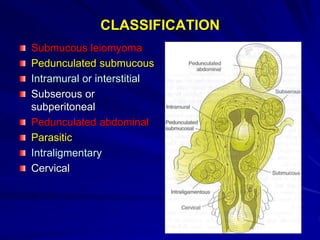
CLASSIFICATION
Submucous leiomyoma
Pedunculated submucous
Intramural or interstitial
Subserous or
subperitoneal
Pedunculated abdominal
Parasitic
Intraligmentary
Cervical
MICROSCOPIC STRUCTURE
Whorled appearance nonstriated muscle fibers
arranged in bundles running in different directions
Individual cells are spindle shaped uniform
Varying amount of connective tissue are interlaced
between muscle fibers
Pseudocapsule of areolar tissue & compressed
myometrium
Arteries are less dense than myometrium & do not have
a regular pattern of distribution
1-2 major vesseles are found at the base or pedicle
SECONDARY CHANGES
1-BENIGN DEGENERATION
Atrophic
Hyaline  yellow, soft gelatinous areas
Cystic liquefaction follows extreme hyalinization
Calcific circulatory deprivation precipitation of ca
carbonate & phosphate
Septic circulatory deprivation necrosis  infection
Myxomatous (fatty) uncommon, follows hyaline or
cystic degenration
1-BENIGN DEGENRATION (cont’d)
Red (carneous) degeneration
Commonly occurs during pregnancy
Edema & hypertrophy impede blood supply aseptic
degenration & infarction with venous thrombosis &
hemorrhage
Painful but self-limiting
May result in preterm labor & rarely DIC
2-MALIGNANT TRANSFORMATION
Transformation to leiomyosarcomas occurs in 0.1-0.5%
CLINICAL FINDINGS
1-SYMPTOMS
Symptomatic in only 35-50% of Pt
Symptoms depend on location, size, changes &
pregnancy status
1-Abnormal uterine bleeding
The most common 30%
Heavy / prolonged bleeding (menorrhagia)  iron
deficiency anemia
1-Abnormal uterine bleeding (cont’d)
Submucous myoma produce the most pronounced
symptoms of menorrhagia, pre & post-menstrual spotting
Bleeding is due to interruption of blood supply to the
endometrium, distortion & congestion of surrounding
vessels or ulceration of the overlying endometrium
Pedunculated submucous  areas of venouse
thrombosis & necrosis on the surface intermenstrtual
bleeding
2-PAIN
Vascular occlusion  necrosis, infection
Torsion of a pedunculated fibroid acute pain
Myometrial contractions to expel the myoma
Red degenration acute pain
Heaviness fullness in the pelvic area
Feeling a mass
If the tumor gets impacted in the pelvis pressure on
nerves back pain radiating to the lower extremities
Dysparunea if it is protruding to vagina
3-PRESSURE EFFECTS
If large may distort or obstruct other organs like ureters,
bladder or rectum urinary symptoms, hydroureter,
constipation, pelvic venous congestion & LL edema
Rarely a posterior fundal tumor extreme retroflexion of
the uterus distorting the bladder base urinary retention
Parasitic tumor may cause bowel obstruction
Cervical tumors serosanguineous vaginal discharge,
bleeding, dyspareunia or infertility
4-INFERTILITY
The relationship is uncertain
27-40% of women with multiple fibroids are infertile 
but other causes of infertility are present
Endocavitary tumors affect fertility more
5- SPONTANEOUS ABORTIONS
~2X N  incidence before myomectomy 40%
after myomectomy 20%
More with intracavitary tumors
EXAMINTION
Most myoma are discovered on routine bimanual pelvic
exam or abdominal examination
Retroflexed retroverted uterus  obscure the palpation
of myomas
LABORATORY FINDINGS
Anemia
Depletion of iron reserve
Rarely erythrocytosis pressure on the ureters back
pressure on the kidneys  erythropoietin
Acute degeneration & infection  ESR, leucocytosis, &
fever
IMAGING
Pelvic U/S is very helpful in confirming the Dx &
excluding pregnancy / Particularly in obese Pt
Saline hysterosonography can identify submucous
myoma that may be missed on U/S
HSG  will show intrauterine leiomyoma
MRI  highly accurate in delineating the size, location &
no. of myomas , but not always necessary
IVP  will show ureteral dilatation or deviation & urinary
anomalies
HYSTROSCOPY  for identification & removal of
submucous myomas
DIFFERENTIAL DIAGNOSIS
Usually easily diagnosed
Exclude pregnancy
Exclude other pelvic masses
-Ovarian Ca
-Tubo-ovarian abscess
-Endometriosis
-Adenexa, omentum or bowel adherent to the uterus
Exclude other causes of uterine enlargement:
-Adenomyosis
-Myometrial hypertrophy
-Congenital anomalies
-Endometrial Ca
DIFFERENTIAL DIAGNOSIS
Exclude other causes of abnormal bleeding
Endometrial hyperplasia
Endometrial or tubal Ca
Uterine sarcoma
Ovarian Ca
Polyps
Adenomyosis
DUB
Endometriosis
Exogenouse estrogens
Endometrial biopsy or D&C is essential in the evaluation of
abnormal bleeding to exclude endometrial Ca
COMPLICATIONS
1-COMPLICATIONS IN PREGNANCY
≥ 2/3 of women with fibroids & unexplained
infertility conceive after myomectomy
Red degeneration
In the 2nd or 3rd trimester of pregnancy rapid 
in size  vascular deprivation  degeneration
Causes pain & tenderness
May initiate preterm labor
Managed conservatively with bedrest & narcotics
+ tocolytics if indicated
After the acute phase pregnancy will continue to
term
COMPLICATIONS IN PREGNANCY
DURING LABOR
Uterine inertia
Malpresentation
Obstruction of the birth canal
Cervical or isthmeic myoma  necessitate CS
PPH
COMPLICATIONS IN NONPREGNANT WOMEN
Heavy bleeding with anemia is the most common
Urinary or bowel obstruction from large parasitic myoma
is much less common
Malignant transformation is rare
Ureteral injury or ligation is a recognized complication of
surgery for Cx myoma
No evidence that COCP  the size of myomas
Postmenopausal women on HRT must be followed up
with pelvic exam or U/S every 6 M
TREATMENT
TREATMENT
DEPENDS ON:
Age
Parity
Pregnancy status
Desire for future pregnancy
General health
Symptoms
Size
Location
A-EMERGENCY MEASURES
Blood transfusion/ PRBC to correct anemia
Emergrncy surgery indicatd for:
- infected myoma
-acute torsion
-intestinal obstruction
Myomectomy is contraindicated during pregnancy
B-SPECIFIC MEASURES
Most cases asymptomatic  no treatment
Postmenopausal  no treatment
Other causes of pelvic mass must be excluded
The Dx must be certain
Initial follow up every 6 M  to determine the rate of
growth of the myoma
Surgery is contraindicated in pregnancy
The only indication for myomectomy in pregnancy is
torsion of a pedunculated fibroid
Myomectomy is not recommended during CS
Pregnant women with previous multiple myomectomy /
especially if the cavity was entered  should be
delivered by CS to  risk of scar rupture in labor
GNRH AGONISTS
RX results in:
1- size of the myomas 50% maximum
2- This shrinkage is achieved in 3M of RX
3-Amenorrhea & hypoestrogenic side-effects occur
4-Osteopososis may occur if Rx last > 6M
It is indicated for
1- bleeding from myoma except for the polypoid
submucous type
2-Preoperative to  size  allow for vaginal hysterectomy
myomectomy
laparoscopic myomectomy
C-SUPPORTIVE MEASURES
PAP smear & endometrial sampling for all Pt with
irregular bleeding
Before surgery
-Correct Hb
-Prophylactic antibiotics
-Mechanical & antibiotic bowel preparation  if difficult
surgery is anticipated
Prophylactic heparin postoperative
D-SURGICAL MEASURES
1-Evaluation for other neoplasia
2-Myomectomy
For symptomatic Pt who wish to preserve fertility
Open myomectomy
Laparoscopic myomectomy
Hysteroscopic myomectomy
3-Hysterectomy
Vaginal hysterectomy
Abdominal hysterectomy
4-Uterine artery embolisation

UTERINE FIBROIDS.ppt

  • 1.
  • 2.
    LEIOMYOMA What is aleiomyoma? It is a benign neoplasm of the muscular wall of the uterus composed primarily of smooth muscle What is the incidence of leiomyomas? They are the most common pelvic tumors It is found in 25% of white women & 50% of black women
  • 3.
    ETIOLOGY Unknown Each individual myomais unicellular in origin Estogens no evidence that it is a causative factor , it has been implicated in growth of myomas Myomas contain estrogen receptors in higher concentration than surrounding myometrium Myomas may increase in size with estrogen therapy & in pregnancy & decrease after menopause They are not detectable before puberty Progestrone increase mitotic activity & reduce apoptosis  in size There may be genetic predisposition
  • 4.
    PATHOLOGY Frequently multiple May reach15 cm in size or larger Firm Spherical or irregularly lobulated Have a false capsule Can be easily enucleated from surrounding myometrium
  • 5.
    CLASSIFICATION Submucous leiomyoma Pedunculated submucous Intramuralor interstitial Subserous or subperitoneal Pedunculated abdominal Parasitic Intraligmentary Cervical
  • 6.
    MICROSCOPIC STRUCTURE Whorled appearancenonstriated muscle fibers arranged in bundles running in different directions Individual cells are spindle shaped uniform Varying amount of connective tissue are interlaced between muscle fibers Pseudocapsule of areolar tissue & compressed myometrium Arteries are less dense than myometrium & do not have a regular pattern of distribution 1-2 major vesseles are found at the base or pedicle
  • 7.
  • 8.
    1-BENIGN DEGENERATION Atrophic Hyaline yellow, soft gelatinous areas Cystic liquefaction follows extreme hyalinization Calcific circulatory deprivation precipitation of ca carbonate & phosphate Septic circulatory deprivation necrosis  infection Myxomatous (fatty) uncommon, follows hyaline or cystic degenration
  • 9.
    1-BENIGN DEGENRATION (cont’d) Red(carneous) degeneration Commonly occurs during pregnancy Edema & hypertrophy impede blood supply aseptic degenration & infarction with venous thrombosis & hemorrhage Painful but self-limiting May result in preterm labor & rarely DIC 2-MALIGNANT TRANSFORMATION Transformation to leiomyosarcomas occurs in 0.1-0.5%
  • 10.
  • 11.
    1-SYMPTOMS Symptomatic in only35-50% of Pt Symptoms depend on location, size, changes & pregnancy status 1-Abnormal uterine bleeding The most common 30% Heavy / prolonged bleeding (menorrhagia)  iron deficiency anemia
  • 12.
    1-Abnormal uterine bleeding(cont’d) Submucous myoma produce the most pronounced symptoms of menorrhagia, pre & post-menstrual spotting Bleeding is due to interruption of blood supply to the endometrium, distortion & congestion of surrounding vessels or ulceration of the overlying endometrium Pedunculated submucous  areas of venouse thrombosis & necrosis on the surface intermenstrtual bleeding
  • 13.
    2-PAIN Vascular occlusion necrosis, infection Torsion of a pedunculated fibroid acute pain Myometrial contractions to expel the myoma Red degenration acute pain Heaviness fullness in the pelvic area Feeling a mass If the tumor gets impacted in the pelvis pressure on nerves back pain radiating to the lower extremities Dysparunea if it is protruding to vagina
  • 14.
    3-PRESSURE EFFECTS If largemay distort or obstruct other organs like ureters, bladder or rectum urinary symptoms, hydroureter, constipation, pelvic venous congestion & LL edema Rarely a posterior fundal tumor extreme retroflexion of the uterus distorting the bladder base urinary retention Parasitic tumor may cause bowel obstruction Cervical tumors serosanguineous vaginal discharge, bleeding, dyspareunia or infertility
  • 15.
    4-INFERTILITY The relationship isuncertain 27-40% of women with multiple fibroids are infertile  but other causes of infertility are present Endocavitary tumors affect fertility more 5- SPONTANEOUS ABORTIONS ~2X N  incidence before myomectomy 40% after myomectomy 20% More with intracavitary tumors
  • 16.
    EXAMINTION Most myoma arediscovered on routine bimanual pelvic exam or abdominal examination Retroflexed retroverted uterus  obscure the palpation of myomas LABORATORY FINDINGS Anemia Depletion of iron reserve Rarely erythrocytosis pressure on the ureters back pressure on the kidneys  erythropoietin Acute degeneration & infection  ESR, leucocytosis, & fever
  • 17.
    IMAGING Pelvic U/S isvery helpful in confirming the Dx & excluding pregnancy / Particularly in obese Pt Saline hysterosonography can identify submucous myoma that may be missed on U/S HSG  will show intrauterine leiomyoma MRI  highly accurate in delineating the size, location & no. of myomas , but not always necessary IVP  will show ureteral dilatation or deviation & urinary anomalies HYSTROSCOPY  for identification & removal of submucous myomas
  • 18.
    DIFFERENTIAL DIAGNOSIS Usually easilydiagnosed Exclude pregnancy Exclude other pelvic masses -Ovarian Ca -Tubo-ovarian abscess -Endometriosis -Adenexa, omentum or bowel adherent to the uterus Exclude other causes of uterine enlargement: -Adenomyosis -Myometrial hypertrophy -Congenital anomalies -Endometrial Ca
  • 19.
    DIFFERENTIAL DIAGNOSIS Exclude othercauses of abnormal bleeding Endometrial hyperplasia Endometrial or tubal Ca Uterine sarcoma Ovarian Ca Polyps Adenomyosis DUB Endometriosis Exogenouse estrogens Endometrial biopsy or D&C is essential in the evaluation of abnormal bleeding to exclude endometrial Ca
  • 20.
  • 21.
    1-COMPLICATIONS IN PREGNANCY ≥2/3 of women with fibroids & unexplained infertility conceive after myomectomy Red degeneration In the 2nd or 3rd trimester of pregnancy rapid  in size  vascular deprivation  degeneration Causes pain & tenderness May initiate preterm labor Managed conservatively with bedrest & narcotics + tocolytics if indicated After the acute phase pregnancy will continue to term
  • 22.
    COMPLICATIONS IN PREGNANCY DURINGLABOR Uterine inertia Malpresentation Obstruction of the birth canal Cervical or isthmeic myoma  necessitate CS PPH
  • 23.
    COMPLICATIONS IN NONPREGNANTWOMEN Heavy bleeding with anemia is the most common Urinary or bowel obstruction from large parasitic myoma is much less common Malignant transformation is rare Ureteral injury or ligation is a recognized complication of surgery for Cx myoma No evidence that COCP  the size of myomas Postmenopausal women on HRT must be followed up with pelvic exam or U/S every 6 M
  • 24.
  • 25.
    TREATMENT DEPENDS ON: Age Parity Pregnancy status Desirefor future pregnancy General health Symptoms Size Location
  • 26.
    A-EMERGENCY MEASURES Blood transfusion/PRBC to correct anemia Emergrncy surgery indicatd for: - infected myoma -acute torsion -intestinal obstruction Myomectomy is contraindicated during pregnancy
  • 27.
    B-SPECIFIC MEASURES Most casesasymptomatic  no treatment Postmenopausal  no treatment Other causes of pelvic mass must be excluded The Dx must be certain Initial follow up every 6 M  to determine the rate of growth of the myoma Surgery is contraindicated in pregnancy The only indication for myomectomy in pregnancy is torsion of a pedunculated fibroid Myomectomy is not recommended during CS Pregnant women with previous multiple myomectomy / especially if the cavity was entered  should be delivered by CS to  risk of scar rupture in labor
  • 28.
    GNRH AGONISTS RX resultsin: 1- size of the myomas 50% maximum 2- This shrinkage is achieved in 3M of RX 3-Amenorrhea & hypoestrogenic side-effects occur 4-Osteopososis may occur if Rx last > 6M It is indicated for 1- bleeding from myoma except for the polypoid submucous type 2-Preoperative to  size  allow for vaginal hysterectomy myomectomy laparoscopic myomectomy
  • 29.
    C-SUPPORTIVE MEASURES PAP smear& endometrial sampling for all Pt with irregular bleeding Before surgery -Correct Hb -Prophylactic antibiotics -Mechanical & antibiotic bowel preparation  if difficult surgery is anticipated Prophylactic heparin postoperative
  • 30.
    D-SURGICAL MEASURES 1-Evaluation forother neoplasia 2-Myomectomy For symptomatic Pt who wish to preserve fertility Open myomectomy Laparoscopic myomectomy Hysteroscopic myomectomy 3-Hysterectomy Vaginal hysterectomy Abdominal hysterectomy 4-Uterine artery embolisation