POSTPARTUM
HEMORRHAGE
By
KRISHNAKUMAR D
AVMC Puducherry
DEFINITION
 The amount of blood loss in excess of 500
mL following birth of the baby (WHO).
Clinical definition
 “Any amount of bleeding from or into the
genital tract following birth of the baby up to
the end of the puerperium
 Which adversely affects the general condition
of the patient evidenced by rise in pulse rate
and falling blood pressure is called
postpartum hemorrhage”.
 The average blood loss following vaginal
delivery, cesarean delivery and cesarean
hysterectomy is 500mL, 1000 mL and 1500 mL
respectively.
 Depending upon the amount of blood loss,
PPH can be:
Minor (< 1L)
Major (> 1L)
Severe(> 2L).
TYPES
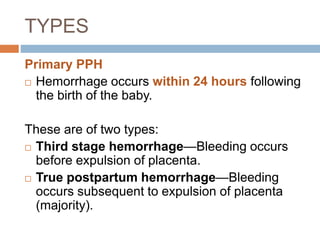
Primary PPH
 Hemorrhage occurs within 24 hours following
the birth of the baby.
These are of two types:
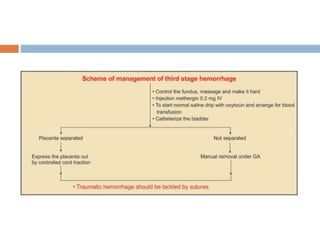
 Third stage hemorrhage—Bleeding occurs
before expulsion of placenta.
 True postpartum hemorrhage—Bleeding
occurs subsequent to expulsion of placenta
(majority).
TYPES
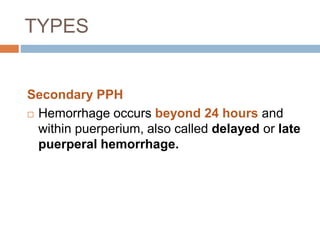
Secondary PPH
 Hemorrhage occurs beyond 24 hours and
within puerperium, also called delayed or late
puerperal hemorrhage.
PRIMARY
POSTPARTUM
HEMORRHAGE
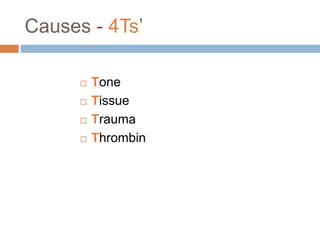
Causes - 4Ts’
 Tone
 Tissue
 Trauma
 Thrombin
Atonic uterus (80%):
 Atonicity of the uterus is the commonest cause of postpartum
hemorrhage.
The following are the conditions which often interfere with the
retraction of the uterus:
 Grand multipara
 Over distension of the uterus
 Malnutrition and anemia (<9.0 g/dL)
 APH(Both placenta previa and abruption)
 Prolonged labor (>12 hours)
 Initiation or augmentation of delivery by oxytocin
 Malformation of the uterus
 Uterine fibroid
Mismanaged third stage of labor - This
includes—
 Too rapid delivery of the baby preventing the
uterine wall to adapt to the diminishing
contents
 Premature attempt to deliver the placenta
before it is separated
 Kneading and fiddling the uterus
 Pulling the cord.
 Manual separation of the placenta increases
blood loss during cesarean delivery.
Other causes of atonic hemorrhage are:
 Obesity (BMI > 35) , Previous PPH ,Age(>40
yrs)
 Drugs: Use of tocolytic drugs (ritodrine),
MgSO4,Nifedipine.
Traumatic (20%)
 Operative delivery
 Episiotomy
 Cesarean section
 Trauma(cervix, vagina, perineum, paraurethral
region and rarely, rupture of the uterus occurs)
Retained tissues
Thrombin Blood
DIAGNOSIS AND CLINICAL
EFFECTS
 In majority, the vaginal bleeding is visible
outside, as a slow trickle.
 Rarely, the bleeding is totally concealed as
either vulvovaginal or broad ligament
hematoma.
The effect of blood loss depends on—
 Predelivery hemoglobin level
 Degree of pregnancy induced hypervolemia
 Speed at which blood loss occurs.
 Alteration of pulse, blood pressure and pulse
pressure appears only after class 2 hemorrhage
(20–25% loss of blood volume).
 On occasion, blood loss is so rapid and brisk
that death may occur within a few minutes.
 In traumatic hemorrhage, the uterus is found
well contracted.
 In atonic hemorrhage,the uterus is found
flabby and becomes hard on massaging.
Prevention
Antenatal
 Improvement of the health status -Hb level normal
(> 10 g/dL)
 High-risk patients (such as twins, hydramnios,
grand multipara, APH, history of previous PPH,
severe anemia)
 Blood grouping
 Placental localization
 All women with prior cesarean delivery must have
their placental site determined by ultrasound/MRI
to determine morbid adherent placenta.
 Women with morbid adherent placenta are at high
risk of PPH.
Prevention
Intranatal
 Active management of the third stage, for all
women in labor should be a routine as it reduces
PPH by 60%.
 Cases with induced or augmented labor by
oxytocin.
 Women delivered by cesarean section, oxytocin 5
IU slow IV is to be given to reduce blood loss.
 Carbetocin(long-acting oxytocin) 100 μg is very
useful to prevent PPH.
 Exploration of the uterovaginal canal.
 Observation for about two hours.
 Expert obstetric anesthetist.
 During cesarean section spontaneous separation
and delivery of the placenta reduces blood loss
(30%).
 Examination of the placenta and membranes should
be a routine to detect at the earliest any missing part.
Management of Third Stage
Bleeding
The principles in the management are:
 To empty the uterus of its contents and to make
it contract.
 To replace the blood.
 To ensure effective hemostasis in traumatic
bleeding.
STEPS OF MANAGEMENT:
Placental site bleeding
 To palpate the fundus and massage - The massage is to be
done by placing four fingers behind the uterus and thumb in front.
 If bleeding continues even after the uterus becomes hard,
suggests, the presence of genital tract injury.
 To start crystalloid solution (Normal saline or Ringer’s solution)
with oxytocin.
 Oxytocin 10 units IM or methergine 0.2 mg is given IV.
 Carbetocin, a longer acting oxytocin derivative is found (100 μg)
as effective as oxytocin infusion.
 To catheterize the bladder.
 To give antibiotics (Ampicillin 2 g and Metronidazole 500 mg IV).
Management of traumatic
bleeding:
 The uterovaginal canal is to be explored under
general anesthesia after the placenta is expelled
and hemostatic sutures are placed on the
offending sites.
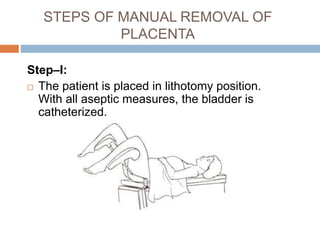
STEPS OF MANUAL REMOVAL OF
PLACENTA
Step–I:
 The patient is placed in lithotomy position.
With all aseptic measures, the bladder is
catheterized.
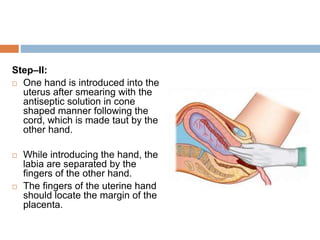
Step–II:
 One hand is introduced into the
uterus after smearing with the
antiseptic solution in cone
shaped manner following the
cord, which is made taut by the
other hand.
 While introducing the hand, the
labia are separated by the
fingers of the other hand.
 The fingers of the uterine hand
should locate the margin of the
placenta.
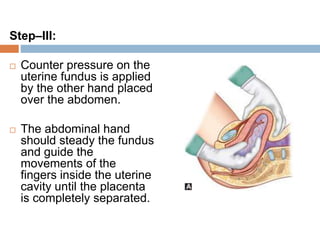
Step–III:
 Counter pressure on the
uterine fundus is applied
by the other hand placed
over the abdomen.
 The abdominal hand
should steady the fundus
and guide the
movements of the
fingers inside the uterine
cavity until the placenta
is completely separated.
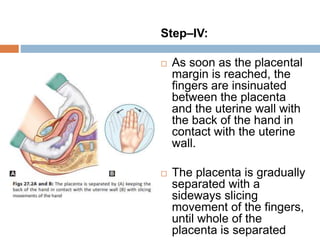
Step–IV:
 As soon as the placental
margin is reached, the
fingers are insinuated
between the placenta
and the uterine wall with
the back of the hand in
contact with the uterine
wall.
 The placenta is gradually
separated with a
sideways slicing
movement of the fingers,
until whole of the
placenta is separated
Step–V:
 When the placenta is
completely separated, it is
extracted by traction of the
cord by the other hand.
 The uterine hand is still
inside the uterus for
exploration of the cavity to
be sure that nothing is left
behind.
Step–VI:
 IV methergine 0.2 mg is
given and the uterine hand
is gradually removed while
massaging the uterus by
the external hand to make
it hard.
 After the completion of
manual removal, inspection
of the cervicovaginal canal
is to be made to exclude
any injury.
Step–VII:
 The placenta and membranes are inspected
for completeness and be sure that the uterus
remains hard and contracted.
Difficulties:
 Hour-glass contraction leading to difficulty in
introducing the hand
 Morbid adherent placenta which may cause
difficulty in getting to the plane of cleavage of
placental separation.
 In such a case placenta is removed gently in
fragments using an ovum forceps.
Complications
 Hemorrhage due to incomplete
removal
 Shock
 Injury to the uterus
 Infection
 Inversion (rare)
 Subinvolution
 Thrombophlebitis
 Embolism.
Management of True
Postpartum Hemorrhage
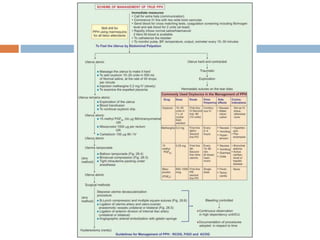
Immediate measures
 Call for extra help
 Put in 2 large bore IVcannulas
 Keep patient flat and warm
 Send blood for full blood count, group, cross matching,
diagnostic tests (RFT, LFT), coagulation screen including
fibrinogen and ask for 2 units (at least) of blood.
 Infuse rapidly 2 liters of normal saline (crystalloids) or
plasma.
 Give oxygen by mask 10–15 L/min.
 Start 20 units of oxytocin in 1 L of normal saline IV at the rate
of 60 drops per minute.
 Transfuse blood as soon as possible.
Monitor
 Pulse
 Blood pressure
 Temperature
 Respiratory rate and oximeter
 Type and amount of fluids (blood, blood products)
the patient has received
 Urine output (continuous catheterization)
 Drugs-type, dose and time
 Central venous pressure (when sited).
ACTUAL
MANAGEMENT
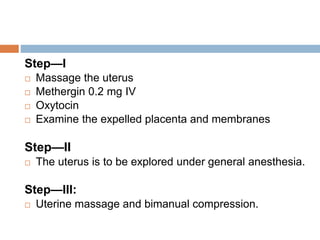
Step—I
 Massage the uterus
 Methergin 0.2 mg IV
 Oxytocin
 Examine the expelled placenta and membranes
Step—II
 The uterus is to be explored under general anesthesia.
Step—III:
 Uterine massage and bimanual compression.
Uterine massage and bimanual
compression
 The whole hand is introduced into the
vagina in cone shaped fashion after
separating the labia with the fingers
of the other hand
 The vaginal hand is clenched into a
fist with the back of the hand directed
posteriorly and the knuckles in the
anterior fornix
 The other hand is placed over the
abdomen behind the uterus to make
it anteverted
 The uterus is firmly squeezed
between the two hands
Step—IV : Uterine tamponade
 Tight intrauterine packing: done uniformly under
general anesthesia.
 Balloon tamponade: Tamponade using various types of
hydrostatic balloon catheter has mostly replaced uterine
packing.
 Mechanism of action is similar to uterine packing.
 Foley catheter, Bakri balloon, Condom catheter or
Sengstaken-Blakemore tube is inserted into the uterine
cavity and the balloon is inflated with normal saline (200–
500 mL).
 It is kept for 4–6 hours. It is successful in atonic PPH.
This can avoid hysterectomy in 78% cases.
Step V Surgical methods to control
PPH
 Ligation of uterine
arteries—the ascending
branch of the uterine
artery.
 Ligation of the ovarian
and uterine artery
anastomosis.
 Ligation of anterior
division of internal iliac
artery (unilateral or
bilateral).
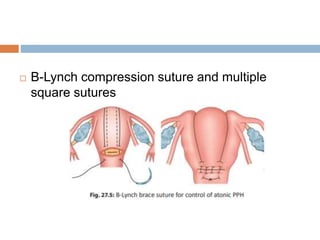
 B-Lynch compression suture and multiple
square sutures
SECONDARY
POSTPARTUM
HEMORRHAGE
 The bleeding usually occurs between 8th and 14th
day of delivery.
The causes of late postpartum hemorrhage are:
 Retained bits of cotyledon or membranes (most
common)
 Infection and separation of slough over a deep
cervicovaginal laceration
 Endometritis and subinvolution of the placental site—
due to delayed healing process
 Secondary hemorrhage from cesarean section
wound usually occur between 10–14 days.
CAUSES
 Withdrawal bleeding following estrogen therapy for
suppression of lactation
Other rare causes are:
 Chorionepithelioma—occurs usually beyond 4
weeks of delivery
 Carcinoma cervix
 Placental polyp
 Infected fibroid or fibroid polyp
 Puerperal inversion of uterus.
MANAGEMENT
Supportive therapy:
 Blood transfusion, if necessary.
 To administer methergine 0.2 mg IM, if the
bleeding is uterine in origin .
 To administer antibiotics (clindamycin and
metronidazole) as a routine.
Conservative
 If the bleeding is slight and no apparent cause is
detected, a careful watch for a period of 24 hours or so is
done in the hospital.
Active treatment:
 It is preferable to explore the uterus urgently under
general anesthesia.
 Most common cause is due to retained bits of cotyledon
or membranes.
 The products are removed by ovum forceps.
 Gentle curettage is done by using flushing curette.
 Methergine 0.2 mg IM.
 The materials removed are to be sent for
histological examination.
 Presence of bleeding from the sloughing
wound of cervicovaginal canal should be
controlled by hemostatic sutures.
Thank You

PPH Postpartum hemorrhage.pptx

  • 1.
  • 2.
    DEFINITION  The amountof blood loss in excess of 500 mL following birth of the baby (WHO).
  • 3.
    Clinical definition  “Anyamount of bleeding from or into the genital tract following birth of the baby up to the end of the puerperium  Which adversely affects the general condition of the patient evidenced by rise in pulse rate and falling blood pressure is called postpartum hemorrhage”.
  • 4.
     The averageblood loss following vaginal delivery, cesarean delivery and cesarean hysterectomy is 500mL, 1000 mL and 1500 mL respectively.  Depending upon the amount of blood loss, PPH can be: Minor (< 1L) Major (> 1L) Severe(> 2L).
  • 5.
    TYPES Primary PPH  Hemorrhageoccurs within 24 hours following the birth of the baby. These are of two types:  Third stage hemorrhage—Bleeding occurs before expulsion of placenta.  True postpartum hemorrhage—Bleeding occurs subsequent to expulsion of placenta (majority).
  • 6.
    TYPES Secondary PPH  Hemorrhageoccurs beyond 24 hours and within puerperium, also called delayed or late puerperal hemorrhage.
  • 7.
  • 8.
    Causes - 4Ts’ Tone  Tissue  Trauma  Thrombin
  • 9.
    Atonic uterus (80%): Atonicity of the uterus is the commonest cause of postpartum hemorrhage. The following are the conditions which often interfere with the retraction of the uterus:  Grand multipara  Over distension of the uterus  Malnutrition and anemia (<9.0 g/dL)  APH(Both placenta previa and abruption)  Prolonged labor (>12 hours)  Initiation or augmentation of delivery by oxytocin  Malformation of the uterus  Uterine fibroid
  • 10.
    Mismanaged third stageof labor - This includes—  Too rapid delivery of the baby preventing the uterine wall to adapt to the diminishing contents  Premature attempt to deliver the placenta before it is separated  Kneading and fiddling the uterus  Pulling the cord.  Manual separation of the placenta increases blood loss during cesarean delivery.
  • 11.
    Other causes ofatonic hemorrhage are:  Obesity (BMI > 35) , Previous PPH ,Age(>40 yrs)  Drugs: Use of tocolytic drugs (ritodrine), MgSO4,Nifedipine.
  • 12.
    Traumatic (20%)  Operativedelivery  Episiotomy  Cesarean section  Trauma(cervix, vagina, perineum, paraurethral region and rarely, rupture of the uterus occurs) Retained tissues Thrombin Blood
  • 13.
    DIAGNOSIS AND CLINICAL EFFECTS In majority, the vaginal bleeding is visible outside, as a slow trickle.  Rarely, the bleeding is totally concealed as either vulvovaginal or broad ligament hematoma. The effect of blood loss depends on—  Predelivery hemoglobin level  Degree of pregnancy induced hypervolemia  Speed at which blood loss occurs.
  • 14.
     Alteration ofpulse, blood pressure and pulse pressure appears only after class 2 hemorrhage (20–25% loss of blood volume).  On occasion, blood loss is so rapid and brisk that death may occur within a few minutes.
  • 15.
     In traumatichemorrhage, the uterus is found well contracted.  In atonic hemorrhage,the uterus is found flabby and becomes hard on massaging.
  • 16.
    Prevention Antenatal  Improvement ofthe health status -Hb level normal (> 10 g/dL)  High-risk patients (such as twins, hydramnios, grand multipara, APH, history of previous PPH, severe anemia)  Blood grouping  Placental localization  All women with prior cesarean delivery must have their placental site determined by ultrasound/MRI to determine morbid adherent placenta.  Women with morbid adherent placenta are at high risk of PPH.
  • 17.
    Prevention Intranatal  Active managementof the third stage, for all women in labor should be a routine as it reduces PPH by 60%.  Cases with induced or augmented labor by oxytocin.  Women delivered by cesarean section, oxytocin 5 IU slow IV is to be given to reduce blood loss.  Carbetocin(long-acting oxytocin) 100 μg is very useful to prevent PPH.
  • 18.
     Exploration ofthe uterovaginal canal.  Observation for about two hours.  Expert obstetric anesthetist.  During cesarean section spontaneous separation and delivery of the placenta reduces blood loss (30%).  Examination of the placenta and membranes should be a routine to detect at the earliest any missing part.
  • 19.
    Management of ThirdStage Bleeding
  • 20.
    The principles inthe management are:  To empty the uterus of its contents and to make it contract.  To replace the blood.  To ensure effective hemostasis in traumatic bleeding.
  • 21.
    STEPS OF MANAGEMENT: Placentalsite bleeding  To palpate the fundus and massage - The massage is to be done by placing four fingers behind the uterus and thumb in front.  If bleeding continues even after the uterus becomes hard, suggests, the presence of genital tract injury.  To start crystalloid solution (Normal saline or Ringer’s solution) with oxytocin.  Oxytocin 10 units IM or methergine 0.2 mg is given IV.  Carbetocin, a longer acting oxytocin derivative is found (100 μg) as effective as oxytocin infusion.  To catheterize the bladder.  To give antibiotics (Ampicillin 2 g and Metronidazole 500 mg IV).
  • 22.
    Management of traumatic bleeding: The uterovaginal canal is to be explored under general anesthesia after the placenta is expelled and hemostatic sutures are placed on the offending sites.
  • 24.
    STEPS OF MANUALREMOVAL OF PLACENTA Step–I:  The patient is placed in lithotomy position. With all aseptic measures, the bladder is catheterized.
  • 25.
    Step–II:  One handis introduced into the uterus after smearing with the antiseptic solution in cone shaped manner following the cord, which is made taut by the other hand.  While introducing the hand, the labia are separated by the fingers of the other hand.  The fingers of the uterine hand should locate the margin of the placenta.
  • 26.
    Step–III:  Counter pressureon the uterine fundus is applied by the other hand placed over the abdomen.  The abdominal hand should steady the fundus and guide the movements of the fingers inside the uterine cavity until the placenta is completely separated.
  • 27.
    Step–IV:  As soonas the placental margin is reached, the fingers are insinuated between the placenta and the uterine wall with the back of the hand in contact with the uterine wall.  The placenta is gradually separated with a sideways slicing movement of the fingers, until whole of the placenta is separated
  • 28.
    Step–V:  When theplacenta is completely separated, it is extracted by traction of the cord by the other hand.  The uterine hand is still inside the uterus for exploration of the cavity to be sure that nothing is left behind. Step–VI:  IV methergine 0.2 mg is given and the uterine hand is gradually removed while massaging the uterus by the external hand to make it hard.  After the completion of manual removal, inspection of the cervicovaginal canal is to be made to exclude any injury.
  • 29.
    Step–VII:  The placentaand membranes are inspected for completeness and be sure that the uterus remains hard and contracted.
  • 30.
    Difficulties:  Hour-glass contractionleading to difficulty in introducing the hand  Morbid adherent placenta which may cause difficulty in getting to the plane of cleavage of placental separation.  In such a case placenta is removed gently in fragments using an ovum forceps.
  • 31.
    Complications  Hemorrhage dueto incomplete removal  Shock  Injury to the uterus  Infection  Inversion (rare)  Subinvolution  Thrombophlebitis  Embolism.
  • 32.
  • 33.
    Immediate measures  Callfor extra help  Put in 2 large bore IVcannulas  Keep patient flat and warm  Send blood for full blood count, group, cross matching, diagnostic tests (RFT, LFT), coagulation screen including fibrinogen and ask for 2 units (at least) of blood.  Infuse rapidly 2 liters of normal saline (crystalloids) or plasma.  Give oxygen by mask 10–15 L/min.  Start 20 units of oxytocin in 1 L of normal saline IV at the rate of 60 drops per minute.  Transfuse blood as soon as possible.
  • 34.
    Monitor  Pulse  Bloodpressure  Temperature  Respiratory rate and oximeter  Type and amount of fluids (blood, blood products) the patient has received  Urine output (continuous catheterization)  Drugs-type, dose and time  Central venous pressure (when sited).
  • 35.
  • 36.
    Step—I  Massage theuterus  Methergin 0.2 mg IV  Oxytocin  Examine the expelled placenta and membranes Step—II  The uterus is to be explored under general anesthesia. Step—III:  Uterine massage and bimanual compression.
  • 37.
    Uterine massage andbimanual compression  The whole hand is introduced into the vagina in cone shaped fashion after separating the labia with the fingers of the other hand  The vaginal hand is clenched into a fist with the back of the hand directed posteriorly and the knuckles in the anterior fornix  The other hand is placed over the abdomen behind the uterus to make it anteverted  The uterus is firmly squeezed between the two hands
  • 38.
    Step—IV : Uterinetamponade  Tight intrauterine packing: done uniformly under general anesthesia.  Balloon tamponade: Tamponade using various types of hydrostatic balloon catheter has mostly replaced uterine packing.  Mechanism of action is similar to uterine packing.  Foley catheter, Bakri balloon, Condom catheter or Sengstaken-Blakemore tube is inserted into the uterine cavity and the balloon is inflated with normal saline (200– 500 mL).  It is kept for 4–6 hours. It is successful in atonic PPH. This can avoid hysterectomy in 78% cases.
  • 39.
    Step V Surgicalmethods to control PPH  Ligation of uterine arteries—the ascending branch of the uterine artery.  Ligation of the ovarian and uterine artery anastomosis.  Ligation of anterior division of internal iliac artery (unilateral or bilateral).
  • 40.
     B-Lynch compressionsuture and multiple square sutures
  • 42.
  • 43.
     The bleedingusually occurs between 8th and 14th day of delivery. The causes of late postpartum hemorrhage are:  Retained bits of cotyledon or membranes (most common)  Infection and separation of slough over a deep cervicovaginal laceration  Endometritis and subinvolution of the placental site— due to delayed healing process  Secondary hemorrhage from cesarean section wound usually occur between 10–14 days.
  • 44.
    CAUSES  Withdrawal bleedingfollowing estrogen therapy for suppression of lactation Other rare causes are:  Chorionepithelioma—occurs usually beyond 4 weeks of delivery  Carcinoma cervix  Placental polyp  Infected fibroid or fibroid polyp  Puerperal inversion of uterus.
  • 45.
    MANAGEMENT Supportive therapy:  Bloodtransfusion, if necessary.  To administer methergine 0.2 mg IM, if the bleeding is uterine in origin .  To administer antibiotics (clindamycin and metronidazole) as a routine.
  • 46.
    Conservative  If thebleeding is slight and no apparent cause is detected, a careful watch for a period of 24 hours or so is done in the hospital. Active treatment:  It is preferable to explore the uterus urgently under general anesthesia.  Most common cause is due to retained bits of cotyledon or membranes.  The products are removed by ovum forceps.  Gentle curettage is done by using flushing curette.
  • 47.
     Methergine 0.2mg IM.  The materials removed are to be sent for histological examination.  Presence of bleeding from the sloughing wound of cervicovaginal canal should be controlled by hemostatic sutures.
  • 48.