EVALUATION OF HEAT STRESS
What is Heat Stress?
Heat stress is a condition in which net heat load on your
body from internal heat production and external sources
exceeds your body’s capacity to cool itself.
Temperature > 37.6 degree Celsius
Measurement of heat stress
Metabolic Factors
 Direct and Indirect Calorimetry
Environmental Factors
 Air temperature
 Air humidity
 Air velocity
 Radiant heat
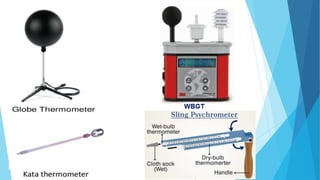
Psychrometer
Katathermometer
Globe Thermometer
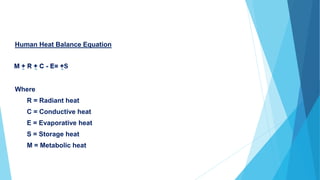
Human Heat Balance Equation
Where
R = Radiant heat
C = Conductive heat
E = Evaporative heat
S = Storage heat
M = Metabolic heat
Heat Stress Indices
1. Effective Temperature : Sensory scale of warmth, compiled from the readings of dry & wet
bulb temperature and air velocity from temperature and standard nomogram. Safe Limit is
30 degree Celsius
2. Corrected Effective Temperature: The effects of radiant heat can be included in an
assessment of effective temperature by using the globe thermometer temperature instead
of the dry-bulb temperature in those cases when the reading of the globe thermometer is
higher than the dry-bulb temperature. In such cases, the result is described as the
corrected effective temperature. Safe Limit is 29 degree Celsius.
3. Predicted 4-hour Sweat Rate: The amount of sweat that would be perspired by a
physically fit and acclimatized young man in the condition under review oral period of 4
hours. It takes into account the metabolic level and type of clothing in addition to the
climatic factors unlike other indices mentioned earlier. Normal Range 2.5 – 3 Liters per 4
hours
Continuation……
4. Belding – Hatch Index: Safe limit is 24 units, if more than 24 units muscular activity should
be discontinued.
5. Oxford Index: It is used to assess the severity of hot humid conditions of the working place
where ventilation is poor.
WD = 0.15d + 0.85 w
Where, WD= Weighted value, d&w= dry & wet bulb temperature
5. Wet Bulb Globe Temperature (WBGT) Index: It embraces in a single value the effect of
‘radiation’, ‘ambient air temperature’ and ‘humidity’. Safe Limit 30 degree Celsius.
Exposure to Sunlight = WBGT = 0.7wb+0.2 gt+0.1db
Non Exposure to Sunlight = WBGT = 0.7wb+0.3gt
Where, db =dry bulb
Advantage: It excludes the use of anemometers and eliminates the problem of obtaining
average air velocity.
Heat Stress.pptx

Heat Stress.pptx

  • 1.
  • 2.
    What is HeatStress? Heat stress is a condition in which net heat load on your body from internal heat production and external sources exceeds your body’s capacity to cool itself. Temperature > 37.6 degree Celsius
  • 3.
    Measurement of heatstress Metabolic Factors  Direct and Indirect Calorimetry Environmental Factors  Air temperature  Air humidity  Air velocity  Radiant heat Psychrometer Katathermometer Globe Thermometer
  • 4.
    Human Heat BalanceEquation Where R = Radiant heat C = Conductive heat E = Evaporative heat S = Storage heat M = Metabolic heat
  • 5.
    Heat Stress Indices 1.Effective Temperature : Sensory scale of warmth, compiled from the readings of dry & wet bulb temperature and air velocity from temperature and standard nomogram. Safe Limit is 30 degree Celsius 2. Corrected Effective Temperature: The effects of radiant heat can be included in an assessment of effective temperature by using the globe thermometer temperature instead of the dry-bulb temperature in those cases when the reading of the globe thermometer is higher than the dry-bulb temperature. In such cases, the result is described as the corrected effective temperature. Safe Limit is 29 degree Celsius. 3. Predicted 4-hour Sweat Rate: The amount of sweat that would be perspired by a physically fit and acclimatized young man in the condition under review oral period of 4 hours. It takes into account the metabolic level and type of clothing in addition to the climatic factors unlike other indices mentioned earlier. Normal Range 2.5 – 3 Liters per 4 hours
  • 6.
    Continuation…… 4. Belding –Hatch Index: Safe limit is 24 units, if more than 24 units muscular activity should be discontinued. 5. Oxford Index: It is used to assess the severity of hot humid conditions of the working place where ventilation is poor. WD = 0.15d + 0.85 w Where, WD= Weighted value, d&w= dry & wet bulb temperature 5. Wet Bulb Globe Temperature (WBGT) Index: It embraces in a single value the effect of ‘radiation’, ‘ambient air temperature’ and ‘humidity’. Safe Limit 30 degree Celsius. Exposure to Sunlight = WBGT = 0.7wb+0.2 gt+0.1db Non Exposure to Sunlight = WBGT = 0.7wb+0.3gt Where, db =dry bulb Advantage: It excludes the use of anemometers and eliminates the problem of obtaining average air velocity.