FIBROID UTERUS
BY - DR SHUBHAVANI B R
GUIDED BY - DR AMITHA KAMAT
CONTENTS
• Introduction
• Incidence
• Etiology
• Risk factors
• Pathology
• Classification
• Secondary changes
• Clinical spectrum
• Investigations
• Management
INTRODUCTION
• Fibroids (Myoma, Leiomyoma, Fibromyoma)
• These are the most common benign, monoclonal tumors of smooth muscle
cells of the uterus.
• Fibroids can be single or multiple.
• It is composed of smooth muscle and fibrous connective tissue.
INCIDENCE
• It is seen in 20-25% of women in reproductive age group.
• It is responsible for 27% of gynecological admissions.
• More common in African and Carribean women.
• The prevalence is highest between 35 – 45yrs age.
• 50% of the fibroids are asymptomatic.
ETIOLOGY
• Genetic factors
•Hormonal factors
GENETIC FACTORS
• Individual leiomyoma is monoclonal; it arises from somatic mutation of
progenitor myocyte.
50% of the leiomyomas have chromosomal abnormalities, most common
being
-Translocation between the long arms of chromosomes 12 to 14.
- Deletion of the long arm of chromosomeY.
• These chromosomal abnormalities alter genes that results in elevation in
the cytokines like EGF,IGF,TGF, and Angiogenic growth factors.
• These growth factors are responsible for the growth of leiomyoma.
HORMONAL CAUSES
Estrogen is the major hormone influencing the growth of the fibroids, hence
the growth of the fibroid is seen only in the reproductive age group.
Increased exposure to estrogen like early menarche, nulliparity, late
menopause, Hormone replacement therapies are all the major risk factors.
Myocytes in leiomyoma have higher number of estrogen receptors than the
adjacent normal myometrium.
Higher levels of cytochrome P450 aromatase enzyme levels are seen in
leiomyomas.
Progesterone acts as mitogen and causes myocyte cellular proliferation,
extracellular matrix accumulation and cellular hypertrophy.
It is evidenced by increasing size of leiomyomas during pregnancy and
shrinkage of the tumor with antiprogesterones like mifepristone.
RISK FACTORS
• Increasing age
• Nulliparity
• Ethnicity
• Obesity
• Meat and high fat diet
• PCOD
• Hormone replacement therapy
• Family history
PROTECTIVE FACTORS
• Multiparity
• Smoking
• Exercise
• OCP use
• Menopause
GROSS APPEARANCE – These are round
to oval shaped, single or multiple, well
circumscribed, firm and pearly white
tumours with cut sections showing
smooth whorled appearance and
trabeculations.
PATHOLOGY OF
LEIOMYOMA
Microscopically interlacing smooth
muscle bundles with swirled pattern and
variable amount of fibrous tissues are
seen.
TYPESOF FIBROIDS
1. Intramural or interstitial(75%)
2. Subserous (10%)
3. Submucous(5%)
4. Cervical (anterior, posterior, central,
lateral) (1-2%)
5. Broad ligament fibroid
CLASSIFICATION
INTRAMURAL/INTERSTITIAL
FIBROID
• 75% of the fibroids are intramural.
• Initially the fibroids are intramural in
origin, they gradually grow inwards or
outwards to become submucous or
subserosal fibroids.
• These fibroids grow steadily with
formation of a false capsule by
compressing the surrounding
myometrium.
SUBSEROSAL FIBROID
• These fibroids are partially or
completely covered by peritoneum.
• They can be sessile or pedunculated
with a pedicle.
• Large pedunculated fibroids can
undergo torsion, and if the pedicle is
torn the fibroid gets the blood supply
from the omental or mesenteric
adhesions – Wandering or parasitic
fibroid.
SUBMUCOUS FIBROID
• These fibroids lie just beneath the
endometrium.
• They can be sessile or pedunculated.
• They produce maximum symptoms like
menorrhagia and dysmenorrhea
compared to other types of fibroids.
• Infertility due to fibroids is maximally
seen in this type as they distort the
uterine cavity.
• Pedunculated fibroids can come out
through the cervix appearing as
endometrial or endocervical polyp.
CERVICAL FIBROID
• These can be anterior – arising from the anterior lip of cervix and grows
anteriorly undermining the bladder producing urinary symptoms.
• Posterior – growing from the posterior part of cervix and compressing the
rectum against sacrum.
• Lateral – the myoma grows from lateral cervix and burrows out in the broad
ligament forming pseudobroad ligament fibroid.They compress ureters and
cause hydronephrosis.
Continued…
• Central – here the tumor is either
interstitial or submucous in origin and
it expands equally in all directions,
giving the appearance of ‘the lantern
on the dome of St Paul’s cathedral’.
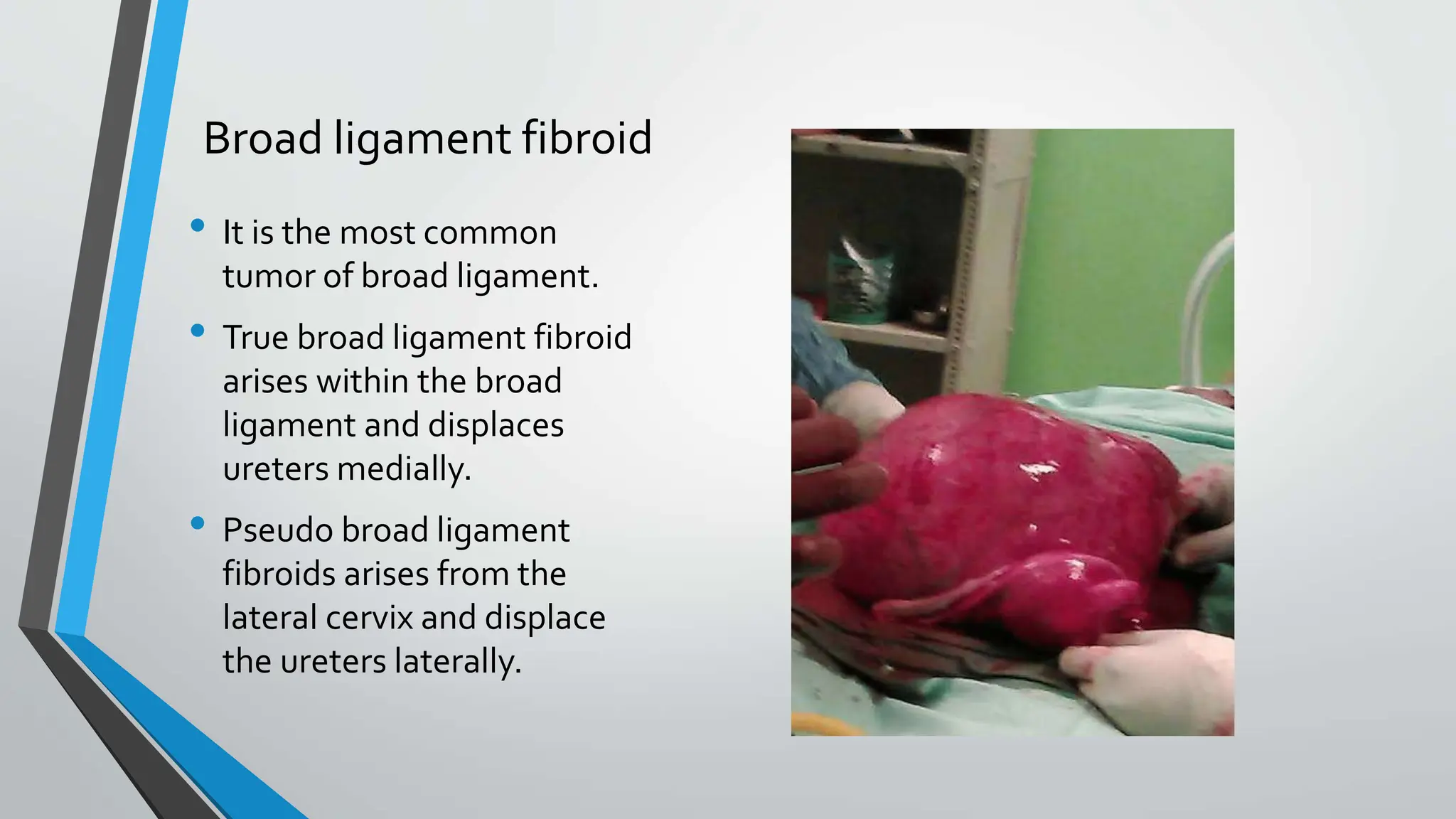
Broad ligament fibroid
• It is the most common
tumor of broad ligament.
• True broad ligament fibroid
arises within the broad
ligament and displaces
ureters medially.
• Pseudo broad ligament
fibroids arises from the
lateral cervix and displace
the ureters laterally.
SECONDARY CHANGES IN FIBROIDS
• Degenerations
• Necrosis
• Infection
• Vascular changes
• Sarcomatous changes (<0.1%)
• Atrophy
Other complications
• Torsion.
• Axial rotation of the uterus.
• Uterine inversion.
• Capsular rupture.
• Pseudo Meig’s syndrome.
DEGENERATIONS
Vascular supply of the leiomyomas is by the peripheral vessels in the loose
areolar tissue beneath the false capsule hence the center of the tumor is least
vascular and undergoes degenerations.
Types – 1 Hyaline degeneration
2 Cystic degeneration
3 Fatty degeneration
4 Calcific degeneration
5 Red degeneration
HYALINE DEGENERATION
• It is the most common type of
degeneration (65%).
• The least vascular central part is the
common site.
• Cut surface shows irregular
homogenous area with loss of whorled
appearance.
• Microscopically, hyaline changes of
both muscle and fibrous tissues seen
with loss of cellular details.
CYSTIC DEGENERATION
• It is commonly seen in interstitial
fibroids after menopause.
• It is formed by liquefaction of the areas
with hyaline changes, with cystic
spaces lined by irregular ragged edges.
• These can often be confused with
ovarian cyst radiologically.
FATTY DEGENERATION
• It is seen after menopause.
• Fat globules are deposited in the
myocytes.
CALCIFIC DEGENERATION
• It is due to precipitation of calcium
carbonate or phosphates within the
tumor following fatty degeneration.
• The whole tumor gets converted into
calcified mass hence it is called womb
stone.
RED DEGENERATION
• It is seen in the second half of
pregnancy due to vascular thrombosis.
• Seen in large fibroids.
• Grossly the tumor is dark in colour with
cut surface showing raw beefy cystic
spaces and it has typical fishy odour
due to fatty acids.
• Clinically it mimics UTI, APH,
strangulated hernia and ovarian torsion
• It is also called necrobiosis.
Continued…..
• It can be diagnosed by USG and MRI.
• Ultrasound imaging shows mass with heterogenous echogenicity located
adjacent and connected to the gravid uterus by a bridge of hypoechoic
tissue.
CLINICAL SPECTRUM OF FIBROID
• Incidental finding : 50% are asymptomatic.
• Gynecological problems : AUB, dysmenorrhea, non cyclic pain,Vaginal
discharge.
• Reproductive problems : Infertility
• Obstetrics problems : Early pregnancy loss, recurrent pregnancy loss,
preterm labour, PPROM, IUGR, pain, red generation, malpresentations,
dysfunctional labour, LSCS and PPH.
• Pressure symptoms : Urinary tract obstruction, bowel symptoms.
• Generalised problems : Anaemia, poor health, mass per abdomen.
• Rare problems : Ascites, polycythemia, benign metastasizing uterine
fibroids with RCC.
• Malignant change : Sarcomatous change.
Menstrual disturbances
• Menorrhagia i.e. an increased blood loss at normally spaced intervals
is the typical symptom of leiomyomas. It is gradual in onset and
progressive.
• The cycles are not altered unless the tumors are so large as to disturb
the blood supply and function of ovary.
• It is commonly manifested in the age group of 35-45yrs.
• Intermenstrual bleeding and continuous irregular bleeding is seen only
when there is ulceration of submucous fibroid or polypoidal change or
sarcomatous change.
Factors causing menorrhagia are
• Increased surface area of the endometrium.
• Increased vascularity of the uterus.
• Associated hyperestrogenism and endometrial hyperplasia.
• Compression of veins by tumors with consequent dilatation and
engorgement of venous plexus in endometrium and myometrium.
• Interference with normal uterine contractions due to interposition of fibroid.
• Imbalance of thromboxaneA2 (TXA2) and prostacyclin (PGI2) with relative
deficiency of thromboxaneA2.
Dysmenorrhea
• It can be spasmodic : In submucous fibroid stimulating expulsive uterine
contraction.
• Congestive : due to pelvic venous congestion.
Pressure symptoms
• Bladder :Weight of the tumor causes bladder irritability and in increased
diurnal frequency, Urinary retention is seen in cervical fibroid or an impacted
corporeal fibroid.
• Alimentary tract : Dyspepsia, rarely constipation is seen from the pressure
over rectum.
• Veins and lymphatics : Edema and varicosities of veins of lower limbs seen in
large fibroids.
• Nerves : Large myomas impinging on sacral plexus and obturator nerves can
cause lower back pain.
• A broad ligament fibroid can produce ureteric compression, hydro ureteric
changes, hydronephrotic changes, infection and pyelitis.
Infertility
• Distortion or elongation of uterine cavity and prevention of rhythmic uterine
contraction during intercourse – difficult sperm ascent and transport.
• Congestion and dilatation of endometrial venous plexuses – defective
implantation.
• Atrophy and ulceration of endometrium over the submucous fibroids –
defective nidation.
• Cornual block and associated salpingitis due to position of the fibroid.
• Elongation of the tube over a big fibroid.
• Associated anovulation and hyper estrogenic state.
Clinical signs
• Pallor
• Mass per abdomen – when tumor > 12weeks size it is felt as firm in
consistency, well defined margins except the lower pole, surface can be
nodular or uniformly enlarged, horizontal mobility is seen and restricted
vertical mobility.
• The mass is dull on percussion.
• On BME – Uterus and mass can be felt as single mass, movements of the
cervix is transmitted to the mass and vice versa.
• Subserous pedunculated fibroids and broad ligament fibroids feel as
different mass with grove sign.
Differential diagnosis
• Adenomyosis
• Pregnancy
• Endometrial polyp
• Myohyperplasia
• Pyometra
• Hematometra
• Malignancy like choriocarcinoma and sarcoma
• Ovarian tumor
• Tubo ovarian mass
• Endometriosis
INVESTIGATIONS
Ultrasound : Diagnosis can be confirmed with transabdominal or
transvaginal ultrasound. It is reliable for evaluation with the uterine volume
less than or equal to 375cc.
TVS has high resolutions and can accurately assess the myoma location,
dimensions, number and any adnexal pathology.
Transabdominal ultrasound is required for the larger myomas to delineate the
exact dimensions.
On ultrasound the uterine contour is enlarged and distorted.
Continued…
Myometrium is normally homogenously hypoechoic and serosal surface is
smooth and regular. Distortion in any of these two suggests myometrial
lesions.
Depending the amount of smooth muscles and connective tissues, fibroids can
be hypoechoic or hyperechoic.
A fibroid usually appear as well defined hypoechoic lesion with peripheral
vascular rim.The echogenicity of the fibroid increases with its fibrous tissue
and vascularity.
In degenerations, fibroids show heterogenous echogenicity.
Calcific degenerations can be detected In ultrasound. Cystic degenerations
appear as anaechoic areas.
Colour doppler
• On colour doppler typically peripheral
vascularity is seen in fibroids,
resistance of the vessels is same as that
of adjacent myometrium.
• Resistance is higher in submucosal and
deep intramural fibroids than
subserosal fibroids.
• Degenerated fibroids have low
resistance.
Diffuse leiomyomatosis
Saline infusion sonography
• 17F SIS catheter is inserted through the
cervical os, 10-20ml of normal saline is
infused slowly.
• The uterine imaging is done with
vaginal ultrasound.
• This procedure is done within first
10days of cycle.
• Submucosal fibroids and polyps can be
detected.
Hysteroscopy
• It is useful to locate the exact site of
small submucosal fibroids in cases of
unexplained infertility and RPL.
• Diagnostic hysteroscopy doesn’t
require anaesthesia or cervical
dilatation.
• A fibreoptic telescope is used for
visualization after distending the
uterine cavity with CO2 or normal
saline or glycine.
• It is performed in the post
menstruation period and the chances
of conception disturbance is absent.
•HSG – in infertility patients due to submucosal fibroids, filling defect can
be seen.
•Diagnostic laparoscopy – Broad ligament fibroids, subserosal
fibroids, associated endometriosis, and tubal pathology can be diagnosed
under direct visualisation.
MRI – It is more accurate than ultrasound and it differentiates between
leiomyoma, leiomyosarcoma and adenomyosis.
It gives better resolution and more accurate assessment of size, number, and
position of myomas, as it is useful in selecting the treatment options like
myomectomy, hysterectomy or uterine artery embolization.
It also detects change in vascularity and size of the fibroids after giving GnRH
agonists pre operatively.
•Intravenous urography – It is done only when there is suspected
ureteric compression by large cervical fibroids, broad ligament fibroids and
large subserosal fibroids.
•Dilatation and curettage or endometrial biopsy – It is
done when there is fibroid uterus with postmenopausal bleeding or
thickened endometrium, to rule out associated malignancy before surgical
treatment.
MANAGEMENT
It can be divided into 4 approaches : 1 Expectant management
2 medical management
3 Non surgical management
4 Surgical management
Leiomyoma diagnosed in uterus, cervix or broad ligament
Asymptomatic uterus upto
12 weeks. Definite diagnosis.
Asymptomatic uterus >/= 14weeks,
diagnosis uncertain, pedunculated.
Symptomatic myoma.
Surgery
Expectant management and
follow up every 6 months
No increase in
size or
symptoms
Increase in size or
symptomatic
Follow up continued
Surgical treatment
Medical management
Improvement
Continued with follow up
Surgical management
Young patients with infertility
and RPL
Pt not keen for
hysterectomy, no
infertility
Uterine artery embolization
Large myoma
Family completed
Cervical fibroid
MRgfUS
Vaginal hysterectomy
For size <14 weeks.
TLH for size 14 -16 weeks TAH
Myomectomy
Open myomectomy
(Large, cervical, broad ligament)
Laparoscopic myomectomy
Hysteroscopic myomectomy
(Submucosal myomas)
Expectant management
• Asymptomatic patients.
• Size of the uterus with myoma less than 12weeks.
• Diagnosis of the fibroid is certain.
• It is suitable for women nearing menopause.
• Clinical and ultrasound follow up is done at every 6 months interval.
• Subserosal or submucosal sessile fibroids not at risk of torsion.
Medical management
• It is considered in symptomatic patients with AUB, infertility, anaemia and
poor health.
• Most common symptom being AUB, patients present with moderate to
severe anaemia. It is important for the correction of anaemia with blood
transfusion or parenteral iron therapy.
• With stoppage of the therapy, the tumor will gradually regain it’s size.
• Various hormonal and non hormonal drugs are used during the correction of
anaemia to minimize further blood loss.
• It is also done pre operatively for 3-6 months in large fibroids requiring
surgical intervention to reduce the size and vascularity of the tumor.
Continued…
• It is given in patients with infertility due to small cornual fibroid for
temporary regression of tumor.
• It can be given in symptomatic perimenopausal women and women with
high risk factors for surgery.
• Preoperative medical management of large fibroids > 14weeks size regress
the tumor size thereby facilitating vaginal hysterectomy.
• Two step approach in resecting large submucosal myomas can be avoided
by pre operative medical management.
• It also reduces operative blood loss during myomectomy or hysterectomy.
Drugs used in medical management
• Antiprogesterone – Mifepristone (RU486)
• Selective progesterone receptor modulators
• GnRH agonists
• GnRH antagonists
• Gonadotropin antagonists
• Aromatase enzyme inhibitors
• LNG – IUS
• Combined oral contraceptive pills
Mifepristone ( RU 486)
• It is a partial agonist and competitive antagonist of both A and B type of
progesterone receptors.
• It has bioavailability of 25% in oral route with t ½ of 20-36hrs.
• A daily dose of 5-10mg is recommended in treatment of leiomyoma.
• It reduces the size of fibroids by 50% and improves menorrhagia
significantly.
• It can be given for 3-6 months and the long term therapy is avoided due to
the risk of endometrial hyperplasia.
Ulipristal acetate
• It is selective progesterone receptor modulator without the effect of
endometrial hyperplasia.
• The efficacy of ulipristal is equal to GnRH analogues in reducing the size and
vascularity of the tumor.
• It is given in a dose of 5mg per orally OD for 3 months.
• It can be given upto 4 cycles with a gap of 3 months after each cycle.
• Reduction in menorrhagia by 90% and tumor size by 53% is seen.
• It is suitable for young nulliparous females and perimenopausal women.
• Disadvantages are high cost and risk of fulminant hepatitis when given for
longer duration.
GnRH analogues
GnRH agonists
Lueprolide, Goserelin, Buserelin, Nafarelin andTriptorelin.
These are the most commonly used drugs in the treatment of leiomyoma.
They act by downregulation of gonadotropin receptors in pituitary causing
decrease in gonadotropins and suppression of estrogen and progesterone
levels.
They also cause pain relief and amenorrhea.
They reduce the size of tumor by 60%.
Suitable for treatment of perimenopausal women.
Disadvantages
High cost
Loss of libido.
Vaginal dryness.
Emotional liability.
Osteopenia and osteoporosis.
Menopausal symptoms like hot flushes; can be treated with conjugated
estrogen 0.3-0.625mg + MPA 10mg from D16 to 25.
• They have high affinity forGnRH receptors and resistance to enzymatic
hydrolysis.
• They initially cause flare effect for 1-2 weeks followed by sustained
downregulation.
• After 2 weeks, estrogen levels falls <20pg/ml.
• Recovery occurs after 2 months of stopping the treatment along with
increase in the size of leiomyoma.
• Inj. Leuprolide acetate 3.75mg IM or SC every month for 3-6 months. It can
also be given as 11.25mg every 3 months.
• Inj. Goserelin 3.6mg depot subcutaneously over anterior abdominal wall
every month for 3-6 months or 10.8mg every 3 months.
• Inj.Triptorelin 3.75mg IM every month or 11.25mg IM every 3 months for 3-6
months.
• Nafarelin 300mcg BD nasal spray for 3-6 months.
GnRH antagonists
• Cetrorelix, Ganirelix, Elagolix and Relugolix.
• They competitively inhibit GnRH.
• Onset of action is rapid with no initial stimulatory action.
• Tab. Elagolix 300mg BD for 24 months can be given with add back therapy
of 1mg estradiol and 0.5mg norethindrone acetate.
• Adverse effects are similar to that of GnRH agonists.
LNG IUS
• It can be used in smaller myomas <12weeks size with HMB.
• It improves blood loss and reduces the size of myoma.
• Also acts as effective contraception.
• It is not suitable for large submucosal myomas distorting the uterine cavity.
• High expulsion rate when inserted in submucosal leiomyomas.
Aromatase inhibitors
• Letrozole and anastrozole causes hypoestrogenic state thereby reducing
the tumor size.
• They are associated with significant menopausal symptoms.
• Not yet approved for the treatment of leiomyomas.
• OCPs :This are used to make cycles anovulatory and reduce menstrual
blood loss.
• Prostaglandin synthetase inhibitors : Mefenamic acid 250-5oomgTID
improves menorrhagia by 20-50%.
• Antifibrinolytic agents :Tranexamic acid 1gm 2-4 times/day reduces
menstrual blood loss by 50%.
It is contraindicated in patients at risk of thromboembolic phenomenon.
Other drugs for symptomatic relief
NON SURGICAL MANAGEMENT
• Uterine artery embolization
• Magnetic resonance guided focused ultrasound.
• Radiofrequency volumetric thermal ablation.
• Myolyisis with Nd –YAG laser or cryotherapy.
• Laparoscopic B/L uterine artery ligation.
Uterine artery embolization
• This procedure is done under IV sedation by interventional radiologist.
• It improves menorrhagia in 80% women, dysmenorrhea in 77% and
reduction in size of the fibroid by 33%.
• Pre operatively Pap smear and Cervical swab cultures should be done.
• CBC, RFT, coagulation profile are mandatory.
• Active PID, pregnancy and malignancy are absolute contraindications for
the procedure.
• Not recommended In women desiring fertility.
Procedure
• Under IV sedation, angiographic catheter is put percutaneously in one
femoral artery.
• Under fluoroscopic guidance the catheter is advanced till both the uterine
arteries.
• PVC particles or trisacryl gelatine microspheres are delivered to the uterine
arteries to produce ischemia and necrosis of myoma.
Uterine artery embolization
Postoperative complications
• Post embolization syndrome
• Persistent fever
• Infection
• Pain
• Groin hematoma
• Vaginal discharge
• Mesenteric artery occlusion
• Reduced fertility
• Pedunculated subserous fibroids can become infected and cause peritonitis.
Magnetic resonance guided focused ultrasound
• Procedure – Under MRI guidance with patient in prone position high
intensity ultrasound energy is focussed on the myoma -> coagulative
necrosis.
• Advantages – Non invasive, Rapid recovery.
• Disadvantages – Expensive
• Contraindications – Pregnancy, previous abdominal surgery, large myomas
>10cm, Pelvic infection and infertility.
Surgical management
• Myomectomy - 1)Vaginal myomectomy
2) Hysteroscopic myomectomy
3) Laparoscopic myomectomy
4) Open myomectomy
• Hysterectomy – 1)Vaginal hysterectomy
2) Laparoscopic hysterectomy
3)Total abdominal hysterectomy
Pre operative investigations
• Complete blood count
• Blood grouping and Rh typing
• Bleeding and clotting time
• Serology for HIV and HBsAg
• Urine examination with culture and sensitivity
• FBS and PPBS
• RFT, LFT and serum electrolytes
• Chest x ray
• ECG
• UPT
Myomectomy
• It is an uterus preserving surgery
where only the myoma is excised,
leaving behind potentially functioning
uterus.
• It was first demonstrated by Victor
Bonney in 1913 in a nulliparous
woman.
• It can be vaginal, abdominal, hysteroscopic or laparoscopic depending the
location and size of the myoma.
• It is suitable for women desiring fertility and women who refuse for
hysterectomy.
• Blood loss during myomectomy is unpredictable and uncontrollable
bleeding is an indication for converting into hysterectomy.The consent for
the same should be taken pre operatively.
• All other causes of infertility should be ruled out before performing
myomectomy including husband’s semen analysis.
• Asymptomatic women with moderate to severe hydroureteronephrosis is
an indication for myomectomy.
• No attempt should be made for myomectomy in asymptomatic subserosal
myomas, intramural and cervical myomas during caesarean section.
• Painful leiomyomas during pregnancy are managed conservatively.
Subserosal myoma with torsion is an indication for laparotomy and
myomectomy.
• Before performing myomectomy endometrial cancer should be ruled out by
endometrial biopsy in perimenopausal women with AUB.
• Preoperatively patient’s general condition should be improved and anaemia
correction should be done either by blood transfusion or parenteral iron
therapy.
• Cochrane review shows significant improvement in preop Hb levels and
reduction in intra operative blood loss with use of pre operative GnRH
analogues for 3-6 months.
• Use of intra myometrial vasopressin also reduces operative blood loss.
Open myomectomy / Conventional myomectomy
• It is indicated if there are > 3 myomas with size > 10-12cms.
• 3-4 units of blood is arranged preoperatively.
• Patient should be explained about 50% recurrence rate in 5 years of surgery.
• Consent for possible hysterectomy should be taken.
• It is performed in proliferative phase of the cycle to reduce blood loss.
Procedure
• Pfannenstiel incision is preferred. For
the myoma size is > 16weeks, broad
ligament myoma, associated
adhesions midline vertical incision is
given.
• Location of the myoma identified,
diluted vasopressin (20IU in 200ml
saline) is injected to the myoma and to
its base.
Bladder peritoneum is incised and reflected
downwards.
• For larger myomas simple
rubber catheter can be used as
torniquet by making small holes
in broad ligament and passing
the torniquet around the cervix
and the lower uterus thereby
occluding uterine artery.
Continued…
• Alternatively Bonney’s myomectomy
clamp can be applied along with ring
forceps to the infundibulopelvic
ligament.
• The clamp is applied from the pubic
end of the abdominal wound with the
angle between the blades and the
shanks opening downwards to grip the
round ligaments.
• Clamps or torniquets used should be
released temporarily to avoid
accumulation of histamine
metabolites.
continued…
• Uterine incision is given over the
anterior uterine wall over the
myoma.
• The capsule of the myoma is cut
and the myoma is enucleated
with myoma screw.
• Multiple myomas can be removed
through single uterine incision, if the
myomas are far from each other
multiple incisions can be given.
• Submucous myomas also removed by
opening the endometrial cavity.
• Bleeding points in the myoma bed can
be ligated or cauterised.
• Incision on the endometrial lining is
closed with 2-0 or 3-0 vicryl.
Bonney’s hood operation
• It is done in large posterior wall
myomas.
• Incision is made over the posterior
wall.
• The myoma enucleated.
• Some redundant hood trimmed.
• The remaining hood is brought
anteriorly and stitched to the anterior
uterine wall.
• After enucleation the dead space is
obliterated by mattress suturing using 1
or 1-0 vicryl in 2-3 layers.
• The serosa is closed by baseball suturing
with 1-0 vicryl.
• Adhesion barriers like interceed,
seprafilm is used to cover the
myomectomy wound.
• Round ligaments are plicated to prevent
retroversion of the uterus.
Complications
• Intraoperative – 1) Primary haemorrhage.
2) Bladder injury.
3) Ureteric injury in broad ligament myoma excision.
4) Bowel injury (sigmoid colon and rectum).
• Post operative – 1) Reactionary haemorrhage.
2) Infection.
3) Need for relaparotomy.
• Late sequelae – 1) Adhesion formation b/w uterus and rectosigmoid.
2) Peritubal adhesions causing infertility.
3) Recurrence.
Laparoscopic myomectomy
• It is done in cases with myoma size </= 5cm and it being Intramural or
subserosal.
• Advantages : Minimally invasive procedure.
Lesser operative blood loss.
Reduced post operative pain.
Lesser hospital stay.
Cosmetic advantage.
Vaginal myomectomy
It is done only in fibroid polyps which are easily accessible and protruding into
the vagina.
Pedicle is clamped, cut and ligated with vicryl suture.
If the pedicle is inaccessible vagina and cervix is cut, bladder separated before
clamping the pedicle.
Hysteroscopic myomectomy
• It is an incisionless day care procedure with faster recovery.
• 85-90% long term efficiency for improvement in HMB.
• Improved fertility.
• Indications – 1) Symptomatic type 0 and type 1 myomas.
2) Infertility due to cornual submucous myomas.
3) Pedunculated myoma.
Procedure
• Patient is placed in lithotomy position after giving subarachnoid block.
• Preoperative 400mcg vaginal misoprostol is kept.
• Cervix is dilated with Hegar dilators.
• Operative hysteroscope is inserted and uterus is distended with glycine or
normal saline to maintain the intra uterine pressure of 75-100mmHg.
• Whole of the uterine cavity is inspected for other pathologies like adhesion,
septum and presence of both the ostia.
• Target myoma is identified, the cutting loop is passed beyond the fibroid,
with the cutting being activated only when the loop is moving towards the
operating surgeon.
Continued…
• Fibroid is resected down to the level of adjacent myometrium.
• In type 1 myomas, while performing the resection more of the myoma
projects into the uterine cavity, allowing for it’s further resection.
• Type 2 myomas can be resected in 2 settings after the interval of 6 weeks to
3 months.
• Fragments of the myoma are removed from the cavity with grasping
forceps.
• Any bleeding area is coagulated with roller ball coagulation.
• Foley’s catheter inflator balloon can also be used for control of bleeding.
Complications of the procedure
• Uterine perforation - first sign being rapid loss of fluid and vision.
• Fluid overload – a fluid deficit of 750ml is a warning sign and fluid deficit of
1ltr is indication for termination of the procedure.
• Haemorrhage.
• Infection.
Hysterectomy
•Indications : 1. Large symptomatic fibroids
2. Family is completed
3. Failure of conservative methods
4. Broad ligament fibroids
5. Cervical fibroids
6. Associated extensive endometriosis
Vaginal hysterectomy
• It is the preferred route if uterus < 14weeks size.
• Myoma can be enucleated before hysterectomy.
• Not suitable in the presence of pelvic adhesions.
Laparoscopic hysterectomy
• It can be done with the uterine size upto 16weeks.
• Minimally invasive.
• Early recovery.
• Not suitable for cervical and broad ligament fibroids.
Total abdominal hysterectomy
• Suitable for large myomas with size > 16weeks.
• Highest success and satisfaction rate.
• Better handling of ureters, bladder and rectum under direct visualisation.
• Broad ligament and cervical fibroids can be removed.
THANKYOU

FIBROID%20UTERUS%20FINAL%20PPT copy.pptx

  • 1.
    FIBROID UTERUS BY -DR SHUBHAVANI B R GUIDED BY - DR AMITHA KAMAT
  • 2.
    CONTENTS • Introduction • Incidence •Etiology • Risk factors • Pathology • Classification • Secondary changes • Clinical spectrum • Investigations • Management
  • 3.
    INTRODUCTION • Fibroids (Myoma,Leiomyoma, Fibromyoma) • These are the most common benign, monoclonal tumors of smooth muscle cells of the uterus. • Fibroids can be single or multiple. • It is composed of smooth muscle and fibrous connective tissue.
  • 4.
    INCIDENCE • It isseen in 20-25% of women in reproductive age group. • It is responsible for 27% of gynecological admissions. • More common in African and Carribean women. • The prevalence is highest between 35 – 45yrs age. • 50% of the fibroids are asymptomatic.
  • 5.
  • 6.
    GENETIC FACTORS • Individualleiomyoma is monoclonal; it arises from somatic mutation of progenitor myocyte. 50% of the leiomyomas have chromosomal abnormalities, most common being -Translocation between the long arms of chromosomes 12 to 14. - Deletion of the long arm of chromosomeY. • These chromosomal abnormalities alter genes that results in elevation in the cytokines like EGF,IGF,TGF, and Angiogenic growth factors. • These growth factors are responsible for the growth of leiomyoma.
  • 7.
    HORMONAL CAUSES Estrogen isthe major hormone influencing the growth of the fibroids, hence the growth of the fibroid is seen only in the reproductive age group. Increased exposure to estrogen like early menarche, nulliparity, late menopause, Hormone replacement therapies are all the major risk factors. Myocytes in leiomyoma have higher number of estrogen receptors than the adjacent normal myometrium. Higher levels of cytochrome P450 aromatase enzyme levels are seen in leiomyomas.
  • 8.
    Progesterone acts asmitogen and causes myocyte cellular proliferation, extracellular matrix accumulation and cellular hypertrophy. It is evidenced by increasing size of leiomyomas during pregnancy and shrinkage of the tumor with antiprogesterones like mifepristone.
  • 9.
    RISK FACTORS • Increasingage • Nulliparity • Ethnicity • Obesity • Meat and high fat diet • PCOD • Hormone replacement therapy • Family history
  • 10.
    PROTECTIVE FACTORS • Multiparity •Smoking • Exercise • OCP use • Menopause
  • 11.
    GROSS APPEARANCE –These are round to oval shaped, single or multiple, well circumscribed, firm and pearly white tumours with cut sections showing smooth whorled appearance and trabeculations. PATHOLOGY OF LEIOMYOMA
  • 12.
    Microscopically interlacing smooth musclebundles with swirled pattern and variable amount of fibrous tissues are seen.
  • 13.
    TYPESOF FIBROIDS 1. Intramuralor interstitial(75%) 2. Subserous (10%) 3. Submucous(5%) 4. Cervical (anterior, posterior, central, lateral) (1-2%) 5. Broad ligament fibroid
  • 14.
  • 16.
    INTRAMURAL/INTERSTITIAL FIBROID • 75% ofthe fibroids are intramural. • Initially the fibroids are intramural in origin, they gradually grow inwards or outwards to become submucous or subserosal fibroids. • These fibroids grow steadily with formation of a false capsule by compressing the surrounding myometrium.
  • 17.
    SUBSEROSAL FIBROID • Thesefibroids are partially or completely covered by peritoneum. • They can be sessile or pedunculated with a pedicle. • Large pedunculated fibroids can undergo torsion, and if the pedicle is torn the fibroid gets the blood supply from the omental or mesenteric adhesions – Wandering or parasitic fibroid.
  • 18.
    SUBMUCOUS FIBROID • Thesefibroids lie just beneath the endometrium. • They can be sessile or pedunculated. • They produce maximum symptoms like menorrhagia and dysmenorrhea compared to other types of fibroids. • Infertility due to fibroids is maximally seen in this type as they distort the uterine cavity. • Pedunculated fibroids can come out through the cervix appearing as endometrial or endocervical polyp.
  • 19.
    CERVICAL FIBROID • Thesecan be anterior – arising from the anterior lip of cervix and grows anteriorly undermining the bladder producing urinary symptoms. • Posterior – growing from the posterior part of cervix and compressing the rectum against sacrum. • Lateral – the myoma grows from lateral cervix and burrows out in the broad ligament forming pseudobroad ligament fibroid.They compress ureters and cause hydronephrosis.
  • 20.
    Continued… • Central –here the tumor is either interstitial or submucous in origin and it expands equally in all directions, giving the appearance of ‘the lantern on the dome of St Paul’s cathedral’.
  • 21.
    Broad ligament fibroid •It is the most common tumor of broad ligament. • True broad ligament fibroid arises within the broad ligament and displaces ureters medially. • Pseudo broad ligament fibroids arises from the lateral cervix and displace the ureters laterally.
  • 22.
    SECONDARY CHANGES INFIBROIDS • Degenerations • Necrosis • Infection • Vascular changes • Sarcomatous changes (<0.1%) • Atrophy
  • 23.
    Other complications • Torsion. •Axial rotation of the uterus. • Uterine inversion. • Capsular rupture. • Pseudo Meig’s syndrome.
  • 24.
    DEGENERATIONS Vascular supply ofthe leiomyomas is by the peripheral vessels in the loose areolar tissue beneath the false capsule hence the center of the tumor is least vascular and undergoes degenerations. Types – 1 Hyaline degeneration 2 Cystic degeneration 3 Fatty degeneration 4 Calcific degeneration 5 Red degeneration
  • 25.
    HYALINE DEGENERATION • Itis the most common type of degeneration (65%). • The least vascular central part is the common site. • Cut surface shows irregular homogenous area with loss of whorled appearance. • Microscopically, hyaline changes of both muscle and fibrous tissues seen with loss of cellular details.
  • 26.
    CYSTIC DEGENERATION • Itis commonly seen in interstitial fibroids after menopause. • It is formed by liquefaction of the areas with hyaline changes, with cystic spaces lined by irregular ragged edges. • These can often be confused with ovarian cyst radiologically.
  • 27.
    FATTY DEGENERATION • Itis seen after menopause. • Fat globules are deposited in the myocytes.
  • 28.
    CALCIFIC DEGENERATION • Itis due to precipitation of calcium carbonate or phosphates within the tumor following fatty degeneration. • The whole tumor gets converted into calcified mass hence it is called womb stone.
  • 29.
    RED DEGENERATION • Itis seen in the second half of pregnancy due to vascular thrombosis. • Seen in large fibroids. • Grossly the tumor is dark in colour with cut surface showing raw beefy cystic spaces and it has typical fishy odour due to fatty acids. • Clinically it mimics UTI, APH, strangulated hernia and ovarian torsion • It is also called necrobiosis.
  • 30.
    Continued….. • It canbe diagnosed by USG and MRI. • Ultrasound imaging shows mass with heterogenous echogenicity located adjacent and connected to the gravid uterus by a bridge of hypoechoic tissue.
  • 31.
    CLINICAL SPECTRUM OFFIBROID • Incidental finding : 50% are asymptomatic. • Gynecological problems : AUB, dysmenorrhea, non cyclic pain,Vaginal discharge. • Reproductive problems : Infertility • Obstetrics problems : Early pregnancy loss, recurrent pregnancy loss, preterm labour, PPROM, IUGR, pain, red generation, malpresentations, dysfunctional labour, LSCS and PPH. • Pressure symptoms : Urinary tract obstruction, bowel symptoms. • Generalised problems : Anaemia, poor health, mass per abdomen. • Rare problems : Ascites, polycythemia, benign metastasizing uterine fibroids with RCC. • Malignant change : Sarcomatous change.
  • 32.
    Menstrual disturbances • Menorrhagiai.e. an increased blood loss at normally spaced intervals is the typical symptom of leiomyomas. It is gradual in onset and progressive. • The cycles are not altered unless the tumors are so large as to disturb the blood supply and function of ovary. • It is commonly manifested in the age group of 35-45yrs. • Intermenstrual bleeding and continuous irregular bleeding is seen only when there is ulceration of submucous fibroid or polypoidal change or sarcomatous change.
  • 33.
    Factors causing menorrhagiaare • Increased surface area of the endometrium. • Increased vascularity of the uterus. • Associated hyperestrogenism and endometrial hyperplasia. • Compression of veins by tumors with consequent dilatation and engorgement of venous plexus in endometrium and myometrium. • Interference with normal uterine contractions due to interposition of fibroid. • Imbalance of thromboxaneA2 (TXA2) and prostacyclin (PGI2) with relative deficiency of thromboxaneA2.
  • 34.
    Dysmenorrhea • It canbe spasmodic : In submucous fibroid stimulating expulsive uterine contraction. • Congestive : due to pelvic venous congestion.
  • 35.
    Pressure symptoms • Bladder:Weight of the tumor causes bladder irritability and in increased diurnal frequency, Urinary retention is seen in cervical fibroid or an impacted corporeal fibroid. • Alimentary tract : Dyspepsia, rarely constipation is seen from the pressure over rectum. • Veins and lymphatics : Edema and varicosities of veins of lower limbs seen in large fibroids. • Nerves : Large myomas impinging on sacral plexus and obturator nerves can cause lower back pain. • A broad ligament fibroid can produce ureteric compression, hydro ureteric changes, hydronephrotic changes, infection and pyelitis.
  • 36.
    Infertility • Distortion orelongation of uterine cavity and prevention of rhythmic uterine contraction during intercourse – difficult sperm ascent and transport. • Congestion and dilatation of endometrial venous plexuses – defective implantation. • Atrophy and ulceration of endometrium over the submucous fibroids – defective nidation. • Cornual block and associated salpingitis due to position of the fibroid. • Elongation of the tube over a big fibroid. • Associated anovulation and hyper estrogenic state.
  • 37.
    Clinical signs • Pallor •Mass per abdomen – when tumor > 12weeks size it is felt as firm in consistency, well defined margins except the lower pole, surface can be nodular or uniformly enlarged, horizontal mobility is seen and restricted vertical mobility. • The mass is dull on percussion. • On BME – Uterus and mass can be felt as single mass, movements of the cervix is transmitted to the mass and vice versa. • Subserous pedunculated fibroids and broad ligament fibroids feel as different mass with grove sign.
  • 38.
    Differential diagnosis • Adenomyosis •Pregnancy • Endometrial polyp • Myohyperplasia • Pyometra • Hematometra • Malignancy like choriocarcinoma and sarcoma • Ovarian tumor • Tubo ovarian mass • Endometriosis
  • 39.
    INVESTIGATIONS Ultrasound : Diagnosiscan be confirmed with transabdominal or transvaginal ultrasound. It is reliable for evaluation with the uterine volume less than or equal to 375cc. TVS has high resolutions and can accurately assess the myoma location, dimensions, number and any adnexal pathology. Transabdominal ultrasound is required for the larger myomas to delineate the exact dimensions. On ultrasound the uterine contour is enlarged and distorted.
  • 40.
    Continued… Myometrium is normallyhomogenously hypoechoic and serosal surface is smooth and regular. Distortion in any of these two suggests myometrial lesions. Depending the amount of smooth muscles and connective tissues, fibroids can be hypoechoic or hyperechoic. A fibroid usually appear as well defined hypoechoic lesion with peripheral vascular rim.The echogenicity of the fibroid increases with its fibrous tissue and vascularity. In degenerations, fibroids show heterogenous echogenicity. Calcific degenerations can be detected In ultrasound. Cystic degenerations appear as anaechoic areas.
  • 42.
    Colour doppler • Oncolour doppler typically peripheral vascularity is seen in fibroids, resistance of the vessels is same as that of adjacent myometrium. • Resistance is higher in submucosal and deep intramural fibroids than subserosal fibroids. • Degenerated fibroids have low resistance.
  • 43.
  • 44.
    Saline infusion sonography •17F SIS catheter is inserted through the cervical os, 10-20ml of normal saline is infused slowly. • The uterine imaging is done with vaginal ultrasound. • This procedure is done within first 10days of cycle. • Submucosal fibroids and polyps can be detected.
  • 45.
    Hysteroscopy • It isuseful to locate the exact site of small submucosal fibroids in cases of unexplained infertility and RPL. • Diagnostic hysteroscopy doesn’t require anaesthesia or cervical dilatation. • A fibreoptic telescope is used for visualization after distending the uterine cavity with CO2 or normal saline or glycine. • It is performed in the post menstruation period and the chances of conception disturbance is absent.
  • 46.
    •HSG – ininfertility patients due to submucosal fibroids, filling defect can be seen. •Diagnostic laparoscopy – Broad ligament fibroids, subserosal fibroids, associated endometriosis, and tubal pathology can be diagnosed under direct visualisation.
  • 47.
    MRI – Itis more accurate than ultrasound and it differentiates between leiomyoma, leiomyosarcoma and adenomyosis. It gives better resolution and more accurate assessment of size, number, and position of myomas, as it is useful in selecting the treatment options like myomectomy, hysterectomy or uterine artery embolization. It also detects change in vascularity and size of the fibroids after giving GnRH agonists pre operatively.
  • 49.
    •Intravenous urography –It is done only when there is suspected ureteric compression by large cervical fibroids, broad ligament fibroids and large subserosal fibroids. •Dilatation and curettage or endometrial biopsy – It is done when there is fibroid uterus with postmenopausal bleeding or thickened endometrium, to rule out associated malignancy before surgical treatment.
  • 50.
    MANAGEMENT It can bedivided into 4 approaches : 1 Expectant management 2 medical management 3 Non surgical management 4 Surgical management
  • 51.
    Leiomyoma diagnosed inuterus, cervix or broad ligament Asymptomatic uterus upto 12 weeks. Definite diagnosis. Asymptomatic uterus >/= 14weeks, diagnosis uncertain, pedunculated. Symptomatic myoma. Surgery Expectant management and follow up every 6 months No increase in size or symptoms Increase in size or symptomatic Follow up continued Surgical treatment Medical management Improvement Continued with follow up Surgical management Young patients with infertility and RPL Pt not keen for hysterectomy, no infertility Uterine artery embolization Large myoma Family completed Cervical fibroid MRgfUS Vaginal hysterectomy For size <14 weeks. TLH for size 14 -16 weeks TAH Myomectomy Open myomectomy (Large, cervical, broad ligament) Laparoscopic myomectomy Hysteroscopic myomectomy (Submucosal myomas)
  • 52.
    Expectant management • Asymptomaticpatients. • Size of the uterus with myoma less than 12weeks. • Diagnosis of the fibroid is certain. • It is suitable for women nearing menopause. • Clinical and ultrasound follow up is done at every 6 months interval. • Subserosal or submucosal sessile fibroids not at risk of torsion.
  • 53.
    Medical management • Itis considered in symptomatic patients with AUB, infertility, anaemia and poor health. • Most common symptom being AUB, patients present with moderate to severe anaemia. It is important for the correction of anaemia with blood transfusion or parenteral iron therapy. • With stoppage of the therapy, the tumor will gradually regain it’s size. • Various hormonal and non hormonal drugs are used during the correction of anaemia to minimize further blood loss. • It is also done pre operatively for 3-6 months in large fibroids requiring surgical intervention to reduce the size and vascularity of the tumor.
  • 54.
    Continued… • It isgiven in patients with infertility due to small cornual fibroid for temporary regression of tumor. • It can be given in symptomatic perimenopausal women and women with high risk factors for surgery. • Preoperative medical management of large fibroids > 14weeks size regress the tumor size thereby facilitating vaginal hysterectomy. • Two step approach in resecting large submucosal myomas can be avoided by pre operative medical management. • It also reduces operative blood loss during myomectomy or hysterectomy.
  • 55.
    Drugs used inmedical management • Antiprogesterone – Mifepristone (RU486) • Selective progesterone receptor modulators • GnRH agonists • GnRH antagonists • Gonadotropin antagonists • Aromatase enzyme inhibitors • LNG – IUS • Combined oral contraceptive pills
  • 56.
    Mifepristone ( RU486) • It is a partial agonist and competitive antagonist of both A and B type of progesterone receptors. • It has bioavailability of 25% in oral route with t ½ of 20-36hrs. • A daily dose of 5-10mg is recommended in treatment of leiomyoma. • It reduces the size of fibroids by 50% and improves menorrhagia significantly. • It can be given for 3-6 months and the long term therapy is avoided due to the risk of endometrial hyperplasia.
  • 57.
    Ulipristal acetate • Itis selective progesterone receptor modulator without the effect of endometrial hyperplasia. • The efficacy of ulipristal is equal to GnRH analogues in reducing the size and vascularity of the tumor. • It is given in a dose of 5mg per orally OD for 3 months. • It can be given upto 4 cycles with a gap of 3 months after each cycle. • Reduction in menorrhagia by 90% and tumor size by 53% is seen. • It is suitable for young nulliparous females and perimenopausal women. • Disadvantages are high cost and risk of fulminant hepatitis when given for longer duration.
  • 58.
    GnRH analogues GnRH agonists Lueprolide,Goserelin, Buserelin, Nafarelin andTriptorelin. These are the most commonly used drugs in the treatment of leiomyoma. They act by downregulation of gonadotropin receptors in pituitary causing decrease in gonadotropins and suppression of estrogen and progesterone levels. They also cause pain relief and amenorrhea. They reduce the size of tumor by 60%. Suitable for treatment of perimenopausal women.
  • 59.
    Disadvantages High cost Loss oflibido. Vaginal dryness. Emotional liability. Osteopenia and osteoporosis. Menopausal symptoms like hot flushes; can be treated with conjugated estrogen 0.3-0.625mg + MPA 10mg from D16 to 25.
  • 60.
    • They havehigh affinity forGnRH receptors and resistance to enzymatic hydrolysis. • They initially cause flare effect for 1-2 weeks followed by sustained downregulation. • After 2 weeks, estrogen levels falls <20pg/ml. • Recovery occurs after 2 months of stopping the treatment along with increase in the size of leiomyoma.
  • 61.
    • Inj. Leuprolideacetate 3.75mg IM or SC every month for 3-6 months. It can also be given as 11.25mg every 3 months. • Inj. Goserelin 3.6mg depot subcutaneously over anterior abdominal wall every month for 3-6 months or 10.8mg every 3 months. • Inj.Triptorelin 3.75mg IM every month or 11.25mg IM every 3 months for 3-6 months. • Nafarelin 300mcg BD nasal spray for 3-6 months.
  • 62.
    GnRH antagonists • Cetrorelix,Ganirelix, Elagolix and Relugolix. • They competitively inhibit GnRH. • Onset of action is rapid with no initial stimulatory action. • Tab. Elagolix 300mg BD for 24 months can be given with add back therapy of 1mg estradiol and 0.5mg norethindrone acetate. • Adverse effects are similar to that of GnRH agonists.
  • 63.
    LNG IUS • Itcan be used in smaller myomas <12weeks size with HMB. • It improves blood loss and reduces the size of myoma. • Also acts as effective contraception. • It is not suitable for large submucosal myomas distorting the uterine cavity. • High expulsion rate when inserted in submucosal leiomyomas.
  • 64.
    Aromatase inhibitors • Letrozoleand anastrozole causes hypoestrogenic state thereby reducing the tumor size. • They are associated with significant menopausal symptoms. • Not yet approved for the treatment of leiomyomas.
  • 65.
    • OCPs :Thisare used to make cycles anovulatory and reduce menstrual blood loss. • Prostaglandin synthetase inhibitors : Mefenamic acid 250-5oomgTID improves menorrhagia by 20-50%. • Antifibrinolytic agents :Tranexamic acid 1gm 2-4 times/day reduces menstrual blood loss by 50%. It is contraindicated in patients at risk of thromboembolic phenomenon. Other drugs for symptomatic relief
  • 66.
    NON SURGICAL MANAGEMENT •Uterine artery embolization • Magnetic resonance guided focused ultrasound. • Radiofrequency volumetric thermal ablation. • Myolyisis with Nd –YAG laser or cryotherapy. • Laparoscopic B/L uterine artery ligation.
  • 67.
    Uterine artery embolization •This procedure is done under IV sedation by interventional radiologist. • It improves menorrhagia in 80% women, dysmenorrhea in 77% and reduction in size of the fibroid by 33%. • Pre operatively Pap smear and Cervical swab cultures should be done. • CBC, RFT, coagulation profile are mandatory. • Active PID, pregnancy and malignancy are absolute contraindications for the procedure. • Not recommended In women desiring fertility.
  • 68.
    Procedure • Under IVsedation, angiographic catheter is put percutaneously in one femoral artery. • Under fluoroscopic guidance the catheter is advanced till both the uterine arteries. • PVC particles or trisacryl gelatine microspheres are delivered to the uterine arteries to produce ischemia and necrosis of myoma.
  • 69.
  • 70.
    Postoperative complications • Postembolization syndrome • Persistent fever • Infection • Pain • Groin hematoma • Vaginal discharge • Mesenteric artery occlusion • Reduced fertility • Pedunculated subserous fibroids can become infected and cause peritonitis.
  • 71.
    Magnetic resonance guidedfocused ultrasound • Procedure – Under MRI guidance with patient in prone position high intensity ultrasound energy is focussed on the myoma -> coagulative necrosis. • Advantages – Non invasive, Rapid recovery. • Disadvantages – Expensive • Contraindications – Pregnancy, previous abdominal surgery, large myomas >10cm, Pelvic infection and infertility.
  • 72.
    Surgical management • Myomectomy- 1)Vaginal myomectomy 2) Hysteroscopic myomectomy 3) Laparoscopic myomectomy 4) Open myomectomy • Hysterectomy – 1)Vaginal hysterectomy 2) Laparoscopic hysterectomy 3)Total abdominal hysterectomy
  • 73.
    Pre operative investigations •Complete blood count • Blood grouping and Rh typing • Bleeding and clotting time • Serology for HIV and HBsAg • Urine examination with culture and sensitivity • FBS and PPBS • RFT, LFT and serum electrolytes • Chest x ray • ECG • UPT
  • 74.
    Myomectomy • It isan uterus preserving surgery where only the myoma is excised, leaving behind potentially functioning uterus. • It was first demonstrated by Victor Bonney in 1913 in a nulliparous woman.
  • 75.
    • It canbe vaginal, abdominal, hysteroscopic or laparoscopic depending the location and size of the myoma. • It is suitable for women desiring fertility and women who refuse for hysterectomy. • Blood loss during myomectomy is unpredictable and uncontrollable bleeding is an indication for converting into hysterectomy.The consent for the same should be taken pre operatively. • All other causes of infertility should be ruled out before performing myomectomy including husband’s semen analysis. • Asymptomatic women with moderate to severe hydroureteronephrosis is an indication for myomectomy.
  • 76.
    • No attemptshould be made for myomectomy in asymptomatic subserosal myomas, intramural and cervical myomas during caesarean section. • Painful leiomyomas during pregnancy are managed conservatively. Subserosal myoma with torsion is an indication for laparotomy and myomectomy. • Before performing myomectomy endometrial cancer should be ruled out by endometrial biopsy in perimenopausal women with AUB.
  • 77.
    • Preoperatively patient’sgeneral condition should be improved and anaemia correction should be done either by blood transfusion or parenteral iron therapy. • Cochrane review shows significant improvement in preop Hb levels and reduction in intra operative blood loss with use of pre operative GnRH analogues for 3-6 months. • Use of intra myometrial vasopressin also reduces operative blood loss.
  • 78.
    Open myomectomy /Conventional myomectomy • It is indicated if there are > 3 myomas with size > 10-12cms. • 3-4 units of blood is arranged preoperatively. • Patient should be explained about 50% recurrence rate in 5 years of surgery. • Consent for possible hysterectomy should be taken. • It is performed in proliferative phase of the cycle to reduce blood loss.
  • 79.
    Procedure • Pfannenstiel incisionis preferred. For the myoma size is > 16weeks, broad ligament myoma, associated adhesions midline vertical incision is given. • Location of the myoma identified, diluted vasopressin (20IU in 200ml saline) is injected to the myoma and to its base.
  • 80.
    Bladder peritoneum isincised and reflected downwards.
  • 81.
    • For largermyomas simple rubber catheter can be used as torniquet by making small holes in broad ligament and passing the torniquet around the cervix and the lower uterus thereby occluding uterine artery.
  • 82.
    Continued… • Alternatively Bonney’smyomectomy clamp can be applied along with ring forceps to the infundibulopelvic ligament. • The clamp is applied from the pubic end of the abdominal wound with the angle between the blades and the shanks opening downwards to grip the round ligaments. • Clamps or torniquets used should be released temporarily to avoid accumulation of histamine metabolites.
  • 83.
    continued… • Uterine incisionis given over the anterior uterine wall over the myoma. • The capsule of the myoma is cut and the myoma is enucleated with myoma screw.
  • 84.
    • Multiple myomascan be removed through single uterine incision, if the myomas are far from each other multiple incisions can be given. • Submucous myomas also removed by opening the endometrial cavity. • Bleeding points in the myoma bed can be ligated or cauterised. • Incision on the endometrial lining is closed with 2-0 or 3-0 vicryl.
  • 85.
    Bonney’s hood operation •It is done in large posterior wall myomas. • Incision is made over the posterior wall. • The myoma enucleated. • Some redundant hood trimmed. • The remaining hood is brought anteriorly and stitched to the anterior uterine wall.
  • 86.
    • After enucleationthe dead space is obliterated by mattress suturing using 1 or 1-0 vicryl in 2-3 layers. • The serosa is closed by baseball suturing with 1-0 vicryl. • Adhesion barriers like interceed, seprafilm is used to cover the myomectomy wound. • Round ligaments are plicated to prevent retroversion of the uterus.
  • 87.
    Complications • Intraoperative –1) Primary haemorrhage. 2) Bladder injury. 3) Ureteric injury in broad ligament myoma excision. 4) Bowel injury (sigmoid colon and rectum). • Post operative – 1) Reactionary haemorrhage. 2) Infection. 3) Need for relaparotomy. • Late sequelae – 1) Adhesion formation b/w uterus and rectosigmoid. 2) Peritubal adhesions causing infertility. 3) Recurrence.
  • 88.
    Laparoscopic myomectomy • Itis done in cases with myoma size </= 5cm and it being Intramural or subserosal. • Advantages : Minimally invasive procedure. Lesser operative blood loss. Reduced post operative pain. Lesser hospital stay. Cosmetic advantage.
  • 89.
    Vaginal myomectomy It isdone only in fibroid polyps which are easily accessible and protruding into the vagina. Pedicle is clamped, cut and ligated with vicryl suture. If the pedicle is inaccessible vagina and cervix is cut, bladder separated before clamping the pedicle.
  • 90.
    Hysteroscopic myomectomy • Itis an incisionless day care procedure with faster recovery. • 85-90% long term efficiency for improvement in HMB. • Improved fertility. • Indications – 1) Symptomatic type 0 and type 1 myomas. 2) Infertility due to cornual submucous myomas. 3) Pedunculated myoma.
  • 91.
    Procedure • Patient isplaced in lithotomy position after giving subarachnoid block. • Preoperative 400mcg vaginal misoprostol is kept. • Cervix is dilated with Hegar dilators. • Operative hysteroscope is inserted and uterus is distended with glycine or normal saline to maintain the intra uterine pressure of 75-100mmHg. • Whole of the uterine cavity is inspected for other pathologies like adhesion, septum and presence of both the ostia. • Target myoma is identified, the cutting loop is passed beyond the fibroid, with the cutting being activated only when the loop is moving towards the operating surgeon.
  • 93.
    Continued… • Fibroid isresected down to the level of adjacent myometrium. • In type 1 myomas, while performing the resection more of the myoma projects into the uterine cavity, allowing for it’s further resection. • Type 2 myomas can be resected in 2 settings after the interval of 6 weeks to 3 months. • Fragments of the myoma are removed from the cavity with grasping forceps. • Any bleeding area is coagulated with roller ball coagulation. • Foley’s catheter inflator balloon can also be used for control of bleeding.
  • 95.
    Complications of theprocedure • Uterine perforation - first sign being rapid loss of fluid and vision. • Fluid overload – a fluid deficit of 750ml is a warning sign and fluid deficit of 1ltr is indication for termination of the procedure. • Haemorrhage. • Infection.
  • 96.
    Hysterectomy •Indications : 1.Large symptomatic fibroids 2. Family is completed 3. Failure of conservative methods 4. Broad ligament fibroids 5. Cervical fibroids 6. Associated extensive endometriosis
  • 97.
    Vaginal hysterectomy • Itis the preferred route if uterus < 14weeks size. • Myoma can be enucleated before hysterectomy. • Not suitable in the presence of pelvic adhesions.
  • 98.
    Laparoscopic hysterectomy • Itcan be done with the uterine size upto 16weeks. • Minimally invasive. • Early recovery. • Not suitable for cervical and broad ligament fibroids.
  • 99.
    Total abdominal hysterectomy •Suitable for large myomas with size > 16weeks. • Highest success and satisfaction rate. • Better handling of ureters, bladder and rectum under direct visualisation. • Broad ligament and cervical fibroids can be removed.
  • 100.