Mohammad Noshad
Wireless Connectivity Through
Lighting: Potential and Limitations
1
2
Outline
 Motivation
 Introduction to Visible Light Communications (VLC)
 Applications
 Challenges
 Modulation and Coding Techniques
 Networking in VLC Systems
3
 Wi-Fi is the technology that provides wireless internet access.
 It is very popular
 Current frequency bands for Wi-Fi (IEEE 802.11)
 2.4, 5, or 60 (mm-wave) GHz
Wi-Fi Technology
Introduction Applications Challenges Modulation & Coding VLC Networks
What is Wrong with Wi-Fi?
 Throughput limitation of Wi-Fi
 The data-rate in Wi-Fi systems (2.4 and 5 GHz bands) is limited to 600 Mb/s
 This speed is divided among all users
 Supports limited number of users in crowded areas
 Each Wi-Fi access point can support limited number of users
 Limited bandwidth reuse
4
Introduction Applications Challenges Modulation & Coding VLC Networks
What is Wrong with Wi-Fi?
 Wi-Fi signals passes through the walls
 It has low security against eavesdropping
 Need password for security
 Currently there is no wireless internet access in some buildings because of the
security concerns
5
Introduction Applications Challenges Modulation & Coding VLC Networks
What is Wrong with Wi-Fi?
 Wi-Fi can cause interference on sensitive devices
6
 There is national RF quite zone
Introduction Applications Challenges Modulation & Coding VLC Networks
What is Wrong with Wi-Fi?
 There is an increasing health concern due to exposure to Wi-Fi:
 Your body is exposed to Wi-Fi 24/7
 It passes through the skin – might be risky for neural system
 It is a concern for children and pregnant women
 Germany, Australia, France and some schools in Canada and US have banned
Wi-Fi use at schools
7
Introduction Applications Challenges Modulation & Coding VLC Networks
8
Other Alternative: Optical Communications
Introduction Applications Challenges Modulation & Coding VLC Networks
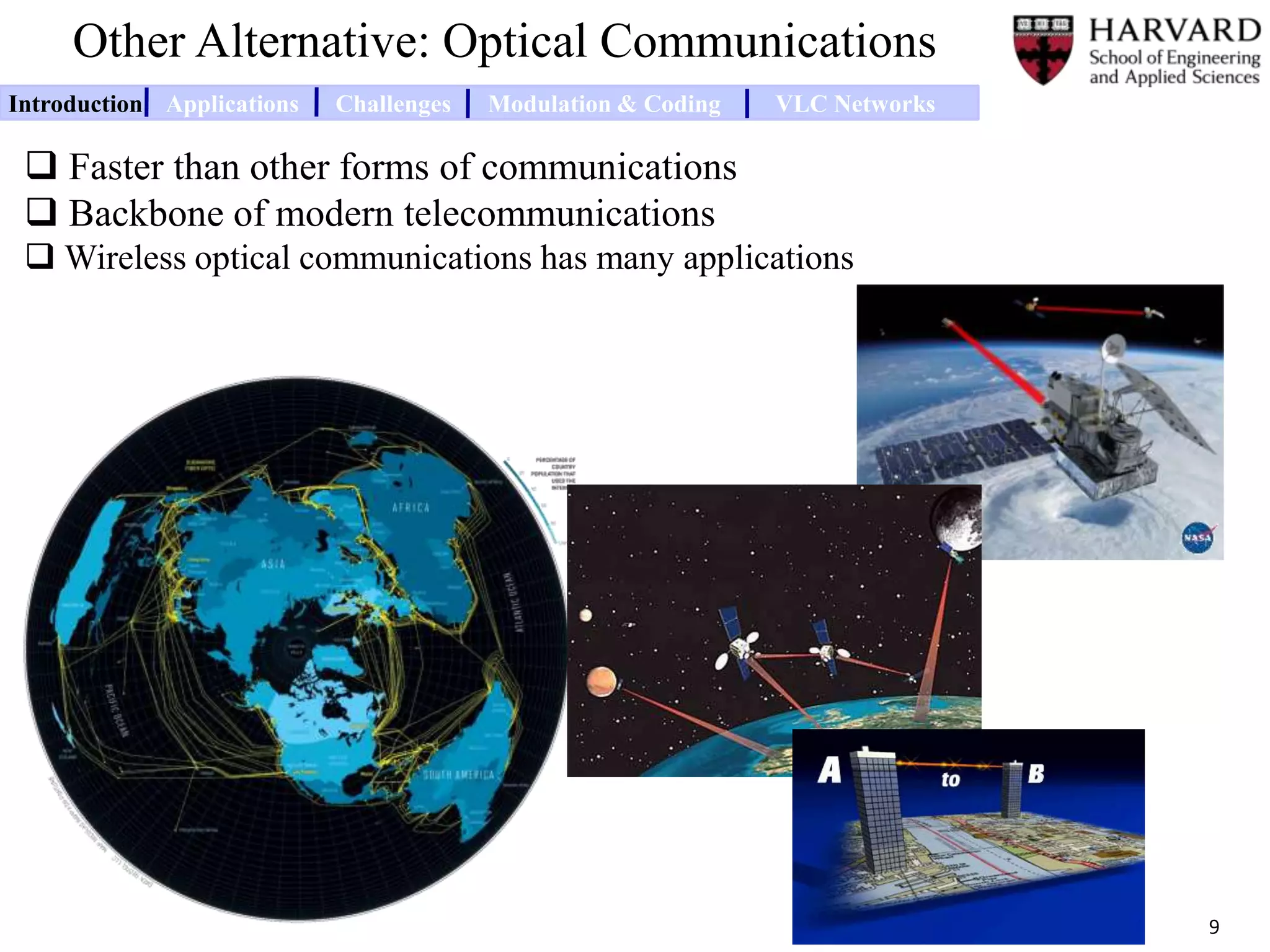
Other Alternative: Optical Communications
 Faster than other forms of communications
 Backbone of modern telecommunications
 Wireless optical communications has many applications
9
Introduction Applications Challenges Modulation & Coding VLC Networks
White Light LEDs
 LED lamps are becoming popular because of their low energy
consumption and longevity
10
Introduction Applications Challenges Modulation & Coding VLC Networks
 Goal: Use the lighting system also for communications
 Transmission requires energy, yet energy is already going from infrastructure
to user in the form of light.
Visible Light Communications (VLC)
11
Introduction Applications Challenges Modulation & Coding VLC Networks
12
 LEDs are good candidates for VLC
 Low cost
 High-Speed
 Safe for eye
 Two technologies in white LEDs
 Phosphor-based
 Cheap
 Trichromatic
 High-speed
 Color control
Visible Light Communications (VLC)
Introduction Applications Challenges Modulation & Coding VLC Networks
13
Applications and Potentials
Advantages
Advantages of VLC
14
Introduction Applications Challenges Modulation & Coding VLC Networks
 Safe for human body
 High security
 Can provide high-speed connection (1 Gb/s)
 No interference on RF signals
 Environmentally “green”
 Can providing accurate (~1 mm) indoor positioning system
(indoor GPS)
Indoor Wireless Networks
 Home
 Office
 Library
 Airplane
 Hospital
 Convention Center
15
Introduction Applications Challenges Modulation & Coding VLC Networks
Future VLC Products
16
VLC-enabled LED bulbs and LED panels
Introduction Applications Challenges Modulation & Coding VLC Networks
Future VLC Products
17
VLC-enabled floor-lamps and desk lamps can be easily bought from the
market and installed.
Introduction Applications Challenges Modulation & Coding VLC Networks
18
VLC modems will be used to connect users to the VLC network
Future VLC Products
Introduction Applications Challenges Modulation & Coding VLC Networks
19
 VLC models will be integrated into smart-phones
 Small modems will be presented to the marked for older
smartphones to stablish connection.
Future VLC Products
Introduction Applications Challenges Modulation & Coding VLC Networks
Another Cool Application
 Car to Car Communication
 Intelligent Traffic System
20
Introduction Applications Challenges Modulation & Coding VLC Networks
21
Visible Light Positioning
 Signals transmitted by LEDs
can be used to estimate the
position of a receiver relative
to the LEDs
 Receiver receives signals from
one or more lights
 Required accuracy depends on
application
Introduction Applications Challenges Modulation & Coding VLC Networks
22
Visible Light Positioning
Introduction Applications Challenges Modulation & Coding VLC Networks
23
VLC Opens Other Potential Applications
 Users are connected to lights
 Lighting features can be simply controlled from the mobile device
 Dim the lights
 Control hue of the light
 Smart lighting is much easier with VLC
 There are photodetectors on the user device and on the luminaries
 Photodetectors sense the intensity of the light
 The lights can control the illumination level automatically
 Internet of things can be developed on VLC networks
 All the electronic devices can connect to access-points using their LEDs
 Access-points know the location of all devices
Introduction Applications Challenges Modulation & Coding VLC Networks
Another Cool Application
 Car to Car Communication through headlights and taillights
 Intelligent Traffic System
24
Introduction Applications Challenges Modulation & Coding VLC Networks
25
Challenges
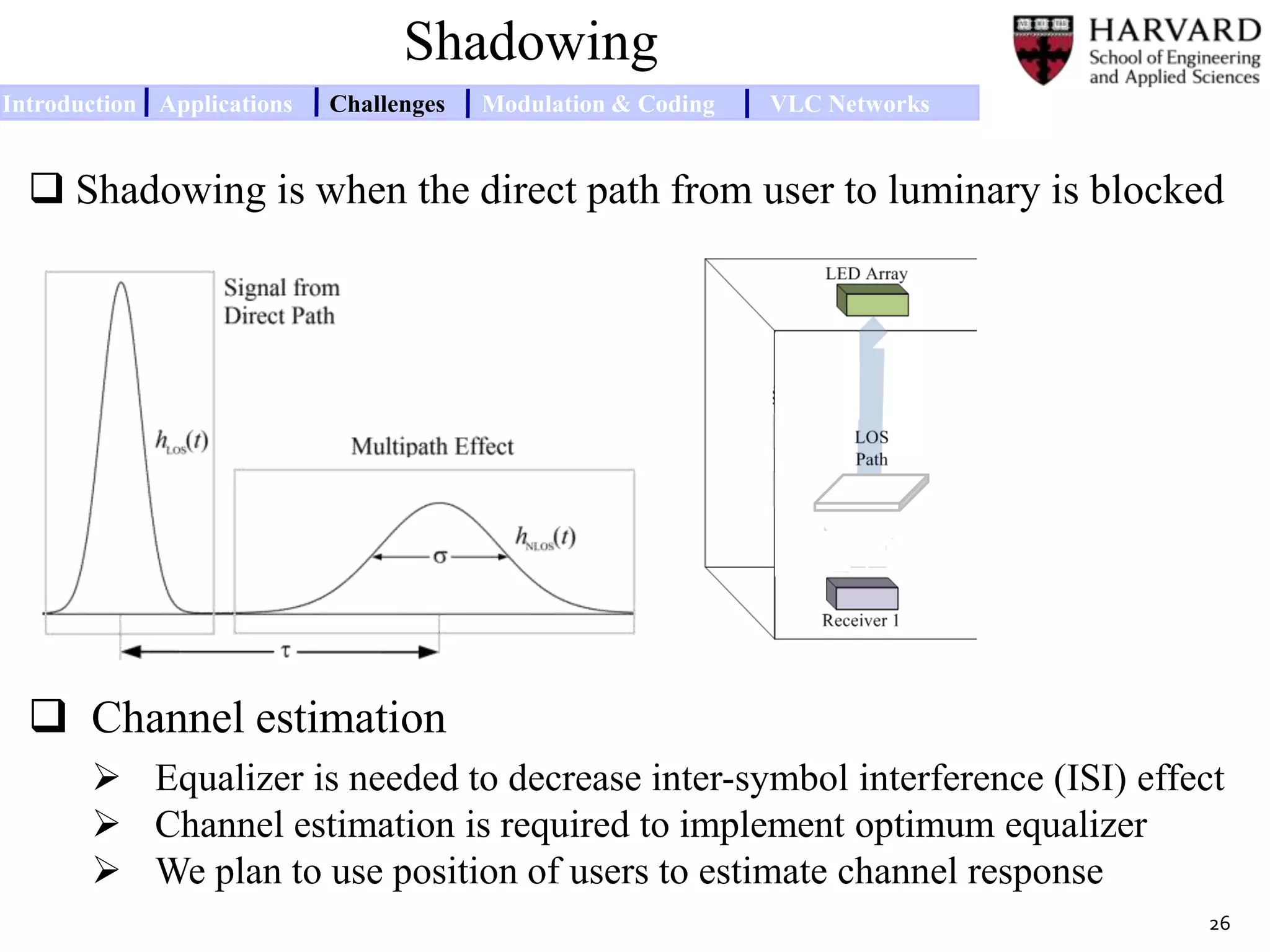
Shadowing
 Shadowing is when the direct path from user to luminary is blocked
 Channel estimation
 Equalizer is needed to decrease inter-symbol interference (ISI) effect
 Channel estimation is required to implement optimum equalizer
 We plan to use position of users to estimate channel response
Introduction Applications Challenges Modulation & Coding VLC Networks
26
Connectivity
Users should stay connected when they move
There are overlaps between the coverage of luminaries
(This is due to lighting standards)
Introduction Applications Challenges Modulation & Coding VLC Networks
27
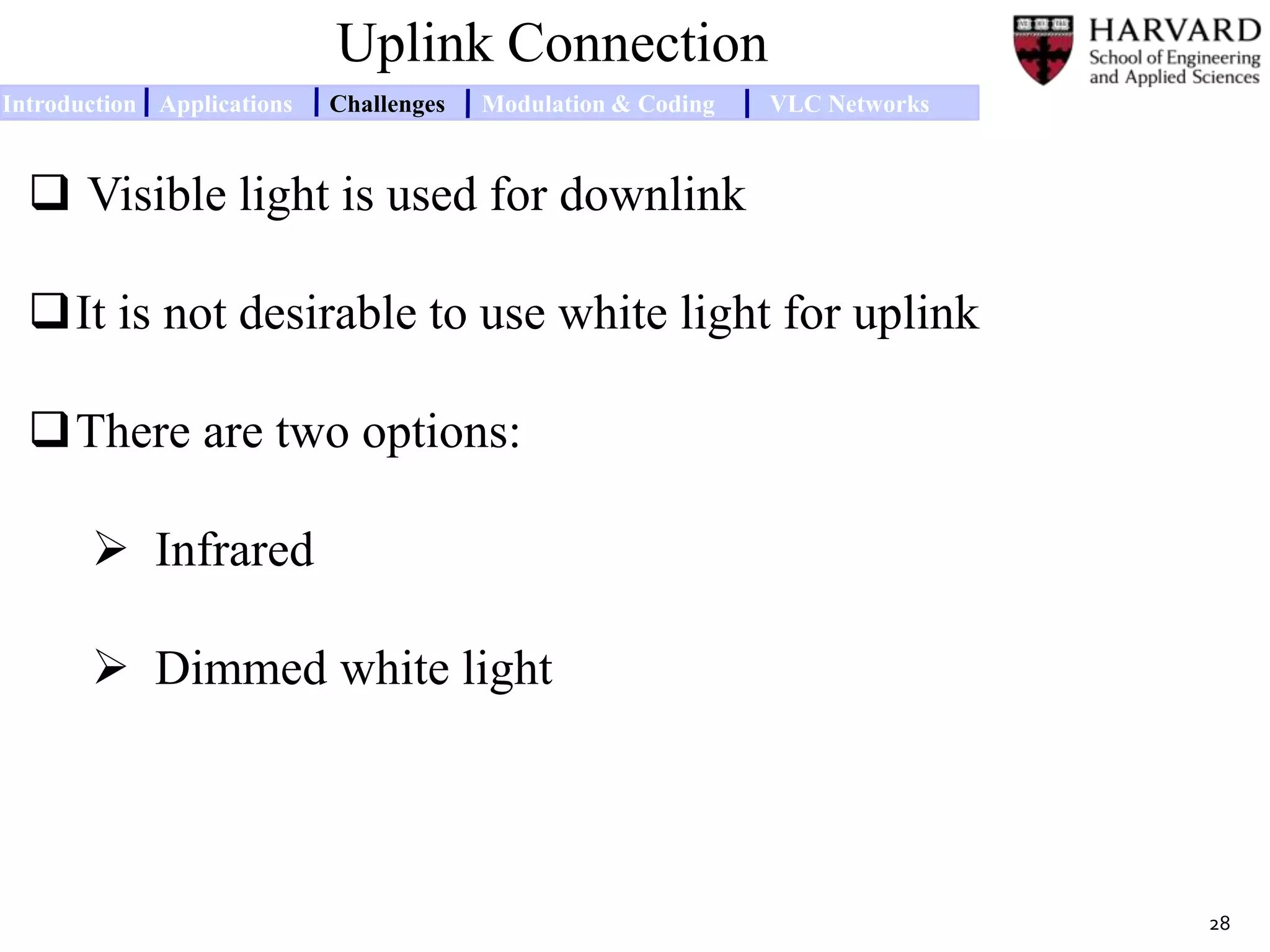
Uplink Connection
 Visible light is used for downlink
It is not desirable to use white light for uplink
There are two options:
 Infrared
 Dimmed white light
Introduction Applications Challenges Modulation & Coding VLC Networks
28
Lighting Standards
29
 The illumination should satisfy some standards
 There is a required level of light for each
environment
The distribution of light should be uniform
Introduction Applications Challenges Modulation & Coding VLC Networks
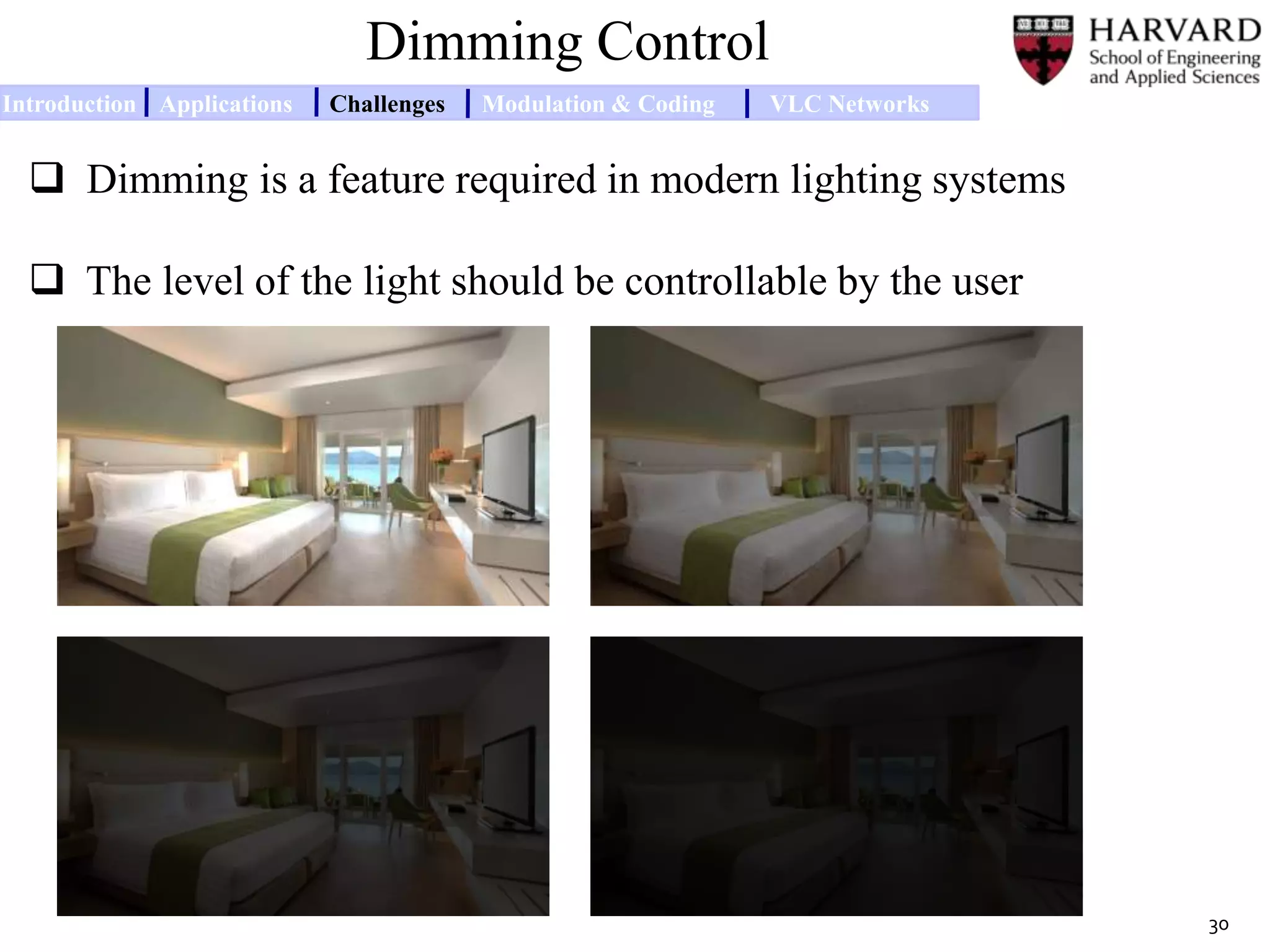
Dimming Control
30
 Dimming is a feature required in modern lighting systems
 The level of the light should be controllable by the user
Introduction Applications Challenges Modulation & Coding VLC Networks
Background Light
31
 Strong background light can affect the performance of the system
 The system should operate when it is exposed to extreme Sun
light
Introduction Applications Challenges Modulation & Coding VLC Networks
Other Challenges
Introduction Applications Challenges Modulation & Coding VLC Networks
32
 Dimming is a feature required
in modern lighting systems
 The level of the light should
be controllable by the user
 The system should operate
when it is exposed to extreme
Sun light
Background light (direct Sun exposure)
Dimming
 The illumination should satisfy
some standards
 There is a required level of
light for each environment
 The distribution of light should
be uniform
Lighting Standards
 We address all of these by modulation and coding
33
Modulation and Coding
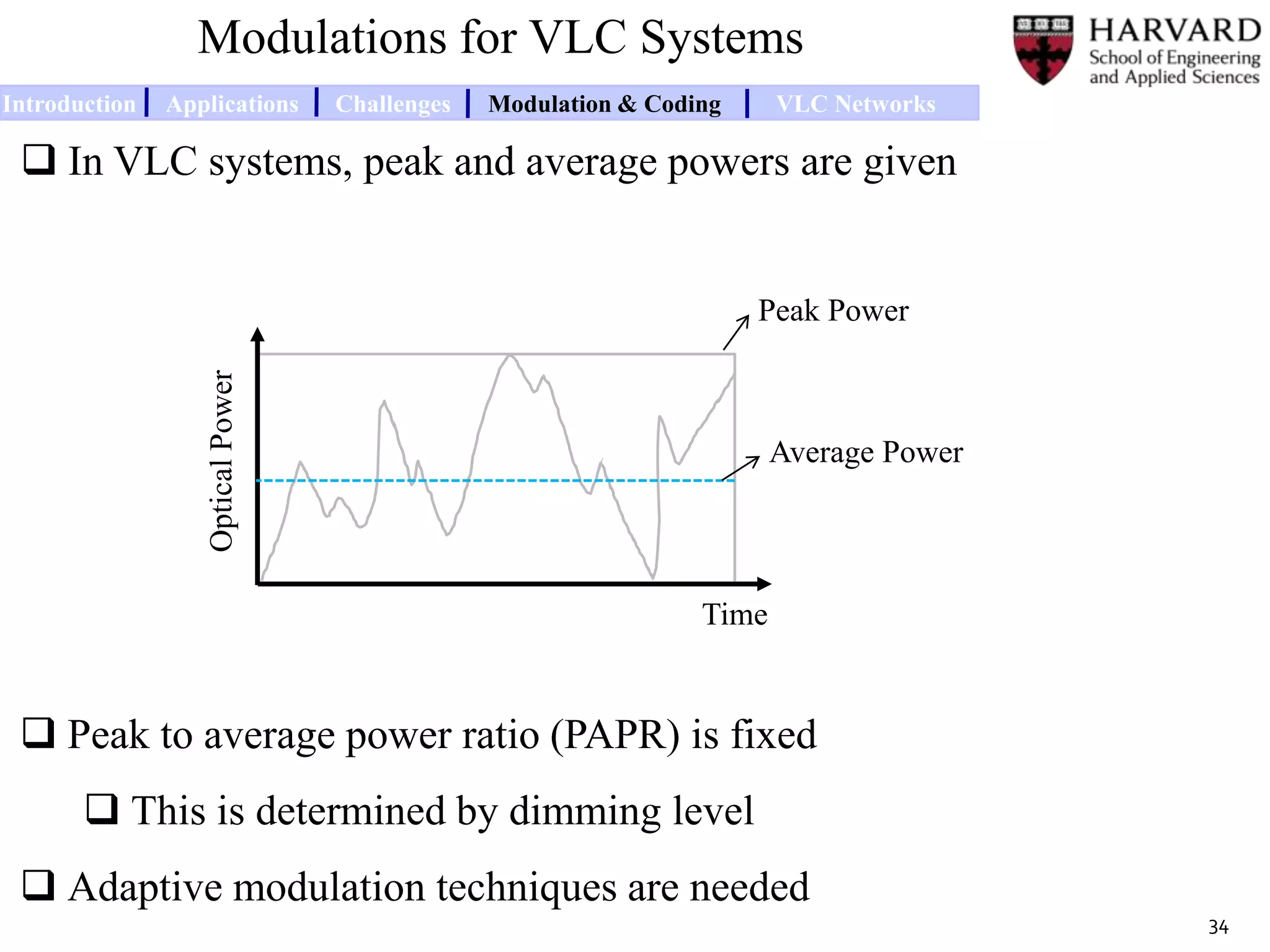
 In VLC systems, peak and average powers are given
Modulations for VLC Systems
Time
OpticalPower
Peak Power
Average Power
 Peak to average power ratio (PAPR) is fixed
 This is determined by dimming level
 Adaptive modulation techniques are needed
34
Introduction Applications Challenges Modulation & Coding VLC Networks
35
 LEDs are the main sources
 Modulations that can be used are different from RF
systems
 Two families of modulations are used:
 Pulsed techniques:
 On-off keying (OOK),
 Pulse amplitude modulation (PAM)
 Pulse position modulation (PPM)
 Subcarrier techniques:
 Orthogonal frequency division multiplexing (OFDM)
 Hadamard Coded Modulation (HCM)
Modulations for VLC Systems
Introduction Applications Challenges Modulation & Coding VLC Networks
36
Orthogonal Frequency Division Multiplexing (OFDM)
 Special version of subcarrier modulation where all the
subcarrier frequencies are orthogonal
 Efficiently utilizes the available bandwidth
Introduction Applications Challenges Modulation & Coding VLC Networks
37
 Original OFDM cannot be used in incoherent optical systems
 It generates complex-valued signals
 Incoherent optical sources can only transmit positive real signals
 Modified forms of OFDM
OFDM for Optical Systems
 Asymmetrically Clipped Optical (ACO) OFDM
 Apply Hermitian symmetry
 Modulate only half of the data
 DC-biased Optical (DCO) OFDM
 Apply Hermitian symmetry to make signal real
 Add a DC bias and clip the negative part
rate of ≈1/2
rate of ≈ 1/4
Introduction Applications Challenges Modulation & Coding VLC Networks
38
OFDM for Optical Systems
Optical
Peak Power
Optical wireless system model
 Clipping the OFDM signal at 0 and Pmax adds a clipping noise
Introduction Applications Challenges Modulation & Coding VLC Networks
39
OFDM for Optical Systems
 Consider two systems:
1) Optical wireless communications requiring high average
power levels, such as VLC systems
2) Optical systems with unconstrained energy usage
 OFDM does not work well in these two cases
Low average power
High average power
Introduction Applications Challenges Modulation & Coding VLC Networks
40
OFDM signal generation
Why not use another orthogonal basis function?
Hadamard matrix is an option
Add a vector to make
signals positiveEach component of u is
M-ary PAM modulated
Hadamard Coded Modulation (HCM): An Alternative for OFDM
Introduction Applications Challenges Modulation & Coding VLC Networks
41
HCM Trnasmitter
 Can be implemented with fast Walsh-Hadamard transform (FWHT)
 FWHT has the same complexity as FFT: O(N logN)
Introduction Applications Challenges Modulation & Coding VLC Networks
M. Noshad, M. Brandt-Pearce, IEEE Global Communications Conference, Dec 2014
42
HCM Receiver
 Receiver is implemented using inverse FWHT (IFWHT)
Introduction Applications Challenges Modulation & Coding VLC Networks
43
HCM versus OFDM
BER of HCM vs ACO-OFDM and DCO-OFDM
Can we shift HCM to the left?
Introduction Applications Challenges Modulation & Coding VLC Networks
44
Improving Energy Efficiency
 The first row of Hadamard matrix is all ones
 Adding or removing a DC value has no effect on (N-1) of the columns
 We use only N-1 rows of Hadamard to modulate the data
 Send (x – min x) instead of x
 Then we can reduce the energy of transmitted signals
 New technique is named DR-reduced (DCR) HCM
0
u2
u1
u3
u4
u5
u6
u7
Introduction Applications Challenges Modulation & Coding VLC Networks
M. Noshad, M. Brandt-Pearce, IEEE Transactions on Communications, Feb 2016.
45
Improving Energy Efficiency
Motivation Past Research Existing Solutions Proposed Techniques Results
HCM signal DCR-HCM signal
DC part
Introduction Applications Challenges Modulation & Coding VLC Networks
46
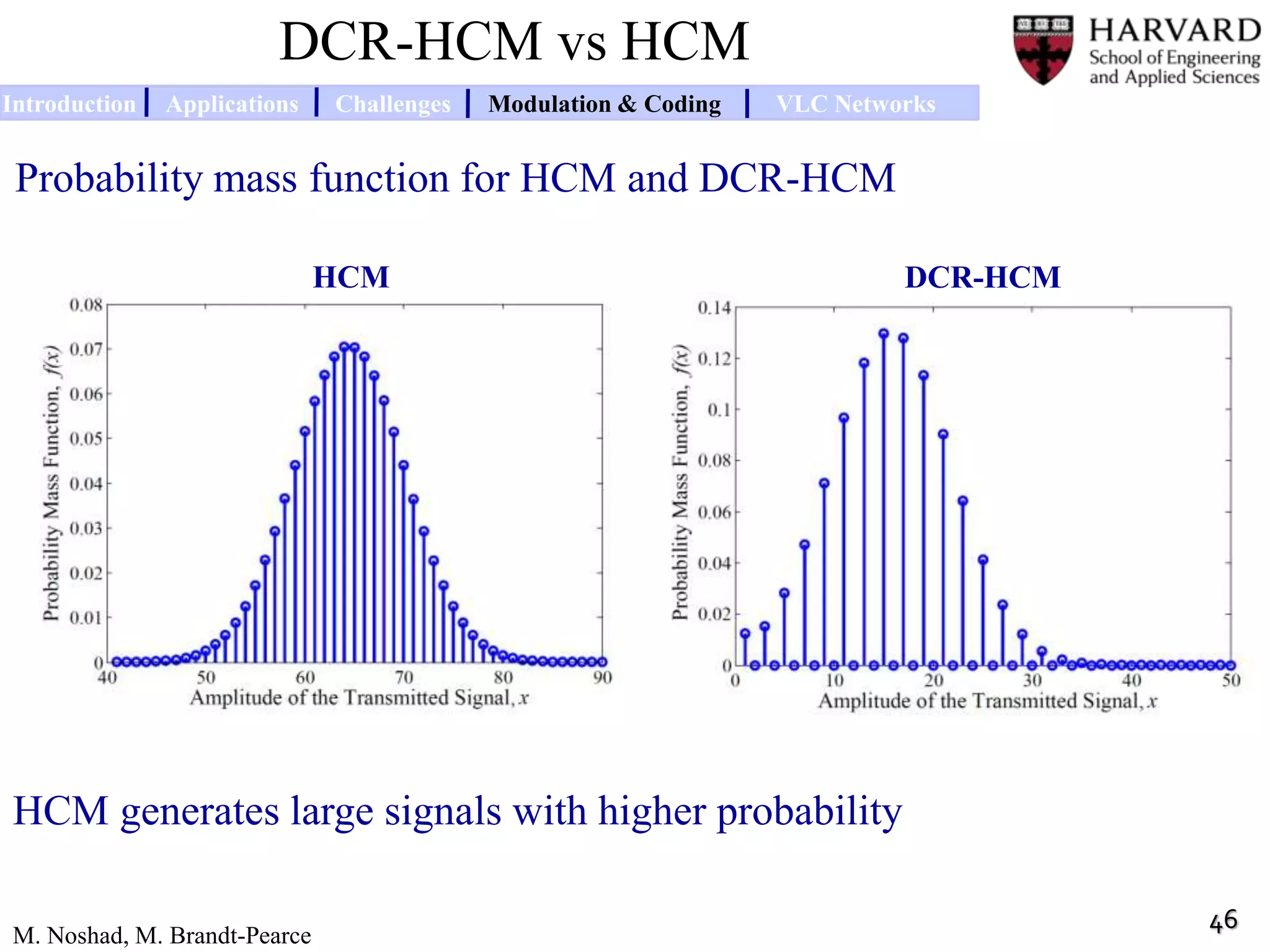
DCR-HCM vs HCM
Probability mass function for HCM and DCR-HCM
M. Noshad, M. Brandt-Pearce
HCM DCR-HCM
HCM generates large signals with higher probability
Introduction Applications Challenges Modulation & Coding VLC Networks
47
BER of HCM and DCR-HCM vs ACO-OFDM and DCO-OFDM
Spectral efficiency = 1
HCM versus OFDM
Introduction Applications Challenges Modulation & Coding VLC Networks
M. Noshad, M. Brandt-Pearce, IEEE Transactions on Communications, Feb 2016.
48
HCM versus OFDM
Maximum achievable SNR versus the spectral efficiency for HCM, DCR-HCM,
ACO-OFDM and DCO-OFDM.
Introduction Applications Challenges Modulation & Coding VLC Networks
49
VLC Networks
VLC Networks
 Providing network access for large number of users is essential is
VLC systems
50
Introduction Applications Challenges Modulation & Coding VLC Networks
Multiuser VLC Networks
 LEDs are used in VLC networks
 Frequency-domain processing may be expensive and
complicated
 They are nonlinear
 Time-based modulations, specially pulsed techniques, are
preferred
 Current Solutions for Multiuser Support
 Time division multiple access
 Code division multiple access
 Spatial division multiple access
51
Introduction Applications Challenges Modulation & Coding VLC Networks
Solutions for Multiuser Support
 Time division multiple access
 Low data-rate
 Inflexible data-rates
 Does not support dimming
 Code division multiple access
 Spatial division multiple access
52
Introduction Applications Challenges Modulation & Coding VLC Networks
Solutions for Multiuser Support
 Time division multiple access
 Code division multiple access
 Time spreading codes are preferred
 Optical orthogonal codes (OOC)
 Are designed for fiber-optic communications
 Codes have the same length and weight
 Cross-correlation is equal or smaller than 1
 For fixed number of users it is hard to control dimming
 Spatial division multiple access 53
Introduction Applications Challenges Modulation & Coding VLC Networks
Solutions for Multiuser Support
 Time division multiple access
 Code division multiple access
 Spatial division multiple access
 Uses narrow optical beams
 The area is divided into sub-spaces
 Face problem when two users are in one sector
 It needs to be used with another multiple access technique
54
Introduction Applications Challenges Modulation & Coding VLC Networks
Conclusions
 Wi-Fi cannot satisfy the increasing demand for high-speed internet
access
 VLC is strong contender for future wireless networks
 Modulation and networking techniques need to be adapted to VLC
systems because of their constraints
 There is still much to be done on the networking aspects of VLC
55
Questions?
56

Ut talk feb 2017

  • 1.
    Mohammad Noshad Wireless ConnectivityThrough Lighting: Potential and Limitations 1
  • 2.
    2 Outline  Motivation  Introductionto Visible Light Communications (VLC)  Applications  Challenges  Modulation and Coding Techniques  Networking in VLC Systems
  • 3.
    3  Wi-Fi isthe technology that provides wireless internet access.  It is very popular  Current frequency bands for Wi-Fi (IEEE 802.11)  2.4, 5, or 60 (mm-wave) GHz Wi-Fi Technology Introduction Applications Challenges Modulation & Coding VLC Networks
  • 4.
    What is Wrongwith Wi-Fi?  Throughput limitation of Wi-Fi  The data-rate in Wi-Fi systems (2.4 and 5 GHz bands) is limited to 600 Mb/s  This speed is divided among all users  Supports limited number of users in crowded areas  Each Wi-Fi access point can support limited number of users  Limited bandwidth reuse 4 Introduction Applications Challenges Modulation & Coding VLC Networks
  • 5.
    What is Wrongwith Wi-Fi?  Wi-Fi signals passes through the walls  It has low security against eavesdropping  Need password for security  Currently there is no wireless internet access in some buildings because of the security concerns 5 Introduction Applications Challenges Modulation & Coding VLC Networks
  • 6.
    What is Wrongwith Wi-Fi?  Wi-Fi can cause interference on sensitive devices 6  There is national RF quite zone Introduction Applications Challenges Modulation & Coding VLC Networks
  • 7.
    What is Wrongwith Wi-Fi?  There is an increasing health concern due to exposure to Wi-Fi:  Your body is exposed to Wi-Fi 24/7  It passes through the skin – might be risky for neural system  It is a concern for children and pregnant women  Germany, Australia, France and some schools in Canada and US have banned Wi-Fi use at schools 7 Introduction Applications Challenges Modulation & Coding VLC Networks
  • 8.
    8 Other Alternative: OpticalCommunications Introduction Applications Challenges Modulation & Coding VLC Networks
  • 9.
    Other Alternative: OpticalCommunications  Faster than other forms of communications  Backbone of modern telecommunications  Wireless optical communications has many applications 9 Introduction Applications Challenges Modulation & Coding VLC Networks
  • 10.
    White Light LEDs LED lamps are becoming popular because of their low energy consumption and longevity 10 Introduction Applications Challenges Modulation & Coding VLC Networks
  • 11.
     Goal: Usethe lighting system also for communications  Transmission requires energy, yet energy is already going from infrastructure to user in the form of light. Visible Light Communications (VLC) 11 Introduction Applications Challenges Modulation & Coding VLC Networks
  • 12.
    12  LEDs aregood candidates for VLC  Low cost  High-Speed  Safe for eye  Two technologies in white LEDs  Phosphor-based  Cheap  Trichromatic  High-speed  Color control Visible Light Communications (VLC) Introduction Applications Challenges Modulation & Coding VLC Networks
  • 13.
  • 14.
    Advantages Advantages of VLC 14 IntroductionApplications Challenges Modulation & Coding VLC Networks  Safe for human body  High security  Can provide high-speed connection (1 Gb/s)  No interference on RF signals  Environmentally “green”  Can providing accurate (~1 mm) indoor positioning system (indoor GPS)
  • 15.
    Indoor Wireless Networks Home  Office  Library  Airplane  Hospital  Convention Center 15 Introduction Applications Challenges Modulation & Coding VLC Networks
  • 16.
    Future VLC Products 16 VLC-enabledLED bulbs and LED panels Introduction Applications Challenges Modulation & Coding VLC Networks
  • 17.
    Future VLC Products 17 VLC-enabledfloor-lamps and desk lamps can be easily bought from the market and installed. Introduction Applications Challenges Modulation & Coding VLC Networks
  • 18.
    18 VLC modems willbe used to connect users to the VLC network Future VLC Products Introduction Applications Challenges Modulation & Coding VLC Networks
  • 19.
    19  VLC modelswill be integrated into smart-phones  Small modems will be presented to the marked for older smartphones to stablish connection. Future VLC Products Introduction Applications Challenges Modulation & Coding VLC Networks
  • 20.
    Another Cool Application Car to Car Communication  Intelligent Traffic System 20 Introduction Applications Challenges Modulation & Coding VLC Networks
  • 21.
    21 Visible Light Positioning Signals transmitted by LEDs can be used to estimate the position of a receiver relative to the LEDs  Receiver receives signals from one or more lights  Required accuracy depends on application Introduction Applications Challenges Modulation & Coding VLC Networks
  • 22.
    22 Visible Light Positioning IntroductionApplications Challenges Modulation & Coding VLC Networks
  • 23.
    23 VLC Opens OtherPotential Applications  Users are connected to lights  Lighting features can be simply controlled from the mobile device  Dim the lights  Control hue of the light  Smart lighting is much easier with VLC  There are photodetectors on the user device and on the luminaries  Photodetectors sense the intensity of the light  The lights can control the illumination level automatically  Internet of things can be developed on VLC networks  All the electronic devices can connect to access-points using their LEDs  Access-points know the location of all devices Introduction Applications Challenges Modulation & Coding VLC Networks
  • 24.
    Another Cool Application Car to Car Communication through headlights and taillights  Intelligent Traffic System 24 Introduction Applications Challenges Modulation & Coding VLC Networks
  • 25.
  • 26.
    Shadowing  Shadowing iswhen the direct path from user to luminary is blocked  Channel estimation  Equalizer is needed to decrease inter-symbol interference (ISI) effect  Channel estimation is required to implement optimum equalizer  We plan to use position of users to estimate channel response Introduction Applications Challenges Modulation & Coding VLC Networks 26
  • 27.
    Connectivity Users should stayconnected when they move There are overlaps between the coverage of luminaries (This is due to lighting standards) Introduction Applications Challenges Modulation & Coding VLC Networks 27
  • 28.
    Uplink Connection  Visiblelight is used for downlink It is not desirable to use white light for uplink There are two options:  Infrared  Dimmed white light Introduction Applications Challenges Modulation & Coding VLC Networks 28
  • 29.
    Lighting Standards 29  Theillumination should satisfy some standards  There is a required level of light for each environment The distribution of light should be uniform Introduction Applications Challenges Modulation & Coding VLC Networks
  • 30.
    Dimming Control 30  Dimmingis a feature required in modern lighting systems  The level of the light should be controllable by the user Introduction Applications Challenges Modulation & Coding VLC Networks
  • 31.
    Background Light 31  Strongbackground light can affect the performance of the system  The system should operate when it is exposed to extreme Sun light Introduction Applications Challenges Modulation & Coding VLC Networks
  • 32.
    Other Challenges Introduction ApplicationsChallenges Modulation & Coding VLC Networks 32  Dimming is a feature required in modern lighting systems  The level of the light should be controllable by the user  The system should operate when it is exposed to extreme Sun light Background light (direct Sun exposure) Dimming  The illumination should satisfy some standards  There is a required level of light for each environment  The distribution of light should be uniform Lighting Standards  We address all of these by modulation and coding
  • 33.
  • 34.
     In VLCsystems, peak and average powers are given Modulations for VLC Systems Time OpticalPower Peak Power Average Power  Peak to average power ratio (PAPR) is fixed  This is determined by dimming level  Adaptive modulation techniques are needed 34 Introduction Applications Challenges Modulation & Coding VLC Networks
  • 35.
    35  LEDs arethe main sources  Modulations that can be used are different from RF systems  Two families of modulations are used:  Pulsed techniques:  On-off keying (OOK),  Pulse amplitude modulation (PAM)  Pulse position modulation (PPM)  Subcarrier techniques:  Orthogonal frequency division multiplexing (OFDM)  Hadamard Coded Modulation (HCM) Modulations for VLC Systems Introduction Applications Challenges Modulation & Coding VLC Networks
  • 36.
    36 Orthogonal Frequency DivisionMultiplexing (OFDM)  Special version of subcarrier modulation where all the subcarrier frequencies are orthogonal  Efficiently utilizes the available bandwidth Introduction Applications Challenges Modulation & Coding VLC Networks
  • 37.
    37  Original OFDMcannot be used in incoherent optical systems  It generates complex-valued signals  Incoherent optical sources can only transmit positive real signals  Modified forms of OFDM OFDM for Optical Systems  Asymmetrically Clipped Optical (ACO) OFDM  Apply Hermitian symmetry  Modulate only half of the data  DC-biased Optical (DCO) OFDM  Apply Hermitian symmetry to make signal real  Add a DC bias and clip the negative part rate of ≈1/2 rate of ≈ 1/4 Introduction Applications Challenges Modulation & Coding VLC Networks
  • 38.
    38 OFDM for OpticalSystems Optical Peak Power Optical wireless system model  Clipping the OFDM signal at 0 and Pmax adds a clipping noise Introduction Applications Challenges Modulation & Coding VLC Networks
  • 39.
    39 OFDM for OpticalSystems  Consider two systems: 1) Optical wireless communications requiring high average power levels, such as VLC systems 2) Optical systems with unconstrained energy usage  OFDM does not work well in these two cases Low average power High average power Introduction Applications Challenges Modulation & Coding VLC Networks
  • 40.
    40 OFDM signal generation Whynot use another orthogonal basis function? Hadamard matrix is an option Add a vector to make signals positiveEach component of u is M-ary PAM modulated Hadamard Coded Modulation (HCM): An Alternative for OFDM Introduction Applications Challenges Modulation & Coding VLC Networks
  • 41.
    41 HCM Trnasmitter  Canbe implemented with fast Walsh-Hadamard transform (FWHT)  FWHT has the same complexity as FFT: O(N logN) Introduction Applications Challenges Modulation & Coding VLC Networks M. Noshad, M. Brandt-Pearce, IEEE Global Communications Conference, Dec 2014
  • 42.
    42 HCM Receiver  Receiveris implemented using inverse FWHT (IFWHT) Introduction Applications Challenges Modulation & Coding VLC Networks
  • 43.
    43 HCM versus OFDM BERof HCM vs ACO-OFDM and DCO-OFDM Can we shift HCM to the left? Introduction Applications Challenges Modulation & Coding VLC Networks
  • 44.
    44 Improving Energy Efficiency The first row of Hadamard matrix is all ones  Adding or removing a DC value has no effect on (N-1) of the columns  We use only N-1 rows of Hadamard to modulate the data  Send (x – min x) instead of x  Then we can reduce the energy of transmitted signals  New technique is named DR-reduced (DCR) HCM 0 u2 u1 u3 u4 u5 u6 u7 Introduction Applications Challenges Modulation & Coding VLC Networks M. Noshad, M. Brandt-Pearce, IEEE Transactions on Communications, Feb 2016.
  • 45.
    45 Improving Energy Efficiency MotivationPast Research Existing Solutions Proposed Techniques Results HCM signal DCR-HCM signal DC part Introduction Applications Challenges Modulation & Coding VLC Networks
  • 46.
    46 DCR-HCM vs HCM Probabilitymass function for HCM and DCR-HCM M. Noshad, M. Brandt-Pearce HCM DCR-HCM HCM generates large signals with higher probability Introduction Applications Challenges Modulation & Coding VLC Networks
  • 47.
    47 BER of HCMand DCR-HCM vs ACO-OFDM and DCO-OFDM Spectral efficiency = 1 HCM versus OFDM Introduction Applications Challenges Modulation & Coding VLC Networks M. Noshad, M. Brandt-Pearce, IEEE Transactions on Communications, Feb 2016.
  • 48.
    48 HCM versus OFDM Maximumachievable SNR versus the spectral efficiency for HCM, DCR-HCM, ACO-OFDM and DCO-OFDM. Introduction Applications Challenges Modulation & Coding VLC Networks
  • 49.
  • 50.
    VLC Networks  Providingnetwork access for large number of users is essential is VLC systems 50 Introduction Applications Challenges Modulation & Coding VLC Networks
  • 51.
    Multiuser VLC Networks LEDs are used in VLC networks  Frequency-domain processing may be expensive and complicated  They are nonlinear  Time-based modulations, specially pulsed techniques, are preferred  Current Solutions for Multiuser Support  Time division multiple access  Code division multiple access  Spatial division multiple access 51 Introduction Applications Challenges Modulation & Coding VLC Networks
  • 52.
    Solutions for MultiuserSupport  Time division multiple access  Low data-rate  Inflexible data-rates  Does not support dimming  Code division multiple access  Spatial division multiple access 52 Introduction Applications Challenges Modulation & Coding VLC Networks
  • 53.
    Solutions for MultiuserSupport  Time division multiple access  Code division multiple access  Time spreading codes are preferred  Optical orthogonal codes (OOC)  Are designed for fiber-optic communications  Codes have the same length and weight  Cross-correlation is equal or smaller than 1  For fixed number of users it is hard to control dimming  Spatial division multiple access 53 Introduction Applications Challenges Modulation & Coding VLC Networks
  • 54.
    Solutions for MultiuserSupport  Time division multiple access  Code division multiple access  Spatial division multiple access  Uses narrow optical beams  The area is divided into sub-spaces  Face problem when two users are in one sector  It needs to be used with another multiple access technique 54 Introduction Applications Challenges Modulation & Coding VLC Networks
  • 55.
    Conclusions  Wi-Fi cannotsatisfy the increasing demand for high-speed internet access  VLC is strong contender for future wireless networks  Modulation and networking techniques need to be adapted to VLC systems because of their constraints  There is still much to be done on the networking aspects of VLC 55
  • 56.

Editor's Notes

  • #10 As of 2006, overseas satellite links accounted for only 1 percent of international traffic, while the remainder was carried by undersea cable.
  • #35 Let’s first focus on modulation schemes for single-user VLC systems.
  • #53 By increasing