Visible Light Communication:
Opportunities, Challenges and Path to
market
Jay Lohokare 111492930
Revati Damle 111461639
Aleksandar Jovicic, Junyi Li, and Tom Richardson, Qualcomm Research
CSE 570 Stony Brook University
Use cases –
1. High data rate downlink communication
2. Highly accurate indoor positioning
VLC (Visible light communication) can potentially supplement RF
Commercialization –
1. Robust engineering
2. Incremental commercialization strategies
Abstract
Flicker fusion threshold (FFT) – Rate of Light stimuli at which the light appears to be completely stable
If Amplitude modulation with high frequency (Beyond FFT), the LED’s primary illumination function
wont get affected
Amplitude Modulation in LEDs
How to achieve VLC?
Have dominated or will soon dominate most of the industries
Main purpose – Display, visualization and illumination
LEDs are widespread – TVs, Displays, Digitals advertisements, Mobile phones, Computer screens
Factors making it better than alternatives –
1. Longevity
2. Efficiency
3. Environment friendly
4. Colour rendering
5. Low costs
LEDs
Unlicensed, highly unused – Opportunity for low-cost broadband communication, which will alleviate
The congested 2.4Ghz industrial, scientific and medical band.
VLC doesn’t penetrate walls – Spatial reuse, as VLCs from adjacent rooms wont interfere. This will facilitate
A high spatial density for communication.
Visible spectrum over traditional RCs:
Signal isolation will facilitate security – prevents eavesdropping
Currently, VLC is non-coherent with it’s medium of propagation – Simple design, simple algorithms for
transmission and receiving process, hence less costly
The data rate falls sharply with distance – Path invrse proportional to distance power 4
(compared to power 2 in RF)
Can’t work outdoors – ‘Shot noise’ if photodiode is exposed to direct sunlight.
VLC Shortcomings compared to RF:
Transmitting the data needs the Light source(s) to be in On state continuously. Dim lights can transfer data
In Kilobyte per second rates.
Thus, VLC is not for Long range, Outdoor communication and high data rate communication.
They thus can complement RF, but not replace them
Simplest form of VLC – Data transfer between lamps/bulbs (Illumination devices) and mobile phones.
100Mbps already achieved commercially!
Compared to Wifi, VLCs provide high aggregate system throughput rates due to the spatial isolation it provides.
VLC:
1. High data transfer rates – Need specialized high speed photo-diodes receivers.
2. Low data transfer rates – Receivers already exist in mobile devices we use.
Other use cases –
High data rate: File transfer, Streaming data from mobile to displays
Low data rate: Indoor positioning
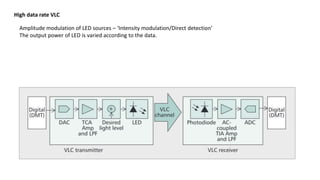
Amplitude modulation of LED sources – ‘Intensity modulation/Direct detection’
The output power of LED is varied according to the data.
High data rate VLC
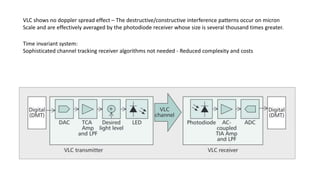
Time invariant system:
Sophisticated channel tracking receiver algorithms not needed - Reduced complexity and costs
VLC shows no doppler spread effect – The destructive/constructive interference patterns occur on micron
Scale and are effectively averaged by the photodiode receiver whose size is several thousand times greater.
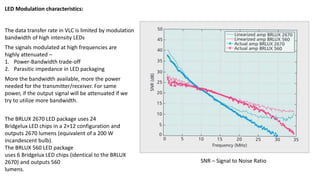
The data transfer rate in VLC is limited by modulation
bandwidth of high intensity LEDs
The signals modulated at high frequencies are
highly attenuated –
1. Power-Bandwidth trade-off
2. Parasitic impedance in LED packaging
LED Modulation characteristics:
The BRLUX 2670 LED package uses 24
Bridgelux LED chips in a 2×12 configuration and
outputs 2670 lumens (equivalent of a 200 W
incandescent bulb).
The BRLUX 560 LED package
uses 6 Bridgelux LED chips (identical to the BRLUX
2670) and outputs 560
lumens.
SNR – Signal to Noise Ratio
More the bandwidth available, more the power
needed for the transmitter/receiver. For same
power, if the output signal will be attenuated if we
try to utilize more bandwidth.
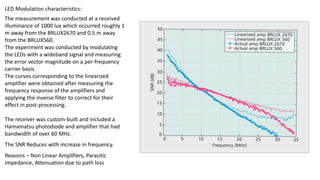
LED Modulation characteristics:
The measurement was conducted at a received
illuminance of 1000 lux which occurred roughly 1
m away from the BRLUX2670 and 0.5 m away
from the BRLUX560.
The experiment was conducted by modulating
the LEDs with a wideband signal and measuring
the error vector magnitude on a per-frequency
carrier basis.
The curves corresponding to the linearized
amplifier were obtained after measuring the
frequency response of the amplifiers and
applying the inverse filter to correct for their
effect in post-processing.
The receiver was custom-built and included a
Hamamatsu photodiode and amplifier that had
bandwidth of over 60 MHz.
The SNR Reduces with increase in frequency.
Reasons – Non Linear Amplifiers, Parasitic
impedance, Attenuation due to path loss
A high order rate can be achieved by spectrally efficient modulation. But such modulation needs
Linear end to end signal response. Linear amplifiers are power hungry, which undermines the main
selling point of LEDs – Power efficiency.
Suppose we want to admit more non-linearity, we will need algorithms to compensate the nonlinearity,
Which increases complexity and thus costs.
Even with limited bandwidth, the data rate is still comparable to Wifi.
One solution – Use array of multiple small LEDs.
Smaller LEDs have lesser internal capacitance – Lesser parasitic impedances.
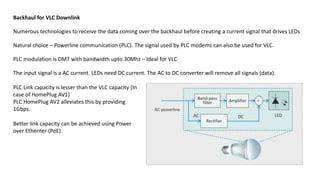
Numerous technologies to receive the data coming over the backhaul before creating a current signal that drives LEDs
Natural choice – Powerline communication (PLC). The signal used by PLC modems can also be used for VLC.
Backhaul for VLC Downlink
PLC modulation is DMT with bandwidth upto 30Mhz – Ideal for VLC
The input signal is a AC current. LEDs need DC current. The AC to DC converter will remove all signals (data).
Better link capacity can be achieved using Power
over Etherner (PoE)
PLC Link capacity is lesser than the VLC capacity (In
case of HomePlug AV1)
PLC HomePlug AV2 alleviates this by providing
1Gbps.
Integration for VLC Uplink
A downlink use case will need uplink/reverse link – To send requests, acknowledgement.
One choice – Wifi (As its preinstalled on most mobile devices) –
Qualcomm Atheros Hy-Fi gateway router supporting heterogenous technologies can be modified to support VLC.
Challenge – Wifi can get congested due to small request packets
Carefully manage the spectrum with proper QoS implementation to overcome this.
The router should have feedback from Wifi and VLC channels to operate efficiently.
Implement using hardware already present in the market.
Camera sensor is a 2D array of photodiodes – peak data transfer rate of Kbps possible.
Low data rate VLC
Front facing cameras in smartphones – Indoor localization using signals coming from ceiling lights.
Back camera can decode information coming from the front of the users – TV, Displays, etc.
VLC over QR codes – Long range, robust, skewness, optical distortion.
Positioning is of great commercial importance in places where LED lightning is used.
Guiding customers to precise location of their interests
Indoor positioning - Need
Analytics of sales in the shop
Targeted marketing based on user preferences
Low data rate VLC – Ceiling LEDs together with Cameras in smartphones.
Achieving very accurate indoor positioning
Efficient switch-mode amplifiers are already installed as part of driver circuitry of LEDs.
The only added costs – Cheap programmable logic devices.
Hybrid communication – VLC with Wifi
This also helps in knowing the orientation of user – Gyroscope in phone tell where user is facing
Drawbacks –
1. Camera power consumption
2. Computational costs for smartphone
3. Flicker – Frequency is less than FFT. However, high frequency modulation incurs attenuation at the
receiver coming from the image sensor’s exposure filter. Therefore, exposure control is of paramount
importance in the practical feasibility of low data rate applications.
VLC has business challenges – Lightning OEMs and Smartphone manufacturers need to work together.
LED market will eventually reach saturation – Long life of LEDs. VLC introduction will give additional feature.
Which will motivate customers to upgrade – New business stream.
Challenges in Commercialization of VLC
Even before saturation, LED OEMs will get edge over other competitors by having upper-hand.
Commercialization could be achieved by having an incremental approach – Introduce features requiring minimal
Changes in infrastructure and investment – Indoor positioning.
The other use cases which will require the mobile developers to introduce new set of hardware to smartphones –
File transfer, mobile to display streaming, etc. These are the most promising use cases and will cause to immediate
and assured widespread of VLC.
VLC can supplement RF communication
VLC has many use cases
Conclusion
Indoor positioning use-case is the first step towards commercialization
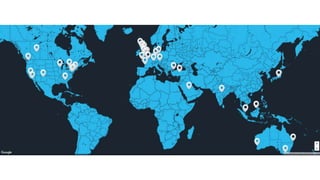
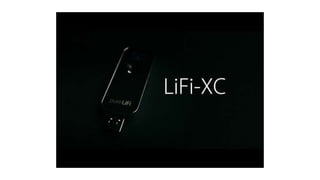
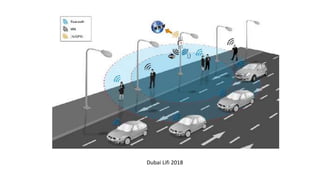
Dubai Lifi 2018
Thank you

Visible Light communication

  • 1.
    Visible Light Communication: Opportunities,Challenges and Path to market Jay Lohokare 111492930 Revati Damle 111461639 Aleksandar Jovicic, Junyi Li, and Tom Richardson, Qualcomm Research CSE 570 Stony Brook University
  • 2.
    Use cases – 1.High data rate downlink communication 2. Highly accurate indoor positioning VLC (Visible light communication) can potentially supplement RF Commercialization – 1. Robust engineering 2. Incremental commercialization strategies Abstract
  • 3.
    Flicker fusion threshold(FFT) – Rate of Light stimuli at which the light appears to be completely stable If Amplitude modulation with high frequency (Beyond FFT), the LED’s primary illumination function wont get affected Amplitude Modulation in LEDs How to achieve VLC? Have dominated or will soon dominate most of the industries Main purpose – Display, visualization and illumination LEDs are widespread – TVs, Displays, Digitals advertisements, Mobile phones, Computer screens Factors making it better than alternatives – 1. Longevity 2. Efficiency 3. Environment friendly 4. Colour rendering 5. Low costs LEDs
  • 4.
    Unlicensed, highly unused– Opportunity for low-cost broadband communication, which will alleviate The congested 2.4Ghz industrial, scientific and medical band. VLC doesn’t penetrate walls – Spatial reuse, as VLCs from adjacent rooms wont interfere. This will facilitate A high spatial density for communication. Visible spectrum over traditional RCs: Signal isolation will facilitate security – prevents eavesdropping Currently, VLC is non-coherent with it’s medium of propagation – Simple design, simple algorithms for transmission and receiving process, hence less costly
  • 5.
    The data ratefalls sharply with distance – Path invrse proportional to distance power 4 (compared to power 2 in RF) Can’t work outdoors – ‘Shot noise’ if photodiode is exposed to direct sunlight. VLC Shortcomings compared to RF: Transmitting the data needs the Light source(s) to be in On state continuously. Dim lights can transfer data In Kilobyte per second rates. Thus, VLC is not for Long range, Outdoor communication and high data rate communication. They thus can complement RF, but not replace them
  • 6.
    Simplest form ofVLC – Data transfer between lamps/bulbs (Illumination devices) and mobile phones. 100Mbps already achieved commercially! Compared to Wifi, VLCs provide high aggregate system throughput rates due to the spatial isolation it provides. VLC: 1. High data transfer rates – Need specialized high speed photo-diodes receivers. 2. Low data transfer rates – Receivers already exist in mobile devices we use. Other use cases – High data rate: File transfer, Streaming data from mobile to displays Low data rate: Indoor positioning
  • 7.
    Amplitude modulation ofLED sources – ‘Intensity modulation/Direct detection’ The output power of LED is varied according to the data. High data rate VLC
  • 8.
    Time invariant system: Sophisticatedchannel tracking receiver algorithms not needed - Reduced complexity and costs VLC shows no doppler spread effect – The destructive/constructive interference patterns occur on micron Scale and are effectively averaged by the photodiode receiver whose size is several thousand times greater.
  • 9.
    The data transferrate in VLC is limited by modulation bandwidth of high intensity LEDs The signals modulated at high frequencies are highly attenuated – 1. Power-Bandwidth trade-off 2. Parasitic impedance in LED packaging LED Modulation characteristics: The BRLUX 2670 LED package uses 24 Bridgelux LED chips in a 2×12 configuration and outputs 2670 lumens (equivalent of a 200 W incandescent bulb). The BRLUX 560 LED package uses 6 Bridgelux LED chips (identical to the BRLUX 2670) and outputs 560 lumens. SNR – Signal to Noise Ratio More the bandwidth available, more the power needed for the transmitter/receiver. For same power, if the output signal will be attenuated if we try to utilize more bandwidth.
  • 10.
    LED Modulation characteristics: Themeasurement was conducted at a received illuminance of 1000 lux which occurred roughly 1 m away from the BRLUX2670 and 0.5 m away from the BRLUX560. The experiment was conducted by modulating the LEDs with a wideband signal and measuring the error vector magnitude on a per-frequency carrier basis. The curves corresponding to the linearized amplifier were obtained after measuring the frequency response of the amplifiers and applying the inverse filter to correct for their effect in post-processing. The receiver was custom-built and included a Hamamatsu photodiode and amplifier that had bandwidth of over 60 MHz. The SNR Reduces with increase in frequency. Reasons – Non Linear Amplifiers, Parasitic impedance, Attenuation due to path loss
  • 11.
    A high orderrate can be achieved by spectrally efficient modulation. But such modulation needs Linear end to end signal response. Linear amplifiers are power hungry, which undermines the main selling point of LEDs – Power efficiency. Suppose we want to admit more non-linearity, we will need algorithms to compensate the nonlinearity, Which increases complexity and thus costs. Even with limited bandwidth, the data rate is still comparable to Wifi. One solution – Use array of multiple small LEDs. Smaller LEDs have lesser internal capacitance – Lesser parasitic impedances.
  • 12.
    Numerous technologies toreceive the data coming over the backhaul before creating a current signal that drives LEDs Natural choice – Powerline communication (PLC). The signal used by PLC modems can also be used for VLC. Backhaul for VLC Downlink PLC modulation is DMT with bandwidth upto 30Mhz – Ideal for VLC The input signal is a AC current. LEDs need DC current. The AC to DC converter will remove all signals (data). Better link capacity can be achieved using Power over Etherner (PoE) PLC Link capacity is lesser than the VLC capacity (In case of HomePlug AV1) PLC HomePlug AV2 alleviates this by providing 1Gbps.
  • 13.
    Integration for VLCUplink A downlink use case will need uplink/reverse link – To send requests, acknowledgement. One choice – Wifi (As its preinstalled on most mobile devices) – Qualcomm Atheros Hy-Fi gateway router supporting heterogenous technologies can be modified to support VLC. Challenge – Wifi can get congested due to small request packets Carefully manage the spectrum with proper QoS implementation to overcome this. The router should have feedback from Wifi and VLC channels to operate efficiently.
  • 14.
    Implement using hardwarealready present in the market. Camera sensor is a 2D array of photodiodes – peak data transfer rate of Kbps possible. Low data rate VLC Front facing cameras in smartphones – Indoor localization using signals coming from ceiling lights. Back camera can decode information coming from the front of the users – TV, Displays, etc. VLC over QR codes – Long range, robust, skewness, optical distortion.
  • 15.
    Positioning is ofgreat commercial importance in places where LED lightning is used. Guiding customers to precise location of their interests Indoor positioning - Need Analytics of sales in the shop Targeted marketing based on user preferences
  • 16.
    Low data rateVLC – Ceiling LEDs together with Cameras in smartphones. Achieving very accurate indoor positioning Efficient switch-mode amplifiers are already installed as part of driver circuitry of LEDs. The only added costs – Cheap programmable logic devices. Hybrid communication – VLC with Wifi This also helps in knowing the orientation of user – Gyroscope in phone tell where user is facing Drawbacks – 1. Camera power consumption 2. Computational costs for smartphone 3. Flicker – Frequency is less than FFT. However, high frequency modulation incurs attenuation at the receiver coming from the image sensor’s exposure filter. Therefore, exposure control is of paramount importance in the practical feasibility of low data rate applications.
  • 17.
    VLC has businesschallenges – Lightning OEMs and Smartphone manufacturers need to work together. LED market will eventually reach saturation – Long life of LEDs. VLC introduction will give additional feature. Which will motivate customers to upgrade – New business stream. Challenges in Commercialization of VLC Even before saturation, LED OEMs will get edge over other competitors by having upper-hand. Commercialization could be achieved by having an incremental approach – Introduce features requiring minimal Changes in infrastructure and investment – Indoor positioning. The other use cases which will require the mobile developers to introduce new set of hardware to smartphones – File transfer, mobile to display streaming, etc. These are the most promising use cases and will cause to immediate and assured widespread of VLC.
  • 18.
    VLC can supplementRF communication VLC has many use cases Conclusion Indoor positioning use-case is the first step towards commercialization
  • 21.
  • 22.