Scheduling for Cloud Systems with Multi-level Data
Locality: Throughput and Heavy-traffic Optimality
Ali Yekkehkhany
In collaboration with Qiaomin Xie, and Professor Yi Lu
University of Illinois at Urbana-Champain (UIUC)
1
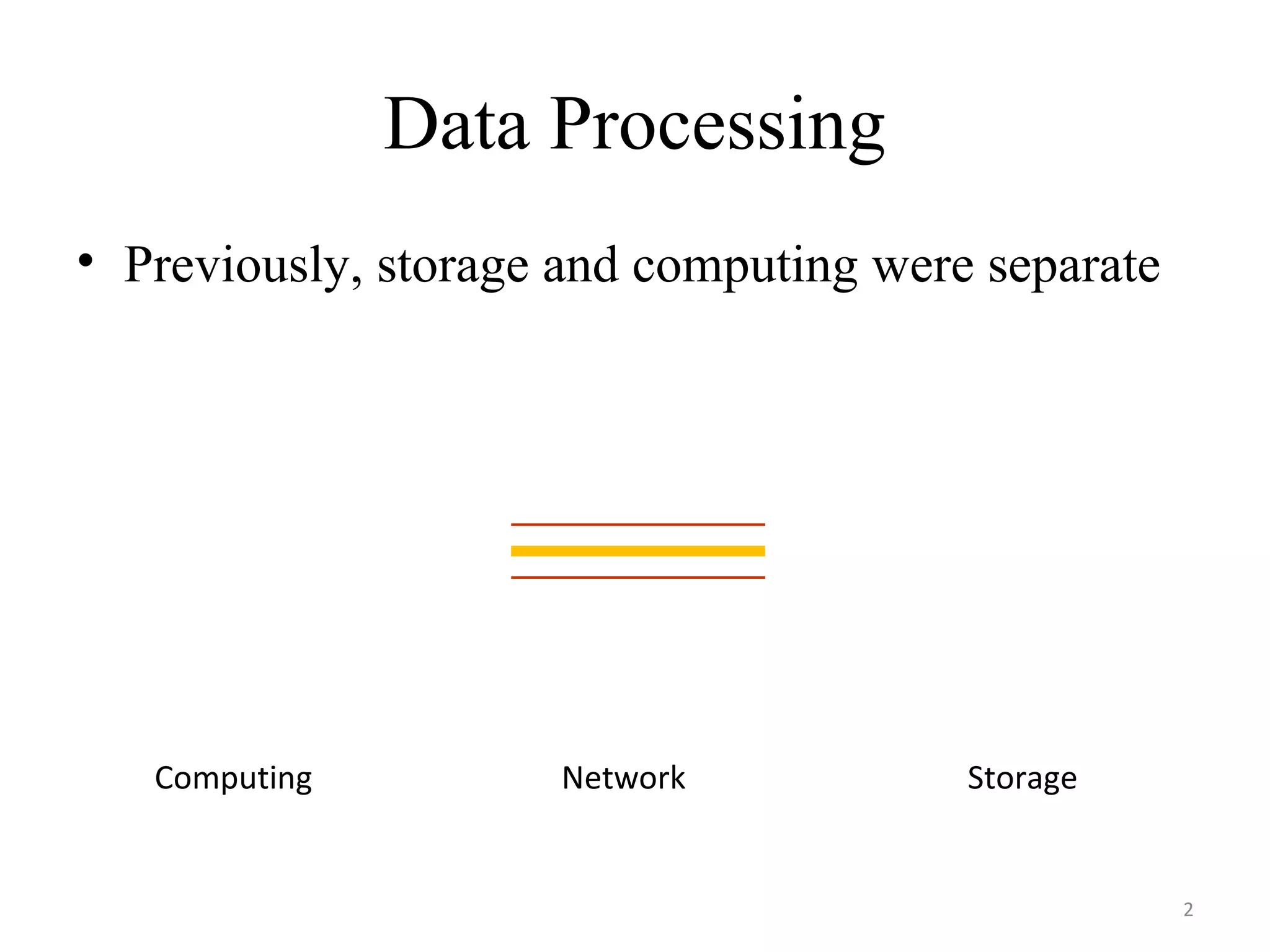
Data Processing
• Previously, storage and computing were separate
Computing StorageNetwork
2
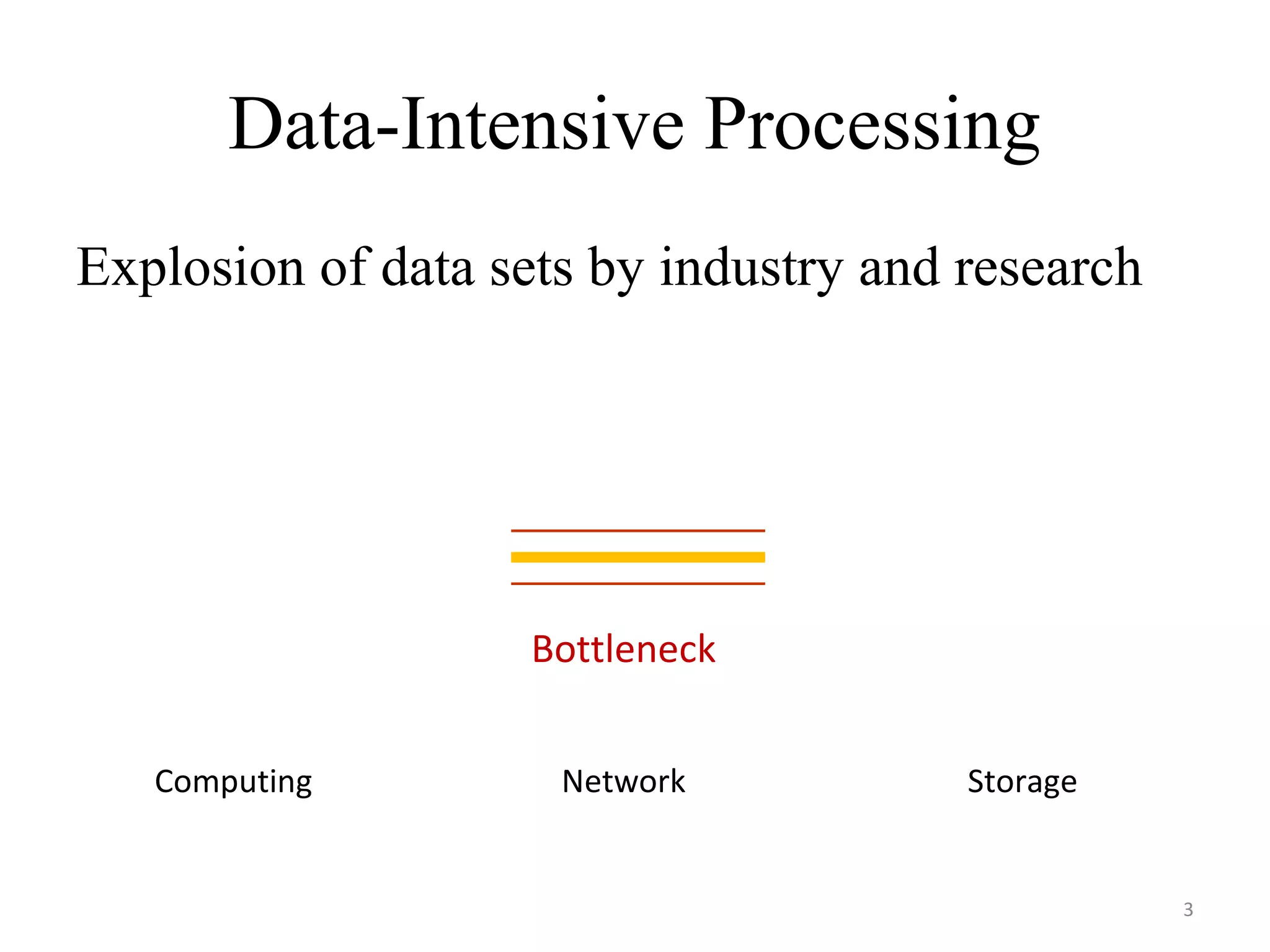
Data-Intensive Processing
Explosion of data sets by industry and research
Computing StorageNetwork
Bottleneck
3
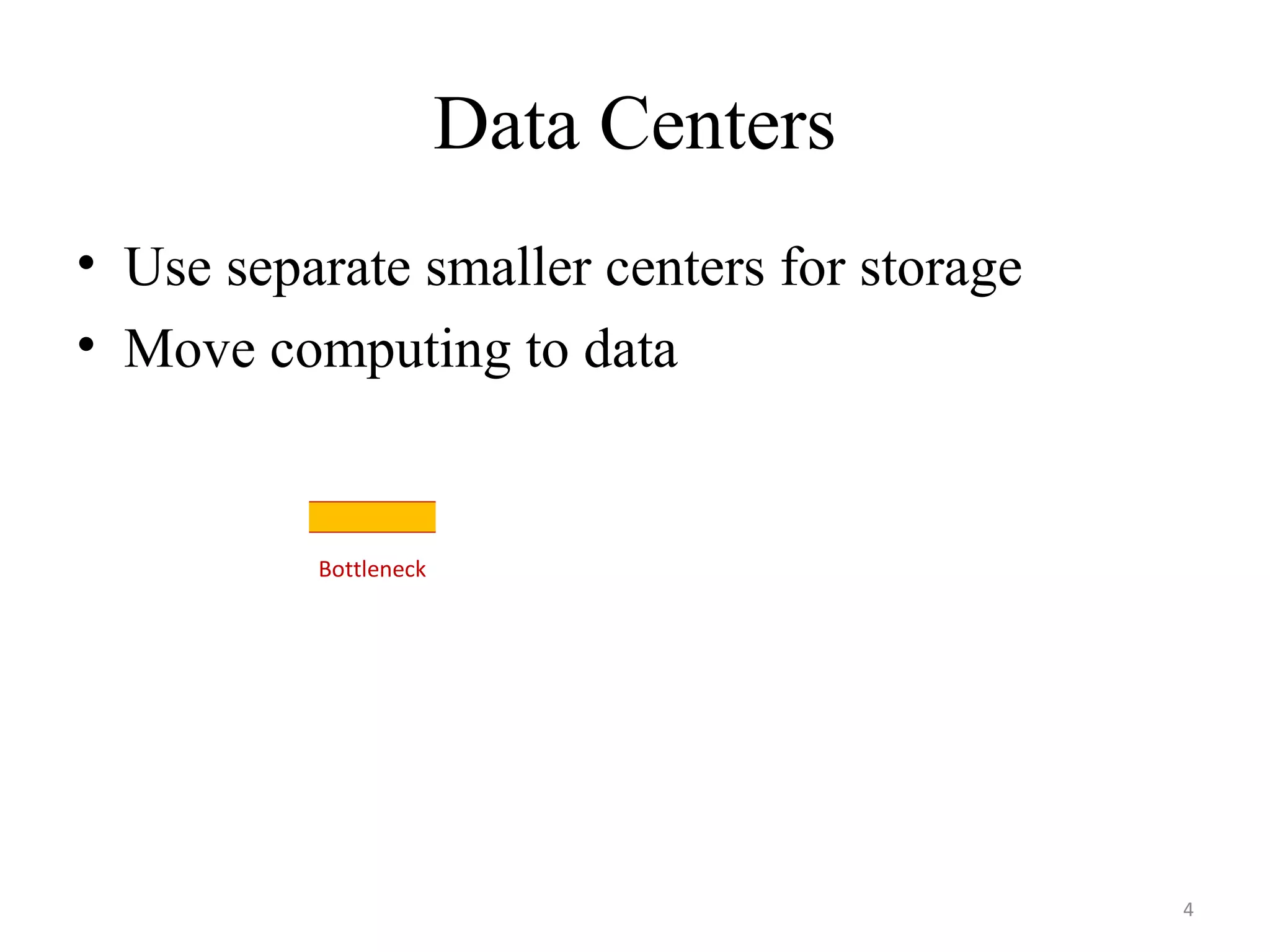
Data Centers
• Use separate smaller centers for storage
• Move computing to data
Bottleneck
4
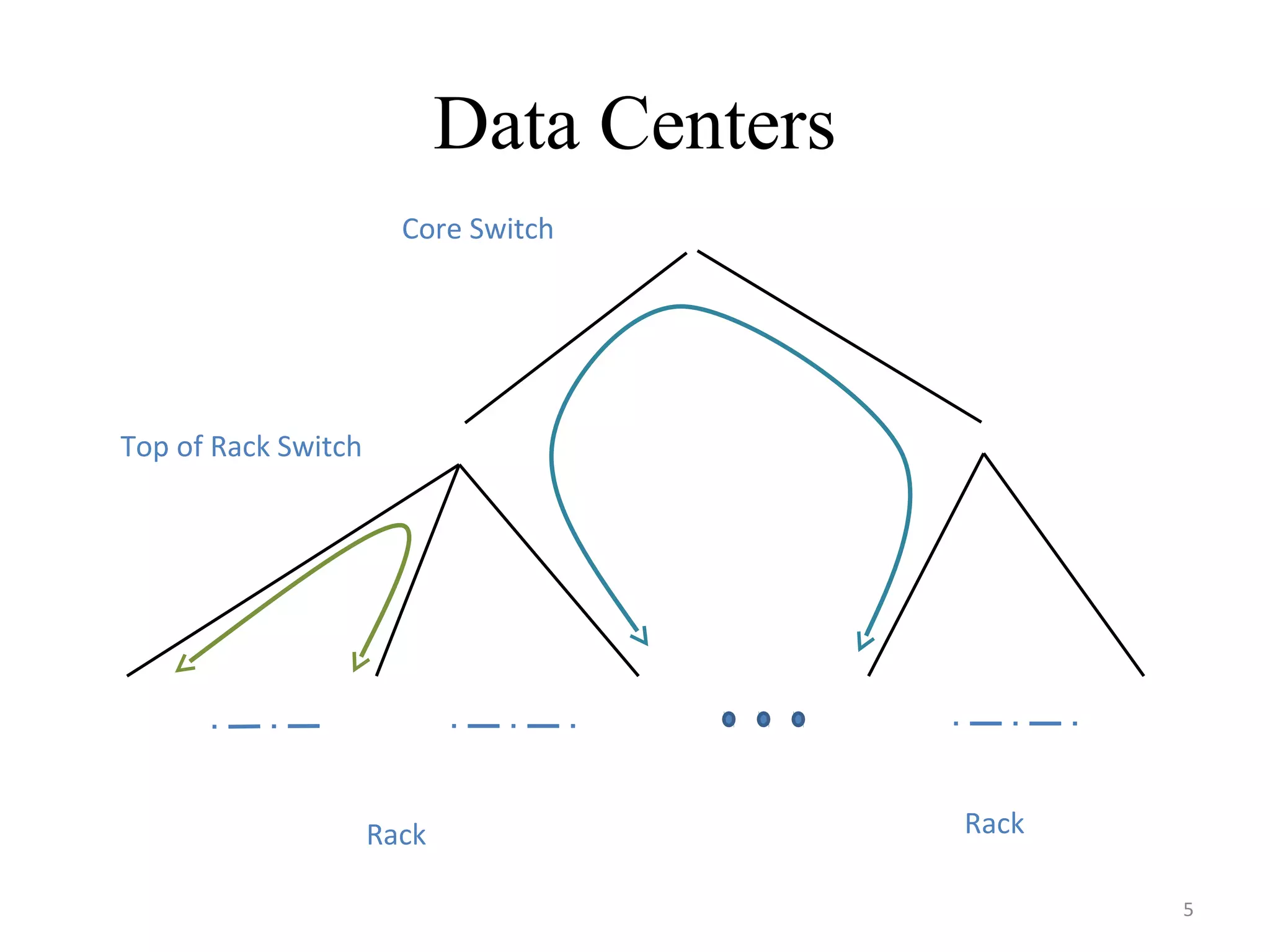
Data Centers
Rack Rack
Top of Rack Switch
Core Switch
5
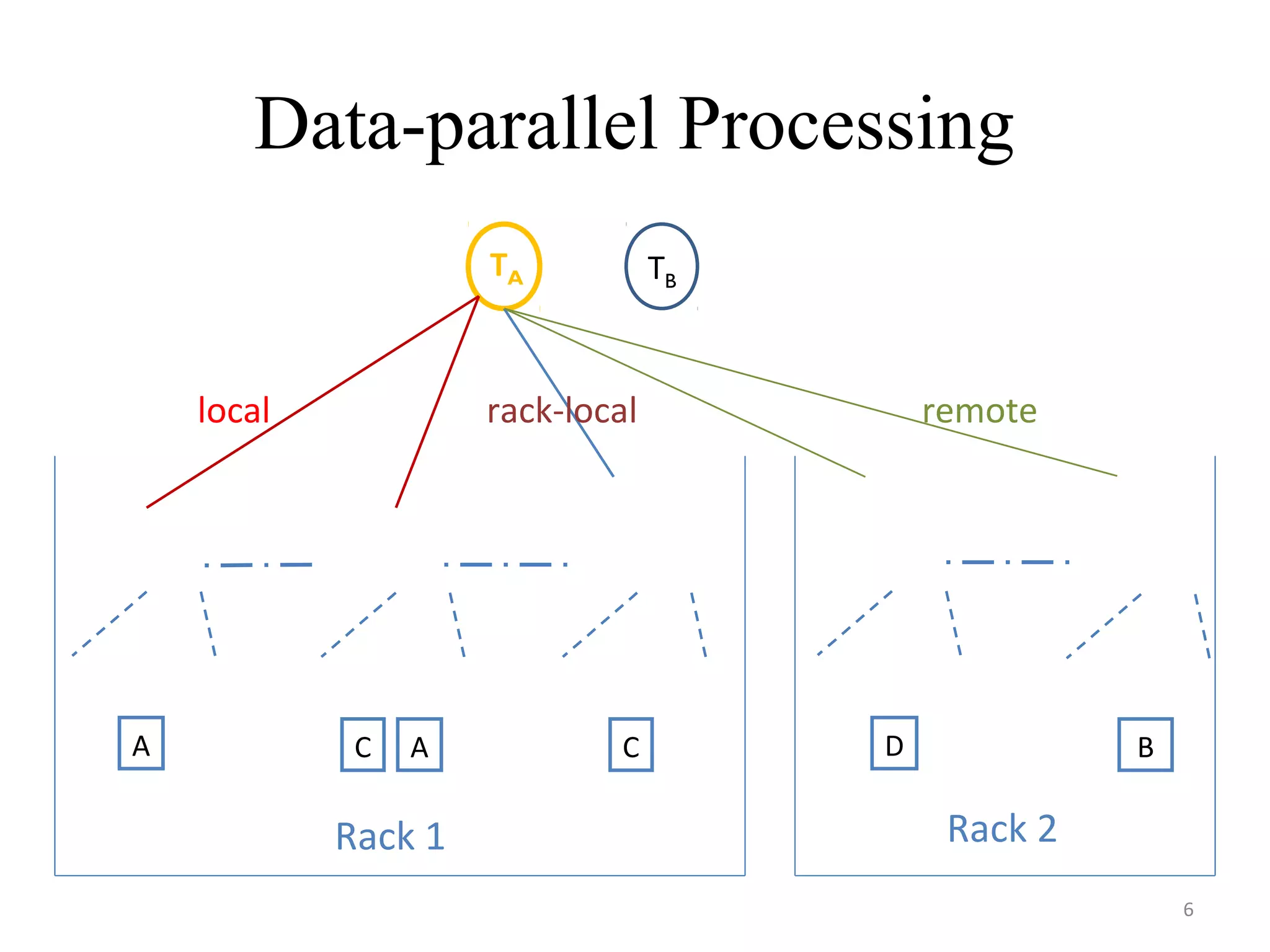
Data-parallel Processing
A A BC D
TA TB
C
Rack 1 Rack 2
local rack-local remote
6
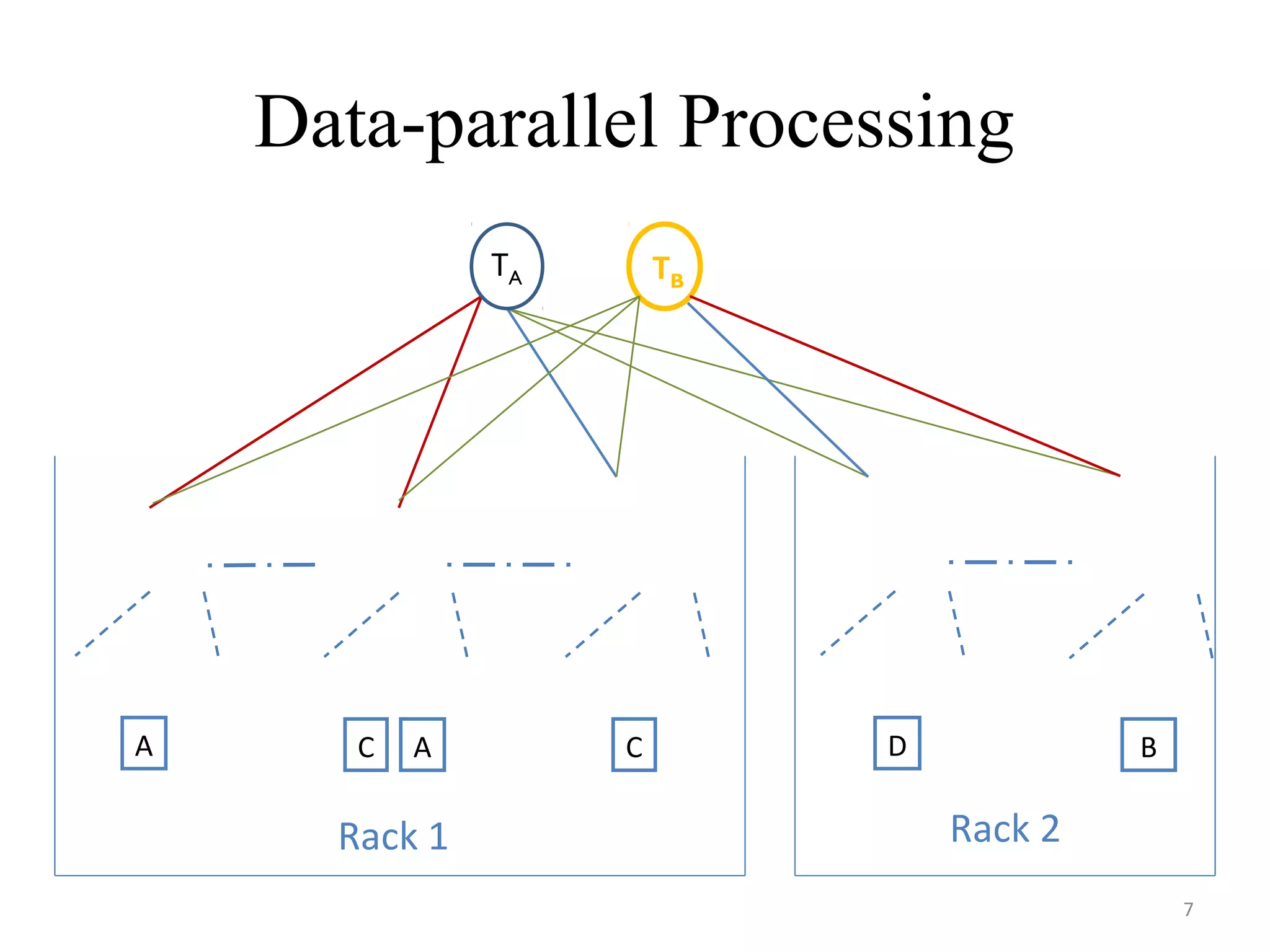
Data-parallel Processing
A A BC D
TB
C
Rack 1 Rack 2
TA
7
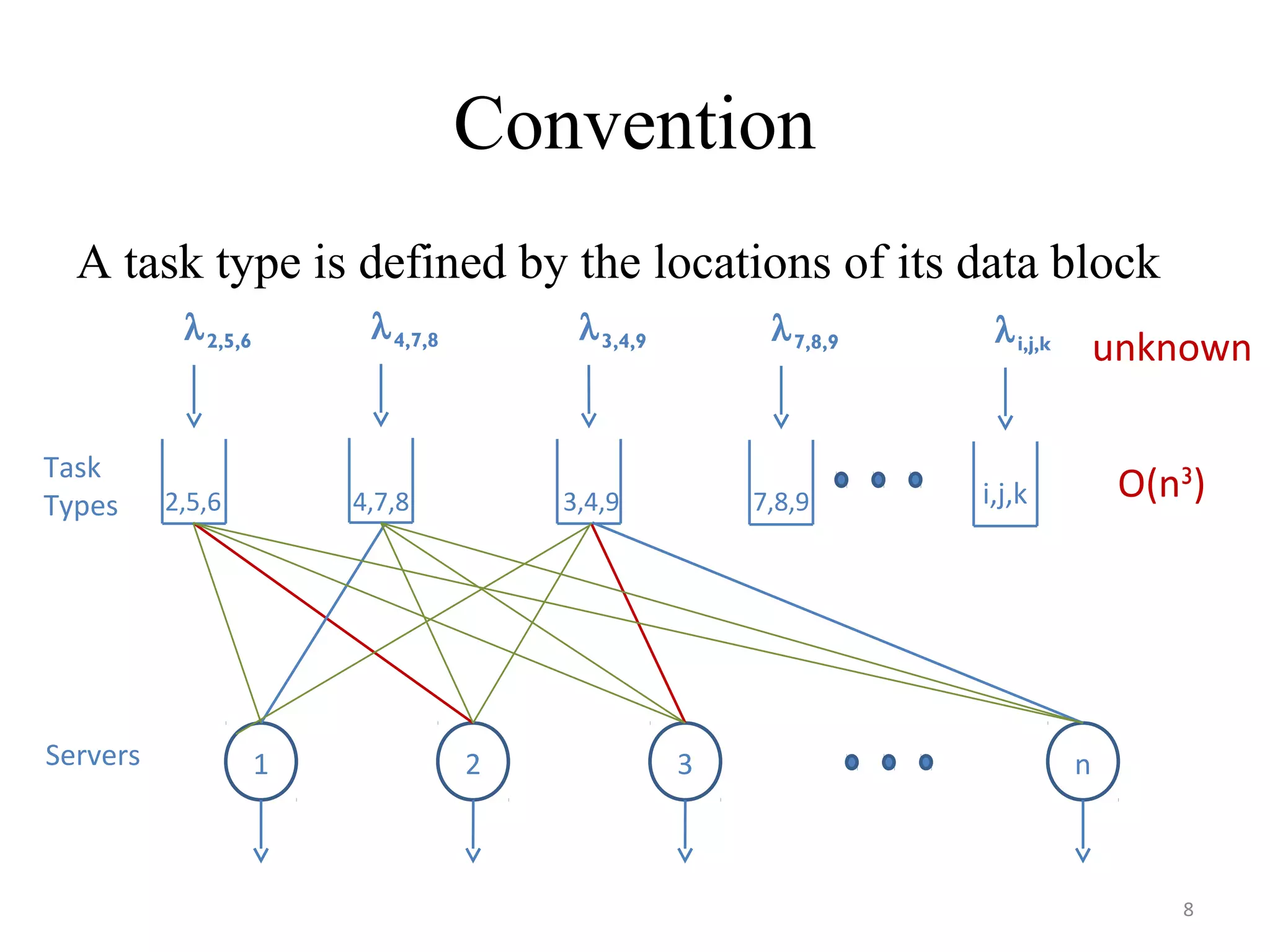
Convention
A task type is defined by the locations of its data block
Task
Types
Servers
2,5,6
λ2,5,6
1
4,7,8
λ4,7,8
3,4,9
λ3,4,9
2 3 n
7,8,9
λ7,8,9 λi,j,k
i,j,k O(n3
)
unknown
8
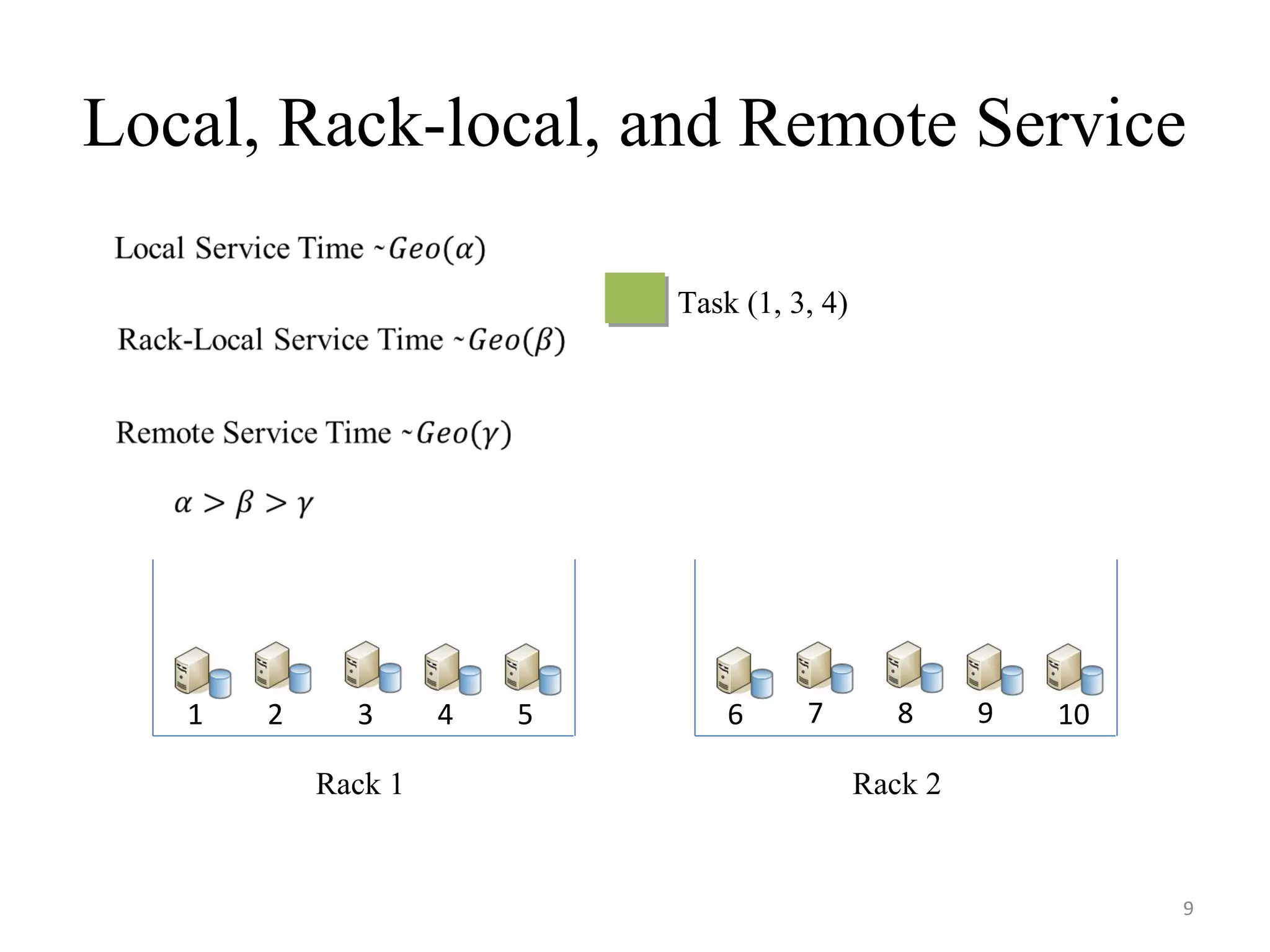
Local, Rack-local, and Remote Service
9
1 2 3 4 5 6 7 8 9 10
Rack 1 Rack 2
Task (1, 3, 4)
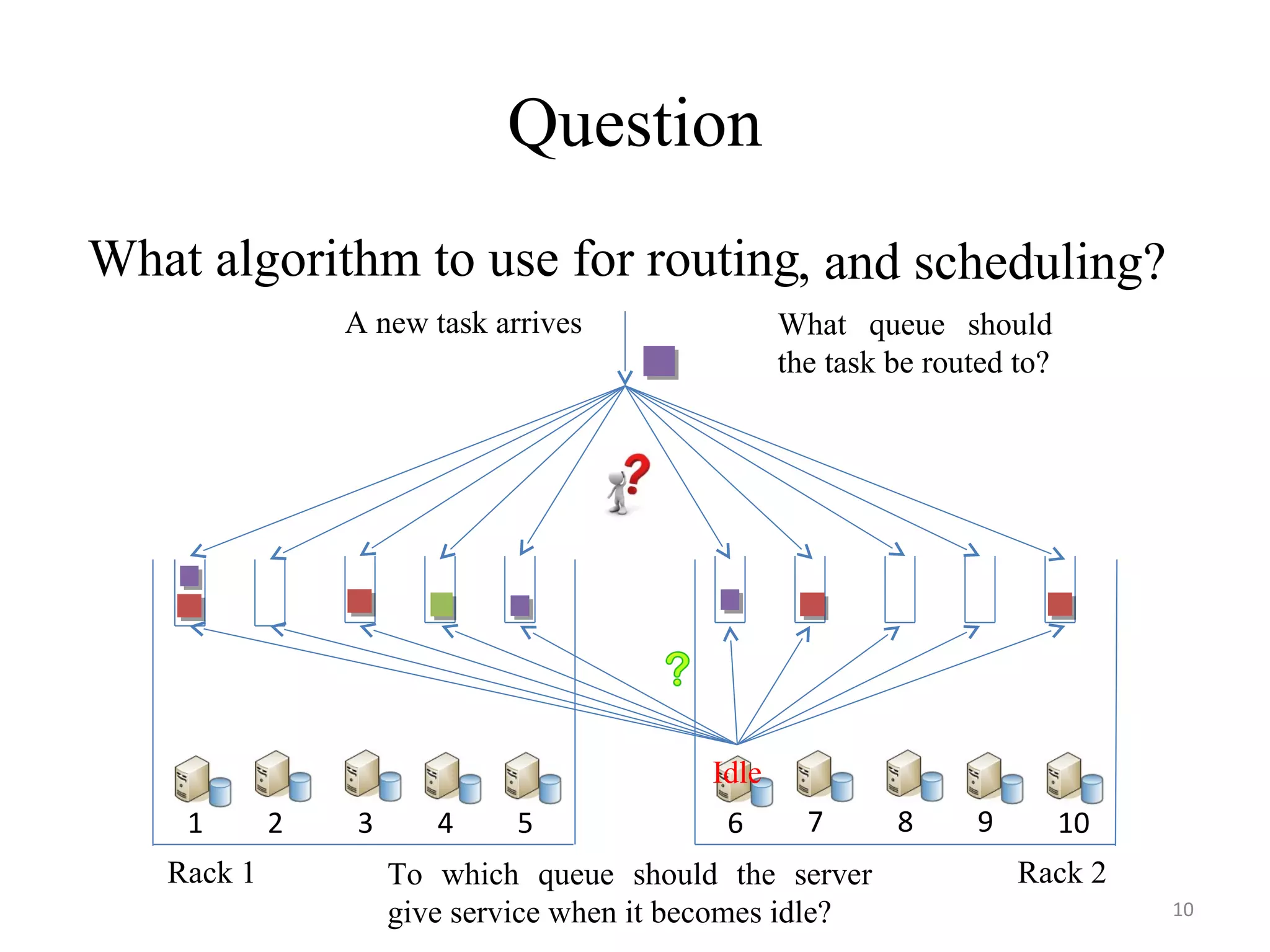
Question
10
1 2 3 4 5 6 7 8 9 10
Rack 1 Rack 2
A new task arrives
, and scheduling?
What queue should
the task be routed to?
What algorithm to use for routing
Idle
To which queue should the server
give service when it becomes idle?
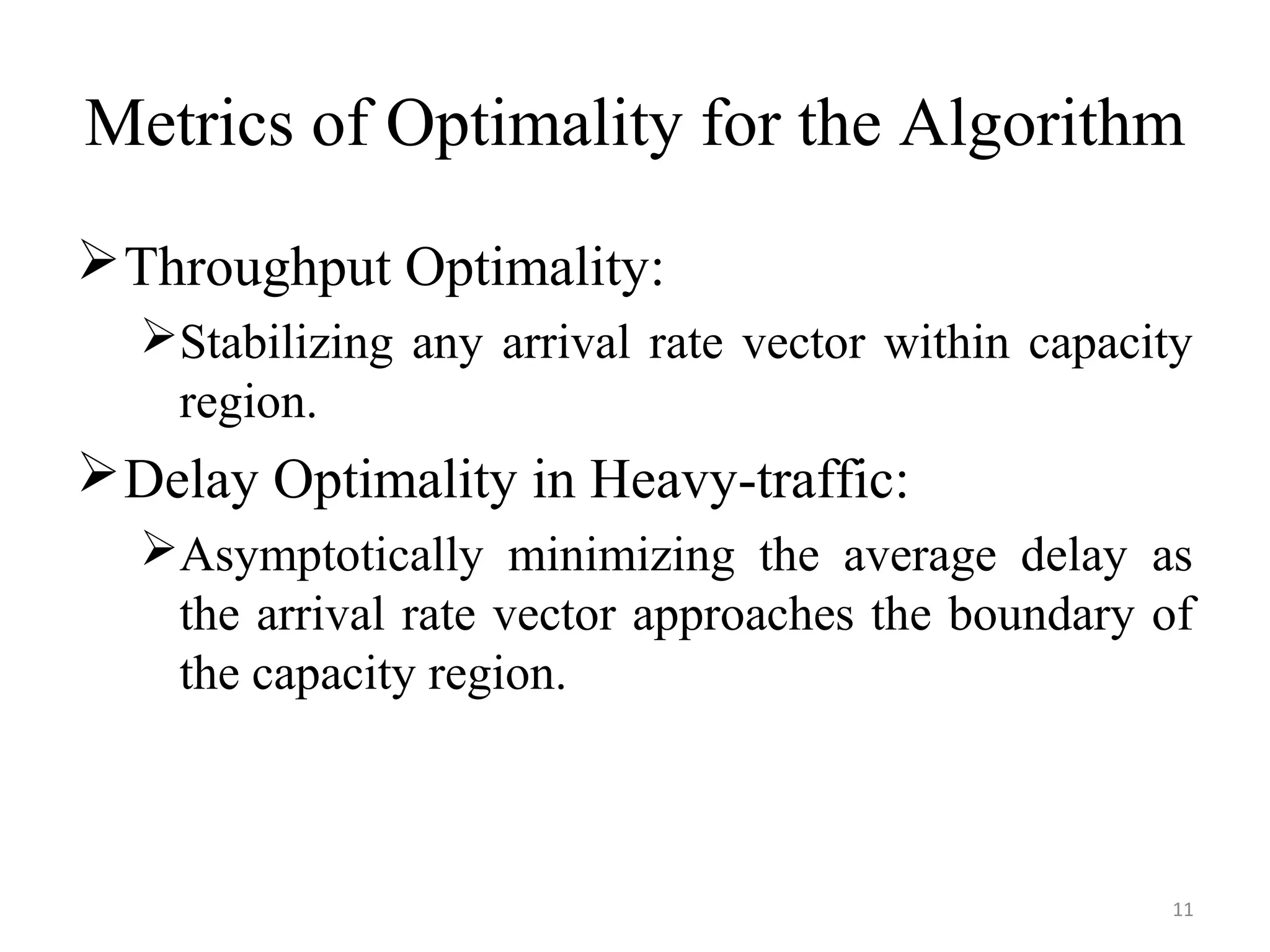
Metrics of Optimality for the Algorithm
Throughput Optimality:
Stabilizing any arrival rate vector within capacity
region.
Delay Optimality in Heavy-traffic:
Asymptotically minimizing the average delay as
the arrival rate vector approaches the boundary of
the capacity region.
11
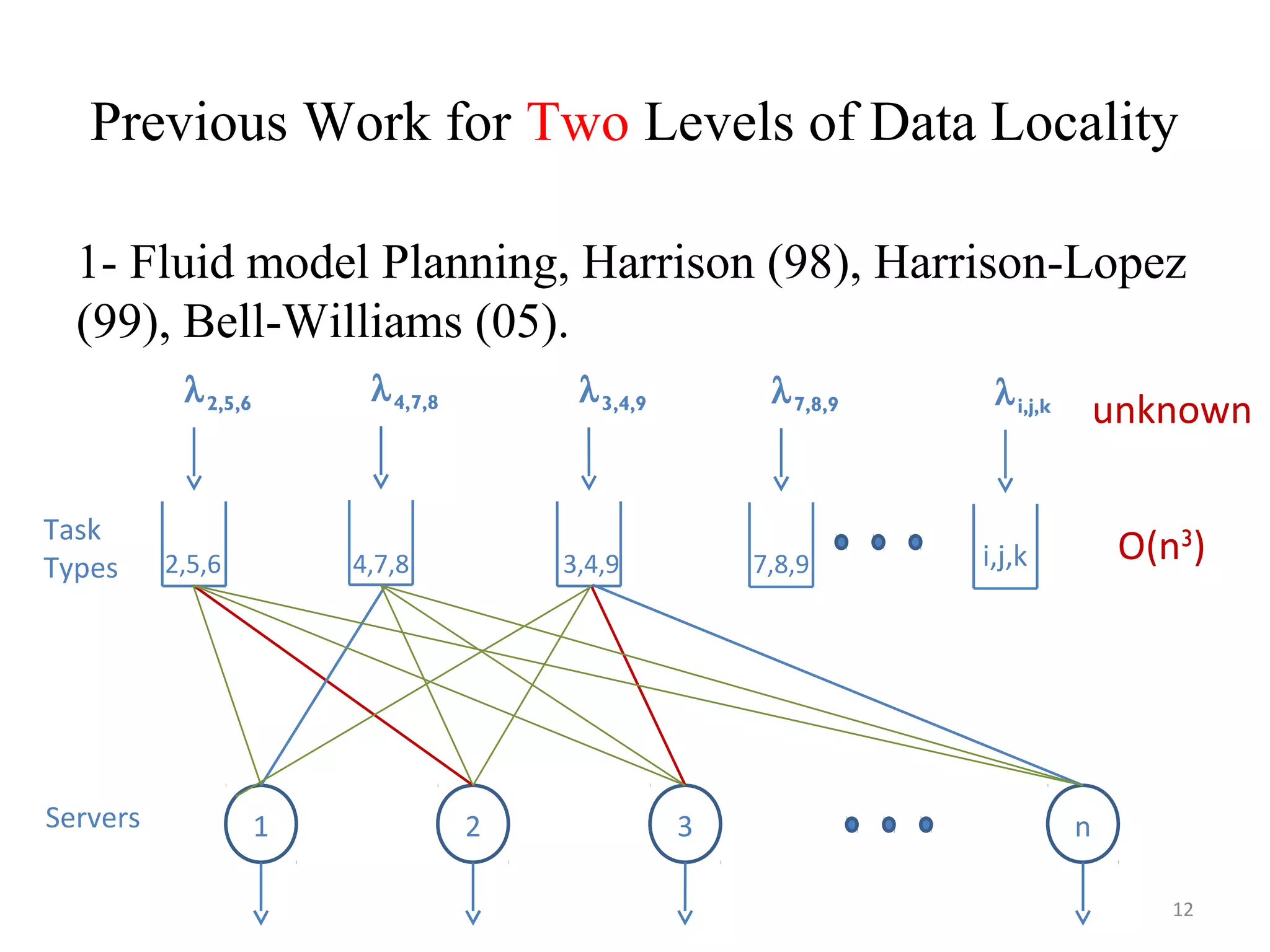
Previous Work for Two Levels of Data Locality
1- Fluid model Planning, Harrison (98), Harrison-Lopez
(99), Bell-Williams (05).
12
Task
Types
Servers
2,5,6
λ2,5,6
1
4,7,8
λ4,7,8
3,4,9
λ3,4,9
2 3 n
7,8,9
λ7,8,9 λi,j,k
i,j,k O(n3
)
unknown
Previous Work for Two Levels of Data Locality
1- Fluid Model Planning:
1.1 Throughput optimal
1.2 Heavy-traffic optimal
But
NOT practical!
13
Previous Work for Two Levels of Data Locality
2- Join the Shortest Queue-Maxweight (JSQ-MW)
Wang et al. (13).
2.1 Throughput optimal
2.2 Not heavy-traffic optimal in all loads
2.3 Heavy-traffic optimal in SPECIFIC loads
14
Previous Work for Two Levels of Data Locality
3- Priority Algorithm for Near Data Scheduling
(Pandas), Q. Xie, Y. Lu (15)
3.1 Throughput optimal
3.2 Heavy-traffic optimal for all loads
15
Three Levels of Data Locality
1. Fluid Model planning
1. Throughput optimal
2. Heavy-traffic optimal
3. NOT practical!
2. Extension of JSQ-MaxWeight
1. Throughput optimal
2. NOT heavy-traffic optimal for all loads
3. Pandas
1. Not throughput optimal
2. Not heavy-traffic optimal
16
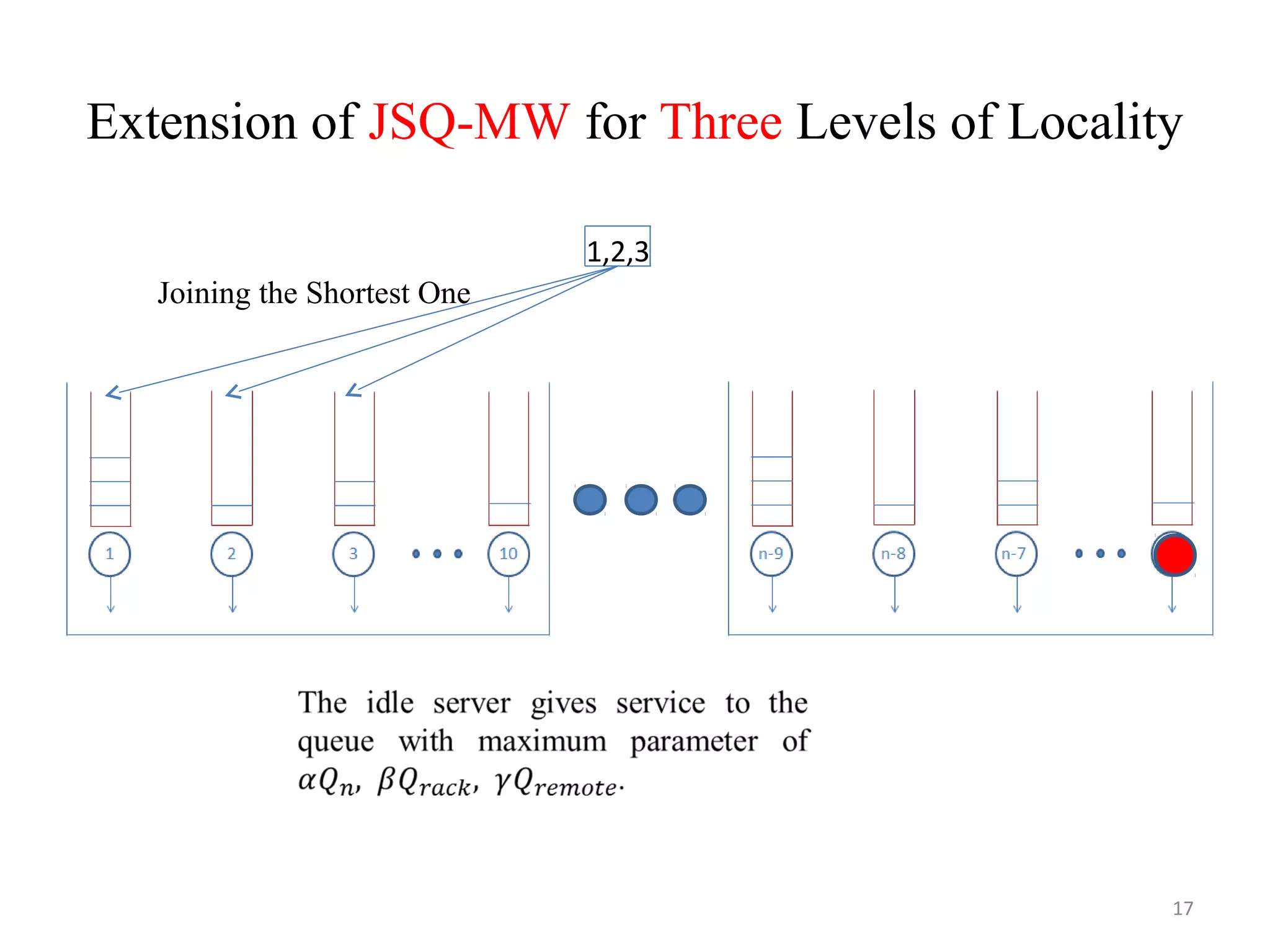
Extension of JSQ-MW for Three Levels of Locality
17
1,2,3
Joining the Shortest One
Extension of JSQ-MW for Three Levels of Locality
• Extension of JSQ-MaxWeight for systems
with rack structure, Xie et al. (16):
– Throughput optimal.
– Not heavy-traffic optimal in all loads. Just heavy
traffic optimal in specific loads.
18
Our Throughput and Heavy-traffic
Optimal Algorithm
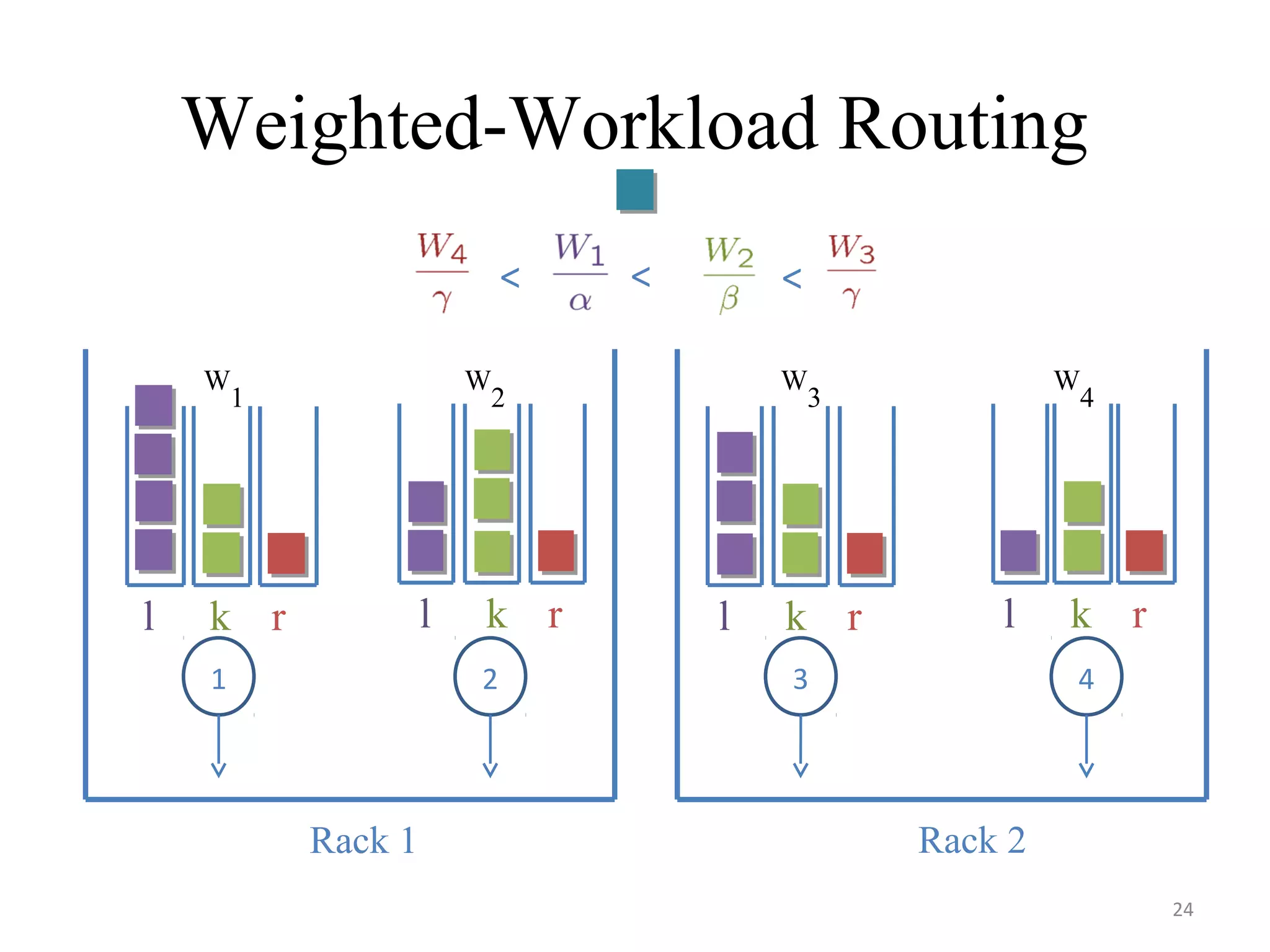
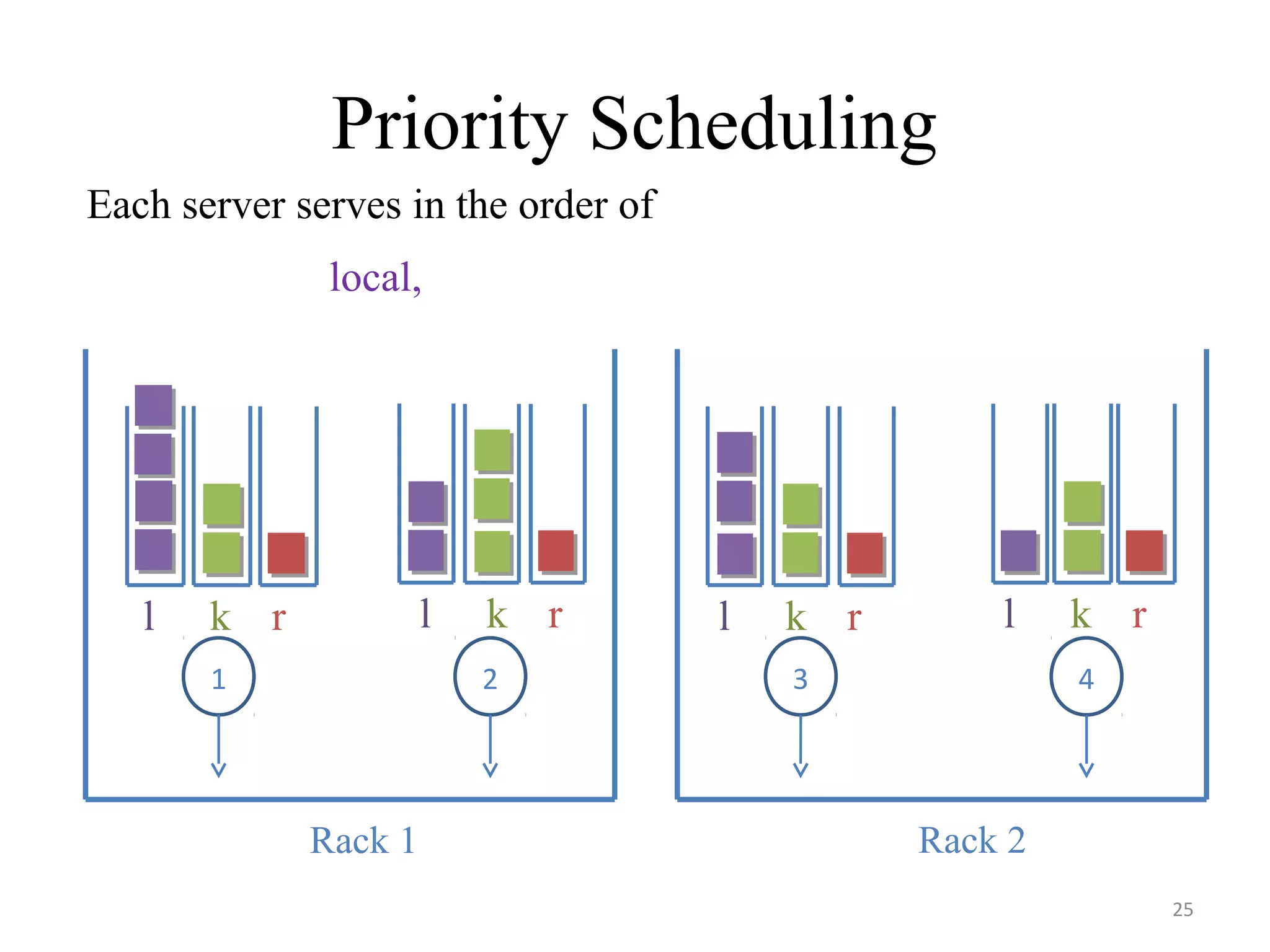
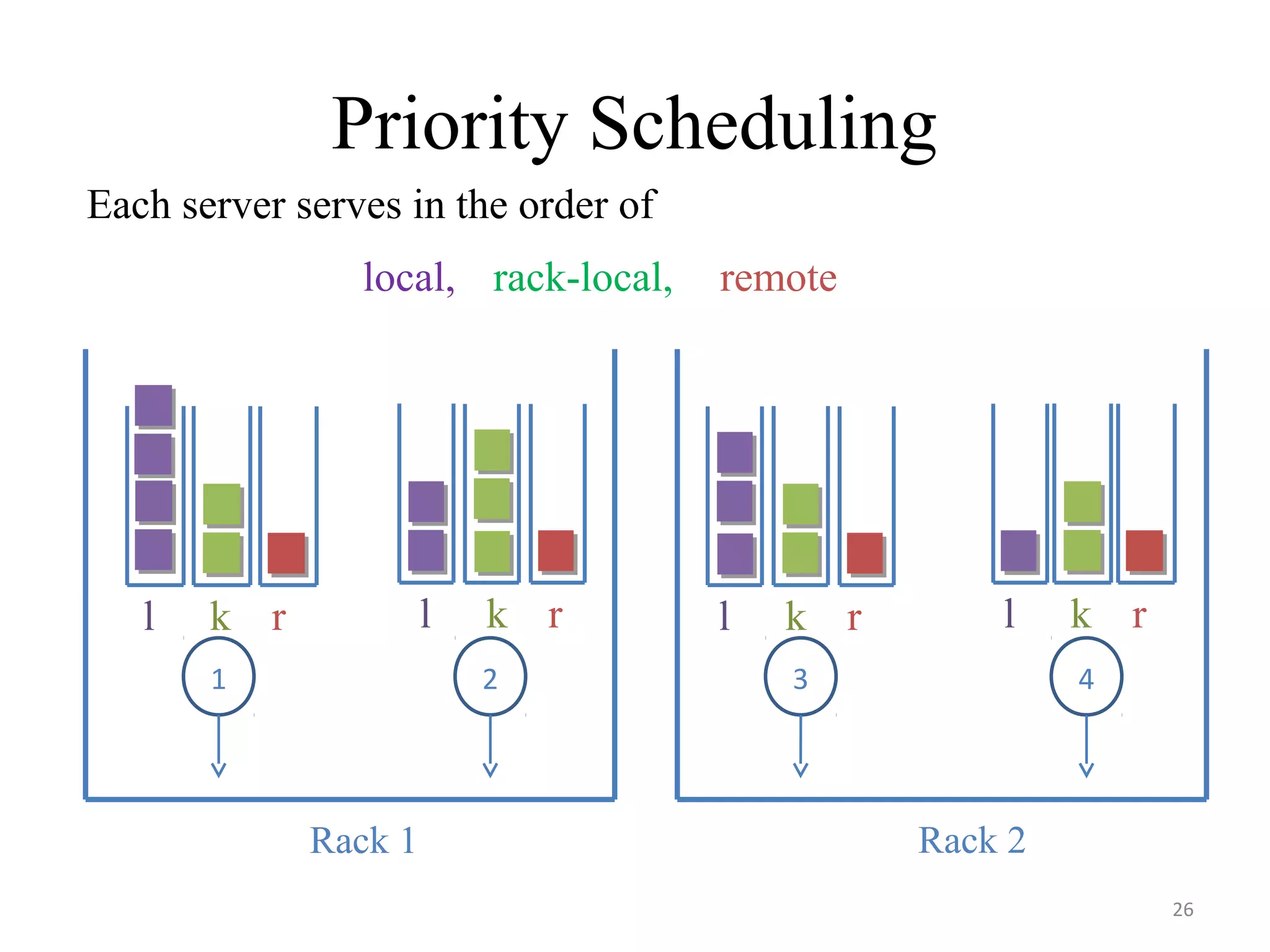
• The routing and scheduling for our algorithm
is as follows:
– Routing: Weighted Workload
– Scheduling: Priority Scheduling for Local, Rack-
local, and Remote tasks queued in the 3 queues
associated to each server.
19
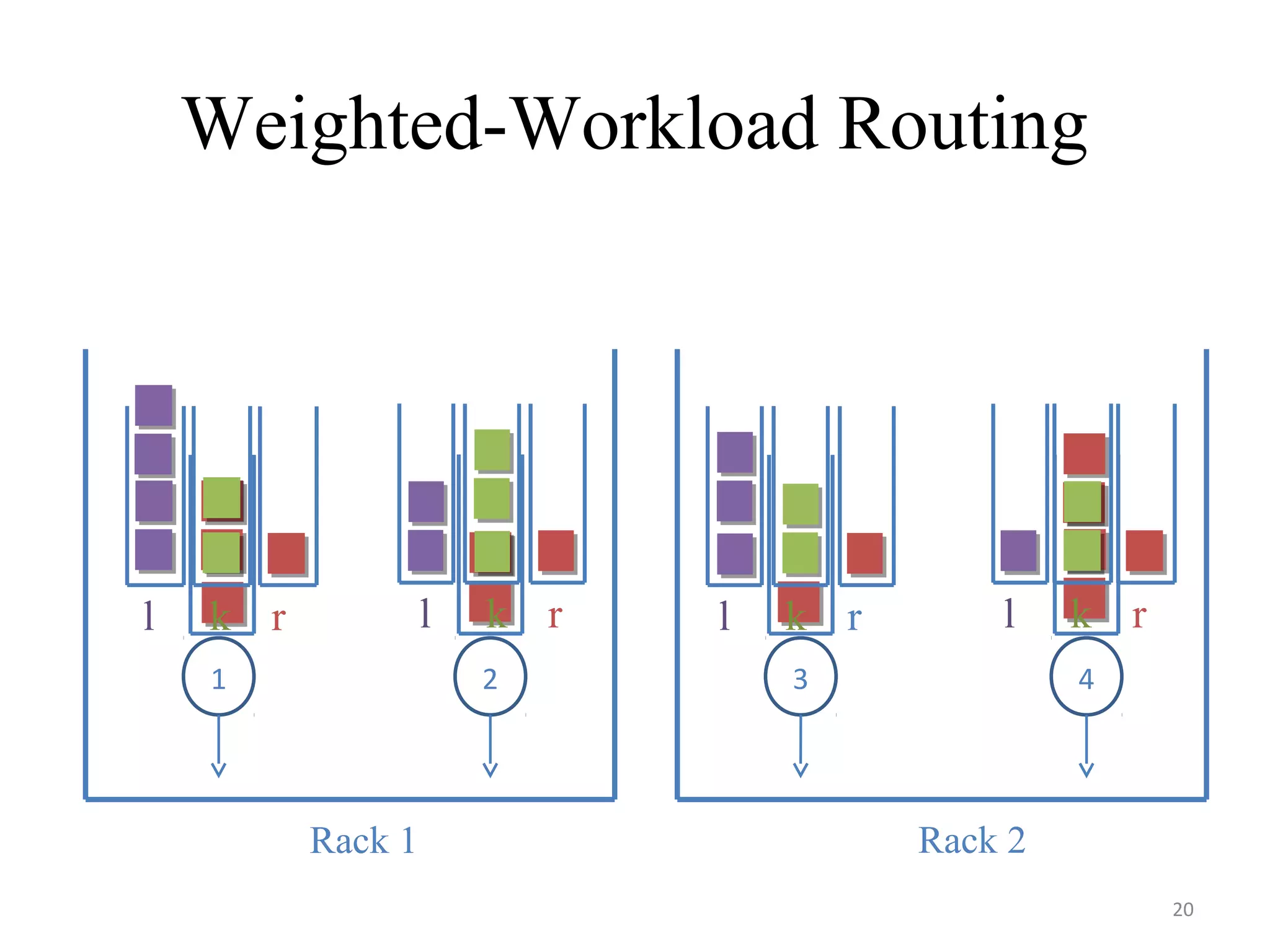
Weighted-Workload Routing
20
Rack 1 Rack 2
1 2 43
l k r l k rl k r l k r
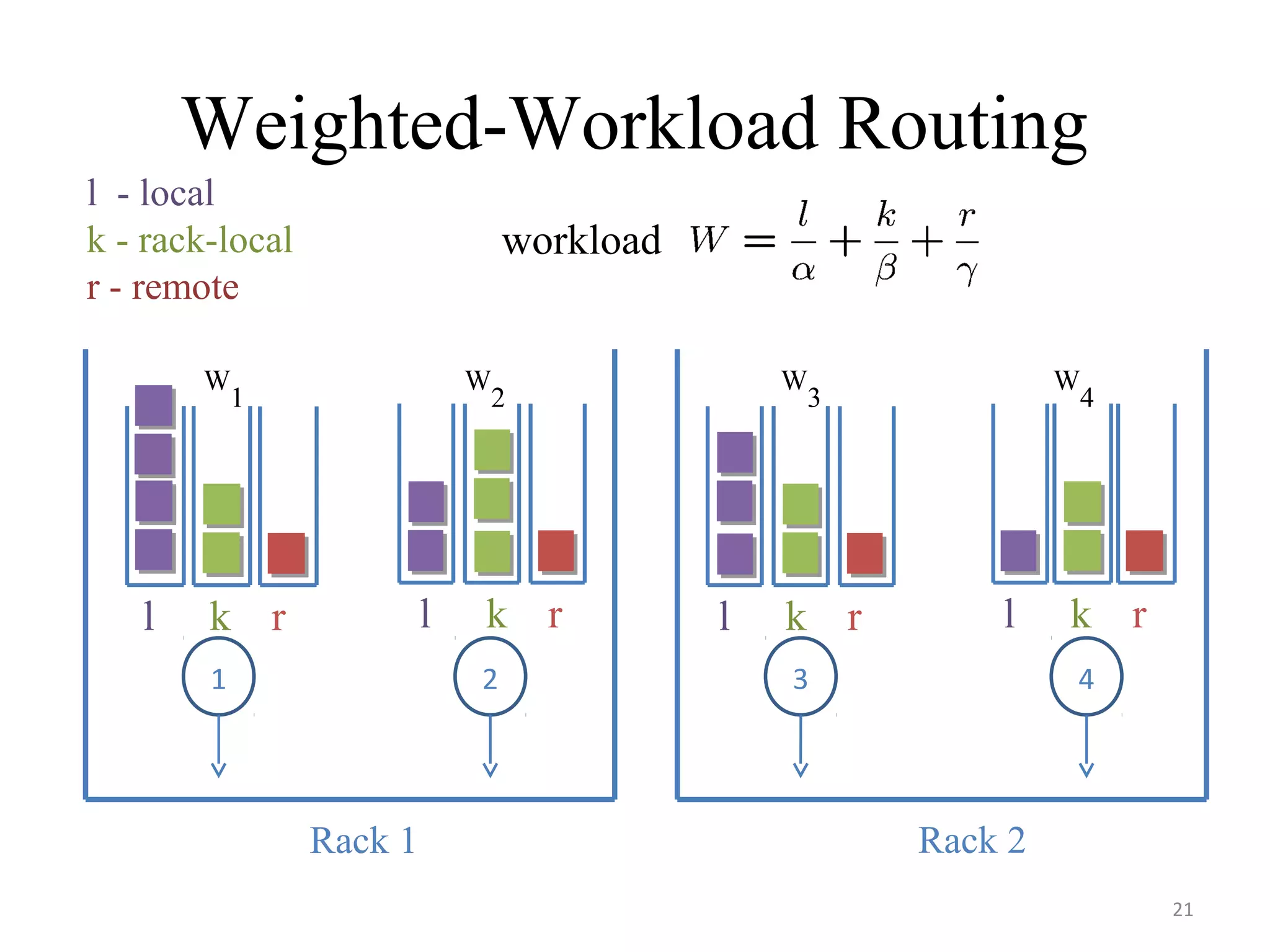
Weighted-Workload Routing
21
1 2
Rack 1 Rack 2
43
l - local
k - rack-local
r - remote
workload
W
1
W
2
W
3
W
4
l k r l k rl k r l k r
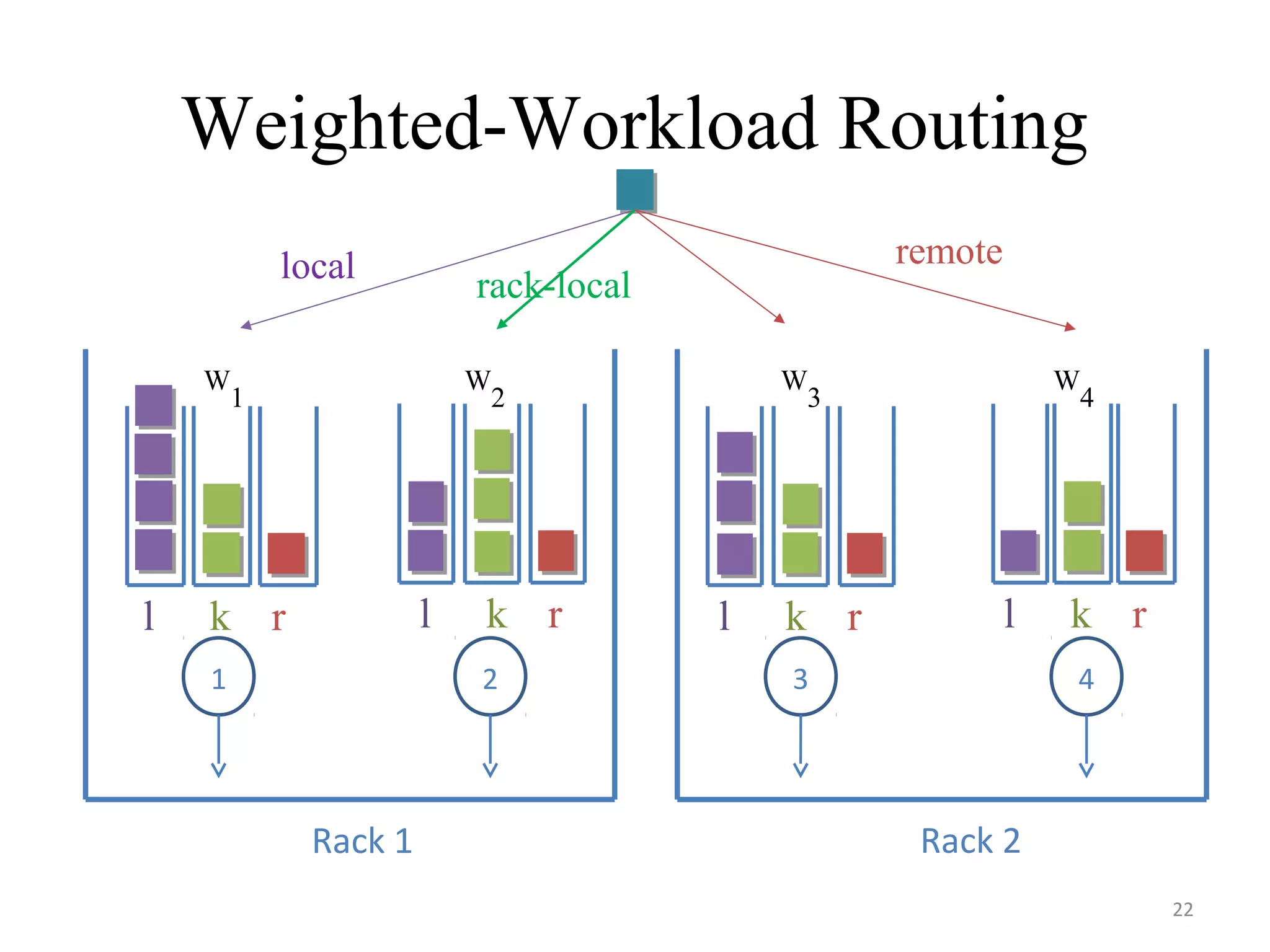
Weighted-Workload Routing
22
1 2
Rack 1 Rack 2
43
W
1
W
2
W
3
W
4
local
rack-local
remote
l k r l k rl k r l k r
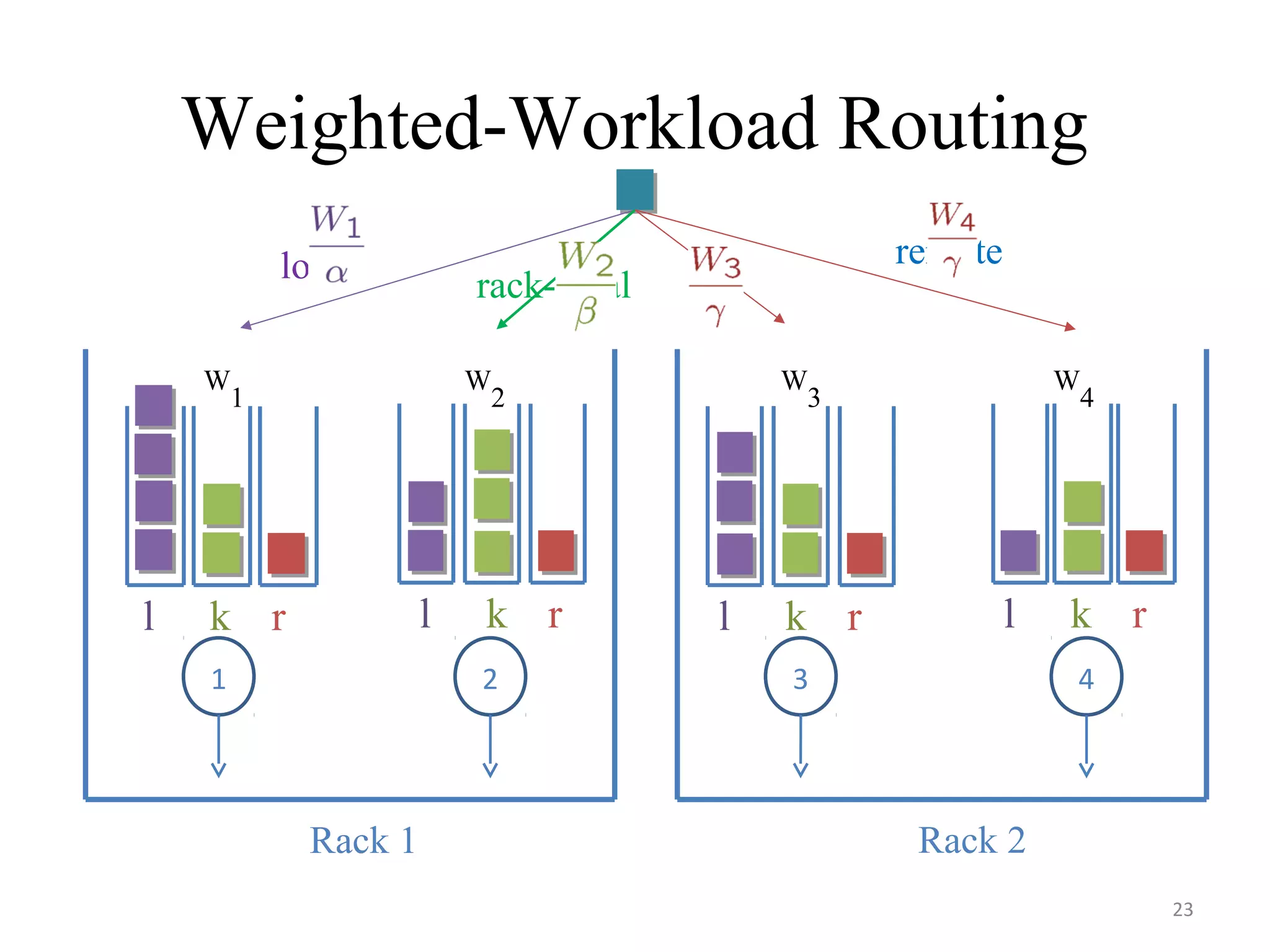
Weighted-Workload Routing
23
1 2
Rack 1 Rack 2
43
W
1
W
2
W
3
W
4
local
rack-local
remote
l k r l k rl k r l k r
Weighted-Workload Routing
24
1 2 43
W
1
W
2
W
3
W
4
< <<
l k r l k rl k r l k r
Rack 1 Rack 2
Priority Scheduling
25
1 2
Rack 1 Rack 2
43
Each server serves in the order of
l k r l k rl k r l k r
local,
Priority Scheduling
26
1 2
Rack 1 Rack 2
43
Each server serves in the order of
l k r l k rl k r l k r
local, rack-local, remote
Weighted Workload Algorithm
The Weighted Workload (WW) algorithm
proposed by Xie et al. (16) is proved to be both
throughput optimal and heavy traffic optimal in
all loads.
27
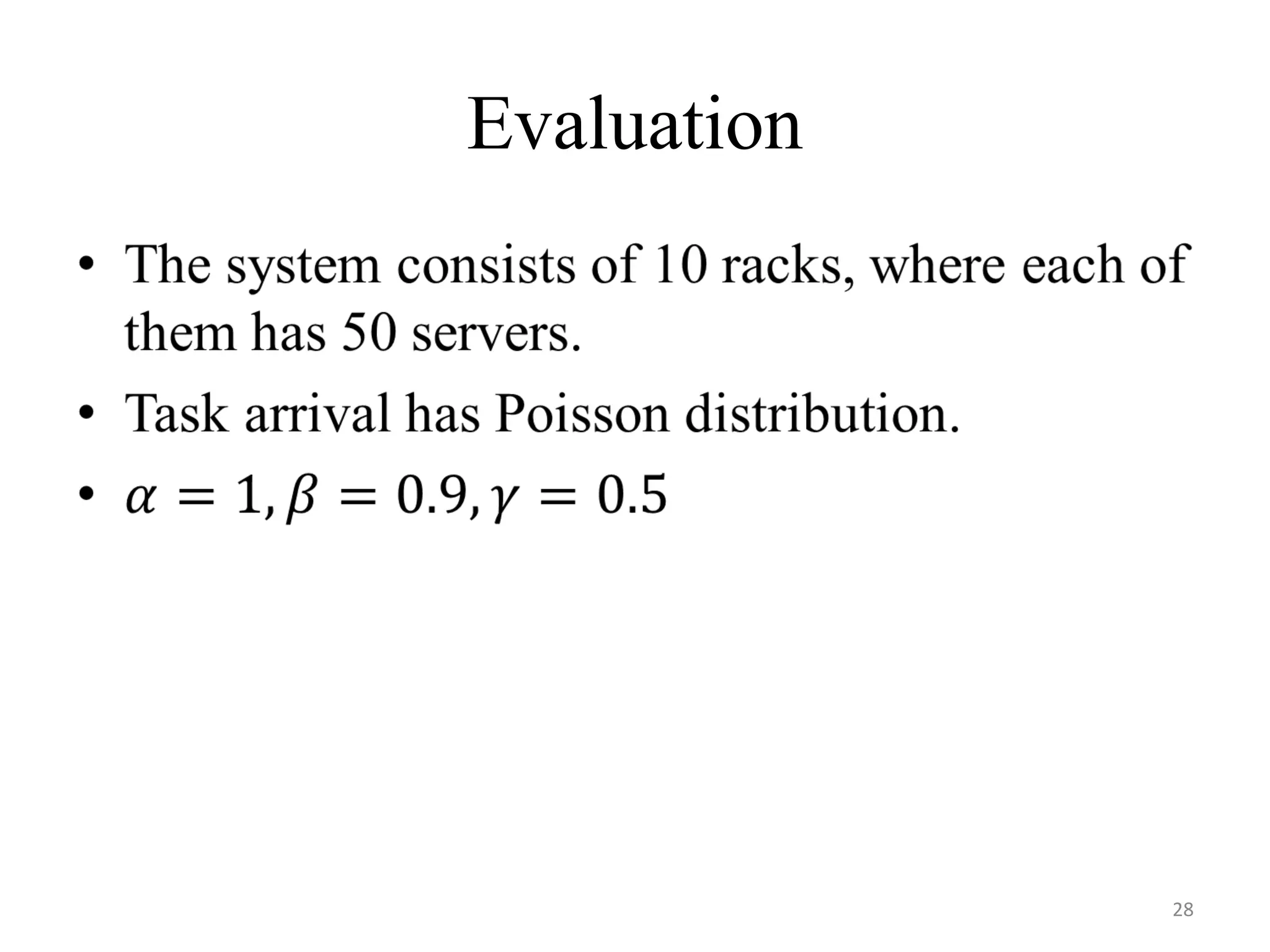
Evaluation
28
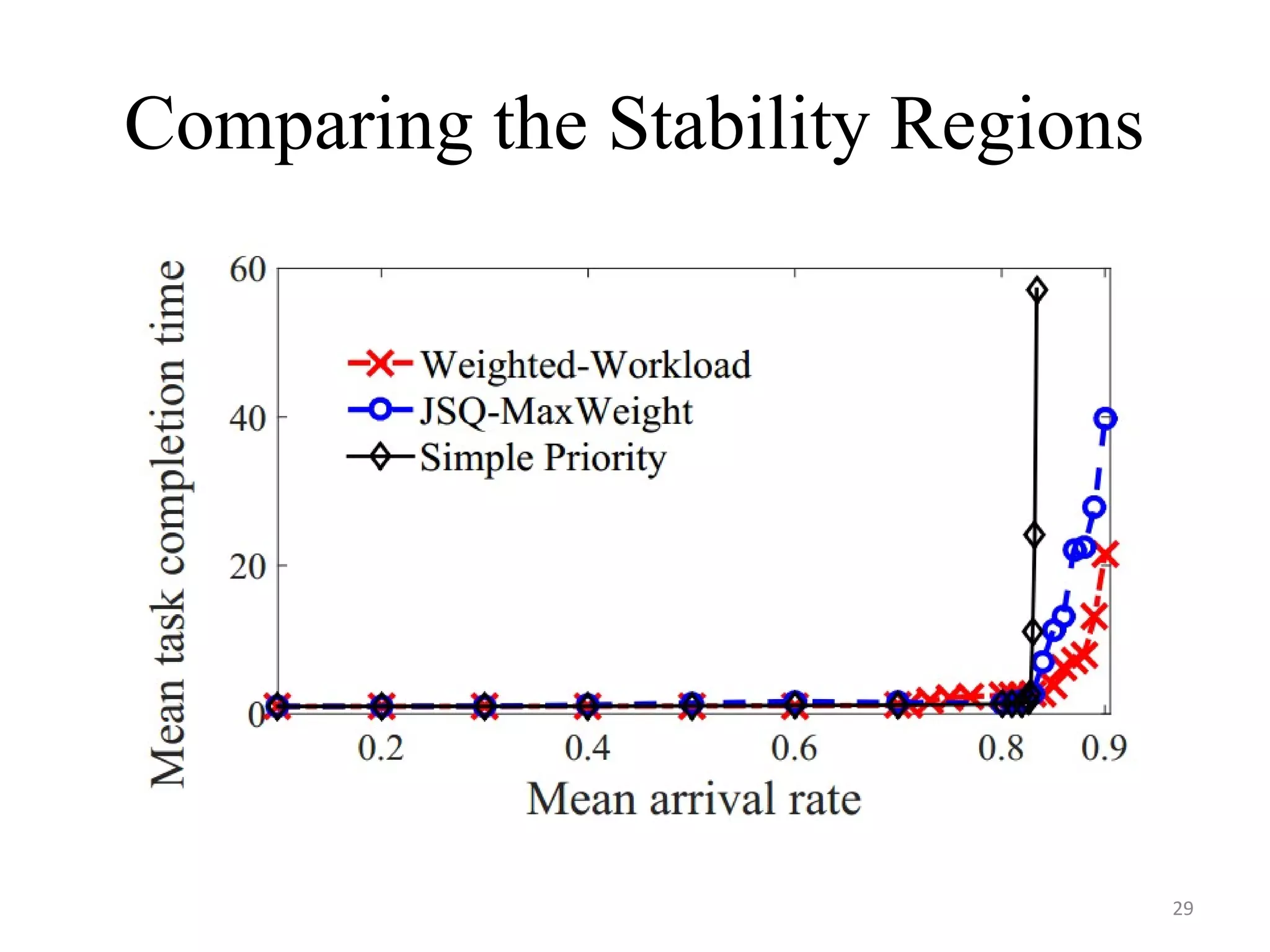
Comparing the Stability Regions
29
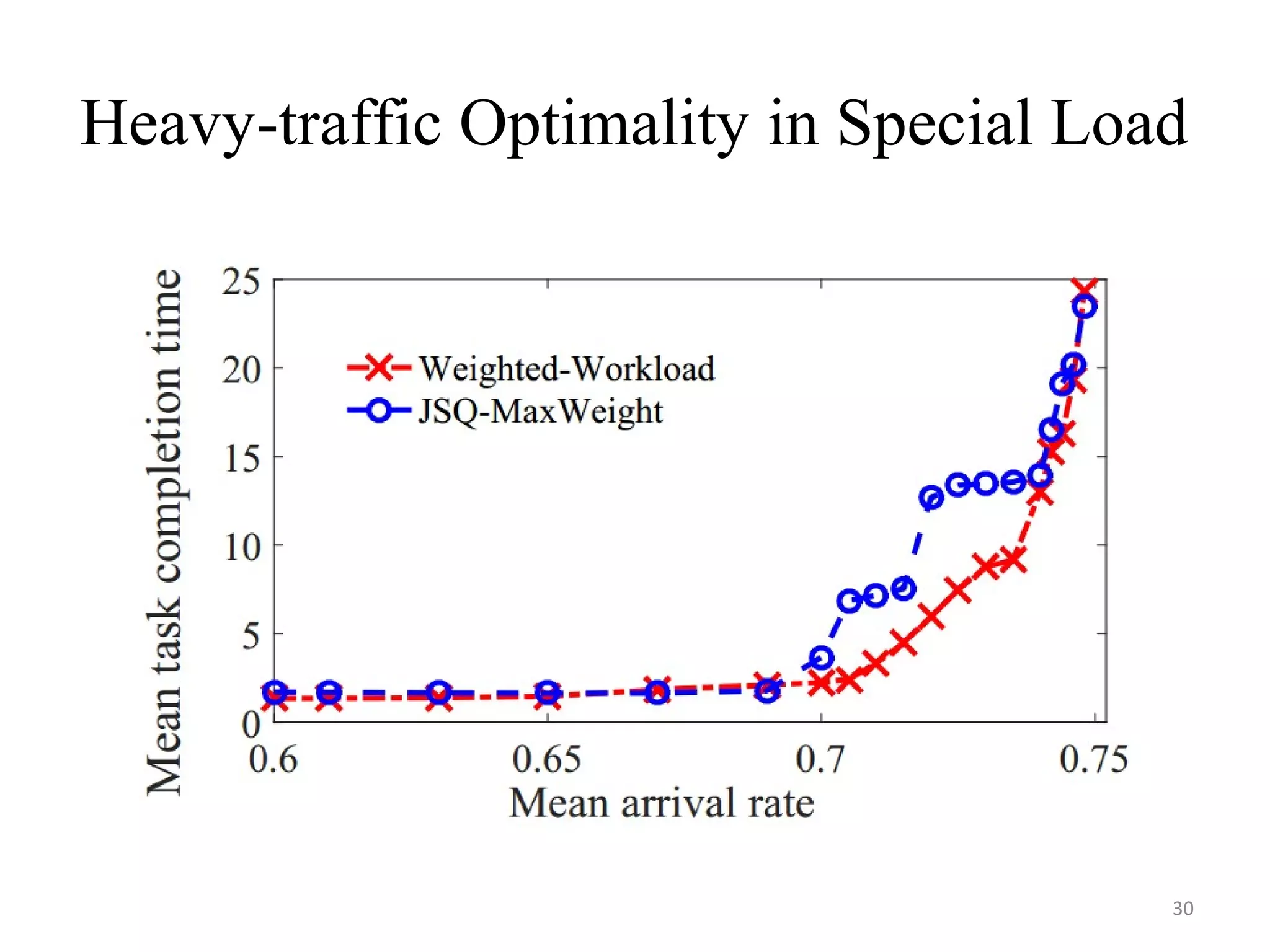
Heavy-traffic Optimality in Special Load
30
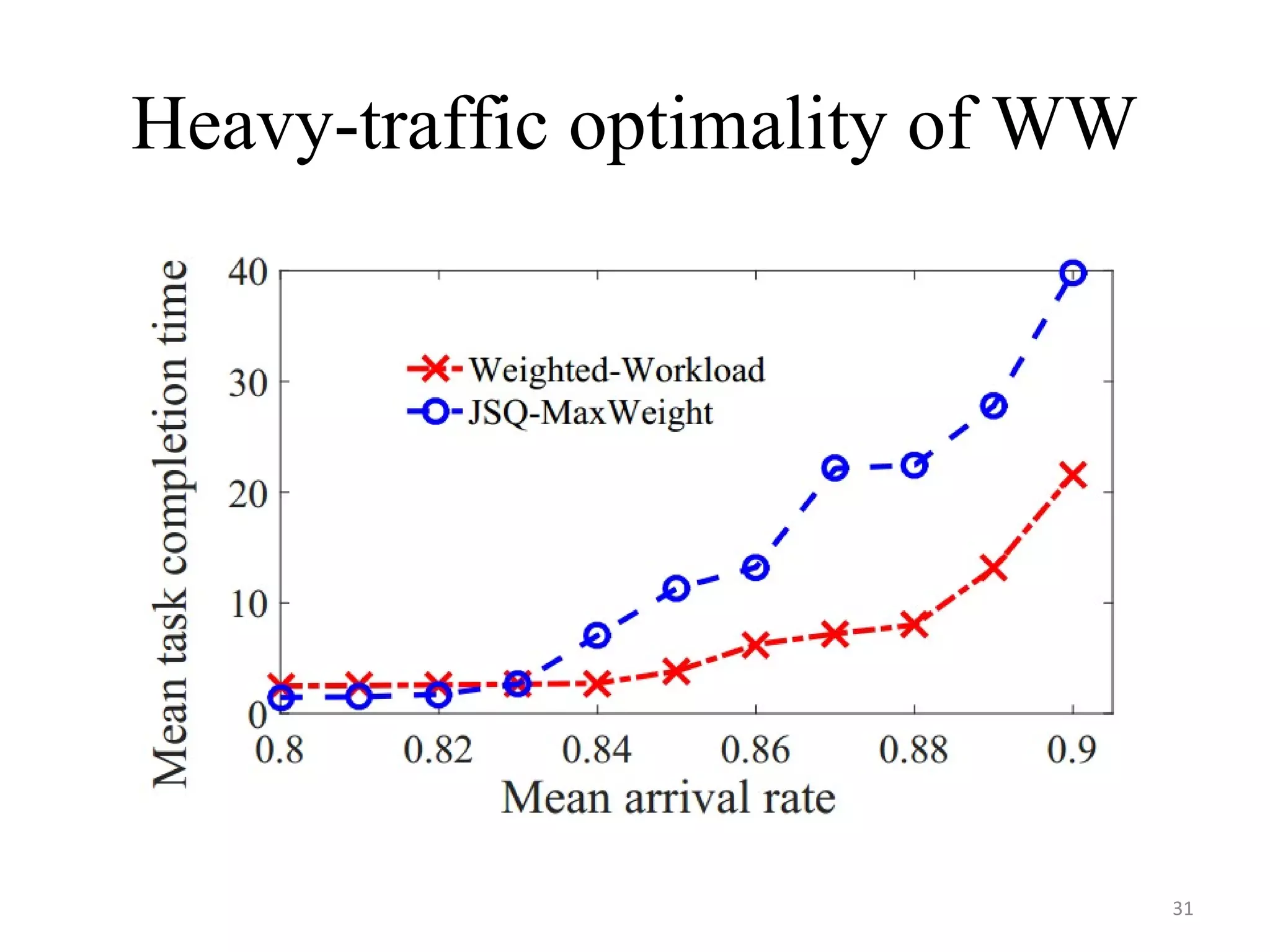
Heavy-traffic optimality of WW
31
References
• [1] Q. Xie, A. Yekkehkhany, Y. Lu. Scheduling with Multi-level Data
Locality: Throughput and Heavy-traffic Optimality. In Proceedings of
INFOCOM. IEEE, 2016.
• [2] Q. Xie, and Y. Lu. Priotrity Algorithm for Near-data Scheduling:
Throughput and Heavy-traffic Optimality. In Proceedings of INFOCOM.
IEEE, 2015.
• [3] W. Wang, K. Zhu, L. Ying, J. Tan, and L. Zhang. Map Task Schedul-
ing in MapReduce with Data Locality: Throughput and Heavy-traffic
Optimality. In Proceedings of INFOCOM. IEEE, 2013.
• [4] J. M. Harrison. Heavy traffic analysis of a system with parallel servers:
Asymptotic optimality of discrete review policies. Annals of Applied
Probability, 1998.
• [5] J. M. Harrison and M. J. L´opez. Heavy traffic resource pooling in
parallel-server systems. Queueing Syst. Theory Appl., 33(4), Apr. 1999.
32
Future Work
• Scheduling for multi-level data locality instead
of three levels of data locality.
33
Thanks for Your Attention
34
Any Questions?!
35
Ali Yekkehkhany
yekkehk2@illinois.edu

Scheduling for cloud systems with multi level data locality

  • 1.
    Scheduling for CloudSystems with Multi-level Data Locality: Throughput and Heavy-traffic Optimality Ali Yekkehkhany In collaboration with Qiaomin Xie, and Professor Yi Lu University of Illinois at Urbana-Champain (UIUC) 1
  • 2.
    Data Processing • Previously,storage and computing were separate Computing StorageNetwork 2
  • 3.
    Data-Intensive Processing Explosion ofdata sets by industry and research Computing StorageNetwork Bottleneck 3
  • 4.
    Data Centers • Useseparate smaller centers for storage • Move computing to data Bottleneck 4
  • 5.
    Data Centers Rack Rack Topof Rack Switch Core Switch 5
  • 6.
    Data-parallel Processing A ABC D TA TB C Rack 1 Rack 2 local rack-local remote 6
  • 7.
    Data-parallel Processing A ABC D TB C Rack 1 Rack 2 TA 7
  • 8.
    Convention A task typeis defined by the locations of its data block Task Types Servers 2,5,6 λ2,5,6 1 4,7,8 λ4,7,8 3,4,9 λ3,4,9 2 3 n 7,8,9 λ7,8,9 λi,j,k i,j,k O(n3 ) unknown 8
  • 9.
    Local, Rack-local, andRemote Service 9 1 2 3 4 5 6 7 8 9 10 Rack 1 Rack 2 Task (1, 3, 4)
  • 10.
    Question 10 1 2 34 5 6 7 8 9 10 Rack 1 Rack 2 A new task arrives , and scheduling? What queue should the task be routed to? What algorithm to use for routing Idle To which queue should the server give service when it becomes idle?
  • 11.
    Metrics of Optimalityfor the Algorithm Throughput Optimality: Stabilizing any arrival rate vector within capacity region. Delay Optimality in Heavy-traffic: Asymptotically minimizing the average delay as the arrival rate vector approaches the boundary of the capacity region. 11
  • 12.
    Previous Work forTwo Levels of Data Locality 1- Fluid model Planning, Harrison (98), Harrison-Lopez (99), Bell-Williams (05). 12 Task Types Servers 2,5,6 λ2,5,6 1 4,7,8 λ4,7,8 3,4,9 λ3,4,9 2 3 n 7,8,9 λ7,8,9 λi,j,k i,j,k O(n3 ) unknown
  • 13.
    Previous Work forTwo Levels of Data Locality 1- Fluid Model Planning: 1.1 Throughput optimal 1.2 Heavy-traffic optimal But NOT practical! 13
  • 14.
    Previous Work forTwo Levels of Data Locality 2- Join the Shortest Queue-Maxweight (JSQ-MW) Wang et al. (13). 2.1 Throughput optimal 2.2 Not heavy-traffic optimal in all loads 2.3 Heavy-traffic optimal in SPECIFIC loads 14
  • 15.
    Previous Work forTwo Levels of Data Locality 3- Priority Algorithm for Near Data Scheduling (Pandas), Q. Xie, Y. Lu (15) 3.1 Throughput optimal 3.2 Heavy-traffic optimal for all loads 15
  • 16.
    Three Levels ofData Locality 1. Fluid Model planning 1. Throughput optimal 2. Heavy-traffic optimal 3. NOT practical! 2. Extension of JSQ-MaxWeight 1. Throughput optimal 2. NOT heavy-traffic optimal for all loads 3. Pandas 1. Not throughput optimal 2. Not heavy-traffic optimal 16
  • 17.
    Extension of JSQ-MWfor Three Levels of Locality 17 1,2,3 Joining the Shortest One
  • 18.
    Extension of JSQ-MWfor Three Levels of Locality • Extension of JSQ-MaxWeight for systems with rack structure, Xie et al. (16): – Throughput optimal. – Not heavy-traffic optimal in all loads. Just heavy traffic optimal in specific loads. 18
  • 19.
    Our Throughput andHeavy-traffic Optimal Algorithm • The routing and scheduling for our algorithm is as follows: – Routing: Weighted Workload – Scheduling: Priority Scheduling for Local, Rack- local, and Remote tasks queued in the 3 queues associated to each server. 19
  • 20.
    Weighted-Workload Routing 20 Rack 1Rack 2 1 2 43 l k r l k rl k r l k r
  • 21.
    Weighted-Workload Routing 21 1 2 Rack1 Rack 2 43 l - local k - rack-local r - remote workload W 1 W 2 W 3 W 4 l k r l k rl k r l k r
  • 22.
    Weighted-Workload Routing 22 1 2 Rack1 Rack 2 43 W 1 W 2 W 3 W 4 local rack-local remote l k r l k rl k r l k r
  • 23.
    Weighted-Workload Routing 23 1 2 Rack1 Rack 2 43 W 1 W 2 W 3 W 4 local rack-local remote l k r l k rl k r l k r
  • 24.
    Weighted-Workload Routing 24 1 243 W 1 W 2 W 3 W 4 < << l k r l k rl k r l k r Rack 1 Rack 2
  • 25.
    Priority Scheduling 25 1 2 Rack1 Rack 2 43 Each server serves in the order of l k r l k rl k r l k r local,
  • 26.
    Priority Scheduling 26 1 2 Rack1 Rack 2 43 Each server serves in the order of l k r l k rl k r l k r local, rack-local, remote
  • 27.
    Weighted Workload Algorithm TheWeighted Workload (WW) algorithm proposed by Xie et al. (16) is proved to be both throughput optimal and heavy traffic optimal in all loads. 27
  • 28.
  • 29.
  • 30.
  • 31.
  • 32.
    References • [1] Q.Xie, A. Yekkehkhany, Y. Lu. Scheduling with Multi-level Data Locality: Throughput and Heavy-traffic Optimality. In Proceedings of INFOCOM. IEEE, 2016. • [2] Q. Xie, and Y. Lu. Priotrity Algorithm for Near-data Scheduling: Throughput and Heavy-traffic Optimality. In Proceedings of INFOCOM. IEEE, 2015. • [3] W. Wang, K. Zhu, L. Ying, J. Tan, and L. Zhang. Map Task Schedul- ing in MapReduce with Data Locality: Throughput and Heavy-traffic Optimality. In Proceedings of INFOCOM. IEEE, 2013. • [4] J. M. Harrison. Heavy traffic analysis of a system with parallel servers: Asymptotic optimality of discrete review policies. Annals of Applied Probability, 1998. • [5] J. M. Harrison and M. J. L´opez. Heavy traffic resource pooling in parallel-server systems. Queueing Syst. Theory Appl., 33(4), Apr. 1999. 32
  • 33.
    Future Work • Schedulingfor multi-level data locality instead of three levels of data locality. 33
  • 34.
    Thanks for YourAttention 34
  • 35.