Problem    Model                 Integral Representation    Utility Maximization


          Relaxed Utility Maximization
             in Complete Markets

                       Paolo Guasoni
               (Joint work with Sara Biagini)

             Boston University and Dublin City University


          Analysis, Stochastics, and Applications
            In Honor of Walter Schachermayer
                      July 15th , 2010
Problem             Model             Integral Representation       Utility Maximization


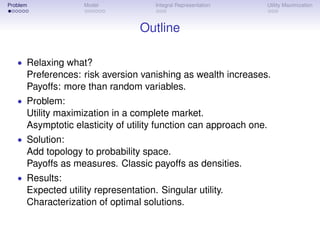
                                  Outline

   • Relaxing what?
      Preferences: risk aversion vanishing as wealth increases.
      Payoffs: more than random variables.
   • Problem:
      Utility maximization in a complete market.
      Asymptotic elasticity of utility function can approach one.
   • Solution:
      Add topology to probability space.
      Payoffs as measures. Classic payoffs as densities.
   • Results:
      Expected utility representation. Singular utility.
      Characterization of optimal solutions.
Problem             Model              Integral Representation   Utility Maximization


                            The Usual Argument

   • Utility Maximization from terminal wealth:

                            max{EP [U(X )] : EQ [X ] ≤ x}

   • Use first-order condition to look for solution:

                                      ˆ       dQ
                                   U (X ) = y
                                              dP
   • Pick the Lagrange multiplier y which saturates constraint:

                                      ˆ
                                   EQ X (y ) = x

   • If there is any.
   • Assumptions on U?
Problem           Model             Integral Representation   Utility Maximization


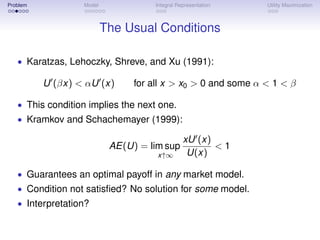
                          The Usual Conditions

   • Karatzas, Lehoczky, Shreve, and Xu (1991):

          U (βx) < αU (x)       for all x > x0 > 0 and some α < 1 < β

   • This condition implies the next one.
   • Kramkov and Schachemayer (1999):

                                               xU (x)
                           AE(U) = lim sup            <1
                                     x↑∞        U(x)

   • Guarantees an optimal payoff in any market model.
   • Condition not satisfied? No solution for some model.
   • Interpretation?
Problem            Model            Integral Representation   Utility Maximization


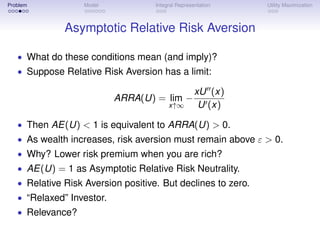
              Asymptotic Relative Risk Aversion

   • What do these conditions mean (and imply)?
   • Suppose Relative Risk Aversion has a limit:

                                                    xU (x)
                           ARRA(U) = lim −
                                         x↑∞         U (x)

   • Then AE(U) < 1 is equivalent to ARRA(U) > 0.
   • As wealth increases, risk aversion must remain above ε > 0.
   • Why? Lower risk premium when you are rich?
   • AE(U) = 1 as Asymptotic Relative Risk Neutrality.
   • Relative Risk Aversion positive. But declines to zero.
   • “Relaxed” Investor.
   • Relevance?
Problem            Model             Integral Representation       Utility Maximization


                             Who Cares?

   • Logarithmic, Power, and Exponential utilities satisfy ARRA(U) > 0.
   • Why bother about ARRA(U) = 0, if there are no examples?
   • Heterogeneous preferences equilibria.
      Benninga and Mayshar (2000), Cvitanic and Malamud (2008).
   • Complete market with several power utility agents.
      Power of utility depends on agent.
   • Utility function of representative agent.
      Relative risk aversion decreases to that of least risk averse agent.
   • All values of relative risk aversion present in the market?
      Risk aversion of representative agent decreases to zero.
   • Asymptotic elasticty equals one. Solution may not exist.
   • But why?
Problem            Model              Integral Representation           Utility Maximization


                           Singular Investment
   • Kramkov and Schachermayer (1999) show what goes wrong.
   • Countable space Ω = (ωn )n≥1 . dP/dQ(ωn ) = pn /qn ↑ ∞ as n ↑ ∞.
   • Finite space ΩN . ωn = ωn for n < N. (ωn )n≥N lumped into ωN .
                         N                                       N

   • Solution exists in each ΩN . Satisfies first order condition:

                N                                             N
            U (Xn ) = y qn /pn     1≤n<N                  U (XN ) = y qN /pN
             N              N−1         N                   N−1
      where pN = 1 −        n=1 pn and qN = 1 −             n=1 qn .
   • What happens to         N
                           (Xn )1≤n≤N as N ↑ ∞?
      N
   • Xn → Xn , which solves U (Xn ) = yqn /pn for n ≥ 1.
   • For large initial wealth x, EQ [X ] < x. Where has x − EQ [X ] gone?
       N N                                   N
   • qN XN converges to x − EQ [X ]. But qN decreases to 0.
   • Invest x − EQ [X ] in a “payoff” equal to ∞ with 0 probability.
Problem             Model           Integral Representation   Utility Maximization


                                 Main Idea


   • The problem wants to concentrate money on null sets.
   • But expected utility does not see such sets.
   • Relax the notion of payoff.
   • Relax utility functional.
   • Do it consistently.
Problem             Model             Integral Representation      Utility Maximization


                                  Setting

   • (Ω, T ) Polish space.
   • P, Q Borel-regular probabilities on Borel σ-field F.
   • Q∼P
   • Payoffs available with initial capital x: C(x) := {X ∈ L0 |EQ [X ] ≤ x}
                                                             +
   • Market complete.
   • U : (0, +∞) → (−∞, +∞)
      strictly increasing, strictly concave, continuously differentiable.
   • Inada conditions U (0+ ) = +∞ and U (+∞) = 0.
   • supX ∈C(x) EP [U(X )] < U(∞)
   • P (and hence Q) has full support, i.e. P(G) > 0 for any open set G.
   • If not, replace Ω with support of P.
Problem             Model             Integral Representation   Utility Maximization


                            Relaxed Payoffs

Definition
A relaxed payoff is an element of D(x), the weak star σ(rba(Ω), Cb (Ω))
closed set {µ ∈ rba(Ω)+ | µ(Ω) ≤ x}.

   • rba(Ω): Borel regular, finitely additive signed measures on Ω.
      Isometric to (Cb (Ω))∗ .
   • µ ∈ rba(Ω) admits unique decomposition:

                                 µ = µ a + µs + µp ,

   • µa     Q and µs ⊥Q countably additive.
   • µp purely finitely additive.
   • All components Borel regular.
Problem           Model               Integral Representation   Utility Maximization


                          Finitely Additive?


   • Dubious interpretation of finitely additive measures as payoffs.
   • Allow them a priori. For technical convenience.
   • Let the problem rule them out.
   • They are not optimal anyway.
Problem            Model             Integral Representation     Utility Maximization


                            Relaxed Utility
   • Relaxed utility map IU : rba(Ω) → [−∞, +∞).
   • Defined on rba(Ω) as upper semicontinuous envelope of IU :

            IU (µ) = inf{G(µ) | G weak ∗ u.s.c., G ≥ IU on L1 (Q)}.

   • Relaxed utility maximization problem:

                                   max IU (µ)
                                  µ∈D(x)


   • Relaxed utility map IU weak star upper semicontinuous.
   • Space of relaxed payoffs D(x) weak star compact.
   • Relaxed utility maximization has solution by construction.
   • Elaborate tautology.
   • Find “concrete” formula for IU . Integral representation.
Problem           Model            Integral Representation               Utility Maximization


                           Singular Utility
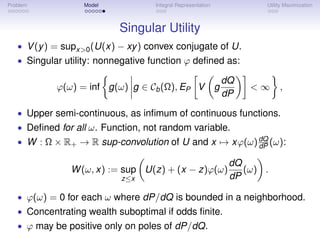
   • V (y ) = supx>0 (U(x) − xy ) convex conjugate of U.
   • Singular utility: nonnegative function ϕ defined as:

                                                                 dQ
            ϕ(ω) = inf g(ω) g ∈ Cb (Ω), EP V                 g        <∞      ,
                                                                 dP

   • Upper semi-continuous, as infimum of continuous functions.
   • Defined for all ω. Function, not random variable.
   • W : Ω × R+ → R sup-convolution of U and x → xϕ(ω) dQ (ω):
                                                       dP

                                                                  dQ
               W (ω, x) := sup U(z) + (x − z)ϕ(ω)                    (ω) .
                           z≤x                                    dP

   • ϕ(ω) = 0 for each ω where dP/dQ is bounded in a neighborhood.
   • Concentrating wealth suboptimal if odds finite.
   • ϕ may be positive only on poles of dP/dQ.
Problem               Model                  Integral Representation               Utility Maximization


                          Integral Representation
Theorem
Let µ ∈ rba(Ω)+ , and Q ∼ P fully supported probabilities.
  i) In general:

                                   dµa
          IU (µ) = EP W       ·,         +      ϕdµs +                      inf            µp (f ).
                                   dQ                         f ∈Cb (Ω),EP [V (f dQ )]<∞
                                                                                 dP


 ii) If ϕ = 0 P-a.s., then:

                               dµa
           IU (µ) = EP U                 +    ϕdµs +                       inf           µp (f ).
                               dQ                           f ∈Cb (Ω),EP [V (f dQ )]<∞
                                                                               dP


                     xU (x)
iii) If lim supx↑∞    U(x)    < 1, then {ϕ = 0} = Ω and

                                                          dµa
                                   IU (µ) = EP U                       .
                                                          dQ
Problem             Model            Integral Representation    Utility Maximization


                                 Three Parts

   • First formula holds for any µ ∈ rba(Ω)+ .
   • But has finitely additive part...
   • ...and has sup-convolution W instead of U.
   • Second formula replaces W with U under additional assumption.
   • Then utility is sum of three pieces.
   • Usual expected utility E[U(X )] with X = dµa .
                                              dQ
   • Finitely additive part.
   • Singular utility   ϕdµs .
   • Accounts for utility from concentration of wealth on P-null sets.
   • ϕ(ω) represents maximal utility from Dirac delta on ω
   • Only usual utility remains for AE(U) < 1.
Problem             Model                 Integral Representation              Utility Maximization


                                Proof Strategy


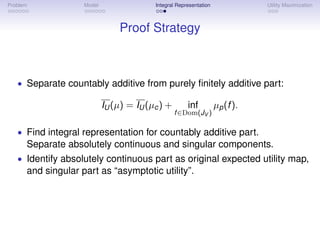
   • Separate countably additive from purely finitely additive part:

                            IU (µ) = IU (µc ) +         inf         µp (f ).
                                                  f∈   Dom(JV )
   • Find integral representation for countably additive part.
      Separate absolutely continuous and singular components.
   • Identify absolutely continuous part as original expected utility map,
      and singular part as “asymptotic utility”.
Problem            Model              Integral Representation   Utility Maximization


                                 Coercivity

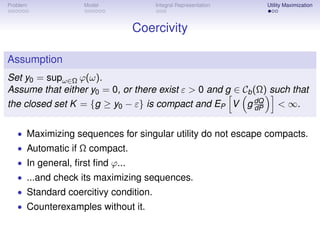
Assumption
Set y0 = supω∈Ω ϕ(ω).
Assume that either y0 = 0, or there exist ε > 0 and g ∈ Cb (Ω) such that
the closed set K = {g ≥ y0 − ε} is compact and EP V g dQ < ∞.
                                                            dP


   • Maximizing sequences for singular utility do not escape compacts.
   • Automatic if Ω compact.
   • In general, first find ϕ...
   • ...and check its maximizing sequences.
   • Standard coercitivy condition.
   • Counterexamples without it.
Problem           Model               Integral Representation               Utility Maximization


                  Relaxed utility Maximization

Theorem
Under coercivity assumption, and if ϕ = 0 a.s.:
  i) u(x) = maxµ∈D(x) IU (µ);
                                                                dµ∗
 ii) u(x) = E[U(X ∗ (x))] +     ϕdµ∗ , where X ∗ (x) =
                                   s                             dQ .
                                                                   a


iii) Budget constraint binding: µ∗ (Ω) = EQ [X ∗ (x)]           + µ∗ (Ω)
                                                                     s     = x.
iv) µ∗ unique. Support of any µ∗ satisfies:
     a                         s

                              supp(µ∗ ) ⊆ argmax(ϕ).
                                    s

 v) If x > x0 , any solution has the form µ∗ = µ∗ + µ∗ , where
                                                a    s
    µ∗ (Ω) = x − x0 .
      s
vi) u(x) = u(x0 ) + (x − x0 ) maxω ϕ(ω) = u(x0 ) + (x − x0 )y0 .
Problem      Model       Integral Representation   Utility Maximization


                     Conclusion


      Happy Birthday for your first 60!
      Ad Maiora et Meliora!

Relaxed Utility Maximization in Complete Markets

  • 1.
    Problem Model Integral Representation Utility Maximization Relaxed Utility Maximization in Complete Markets Paolo Guasoni (Joint work with Sara Biagini) Boston University and Dublin City University Analysis, Stochastics, and Applications In Honor of Walter Schachermayer July 15th , 2010
  • 2.
    Problem Model Integral Representation Utility Maximization Outline • Relaxing what? Preferences: risk aversion vanishing as wealth increases. Payoffs: more than random variables. • Problem: Utility maximization in a complete market. Asymptotic elasticity of utility function can approach one. • Solution: Add topology to probability space. Payoffs as measures. Classic payoffs as densities. • Results: Expected utility representation. Singular utility. Characterization of optimal solutions.
  • 3.
    Problem Model Integral Representation Utility Maximization The Usual Argument • Utility Maximization from terminal wealth: max{EP [U(X )] : EQ [X ] ≤ x} • Use first-order condition to look for solution: ˆ dQ U (X ) = y dP • Pick the Lagrange multiplier y which saturates constraint: ˆ EQ X (y ) = x • If there is any. • Assumptions on U?
  • 4.
    Problem Model Integral Representation Utility Maximization The Usual Conditions • Karatzas, Lehoczky, Shreve, and Xu (1991): U (βx) < αU (x) for all x > x0 > 0 and some α < 1 < β • This condition implies the next one. • Kramkov and Schachemayer (1999): xU (x) AE(U) = lim sup <1 x↑∞ U(x) • Guarantees an optimal payoff in any market model. • Condition not satisfied? No solution for some model. • Interpretation?
  • 5.
    Problem Model Integral Representation Utility Maximization Asymptotic Relative Risk Aversion • What do these conditions mean (and imply)? • Suppose Relative Risk Aversion has a limit: xU (x) ARRA(U) = lim − x↑∞ U (x) • Then AE(U) < 1 is equivalent to ARRA(U) > 0. • As wealth increases, risk aversion must remain above ε > 0. • Why? Lower risk premium when you are rich? • AE(U) = 1 as Asymptotic Relative Risk Neutrality. • Relative Risk Aversion positive. But declines to zero. • “Relaxed” Investor. • Relevance?
  • 6.
    Problem Model Integral Representation Utility Maximization Who Cares? • Logarithmic, Power, and Exponential utilities satisfy ARRA(U) > 0. • Why bother about ARRA(U) = 0, if there are no examples? • Heterogeneous preferences equilibria. Benninga and Mayshar (2000), Cvitanic and Malamud (2008). • Complete market with several power utility agents. Power of utility depends on agent. • Utility function of representative agent. Relative risk aversion decreases to that of least risk averse agent. • All values of relative risk aversion present in the market? Risk aversion of representative agent decreases to zero. • Asymptotic elasticty equals one. Solution may not exist. • But why?
  • 7.
    Problem Model Integral Representation Utility Maximization Singular Investment • Kramkov and Schachermayer (1999) show what goes wrong. • Countable space Ω = (ωn )n≥1 . dP/dQ(ωn ) = pn /qn ↑ ∞ as n ↑ ∞. • Finite space ΩN . ωn = ωn for n < N. (ωn )n≥N lumped into ωN . N N • Solution exists in each ΩN . Satisfies first order condition: N N U (Xn ) = y qn /pn 1≤n<N U (XN ) = y qN /pN N N−1 N N−1 where pN = 1 − n=1 pn and qN = 1 − n=1 qn . • What happens to N (Xn )1≤n≤N as N ↑ ∞? N • Xn → Xn , which solves U (Xn ) = yqn /pn for n ≥ 1. • For large initial wealth x, EQ [X ] < x. Where has x − EQ [X ] gone? N N N • qN XN converges to x − EQ [X ]. But qN decreases to 0. • Invest x − EQ [X ] in a “payoff” equal to ∞ with 0 probability.
  • 8.
    Problem Model Integral Representation Utility Maximization Main Idea • The problem wants to concentrate money on null sets. • But expected utility does not see such sets. • Relax the notion of payoff. • Relax utility functional. • Do it consistently.
  • 9.
    Problem Model Integral Representation Utility Maximization Setting • (Ω, T ) Polish space. • P, Q Borel-regular probabilities on Borel σ-field F. • Q∼P • Payoffs available with initial capital x: C(x) := {X ∈ L0 |EQ [X ] ≤ x} + • Market complete. • U : (0, +∞) → (−∞, +∞) strictly increasing, strictly concave, continuously differentiable. • Inada conditions U (0+ ) = +∞ and U (+∞) = 0. • supX ∈C(x) EP [U(X )] < U(∞) • P (and hence Q) has full support, i.e. P(G) > 0 for any open set G. • If not, replace Ω with support of P.
  • 10.
    Problem Model Integral Representation Utility Maximization Relaxed Payoffs Definition A relaxed payoff is an element of D(x), the weak star σ(rba(Ω), Cb (Ω)) closed set {µ ∈ rba(Ω)+ | µ(Ω) ≤ x}. • rba(Ω): Borel regular, finitely additive signed measures on Ω. Isometric to (Cb (Ω))∗ . • µ ∈ rba(Ω) admits unique decomposition: µ = µ a + µs + µp , • µa Q and µs ⊥Q countably additive. • µp purely finitely additive. • All components Borel regular.
  • 11.
    Problem Model Integral Representation Utility Maximization Finitely Additive? • Dubious interpretation of finitely additive measures as payoffs. • Allow them a priori. For technical convenience. • Let the problem rule them out. • They are not optimal anyway.
  • 12.
    Problem Model Integral Representation Utility Maximization Relaxed Utility • Relaxed utility map IU : rba(Ω) → [−∞, +∞). • Defined on rba(Ω) as upper semicontinuous envelope of IU : IU (µ) = inf{G(µ) | G weak ∗ u.s.c., G ≥ IU on L1 (Q)}. • Relaxed utility maximization problem: max IU (µ) µ∈D(x) • Relaxed utility map IU weak star upper semicontinuous. • Space of relaxed payoffs D(x) weak star compact. • Relaxed utility maximization has solution by construction. • Elaborate tautology. • Find “concrete” formula for IU . Integral representation.
  • 13.
    Problem Model Integral Representation Utility Maximization Singular Utility • V (y ) = supx>0 (U(x) − xy ) convex conjugate of U. • Singular utility: nonnegative function ϕ defined as: dQ ϕ(ω) = inf g(ω) g ∈ Cb (Ω), EP V g <∞ , dP • Upper semi-continuous, as infimum of continuous functions. • Defined for all ω. Function, not random variable. • W : Ω × R+ → R sup-convolution of U and x → xϕ(ω) dQ (ω): dP dQ W (ω, x) := sup U(z) + (x − z)ϕ(ω) (ω) . z≤x dP • ϕ(ω) = 0 for each ω where dP/dQ is bounded in a neighborhood. • Concentrating wealth suboptimal if odds finite. • ϕ may be positive only on poles of dP/dQ.
  • 14.
    Problem Model Integral Representation Utility Maximization Integral Representation Theorem Let µ ∈ rba(Ω)+ , and Q ∼ P fully supported probabilities. i) In general: dµa IU (µ) = EP W ·, + ϕdµs + inf µp (f ). dQ f ∈Cb (Ω),EP [V (f dQ )]<∞ dP ii) If ϕ = 0 P-a.s., then: dµa IU (µ) = EP U + ϕdµs + inf µp (f ). dQ f ∈Cb (Ω),EP [V (f dQ )]<∞ dP xU (x) iii) If lim supx↑∞ U(x) < 1, then {ϕ = 0} = Ω and dµa IU (µ) = EP U . dQ
  • 15.
    Problem Model Integral Representation Utility Maximization Three Parts • First formula holds for any µ ∈ rba(Ω)+ . • But has finitely additive part... • ...and has sup-convolution W instead of U. • Second formula replaces W with U under additional assumption. • Then utility is sum of three pieces. • Usual expected utility E[U(X )] with X = dµa . dQ • Finitely additive part. • Singular utility ϕdµs . • Accounts for utility from concentration of wealth on P-null sets. • ϕ(ω) represents maximal utility from Dirac delta on ω • Only usual utility remains for AE(U) < 1.
  • 16.
    Problem Model Integral Representation Utility Maximization Proof Strategy • Separate countably additive from purely finitely additive part: IU (µ) = IU (µc ) + inf µp (f ). f∈ Dom(JV ) • Find integral representation for countably additive part. Separate absolutely continuous and singular components. • Identify absolutely continuous part as original expected utility map, and singular part as “asymptotic utility”.
  • 17.
    Problem Model Integral Representation Utility Maximization Coercivity Assumption Set y0 = supω∈Ω ϕ(ω). Assume that either y0 = 0, or there exist ε > 0 and g ∈ Cb (Ω) such that the closed set K = {g ≥ y0 − ε} is compact and EP V g dQ < ∞. dP • Maximizing sequences for singular utility do not escape compacts. • Automatic if Ω compact. • In general, first find ϕ... • ...and check its maximizing sequences. • Standard coercitivy condition. • Counterexamples without it.
  • 18.
    Problem Model Integral Representation Utility Maximization Relaxed utility Maximization Theorem Under coercivity assumption, and if ϕ = 0 a.s.: i) u(x) = maxµ∈D(x) IU (µ); dµ∗ ii) u(x) = E[U(X ∗ (x))] + ϕdµ∗ , where X ∗ (x) = s dQ . a iii) Budget constraint binding: µ∗ (Ω) = EQ [X ∗ (x)] + µ∗ (Ω) s = x. iv) µ∗ unique. Support of any µ∗ satisfies: a s supp(µ∗ ) ⊆ argmax(ϕ). s v) If x > x0 , any solution has the form µ∗ = µ∗ + µ∗ , where a s µ∗ (Ω) = x − x0 . s vi) u(x) = u(x0 ) + (x − x0 ) maxω ϕ(ω) = u(x0 ) + (x − x0 )y0 .
  • 19.
    Problem Model Integral Representation Utility Maximization Conclusion Happy Birthday for your first 60! Ad Maiora et Meliora!