Outline Model Main Result Implications Heuristics
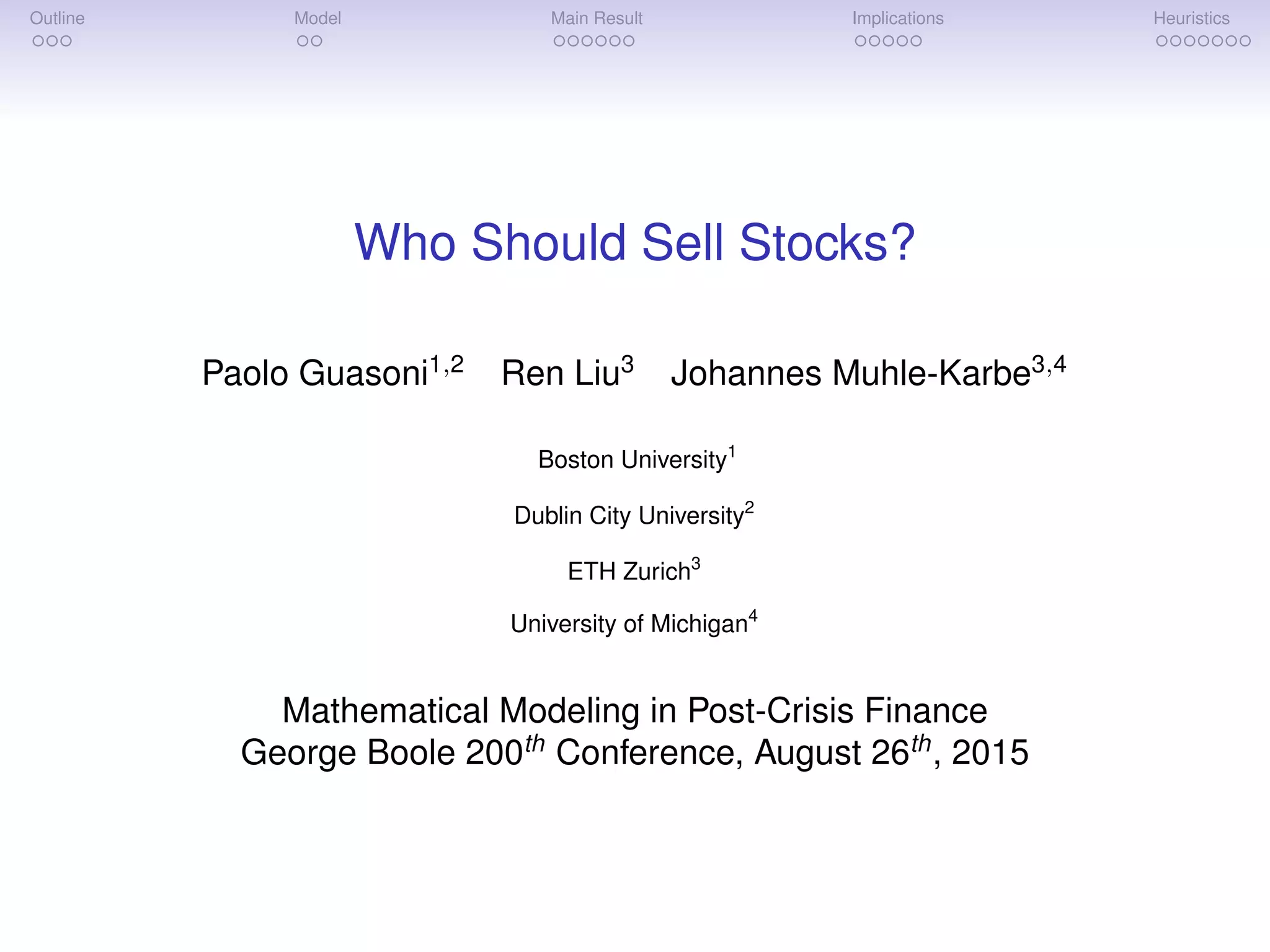
Who Should Sell Stocks?
Paolo Guasoni1,2
Ren Liu3
Johannes Muhle-Karbe3,4
Boston University1
Dublin City University2
ETH Zurich3
University of Michigan4
Mathematical Modeling in Post-Crisis Finance
George Boole 200th
Conference, August 26th
, 2015
Outline Model Main Result Implications Heuristics
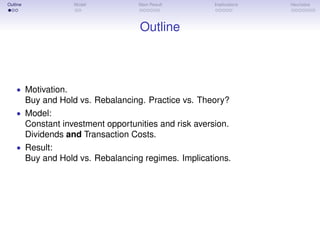
Outline
• Motivation.
Buy and Hold vs. Rebalancing. Practice vs. Theory?
• Model:
Constant investment opportunities and risk aversion.
Dividends and Transaction Costs.
• Result:
Buy and Hold vs. Rebalancing regimes. Implications.
Outline Model Main Result Implications Heuristics
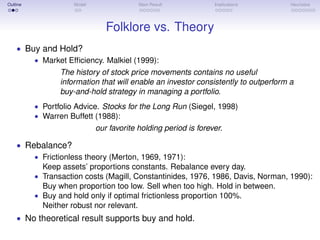
Folklore vs. Theory
• Buy and Hold?
• Market Efficiency. Malkiel (1999):
The history of stock price movements contains no useful
information that will enable an investor consistently to outperform a
buy-and-hold strategy in managing a portfolio.
• Portfolio Advice. Stocks for the Long Run (Siegel, 1998)
• Warren Buffett (1988):
our favorite holding period is forever.
• Rebalance?
• Frictionless theory (Merton, 1969, 1971):
Keep assets’ proportions constants. Rebalance every day.
• Transaction costs (Magill, Constantinides, 1976, 1986, Davis, Norman, 1990):
Buy when proportion too low. Sell when too high. Hold in between.
• Buy and hold only if optimal frictionless proportion 100%.
Neither robust nor relevant.
• No theoretical result supports buy and hold.
Outline Model Main Result Implications Heuristics
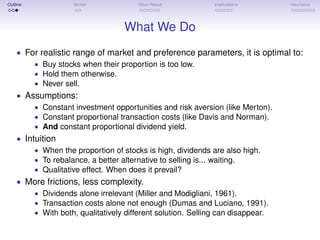
What We Do
• For realistic range of market and preference parameters, it is optimal to:
• Buy stocks when their proportion is too low.
• Hold them otherwise.
• Never sell.
• Assumptions:
• Constant investment opportunities and risk aversion (like Merton).
• Constant proportional transaction costs (like Davis and Norman).
• And constant proportional dividend yield.
• Intuition
• When the proportion of stocks is high, dividends are also high.
• To rebalance, a better alternative to selling is... waiting.
• Qualitative effect. When does it prevail?
• More frictions, less complexity.
• Dividends alone irrelevant (Miller and Modigliani, 1961).
• Transaction costs alone not enough (Dumas and Luciano, 1991).
• With both, qualitatively different solution. Selling can disappear.
Outline Model Main Result Implications Heuristics
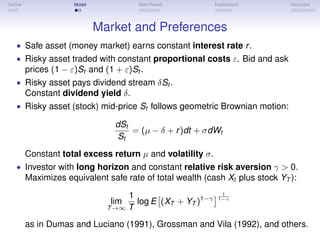
Market and Preferences
• Safe asset (money market) earns constant interest rate r.
• Risky asset traded with constant proportional costs ε. Bid and ask
prices (1 − ε)St and (1 + ε)St .
• Risky asset pays dividend stream δSt .
Constant dividend yield δ.
• Risky asset (stock) mid-price St follows geometric Brownian motion:
dSt
St
= (µ − δ + r)dt + σdWt
Constant total excess return µ and volatility σ.
• Investor with long horizon and constant relative risk aversion γ > 0.
Maximizes equivalent safe rate of total wealth (cash Xt plus stock YT ):
lim
T→∞
1
T
log E (XT + YT )1−γ
1
1−γ
as in Dumas and Luciano (1991), Grossman and Vila (1992), and others.
Outline Model Main Result Implications Heuristics
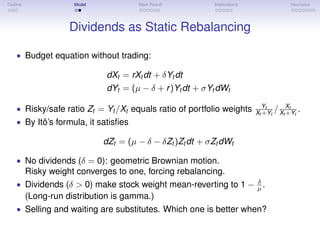
Dividends as Static Rebalancing
• Budget equation without trading:
dXt = rXt dt + δYt dt
dYt = (µ − δ + r)Yt dt + σYt dWt
• Risky/safe ratio Zt = Yt /Xt equals ratio of portfolio weights Yt
Xt +Yt
/ Xt
Xt +Yt
.
• By Itô’s formula, it satisfies
dZt = (µ − δ − δZt )Zt dt + σZt dWt
• No dividends (δ = 0): geometric Brownian motion.
Risky weight converges to one, forcing rebalancing.
• Dividends (δ > 0) make stock weight mean-reverting to 1 − δ
µ .
(Long-run distribution is gamma.)
• Selling and waiting are substitutes. Which one is better when?
Outline Model Main Result Implications Heuristics
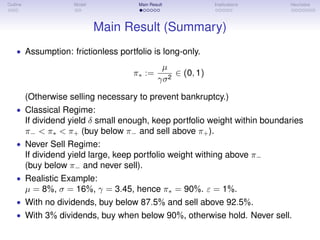
Main Result (Summary)
• Assumption: frictionless portfolio is long-only.
π∗ :=
µ
γσ2
∈ (0, 1)
(Otherwise selling necessary to prevent bankruptcy.)
• Classical Regime:
If dividend yield δ small enough, keep portfolio weight within boundaries
π− < π∗ < π+ (buy below π− and sell above π+).
• Never Sell Regime:
If dividend yield large, keep portfolio weight withing above π−
(buy below π− and never sell).
• Realistic Example:
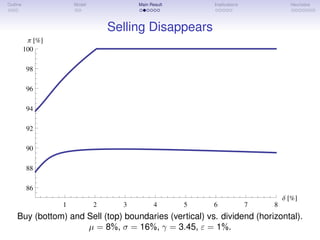
µ = 8%, σ = 16%, γ = 3.45, hence π∗ = 90%. ε = 1%.
• With no dividends, buy below 87.5% and sell above 92.5%.
• With 3% dividends, buy when below 90%, otherwise hold. Never sell.
Outline Model Main Result Implications Heuristics
Selling Disappears
1 2 3 4 5 6 7 8
∆
86
88
90
92
94
96
98
100
Π
Buy (bottom) and Sell (top) boundaries (vertical) vs. dividend (horizontal).
µ = 8%, σ = 16%, γ = 3.45, ε = 1%.
Outline Model Main Result Implications Heuristics
Main Result (details)
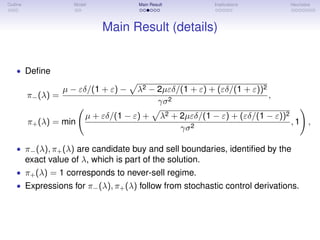
• Define
π−(λ) =
µ − εδ/(1 + ε) − λ2 − 2µεδ/(1 + ε) + (εδ/(1 + ε))2
γσ2
,
π+(λ) = min
µ + εδ/(1 − ε) + λ2 + 2µεδ/(1 − ε) + (εδ/(1 − ε))2
γσ2
, 1 ,
• π−(λ), π+(λ) are candidate buy and sell boundaries, identified by the
exact value of λ, which is part of the solution.
• π+(λ) = 1 corresponds to never-sell regime.
• Expressions for π−(λ), π+(λ) follow from stochastic control derivations.
Outline Model Main Result Implications Heuristics
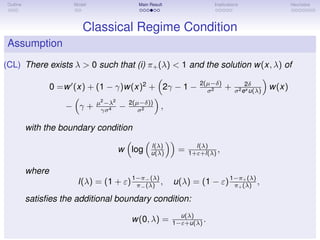
Classical Regime Condition
Assumption
(CL) There exists λ > 0 such that (i) π+(λ) < 1 and the solution w(x, λ) of
0 =w (x) + (1 − γ)w(x)2
+ 2γ − 1 − 2(µ−δ)
σ2 + 2δ
σ2ex u(λ)
w(x)
− γ + µ2
−λ2
γσ4 − 2(µ−δ))
σ2 ,
with the boundary condition
w log l(λ)
u(λ) = l(λ)
1+ε+l(λ) ,
where
l(λ) = (1 + ε)1−π−(λ)
π−(λ) , u(λ) = (1 − ε)1−π+(λ)
π+(λ) ,
satisfies the additional boundary condition:
w(0, λ) = u(λ)
1−ε+u(λ) .
Outline Model Main Result Implications Heuristics
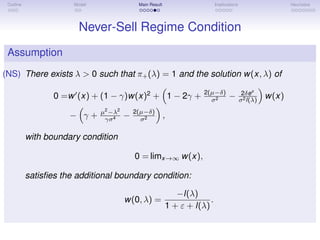
Never-Sell Regime Condition
Assumption
(NS) There exists λ > 0 such that π+(λ) = 1 and the solution w(x, λ) of
0 =w (x) + (1 − γ)w(x)2
+ 1 − 2γ + 2(µ−δ)
σ2 − 2δex
σ2l(λ)
w(x)
− γ + µ2
−λ2
γσ4 − 2(µ−δ)
σ2 ,
with boundary condition
0 = limx→∞ w(x),
satisfies the additional boundary condition:
w(0, λ) =
−l(λ)
1 + ε + l(λ)
.
Outline Model Main Result Implications Heuristics
Main Result (Statement)
Theorem
Under either condition (CL) or (NS),
• Optimal Strategy:
Hold within (π−, π+). At boundaries, trade to keep the risky weight inside
[π−, π+]. (π− evaluated at ask price (1 + ε)St , π+ at bid (1 − ε)St .)
• Equivalent Safe Rate:
Trading the dividend-paying risky asset with transaction costs equivalent
to leaving all wealth in a hypothetical safe asset that pays the rate
EsR = r +
µ2
− λ2
2γσ2
.
• Reduced value function w(x, λ) has solution in terms of special functions.
• λ does not have closed-form expression. Asymptotics.
Outline Model Main Result Implications Heuristics
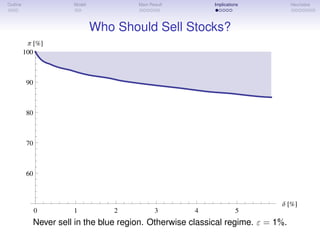
Who Should Sell Stocks?
0 1 2 3 4 5
∆
60
70
80
90
100
Π
Never sell in the blue region. Otherwise classical regime. ε = 1%.
Outline Model Main Result Implications Heuristics
Asymptotics
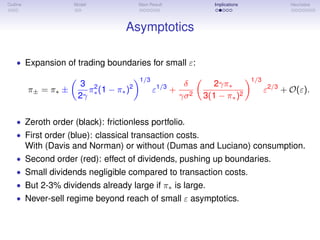
• Expansion of trading boundaries for small ε:
π± = π∗ ±
3
2γ
π2
∗(1 − π∗)2
1/3
ε1/3
+
δ
γσ2
2γπ∗
3(1 − π∗)2
1/3
ε2/3
+ O(ε).
• Zeroth order (black): frictionless portfolio.
• First order (blue): classical transaction costs.
With (Davis and Norman) or without (Dumas and Luciano) consumption.
• Second order (red): effect of dividends, pushing up boundaries.
• Small dividends negligible compared to transaction costs.
• But 2-3% dividends already large if π∗ is large.
• Never-sell regime beyond reach of small ε asymptotics.
Outline Model Main Result Implications Heuristics
Never Sell. No Regrets.
π∗ optimal never sell buy & hold
[π−, π+] [π−, 1] [0, 1]
50% 1.67% 2.00% 4.67%
60% 1.76% 1.76% 4.41%
70% 1.58% 1.58% 4.21%
80% 1.43% 1.43% 3.81%
90% 1.52% 1.52% 3.70%
• Even when it is not optimal, the never-sell strategy is closer to optimal
than the static buy-and-hold.
• Relative equivalent safe rate loss (EsR0 − EsR)/ EsR0 of optimal
([π−, π+]), never sell ([π−, 1]) and buy-and-hold ([0, 1]) strategies.
• Simulation with T = 20, time step dt = 1/250, and sample N = 2 × 10⁷
.
• µ = 8%, σ = 16%, r = 1%, δ = 2%, and ε = 1%.
Outline Model Main Result Implications Heuristics
Never Sell. Never Pay Taxes (on Capital Gains).
• Discussion so far neglects effect of taxes on capital gains...
• ...which do not affect the never-sell strategy...
• ...but reduce the performance of other “optimal ” policies...
• ...making never-sell superior after tax.
π∗ [π−, π+] [π−, π+] never sell buy & hold
(average) (specific)
50% 2.41% 2.41% 2.07% 4.48%
60% 2.13% 2.13% 1.83% 3.96%
70% 1.91% 1.91% 1.64% 3.55%
80% 1.49% 1.49% 1.49% 3.22%
90% 1.36% 1.36% 1.36% 2.94%
• Relative loss (EsR0,τ − EsR)/ EsR0,τ with capital gains taxes, for optimal
([π−, π+]), never sell ([π−, 1]), and buy-and-hold ([0, 1]) strategies.
• Simulation with T = 20, time step dt = 1/250, and sample N = 2 × 10⁷
.
• Both taxes on dividends (τ) and capital gains (α) accounted for.
• µ = 8%, σ = 16%, α = 20%, τ = 20%, r = 1%, δ = 2%, and ε = 1%.
Outline Model Main Result Implications Heuristics
Terms and Conditions
• Never Selling superior to rebalancing for long-term investors with
moderate risk aversion, and no intermediate consumption.
• With high consumption and low dividends selling is necessary.
π∗ [πJS
− , πJS
+ ] never sell buy & hold
50% 1.00% 1.67% 2.00%
60% 0.59% 1.17% 1.47%
70% 0.53% 1.05% 1.05%
80% 0.48% 0.71% 0.71%
90% 0.22% 0.65% 0.65%
• Relative loss (EsR0 − EsR)/ EsR0 of the asymptotically optimal
([πJS
− , πJS
+ ]), never-sell ([π−, 1]) and static buy-and-hold ([0, 1]) strategies
with πJS
± from Janecek-Shreve.
• Simulation with T = 20, time step dt = 1/250, and sample N = 2 × 10⁷
.
• µ = 8%, σ = 16%, ρ = 2%, r = 1%, τ = 0%, ε = 1% and δ = 3%.
Outline Model Main Result Implications Heuristics
Wealth and Value Dynamics
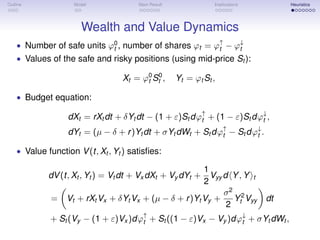
• Number of safe units ϕ0
t , number of shares ϕt = ϕ↑
t − ϕ↓
t
• Values of the safe and risky positions (using mid-price St ):
Xt = ϕ0
t S0
t , Yt = ϕt St ,
• Budget equation:
dXt = rXt dt + δYt dt − (1 + ε)St dϕ↑
t + (1 − ε)St dϕ↓
t ,
dYt = (µ − δ + r)Yt dt + σYt dWt + St dϕ↑
t − St dϕ↓
t .
• Value function V(t, Xt , Yt ) satisfies:
dV(t, Xt , Yt ) = Vt dt + Vx dXt + Vy dYt +
1
2
Vyy d Y, Y t
= Vt + rXt Vx + δYt Vx + (µ − δ + r)Yt Vy +
σ2
2
Y2
t Vyy dt
+ St (Vy − (1 + ε)Vx )dϕ↑
t + St ((1 − ε)Vx − Vy )dϕ↓
t + σYt dWt ,
Outline Model Main Result Implications Heuristics
HJB Equation
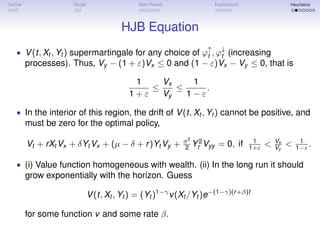
• V(t, Xt , Yt ) supermartingale for any choice of ϕ↑
t , ϕ↓
t (increasing
processes). Thus, Vy − (1 + ε)Vx ≤ 0 and (1 − ε)Vx − Vy ≤ 0, that is
1
1 + ε
≤
Vx
Vy
≤
1
1 − ε
.
• In the interior of this region, the drift of V(t, Xt , Yt ) cannot be positive, and
must be zero for the optimal policy,
Vt + rXt Vx + δYt Vx + (µ − δ + r)Yt Vy + σ2
2 Y2
t Vyy = 0, if 1
1+ε < Vx
Vy
< 1
1−ε .
• (i) Value function homogeneous with wealth. (ii) In the long run it should
grow exponentially with the horizon. Guess
V(t, Xt , Yt ) = (Yt )1−γ
v(Xt /Yt )e−(1−γ)(r+β)t
for some function v and some rate β.
Outline Model Main Result Implications Heuristics
Second Order Linear ODE
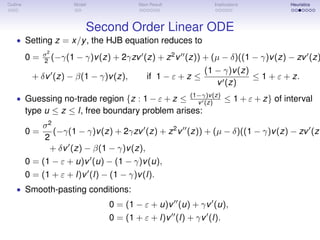
• Setting z = x/y, the HJB equation reduces to
0 = σ2
2 (−γ(1 − γ)v(z) + 2γzv (z) + z2
v (z)) + (µ − δ)((1 − γ)v(z) − zv (z)
+ δv (z) − β(1 − γ)v(z), if 1 − ε + z ≤
(1 − γ)v(z)
v (z)
≤ 1 + ε + z.
• Guessing no-trade region {z : 1 − ε + z ≤ (1−γ)v(z)
v (z) ≤ 1 + ε + z} of interval
type u ≤ z ≤ l, free boundary problem arises:
0 =
σ2
2
(−γ(1 − γ)v(z) + 2γzv (z) + z2
v (z)) + (µ − δ)((1 − γ)v(z) − zv (z)
+ δv (z) − β(1 − γ)v(z),
0 = (1 − ε + u)v (u) − (1 − γ)v(u),
0 = (1 + ε + l)v (l) − (1 − γ)v(l).
• Smooth-pasting conditions:
0 = (1 − ε + u)v (u) + γv (u),
0 = (1 + ε + l)v (l) + γv (l).
Outline Model Main Result Implications Heuristics
First Order Nonlinear ODE
• The substitution
v(z) = e(1−γ)
log (z/u(λ))
0
w(y)dy
, i.e., w(x) =
u(λ)ex
v (u(λ)ex
)
(1 − γ)v(u(λ)ex )
,
reduces the boundary value problem to a Riccati equation:
0 = w (x) + (1 − γ)w(x)2
+ 2γ − 1 −
2(µ − δ)
σ2
+
2δ
σ2ex u
w
− γ +
µ2
− λ2
γσ4
−
2(µ − δ)
σ2
,
w(0, λ) =
u
1 − ε + u
,
w log l(λ)
u(λ) , λ =
l
1 + ε + l
,
Outline Model Main Result Implications Heuristics
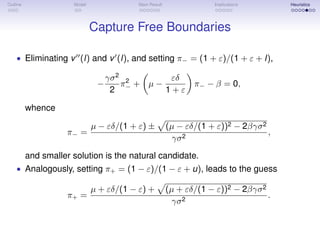
Capture Free Boundaries
• Eliminating v (l) and v (l), and setting π− = (1 + ε)/(1 + ε + l),
−
γσ2
2
π2
− + µ −
εδ
1 + ε
π− − β = 0,
whence
π− =
µ − εδ/(1 + ε) ± (µ − εδ/(1 + ε))2 − 2βγσ2
γσ2
,
and smaller solution is the natural candidate.
• Analogously, setting π+ = (1 − ε)/(1 − ε + u), leads to the guess
π+ =
µ + εδ/(1 − ε) + (µ + εδ/(1 − ε))2 − 2βγσ2
γσ2
.
Outline Model Main Result Implications Heuristics
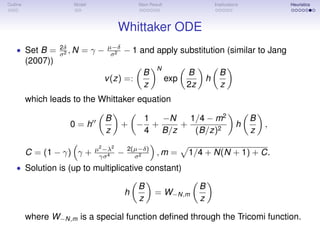
Whittaker ODE
• Set B = 2δ
σ2 , N = γ − µ−δ
σ2 − 1 and apply substitution (similar to Jang
(2007))
v(z) =:
B
z
N
exp
B
2z
h
B
z
which leads to the Whittaker equation
0 = h
B
z
+ −
1
4
+
−N
B/z
+
1/4 − m2
(B/z)2
h
B
z
,
C = (1 − γ) γ + µ2
−λ2
γσ4 − 2(µ−δ)
σ2 , m = 1/4 + N(N + 1) + C.
• Solution is (up to multiplicative constant)
h
B
z
= W−N,m
B
z
where W−N,m is a special function defined through the Tricomi function.
Outline Model Main Result Implications Heuristics
Conclusion
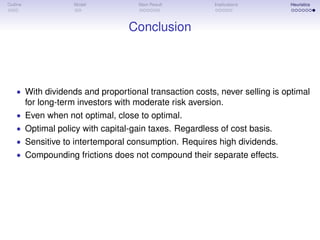
• With dividends and proportional transaction costs, never selling is optimal
for long-term investors with moderate risk aversion.
• Even when not optimal, close to optimal.
• Optimal policy with capital-gain taxes. Regardless of cost basis.
• Sensitive to intertemporal consumption. Requires high dividends.
• Compounding frictions does not compound their separate effects.

Who Should Sell Stocks?

  • 1.
    Outline Model MainResult Implications Heuristics Who Should Sell Stocks? Paolo Guasoni1,2 Ren Liu3 Johannes Muhle-Karbe3,4 Boston University1 Dublin City University2 ETH Zurich3 University of Michigan4 Mathematical Modeling in Post-Crisis Finance George Boole 200th Conference, August 26th , 2015
  • 2.
    Outline Model MainResult Implications Heuristics Outline • Motivation. Buy and Hold vs. Rebalancing. Practice vs. Theory? • Model: Constant investment opportunities and risk aversion. Dividends and Transaction Costs. • Result: Buy and Hold vs. Rebalancing regimes. Implications.
  • 3.
    Outline Model MainResult Implications Heuristics Folklore vs. Theory • Buy and Hold? • Market Efficiency. Malkiel (1999): The history of stock price movements contains no useful information that will enable an investor consistently to outperform a buy-and-hold strategy in managing a portfolio. • Portfolio Advice. Stocks for the Long Run (Siegel, 1998) • Warren Buffett (1988): our favorite holding period is forever. • Rebalance? • Frictionless theory (Merton, 1969, 1971): Keep assets’ proportions constants. Rebalance every day. • Transaction costs (Magill, Constantinides, 1976, 1986, Davis, Norman, 1990): Buy when proportion too low. Sell when too high. Hold in between. • Buy and hold only if optimal frictionless proportion 100%. Neither robust nor relevant. • No theoretical result supports buy and hold.
  • 4.
    Outline Model MainResult Implications Heuristics What We Do • For realistic range of market and preference parameters, it is optimal to: • Buy stocks when their proportion is too low. • Hold them otherwise. • Never sell. • Assumptions: • Constant investment opportunities and risk aversion (like Merton). • Constant proportional transaction costs (like Davis and Norman). • And constant proportional dividend yield. • Intuition • When the proportion of stocks is high, dividends are also high. • To rebalance, a better alternative to selling is... waiting. • Qualitative effect. When does it prevail? • More frictions, less complexity. • Dividends alone irrelevant (Miller and Modigliani, 1961). • Transaction costs alone not enough (Dumas and Luciano, 1991). • With both, qualitatively different solution. Selling can disappear.
  • 5.
    Outline Model MainResult Implications Heuristics Market and Preferences • Safe asset (money market) earns constant interest rate r. • Risky asset traded with constant proportional costs ε. Bid and ask prices (1 − ε)St and (1 + ε)St . • Risky asset pays dividend stream δSt . Constant dividend yield δ. • Risky asset (stock) mid-price St follows geometric Brownian motion: dSt St = (µ − δ + r)dt + σdWt Constant total excess return µ and volatility σ. • Investor with long horizon and constant relative risk aversion γ > 0. Maximizes equivalent safe rate of total wealth (cash Xt plus stock YT ): lim T→∞ 1 T log E (XT + YT )1−γ 1 1−γ as in Dumas and Luciano (1991), Grossman and Vila (1992), and others.
  • 6.
    Outline Model MainResult Implications Heuristics Dividends as Static Rebalancing • Budget equation without trading: dXt = rXt dt + δYt dt dYt = (µ − δ + r)Yt dt + σYt dWt • Risky/safe ratio Zt = Yt /Xt equals ratio of portfolio weights Yt Xt +Yt / Xt Xt +Yt . • By Itô’s formula, it satisfies dZt = (µ − δ − δZt )Zt dt + σZt dWt • No dividends (δ = 0): geometric Brownian motion. Risky weight converges to one, forcing rebalancing. • Dividends (δ > 0) make stock weight mean-reverting to 1 − δ µ . (Long-run distribution is gamma.) • Selling and waiting are substitutes. Which one is better when?
  • 7.
    Outline Model MainResult Implications Heuristics Main Result (Summary) • Assumption: frictionless portfolio is long-only. π∗ := µ γσ2 ∈ (0, 1) (Otherwise selling necessary to prevent bankruptcy.) • Classical Regime: If dividend yield δ small enough, keep portfolio weight within boundaries π− < π∗ < π+ (buy below π− and sell above π+). • Never Sell Regime: If dividend yield large, keep portfolio weight withing above π− (buy below π− and never sell). • Realistic Example: µ = 8%, σ = 16%, γ = 3.45, hence π∗ = 90%. ε = 1%. • With no dividends, buy below 87.5% and sell above 92.5%. • With 3% dividends, buy when below 90%, otherwise hold. Never sell.
  • 8.
    Outline Model MainResult Implications Heuristics Selling Disappears 1 2 3 4 5 6 7 8 ∆ 86 88 90 92 94 96 98 100 Π Buy (bottom) and Sell (top) boundaries (vertical) vs. dividend (horizontal). µ = 8%, σ = 16%, γ = 3.45, ε = 1%.
  • 9.
    Outline Model MainResult Implications Heuristics Main Result (details) • Define π−(λ) = µ − εδ/(1 + ε) − λ2 − 2µεδ/(1 + ε) + (εδ/(1 + ε))2 γσ2 , π+(λ) = min µ + εδ/(1 − ε) + λ2 + 2µεδ/(1 − ε) + (εδ/(1 − ε))2 γσ2 , 1 , • π−(λ), π+(λ) are candidate buy and sell boundaries, identified by the exact value of λ, which is part of the solution. • π+(λ) = 1 corresponds to never-sell regime. • Expressions for π−(λ), π+(λ) follow from stochastic control derivations.
  • 10.
    Outline Model MainResult Implications Heuristics Classical Regime Condition Assumption (CL) There exists λ > 0 such that (i) π+(λ) < 1 and the solution w(x, λ) of 0 =w (x) + (1 − γ)w(x)2 + 2γ − 1 − 2(µ−δ) σ2 + 2δ σ2ex u(λ) w(x) − γ + µ2 −λ2 γσ4 − 2(µ−δ)) σ2 , with the boundary condition w log l(λ) u(λ) = l(λ) 1+ε+l(λ) , where l(λ) = (1 + ε)1−π−(λ) π−(λ) , u(λ) = (1 − ε)1−π+(λ) π+(λ) , satisfies the additional boundary condition: w(0, λ) = u(λ) 1−ε+u(λ) .
  • 11.
    Outline Model MainResult Implications Heuristics Never-Sell Regime Condition Assumption (NS) There exists λ > 0 such that π+(λ) = 1 and the solution w(x, λ) of 0 =w (x) + (1 − γ)w(x)2 + 1 − 2γ + 2(µ−δ) σ2 − 2δex σ2l(λ) w(x) − γ + µ2 −λ2 γσ4 − 2(µ−δ) σ2 , with boundary condition 0 = limx→∞ w(x), satisfies the additional boundary condition: w(0, λ) = −l(λ) 1 + ε + l(λ) .
  • 12.
    Outline Model MainResult Implications Heuristics Main Result (Statement) Theorem Under either condition (CL) or (NS), • Optimal Strategy: Hold within (π−, π+). At boundaries, trade to keep the risky weight inside [π−, π+]. (π− evaluated at ask price (1 + ε)St , π+ at bid (1 − ε)St .) • Equivalent Safe Rate: Trading the dividend-paying risky asset with transaction costs equivalent to leaving all wealth in a hypothetical safe asset that pays the rate EsR = r + µ2 − λ2 2γσ2 . • Reduced value function w(x, λ) has solution in terms of special functions. • λ does not have closed-form expression. Asymptotics.
  • 13.
    Outline Model MainResult Implications Heuristics Who Should Sell Stocks? 0 1 2 3 4 5 ∆ 60 70 80 90 100 Π Never sell in the blue region. Otherwise classical regime. ε = 1%.
  • 14.
    Outline Model MainResult Implications Heuristics Asymptotics • Expansion of trading boundaries for small ε: π± = π∗ ± 3 2γ π2 ∗(1 − π∗)2 1/3 ε1/3 + δ γσ2 2γπ∗ 3(1 − π∗)2 1/3 ε2/3 + O(ε). • Zeroth order (black): frictionless portfolio. • First order (blue): classical transaction costs. With (Davis and Norman) or without (Dumas and Luciano) consumption. • Second order (red): effect of dividends, pushing up boundaries. • Small dividends negligible compared to transaction costs. • But 2-3% dividends already large if π∗ is large. • Never-sell regime beyond reach of small ε asymptotics.
  • 15.
    Outline Model MainResult Implications Heuristics Never Sell. No Regrets. π∗ optimal never sell buy & hold [π−, π+] [π−, 1] [0, 1] 50% 1.67% 2.00% 4.67% 60% 1.76% 1.76% 4.41% 70% 1.58% 1.58% 4.21% 80% 1.43% 1.43% 3.81% 90% 1.52% 1.52% 3.70% • Even when it is not optimal, the never-sell strategy is closer to optimal than the static buy-and-hold. • Relative equivalent safe rate loss (EsR0 − EsR)/ EsR0 of optimal ([π−, π+]), never sell ([π−, 1]) and buy-and-hold ([0, 1]) strategies. • Simulation with T = 20, time step dt = 1/250, and sample N = 2 × 10⁷ . • µ = 8%, σ = 16%, r = 1%, δ = 2%, and ε = 1%.
  • 16.
    Outline Model MainResult Implications Heuristics Never Sell. Never Pay Taxes (on Capital Gains). • Discussion so far neglects effect of taxes on capital gains... • ...which do not affect the never-sell strategy... • ...but reduce the performance of other “optimal ” policies... • ...making never-sell superior after tax. π∗ [π−, π+] [π−, π+] never sell buy & hold (average) (specific) 50% 2.41% 2.41% 2.07% 4.48% 60% 2.13% 2.13% 1.83% 3.96% 70% 1.91% 1.91% 1.64% 3.55% 80% 1.49% 1.49% 1.49% 3.22% 90% 1.36% 1.36% 1.36% 2.94% • Relative loss (EsR0,τ − EsR)/ EsR0,τ with capital gains taxes, for optimal ([π−, π+]), never sell ([π−, 1]), and buy-and-hold ([0, 1]) strategies. • Simulation with T = 20, time step dt = 1/250, and sample N = 2 × 10⁷ . • Both taxes on dividends (τ) and capital gains (α) accounted for. • µ = 8%, σ = 16%, α = 20%, τ = 20%, r = 1%, δ = 2%, and ε = 1%.
  • 17.
    Outline Model MainResult Implications Heuristics Terms and Conditions • Never Selling superior to rebalancing for long-term investors with moderate risk aversion, and no intermediate consumption. • With high consumption and low dividends selling is necessary. π∗ [πJS − , πJS + ] never sell buy & hold 50% 1.00% 1.67% 2.00% 60% 0.59% 1.17% 1.47% 70% 0.53% 1.05% 1.05% 80% 0.48% 0.71% 0.71% 90% 0.22% 0.65% 0.65% • Relative loss (EsR0 − EsR)/ EsR0 of the asymptotically optimal ([πJS − , πJS + ]), never-sell ([π−, 1]) and static buy-and-hold ([0, 1]) strategies with πJS ± from Janecek-Shreve. • Simulation with T = 20, time step dt = 1/250, and sample N = 2 × 10⁷ . • µ = 8%, σ = 16%, ρ = 2%, r = 1%, τ = 0%, ε = 1% and δ = 3%.
  • 18.
    Outline Model MainResult Implications Heuristics Wealth and Value Dynamics • Number of safe units ϕ0 t , number of shares ϕt = ϕ↑ t − ϕ↓ t • Values of the safe and risky positions (using mid-price St ): Xt = ϕ0 t S0 t , Yt = ϕt St , • Budget equation: dXt = rXt dt + δYt dt − (1 + ε)St dϕ↑ t + (1 − ε)St dϕ↓ t , dYt = (µ − δ + r)Yt dt + σYt dWt + St dϕ↑ t − St dϕ↓ t . • Value function V(t, Xt , Yt ) satisfies: dV(t, Xt , Yt ) = Vt dt + Vx dXt + Vy dYt + 1 2 Vyy d Y, Y t = Vt + rXt Vx + δYt Vx + (µ − δ + r)Yt Vy + σ2 2 Y2 t Vyy dt + St (Vy − (1 + ε)Vx )dϕ↑ t + St ((1 − ε)Vx − Vy )dϕ↓ t + σYt dWt ,
  • 19.
    Outline Model MainResult Implications Heuristics HJB Equation • V(t, Xt , Yt ) supermartingale for any choice of ϕ↑ t , ϕ↓ t (increasing processes). Thus, Vy − (1 + ε)Vx ≤ 0 and (1 − ε)Vx − Vy ≤ 0, that is 1 1 + ε ≤ Vx Vy ≤ 1 1 − ε . • In the interior of this region, the drift of V(t, Xt , Yt ) cannot be positive, and must be zero for the optimal policy, Vt + rXt Vx + δYt Vx + (µ − δ + r)Yt Vy + σ2 2 Y2 t Vyy = 0, if 1 1+ε < Vx Vy < 1 1−ε . • (i) Value function homogeneous with wealth. (ii) In the long run it should grow exponentially with the horizon. Guess V(t, Xt , Yt ) = (Yt )1−γ v(Xt /Yt )e−(1−γ)(r+β)t for some function v and some rate β.
  • 20.
    Outline Model MainResult Implications Heuristics Second Order Linear ODE • Setting z = x/y, the HJB equation reduces to 0 = σ2 2 (−γ(1 − γ)v(z) + 2γzv (z) + z2 v (z)) + (µ − δ)((1 − γ)v(z) − zv (z) + δv (z) − β(1 − γ)v(z), if 1 − ε + z ≤ (1 − γ)v(z) v (z) ≤ 1 + ε + z. • Guessing no-trade region {z : 1 − ε + z ≤ (1−γ)v(z) v (z) ≤ 1 + ε + z} of interval type u ≤ z ≤ l, free boundary problem arises: 0 = σ2 2 (−γ(1 − γ)v(z) + 2γzv (z) + z2 v (z)) + (µ − δ)((1 − γ)v(z) − zv (z) + δv (z) − β(1 − γ)v(z), 0 = (1 − ε + u)v (u) − (1 − γ)v(u), 0 = (1 + ε + l)v (l) − (1 − γ)v(l). • Smooth-pasting conditions: 0 = (1 − ε + u)v (u) + γv (u), 0 = (1 + ε + l)v (l) + γv (l).
  • 21.
    Outline Model MainResult Implications Heuristics First Order Nonlinear ODE • The substitution v(z) = e(1−γ) log (z/u(λ)) 0 w(y)dy , i.e., w(x) = u(λ)ex v (u(λ)ex ) (1 − γ)v(u(λ)ex ) , reduces the boundary value problem to a Riccati equation: 0 = w (x) + (1 − γ)w(x)2 + 2γ − 1 − 2(µ − δ) σ2 + 2δ σ2ex u w − γ + µ2 − λ2 γσ4 − 2(µ − δ) σ2 , w(0, λ) = u 1 − ε + u , w log l(λ) u(λ) , λ = l 1 + ε + l ,
  • 22.
    Outline Model MainResult Implications Heuristics Capture Free Boundaries • Eliminating v (l) and v (l), and setting π− = (1 + ε)/(1 + ε + l), − γσ2 2 π2 − + µ − εδ 1 + ε π− − β = 0, whence π− = µ − εδ/(1 + ε) ± (µ − εδ/(1 + ε))2 − 2βγσ2 γσ2 , and smaller solution is the natural candidate. • Analogously, setting π+ = (1 − ε)/(1 − ε + u), leads to the guess π+ = µ + εδ/(1 − ε) + (µ + εδ/(1 − ε))2 − 2βγσ2 γσ2 .
  • 23.
    Outline Model MainResult Implications Heuristics Whittaker ODE • Set B = 2δ σ2 , N = γ − µ−δ σ2 − 1 and apply substitution (similar to Jang (2007)) v(z) =: B z N exp B 2z h B z which leads to the Whittaker equation 0 = h B z + − 1 4 + −N B/z + 1/4 − m2 (B/z)2 h B z , C = (1 − γ) γ + µ2 −λ2 γσ4 − 2(µ−δ) σ2 , m = 1/4 + N(N + 1) + C. • Solution is (up to multiplicative constant) h B z = W−N,m B z where W−N,m is a special function defined through the Tricomi function.
  • 24.
    Outline Model MainResult Implications Heuristics Conclusion • With dividends and proportional transaction costs, never selling is optimal for long-term investors with moderate risk aversion. • Even when not optimal, close to optimal. • Optimal policy with capital-gain taxes. Regardless of cost basis. • Sensitive to intertemporal consumption. Requires high dividends. • Compounding frictions does not compound their separate effects.