On clustering procedure and nonparametric mixture
                    estimation

                     S. Auray, N. Klutchnikoff and L. Rouvière

                                     Crest-Ensai


                                 J ANUARY 2013
 L. Rouvière (Crest Ensai)                                       1 / 28
Outline


1   Introduction


2   The model
      Notations and examples
      Main results


3   Clustering methods
      A toy example
      Disjoint support densities


    L. Rouvière (Crest Ensai)      2 / 28
1   Introduction


2   The model
      Notations and examples
      Main results


3   Clustering methods
      A toy example
      Disjoint support densities


    L. Rouvière (Crest Ensai)      3 / 28
Mixture density model


     Let Y be a real random variable drawn from a mixture density
     model
                                            M
                                  f (x) =         αi fi (x).
                                            i=1

     The number of components M is known.

The problem
Find efficient estimators αi and ˆi of αi and fi :
                         ˆ      f

                 E|ˆ i − αi | = O(n−γ ) and
                   α                              E ˆi − fi
                                                    f          1   = O(n−β )

where β corresponds to optimal rates for classical function classes.


   L. Rouvière (Crest Ensai)                                                   4 / 28
Mixture density model


     Let Y be a real random variable drawn from a mixture density
     model
                                            M
                                  f (x) =         αi fi (x).
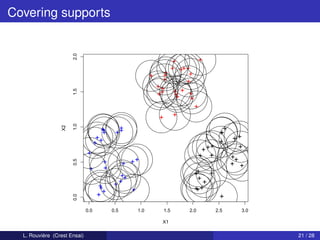
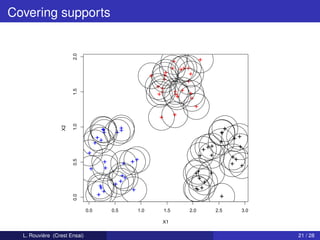
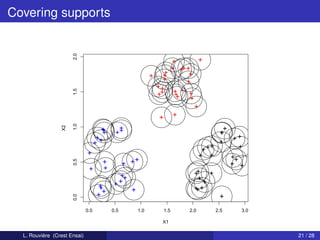
                                            i=1

     The number of components M is known.

The problem
Find efficient estimators αi and ˆi of αi and fi :
                         ˆ      f

                 E|ˆ i − αi | = O(n−γ ) and
                   α                              E ˆi − fi
                                                    f          1   = O(n−β )

where β corresponds to optimal rates for classical function classes.


   L. Rouvière (Crest Ensai)                                                   4 / 28
A classical problem


A number of practical methods have been proposed including
     parametric approaches: EM algorithm (Dempster, 1977)
     nonparametric techniques (Hall and Zhou, 2003)
     Bayesian algorithms (Biernacki, Celeux and Govaert, 2000)
     model selection methods (Maugis-Rabusseau and Michel, 2012)
     and numerous other ad hoc rules

The classification approach
The mixture components origin are identified by a random variable I
which takes values in {1, . . . , M}. I represent the group or label of Y


   L. Rouvière (Crest Ensai)                                                5 / 28
A classical problem


A number of practical methods have been proposed including
     parametric approaches: EM algorithm (Dempster, 1977)
     nonparametric techniques (Hall and Zhou, 2003)
     Bayesian algorithms (Biernacki, Celeux and Govaert, 2000)
     model selection methods (Maugis-Rabusseau and Michel, 2012)
     and numerous other ad hoc rules

The classification approach
The mixture components origin are identified by a random variable I
which takes values in {1, . . . , M}. I represent the group or label of Y


   L. Rouvière (Crest Ensai)                                                5 / 28
A simple solution: labels are observed
     Let I be a random variable taking values in {1, . . . , M} which
     represents the label or group of Y ;
     fi is the density of the conditional distribution L(Y |I = i);
     Given n pairs (Y1 , I1 ), . . . , (Yn , In ) drawn frow the distribution of
     (Y , I)

     it is easy to define efficient estimates of αi and fi :
                                                          n
                       Ni                       1Ni >0
              αi =
              ¯                and ¯i,h (t) =
                                   f                            Kt,h (Yk )1i (Ik ) ,
                       n                         Ni
                                                         k =1

     where
                                                                             1         t −y
        Ni = Card{k = 1, . . . , n : Ik = i}         and Kt,h (y ) =           K              .
                                                                             h           h

But Ik , k = 1, . . . , n are not observed...
   L. Rouvière (Crest Ensai)                                                                  6 / 28
A simple solution: labels are observed
     Let I be a random variable taking values in {1, . . . , M} which
     represents the label or group of Y ;
     fi is the density of the conditional distribution L(Y |I = i);
     Given n pairs (Y1 , I1 ), . . . , (Yn , In ) drawn frow the distribution of
     (Y , I)

     it is easy to define efficient estimates of αi and fi :
                                                          n
                       Ni                       1Ni >0
              αi =
              ¯                and ¯i,h (t) =
                                   f                            Kt,h (Yk )1i (Ik ) ,
                       n                         Ni
                                                         k =1

     where
                                                                             1         t −y
        Ni = Card{k = 1, . . . , n : Ik = i}         and Kt,h (y ) =           K              .
                                                                             h           h

But Ik , k = 1, . . . , n are not observed...
   L. Rouvière (Crest Ensai)                                                                  6 / 28
A simple solution: labels are observed
     Let I be a random variable taking values in {1, . . . , M} which
     represents the label or group of Y ;
     fi is the density of the conditional distribution L(Y |I = i);
     Given n pairs (Y1 , I1 ), . . . , (Yn , In ) drawn frow the distribution of
     (Y , I)

     it is easy to define efficient estimates of αi and fi :
                                                          n
                       Ni                       1Ni >0
              αi =
              ¯                and ¯i,h (t) =
                                   f                            Kt,h (Yk )1i (Ik ) ,
                       n                         Ni
                                                         k =1

     where
                                                                             1         t −y
        Ni = Card{k = 1, . . . , n : Ik = i}         and Kt,h (y ) =           K              .
                                                                             h           h

But Ik , k = 1, . . . , n are not observed...
   L. Rouvière (Crest Ensai)                                                                  6 / 28
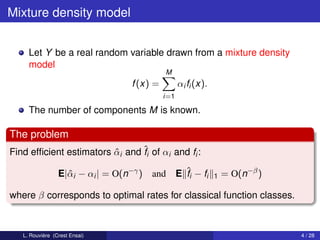
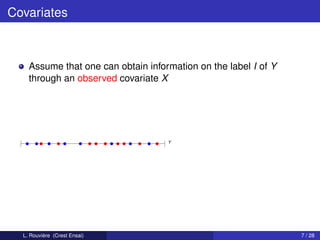
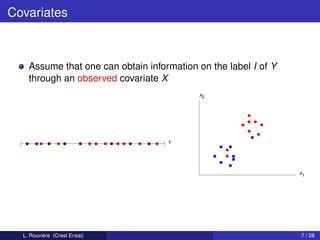
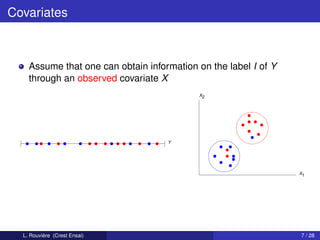
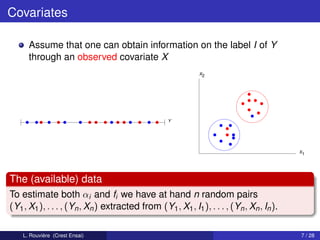
Covariates


    Assume that one can obtain information on the label I of Y
    through an observed covariate X


  L. Rouvière (Crest Ensai)                                      7 / 28
Covariates


    Assume that one can obtain information on the label I of Y
    through an observed covariate X
                                           X2


                                    Y


                                                                 X1


  L. Rouvière (Crest Ensai)                                      7 / 28
Covariates


    Assume that one can obtain information on the label I of Y
    through an observed covariate X
                                           X2


                                    Y


                                                                 X1


  L. Rouvière (Crest Ensai)                                      7 / 28
Covariates


    Assume that one can obtain information on the label I of Y
    through an observed covariate X
                                           X2


                                    Y


                                                                 X1


  L. Rouvière (Crest Ensai)                                      7 / 28
Covariates

      Assume that one can obtain information on the label I of Y
      through an observed covariate X
                                                             X2


                                                   Y


                                                                                          X1


The (available) data
To estimate both αi and fi we have at hand n random pairs
(Y1 , X1 ), . . . , (Yn , Xn ) extracted from (Y1 , X1 , I1 ), . . . , (Yn , Xn , In ).

    L. Rouvière (Crest Ensai)                                                             7 / 28
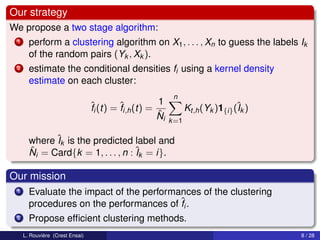
Our strategy
We propose a two stage algorithm:
 1     perform a clustering algorithm on X1 , . . . , Xn to guess the labels Ik
       of the random pairs (Yk , Xk ).
 2     estimate the conditional densities fi using a kernel density
       estimate on each cluster:
                                                           n
                                 ˆi (t) = ˆi,h (t) = 1
                                 f        f                      Kt,h (Yk )1{i} (ˆk )
                                                                                 I
                                                     ˆ
                                                     Ni   k =1

       where ˆk is the predicted label and
              I
       ˆ i = Card{k = 1, . . . , n : ˆk = i}.
       N                             I

Our mission
 1     Evaluate the impact of the performances of the clustering
       procedures on the performances of ˆi .
                                          f
 2     Propose efficient clustering methods.
     L. Rouvière (Crest Ensai)                                                          8 / 28
Our strategy
We propose a two stage algorithm:
 1     perform a clustering algorithm on X1 , . . . , Xn to guess the labels Ik
       of the random pairs (Yk , Xk ).
 2     estimate the conditional densities fi using a kernel density
       estimate on each cluster:
                                                           n
                                 ˆi (t) = ˆi,h (t) = 1
                                 f        f                      Kt,h (Yk )1{i} (ˆk )
                                                                                 I
                                                     ˆ
                                                     Ni   k =1

       where ˆk is the predicted label and
              I
       ˆ i = Card{k = 1, . . . , n : ˆk = i}.
       N                             I

Our mission
 1     Evaluate the impact of the performances of the clustering
       procedures on the performances of ˆi .
                                          f
 2     Propose efficient clustering methods.
     L. Rouvière (Crest Ensai)                                                          8 / 28
1   Introduction


2   The model
      Notations and examples
      Main results


3   Clustering methods
      A toy example
      Disjoint support densities


    L. Rouvière (Crest Ensai)      9 / 28
Notations


    (Y1 , X1 , I1 ), . . . , (Yn , Xn , In ) n i.i.d. random variables wich take
    values in R × Rd × {1, . . . , M}.

    Recall that fi is the density of L(Y |I = i) and αi = P(Y = i).

    We assume that the conditional distribution L(X |I = i) admits a
    density gi,n which could depend on n.

Remark
    The dependence between Y and X is not specified in this model
    (X = Y is included in the model).
    Only the conditional densities gi,n are allowed to depend on n.


  L. Rouvière (Crest Ensai)                                                        10 / 28
Notations


    (Y1 , X1 , I1 ), . . . , (Yn , Xn , In ) n i.i.d. random variables wich take
    values in R × Rd × {1, . . . , M}.

    Recall that fi is the density of L(Y |I = i) and αi = P(Y = i).

    We assume that the conditional distribution L(X |I = i) admits a
    density gi,n which could depend on n.

Remark
    The dependence between Y and X is not specified in this model
    (X = Y is included in the model).
    Only the conditional densities gi,n are allowed to depend on n.


  L. Rouvière (Crest Ensai)                                                        10 / 28
Notations


    (Y1 , X1 , I1 ), . . . , (Yn , Xn , In ) n i.i.d. random variables wich take
    values in R × Rd × {1, . . . , M}.

    Recall that fi is the density of L(Y |I = i) and αi = P(Y = i).

    We assume that the conditional distribution L(X |I = i) admits a
    density gi,n which could depend on n.

Remark
    The dependence between Y and X is not specified in this model
    (X = Y is included in the model).
    Only the conditional densities gi,n are allowed to depend on n.


  L. Rouvière (Crest Ensai)                                                        10 / 28
Performance of the clustering method
     Assume we are given a clustering procedure which split the
                                                   ˆ ˆ               ˆ
     sample {X1 , . . . , Xn } into M + 1 clusters C0 , C1 , . . . , CM :
                      M
                           ˆ
                           Ci = {X1 , . . . , Xn }   and           ˆ    ˆ
                                                           ∀i = j, Ci ∩ Cj = ∅.
                     i=0

                 ˆ
     The cluster C0 (which could be empty) contains unpredicted
     observations.
     The predicted labels are defined by
                                                 ˆ
                      ˆk = ˆ k ) = j if Xk ∈ Cj
                       I    I(X
                                      0 otherwise.

Performance
The missclassification error of the clustering method is

                               ϕn = max max P(ˆk = j|Ik = j).
                                              I
                                    1≤k ≤n 1≤i≤M
   L. Rouvière (Crest Ensai)                                                      11 / 28
Performance of the clustering method
     Assume we are given a clustering procedure which split the
                                                   ˆ ˆ               ˆ
     sample {X1 , . . . , Xn } into M + 1 clusters C0 , C1 , . . . , CM :
                      M
                           ˆ
                           Ci = {X1 , . . . , Xn }   and           ˆ    ˆ
                                                           ∀i = j, Ci ∩ Cj = ∅.
                     i=0

                 ˆ
     The cluster C0 (which could be empty) contains unpredicted
     observations.
     The predicted labels are defined by
                                                 ˆ
                      ˆk = ˆ k ) = j if Xk ∈ Cj
                       I    I(X
                                      0 otherwise.

Performance
The missclassification error of the clustering method is

                               ϕn = max max P(ˆk = j|Ik = j).
                                              I
                                    1≤k ≤n 1≤i≤M
   L. Rouvière (Crest Ensai)                                                      11 / 28
Performance of the clustering method
     Assume we are given a clustering procedure which split the
                                                   ˆ ˆ               ˆ
     sample {X1 , . . . , Xn } into M + 1 clusters C0 , C1 , . . . , CM :
                      M
                           ˆ
                           Ci = {X1 , . . . , Xn }   and           ˆ    ˆ
                                                           ∀i = j, Ci ∩ Cj = ∅.
                     i=0

                 ˆ
     The cluster C0 (which could be empty) contains unpredicted
     observations.
     The predicted labels are defined by
                                                 ˆ
                      ˆk = ˆ k ) = j if Xk ∈ Cj
                       I    I(X
                                      0 otherwise.

Performance
The missclassification error of the clustering method is

                               ϕn = max max P(ˆk = j|Ik = j).
                                              I
                                    1≤k ≤n 1≤i≤M
   L. Rouvière (Crest Ensai)                                                      11 / 28
A toy example


    Here M = 2 and the conditionnal distributions gi,n are given by

          g1,n (x) = g1 (x) = 1[0,1] (x)   and g2,n (x) = 1[1−λn ,2−λn ] (x).


  L. Rouvière (Crest Ensai)                                                     12 / 28
A toy example


    Here M = 2 and the conditionnal distributions gi,n are given by

            g1,n (x) = g1 (x) = 1[0,1] (x)          and g2,n (x) = 1[1−λn ,2−λn ] (x).
                         Ik = 1      Ik = 1 or 2             Ik = 2

                        ˆ = 1
                        Ik           ˆ = 0
                                     Ik                      ˆ = 2
                                                             Ik


        0                                       1                                      2
                                           λn                                     λn

                                      ˆ
                                      λn                                     ˆ
                                                                             λn


  L. Rouvière (Crest Ensai)                                                                12 / 28
A toy example


    Here M = 2 and the conditionnal distributions gi,n are given by

            g1,n (x) = g1 (x) = 1[0,1] (x)          and g2,n (x) = 1[1−λn ,2−λn ] (x).
                         Ik = 1      Ik = 1 or 2             Ik = 2

                        ˆ = 1
                        Ik           ˆ = 0
                                     Ik                      ˆ = 2
                                                             Ik


        0                                       1                                      2
                                           λn                                     λn

                                      ˆ
                                      λn                                     ˆ
                                                                             λn


  L. Rouvière (Crest Ensai)                                                                12 / 28
A more realistic situation

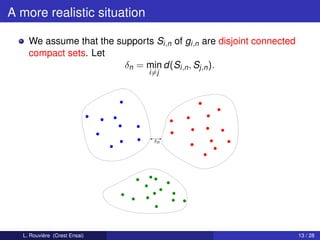
    We assume that the supports Si,n of gi,n are disjoint connected
    compact sets. Let
                         δn = min d(Si,n , Sj,n ).
                                i=j


                                 δn


  L. Rouvière (Crest Ensai)                                           13 / 28
Recall that
                                                       n
                          ˆi (t) = ˆi,h (t) = 1
                          f        f                           Kt,h (Yk )1{i} (ˆk )
                                                                               I
                                              ˆ
                                              Ni   k =1
and
                                                           n
                       ¯i (t) = ¯i,h (t) = 1Ni >0
                       f        f                               Kt,h (Yk )1{i} (Ik ).
                                            Ni
                                                       k =1
                      ˆ
Moreover, we set αi = Ni /n.
                 ˆ
Theorem
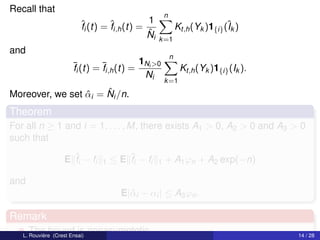
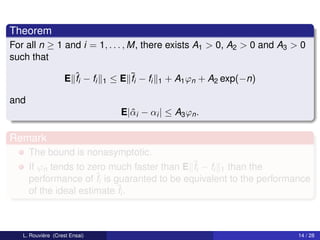
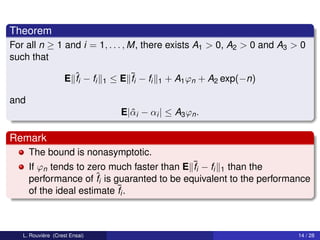
For all n ≥ 1 and i = 1, . . . , M, there exists A1 > 0, A2 > 0 and A3 > 0
such that

                    E ˆi − fi
                      f         1   ≤ E ¯i − fi
                                        f          1   + A1 ϕn + A2 exp(−n)

and
                                      E|ˆ i − αi | ≤ A3 ϕn .
                                        α

Remark
      The bound is nonasymptotic.
   L. Rouvière (Crest Ensai)                                                            14 / 28
Theorem
For all n ≥ 1 and i = 1, . . . , M, there exists A1 > 0, A2 > 0 and A3 > 0
such that

                    E ˆi − fi
                      f         1   ≤ E ¯i − fi
                                        f         1   + A1 ϕn + A2 exp(−n)

and
                                      E|ˆ i − αi | ≤ A3 ϕn .
                                        α

Remark
      The bound is nonasymptotic.
      If ϕn tends to zero much faster than E ¯i − fi 1 than the
                                             f
      performance of ˆi is guaranted to be equivalent to the performance
                       f
      of the ideal estimate ¯i .
                            f


   L. Rouvière (Crest Ensai)                                                 14 / 28
Theorem
For all n ≥ 1 and i = 1, . . . , M, there exists A1 > 0, A2 > 0 and A3 > 0
such that

                    E ˆi − fi
                      f         1   ≤ E ¯i − fi
                                        f         1   + A1 ϕn + A2 exp(−n)

and
                                      E|ˆ i − αi | ≤ A3 ϕn .
                                        α

Remark
      The bound is nonasymptotic.
      If ϕn tends to zero much faster than E ¯i − fi 1 than the
                                             f
      performance of ˆi is guaranted to be equivalent to the performance
                       f
      of the ideal estimate ¯i .
                            f


   L. Rouvière (Crest Ensai)                                                 14 / 28
Lipschitz class


Definition
Let s ∈ N and C > 0. We call W(s, C) the Lipschitz with parameters
s, C the class of all densities on [0, 1] with s − 1 asolutely continous
derivatives for which for all x, y ∈ R,

                               |f (s) (x) − f (s) (y )| ≤ C|x − y |.

Optimal rate
The minimax L1 risk for compactly supported Lipschitz class W(s, L) is
of order n−s/(2s+1) (see Devroye and Györfi, 1985).


   L. Rouvière (Crest Ensai)                                               15 / 28
Lipschitz class


Definition
Let s ∈ N and C > 0. We call W(s, C) the Lipschitz with parameters
s, C the class of all densities on [0, 1] with s − 1 asolutely continous
derivatives for which for all x, y ∈ R,

                               |f (s) (x) − f (s) (y )| ≤ C|x − y |.

Optimal rate
The minimax L1 risk for compactly supported Lipschitz class W(s, L) is
of order n−s/(2s+1) (see Devroye and Györfi, 1985).


   L. Rouvière (Crest Ensai)                                               15 / 28
An example of rate of convergence


Corollary
Assume that fi belongs to W(s, L). Moreover if ϕn = o(n−s/(2s+1) ), then

                               E ˆi − fi
                                 f         1   = O n−s/(2s+1) .

(under classical assumptions on K and hi,n ).

An important complement
Provide clustering procedures such that ϕn = o(n−s/(2s+1) ).


   L. Rouvière (Crest Ensai)                                         16 / 28
An example of rate of convergence


Corollary
Assume that fi belongs to W(s, L). Moreover if ϕn = o(n−s/(2s+1) ), then

                               E ˆi − fi
                                 f         1   = O n−s/(2s+1) .

(under classical assumptions on K and hi,n ).

An important complement
Provide clustering procedures such that ϕn = o(n−s/(2s+1) ).


   L. Rouvière (Crest Ensai)                                         16 / 28
1   Introduction


2   The model
      Notations and examples
      Main results


3   Clustering methods
      A toy example
      Disjoint support densities


    L. Rouvière (Crest Ensai)      17 / 28
Here M = 2 and the conditionnal distributions gi,n are given by

        g1,n (x) = g1 (x) = 1[0,1] (x)   and g2,n (x) = 1[1−λn ,2−λn ] (x).


L. Rouvière (Crest Ensai)                                                     18 / 28
Here M = 2 and the conditionnal distributions gi,n are given by

          g1,n (x) = g1 (x) = 1[0,1] (x)          and g2,n (x) = 1[1−λn ,2−λn ] (x).
                       Ik = 1      Ik = 1 or 2             Ik = 2

                      ˆ = 1
                      Ik           ˆ = 0
                                   Ik                      ˆ = 2
                                                           Ik


      0                                       1                                      2
                                         λn                                     λn

                                    ˆ
                                    λn                                     ˆ
                                                                           λn


L. Rouvière (Crest Ensai)                                                                18 / 28
Here M = 2 and the conditionnal distributions gi,n are given by

          g1,n (x) = g1 (x) = 1[0,1] (x)             and g2,n (x) = 1[1−λn ,2−λn ] (x).
                       Ik = 1         Ik = 1 or 2             Ik = 2

                      ˆ = 1
                      Ik              ˆ = 0
                                      Ik                      ˆ = 2
                                                              Ik


      0                                          1                                      2
                                            λn                                     λn

                                       ˆ
                                       λn                                     ˆ
                                                                              λn


            ˆ
  We choose λn = 2 − X(n) and
                                    
                                                   ˆ
                                    1 if Xk ≤ 1 − λn
                                    
                                ˆk = 0 if 1 − λn < Xk < 1
                                I             ˆ
                                    
                                     2 if Xk ≥ 1.
                                    


L. Rouvière (Crest Ensai)                                                                   18 / 28
Here M = 2 and the conditionnal distributions gi,n are given by
             g1,n (x) = g1 (x) = 1[0,1] (x)             and g2,n (x) = 1[1−λn ,2−λn ] (x).
                          Ik = 1          Ik = 1 or 2            Ik = 2

                         ˆ = 1
                         Ik              ˆ = 0
                                         Ik                      ˆ = 2
                                                                 Ik


         0                                          1                                      2
                                               λn                                     λn

                                          ˆ
                                          λn                                     ˆ
                                                                                 λn


               ˆ
     We choose λn = 2 − X(n) and
                         
                                        ˆ
                         1 if Xk ≤ 1 − λn
                         
                    ˆk = 0 if 1 − λn < Xk < 1
                     I              ˆ
                         
                           2 if Xk ≥ 1.
                         


Find an upper boud of

                               ϕn = max max P(ˆk = j|Ik = j).
                                              I
                                    1≤k ≤n 1≤i≤M
   L. Rouvière (Crest Ensai)                                                                   18 / 28
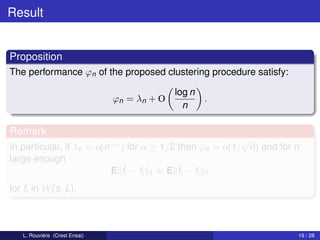
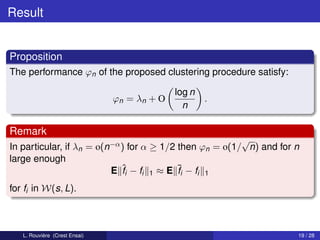
Result


Proposition
The performance ϕn of the proposed clustering procedure satisfy:

                                             log n
                               ϕn = λn + O           .
                                               n

Remark
                                                         √
In particular, if λn = o(n−α ) for α ≥ 1/2 then ϕn = o(1/ n) and for n
large enough
                          E ˆi − fi 1 ≈ E ¯i − fi 1
                             f             f
for fi in W(s, L).


   L. Rouvière (Crest Ensai)                                         19 / 28
Result


Proposition
The performance ϕn of the proposed clustering procedure satisfy:

                                             log n
                               ϕn = λn + O           .
                                               n

Remark
                                                         √
In particular, if λn = o(n−α ) for α ≥ 1/2 then ϕn = o(1/ n) and for n
large enough
                          E ˆi − fi 1 ≈ E ¯i − fi 1
                             f             f
for fi in W(s, L).


   L. Rouvière (Crest Ensai)                                         19 / 28
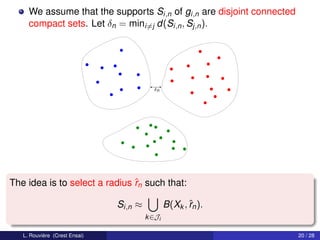
We assume that the supports Si,n of gi,n are disjoint connected
     compact sets. Let δn = mini=j d(Si,n , Sj,n ).


                                          δn


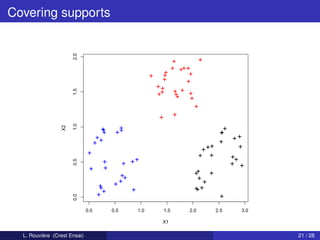
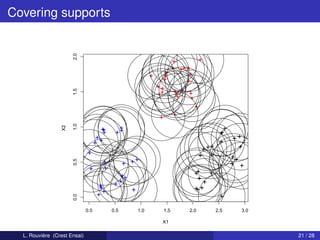
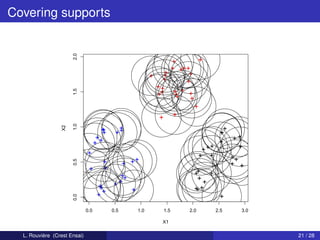
The idea is to select a radius ˆn such that:
                               r

                               Si,n ≈           B(Xk , ˆn ).
                                                       r
                                        k ∈Ji

   L. Rouvière (Crest Ensai)                                           20 / 28
We assume that the supports Si,n of gi,n are disjoint connected
     compact sets. Let δn = mini=j d(Si,n , Sj,n ).


                                          δn


The idea is to select a radius ˆn such that:
                               r

                               Si,n ≈           B(Xk , ˆn ).
                                                       r
                                        k ∈Ji

   L. Rouvière (Crest Ensai)                                           20 / 28
Covering supports


                      2.0
                      1.5
                      1.0
                 X2

                      0.5
                      0.0


                              0.0   0.5   1.0   1.5   2.0   2.5   3.0

                                                X1

  L. Rouvière (Crest Ensai)                                             21 / 28
Covering supports


                      2.0
                      1.5
                      1.0
                 X2

                      0.5
                      0.0


                              0.0   0.5   1.0   1.5   2.0   2.5   3.0

                                                X1

  L. Rouvière (Crest Ensai)                                             21 / 28
Covering supports


                      2.0
                      1.5
                      1.0
                 X2

                      0.5
                      0.0


                              0.0   0.5   1.0   1.5   2.0   2.5   3.0

                                                X1

  L. Rouvière (Crest Ensai)                                             21 / 28
Covering supports


                      2.0
                      1.5
                      1.0
                 X2

                      0.5
                      0.0


                              0.0   0.5   1.0   1.5   2.0   2.5   3.0

                                                X1

  L. Rouvière (Crest Ensai)                                             21 / 28
Covering supports


                      2.0
                      1.5
                      1.0
                 X2

                      0.5
                      0.0


                              0.0   0.5   1.0   1.5   2.0   2.5   3.0

                                                X1

  L. Rouvière (Crest Ensai)                                             21 / 28
Covering supports


                      2.0
                      1.5
                      1.0
                 X2

                      0.5
                      0.0


                              0.0   0.5   1.0   1.5   2.0   2.5   3.0

                                                X1

  L. Rouvière (Crest Ensai)                                             21 / 28
The algorithm


    For r > 0 let A = (Ak ,k )1≤k ,k       ≤n   defined by

                        1 if Xk − Xk   2   ≤ 2r ⇐⇒ B(Xk , r ) ∩ B(Xk , r ) = ∅
        Ak ,k =
                        0 otherwise.


    This matrix induces a non-oriented graph and two different
    observations Xk and Xk belong to the same cluster if k and k
    belong to the same connected component of the graph.
        ˆ
    Let Mr be the number of clusters (connected components) and
               ˆ           ˆˆ
    denote by C1 , . . . , CMr the associated clusters.


  L. Rouvière (Crest Ensai)                                                  22 / 28
The algorithm


    For r > 0 let A = (Ak ,k )1≤k ,k       ≤n   defined by

                        1 if Xk − Xk   2   ≤ 2r ⇐⇒ B(Xk , r ) ∩ B(Xk , r ) = ∅
        Ak ,k =
                        0 otherwise.


    This matrix induces a non-oriented graph and two different
    observations Xk and Xk belong to the same cluster if k and k
    belong to the same connected component of the graph.
        ˆ
    Let Mr be the number of clusters (connected components) and
               ˆ           ˆˆ
    denote by C1 , . . . , CMr the associated clusters.


  L. Rouvière (Crest Ensai)                                                  22 / 28
The algorithm


    For r > 0 let A = (Ak ,k )1≤k ,k       ≤n   defined by

                        1 if Xk − Xk   2   ≤ 2r ⇐⇒ B(Xk , r ) ∩ B(Xk , r ) = ∅
        Ak ,k =
                        0 otherwise.


    This matrix induces a non-oriented graph and two different
    observations Xk and Xk belong to the same cluster if k and k
    belong to the same connected component of the graph.
        ˆ
    Let Mr be the number of clusters (connected components) and
               ˆ           ˆˆ
    denote by C1 , . . . , CMr the associated clusters.


  L. Rouvière (Crest Ensai)                                                  22 / 28
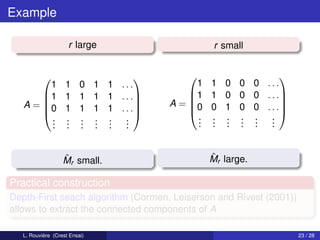
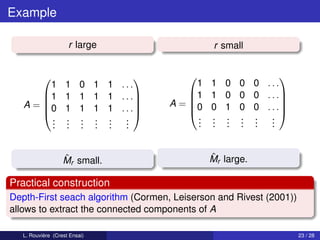
Example

                     r large                  r small


                                                       
                                         1 1 0 0 0 ...
                       
         1 1 0 1 1 ...
       1 1 1 1 1 . . .                1 1 0 0 0 . . .
                                    A = 0 0 1 0 0 . . .
                                                       
   A = 0 1 1 1 1 . . . 
                       
                                                       
                                          . . . . . .
                       
         . . . . . .
         . . . . . .                      . . . . . .
         . . . . . .                      . . . . . .


                   ˆ
                   Mr small.                 ˆ
                                             Mr large.

Practical construction
Depth-First seach algorithm (Cormen, Leiserson and Rivest (2001))
allows to extract the connected components of A

   L. Rouvière (Crest Ensai)                                        23 / 28
Example

                     r large                  r small


                                                       
                                         1 1 0 0 0 ...
                       
         1 1 0 1 1 ...
       1 1 1 1 1 . . .                1 1 0 0 0 . . .
                                    A = 0 0 1 0 0 . . .
                                                       
   A = 0 1 1 1 1 . . . 
                       
                                                       
                                          . . . . . .
                       
         . . . . . .
         . . . . . .                      . . . . . .
         . . . . . .                      . . . . . .


                   ˆ
                   Mr small.                 ˆ
                                             Mr large.

Practical construction
Depth-First seach algorithm (Cormen, Leiserson and Rivest (2001))
allows to extract the connected components of A

   L. Rouvière (Crest Ensai)                                        23 / 28
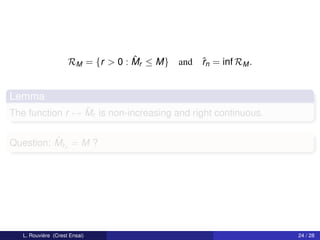
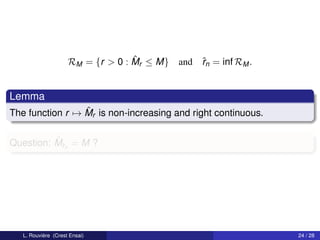
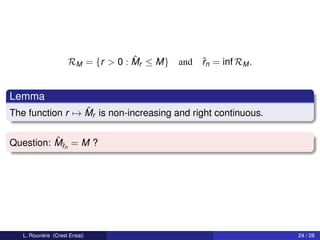
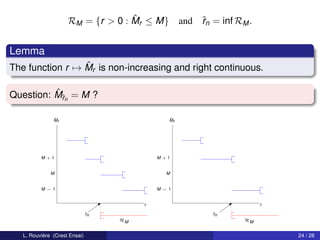
ˆ
                     RM = {r > 0 : Mr ≤ M}   and ˆn = inf RM .
                                                 r


Lemma
                 ˆ
The function r → Mr is non-increasing and right continuous.

          ˆr
Question: Mˆn = M ?


   L. Rouvière (Crest Ensai)                                     24 / 28
ˆ
                     RM = {r > 0 : Mr ≤ M}   and ˆn = inf RM .
                                                 r


Lemma
                 ˆ
The function r → Mr is non-increasing and right continuous.

          ˆr
Question: Mˆn = M ?


   L. Rouvière (Crest Ensai)                                     24 / 28
ˆ
                     RM = {r > 0 : Mr ≤ M}   and ˆn = inf RM .
                                                 r


Lemma
                 ˆ
The function r → Mr is non-increasing and right continuous.

          ˆr
Question: Mˆn = M ?


   L. Rouvière (Crest Ensai)                                     24 / 28
ˆ
                     RM = {r > 0 : Mr ≤ M}           and ˆn = inf RM .
                                                         r


Lemma
                 ˆ
The function r → Mr is non-increasing and right continuous.

          ˆr
Question: Mˆn = M ?

               ˆ
               Mr                               ˆ
                                                Mr


          M +1                               M +1


              M                                M


          M −1                               M −1


                                         r                               r

                               ˆn
                               r                            ˆn
                                                            r
                                    RM                              RM


   L. Rouvière (Crest Ensai)                                                 24 / 28
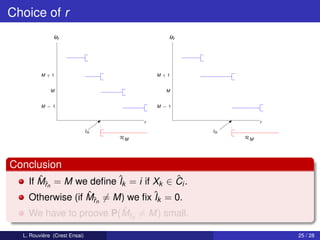
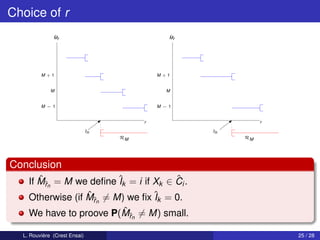
Choice of r
              ˆ
              Mr                                   ˆ
                                                   Mr


         M +1                                   M +1


             M                                    M


         M −1                                   M −1


                                            r                     r

                              ˆn
                              r                         ˆn
                                                        r
                                       RM                    RM


Conclusion
       ˆr               I              ˆ
    If Mˆn = M we define ˆk = i if Xk ∈ Ci .
    Otherwise (if Mˆ = M) we fix ˆk = 0.
                  ˆr              In
                        ˆr
    We have to proove P(Mˆn = M) small.

  L. Rouvière (Crest Ensai)                                           25 / 28
Choice of r
              ˆ
              Mr                                   ˆ
                                                   Mr


         M +1                                   M +1


             M                                    M


         M −1                                   M −1


                                            r                     r

                              ˆn
                              r                         ˆn
                                                        r
                                       RM                    RM


Conclusion
       ˆr               I              ˆ
    If Mˆn = M we define ˆk = i if Xk ∈ Ci .
    Otherwise (if Mˆ = M) we fix ˆk = 0.
                  ˆr              In
                        ˆr
    We have to proove P(Mˆn = M) small.

  L. Rouvière (Crest Ensai)                                           25 / 28
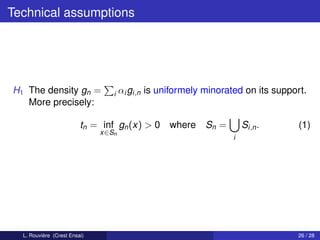
Technical assumptions


H1 The density gn =              i   αi gi,n is uniformely minorated on its support.
   More precisely:

                         tn = inf gn (x) > 0 where Sn =              Si,n .       (1)
                              x∈Sn
                                                                 i


  L. Rouvière (Crest Ensai)                                                      26 / 28
Technical assumptions


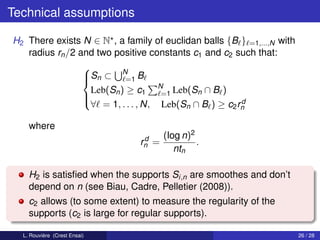
H2 There exists N ∈ N , a family of euclidan balls {B } =1,...,N with
   radius rn /2 and two positive constants c1 and c2 such that:

                 Sn ⊂ N B
                 
                          =1
                  Leb(Sn ) ≥ c1 N Leb(Sn ∩ B )
                                    =1
                 
                                                      d
                  ∀ = 1, . . . , N, Leb(Sn ∩ B ) ≥ c2 rn

    where
                                d     (log n)2
                               rn =            .
                                         ntn


  L. Rouvière (Crest Ensai)                                             26 / 28
Technical assumptions

H2 There exists N ∈ N , a family of euclidan balls {B } =1,...,N with
   radius rn /2 and two positive constants c1 and c2 such that:

                 Sn ⊂ N B
                 
                          =1
                  Leb(Sn ) ≥ c1 N Leb(Sn ∩ B )
                                    =1
                 
                                                      d
                  ∀ = 1, . . . , N, Leb(Sn ∩ B ) ≥ c2 rn

    where
                                d     (log n)2
                               rn =            .
                                         ntn

    H2 is satisfied when the supports Si,n are smoothes and don’t
    depend on n (see Biau, Cadre, Pelletier (2008)).
    c2 allows (to some extent) to measure the regularity of the
    supports (c2 is large for regular supports).

  L. Rouvière (Crest Ensai)                                             26 / 28
Result
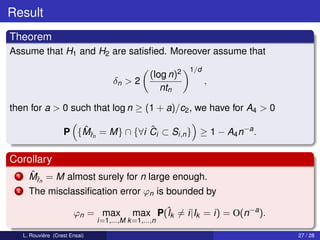
Theorem
Assume that H1 and H2 are satisfied. Moreover assume that
                                                              1/d
                                                   (log n)2
                                      δn > 2                        ,
                                                      ntn

then for a > 0 such that log n ≥ (1 + a)/c2 , we have for A4 > 0

                        ˆr             ˆ
                     P {Mˆn = M} ∩ {∀i Ci ⊂ Si,n } ≥ 1 − A4 n−a .

Corollary
 1     ˆr
       Mˆn = M almost surely for n large enough.
 2     The misclassification error ϕn is bounded by

                         ϕn = max            max P(ˆk = i|Ik = i) = O(n−a ).
                                                   I
                                 i=1,...,M k =1,...,n

     L. Rouvière (Crest Ensai)                                                 27 / 28
Result
Theorem
Assume that H1 and H2 are satisfied. Moreover assume that
                                                              1/d
                                                   (log n)2
                                      δn > 2                        ,
                                                      ntn

then for a > 0 such that log n ≥ (1 + a)/c2 , we have for A4 > 0

                        ˆr             ˆ
                     P {Mˆn = M} ∩ {∀i Ci ⊂ Si,n } ≥ 1 − A4 n−a .

Corollary
 1     ˆr
       Mˆn = M almost surely for n large enough.
 2     The misclassification error ϕn is bounded by

                         ϕn = max            max P(ˆk = i|Ik = i) = O(n−a ).
                                                   I
                                 i=1,...,M k =1,...,n

     L. Rouvière (Crest Ensai)                                                 27 / 28
Example


Corollary
Assume that gi,n are univariate densities and

                               tn = n−γ ,   γ ∈]0, 1[.

Then the kernel density estimate ˆi achieves the optimal rate over the
                                 f
class W(s, L) provided
                                                   1/d
                                        (log n)2
                               δn > 2                    .
                                          n1−γ


   L. Rouvière (Crest Ensai)                                        28 / 28
H2


       H2 implies that the covering number M should verify
                                                              n
                                         N ≤ (c1 c2 )−1             .
                                                           (log n)2


       H2 is clearly satisfied for d = 1.

       However for higher dimensions, even if Sn is assumed to be
       compact, its diameter can be as large as we want

                                 hn (x, y ) = 1[1−a−1 ,an ] (x)1[0,1/x 2 ] (y ).
                                                      n


     L. Rouvière (Crest Ensai)                                                     29 / 28

Rouviere

  • 1.
    On clustering procedureand nonparametric mixture estimation S. Auray, N. Klutchnikoff and L. Rouvière Crest-Ensai J ANUARY 2013 L. Rouvière (Crest Ensai) 1 / 28
  • 2.
    Outline 1 Introduction 2 The model Notations and examples Main results 3 Clustering methods A toy example Disjoint support densities L. Rouvière (Crest Ensai) 2 / 28
  • 3.
    1 Introduction 2 The model Notations and examples Main results 3 Clustering methods A toy example Disjoint support densities L. Rouvière (Crest Ensai) 3 / 28
  • 4.
    Mixture density model Let Y be a real random variable drawn from a mixture density model M f (x) = αi fi (x). i=1 The number of components M is known. The problem Find efficient estimators αi and ˆi of αi and fi : ˆ f E|ˆ i − αi | = O(n−γ ) and α E ˆi − fi f 1 = O(n−β ) where β corresponds to optimal rates for classical function classes. L. Rouvière (Crest Ensai) 4 / 28
  • 5.
    Mixture density model Let Y be a real random variable drawn from a mixture density model M f (x) = αi fi (x). i=1 The number of components M is known. The problem Find efficient estimators αi and ˆi of αi and fi : ˆ f E|ˆ i − αi | = O(n−γ ) and α E ˆi − fi f 1 = O(n−β ) where β corresponds to optimal rates for classical function classes. L. Rouvière (Crest Ensai) 4 / 28
  • 6.
    A classical problem Anumber of practical methods have been proposed including parametric approaches: EM algorithm (Dempster, 1977) nonparametric techniques (Hall and Zhou, 2003) Bayesian algorithms (Biernacki, Celeux and Govaert, 2000) model selection methods (Maugis-Rabusseau and Michel, 2012) and numerous other ad hoc rules The classification approach The mixture components origin are identified by a random variable I which takes values in {1, . . . , M}. I represent the group or label of Y L. Rouvière (Crest Ensai) 5 / 28
  • 7.
    A classical problem Anumber of practical methods have been proposed including parametric approaches: EM algorithm (Dempster, 1977) nonparametric techniques (Hall and Zhou, 2003) Bayesian algorithms (Biernacki, Celeux and Govaert, 2000) model selection methods (Maugis-Rabusseau and Michel, 2012) and numerous other ad hoc rules The classification approach The mixture components origin are identified by a random variable I which takes values in {1, . . . , M}. I represent the group or label of Y L. Rouvière (Crest Ensai) 5 / 28
  • 8.
    A simple solution:labels are observed Let I be a random variable taking values in {1, . . . , M} which represents the label or group of Y ; fi is the density of the conditional distribution L(Y |I = i); Given n pairs (Y1 , I1 ), . . . , (Yn , In ) drawn frow the distribution of (Y , I) it is easy to define efficient estimates of αi and fi : n Ni 1Ni >0 αi = ¯ and ¯i,h (t) = f Kt,h (Yk )1i (Ik ) , n Ni k =1 where 1 t −y Ni = Card{k = 1, . . . , n : Ik = i} and Kt,h (y ) = K . h h But Ik , k = 1, . . . , n are not observed... L. Rouvière (Crest Ensai) 6 / 28
  • 9.
    A simple solution:labels are observed Let I be a random variable taking values in {1, . . . , M} which represents the label or group of Y ; fi is the density of the conditional distribution L(Y |I = i); Given n pairs (Y1 , I1 ), . . . , (Yn , In ) drawn frow the distribution of (Y , I) it is easy to define efficient estimates of αi and fi : n Ni 1Ni >0 αi = ¯ and ¯i,h (t) = f Kt,h (Yk )1i (Ik ) , n Ni k =1 where 1 t −y Ni = Card{k = 1, . . . , n : Ik = i} and Kt,h (y ) = K . h h But Ik , k = 1, . . . , n are not observed... L. Rouvière (Crest Ensai) 6 / 28
  • 10.
    A simple solution:labels are observed Let I be a random variable taking values in {1, . . . , M} which represents the label or group of Y ; fi is the density of the conditional distribution L(Y |I = i); Given n pairs (Y1 , I1 ), . . . , (Yn , In ) drawn frow the distribution of (Y , I) it is easy to define efficient estimates of αi and fi : n Ni 1Ni >0 αi = ¯ and ¯i,h (t) = f Kt,h (Yk )1i (Ik ) , n Ni k =1 where 1 t −y Ni = Card{k = 1, . . . , n : Ik = i} and Kt,h (y ) = K . h h But Ik , k = 1, . . . , n are not observed... L. Rouvière (Crest Ensai) 6 / 28
  • 11.
    Covariates Assume that one can obtain information on the label I of Y through an observed covariate X L. Rouvière (Crest Ensai) 7 / 28
  • 12.
    Covariates Assume that one can obtain information on the label I of Y through an observed covariate X X2 Y X1 L. Rouvière (Crest Ensai) 7 / 28
  • 13.
    Covariates Assume that one can obtain information on the label I of Y through an observed covariate X X2 Y X1 L. Rouvière (Crest Ensai) 7 / 28
  • 14.
    Covariates Assume that one can obtain information on the label I of Y through an observed covariate X X2 Y X1 L. Rouvière (Crest Ensai) 7 / 28
  • 15.
    Covariates Assume that one can obtain information on the label I of Y through an observed covariate X X2 Y X1 The (available) data To estimate both αi and fi we have at hand n random pairs (Y1 , X1 ), . . . , (Yn , Xn ) extracted from (Y1 , X1 , I1 ), . . . , (Yn , Xn , In ). L. Rouvière (Crest Ensai) 7 / 28
  • 16.
    Our strategy We proposea two stage algorithm: 1 perform a clustering algorithm on X1 , . . . , Xn to guess the labels Ik of the random pairs (Yk , Xk ). 2 estimate the conditional densities fi using a kernel density estimate on each cluster: n ˆi (t) = ˆi,h (t) = 1 f f Kt,h (Yk )1{i} (ˆk ) I ˆ Ni k =1 where ˆk is the predicted label and I ˆ i = Card{k = 1, . . . , n : ˆk = i}. N I Our mission 1 Evaluate the impact of the performances of the clustering procedures on the performances of ˆi . f 2 Propose efficient clustering methods. L. Rouvière (Crest Ensai) 8 / 28
  • 17.
    Our strategy We proposea two stage algorithm: 1 perform a clustering algorithm on X1 , . . . , Xn to guess the labels Ik of the random pairs (Yk , Xk ). 2 estimate the conditional densities fi using a kernel density estimate on each cluster: n ˆi (t) = ˆi,h (t) = 1 f f Kt,h (Yk )1{i} (ˆk ) I ˆ Ni k =1 where ˆk is the predicted label and I ˆ i = Card{k = 1, . . . , n : ˆk = i}. N I Our mission 1 Evaluate the impact of the performances of the clustering procedures on the performances of ˆi . f 2 Propose efficient clustering methods. L. Rouvière (Crest Ensai) 8 / 28
  • 18.
    1 Introduction 2 The model Notations and examples Main results 3 Clustering methods A toy example Disjoint support densities L. Rouvière (Crest Ensai) 9 / 28
  • 19.
    Notations (Y1 , X1 , I1 ), . . . , (Yn , Xn , In ) n i.i.d. random variables wich take values in R × Rd × {1, . . . , M}. Recall that fi is the density of L(Y |I = i) and αi = P(Y = i). We assume that the conditional distribution L(X |I = i) admits a density gi,n which could depend on n. Remark The dependence between Y and X is not specified in this model (X = Y is included in the model). Only the conditional densities gi,n are allowed to depend on n. L. Rouvière (Crest Ensai) 10 / 28
  • 20.
    Notations (Y1 , X1 , I1 ), . . . , (Yn , Xn , In ) n i.i.d. random variables wich take values in R × Rd × {1, . . . , M}. Recall that fi is the density of L(Y |I = i) and αi = P(Y = i). We assume that the conditional distribution L(X |I = i) admits a density gi,n which could depend on n. Remark The dependence between Y and X is not specified in this model (X = Y is included in the model). Only the conditional densities gi,n are allowed to depend on n. L. Rouvière (Crest Ensai) 10 / 28
  • 21.
    Notations (Y1 , X1 , I1 ), . . . , (Yn , Xn , In ) n i.i.d. random variables wich take values in R × Rd × {1, . . . , M}. Recall that fi is the density of L(Y |I = i) and αi = P(Y = i). We assume that the conditional distribution L(X |I = i) admits a density gi,n which could depend on n. Remark The dependence between Y and X is not specified in this model (X = Y is included in the model). Only the conditional densities gi,n are allowed to depend on n. L. Rouvière (Crest Ensai) 10 / 28
  • 22.
    Performance of theclustering method Assume we are given a clustering procedure which split the ˆ ˆ ˆ sample {X1 , . . . , Xn } into M + 1 clusters C0 , C1 , . . . , CM : M ˆ Ci = {X1 , . . . , Xn } and ˆ ˆ ∀i = j, Ci ∩ Cj = ∅. i=0 ˆ The cluster C0 (which could be empty) contains unpredicted observations. The predicted labels are defined by ˆ ˆk = ˆ k ) = j if Xk ∈ Cj I I(X 0 otherwise. Performance The missclassification error of the clustering method is ϕn = max max P(ˆk = j|Ik = j). I 1≤k ≤n 1≤i≤M L. Rouvière (Crest Ensai) 11 / 28
  • 23.
    Performance of theclustering method Assume we are given a clustering procedure which split the ˆ ˆ ˆ sample {X1 , . . . , Xn } into M + 1 clusters C0 , C1 , . . . , CM : M ˆ Ci = {X1 , . . . , Xn } and ˆ ˆ ∀i = j, Ci ∩ Cj = ∅. i=0 ˆ The cluster C0 (which could be empty) contains unpredicted observations. The predicted labels are defined by ˆ ˆk = ˆ k ) = j if Xk ∈ Cj I I(X 0 otherwise. Performance The missclassification error of the clustering method is ϕn = max max P(ˆk = j|Ik = j). I 1≤k ≤n 1≤i≤M L. Rouvière (Crest Ensai) 11 / 28
  • 24.
    Performance of theclustering method Assume we are given a clustering procedure which split the ˆ ˆ ˆ sample {X1 , . . . , Xn } into M + 1 clusters C0 , C1 , . . . , CM : M ˆ Ci = {X1 , . . . , Xn } and ˆ ˆ ∀i = j, Ci ∩ Cj = ∅. i=0 ˆ The cluster C0 (which could be empty) contains unpredicted observations. The predicted labels are defined by ˆ ˆk = ˆ k ) = j if Xk ∈ Cj I I(X 0 otherwise. Performance The missclassification error of the clustering method is ϕn = max max P(ˆk = j|Ik = j). I 1≤k ≤n 1≤i≤M L. Rouvière (Crest Ensai) 11 / 28
  • 25.
    A toy example Here M = 2 and the conditionnal distributions gi,n are given by g1,n (x) = g1 (x) = 1[0,1] (x) and g2,n (x) = 1[1−λn ,2−λn ] (x). L. Rouvière (Crest Ensai) 12 / 28
  • 26.
    A toy example Here M = 2 and the conditionnal distributions gi,n are given by g1,n (x) = g1 (x) = 1[0,1] (x) and g2,n (x) = 1[1−λn ,2−λn ] (x). Ik = 1 Ik = 1 or 2 Ik = 2 ˆ = 1 Ik ˆ = 0 Ik ˆ = 2 Ik 0 1 2 λn λn ˆ λn ˆ λn L. Rouvière (Crest Ensai) 12 / 28
  • 27.
    A toy example Here M = 2 and the conditionnal distributions gi,n are given by g1,n (x) = g1 (x) = 1[0,1] (x) and g2,n (x) = 1[1−λn ,2−λn ] (x). Ik = 1 Ik = 1 or 2 Ik = 2 ˆ = 1 Ik ˆ = 0 Ik ˆ = 2 Ik 0 1 2 λn λn ˆ λn ˆ λn L. Rouvière (Crest Ensai) 12 / 28
  • 28.
    A more realisticsituation We assume that the supports Si,n of gi,n are disjoint connected compact sets. Let δn = min d(Si,n , Sj,n ). i=j δn L. Rouvière (Crest Ensai) 13 / 28
  • 29.
    Recall that n ˆi (t) = ˆi,h (t) = 1 f f Kt,h (Yk )1{i} (ˆk ) I ˆ Ni k =1 and n ¯i (t) = ¯i,h (t) = 1Ni >0 f f Kt,h (Yk )1{i} (Ik ). Ni k =1 ˆ Moreover, we set αi = Ni /n. ˆ Theorem For all n ≥ 1 and i = 1, . . . , M, there exists A1 > 0, A2 > 0 and A3 > 0 such that E ˆi − fi f 1 ≤ E ¯i − fi f 1 + A1 ϕn + A2 exp(−n) and E|ˆ i − αi | ≤ A3 ϕn . α Remark The bound is nonasymptotic. L. Rouvière (Crest Ensai) 14 / 28
  • 30.
    Theorem For all n≥ 1 and i = 1, . . . , M, there exists A1 > 0, A2 > 0 and A3 > 0 such that E ˆi − fi f 1 ≤ E ¯i − fi f 1 + A1 ϕn + A2 exp(−n) and E|ˆ i − αi | ≤ A3 ϕn . α Remark The bound is nonasymptotic. If ϕn tends to zero much faster than E ¯i − fi 1 than the f performance of ˆi is guaranted to be equivalent to the performance f of the ideal estimate ¯i . f L. Rouvière (Crest Ensai) 14 / 28
  • 31.
    Theorem For all n≥ 1 and i = 1, . . . , M, there exists A1 > 0, A2 > 0 and A3 > 0 such that E ˆi − fi f 1 ≤ E ¯i − fi f 1 + A1 ϕn + A2 exp(−n) and E|ˆ i − αi | ≤ A3 ϕn . α Remark The bound is nonasymptotic. If ϕn tends to zero much faster than E ¯i − fi 1 than the f performance of ˆi is guaranted to be equivalent to the performance f of the ideal estimate ¯i . f L. Rouvière (Crest Ensai) 14 / 28
  • 32.
    Lipschitz class Definition Let s∈ N and C > 0. We call W(s, C) the Lipschitz with parameters s, C the class of all densities on [0, 1] with s − 1 asolutely continous derivatives for which for all x, y ∈ R, |f (s) (x) − f (s) (y )| ≤ C|x − y |. Optimal rate The minimax L1 risk for compactly supported Lipschitz class W(s, L) is of order n−s/(2s+1) (see Devroye and Györfi, 1985). L. Rouvière (Crest Ensai) 15 / 28
  • 33.
    Lipschitz class Definition Let s∈ N and C > 0. We call W(s, C) the Lipschitz with parameters s, C the class of all densities on [0, 1] with s − 1 asolutely continous derivatives for which for all x, y ∈ R, |f (s) (x) − f (s) (y )| ≤ C|x − y |. Optimal rate The minimax L1 risk for compactly supported Lipschitz class W(s, L) is of order n−s/(2s+1) (see Devroye and Györfi, 1985). L. Rouvière (Crest Ensai) 15 / 28
  • 34.
    An example ofrate of convergence Corollary Assume that fi belongs to W(s, L). Moreover if ϕn = o(n−s/(2s+1) ), then E ˆi − fi f 1 = O n−s/(2s+1) . (under classical assumptions on K and hi,n ). An important complement Provide clustering procedures such that ϕn = o(n−s/(2s+1) ). L. Rouvière (Crest Ensai) 16 / 28
  • 35.
    An example ofrate of convergence Corollary Assume that fi belongs to W(s, L). Moreover if ϕn = o(n−s/(2s+1) ), then E ˆi − fi f 1 = O n−s/(2s+1) . (under classical assumptions on K and hi,n ). An important complement Provide clustering procedures such that ϕn = o(n−s/(2s+1) ). L. Rouvière (Crest Ensai) 16 / 28
  • 36.
    1 Introduction 2 The model Notations and examples Main results 3 Clustering methods A toy example Disjoint support densities L. Rouvière (Crest Ensai) 17 / 28
  • 37.
    Here M =2 and the conditionnal distributions gi,n are given by g1,n (x) = g1 (x) = 1[0,1] (x) and g2,n (x) = 1[1−λn ,2−λn ] (x). L. Rouvière (Crest Ensai) 18 / 28
  • 38.
    Here M =2 and the conditionnal distributions gi,n are given by g1,n (x) = g1 (x) = 1[0,1] (x) and g2,n (x) = 1[1−λn ,2−λn ] (x). Ik = 1 Ik = 1 or 2 Ik = 2 ˆ = 1 Ik ˆ = 0 Ik ˆ = 2 Ik 0 1 2 λn λn ˆ λn ˆ λn L. Rouvière (Crest Ensai) 18 / 28
  • 39.
    Here M =2 and the conditionnal distributions gi,n are given by g1,n (x) = g1 (x) = 1[0,1] (x) and g2,n (x) = 1[1−λn ,2−λn ] (x). Ik = 1 Ik = 1 or 2 Ik = 2 ˆ = 1 Ik ˆ = 0 Ik ˆ = 2 Ik 0 1 2 λn λn ˆ λn ˆ λn ˆ We choose λn = 2 − X(n) and  ˆ 1 if Xk ≤ 1 − λn  ˆk = 0 if 1 − λn < Xk < 1 I ˆ  2 if Xk ≥ 1.  L. Rouvière (Crest Ensai) 18 / 28
  • 40.
    Here M =2 and the conditionnal distributions gi,n are given by g1,n (x) = g1 (x) = 1[0,1] (x) and g2,n (x) = 1[1−λn ,2−λn ] (x). Ik = 1 Ik = 1 or 2 Ik = 2 ˆ = 1 Ik ˆ = 0 Ik ˆ = 2 Ik 0 1 2 λn λn ˆ λn ˆ λn ˆ We choose λn = 2 − X(n) and  ˆ 1 if Xk ≤ 1 − λn  ˆk = 0 if 1 − λn < Xk < 1 I ˆ  2 if Xk ≥ 1.  Find an upper boud of ϕn = max max P(ˆk = j|Ik = j). I 1≤k ≤n 1≤i≤M L. Rouvière (Crest Ensai) 18 / 28
  • 41.
    Result Proposition The performance ϕnof the proposed clustering procedure satisfy: log n ϕn = λn + O . n Remark √ In particular, if λn = o(n−α ) for α ≥ 1/2 then ϕn = o(1/ n) and for n large enough E ˆi − fi 1 ≈ E ¯i − fi 1 f f for fi in W(s, L). L. Rouvière (Crest Ensai) 19 / 28
  • 42.
    Result Proposition The performance ϕnof the proposed clustering procedure satisfy: log n ϕn = λn + O . n Remark √ In particular, if λn = o(n−α ) for α ≥ 1/2 then ϕn = o(1/ n) and for n large enough E ˆi − fi 1 ≈ E ¯i − fi 1 f f for fi in W(s, L). L. Rouvière (Crest Ensai) 19 / 28
  • 43.
    We assume thatthe supports Si,n of gi,n are disjoint connected compact sets. Let δn = mini=j d(Si,n , Sj,n ). δn The idea is to select a radius ˆn such that: r Si,n ≈ B(Xk , ˆn ). r k ∈Ji L. Rouvière (Crest Ensai) 20 / 28
  • 44.
    We assume thatthe supports Si,n of gi,n are disjoint connected compact sets. Let δn = mini=j d(Si,n , Sj,n ). δn The idea is to select a radius ˆn such that: r Si,n ≈ B(Xk , ˆn ). r k ∈Ji L. Rouvière (Crest Ensai) 20 / 28
  • 45.
    Covering supports 2.0 1.5 1.0 X2 0.5 0.0 0.0 0.5 1.0 1.5 2.0 2.5 3.0 X1 L. Rouvière (Crest Ensai) 21 / 28
  • 46.
    Covering supports 2.0 1.5 1.0 X2 0.5 0.0 0.0 0.5 1.0 1.5 2.0 2.5 3.0 X1 L. Rouvière (Crest Ensai) 21 / 28
  • 47.
    Covering supports 2.0 1.5 1.0 X2 0.5 0.0 0.0 0.5 1.0 1.5 2.0 2.5 3.0 X1 L. Rouvière (Crest Ensai) 21 / 28
  • 48.
    Covering supports 2.0 1.5 1.0 X2 0.5 0.0 0.0 0.5 1.0 1.5 2.0 2.5 3.0 X1 L. Rouvière (Crest Ensai) 21 / 28
  • 49.
    Covering supports 2.0 1.5 1.0 X2 0.5 0.0 0.0 0.5 1.0 1.5 2.0 2.5 3.0 X1 L. Rouvière (Crest Ensai) 21 / 28
  • 50.
    Covering supports 2.0 1.5 1.0 X2 0.5 0.0 0.0 0.5 1.0 1.5 2.0 2.5 3.0 X1 L. Rouvière (Crest Ensai) 21 / 28
  • 51.
    The algorithm For r > 0 let A = (Ak ,k )1≤k ,k ≤n defined by 1 if Xk − Xk 2 ≤ 2r ⇐⇒ B(Xk , r ) ∩ B(Xk , r ) = ∅ Ak ,k = 0 otherwise. This matrix induces a non-oriented graph and two different observations Xk and Xk belong to the same cluster if k and k belong to the same connected component of the graph. ˆ Let Mr be the number of clusters (connected components) and ˆ ˆˆ denote by C1 , . . . , CMr the associated clusters. L. Rouvière (Crest Ensai) 22 / 28
  • 52.
    The algorithm For r > 0 let A = (Ak ,k )1≤k ,k ≤n defined by 1 if Xk − Xk 2 ≤ 2r ⇐⇒ B(Xk , r ) ∩ B(Xk , r ) = ∅ Ak ,k = 0 otherwise. This matrix induces a non-oriented graph and two different observations Xk and Xk belong to the same cluster if k and k belong to the same connected component of the graph. ˆ Let Mr be the number of clusters (connected components) and ˆ ˆˆ denote by C1 , . . . , CMr the associated clusters. L. Rouvière (Crest Ensai) 22 / 28
  • 53.
    The algorithm For r > 0 let A = (Ak ,k )1≤k ,k ≤n defined by 1 if Xk − Xk 2 ≤ 2r ⇐⇒ B(Xk , r ) ∩ B(Xk , r ) = ∅ Ak ,k = 0 otherwise. This matrix induces a non-oriented graph and two different observations Xk and Xk belong to the same cluster if k and k belong to the same connected component of the graph. ˆ Let Mr be the number of clusters (connected components) and ˆ ˆˆ denote by C1 , . . . , CMr the associated clusters. L. Rouvière (Crest Ensai) 22 / 28
  • 54.
    Example r large r small   1 1 0 0 0 ...   1 1 0 1 1 ... 1 1 1 1 1 . . .  1 1 0 0 0 . . . A = 0 0 1 0 0 . . .   A = 0 1 1 1 1 . . .      . . . . . .   . . . . . . . . . . . . . . . . . . . . . . . . . . . . . . ˆ Mr small. ˆ Mr large. Practical construction Depth-First seach algorithm (Cormen, Leiserson and Rivest (2001)) allows to extract the connected components of A L. Rouvière (Crest Ensai) 23 / 28
  • 55.
    Example r large r small   1 1 0 0 0 ...   1 1 0 1 1 ... 1 1 1 1 1 . . .  1 1 0 0 0 . . . A = 0 0 1 0 0 . . .   A = 0 1 1 1 1 . . .      . . . . . .   . . . . . . . . . . . . . . . . . . . . . . . . . . . . . . ˆ Mr small. ˆ Mr large. Practical construction Depth-First seach algorithm (Cormen, Leiserson and Rivest (2001)) allows to extract the connected components of A L. Rouvière (Crest Ensai) 23 / 28
  • 56.
    ˆ RM = {r > 0 : Mr ≤ M} and ˆn = inf RM . r Lemma ˆ The function r → Mr is non-increasing and right continuous. ˆr Question: Mˆn = M ? L. Rouvière (Crest Ensai) 24 / 28
  • 57.
    ˆ RM = {r > 0 : Mr ≤ M} and ˆn = inf RM . r Lemma ˆ The function r → Mr is non-increasing and right continuous. ˆr Question: Mˆn = M ? L. Rouvière (Crest Ensai) 24 / 28
  • 58.
    ˆ RM = {r > 0 : Mr ≤ M} and ˆn = inf RM . r Lemma ˆ The function r → Mr is non-increasing and right continuous. ˆr Question: Mˆn = M ? L. Rouvière (Crest Ensai) 24 / 28
  • 59.
    ˆ RM = {r > 0 : Mr ≤ M} and ˆn = inf RM . r Lemma ˆ The function r → Mr is non-increasing and right continuous. ˆr Question: Mˆn = M ? ˆ Mr ˆ Mr M +1 M +1 M M M −1 M −1 r r ˆn r ˆn r RM RM L. Rouvière (Crest Ensai) 24 / 28
  • 60.
    Choice of r ˆ Mr ˆ Mr M +1 M +1 M M M −1 M −1 r r ˆn r ˆn r RM RM Conclusion ˆr I ˆ If Mˆn = M we define ˆk = i if Xk ∈ Ci . Otherwise (if Mˆ = M) we fix ˆk = 0. ˆr In ˆr We have to proove P(Mˆn = M) small. L. Rouvière (Crest Ensai) 25 / 28
  • 61.
    Choice of r ˆ Mr ˆ Mr M +1 M +1 M M M −1 M −1 r r ˆn r ˆn r RM RM Conclusion ˆr I ˆ If Mˆn = M we define ˆk = i if Xk ∈ Ci . Otherwise (if Mˆ = M) we fix ˆk = 0. ˆr In ˆr We have to proove P(Mˆn = M) small. L. Rouvière (Crest Ensai) 25 / 28
  • 62.
    Technical assumptions H1 Thedensity gn = i αi gi,n is uniformely minorated on its support. More precisely: tn = inf gn (x) > 0 where Sn = Si,n . (1) x∈Sn i L. Rouvière (Crest Ensai) 26 / 28
  • 63.
    Technical assumptions H2 Thereexists N ∈ N , a family of euclidan balls {B } =1,...,N with radius rn /2 and two positive constants c1 and c2 such that: Sn ⊂ N B   =1 Leb(Sn ) ≥ c1 N Leb(Sn ∩ B ) =1   d ∀ = 1, . . . , N, Leb(Sn ∩ B ) ≥ c2 rn where d (log n)2 rn = . ntn L. Rouvière (Crest Ensai) 26 / 28
  • 64.
    Technical assumptions H2 Thereexists N ∈ N , a family of euclidan balls {B } =1,...,N with radius rn /2 and two positive constants c1 and c2 such that: Sn ⊂ N B   =1 Leb(Sn ) ≥ c1 N Leb(Sn ∩ B ) =1   d ∀ = 1, . . . , N, Leb(Sn ∩ B ) ≥ c2 rn where d (log n)2 rn = . ntn H2 is satisfied when the supports Si,n are smoothes and don’t depend on n (see Biau, Cadre, Pelletier (2008)). c2 allows (to some extent) to measure the regularity of the supports (c2 is large for regular supports). L. Rouvière (Crest Ensai) 26 / 28
  • 65.
    Result Theorem Assume that H1and H2 are satisfied. Moreover assume that 1/d (log n)2 δn > 2 , ntn then for a > 0 such that log n ≥ (1 + a)/c2 , we have for A4 > 0 ˆr ˆ P {Mˆn = M} ∩ {∀i Ci ⊂ Si,n } ≥ 1 − A4 n−a . Corollary 1 ˆr Mˆn = M almost surely for n large enough. 2 The misclassification error ϕn is bounded by ϕn = max max P(ˆk = i|Ik = i) = O(n−a ). I i=1,...,M k =1,...,n L. Rouvière (Crest Ensai) 27 / 28
  • 66.
    Result Theorem Assume that H1and H2 are satisfied. Moreover assume that 1/d (log n)2 δn > 2 , ntn then for a > 0 such that log n ≥ (1 + a)/c2 , we have for A4 > 0 ˆr ˆ P {Mˆn = M} ∩ {∀i Ci ⊂ Si,n } ≥ 1 − A4 n−a . Corollary 1 ˆr Mˆn = M almost surely for n large enough. 2 The misclassification error ϕn is bounded by ϕn = max max P(ˆk = i|Ik = i) = O(n−a ). I i=1,...,M k =1,...,n L. Rouvière (Crest Ensai) 27 / 28
  • 67.
    Example Corollary Assume that gi,nare univariate densities and tn = n−γ , γ ∈]0, 1[. Then the kernel density estimate ˆi achieves the optimal rate over the f class W(s, L) provided 1/d (log n)2 δn > 2 . n1−γ L. Rouvière (Crest Ensai) 28 / 28
  • 68.
    H2 H2 implies that the covering number M should verify n N ≤ (c1 c2 )−1 . (log n)2 H2 is clearly satisfied for d = 1. However for higher dimensions, even if Sn is assumed to be compact, its diameter can be as large as we want hn (x, y ) = 1[1−a−1 ,an ] (x)1[0,1/x 2 ] (y ). n L. Rouvière (Crest Ensai) 29 / 28