Model                       Results                    Heuristics


           Dynamic Trading Volume

           Paolo Guasoni1,2           Marko Weber2,3

                       Boston University1

                     Dublin City University2

                   Scuola Normale Superiore3


            Probability, Control and Finance
        A Conference in Honor of Ioannis Karatzas
           Columbia University, June 5th , 2012
Model                                  Results                               Heuristics


                                     Outline


   • Motivation:
        Liquidity, Market Depth, Trading Volume.
   • Model:
        Finite Depth. Constant investment opportunities and risk aversion.
   • Results:
        Optimal policy and welfare. Trading volume dynamics.
Model                                Results                          Heuristics


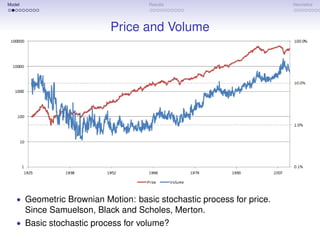
                            Price and Volume


   • Geometric Brownian Motion: basic stochastic process for price.
        Since Samuelson, Black and Scholes, Merton.
   • Basic stochastic process for volume?
Model                                      Results                       Heuristics


                             Unsettling Answers

   • Volume: rate of change in total quantities traded.
   • Portfolio models, exogenous prices. After Merton (1969, 1973).
        Continuous rebalancing. Quantities are diffusions.
        Volume infinite.
   • Equilibrium models, endogenous prices. After Lucas (1973).
        Representative agent holds risky asset at all times.
        Volume zero.
   • Multiple agents models. After Milgrom and Stokey (1982).
        Prices change, portfolios don’t.
        Volume zero.
   • All these models: no frictions.
   • Transaction costs, exogenous prices. After Constantinides (1986).
        Volume finite as time-average.
        Either zero (no trade region) or infinite (trading boundaries).
Model                                    Results                          Heuristics


                                     This Talk


   • Question:
     if price is geometric Brownian Motion, what is the process for volume?
   • Inputs
        • Price exogenous. Geometric Brownian Motion.
        • Representative agent.
          Constant relative risk aversion and long horizon.
        • Friction. Execution price linear in volume.
   • Outputs
       • Stochastic process for trading volume.
       • Optimal trading policy and welfare.
       • Small friction asymptotics explicit.
Model                                     Results                             Heuristics


                                         Market
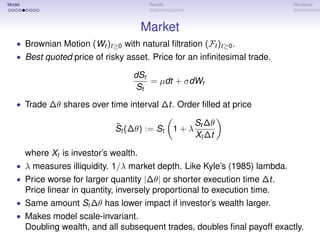
   • Brownian Motion (Wt )t≥0 with natural filtration (Ft )t≥0 .
   • Best quoted price of risky asset. Price for an infinitesimal trade.

                                     dSt
                                         = µdt + σdWt
                                     St
   • Trade ∆θ shares over time interval ∆t. Order filled at price

                                ˜                         St ∆θ
                                St (∆θ) := St       1+λ
                                                          Xt ∆t

        where Xt is investor’s wealth.
   • λ measures illiquidity. 1/λ market depth. Like Kyle’s (1985) lambda.
   • Price worse for larger quantity |∆θ| or shorter execution time ∆t.
        Price linear in quantity, inversely proportional to execution time.
   • Same amount St ∆θ has lower impact if investor’s wealth larger.
   • Makes model scale-invariant.
        Doubling wealth, and all subsequent trades, doubles final payoff exactly.
Model                                 Results                               Heuristics


                                Alternatives?
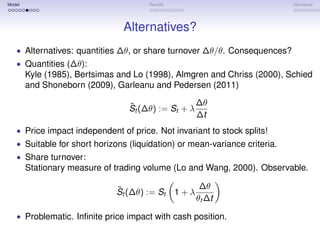
   • Alternatives: quantities ∆θ, or share turnover ∆θ/θ. Consequences?
   • Quantities (∆θ):
        Kyle (1985), Bertsimas and Lo (1998), Almgren and Chriss (2000), Schied
        and Shoneborn (2009), Garleanu and Pedersen (2011)

                                 ˜                 ∆θ
                                 St (∆θ) := St + λ
                                                   ∆t
   • Price impact independent of price. Not invariant to stock splits!
   • Suitable for short horizons (liquidation) or mean-variance criteria.
   • Share turnover:
        Stationary measure of trading volume (Lo and Wang, 2000). Observable.

                              ˜                        ∆θ
                              St (∆θ) := St     1+λ
                                                      θt ∆t

   • Problematic. Infinite price impact with cash position.
Model                                    Results                                  Heuristics


                             Wealth and Portfolio
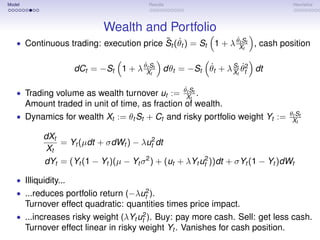
                                         ˜ ˙                  ˙t
   • Continuous trading: execution price St (θt ) = St 1 + λ θXSt , cash position
                                                                 t


                                       ˙t            ˙      S ˙
                      dCt = −St 1 + λ θXSt dθt = −St θt + λ Xtt θt2 dt
                                          t


                                                    ˙
                                                   θt St
   • Trading volume as wealth turnover ut :=       . Xt
     Amount traded in unit of time, as fraction of wealth.
                                                                                 θt St
   • Dynamics for wealth Xt := θt St + Ct and risky portfolio weight Yt :=        Xt

           dXt
               = Yt (µdt + σdWt ) − λut2 dt
           Xt
           dYt = (Yt (1 − Yt )(µ − Yt σ 2 ) + (ut + λYt ut2 ))dt + σYt (1 − Yt )dWt

   • Illiquidity...
   • ...reduces portfolio return (−λut2 ).
     Turnover effect quadratic: quantities times price impact.
   • ...increases risky weight (λYt ut2 ). Buy: pay more cash. Sell: get less cash.
     Turnover effect linear in risky weight Yt . Vanishes for cash position.
Model                                        Results                                 Heuristics


                             Admissible Strategies
Definition
Admissible strategy: process (ut )t≥0 , adapted to Ft , such that system

          dXt
              = Yt (µdt + σdWt ) − λut2 dt
           Xt
          dYt = (Yt (1 − Yt )(µ − Yt σ 2 ) + (ut + λYt ut2 ))dt + σYt (1 − Yt )dWt

has unique solution satisfying Xt ≥ 0 a.s. for all t ≥ 0.

   • Contrast to models without frictions or with transaction costs:
        control variable is not risky weight Yt , but its “rate of change” ut .
   • Portfolio weight Yt is now a state variable.
   • Illiquid vs. perfectly liquid market.
        Steering a ship vs. driving a race car.
                                     µ
   • Frictionless solution Yt =     γσ 2
                                           unfeasible. A still ship in stormy sea.
Model                                  Results                               Heuristics


                                    Objective

   • Investor with relative risk aversion γ.
   • Maximize equivalent safe rate, i.e., power utility over long horizon:
                                                         1
                                         1        1−γ   1−γ
                             max lim       log E XT
                                u   T →∞ T

   • Tradeoff between speed and impact.
   • Optimal policy and welfare.
   • Implied trading volume.
   • Dependence on parameters.
   • Asymptotics for small λ.
   • Comparison with transaction costs.
Model                                            Results                           Heuristics


                                         Verification
Theorem
      µ
If   γσ 2
            ∈ (0, 1), then the optimal wealth turnover and equivalent safe rate are:

                                  1   q(y )
                      ˆ
                      u (y ) =                                           ˆ
                                                                   EsRγ (u ) = β
                                 2λ 1 − yq(y )
                       2
               µ
where β ∈ (0, 2γσ2 ) and q : [0, 1] → R are the unique pair that solves the ODE

                  2                                        2   2
                                         q
−β+µy −γ σ y 2 +y (1−y )(µ−γσ 2 y )q+ 4λ(1−yq) + σ y 2 (1−y )2 (q +(1−γ)q 2 ) = 0
         2                                       2

            √
and q(0) = 2 λβ, q(1) = λd −                λd(λd − 2), where d = −γσ 2 − 2β + 2µ.

     • A license to solve an ODE, of Abel type.
     • Function q and scalar β not explicit.
     • Asymptotic expansion for λ near zero?
Model                                        Results                                 Heuristics


                                       Asymptotics

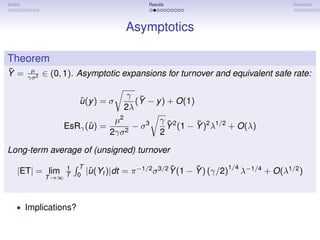
Theorem
¯
Y =      µ
               ∈ (0, 1). Asymptotic expansions for turnover and equivalent safe rate:
        γσ 2


                                     γ ¯
                        ˆ
                        u (y ) = σ     (Y − y ) + O(1)
                                    2λ
                                 µ2          γ ¯2      ¯
                          ˆ
                    EsRγ (u ) =     2
                                      − σ3     Y (1 − Y )2 λ1/2 + O(λ)
                                2γσ          2

Long-term average of (unsigned) turnover
                    1   T                              ¯      ¯        1/4
    |ET| = lim              |u (Yt )|dt = π −1/2 σ 3/2 Y (1 − Y ) (γ/2) λ−1/4 + O(λ1/2 )
                             ˆ
               T →∞ T   0


   • Implications?
Model                                       Results                            Heuristics


                                        Turnover


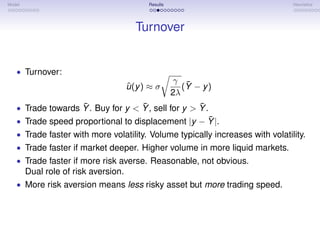
   • Turnover:
                                                       γ ¯
                                      ˆ
                                      u (y ) ≈ σ         (Y − y )
                                                      2λ
                   ¯               ¯                ¯
   • Trade towards Y . Buy for y < Y , sell for y > Y .
                                                   ¯
   • Trade speed proportional to displacement |y − Y |.
   • Trade faster with more volatility. Volume typically increases with volatility.
   • Trade faster if market deeper. Higher volume in more liquid markets.
   • Trade faster if more risk averse. Reasonable, not obvious.
        Dual role of risk aversion.
   • More risk aversion means less risky asset but more trading speed.
Model                                   Results                      Heuristics


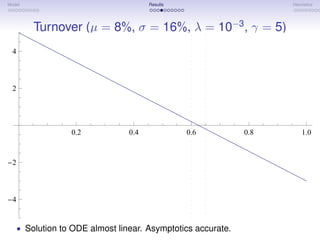
          Turnover (µ = 8%, σ = 16%, λ = 10−3 , γ = 5)
  4


  2


                   0.2            0.4             0.6          0.8       1.0


  2


  4


      • Solution to ODE almost linear. Asymptotics accurate.
Model                                    Results                         Heuristics


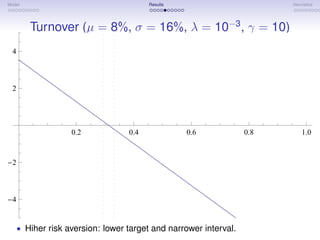
         Turnover (µ = 8%, σ = 16%, λ = 10−3 , γ = 10)
  4


  2


                    0.2            0.4             0.6             0.8       1.0


  2


  4


      • Hiher risk aversion: lower target and narrower interval.
Model                                     Results                           Heuristics


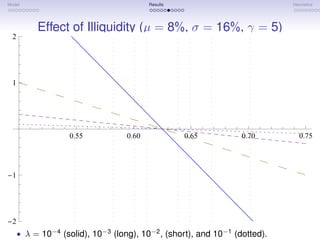
           Effect of Illiquidity (µ = 8%, σ = 16%, γ = 5)
  2


  1


                    0.55           0.60             0.65          0.70         0.75


  1


  2
      • λ = 10−4 (solid), 10−3 (long), 10−2 , (short), and 10−1 (dotted).
Model                                          Results                                Heuristics


                                     Trading Volume
   • Wealth turnover approximately Ornstein-Uhlenbeck:

                             γ 2 ¯2      ¯                              γ ¯      ¯
           ˆ
         d ut = σ              (σ Y (1 − Y )(1 − γ) − ut )dt − σ 2
                                                      ˆ                   Y (1 − Y )dWt
                            2λ                                         2λ
   • In the following sense:


Theorem
            ˆ
The process ut has asymptotic moments:
                        T
             1                              ¯        ¯
  ET := lim                 u (Yt )dt = σ 2 Y 2 (1 − Y )(1 − γ) + o(1) ,
                            ˆ
        T →∞ T      0
            1 T                           1 ¯         ¯
  VT := lim       (u (Yt ) − ET)2 dt = σ 3 Y 2 (1 − Y )2 (γ/2)1/2 λ1/2 + o(λ1/2 ) ,
                   ˆ
       T →∞ T 0                           2
            1                     ¯         ¯
  QT := lim   E[ u (Y ) T ] = σ 4 Y 2 (1 − Y )2 (γ/2)λ−1 + o(λ−1 )
                 ˆ
       T →∞ T
Model                                    Results                                   Heuristics


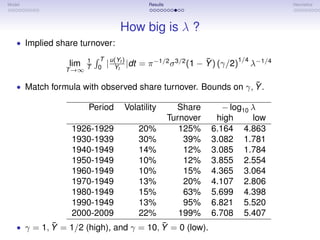
                                How big is λ ?
   • Implied share turnover:
                        T                                            1/4
                lim 1       | u(Yt ) |dt = π −1/2 σ 3/2 (1 − Y ) (γ/2)
                                                             ¯             λ−1/4
               T →∞ T   0      Yt

                                                              ¯
   • Match formula with observed share turnover. Bounds on γ, Y .

                     Period      Volatility          Share       − log10 λ
                                                   Turnover    high      low
                 1926-1929            20%             125%    6.164 4.863
                 1930-1939            30%              39%    3.082 1.781
                 1940-1949            14%              12%    3.085 1.784
                 1950-1949            10%              12%    3.855 2.554
                 1960-1949            10%              15%    4.365 3.064
                 1970-1949            13%              20%    4.107 2.806
                 1980-1949            15%              63%    5.699 4.398
                 1990-1949            13%              95%    6.821 5.520
                 2000-2009            22%             199%    6.708 5.407
            ¯                           ¯
   • γ = 1, Y = 1/2 (high), and γ = 10, Y = 0 (low).
Model                                   Results                                 Heuristics


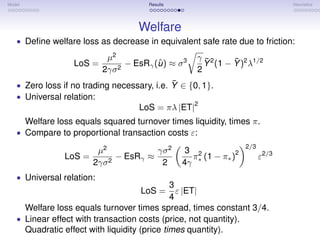
                                     Welfare
   • Define welfare loss as decrease in equivalent safe rate due to friction:

                             µ2                       γ ¯2     ¯
                    LoS =         − EsRγ (u ) ≈ σ 3
                                          ˆ             Y (1 − Y )2 λ1/2
                            2γσ 2                     2
                                             ¯
   • Zero loss if no trading necessary, i.e. Y ∈ {0, 1}.
   • Universal relation:
                                                      2
                                      LoS = πλ |ET|
        Welfare loss equals squared turnover times liquidity, times π.
   • Compare to proportional transaction costs ε:
                                                                   2/3
                           µ2            γσ 2      3 2         2
                  LoS =         − EsRγ ≈            π (1 − π∗ )          ε2/3
                          2γσ 2           2       4γ ∗
   • Universal relation:
                                              3
                                      LoS =     ε |ET|
                                              4
     Welfare loss equals turnover times spread, times constant 3/4.
   • Linear effect with transaction costs (price, not quantity).
     Quadratic effect with liquidity (price times quantity).
Model                                       Results                                 Heuristics


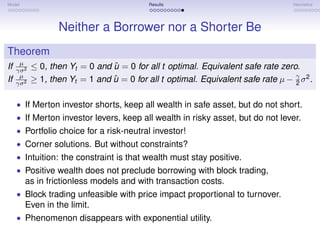
                   Neither a Borrower nor a Shorter Be
Theorem
      µ
If   γσ 2
                                 ˆ
            ≤ 0, then Yt = 0 and u = 0 for all t optimal. Equivalent safe rate zero.
      µ
If   γσ 2
            ≥ 1, then Yt = 1 and u = 0 for all t optimal. Equivalent safe rate µ − γ σ 2 .
                                 ˆ                                                 2


     • If Merton investor shorts, keep all wealth in safe asset, but do not short.
     • If Merton investor levers, keep all wealth in risky asset, but do not lever.
     • Portfolio choice for a risk-neutral investor!
     • Corner solutions. But without constraints?
     • Intuition: the constraint is that wealth must stay positive.
     • Positive wealth does not preclude borrowing with block trading,
        as in frictionless models and with transaction costs.
     • Block trading unfeasible with price impact proportional to turnover.
        Even in the limit.
     • Phenomenon disappears with exponential utility.
Model                                          Results                                      Heuristics


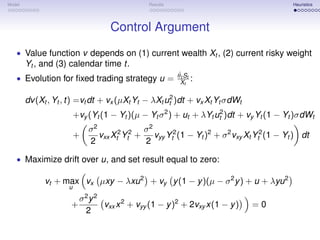
                                    Control Argument
   • Value function v depends on (1) current wealth Xt , (2) current risky weight
        Yt , and (3) calendar time t.
                                                          ˙
                                                         θt St
   • Evolution for fixed trading strategy u =               Xt    :

        dv (Xt , Yt , t) =vt dt + vx (µXt Yt − λXt ut2 )dt + vx Xt Yt σdWt
                         +vy (Yt (1 − Yt )(µ − Yt σ 2 ) + ut + λYt ut2 )dt + vy Yt (1 − Yt )σdWt
                             σ2               σ2
                         +      vxx Xt2 Yt2 +    vyy Yt2 (1 − Yt )2 + σ 2 vxy Xt Yt2 (1 − Yt ) dt
                             2                2

   • Maximize drift over u, and set result equal to zero:

              vt + max vx µxy − λxu 2 + vy y (1 − y )(µ − σ 2 y ) + u + λyu 2
                     u
                          σ2 y 2
                      +          vxx x 2 + vyy (1 − y )2 + 2vxy x(1 − y )      =0
                           2
Model                                               Results                                     Heuristics


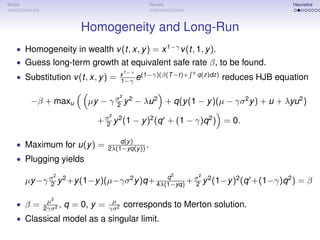
                          Homogeneity and Long-Run
   • Homogeneity in wealth v (t, x, y ) = x 1−γ v (t, 1, y ).
   • Guess long-term growth at equivalent safe rate β, to be found.
   • Substitution v (t, x, y ) =          x 1−γ (1−γ)(β(T −t)+    y
                                                                      q(z)dz)
                                          1−γ e                                 reduces HJB equation

                                          2
         −β + maxu         µy − γ σ y 2 − λu 2 + q(y (1 − y )(µ − γσ 2 y ) + u + λyu 2 )
                                  2
                                   2
                              + σ y 2 (1 − y )2 (q + (1 − γ)q 2 ) = 0.
                                2

                                       q(y )
   • Maximum for u(y ) =           2λ(1−yq(y )) .
   • Plugging yields
               2                                              2       2
                                              q
        µy −γ σ y 2 +y (1−y )(µ−γσ 2 y )q+ 4λ(1−yq) + σ y 2 (1−y )2 (q +(1−γ)q 2 ) = β
              2                                       2

             µ2                     µ
   • β=     2γσ 2
                  ,   q = 0, y =   γσ 2
                                              corresponds to Merton solution.
   • Classical model as a singular limit.
Model                                     Results                               Heuristics


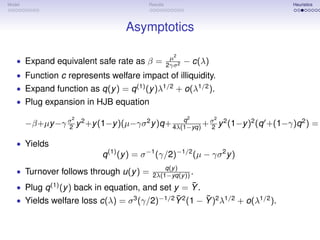
                                   Asymptotics

                                                     µ2
   • Expand equivalent safe rate as β =             2γσ 2
                                                            − c(λ)
   • Function c represents welfare impact of illiquidity.
   • Expand function as q(y ) = q (1) (y )λ1/2 + o(λ1/2 ).
   • Plug expansion in HJB equation
                    2                                       2        2
                                                 q
        −β+µy −γ σ y 2 +y (1−y )(µ−γσ 2 y )q+ 4λ(1−yq) + σ y 2 (1−y )2 (q +(1−γ)q 2 ) =
                 2                                       2

   • Yields
                            q (1) (y ) = σ −1 (γ/2)−1/2 (µ − γσ 2 y )
                                               q(y )
   • Turnover follows through u(y ) =      2λ(1−yq(y )) .
                                                   ¯
   • Plug q (1) (y ) back in equation, and set y = Y .
                                              ¯        ¯
   • Yields welfare loss c(λ) = σ 3 (γ/2)−1/2 Y 2 (1 − Y )2 λ1/2 + o(λ1/2 ).
Model                               Results              Heuristics


                                  Issues


   • How to make argument rigorous?
   • Heuristics yield ODE, but no boundary conditions!
   • Relation between ODE and optimization problem?
Model                                     Results                                      Heuristics


                                   Verification
Lemma
                                                         y
Let q solve the HJB equation, and define Q(y ) =        q(z)dz. There exists a
            ˆ
probability P, equivalent to P, such that the terminal wealth XT of any
admissible strategy satisfies:
                       1−γ    1                                    1
                    E[XT ] 1−γ ≤ eβT +Q(y ) EP [e−(1−γ)Q(YT ) ] 1−γ ,
                                             ˆ

and equality holds for the optimal strategy.

   •    Solution of HJB equation yields asymptotic upper bound for any strategy.
   •    Upper bound reached for optimal strategy.
   •    Valid for any β, for corresponding Q.
   •    Idea: pick largest β ∗ to make Q disappear in the long run.
   •    A priori bounds:
                                           µ2
                                   β∗ <                      (frictionless solution)
                                          2γσ 2
                          γ 2
             max 0, µ −     σ <β ∗                   (all in safe or risky asset)
                          2
Model                                     Results                               Heuristics


                                       Existence
Theorem
                µ
Assume 0 < γσ2 < 1. There exists β ∗ such that HJB equation has solution
q(y ) with positive finite limit in 0 and negative finite limit in 1.

   • for β > 0, there exists a unique solution q0,β (y ) to HJB equation with
                                              √
        positive finite limit in 0 (and the limit is 2 λβ);
                       γσ 2
   • for β > µ −        2 ,
                         there exists a unique solution q1,β (y ) to HJB equation
        with negative finite limit in 1 (and the limit is λd − λd(λd − 2), where
                       γσ 2
        d := 2(µ −      2     − β));
   • there exists βu such that q0,βu (y ) > q1,βu (y ) for some y ;
   • there exists βl such that q0,βl (y ) < q1,βl (y ) for some y ;
   • by continuity and boundedness, there exists β ∗ ∈ (βl , βu ) such that
        q0,β ∗ (y ) = q1,β ∗ (y ).
   • Boundary conditions are natural!
Model                                     Results                              Heuristics


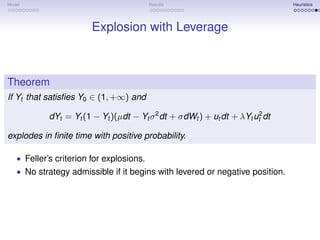
                        Explosion with Leverage


Theorem
If Yt that satisfies Y0 ∈ (1, +∞) and

            dYt = Yt (1 − Yt )(µdt − Yt σ 2 dt + σdWt ) + ut dt + λYt ut2 dt

explodes in finite time with positive probability.

   • Feller’s criterion for explosions.
   • No strategy admissible if it begins with levered or negative position.
Model                                  Results                            Heuristics


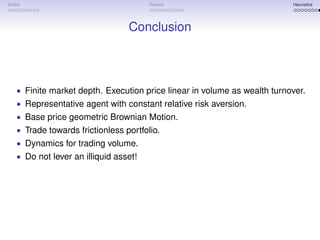
                                 Conclusion


   • Finite market depth. Execution price linear in volume as wealth turnover.
   • Representative agent with constant relative risk aversion.
   • Base price geometric Brownian Motion.
   • Trade towards frictionless portfolio.
   • Dynamics for trading volume.
   • Do not lever an illiquid asset!
Model            Results         Heuristics


        Happy Birthday Yannis!

Dynamic Trading Volume

  • 1.
    Model Results Heuristics Dynamic Trading Volume Paolo Guasoni1,2 Marko Weber2,3 Boston University1 Dublin City University2 Scuola Normale Superiore3 Probability, Control and Finance A Conference in Honor of Ioannis Karatzas Columbia University, June 5th , 2012
  • 2.
    Model Results Heuristics Outline • Motivation: Liquidity, Market Depth, Trading Volume. • Model: Finite Depth. Constant investment opportunities and risk aversion. • Results: Optimal policy and welfare. Trading volume dynamics.
  • 3.
    Model Results Heuristics Price and Volume • Geometric Brownian Motion: basic stochastic process for price. Since Samuelson, Black and Scholes, Merton. • Basic stochastic process for volume?
  • 4.
    Model Results Heuristics Unsettling Answers • Volume: rate of change in total quantities traded. • Portfolio models, exogenous prices. After Merton (1969, 1973). Continuous rebalancing. Quantities are diffusions. Volume infinite. • Equilibrium models, endogenous prices. After Lucas (1973). Representative agent holds risky asset at all times. Volume zero. • Multiple agents models. After Milgrom and Stokey (1982). Prices change, portfolios don’t. Volume zero. • All these models: no frictions. • Transaction costs, exogenous prices. After Constantinides (1986). Volume finite as time-average. Either zero (no trade region) or infinite (trading boundaries).
  • 5.
    Model Results Heuristics This Talk • Question: if price is geometric Brownian Motion, what is the process for volume? • Inputs • Price exogenous. Geometric Brownian Motion. • Representative agent. Constant relative risk aversion and long horizon. • Friction. Execution price linear in volume. • Outputs • Stochastic process for trading volume. • Optimal trading policy and welfare. • Small friction asymptotics explicit.
  • 6.
    Model Results Heuristics Market • Brownian Motion (Wt )t≥0 with natural filtration (Ft )t≥0 . • Best quoted price of risky asset. Price for an infinitesimal trade. dSt = µdt + σdWt St • Trade ∆θ shares over time interval ∆t. Order filled at price ˜ St ∆θ St (∆θ) := St 1+λ Xt ∆t where Xt is investor’s wealth. • λ measures illiquidity. 1/λ market depth. Like Kyle’s (1985) lambda. • Price worse for larger quantity |∆θ| or shorter execution time ∆t. Price linear in quantity, inversely proportional to execution time. • Same amount St ∆θ has lower impact if investor’s wealth larger. • Makes model scale-invariant. Doubling wealth, and all subsequent trades, doubles final payoff exactly.
  • 7.
    Model Results Heuristics Alternatives? • Alternatives: quantities ∆θ, or share turnover ∆θ/θ. Consequences? • Quantities (∆θ): Kyle (1985), Bertsimas and Lo (1998), Almgren and Chriss (2000), Schied and Shoneborn (2009), Garleanu and Pedersen (2011) ˜ ∆θ St (∆θ) := St + λ ∆t • Price impact independent of price. Not invariant to stock splits! • Suitable for short horizons (liquidation) or mean-variance criteria. • Share turnover: Stationary measure of trading volume (Lo and Wang, 2000). Observable. ˜ ∆θ St (∆θ) := St 1+λ θt ∆t • Problematic. Infinite price impact with cash position.
  • 8.
    Model Results Heuristics Wealth and Portfolio ˜ ˙ ˙t • Continuous trading: execution price St (θt ) = St 1 + λ θXSt , cash position t ˙t ˙ S ˙ dCt = −St 1 + λ θXSt dθt = −St θt + λ Xtt θt2 dt t ˙ θt St • Trading volume as wealth turnover ut := . Xt Amount traded in unit of time, as fraction of wealth. θt St • Dynamics for wealth Xt := θt St + Ct and risky portfolio weight Yt := Xt dXt = Yt (µdt + σdWt ) − λut2 dt Xt dYt = (Yt (1 − Yt )(µ − Yt σ 2 ) + (ut + λYt ut2 ))dt + σYt (1 − Yt )dWt • Illiquidity... • ...reduces portfolio return (−λut2 ). Turnover effect quadratic: quantities times price impact. • ...increases risky weight (λYt ut2 ). Buy: pay more cash. Sell: get less cash. Turnover effect linear in risky weight Yt . Vanishes for cash position.
  • 9.
    Model Results Heuristics Admissible Strategies Definition Admissible strategy: process (ut )t≥0 , adapted to Ft , such that system dXt = Yt (µdt + σdWt ) − λut2 dt Xt dYt = (Yt (1 − Yt )(µ − Yt σ 2 ) + (ut + λYt ut2 ))dt + σYt (1 − Yt )dWt has unique solution satisfying Xt ≥ 0 a.s. for all t ≥ 0. • Contrast to models without frictions or with transaction costs: control variable is not risky weight Yt , but its “rate of change” ut . • Portfolio weight Yt is now a state variable. • Illiquid vs. perfectly liquid market. Steering a ship vs. driving a race car. µ • Frictionless solution Yt = γσ 2 unfeasible. A still ship in stormy sea.
  • 10.
    Model Results Heuristics Objective • Investor with relative risk aversion γ. • Maximize equivalent safe rate, i.e., power utility over long horizon: 1 1 1−γ 1−γ max lim log E XT u T →∞ T • Tradeoff between speed and impact. • Optimal policy and welfare. • Implied trading volume. • Dependence on parameters. • Asymptotics for small λ. • Comparison with transaction costs.
  • 11.
    Model Results Heuristics Verification Theorem µ If γσ 2 ∈ (0, 1), then the optimal wealth turnover and equivalent safe rate are: 1 q(y ) ˆ u (y ) = ˆ EsRγ (u ) = β 2λ 1 − yq(y ) 2 µ where β ∈ (0, 2γσ2 ) and q : [0, 1] → R are the unique pair that solves the ODE 2 2 2 q −β+µy −γ σ y 2 +y (1−y )(µ−γσ 2 y )q+ 4λ(1−yq) + σ y 2 (1−y )2 (q +(1−γ)q 2 ) = 0 2 2 √ and q(0) = 2 λβ, q(1) = λd − λd(λd − 2), where d = −γσ 2 − 2β + 2µ. • A license to solve an ODE, of Abel type. • Function q and scalar β not explicit. • Asymptotic expansion for λ near zero?
  • 12.
    Model Results Heuristics Asymptotics Theorem ¯ Y = µ ∈ (0, 1). Asymptotic expansions for turnover and equivalent safe rate: γσ 2 γ ¯ ˆ u (y ) = σ (Y − y ) + O(1) 2λ µ2 γ ¯2 ¯ ˆ EsRγ (u ) = 2 − σ3 Y (1 − Y )2 λ1/2 + O(λ) 2γσ 2 Long-term average of (unsigned) turnover 1 T ¯ ¯ 1/4 |ET| = lim |u (Yt )|dt = π −1/2 σ 3/2 Y (1 − Y ) (γ/2) λ−1/4 + O(λ1/2 ) ˆ T →∞ T 0 • Implications?
  • 13.
    Model Results Heuristics Turnover • Turnover: γ ¯ ˆ u (y ) ≈ σ (Y − y ) 2λ ¯ ¯ ¯ • Trade towards Y . Buy for y < Y , sell for y > Y . ¯ • Trade speed proportional to displacement |y − Y |. • Trade faster with more volatility. Volume typically increases with volatility. • Trade faster if market deeper. Higher volume in more liquid markets. • Trade faster if more risk averse. Reasonable, not obvious. Dual role of risk aversion. • More risk aversion means less risky asset but more trading speed.
  • 14.
    Model Results Heuristics Turnover (µ = 8%, σ = 16%, λ = 10−3 , γ = 5) 4 2 0.2 0.4 0.6 0.8 1.0 2 4 • Solution to ODE almost linear. Asymptotics accurate.
  • 15.
    Model Results Heuristics Turnover (µ = 8%, σ = 16%, λ = 10−3 , γ = 10) 4 2 0.2 0.4 0.6 0.8 1.0 2 4 • Hiher risk aversion: lower target and narrower interval.
  • 16.
    Model Results Heuristics Effect of Illiquidity (µ = 8%, σ = 16%, γ = 5) 2 1 0.55 0.60 0.65 0.70 0.75 1 2 • λ = 10−4 (solid), 10−3 (long), 10−2 , (short), and 10−1 (dotted).
  • 17.
    Model Results Heuristics Trading Volume • Wealth turnover approximately Ornstein-Uhlenbeck: γ 2 ¯2 ¯ γ ¯ ¯ ˆ d ut = σ (σ Y (1 − Y )(1 − γ) − ut )dt − σ 2 ˆ Y (1 − Y )dWt 2λ 2λ • In the following sense: Theorem ˆ The process ut has asymptotic moments: T 1 ¯ ¯ ET := lim u (Yt )dt = σ 2 Y 2 (1 − Y )(1 − γ) + o(1) , ˆ T →∞ T 0 1 T 1 ¯ ¯ VT := lim (u (Yt ) − ET)2 dt = σ 3 Y 2 (1 − Y )2 (γ/2)1/2 λ1/2 + o(λ1/2 ) , ˆ T →∞ T 0 2 1 ¯ ¯ QT := lim E[ u (Y ) T ] = σ 4 Y 2 (1 − Y )2 (γ/2)λ−1 + o(λ−1 ) ˆ T →∞ T
  • 18.
    Model Results Heuristics How big is λ ? • Implied share turnover: T 1/4 lim 1 | u(Yt ) |dt = π −1/2 σ 3/2 (1 − Y ) (γ/2) ¯ λ−1/4 T →∞ T 0 Yt ¯ • Match formula with observed share turnover. Bounds on γ, Y . Period Volatility Share − log10 λ Turnover high low 1926-1929 20% 125% 6.164 4.863 1930-1939 30% 39% 3.082 1.781 1940-1949 14% 12% 3.085 1.784 1950-1949 10% 12% 3.855 2.554 1960-1949 10% 15% 4.365 3.064 1970-1949 13% 20% 4.107 2.806 1980-1949 15% 63% 5.699 4.398 1990-1949 13% 95% 6.821 5.520 2000-2009 22% 199% 6.708 5.407 ¯ ¯ • γ = 1, Y = 1/2 (high), and γ = 10, Y = 0 (low).
  • 19.
    Model Results Heuristics Welfare • Define welfare loss as decrease in equivalent safe rate due to friction: µ2 γ ¯2 ¯ LoS = − EsRγ (u ) ≈ σ 3 ˆ Y (1 − Y )2 λ1/2 2γσ 2 2 ¯ • Zero loss if no trading necessary, i.e. Y ∈ {0, 1}. • Universal relation: 2 LoS = πλ |ET| Welfare loss equals squared turnover times liquidity, times π. • Compare to proportional transaction costs ε: 2/3 µ2 γσ 2 3 2 2 LoS = − EsRγ ≈ π (1 − π∗ ) ε2/3 2γσ 2 2 4γ ∗ • Universal relation: 3 LoS = ε |ET| 4 Welfare loss equals turnover times spread, times constant 3/4. • Linear effect with transaction costs (price, not quantity). Quadratic effect with liquidity (price times quantity).
  • 20.
    Model Results Heuristics Neither a Borrower nor a Shorter Be Theorem µ If γσ 2 ˆ ≤ 0, then Yt = 0 and u = 0 for all t optimal. Equivalent safe rate zero. µ If γσ 2 ≥ 1, then Yt = 1 and u = 0 for all t optimal. Equivalent safe rate µ − γ σ 2 . ˆ 2 • If Merton investor shorts, keep all wealth in safe asset, but do not short. • If Merton investor levers, keep all wealth in risky asset, but do not lever. • Portfolio choice for a risk-neutral investor! • Corner solutions. But without constraints? • Intuition: the constraint is that wealth must stay positive. • Positive wealth does not preclude borrowing with block trading, as in frictionless models and with transaction costs. • Block trading unfeasible with price impact proportional to turnover. Even in the limit. • Phenomenon disappears with exponential utility.
  • 21.
    Model Results Heuristics Control Argument • Value function v depends on (1) current wealth Xt , (2) current risky weight Yt , and (3) calendar time t. ˙ θt St • Evolution for fixed trading strategy u = Xt : dv (Xt , Yt , t) =vt dt + vx (µXt Yt − λXt ut2 )dt + vx Xt Yt σdWt +vy (Yt (1 − Yt )(µ − Yt σ 2 ) + ut + λYt ut2 )dt + vy Yt (1 − Yt )σdWt σ2 σ2 + vxx Xt2 Yt2 + vyy Yt2 (1 − Yt )2 + σ 2 vxy Xt Yt2 (1 − Yt ) dt 2 2 • Maximize drift over u, and set result equal to zero: vt + max vx µxy − λxu 2 + vy y (1 − y )(µ − σ 2 y ) + u + λyu 2 u σ2 y 2 + vxx x 2 + vyy (1 − y )2 + 2vxy x(1 − y ) =0 2
  • 22.
    Model Results Heuristics Homogeneity and Long-Run • Homogeneity in wealth v (t, x, y ) = x 1−γ v (t, 1, y ). • Guess long-term growth at equivalent safe rate β, to be found. • Substitution v (t, x, y ) = x 1−γ (1−γ)(β(T −t)+ y q(z)dz) 1−γ e reduces HJB equation 2 −β + maxu µy − γ σ y 2 − λu 2 + q(y (1 − y )(µ − γσ 2 y ) + u + λyu 2 ) 2 2 + σ y 2 (1 − y )2 (q + (1 − γ)q 2 ) = 0. 2 q(y ) • Maximum for u(y ) = 2λ(1−yq(y )) . • Plugging yields 2 2 2 q µy −γ σ y 2 +y (1−y )(µ−γσ 2 y )q+ 4λ(1−yq) + σ y 2 (1−y )2 (q +(1−γ)q 2 ) = β 2 2 µ2 µ • β= 2γσ 2 , q = 0, y = γσ 2 corresponds to Merton solution. • Classical model as a singular limit.
  • 23.
    Model Results Heuristics Asymptotics µ2 • Expand equivalent safe rate as β = 2γσ 2 − c(λ) • Function c represents welfare impact of illiquidity. • Expand function as q(y ) = q (1) (y )λ1/2 + o(λ1/2 ). • Plug expansion in HJB equation 2 2 2 q −β+µy −γ σ y 2 +y (1−y )(µ−γσ 2 y )q+ 4λ(1−yq) + σ y 2 (1−y )2 (q +(1−γ)q 2 ) = 2 2 • Yields q (1) (y ) = σ −1 (γ/2)−1/2 (µ − γσ 2 y ) q(y ) • Turnover follows through u(y ) = 2λ(1−yq(y )) . ¯ • Plug q (1) (y ) back in equation, and set y = Y . ¯ ¯ • Yields welfare loss c(λ) = σ 3 (γ/2)−1/2 Y 2 (1 − Y )2 λ1/2 + o(λ1/2 ).
  • 24.
    Model Results Heuristics Issues • How to make argument rigorous? • Heuristics yield ODE, but no boundary conditions! • Relation between ODE and optimization problem?
  • 25.
    Model Results Heuristics Verification Lemma y Let q solve the HJB equation, and define Q(y ) = q(z)dz. There exists a ˆ probability P, equivalent to P, such that the terminal wealth XT of any admissible strategy satisfies: 1−γ 1 1 E[XT ] 1−γ ≤ eβT +Q(y ) EP [e−(1−γ)Q(YT ) ] 1−γ , ˆ and equality holds for the optimal strategy. • Solution of HJB equation yields asymptotic upper bound for any strategy. • Upper bound reached for optimal strategy. • Valid for any β, for corresponding Q. • Idea: pick largest β ∗ to make Q disappear in the long run. • A priori bounds: µ2 β∗ < (frictionless solution) 2γσ 2 γ 2 max 0, µ − σ <β ∗ (all in safe or risky asset) 2
  • 26.
    Model Results Heuristics Existence Theorem µ Assume 0 < γσ2 < 1. There exists β ∗ such that HJB equation has solution q(y ) with positive finite limit in 0 and negative finite limit in 1. • for β > 0, there exists a unique solution q0,β (y ) to HJB equation with √ positive finite limit in 0 (and the limit is 2 λβ); γσ 2 • for β > µ − 2 , there exists a unique solution q1,β (y ) to HJB equation with negative finite limit in 1 (and the limit is λd − λd(λd − 2), where γσ 2 d := 2(µ − 2 − β)); • there exists βu such that q0,βu (y ) > q1,βu (y ) for some y ; • there exists βl such that q0,βl (y ) < q1,βl (y ) for some y ; • by continuity and boundedness, there exists β ∗ ∈ (βl , βu ) such that q0,β ∗ (y ) = q1,β ∗ (y ). • Boundary conditions are natural!
  • 27.
    Model Results Heuristics Explosion with Leverage Theorem If Yt that satisfies Y0 ∈ (1, +∞) and dYt = Yt (1 − Yt )(µdt − Yt σ 2 dt + σdWt ) + ut dt + λYt ut2 dt explodes in finite time with positive probability. • Feller’s criterion for explosions. • No strategy admissible if it begins with levered or negative position.
  • 28.
    Model Results Heuristics Conclusion • Finite market depth. Execution price linear in volume as wealth turnover. • Representative agent with constant relative risk aversion. • Base price geometric Brownian Motion. • Trade towards frictionless portfolio. • Dynamics for trading volume. • Do not lever an illiquid asset!
  • 29.
    Model Results Heuristics Happy Birthday Yannis!