Why Nonlinear/Non-Gaussian DSGE Models?

                                    Jesús Fernández-Villaverde

                                       University of Pennsylvania


                                           July 10, 2011


Jesús Fernández-Villaverde (PENN)       Nonlinear/Non-Gaussian DSGE   July 10, 2011   1 / 38
Introduction


Motivation

       These lectures review recent advances in nonlinear and non-gaussian
       macro model-building.


       First, we will justify why we are interested in this class of models.


       Then, we will study both the solution and estimation of those models.


       We will work with discrete time models.


       We will focus on DSGE models.


Jesús Fernández-Villaverde (PENN)   Nonlinear/Non-Gaussian DSGE   July 10, 2011   2 / 38
Introduction


Nonlinearities

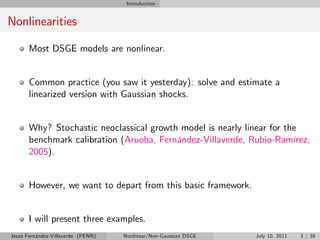
       Most DSGE models are nonlinear.


       Common practice (you saw it yesterday): solve and estimate a
       linearized version with Gaussian shocks.


       Why? Stochastic neoclassical growth model is nearly linear for the
       benchmark calibration (Aruoba, Fernández-Villaverde, Rubio-Ramírez,
       2005).


       However, we want to depart from this basic framework.


       I will present three examples.
Jesús Fernández-Villaverde (PENN)   Nonlinear/Non-Gaussian DSGE   July 10, 2011   3 / 38
Three Examples


Example I: Epstein-Zin Preferences

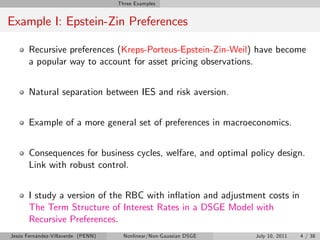
       Recursive preferences (Kreps-Porteus-Epstein-Zin-Weil) have become
       a popular way to account for asset pricing observations.


       Natural separation between IES and risk aversion.


       Example of a more general set of preferences in macroeconomics.


       Consequences for business cycles, welfare, and optimal policy design.
       Link with robust control.


       I study a version of the RBC with in‡ation and adjustment costs in
       The Term Structure of Interest Rates in a DSGE Model with
       Recursive Preferences.
Jesús Fernández-Villaverde (PENN)     Nonlinear/Non-Gaussian DSGE   July 10, 2011   4 / 38
Three Examples


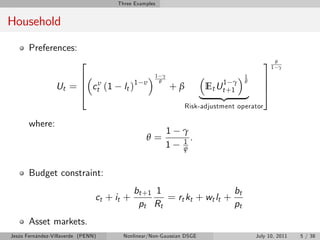
Household

       Preferences:
                          2                                                              31 θγ
                      6                            1 γ
                                                                          1 γ
                                                                                1
                                                                                         7
                 Ut = 6 ctυ (1         lt )1                           Et Ut +1          7
                                               υ    θ                           θ
                      4                                  +β                              5
                                                                     |     {z   }
                                                              Risk-adjustment operator

       where:
                                                         1   γ
                                               θ=            1
                                                                 .
                                                         1   ψ


       Budget constraint:
                                            bt +1 1                   bt
                                ct + it +           = rt kt + wt lt +
                                             pt Rt                    pt
       Asset markets.
Jesús Fernández-Villaverde (PENN)      Nonlinear/Non-Gaussian DSGE                  July 10, 2011   5 / 38
Three Examples


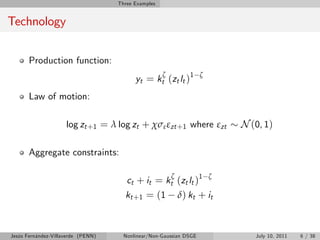
Technology


       Production function:
                                          yt = kt (zt lt )1
                                                     ζ              ζ


       Law of motion:

                     log zt +1 = λ log zt + χσε εzt +1 where εzt            N (0, 1)

       Aggregate constraints:

                                       ct + it = kt (zt lt )1
                                                         ζ              ζ

                                      kt +1 = (1             δ) kt + it


Jesús Fernández-Villaverde (PENN)     Nonlinear/Non-Gaussian DSGE              July 10, 2011   6 / 38
Three Examples


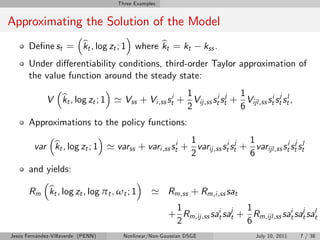
Approximating the Solution of the Model
                  b                     b
       De…ne st = kt , log zt ; 1 where kt = kt                     kss .
       Under di¤erentiability conditions, third-order Taylor approximation of
       the value function around the steady state:
                                                   1                 1
             V kt , log zt ; 1 ' Vss + Vi ,ss sti + Vij ,ss sti stj + Vijl ,ss sti stj stl ,
               b
                                                   2                 6
       Approximations to the policy functions:
                                                     1                   1
         var kt , log zt ; 1 ' varss + vari ,ss sti + varij ,ss sti stj + varijl ,ss sti stj stl
             b
                                                     2                   6
       and yields:

          b
       Rm kt , log zt , log π t , ω t ; 1       ' Rm,ss + Rm,i ,ss sat
                                                       1            i j    1             i j l
                                                      + Rm,ij ,ss sat sat + Rm,ijl ,ss sat sat sat
                                                       2                   6
Jesús Fernández-Villaverde (PENN)     Nonlinear/Non-Gaussian DSGE               July 10, 2011   7 / 38
Three Examples


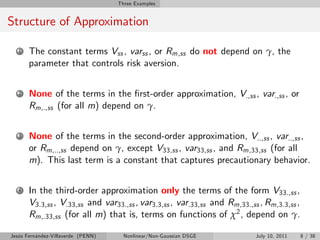
Structure of Approximation

   1   The constant terms Vss , varss , or Rm,ss do not depend on γ, the
       parameter that controls risk aversion.


   2   None of the terms in the …rst-order approximation, V.,ss , var.,ss , or
       Rm,.,ss (for all m) depend on γ.


   3   None of the terms in the second-order approximation, V..,ss , var..,ss ,
       or Rm,..,ss depend on γ, except V33,ss , var33,ss , and Rm,33,ss (for all
       m). This last term is a constant that captures precautionary behavior.


   4   In the third-order approximation only the terms of the form V33.,ss ,
       V3.3,ss , V.33,ss and var33.,ss , var3.3,ss , var.33,ss and Rm,33.,ss , Rm,3.3,ss ,
       Rm,.33,ss (for all m) that is, terms on functions of χ2 , depend on γ.

Jesús Fernández-Villaverde (PENN)     Nonlinear/Non-Gaussian DSGE           July 10, 2011    8 / 38
Three Examples


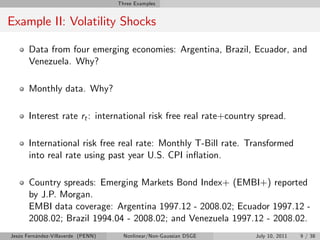
Example II: Volatility Shocks

       Data from four emerging economies: Argentina, Brazil, Ecuador, and
       Venezuela. Why?

       Monthly data. Why?

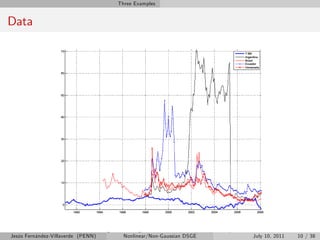
       Interest rate rt : international risk free real rate+country spread.

       International risk free real rate: Monthly T-Bill rate. Transformed
       into real rate using past year U.S. CPI in‡ation.

       Country spreads: Emerging Markets Bond Index+ (EMBI+) reported
       by J.P. Morgan.
       EMBI data coverage: Argentina 1997.12 - 2008.02; Ecuador 1997.12 -
       2008.02; Brazil 1994.04 - 2008.02; and Venezuela 1997.12 - 2008.02.
Jesús Fernández-Villaverde (PENN)     Nonlinear/Non-Gaussian DSGE   July 10, 2011   9 / 38
Three Examples


Data


                         Figure: Country Spreads and DSGE Real Rate
Jesús Fernández-Villaverde (PENN)    Nonlinear/Non-Gaussian T-Bill    July 10, 2011   10 / 38
Three Examples


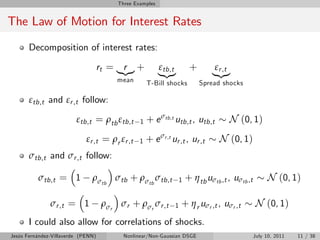
The Law of Motion for Interest Rates
       Decomposition of interest rates:

                                    rt = |{z} +
                                           r              εtb,t        +        εr ,t
                                                          |{z}                 |{z}
                                         mean        T-Bill shocks         Spread shocks

       εtb,t and εr ,t follow:

                         εtb,t = ρtb εtb,t       1   + e σtb,t utb,t , utb,t         N (0, 1)
                             εr ,t = ρr εr ,t    1   + e σr ,t ur ,t , ur ,t      N (0, 1)
       σtb,t and σr ,t follow:

          σtb,t = 1            ρσtb σtb + ρσtb σtb,t              1   + η tb uσtb ,t , uσtb ,t        N (0, 1)

               σr ,t = 1             ρσr σr + ρσr σr ,t         1   + η r uσr ,t , uσr ,t        N (0, 1)
       I could also allow for correlations of shocks.
Jesús Fernández-Villaverde (PENN)          Nonlinear/Non-Gaussian DSGE                           July 10, 2011   11 / 38
Three Examples


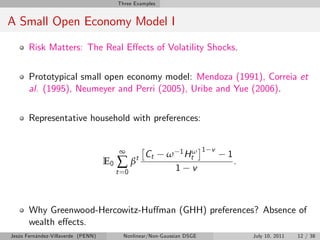
A Small Open Economy Model I
       Risk Matters: The Real E¤ects of Volatility Shocks.


       Prototypical small open economy model: Mendoza (1991), Correia et
       al. (1995), Neumeyer and Perri (2005), Uribe and Yue (2006).


       Representative household with preferences:


                                          ∞         Ct    ω    1H ω 1 v   1
                                         ∑β     t                t
                                    E0                                        .
                                         t =0                 1     v


       Why Greenwood-Hercowitz-Hu¤man (GHH) preferences? Absence of
       wealth e¤ects.
Jesús Fernández-Villaverde (PENN)          Nonlinear/Non-Gaussian DSGE            July 10, 2011   12 / 38
Three Examples


A Small Open Economy Model II

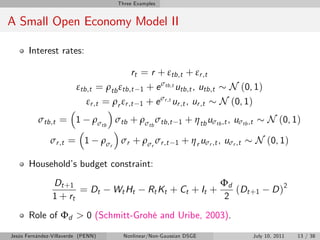
       Interest rates:

                                            rt = r + εtb,t + εr ,t
                         εtb,t = ρtb εtb,t      1 + e σtb,t utb,t , utb,t N (0, 1)
                                                     σr ,t
                             εr ,t = ρr εr ,t   1 +e       ur ,t , ur ,t N (0, 1)
          σtb,t = 1            ρσtb σtb + ρσtb σtb,t          1   + η tb uσtb ,t , uσtb ,t        N (0, 1)

               σr ,t = 1            ρσr σr + ρσr σr ,t       1   + η r uσr ,t , uσr ,t       N (0, 1)

       Household’ budget constraint:
                 s
                Dt + 1                                                        Φd
                       = Dt            Wt Ht        Rt Kt + Ct + It +            ( Dt + 1           D )2
                1 + rt                                                         2
       Role of Φd > 0 (Schmitt-Grohé and Uribe, 2003).

Jesús Fernández-Villaverde (PENN)         Nonlinear/Non-Gaussian DSGE                        July 10, 2011   13 / 38
Three Examples


A Small Open Economy Model III

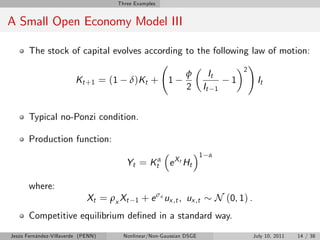
       The stock of capital evolves according to the following law of motion:
                                                               !
                                                             2
                                              φ    It
                  Kt + 1 = ( 1 δ ) Kt + 1                 1      It
                                              2 It 1


       Typical no-Ponzi condition.

       Production function:
                                                                    1 α
                                       Yt = Ktα e X t Ht

       where:
                             Xt = ρx Xt   1   + e σx ux ,t , ux ,t        N (0, 1) .
       Competitive equilibrium de…ned in a standard way.
Jesús Fernández-Villaverde (PENN)     Nonlinear/Non-Gaussian DSGE                      July 10, 2011   14 / 38
Three Examples


Solving the Model
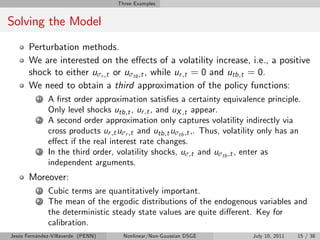
       Perturbation methods.
       We are interested on the e¤ects of a volatility increase, i.e., a positive
       shock to either uσr ,t or uσtb ,t , while ur ,t = 0 and utb,t = 0.
       We need to obtain a third approximation of the policy functions:
          1   A …rst order approximation satis…es a certainty equivalence principle.
              Only level shocks utb,t , ur ,t , and uX ,t appear.
          2   A second order approximation only captures volatility indirectly via
              cross products ur ,t uσr ,t and utb,t uσtb ,t ,. Thus, volatility only has an
              e¤ect if the real interest rate changes.
          3   In the third order, volatility shocks, uσ,t and uσtb ,t , enter as
              independent arguments.
       Moreover:
          1   Cubic terms are quantitatively important.
          2   The mean of the ergodic distributions of the endogenous variables and
              the deterministic steady state values are quite di¤erent. Key for
              calibration.
Jesús Fernández-Villaverde (PENN)     Nonlinear/Non-Gaussian DSGE           July 10, 2011   15 / 38
Three Examples


Example III: Fortune or Virtue
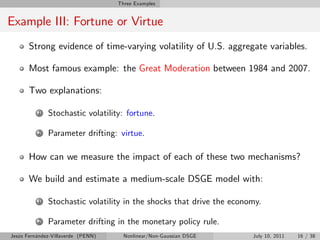
       Strong evidence of time-varying volatility of U.S. aggregate variables.

       Most famous example: the Great Moderation between 1984 and 2007.

       Two explanations:

          1   Stochastic volatility: fortune.

          2   Parameter drifting: virtue.

       How can we measure the impact of each of these two mechanisms?

       We build and estimate a medium-scale DSGE model with:

          1   Stochastic volatility in the shocks that drive the economy.

          2   Parameter drifting in the monetary policy rule.
Jesús Fernández-Villaverde (PENN)     Nonlinear/Non-Gaussian DSGE     July 10, 2011   16 / 38
Three Examples


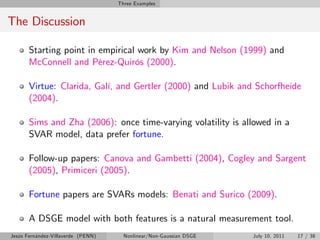
The Discussion

       Starting point in empirical work by Kim and Nelson (1999) and
       McConnell and Pérez-Quirós (2000).

       Virtue: Clarida, Galí, and Gertler (2000) and Lubik and Schorfheide
       (2004).

       Sims and Zha (2006): once time-varying volatility is allowed in a
       SVAR model, data prefer fortune.

       Follow-up papers: Canova and Gambetti (2004), Cogley and Sargent
       (2005), Primiceri (2005).

       Fortune papers are SVARs models: Benati and Surico (2009).

       A DSGE model with both features is a natural measurement tool.
Jesús Fernández-Villaverde (PENN)     Nonlinear/Non-Gaussian DSGE   July 10, 2011   17 / 38
Three Examples


The Goals


   1   How do we write a medium-scale DSGE with stochastic volatility and
       parameter drifting?


   2   How do we evaluate the likelihood of the model and how to
       characterize the decision rules of the equilibrium?


   3   How do we estimate the model using U.S. data and assess model …t?


   4   How do we build counterfactual histories?


Jesús Fernández-Villaverde (PENN)     Nonlinear/Non-Gaussian DSGE   July 10, 2011   18 / 38
Three Examples


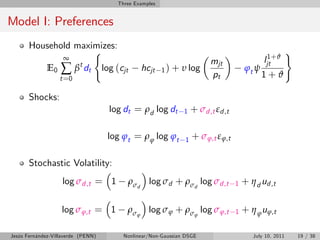
Model I: Preferences
       Household maximizes:
                     (                                                                                     )
                    ∞
                                                                          mjt                  ljt+ϑ
                                                                                                1
             E0    ∑ β dt t
                                    log (cjt    hcjt     1 ) + υ log
                                                                          pt
                                                                                        ϕt ψ
                                                                                               1+ϑ
                  t =0

       Shocks:
                                      log dt = ρd log dt        1   + σd ,t εd ,t

                                     log ϕt = ρ ϕ log ϕt        1   + σ ϕ,t ε ϕ,t

       Stochastic Volatility:
                    log σd ,t = 1          ρσd log σd + ρσd log σd ,t               1   + η d ud ,t

                   log σ ϕ,t = 1           ρσ ϕ log σ ϕ + ρσ ϕ log σ ϕ,t            1   + η ϕ u ϕ,t

Jesús Fernández-Villaverde (PENN)         Nonlinear/Non-Gaussian DSGE                      July 10, 2011       19 / 38
Three Examples


Model II: Constraints
       Budget constraint:
                                                            Z
                                     mjt   bjt +1
                     cjt + xjt +         +        +              qjt +1,t ajt +1 d ω j ,t +1,t =
                                     pt     pt
                                                                mjt   1                  bjt
       wjt ljt + rt ujt         µt 1 Φ [ujt ] kjt       1   +              + Rt      1       + ajt + Tt + zt
                                                                 pt                      pt
       The capital evolves:
                                                                                  xjt
                          kjt = (1       δ) kjt   1   + µt 1              V                        xjt
                                                                               xjt       1

       Investment-speci…c productivity µt follows a random walk in logs:
                                    log µt = Λµ + log µt              1   + σµ,t εµ,t

       Stochastic Volatility:
                    log σµ,t = 1           ρσµ    log σ + ρ
                                                          µ       σµ      log σµ,t           1   + η µ uµ,t
Jesús Fernández-Villaverde (PENN)        Nonlinear/Non-Gaussian DSGE                                July 10, 2011   20 / 38
Three Examples


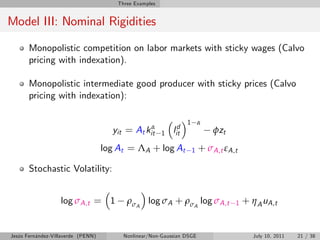
Model III: Nominal Rigidities

       Monopolistic competition on labor markets with sticky wages (Calvo
       pricing with indexation).

       Monopolistic intermediate good producer with sticky prices (Calvo
       pricing with indexation):

                                                                   1 α
                                                α              d
                                      yit = At kit       1   lit            φzt
                                    log At = ΛA + log At            1   + σA,t εA,t

       Stochastic Volatility:


                   log σA,t = 1            ρσA log σA + ρσA log σA,t              1   + η A uA,t


Jesús Fernández-Villaverde (PENN)         Nonlinear/Non-Gaussian DSGE                    July 10, 2011   21 / 38
Three Examples


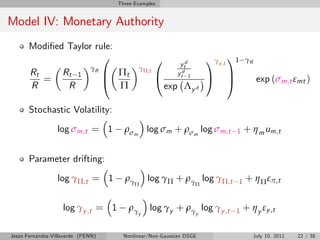
Model IV: Monetary Authority
       Modi…ed Taylor rule:
                        0                             0                  1γy ,t 11       γR
                                                              ytd
                                    B Πt
                              γR               γΠ,t
       Rt           Rt 1                              @      ytd 1
                                                                         A C
          =                         @                                           A              exp (σm,t εmt )
       R             R                Π                   exp Λy d

       Stochastic Volatility:

                  log σm,t = 1          ρσm log σm + ρσm log σm,t                1       + η m um,t

       Parameter drifting:

                  log γΠ,t = 1          ργ         log γΠ + ργ log γΠ,t              1   + η Π επ,t
                                             Π                       Π


                    log γy ,t = 1         ργ       log γy + ργ log γy ,t         1   + η y εy ,t
                                               y                     y


Jesús Fernández-Villaverde (PENN)       Nonlinear/Non-Gaussian DSGE                           July 10, 2011   22 / 38
More About Nonlinearities


More About Nonlinearities I

       The previous examples are not exhaustive.

       Unfortunately, linearization eliminates phenomena of interest:

          1   Asymmetries.

          2   Threshold e¤ects.

          3   Precautionary behavior.

          4   Big shocks.

          5   Convergence away from the steady state.

          6   And many others....


Jesús Fernández-Villaverde (PENN)           Nonlinear/Non-Gaussian DSGE   July 10, 2011   23 / 38
More About Nonlinearities


More About Nonlinearities II

Linearization limits our study of dynamics:

   1   Zero bound on the nominal interest rate.

   2   Finite escape time.

   3   Multiple steady states.

   4   Limit cycles.

   5   Subharmonic, harmonic, or almost-periodic oscillations.

   6   Chaos.


Jesús Fernández-Villaverde (PENN)           Nonlinear/Non-Gaussian DSGE   July 10, 2011   24 / 38
More About Nonlinearities


More About Nonlinearities III

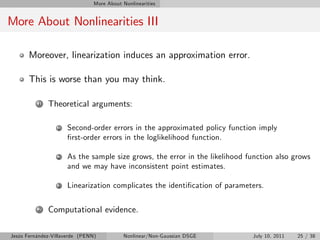
       Moreover, linearization induces an approximation error.

       This is worse than you may think.

          1   Theoretical arguments:

                  1   Second-order errors in the approximated policy function imply
                      …rst-order errors in the loglikelihood function.

                  2   As the sample size grows, the error in the likelihood function also grows
                      and we may have inconsistent point estimates.

                  3   Linearization complicates the identi…cation of parameters.

          2   Computational evidence.

Jesús Fernández-Villaverde (PENN)           Nonlinear/Non-Gaussian DSGE      July 10, 2011   25 / 38
More About Nonlinearities


Arguments Against Nonlinearities
   1   Theoretical reasons: we know way less about nonlinear and
       non-gaussian systems.

   2   Computational limitations.

   3   Bias.


Mark Twain
To a man with a hammer, everything looks like a nail.

Teller’ Law
       s
A state-of-the-art computation requires 100 hours of CPU time on the
state-of-the art computer, independent of the decade.
Jesús Fernández-Villaverde (PENN)           Nonlinear/Non-Gaussian DSGE   July 10, 2011   26 / 38
Solution


Solving DSGE Models

       We want to have a general formalism to think about solving DSGE
       models.


       We need to move beyond value function iteration.


       Theory of functional equations.


       We can cast numerous problems in macroeconomics involve
       functional equations.


       Examples: Value Function, Euler Equations.


Jesús Fernández-Villaverde (PENN)   Nonlinear/Non-Gaussian DSGE   July 10, 2011   27 / 38
Solution


Functional Equation

       Let J 1 and J 2 be two functional spaces, Ω                <l and let H : J 1 ! J 2
       be an operator between these two spaces.


       A functional equation problem is to …nd a function d : Ω ! <m such
       that

                                             H (d ) = 0


       Regular equations are particular examples of functional equations.


       Note that 0 is the space zero, di¤erent in general that the zero in the
       reals.

Jesús Fernández-Villaverde (PENN)   Nonlinear/Non-Gaussian DSGE            July 10, 2011   28 / 38
Solution


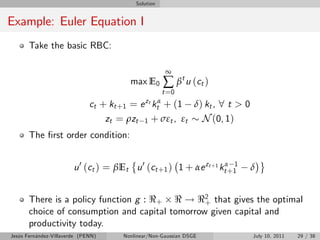
Example: Euler Equation I
       Take the basic RBC:

                                                          ∞
                                          max E0         ∑ β t u ( ct )
                                                         t =0
                              ct + kt +1 =    e zt ktα
                                                  + (1 δ) kt , 8 t > 0
                                    zt = ρzt 1 + σεt , εt N (0, 1)
       The …rst order condition:


                        u 0 (ct ) = βEt u 0 (ct +1 ) 1 + αe zt +1 ktα+1
                                                                      1
                                                                          δ


       There is a policy function g : <+ < ! <2 that gives the optimal
                                                 +
       choice of consumption and capital tomorrow given capital and
       productivity today.
Jesús Fernández-Villaverde (PENN)       Nonlinear/Non-Gaussian DSGE       July 10, 2011   29 / 38
Solution


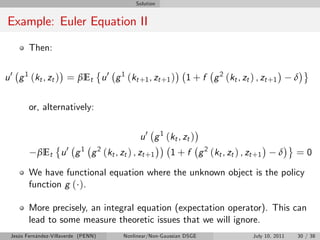
Example: Euler Equation II

        Then:


u 0 g 1 (kt , zt ) = βEt u 0 g 1 (kt +1 , zt +1 )           1 + f g 2 (kt , zt ) , zt +1        δ


        or, alternatively:


                                           u 0 g 1 (kt , zt )
           βEt u 0 g 1 g 2 (kt , zt ) , zt +1         1 + f g 2 (kt , zt ) , zt +1         δ    =0

        We have functional equation where the unknown object is the policy
        function g ( ).

        More precisely, an integral equation (expectation operator). This can
        lead to some measure theoretic issues that we will ignore.
 Jesús Fernández-Villaverde (PENN)   Nonlinear/Non-Gaussian DSGE                July 10, 2011   30 / 38
Solution


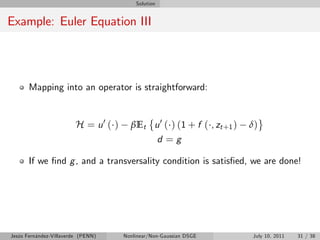
Example: Euler Equation III


       Mapping into an operator is straightforward:


                         H = u0 ( )     βEt u 0 ( ) (1 + f ( , zt +1 )   δ)
                                                     d =g

       If we …nd g , and a transversality condition is satis…ed, we are done!


Jesús Fernández-Villaverde (PENN)     Nonlinear/Non-Gaussian DSGE        July 10, 2011   31 / 38
Solution


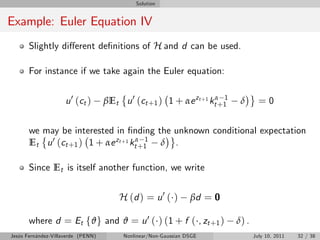
Example: Euler Equation IV
       Slightly di¤erent de…nitions of H and d can be used.

       For instance if we take again the Euler equation:


                     u 0 ( ct )     βEt u 0 (ct +1 ) 1 + αe zt +1 ktα+1
                                                                      1
                                                                           δ       =0

       we may be interested in …nding the unknown conditional expectation
       Et u 0 (ct +1 ) 1 + αe zt +1 ktα+1 δ .
                                        1


       Since Et is itself another function, we write


                                        H (d ) = u 0 ( )         βd = 0

       where d = Et fϑ g and ϑ = u 0 ( ) (1 + f ( , zt +1 )               δ) .
Jesús Fernández-Villaverde (PENN)        Nonlinear/Non-Gaussian DSGE             July 10, 2011   32 / 38
Solution


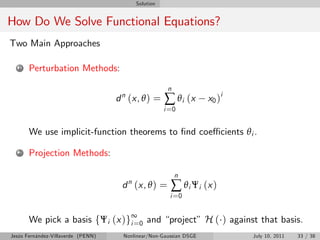
How Do We Solve Functional Equations?
Two Main Approaches

   1   Perturbation Methods:

                                                      n
                                    d n (x, θ ) =    ∑ θ i (x       x0 )i
                                                     i =0


       We use implicit-function theorems to …nd coe¢ cients θ i .

   2   Projection Methods:

                                                          n
                                     d n (x, θ ) =     ∑ θ i Ψi (x )
                                                       i =0


       We pick a basis fΨi (x )gi∞ 0 and “project” H ( ) against that basis.
                                 =
Jesús Fernández-Villaverde (PENN)     Nonlinear/Non-Gaussian DSGE           July 10, 2011   33 / 38
Solution


Relation with Value Function Iteration
       There is a third main approach: the dynamic programing algorithm.


       Advantages:

          1   Strong theoretical properties.

          2   Intuitive interpretation.


       Problems:

          1   Di¢ cult to use with non-pareto e¢ cient economies.

          2   Curse of dimensionality.
Jesús Fernández-Villaverde (PENN)   Nonlinear/Non-Gaussian DSGE     July 10, 2011   34 / 38
Estimation


Evaluating the Likelihood Function


       How do we take the model to the data?


       Usually we cannot write the likelihood of a DSGE model.


       Once the model is nonlinear and/or non-gaussian we cannot use the
       Kalman …lter to evaluate the likelihood function of the model.


       How do we evaluate then such likelihood? Using Sequential Monte
       Carlo.


Jesús Fernández-Villaverde (PENN)   Nonlinear/Non-Gaussian DSGE   July 10, 2011   35 / 38
Estimation


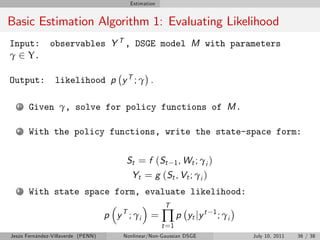
Basic Estimation Algorithm 1: Evaluating Likelihood
Input:         observables Y T , DSGE model M with parameters
γ 2 Υ.

Output:          likelihood p y T ; γ .

   1   Given γ, solve for policy functions of M.

   2   With the policy functions, write the state-space form:


                                          St = f ( St        1 , Wt ; γ i )
                                            Yt = g (St , Vt ; γi )
   3   With state space form, evaluate likelihood:
                                                         T
                                    p y T ; γi     =    ∏p       yt jy t      1
                                                                                  ; γi
                                                        t =1
Jesús Fernández-Villaverde (PENN)        Nonlinear/Non-Gaussian DSGE                     July 10, 2011   36 / 38
Estimation


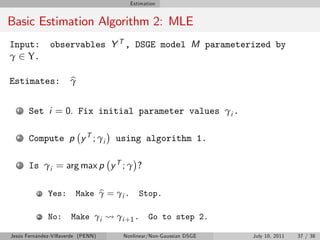
Basic Estimation Algorithm 2: MLE
Input:         observables Y T , DSGE model M parameterized by
γ 2 Υ.

Estimates:             b
                       γ

   1   Set i = 0. Fix initial parameter values γi .

   2   Compute p y T ; γi           using algorithm 1.

   3   Is γi = arg max p y T ; γ ?

          1   Yes:            b
                         Make γ = γi .      Stop.

          2   No:      Make γi      γ i +1 .    Go to step 2.

Jesús Fernández-Villaverde (PENN)     Nonlinear/Non-Gaussian DSGE   July 10, 2011   37 / 38
Estimation


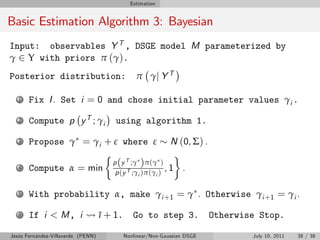
Basic Estimation Algorithm 3: Bayesian
Input: observables Y T , DSGE model M parameterized by
γ 2 Υ with priors π (γ).
Posterior distribution:                          π γj Y T

   1   Fix I . Set i = 0 and chose initial parameter values γi .

   2   Compute p y T ; γi               using algorithm 1.

   3   Propose γ = γi + ε where ε                             N (0, Σ) .

                                       p (y T ;γ )π (γ )
   4   Compute α = min                  p (y T ;γi )π (γi )
                                                            ,1    .

   5   With probability α, make γi +1 = γ . Otherwise γi +1 = γi .

   6   If i < M, i                  ı + 1.
                                    ¯           Go to step 3.              Otherwise Stop.

Jesús Fernández-Villaverde (PENN)            Nonlinear/Non-Gaussian DSGE           July 10, 2011   38 / 38

Chapter 1 nonlinear

  • 1.
    Why Nonlinear/Non-Gaussian DSGEModels? Jesús Fernández-Villaverde University of Pennsylvania July 10, 2011 Jesús Fernández-Villaverde (PENN) Nonlinear/Non-Gaussian DSGE July 10, 2011 1 / 38
  • 2.
    Introduction Motivation These lectures review recent advances in nonlinear and non-gaussian macro model-building. First, we will justify why we are interested in this class of models. Then, we will study both the solution and estimation of those models. We will work with discrete time models. We will focus on DSGE models. Jesús Fernández-Villaverde (PENN) Nonlinear/Non-Gaussian DSGE July 10, 2011 2 / 38
  • 3.
    Introduction Nonlinearities Most DSGE models are nonlinear. Common practice (you saw it yesterday): solve and estimate a linearized version with Gaussian shocks. Why? Stochastic neoclassical growth model is nearly linear for the benchmark calibration (Aruoba, Fernández-Villaverde, Rubio-Ramírez, 2005). However, we want to depart from this basic framework. I will present three examples. Jesús Fernández-Villaverde (PENN) Nonlinear/Non-Gaussian DSGE July 10, 2011 3 / 38
  • 4.
    Three Examples Example I:Epstein-Zin Preferences Recursive preferences (Kreps-Porteus-Epstein-Zin-Weil) have become a popular way to account for asset pricing observations. Natural separation between IES and risk aversion. Example of a more general set of preferences in macroeconomics. Consequences for business cycles, welfare, and optimal policy design. Link with robust control. I study a version of the RBC with in‡ation and adjustment costs in The Term Structure of Interest Rates in a DSGE Model with Recursive Preferences. Jesús Fernández-Villaverde (PENN) Nonlinear/Non-Gaussian DSGE July 10, 2011 4 / 38
  • 5.
    Three Examples Household Preferences: 2 31 θγ 6 1 γ 1 γ 1 7 Ut = 6 ctυ (1 lt )1 Et Ut +1 7 υ θ θ 4 +β 5 | {z } Risk-adjustment operator where: 1 γ θ= 1 . 1 ψ Budget constraint: bt +1 1 bt ct + it + = rt kt + wt lt + pt Rt pt Asset markets. Jesús Fernández-Villaverde (PENN) Nonlinear/Non-Gaussian DSGE July 10, 2011 5 / 38
  • 6.
    Three Examples Technology Production function: yt = kt (zt lt )1 ζ ζ Law of motion: log zt +1 = λ log zt + χσε εzt +1 where εzt N (0, 1) Aggregate constraints: ct + it = kt (zt lt )1 ζ ζ kt +1 = (1 δ) kt + it Jesús Fernández-Villaverde (PENN) Nonlinear/Non-Gaussian DSGE July 10, 2011 6 / 38
  • 7.
    Three Examples Approximating theSolution of the Model b b De…ne st = kt , log zt ; 1 where kt = kt kss . Under di¤erentiability conditions, third-order Taylor approximation of the value function around the steady state: 1 1 V kt , log zt ; 1 ' Vss + Vi ,ss sti + Vij ,ss sti stj + Vijl ,ss sti stj stl , b 2 6 Approximations to the policy functions: 1 1 var kt , log zt ; 1 ' varss + vari ,ss sti + varij ,ss sti stj + varijl ,ss sti stj stl b 2 6 and yields: b Rm kt , log zt , log π t , ω t ; 1 ' Rm,ss + Rm,i ,ss sat 1 i j 1 i j l + Rm,ij ,ss sat sat + Rm,ijl ,ss sat sat sat 2 6 Jesús Fernández-Villaverde (PENN) Nonlinear/Non-Gaussian DSGE July 10, 2011 7 / 38
  • 8.
    Three Examples Structure ofApproximation 1 The constant terms Vss , varss , or Rm,ss do not depend on γ, the parameter that controls risk aversion. 2 None of the terms in the …rst-order approximation, V.,ss , var.,ss , or Rm,.,ss (for all m) depend on γ. 3 None of the terms in the second-order approximation, V..,ss , var..,ss , or Rm,..,ss depend on γ, except V33,ss , var33,ss , and Rm,33,ss (for all m). This last term is a constant that captures precautionary behavior. 4 In the third-order approximation only the terms of the form V33.,ss , V3.3,ss , V.33,ss and var33.,ss , var3.3,ss , var.33,ss and Rm,33.,ss , Rm,3.3,ss , Rm,.33,ss (for all m) that is, terms on functions of χ2 , depend on γ. Jesús Fernández-Villaverde (PENN) Nonlinear/Non-Gaussian DSGE July 10, 2011 8 / 38
  • 9.
    Three Examples Example II:Volatility Shocks Data from four emerging economies: Argentina, Brazil, Ecuador, and Venezuela. Why? Monthly data. Why? Interest rate rt : international risk free real rate+country spread. International risk free real rate: Monthly T-Bill rate. Transformed into real rate using past year U.S. CPI in‡ation. Country spreads: Emerging Markets Bond Index+ (EMBI+) reported by J.P. Morgan. EMBI data coverage: Argentina 1997.12 - 2008.02; Ecuador 1997.12 - 2008.02; Brazil 1994.04 - 2008.02; and Venezuela 1997.12 - 2008.02. Jesús Fernández-Villaverde (PENN) Nonlinear/Non-Gaussian DSGE July 10, 2011 9 / 38
  • 10.
    Three Examples Data Figure: Country Spreads and DSGE Real Rate Jesús Fernández-Villaverde (PENN) Nonlinear/Non-Gaussian T-Bill July 10, 2011 10 / 38
  • 11.
    Three Examples The Lawof Motion for Interest Rates Decomposition of interest rates: rt = |{z} + r εtb,t + εr ,t |{z} |{z} mean T-Bill shocks Spread shocks εtb,t and εr ,t follow: εtb,t = ρtb εtb,t 1 + e σtb,t utb,t , utb,t N (0, 1) εr ,t = ρr εr ,t 1 + e σr ,t ur ,t , ur ,t N (0, 1) σtb,t and σr ,t follow: σtb,t = 1 ρσtb σtb + ρσtb σtb,t 1 + η tb uσtb ,t , uσtb ,t N (0, 1) σr ,t = 1 ρσr σr + ρσr σr ,t 1 + η r uσr ,t , uσr ,t N (0, 1) I could also allow for correlations of shocks. Jesús Fernández-Villaverde (PENN) Nonlinear/Non-Gaussian DSGE July 10, 2011 11 / 38
  • 12.
    Three Examples A SmallOpen Economy Model I Risk Matters: The Real E¤ects of Volatility Shocks. Prototypical small open economy model: Mendoza (1991), Correia et al. (1995), Neumeyer and Perri (2005), Uribe and Yue (2006). Representative household with preferences: ∞ Ct ω 1H ω 1 v 1 ∑β t t E0 . t =0 1 v Why Greenwood-Hercowitz-Hu¤man (GHH) preferences? Absence of wealth e¤ects. Jesús Fernández-Villaverde (PENN) Nonlinear/Non-Gaussian DSGE July 10, 2011 12 / 38
  • 13.
    Three Examples A SmallOpen Economy Model II Interest rates: rt = r + εtb,t + εr ,t εtb,t = ρtb εtb,t 1 + e σtb,t utb,t , utb,t N (0, 1) σr ,t εr ,t = ρr εr ,t 1 +e ur ,t , ur ,t N (0, 1) σtb,t = 1 ρσtb σtb + ρσtb σtb,t 1 + η tb uσtb ,t , uσtb ,t N (0, 1) σr ,t = 1 ρσr σr + ρσr σr ,t 1 + η r uσr ,t , uσr ,t N (0, 1) Household’ budget constraint: s Dt + 1 Φd = Dt Wt Ht Rt Kt + Ct + It + ( Dt + 1 D )2 1 + rt 2 Role of Φd > 0 (Schmitt-Grohé and Uribe, 2003). Jesús Fernández-Villaverde (PENN) Nonlinear/Non-Gaussian DSGE July 10, 2011 13 / 38
  • 14.
    Three Examples A SmallOpen Economy Model III The stock of capital evolves according to the following law of motion: ! 2 φ It Kt + 1 = ( 1 δ ) Kt + 1 1 It 2 It 1 Typical no-Ponzi condition. Production function: 1 α Yt = Ktα e X t Ht where: Xt = ρx Xt 1 + e σx ux ,t , ux ,t N (0, 1) . Competitive equilibrium de…ned in a standard way. Jesús Fernández-Villaverde (PENN) Nonlinear/Non-Gaussian DSGE July 10, 2011 14 / 38
  • 15.
    Three Examples Solving theModel Perturbation methods. We are interested on the e¤ects of a volatility increase, i.e., a positive shock to either uσr ,t or uσtb ,t , while ur ,t = 0 and utb,t = 0. We need to obtain a third approximation of the policy functions: 1 A …rst order approximation satis…es a certainty equivalence principle. Only level shocks utb,t , ur ,t , and uX ,t appear. 2 A second order approximation only captures volatility indirectly via cross products ur ,t uσr ,t and utb,t uσtb ,t ,. Thus, volatility only has an e¤ect if the real interest rate changes. 3 In the third order, volatility shocks, uσ,t and uσtb ,t , enter as independent arguments. Moreover: 1 Cubic terms are quantitatively important. 2 The mean of the ergodic distributions of the endogenous variables and the deterministic steady state values are quite di¤erent. Key for calibration. Jesús Fernández-Villaverde (PENN) Nonlinear/Non-Gaussian DSGE July 10, 2011 15 / 38
  • 16.
    Three Examples Example III:Fortune or Virtue Strong evidence of time-varying volatility of U.S. aggregate variables. Most famous example: the Great Moderation between 1984 and 2007. Two explanations: 1 Stochastic volatility: fortune. 2 Parameter drifting: virtue. How can we measure the impact of each of these two mechanisms? We build and estimate a medium-scale DSGE model with: 1 Stochastic volatility in the shocks that drive the economy. 2 Parameter drifting in the monetary policy rule. Jesús Fernández-Villaverde (PENN) Nonlinear/Non-Gaussian DSGE July 10, 2011 16 / 38
  • 17.
    Three Examples The Discussion Starting point in empirical work by Kim and Nelson (1999) and McConnell and Pérez-Quirós (2000). Virtue: Clarida, Galí, and Gertler (2000) and Lubik and Schorfheide (2004). Sims and Zha (2006): once time-varying volatility is allowed in a SVAR model, data prefer fortune. Follow-up papers: Canova and Gambetti (2004), Cogley and Sargent (2005), Primiceri (2005). Fortune papers are SVARs models: Benati and Surico (2009). A DSGE model with both features is a natural measurement tool. Jesús Fernández-Villaverde (PENN) Nonlinear/Non-Gaussian DSGE July 10, 2011 17 / 38
  • 18.
    Three Examples The Goals 1 How do we write a medium-scale DSGE with stochastic volatility and parameter drifting? 2 How do we evaluate the likelihood of the model and how to characterize the decision rules of the equilibrium? 3 How do we estimate the model using U.S. data and assess model …t? 4 How do we build counterfactual histories? Jesús Fernández-Villaverde (PENN) Nonlinear/Non-Gaussian DSGE July 10, 2011 18 / 38
  • 19.
    Three Examples Model I:Preferences Household maximizes: ( ) ∞ mjt ljt+ϑ 1 E0 ∑ β dt t log (cjt hcjt 1 ) + υ log pt ϕt ψ 1+ϑ t =0 Shocks: log dt = ρd log dt 1 + σd ,t εd ,t log ϕt = ρ ϕ log ϕt 1 + σ ϕ,t ε ϕ,t Stochastic Volatility: log σd ,t = 1 ρσd log σd + ρσd log σd ,t 1 + η d ud ,t log σ ϕ,t = 1 ρσ ϕ log σ ϕ + ρσ ϕ log σ ϕ,t 1 + η ϕ u ϕ,t Jesús Fernández-Villaverde (PENN) Nonlinear/Non-Gaussian DSGE July 10, 2011 19 / 38
  • 20.
    Three Examples Model II:Constraints Budget constraint: Z mjt bjt +1 cjt + xjt + + + qjt +1,t ajt +1 d ω j ,t +1,t = pt pt mjt 1 bjt wjt ljt + rt ujt µt 1 Φ [ujt ] kjt 1 + + Rt 1 + ajt + Tt + zt pt pt The capital evolves: xjt kjt = (1 δ) kjt 1 + µt 1 V xjt xjt 1 Investment-speci…c productivity µt follows a random walk in logs: log µt = Λµ + log µt 1 + σµ,t εµ,t Stochastic Volatility: log σµ,t = 1 ρσµ log σ + ρ µ σµ log σµ,t 1 + η µ uµ,t Jesús Fernández-Villaverde (PENN) Nonlinear/Non-Gaussian DSGE July 10, 2011 20 / 38
  • 21.
    Three Examples Model III:Nominal Rigidities Monopolistic competition on labor markets with sticky wages (Calvo pricing with indexation). Monopolistic intermediate good producer with sticky prices (Calvo pricing with indexation): 1 α α d yit = At kit 1 lit φzt log At = ΛA + log At 1 + σA,t εA,t Stochastic Volatility: log σA,t = 1 ρσA log σA + ρσA log σA,t 1 + η A uA,t Jesús Fernández-Villaverde (PENN) Nonlinear/Non-Gaussian DSGE July 10, 2011 21 / 38
  • 22.
    Three Examples Model IV:Monetary Authority Modi…ed Taylor rule: 0 0 1γy ,t 11 γR ytd B Πt γR γΠ,t Rt Rt 1 @ ytd 1 A C = @ A exp (σm,t εmt ) R R Π exp Λy d Stochastic Volatility: log σm,t = 1 ρσm log σm + ρσm log σm,t 1 + η m um,t Parameter drifting: log γΠ,t = 1 ργ log γΠ + ργ log γΠ,t 1 + η Π επ,t Π Π log γy ,t = 1 ργ log γy + ργ log γy ,t 1 + η y εy ,t y y Jesús Fernández-Villaverde (PENN) Nonlinear/Non-Gaussian DSGE July 10, 2011 22 / 38
  • 23.
    More About Nonlinearities MoreAbout Nonlinearities I The previous examples are not exhaustive. Unfortunately, linearization eliminates phenomena of interest: 1 Asymmetries. 2 Threshold e¤ects. 3 Precautionary behavior. 4 Big shocks. 5 Convergence away from the steady state. 6 And many others.... Jesús Fernández-Villaverde (PENN) Nonlinear/Non-Gaussian DSGE July 10, 2011 23 / 38
  • 24.
    More About Nonlinearities MoreAbout Nonlinearities II Linearization limits our study of dynamics: 1 Zero bound on the nominal interest rate. 2 Finite escape time. 3 Multiple steady states. 4 Limit cycles. 5 Subharmonic, harmonic, or almost-periodic oscillations. 6 Chaos. Jesús Fernández-Villaverde (PENN) Nonlinear/Non-Gaussian DSGE July 10, 2011 24 / 38
  • 25.
    More About Nonlinearities MoreAbout Nonlinearities III Moreover, linearization induces an approximation error. This is worse than you may think. 1 Theoretical arguments: 1 Second-order errors in the approximated policy function imply …rst-order errors in the loglikelihood function. 2 As the sample size grows, the error in the likelihood function also grows and we may have inconsistent point estimates. 3 Linearization complicates the identi…cation of parameters. 2 Computational evidence. Jesús Fernández-Villaverde (PENN) Nonlinear/Non-Gaussian DSGE July 10, 2011 25 / 38
  • 26.
    More About Nonlinearities ArgumentsAgainst Nonlinearities 1 Theoretical reasons: we know way less about nonlinear and non-gaussian systems. 2 Computational limitations. 3 Bias. Mark Twain To a man with a hammer, everything looks like a nail. Teller’ Law s A state-of-the-art computation requires 100 hours of CPU time on the state-of-the art computer, independent of the decade. Jesús Fernández-Villaverde (PENN) Nonlinear/Non-Gaussian DSGE July 10, 2011 26 / 38
  • 27.
    Solution Solving DSGE Models We want to have a general formalism to think about solving DSGE models. We need to move beyond value function iteration. Theory of functional equations. We can cast numerous problems in macroeconomics involve functional equations. Examples: Value Function, Euler Equations. Jesús Fernández-Villaverde (PENN) Nonlinear/Non-Gaussian DSGE July 10, 2011 27 / 38
  • 28.
    Solution Functional Equation Let J 1 and J 2 be two functional spaces, Ω <l and let H : J 1 ! J 2 be an operator between these two spaces. A functional equation problem is to …nd a function d : Ω ! <m such that H (d ) = 0 Regular equations are particular examples of functional equations. Note that 0 is the space zero, di¤erent in general that the zero in the reals. Jesús Fernández-Villaverde (PENN) Nonlinear/Non-Gaussian DSGE July 10, 2011 28 / 38
  • 29.
    Solution Example: Euler EquationI Take the basic RBC: ∞ max E0 ∑ β t u ( ct ) t =0 ct + kt +1 = e zt ktα + (1 δ) kt , 8 t > 0 zt = ρzt 1 + σεt , εt N (0, 1) The …rst order condition: u 0 (ct ) = βEt u 0 (ct +1 ) 1 + αe zt +1 ktα+1 1 δ There is a policy function g : <+ < ! <2 that gives the optimal + choice of consumption and capital tomorrow given capital and productivity today. Jesús Fernández-Villaverde (PENN) Nonlinear/Non-Gaussian DSGE July 10, 2011 29 / 38
  • 30.
    Solution Example: Euler EquationII Then: u 0 g 1 (kt , zt ) = βEt u 0 g 1 (kt +1 , zt +1 ) 1 + f g 2 (kt , zt ) , zt +1 δ or, alternatively: u 0 g 1 (kt , zt ) βEt u 0 g 1 g 2 (kt , zt ) , zt +1 1 + f g 2 (kt , zt ) , zt +1 δ =0 We have functional equation where the unknown object is the policy function g ( ). More precisely, an integral equation (expectation operator). This can lead to some measure theoretic issues that we will ignore. Jesús Fernández-Villaverde (PENN) Nonlinear/Non-Gaussian DSGE July 10, 2011 30 / 38
  • 31.
    Solution Example: Euler EquationIII Mapping into an operator is straightforward: H = u0 ( ) βEt u 0 ( ) (1 + f ( , zt +1 ) δ) d =g If we …nd g , and a transversality condition is satis…ed, we are done! Jesús Fernández-Villaverde (PENN) Nonlinear/Non-Gaussian DSGE July 10, 2011 31 / 38
  • 32.
    Solution Example: Euler EquationIV Slightly di¤erent de…nitions of H and d can be used. For instance if we take again the Euler equation: u 0 ( ct ) βEt u 0 (ct +1 ) 1 + αe zt +1 ktα+1 1 δ =0 we may be interested in …nding the unknown conditional expectation Et u 0 (ct +1 ) 1 + αe zt +1 ktα+1 δ . 1 Since Et is itself another function, we write H (d ) = u 0 ( ) βd = 0 where d = Et fϑ g and ϑ = u 0 ( ) (1 + f ( , zt +1 ) δ) . Jesús Fernández-Villaverde (PENN) Nonlinear/Non-Gaussian DSGE July 10, 2011 32 / 38
  • 33.
    Solution How Do WeSolve Functional Equations? Two Main Approaches 1 Perturbation Methods: n d n (x, θ ) = ∑ θ i (x x0 )i i =0 We use implicit-function theorems to …nd coe¢ cients θ i . 2 Projection Methods: n d n (x, θ ) = ∑ θ i Ψi (x ) i =0 We pick a basis fΨi (x )gi∞ 0 and “project” H ( ) against that basis. = Jesús Fernández-Villaverde (PENN) Nonlinear/Non-Gaussian DSGE July 10, 2011 33 / 38
  • 34.
    Solution Relation with ValueFunction Iteration There is a third main approach: the dynamic programing algorithm. Advantages: 1 Strong theoretical properties. 2 Intuitive interpretation. Problems: 1 Di¢ cult to use with non-pareto e¢ cient economies. 2 Curse of dimensionality. Jesús Fernández-Villaverde (PENN) Nonlinear/Non-Gaussian DSGE July 10, 2011 34 / 38
  • 35.
    Estimation Evaluating the LikelihoodFunction How do we take the model to the data? Usually we cannot write the likelihood of a DSGE model. Once the model is nonlinear and/or non-gaussian we cannot use the Kalman …lter to evaluate the likelihood function of the model. How do we evaluate then such likelihood? Using Sequential Monte Carlo. Jesús Fernández-Villaverde (PENN) Nonlinear/Non-Gaussian DSGE July 10, 2011 35 / 38
  • 36.
    Estimation Basic Estimation Algorithm1: Evaluating Likelihood Input: observables Y T , DSGE model M with parameters γ 2 Υ. Output: likelihood p y T ; γ . 1 Given γ, solve for policy functions of M. 2 With the policy functions, write the state-space form: St = f ( St 1 , Wt ; γ i ) Yt = g (St , Vt ; γi ) 3 With state space form, evaluate likelihood: T p y T ; γi = ∏p yt jy t 1 ; γi t =1 Jesús Fernández-Villaverde (PENN) Nonlinear/Non-Gaussian DSGE July 10, 2011 36 / 38
  • 37.
    Estimation Basic Estimation Algorithm2: MLE Input: observables Y T , DSGE model M parameterized by γ 2 Υ. Estimates: b γ 1 Set i = 0. Fix initial parameter values γi . 2 Compute p y T ; γi using algorithm 1. 3 Is γi = arg max p y T ; γ ? 1 Yes: b Make γ = γi . Stop. 2 No: Make γi γ i +1 . Go to step 2. Jesús Fernández-Villaverde (PENN) Nonlinear/Non-Gaussian DSGE July 10, 2011 37 / 38
  • 38.
    Estimation Basic Estimation Algorithm3: Bayesian Input: observables Y T , DSGE model M parameterized by γ 2 Υ with priors π (γ). Posterior distribution: π γj Y T 1 Fix I . Set i = 0 and chose initial parameter values γi . 2 Compute p y T ; γi using algorithm 1. 3 Propose γ = γi + ε where ε N (0, Σ) . p (y T ;γ )π (γ ) 4 Compute α = min p (y T ;γi )π (γi ) ,1 . 5 With probability α, make γi +1 = γ . Otherwise γi +1 = γi . 6 If i < M, i ı + 1. ¯ Go to step 3. Otherwise Stop. Jesús Fernández-Villaverde (PENN) Nonlinear/Non-Gaussian DSGE July 10, 2011 38 / 38